tickdelta
Sign in

Tickdelta is free for now. Sign up and get Pro free

← Screener

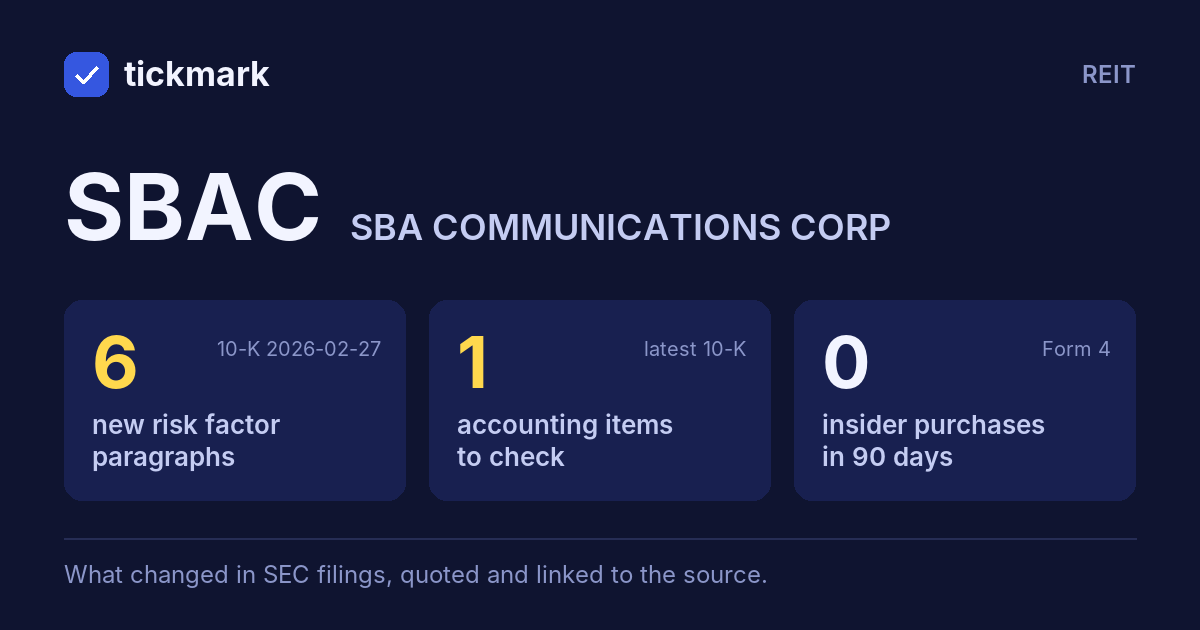
SBACSBA Communications

Real estate · REIT · Nasdaq
Compare with peers → Embed
The 10-K against last year's

129 changes: 15 added, 16 removed, 93 reworded, 5 quiet changes

10-K Feb 27, 2026 vs Feb 26, 2025
Risk FactorsRedline ↓
11.2%
of the text changed · 11,558 words now
23.5%
of the text changed · 9,584 words now
Legal ProceedingsRedline ↓
1.0%
of the text changed · 199 words now
Accounting PoliciesRedline ↓
10.3%
of the text changed · 5,132 words now

10-K 0001034054-26-000002 (2026-02-27) vs 10-K 0001034054-25-000002 (2025-02-26)

The redline

The paragraph that changed most in each section

Marked against last year's 10-K: cut words struck through, new words highlighted and underlined.

Risk Factors 232 words changed in this paragraph; it is 59% similar to last year's version.
Improvements or changes in the efficiency, capacity and range with new technologies, architecture, and design of wireless networks or changes in a wireless service provider customer's business model may reduce the demand for our wireless infrastructure. Also, as customers deploy increased capital to develop and implement new technologies, they may allocate less of their budgets to lease space on our towers. For example, new technologies that may promote network sharing, joint development, or resale agreements by our wireless service provider customers, such as signal combining technologies or network functions virtualization, may reduce the need for our wireless infrastructure, or may result in the decommissioning of equipment on certain sites because portions of the customers' networks may become redundant. In addition, other technologies and architectures, such as WiFi, DAS, femtocells, other small cells, or satellite (such as low earth orbiting) and mesh transmission systems orbit) may, in the future, serve as substitutes for, or alternatives to, the traditional macro site communications architecture that is the basis of substantially all of our site leasing business. Certain small cell complementary network technologies or satellite services could shift a portion of our customers’ network investments away from traditional tower-based networks, which may reduce the need for carriers to add more equipment at certain communications sites. The majority of our tower portfolio comprises traditional macro sites and therefore is not as diversified into non-macro sites and other technologies and architectures as some of our competitors. In addition, new technologies that enhance the range, efficiency, and capacity of wireless equipment could reduce demand for our wireless infrastructure. For example, our wireless service provider customers have engaged in increased use of network sharing, roaming, or resale arrangements, resulting in reduced capital spending or a decision to sell or not renew their spectrum licenses or concessions. Any significant reduction in demand for our wireless infrastructure resulting from new technologies or new architectures or changes in a customer's business model may negatively impact our revenues or otherwise have a material adverse effect on our business and results of operations. Any such event may have a disproportionate impact on our business compared to our competitors, whose portfolios may be more technologically and architecturally diversified than ours. In addition, while we are exploring and investing in ancillary services and emerging technologies, including our mobile edge computing initiative and private networks, those investments may not prove to be profitable.

Source: Item 1A, 10-K 0001034054-26-000002 vs Item 1A, 10-K 0001034054-25-000002

MD&A 136 words changed in this paragraph; it is 66% similar to last year's version.
We believe that Management uses Adjusted EBITDA in evaluating, and believes that it is useful to investors or other interested parties in evaluating our financial performance. Adjusted EBITDA is evaluating, the primary measure used by management (1) to evaluate the economic productivity profitability of our operations and (2) for purposes of making decisions about allocating resources to, and assessing the to evaluate our performance of, our operations. Management believes that Adjusted EBITDA helps investors or other interested parties to meaningfully evaluate and compare the results of our operations (1) 1) from period to period and (2) compared to our competitors, by excluding removing the impact of our capital structure (primarily interest charges from our outstanding debt) and asset base (primarily depreciation, amortization, amortization and accretion) from our financial results. In addition, Adjusted EBITDA is a widely used performance measure across the telecommunications real estate sector and management believes that it allows investors to evaluate our comparative performance without regard to items such as depreciation, amortization, and accretion, which can vary across different companies depending upon accounting methods and the book value of assets. Management also believes Adjusted EBITDA is frequently used by investors or other interested parties in the evaluation of REITs. In addition, Adjusted EBITDA is similar to the measure of current financial performance generally used by our lenders to determine compliance with certain covenants under our Senior Credit Agreement and the indentures relating to the 2020 Senior Notes and 2021 Senior Notes. Adjusted EBITDA should be considered only as a supplement to net income computed in accordance with GAAP as a measure of our performance.

Source: Item 7, 10-K 0001034054-26-000002 vs Item 7, 10-K 0001034054-25-000002

Accounting Policies 102 words changed in this paragraph; it is 56% similar to last year's version.
PSUs The Company measures and recognizes compensation expense for all share-based payment awards made to employees and directors, including restricted stock units (“RSUs”), performance-based restricted stock units (“PSUs”), stock options, and purchases under the Company’s employee stock purchase plans. The Company records compensation expense for RSUs, PSUs, and stock options on a straight-line basis over the vesting period; however, compensation expense related to certain PSUs are subject to adjustment on performance relative to the established targets. Compensation expense for stock options is based on the estimated fair value of the options on the date of the grant using the Black-Scholes option-pricing model. Compensation expense for RSUs and PSUs is based on the fair market value of the units awarded at the date of the grant. Fair value for a portion of the PSUs was calculated using a Monte Carlo simulation model. Compensation expense for stock options is based on the estimated fair value of the options on the date of the grant using the Black-Scholes option-pricing model.

Source: 10-K text, Note 2 – SUMMARY OF SIGNIFICANT ACCOUNTING POLICIES, 10-K 0001034054-26-000002 vs 10-K text, Note 2 – SUMMARY OF SIGNIFICANT ACCOUNTING POLICIES, 10-K 0001034054-25-000002

Legal Proceedings 4 words changed in this paragraph; it is 96% similar to last year's version.
The Company is obligated under various non-cancelable operating leases for land, office space, equipment, and site leases. In addition, the Company is obligated under various non-cancelable financing leases for vehicles. The annual minimum lease payments, including fixed rate escalations as of December 31, 2024 2025 are as follows (in thousands): follows:

Source: Item 3, via Note 17 – COMMITMENTS AND CONTINGENCIES, 10-K 0001034054-26-000002 vs Item 3, via Note 17 – COMMITMENTS AND CONTINGENCIES, 10-K 0001034054-25-000002

Every change, by type

Sentences and paragraphs added, removed or reworded

Sentences and paragraphs of SBAC's Risk Factors and MD&A, 10-K 2026-02-27 against 10-K 2025-02-26. Each links to the text at sec.gov.

RemovedRisk Factors
Our domestic and international wireless service providers have and may continue to be subject to consolidation pressures arising from competitive pressures, spectrum limitations, the significant capital expenditures necessary to build out national networks on evolving technology and governmental policies seeking to limit the telecommunications infrastructure footprint within a market. Significant consolidation among our wireless service provider customers has resulted, and is expected to continue to result, in our

Read it in 10-K 2025-02-26 at sec.gov ↗

RemovedRisk Factors
if competitors construct towers near our existing towers. Any of these factors could materially and adversely affect our growth rate and our future operations.

Read it in 10-K 2025-02-26 at sec.gov ↗

RemovedRisk Factors
operational, technical and managerial resources which could adversely affect our business and operations. Additionally, if we are unable to effectively upgrade and improve the efficiency of our information technology systems, we may experience disruptions to our operations and services.

Read it in 10-K 2025-02-26 at sec.gov ↗

RemovedMD&A
We derive site leasing revenues primarily from wireless service provider tenants. Wireless service providers enter into either (1) standalone individual tenant site leases with us, each of which relates to the lease or use of space at an individual site, or (2) master

Read it in 10-K 2025-02-26 at sec.gov ↗

RemovedMD&A
are strategically positioned, we have historically experienced low tenant lease terminations as a percentage of revenue other than in connection with customer consolidation or cessations of a specific technology.

Read it in 10-K 2025-02-26 at sec.gov ↗

RemovedMD&A
During the first quarter of 2024, we completed our assessment on the remaining estimated useful lives of our towers and intangible assets. We concluded through our assessment that, for U.S. GAAP purposes, we should modify our current estimates for asset lives based on our historical operating experience and the findings obtained by our independent consultant. We previously depreciated our towers on a straight-line basis over the shorter of the (i) term of the underlying ground lease (including renewal options) taking into account residual value or (ii) estimated useful life of a tower, which we had historically estimated to be 15 years. Based on our assessment, we revised the estimated useful lives of our towers and certain related intangible assets (which are amortized on a similar basis to our tower assets, as their useful lives correlate to the useful life of the towers) from 15 years to 30 years, effective January 1, 2024. We accounted for the change in estimated useful lives as a change in estimate under ASC 250 “Accounting Changes and Error Corrections.” The impact of the change in estimate was accounted for prospectively effective January 1, 2024, resulting in a reduction in depreciation and amortization expense of approximately $411.5 million ($372.5 million after tax, or an increase of $3.45 per diluted share) for the year ended December 31, 2024. There have been no other material changes to our significant accounting policies during the year ended December 31, 2024.

Read it in 10-K 2025-02-26 at sec.gov ↗

RemovedMD&A
(3)Includes $11.1 million and $100.5 million of loans to an unconsolidated joint venture for the years ended December 31, 2024 and 2023, respectively.

Read it in 10-K 2025-02-26 at sec.gov ↗

Show the other 7
RemovedMD&A
During the fourth quarter of 2024, we entered into an agreement to purchase over 7,000 communication sites in Central America from Millicom International Cellular S.A. (“Millicom”) for approximately $975.0 million in cash. These sites are located in Guatemala, Honduras, Panama, El Salvador, and Nicaragua, with significantly all cash flows denominated in USD. Upon closing, Millicom will enter into country-specific MLAs to lease back space on all acquired sites for an initial term of 15 years. The MLAs will also incorporate an extension to our approximately 1,500 existing site leases with Millicom for a new 15-year term. Additionally, as part of the purchase agreement, we have agreed to a seven-year exclusivity right with Millicom for us to build up to 2,500 build-to-suit sites in Central America for Millicom with new leases on any sites built having an initial lease term of 15 years. This transaction has an estimated closing date of September 1, 2025; however, the ultimate closing is dependent upon regulatory approvals and other requirements and may differ from this date.

Read it in 10-K 2025-02-26 at sec.gov ↗

RemovedMD&A
On January 25, 2024, we, through our wholly owned subsidiary SBA Senior Finance II, amended and restated our Senior Credit Agreement to (1) issue a new $2.3 billion Term Loan and retire the 2018 Term Loan, (2) increase the total commitments under the Revolving Credit Facility from $1.5 billion to $1.75 billion, (3) extend the maturity date of the Revolving Credit Facility to January 25, 2029, and (4) amend certain other terms and conditions under the Senior Credit Agreement.

Read it in 10-K 2025-02-26 at sec.gov ↗

RemovedMD&A
On February 23, 2024, we, through our wholly owned subsidiary, SBA Senior Finance II LLC, further increased the total commitments under the Revolving Credit Facility from $1.75 billion to $2.0 billion.

Read it in 10-K 2025-02-26 at sec.gov ↗

RemovedMD&A
membership interests of SBA Telecommunications, LLC, SBA Senior Finance, LLC and SBA Senior Finance II and on substantially all of the assets (other than leasehold, easement and fee interests in real property) of SBA Senior Finance II and the Subsidiary Guarantors.

Read it in 10-K 2025-02-26 at sec.gov ↗

RemovedMD&A
On January 25, 2024, we, through our wholly owned subsidiary, SBA Senior Finance II, retired the 2018 Term Loan. In connection with the repayment, we expensed $3.3 million of net deferred financing fees and $1.2 million of original issuance discount related to the debt.

Read it in 10-K 2025-02-26 at sec.gov ↗

RemovedMD&A
Each of our senior notes is subject to redemption, at our option, in whole or in part on or after the date set forth above. During the subsequent three twelve-month periods, the senior notes are redeemable, at our option, at reducing redemption prices based on the applicable interest rate coupon (as set forth in the indenture) plus accrued and unpaid interest. Subsequent to such date, the senior notes become redeemable until maturity at 100% of the principal plus accrued and unpaid interest. We may redeem each of the senior notes during the time periods and at the redemption prices set forth in the indentures.

Read it in 10-K 2025-02-26 at sec.gov ↗

Next Related parties →