Form 10-K for the fiscal year ended December 31, 2013
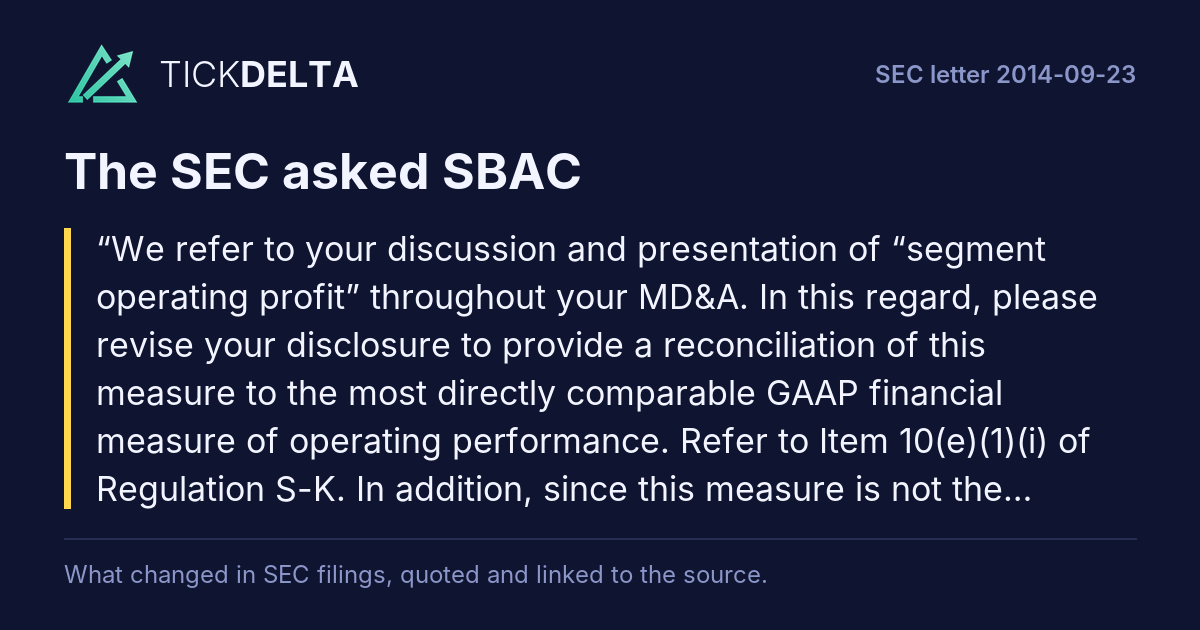
We refer to your discussion and presentation of “segment operating profit” throughout your MD&A. In this regard, please revise your disclosure to provide a reconciliation of this measure to the most directly comparable GAAP financial measure of operating performance. Refer to Item 10(e)(1)(i) of Regulation S-K.Rest of the question
In addition, since this measure is not the measure of profit disclosed in Note 20 - Segment Data, it does not appear appropriate to label this measure as "segment operating profit." 16. Stock-Based Compensation, page F-34
The Company acknowledges the Staff’s comment. The Company respectively advises the Staff that “segment operating profit” as presented in the MD&A is a calculation based on two line items taken directly from the Company’s financial statements, specifically “Revenues” for the relevant segment minus “Cost of revenues (exclusive of depreciation, accretion, and amortization shown below)” for the relevant segment and both of which are included in the segment note to the Company’s financial statements (Note 20 to the Financial Statements for the year ended
December 31, 2013).Read in the reply ↗Rest of the answer
In light of the Staff’s comments and based on discussions held with the staff telephonically, the Company has decided to enhance its disclosures in its “Segment Data” footnote to the financial statements to include this subtotal within its presentation of segment operating profit. The presentation will provide readers of the financial statements with all the operating metrics which are used by the Company’s chief operating decision maker
(“CODM”) in assessing performance and allocating resources at the reportable segment level. Therefore, in accordance with ASC 280-10-50-22, in future filings, the Company will disclose in its “Segment Data” note to the
Company’s financial statements that segment operating profit is a measure of segment profit that the Company’s CODM utilizes in assessing performance and allocating resources at the reportable segment level and will reconcile this measure to Net Loss from Continuing Operations as set forth below.
GREENBERG TRAURIG, P.A. ¡ ATTORNEYS AT LAW ¡ WWW.GTLAW.COM
Domestic Site
Leasing
Int’l Site
Site
Development
Not
Identified by
Segment
Total
(in thousands)
For the year ended December 31, 2013
Revenues
$
1,048,756
84,257
171,853
—
1,304,866
Cost of revenues less depreciation, amortization and accretion
242,839
27,933
137,481
408,253
Segment operating profit
805,917
56,324
34,372
896,613
Selling, general, and administrative
59,320
10,065
7,760
8,331
85,476
Asset impairment and decommission costs
26,478
2,482
28,960
Acquisition related expenses
6,525
12,673
19,198
Depreciation, amortization and accretion
484,053
44,973
2,280
2,028
533,334
Operating income (loss)
229,541
(13,869
)
24,332
(10,359
229,645
Other expense (principally interest expense and other expense)
(285,554
Income (loss) from continuing operations
(55,909
16. Stock-Based Compensation, page F-34
First report after the company's reply of 2014-10-07: 10-Q filed 2014-11-07 ↗, against the 10-Q filed 2014-08-05 ↗.
Tickdelta does not hold the text of both reports, so they are not compared here.
We note that expected volatility was 25.0-29.0% in 2013, and 53% and 53.9% in 2012 and 2011, respectively. Please tell us why expected volatility decreased significantly in 2013.
The Company acknowledges the Staff’s comment. The Company respectfully advises the Staff that the expected volatility decreased from
53.9% and 53% in 2011 and 2012, respectively, to a range of 25% to 29% in 2013 because of the significant difference in historical volatility of the Company’s stock in the 2008-2009 period as compared to the 2010-2013 period and the
Company’s decision to place less weight on the 2008 period in its estimates once it was determined that that level of volatility was unlikely to be repeated.
In accordance with ASC 718, the Company calculates its estimate ofRead in the reply ↗Rest of the answer
expected volatility by considering historical volatility. According to ASC
718, historical realized volatility is measured over a period corresponding to the weighted average expected life of the option, which in the case of the Company was 3.9 to 4.8 years. During 2008, the Company’s common stock experienced a significant increase in its volatility increasing to 91.5% for the 2008 calendar year. The elevated volatility in 2008 was included in the look-back period utilized in calculating the 2011 and 2012 estimated volatility resulting in the higher historical volatility percentages. However, only a portion of 2008 was included in the 2013 calculations, resulting in a reduction in the calculated volatility.
In addition, in connection with its calculation of estimated volatility in 2013, the Company took into consideration ASC 718-10-55-37(a) which states that “if an entity’s share
GREENBERG TRAURIG,
P.A. ¡ ATTORNEYS AT LAW ¡ WWW.GTLAW.COM price was extremely volatile for an identifiable period of time, due to general market declines, that entity might place less weight on its volatility during that period of time.” Based on the relative stability of its volatility in the period from 2010 to early 2013 (23%), in calculating its 2013 estimated volatility, the Company, in accordance with ASC 718-10-55-37(a), weighted the 2008-2009 period lower than the 2010-2013 period, resulting in an estimated volatility of approximately 25%.
* *
*
In responding to your comments, the Company acknowledges that (i) the Company is responsible for the adequacy and accuracy of the disclosure in the filing; (ii) Staff comments or changes to disclosure in response to Staff comments do not foreclose the Commission from taking any action with respect to the filing; and
(iii) the Company may not assert Staff comments as a defense in any proceeding initiated by the Commission or any person under the federal securities laws of the United States.
First report after the company's reply of 2014-10-07: 10-Q filed 2014-11-07 ↗, against the 10-Q filed 2014-08-05 ↗.
Tickdelta does not hold the text of both reports, so they are not compared here.
Also in this review: company letter, 2014-11-12, closing letter, 2014-11-18