Form 10-K for the Fiscal Year Ended September 29, 2019
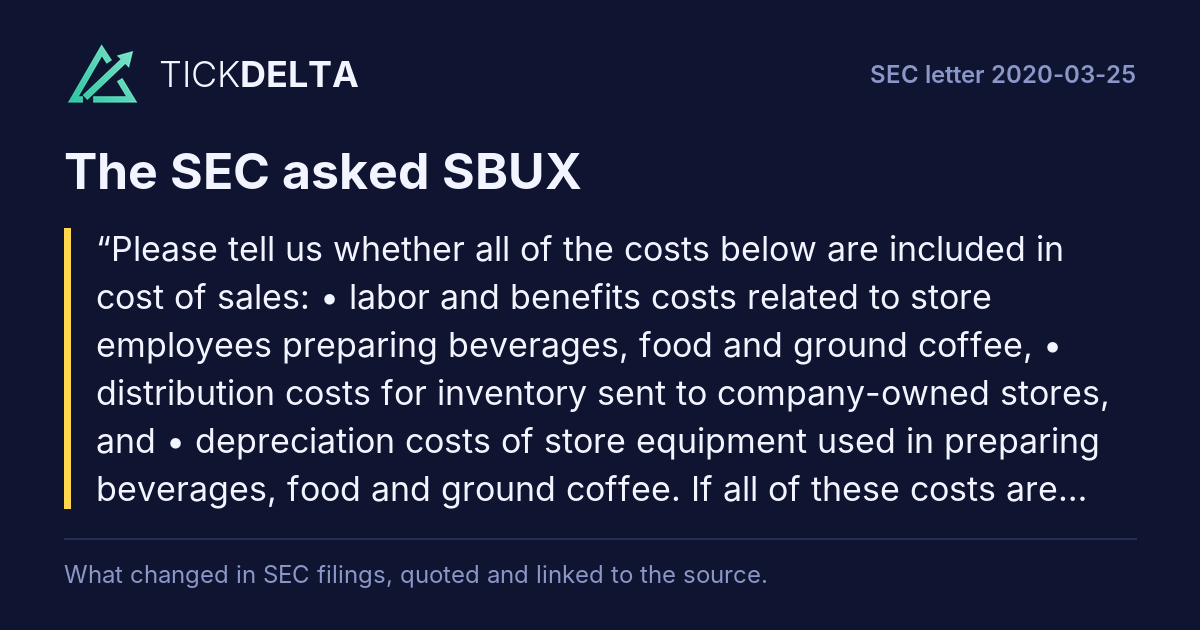
Please tell us whether all of the costs below are included in cost of sales: • labor and benefits costs related to store employees preparing beverages, food and ground coffee, • distribution costs for inventory sent to company-owned stores, and • depreciation costs of store equipment used in preparing beverages, food and ground coffee.Rest of the question
If all of these costs are not included in cost of sales, please also tell us how you determined that they were not required to be included or retitle this line item to better reflect what it represents. Refer to ASC 330-10-30.
We advise the Staff that we consider cost of sales to be the accumulation of costs incurred to source, acquire, manufacture and deliver finished goods for resale. Specifically, cost of sales primarily consists of raw materials, purchased goods and packaging costs as well as our supply chain organization’s operational costs, such as wages
U.S.Read in the reply ↗Rest of the answer
Securities and Exchange Commission
Page and benefits, occupancy costs, depreciation expenses relating to manufacturing facilities and distribution operations and other costs, in support of sourcing, procuring, manufacturing, warehousing and transportation activities of products sold at our company-operated and licensed stores as well as through our Channel Development segment and other businesses. Also included are inventory and supply chain asset impairment costs. Accordingly, distribution costs for inventory provided to company-operated stores are included in cost of sales.
We consider products to be finished goods when sourcing, acquisition, production, manufacturing and distribution activities have been completed and the related products have been received at company-operated stores or at licensed partners’ stores, distribution centers or contractual destinations. Additional costs incurred at company-operated stores are more closely related to sales efforts and are classified as store operating expenses. Under this framework, wages and benefits related to store employees are included in store operating expenses; however, store equipment depreciation costs are included in depreciation and amortization expenses on our consolidated statements of earnings. With respect to store employee wages and benefits related to preparing beverages, food and ground coffee, it should be noted that such preparation time is not tracked separately and represents a fraction of regular tasks, which include:
welcoming customers, explaining menu items, informing customers about new items and limited-time-offerings, answering questions, handling complaints and accepting orders and payments;
operating cash registers and credit card machines;
managing supply orders;
taking inventory, replenishing items in display cases, behind the counter or in storage areas and restocking dining areas;
preparing and packaging beverage and food items for sale;
cleaning coffee and other machines, restaurant areas and restrooms;
emptying trash and sanitizing equipment and utensils;
updating signage and displays;
ensuring the store and equipment are in good working order and coordinating repairs and service;
working with field and corporate leadership on store performance, safety and security measures, promotions of new beverage and food items and customer reward programs; and recruiting, hiring and training new partners (employees) and training existing partners.
While both beverage and food preparation are an important component of store employee responsibilities, we typically expect, on average, the preparation time to be incidental to overall store operations and inventory turns to be fairly high. Furthermore, capitalizing beverage preparation overhead costs would be administratively burdensome since store labor is variable depending on each store’s circumstance (i.e., customer traffic patterns and composition, localized beverage availability and customization, variation of beverage equipment in each store, selection of stores testing new beverages, variations in wage rates, types of store formats and capabilities, etc.). Additionally, seasonal and other changes in our core product and limited time offerings would warrant frequent updates of overhead rates for inventory capitalization, which would require reliable detailed tracking, or some other means, of estimating every beverage, every day at every store. As food preparation generally involves defrosting or reheating products, we do not believe significant costs are incurred to be capitalized. Therefore, it is our view that wages and benefits relating to beverage and food preparation are relatively minor to the overall store operating costs and are predominantly supporting store and selling operations as opposed to inventory production. Furthermore, these costs would also represent a small fraction of the total costs we incur to source, procure, manufacture and distribute products to our stores. As a result, wages and benefits related to beverage and food preparation are included in store operating expenses, and depreciation costs of related store equipment are included in depreciation and amortization expenses, similar to depreciation costs related to other fixed assets in our stores. Further consideration surrounding our presentation and classification of these costs is provided in the immediately succeeding paragraphs.
As presented in Item 7. Management’s Discussion and Analysis of Financial Condition and Results of Operations in our Form 10-K for the fiscal year ended September 29, 2019, we analyze store operating expenses as a percentage of net revenues from company-operated stores. We believe the inclusion of all costs incurred within our physical stores (such as wages and benefits related to store employees and occupancy costs) in store operating expenses provides a more meaningful and faithful metric of our store operating results. Additionally, we do not present gross margin, or net revenues less cost of sales, as part of our consolidated statements of earnings, nor does management use gross margin metrics to regularly evaluate performance.
Additionally, in accordance with ASC 360, we evaluate property, plant and equipment for impairment when facts and circumstances indicate the carrying values of such assets may not be recoverable. For company-operated store assets, the impairment test is performed at the individual store asset group level; that is, all fixed assets in each individual store are considered an asset group since the store represents the lowest level of identifiable cash flows. Inclusion of store equipment used in beverage and food preparation as part of the individual store asset group allows for a more meaningful impairment and performance evaluation of each store as well as our company-operated retail businesses, versus the alternative of comingling store-specific equipment with other warehousing and manufacturing assets, which support the entire enterprise
(i.e., multiple lines and channels of businesses).
We acknowledge ASC
330-10-30 addresses inventoriable costs and have observed the diversity in practice regarding how such costs are classified. Based on our considerations herein and given that we do not classify certain costs that bring final products to our end customers as part of inventory or cost of sales, we agree to change the description of the cost of sales caption to “product and distribution costs” on our consolidated statements of earnings beginning with the Form 10-Q for our fiscal quarter ending June 28, 2020. We will also expand our Summary of Significant Accounting Policies footnote to include additional disclosures as noted in our response to the Staff’s third comment.
First report after the company's reply of 2020-04-24: 10-Q filed 2020-04-28 ↗, against the 10-Q filed 2020-01-28 ↗.
Tickdelta does not hold the text of both reports, so they are not compared here.
Please present the material components of the store operating expenses line item separately. Refer to Rule 5-03.3 of Regulation S-X.
With respect to presenting material components of store operating expenses, we believe the application of Rule 5-03.3 of Regulation S-X allows for judgment and have noted significant diversity in practice. Rather than aggregating all direct business operating expenses, our current presentation provides a clear distinction between store operating expenses and non-store operating expenses, which are captioned as other operating expenses on our consolidated statement of earnings.Read in the reply ↗Rest of the answer
This distinction provides a meaningful segregation between costs incurred at our company-operated stores versus our licensing and Channel Development businesses. Furthermore, it provides insight into how store-related expenses contribute to the generation of revenues from our company-operated stores, as evidenced by our disclosures and analysis of store operating expenses as a percentage of related revenues. As operating income and, more importantly, operating margin are the line-items of primary focus in our investor communications, we believe our current disaggregation of operating expenses provides qualitatively and quantitatively sufficient and relevant information for investors to understand the drivers of our operating results and thereby meets the presentation requirements of Rule 5-03.3 of Regulation S-X.
To enhance transparency, beginning with our Form 10-Q for the fiscal quarter ending June 28, 2020, we will provide the material components of store operating expenses in the footnotes to the consolidated financial statements and present the dollar amounts for wages and benefits, occupancy costs and other expenses, which represented approximately 57%, 23% and 20%, respectively, of total store operating expenses for our fiscal year ended September 29, 2019.
First report after the company's reply of 2020-04-24: 10-Q filed 2020-04-28 ↗, against the 10-Q filed 2020-01-28 ↗.
Tickdelta does not hold the text of both reports, so they are not compared here.
Please tell us and disclose in an accounting policy footnote the specific types of amounts included in cost of sales, store operating expenses and general and administrative expenses.
We advise the Staff that the specific types of amounts included in cost of sales (to be renamed “product and distribution costs”), store operating expenses and general and administrative expenses are as follows:
Product and distribution costs
Product and distribution costs primarily consist of raw materials, purchased goods and packaging costs as well as operational costs of our supply chain organization, such as wages and benefits, occupancy costs, depreciation expenses and other costs, in support of sourcing, procuring, manufacturing, warehousing and transportation activities of productsRead in the reply ↗Rest of the answer
sold at our company-operated and licensed stores as well as through Channel Development and our other businesses. Also included are inventory and supply chain asset impairment costs.
Store operating expenses
Store operating expenses consist of costs incurred in our company-operated stores, primarily wages and benefits related to store employees, occupancy costs, and other costs that directly support the operation and sales-related activities of those stores.
General and administrative expenses
General and administrative expenses primarily consist of wages and benefits, professional service fees incurred to support corporate functions, including technology, finance, legal and partner (employee) resources, and occupancy costs for regional and corporate offices.
Beginning with our Form 10-Q for the fiscal quarter ending June 28, 2020, we will include these line-item descriptions in our significant accounting policies.
First report after the company's reply of 2020-04-24: 10-Q filed 2020-04-28 ↗, against the 10-Q filed 2020-01-28 ↗.
Tickdelta does not hold the text of both reports, so they are not compared here.
Please disclose your revenues from China or tell us how you determined that they were not material. Refer to ASC 280-10-50-41(a).
We advise the Staff that while our revenues are predominantly generated in the U.S., we continuously evaluate the significance of revenues earned in other geographic areas to our overall financial statements along with related disclosure requirements in accordance with ASC 280-10-50-41(a). We recognize China is currently our fastest growing market and second largest market overall.Read in the reply ↗Rest of the answer
Revenues from our China market as a percentage of consolidated net revenues for each of the three years in the period ended September 29, 2019 were as follows: 11% (fiscal 2019), 10% (fiscal 2018) and 5% (fiscal 2017). We have historically applied judgment when evaluating our disclosures related to information by geographic area as ASC 280 does not prescribe a quantitative threshold for purposes of disclosing revenues from an individual country. However, interpretive industry guidance suggests that disclosure is prudent for revenue amounts of greater than 10% of consolidated revenue.
Based on the fact that we have historically presented revenues from our company-operated stores in China in earning releases and the considerations above, beginning with our Form 10-K for the fiscal year ending September 27, 2020, we will expand the annually required
Information by geographic area section of the Segment Reporting footnote to include net revenues from our business operations in China should they exceed 10% of consolidated net revenues in any of the periods presented. In the future, we may also disclose net revenues from other countries due to other qualitative factors.
First report after the company's reply of 2020-04-24: 10-Q filed 2020-04-28 ↗, against the 10-Q filed 2020-01-28 ↗.
Tickdelta does not hold the text of both reports, so they are not compared here.
Also in this review: closing letter, 2020-04-28