Paragraphs with nothing like them in last year's 10-K
Quoted exactly
20 paragraphs in Risk Factors of the 10-K filed Feb 26, 2026
with nothing like them in the 10-K filed Feb 27, 2025. Quoted exactly.
Paragraphs that were only edited are under 10-K change.
Some of our competitors are substantially larger and have greater financial, technological, operational and marketing resources than we do. These competitors may benefit from more diverse product offerings, broader consumer and merchant bases, established distribution channels, stronger brand recognition and loyalty, longer operating histories and access to lower cost funding. They may also be able to cross-subsidize products and invest more heavily in technology, acquire competitors, or offer more favorable pricing or incentives to merchants and consumers.
The increasing adoption of BNPL and other alternative payment products may attract additional large financial institutions, card networks and technology companies into our markets. Such interests may be better positioned due to scale, brand strength and existing customer relationships.
Competition, particularly for large or high-volume merchants, may require us to reduce merchant fees, increase incentives or otherwise modify our pricing. In economic terms, if we are unable to compete effectively, demand for our platform and products may decline our growth and consumers and merchants may slow and. Our revenues, margins and market share could be adversely affected.
Prior to 2023, we incurred substantial net losses. Although we achieved profitability in 2023 and subsequent periods, we may not be able to maintain profitability on a quarterly or annual basis, particularly as we continue to invest in growth initiatives.
We plan to continue investing in the growth of our business, including enhancing our technology infrastructure and platform capabilities, developing and launching new consumer products and services, expanding our merchant network, and increasing our sales and marketing efforts to acquire and retain both consumers and merchants, and pursuing initiatives designed to enhance our funding efficiency and financial services capabilities, which may include seeking additional licenses and/or a bank charter. These initiatives require significant ongoing investment and may increase our operating expenses and capital requirements in the near term.
New products and services, expansion into new markets, efforts to grow our merchant network, increased sales and marketing activities, and initiatives to enhance our funding and financial services capabilities may require meaningful upfront expenditures. These investments may increase our technology, regulatory, compliance, capital, and marketing costs, and may not generate the corresponding revenue, transaction volume, consumer adoption, or funding efficiencies at the levels or within the timeframes we anticipate, which could adversely affect our profitability.
Our ability to sustain profitability will depend on our ability to generate sufficient revenue growth and operating leverage to offset these expenditures. If revenue growth slows, if expenses increase more rapidly than anticipated, or if our growth initiatives do not perform as expected, we may not maintain profitability and could incur additional losses in future periods, which could adversely affect our business, financial condition, and results of operations.
The attractiveness of the Sezzle Platform as a payment method, depends upon, among other things: its ease of use and functionality; its features and benefits, including our subscription products; the overall consumer experience and level of satisfaction; the strength of our brand and reputation; and consumer trust. If we fail to meet consumer expectations in any of these areas, or if competing platforms and/or payment options offer more compelling features, pricing or convenience, consumers may reduce their usage of our platform or shift to alternative payment providers, resulting in lower transaction volumes and lower GMV.
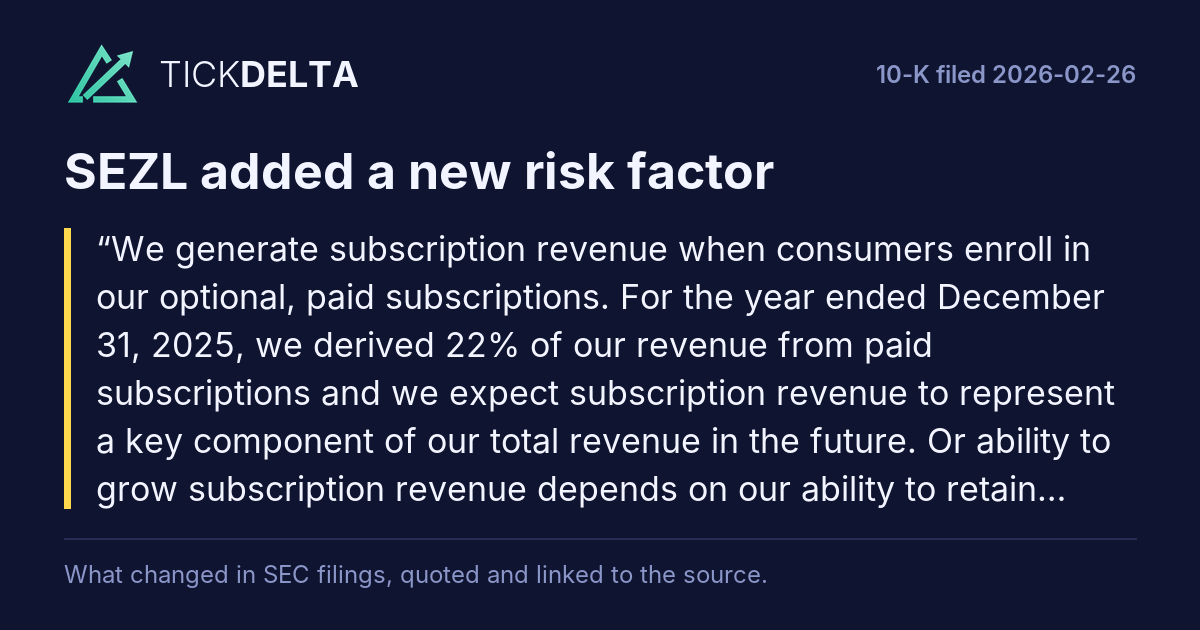
We generate subscription revenue when consumers enroll in our optional, paid subscriptions. For the year ended December 31, 2025, we derived 22% of our revenue from paid subscriptions and we expect subscription revenue to represent a key component of our total revenue in the future. Or ability to grow subscription revenue depends on our ability to retain existing subscribers and attract new subscribers.
Subscriber growth and retention depends on the attractiveness, functionality, and relative value of the benefits included in our subscription products. If we are unable to maintain, enhance, or expand the benefits offered through our subscription products, we may fail to attract new subscribers and/or existing subscribers may fail to renew their subscription, resulting in declines in our revenue and financial performance.
We have adjusted, and may continue to adjust, our subscription pricing from time to time. If subscribers do not view our pricing as providing sufficient value, they may choose not to enroll in or renew a subscription. Conversely, efforts to enhance or expand our subscription products may require additional investment, and we may not be able to offset such costs through pricing adjustments or subscriber growth.
In addition, we operate in a highly competitive environment in which competitors may introduce similar subscription products at lower prices, bundle comparable benefits with other services, or offer more extensive or differentiated benefits that consumers find more attractive. Increased competition could lead consumers to switch to competing subscription offerings or pressure us to modify our pricing or benefits structure.
The development, enhancement, and maintenance of our subscription products to deliver compelling benefits, remain competitive, and require responding to evolving consumer preferences. If we are unable to successfully design, implement, and market subscription products that consumers find valuable, subscribers may cancel or choose not to enroll. Any failure to effectively manage subscriber acquisition, retention, pricing, and development could adversely affect our business, financial condition, and results of operations.
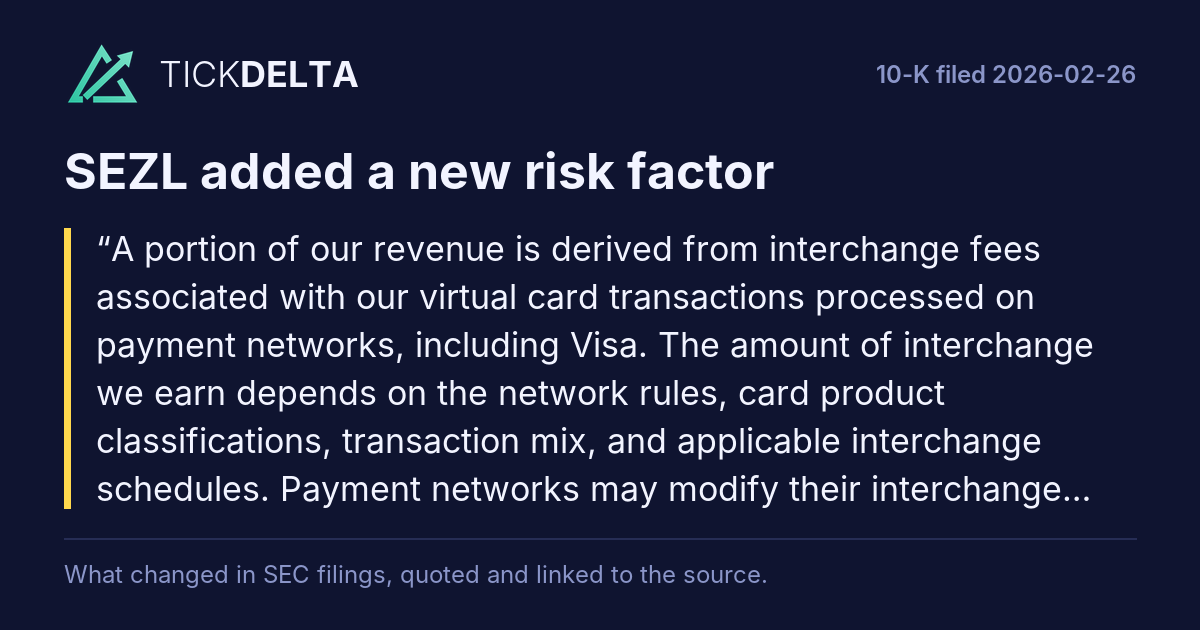
A portion of our revenue is derived from interchange fees associated with our virtual card transactions processed on payment networks, including Visa. The amount of interchange we earn depends on the network rules, card product classifications, transaction mix, and applicable interchange schedules. Payment networks may modify their interchange fee structures, eligibility criteria, or program requirements, including with respect to our virtual card program, which could reduce the interchange revenue we earn and adversely affect our transaction economics.
Show the other 5
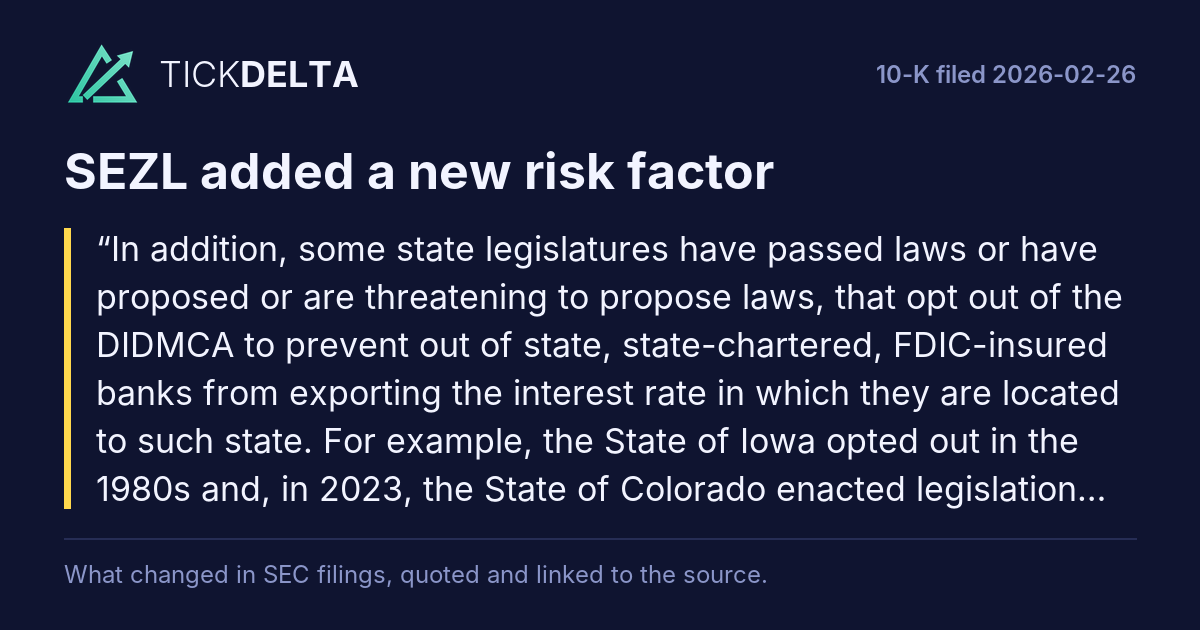
In addition, some state legislatures have passed laws or have proposed or are threatening to propose laws, that opt out of the DIDMCA to prevent out of state, state-chartered, FDIC-insured banks from exporting the interest rate in which they are located to such state. For example, the State of Iowa opted out in the 1980s and, in 2023, the State of Colorado enacted legislation to opt-out of DIDMCA’s interest-rate exportation provisions. In March 2024, industry trade associations challenged Colorado’s DIDMCA opt-out law, and a federal district court issued a preliminary injunction blocking its enforcement. In November 2025, the U.S. Court of Appeals for the Tenth Circuit issued a decision in the case; however, the preliminary injunction remains in effect unless and until further court action lifts it. If the injunction is lifted and Colorado’s opt-out law becomes enforceable, Colorado regulators could seek to apply the state’s interest rate limits and other consumer lending laws to out-of-state, state-chartered, FDIC-insured banks making loans to Colorado residents. Enforcement of Colorado’s opt-out law, or the adoption or enforcement of similar laws in other states, could limit our and our bank partner’s ability to rely on federal interest rate exportation, increase compliance and operational complexity and costs, require changes to our product pricing or structure, or result in the discontinuation of certain products in affected jurisdictions, which could adversely affect our business, results of operations, and financial condition.
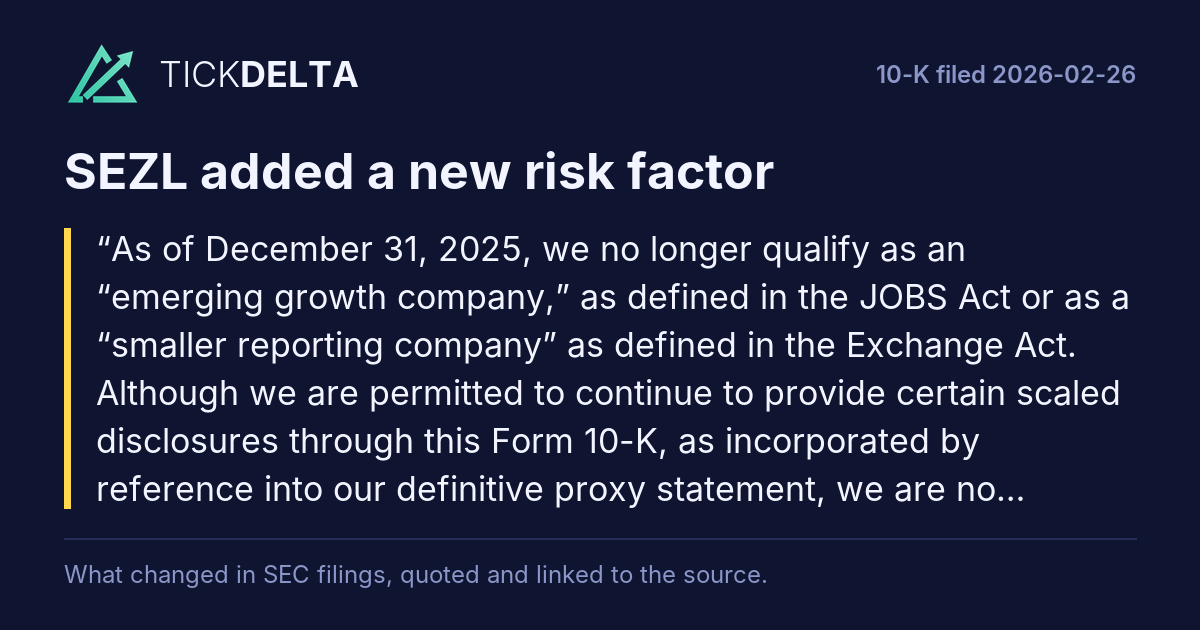
As of December 31, 2025, we no longer qualify as an “emerging growth company,” as defined in the JOBS Act or as a “smaller reporting company” as defined in the Exchange Act. Although we are permitted to continue to provide certain scaled disclosures through this Form 10-K, as incorporated by reference into our definitive proxy statement, we are no longer entitled to rely on various exemptions from disclosure and compliance requirements previously available to us. These include, among other things, compliance with the auditor attestation requirements under Section 404(b) of the Sarbanes-Oxley Act, expanded executive compensation disclosures, advisory votes on executive compensation matters, and other corporate governance and reporting obligations.
The loss of emerging growth company and smaller reporting company status has increased our accounting, legal, and compliance costs and placed additional demands on our management and financial resources. As a result, we are subject to expanded disclosure, internal control, and corporate governance requirements under SEC rules, the Sarbanes-Oxley Act, the Dodd-Frank Act, the Securities Act, the Exchange Act, and Nasdaq rules. If we are unable to comply with these requirements in a timely and effective manner, or if our disclosures are perceived as inadequate by investors or regulators, the market price of our common stock could decline and we could become subject to regulatory actions or stockholder litigation.
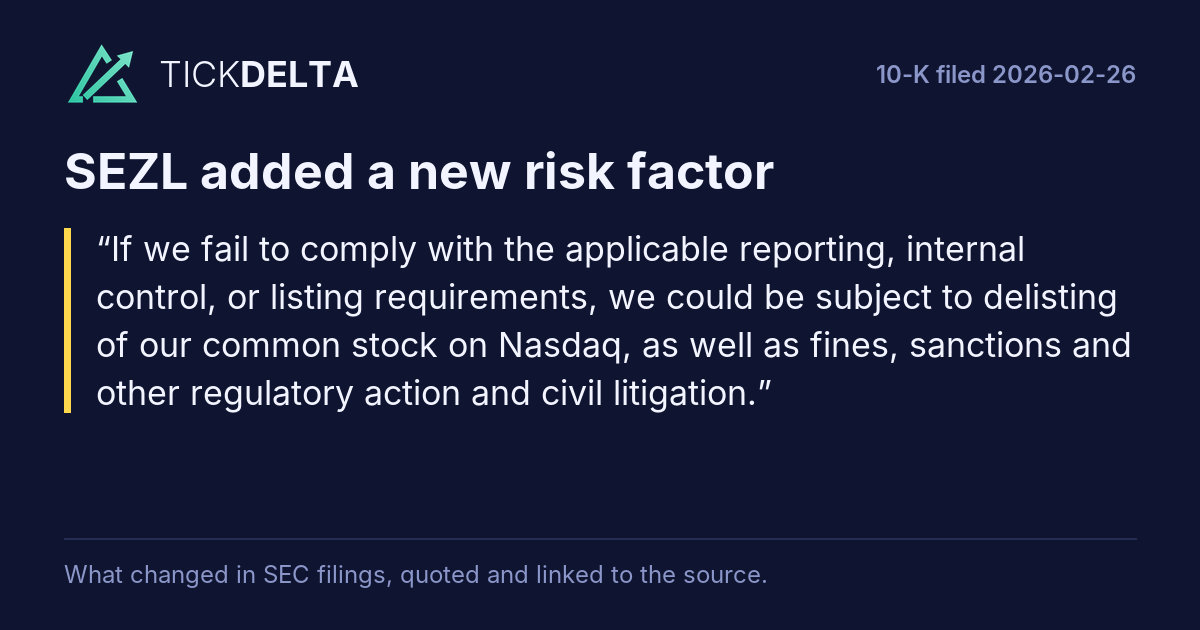
If we fail to comply with the applicable reporting, internal control, or listing requirements, we could be subject to delisting of our common stock on Nasdaq, as well as fines, sanctions and other regulatory action and civil litigation.
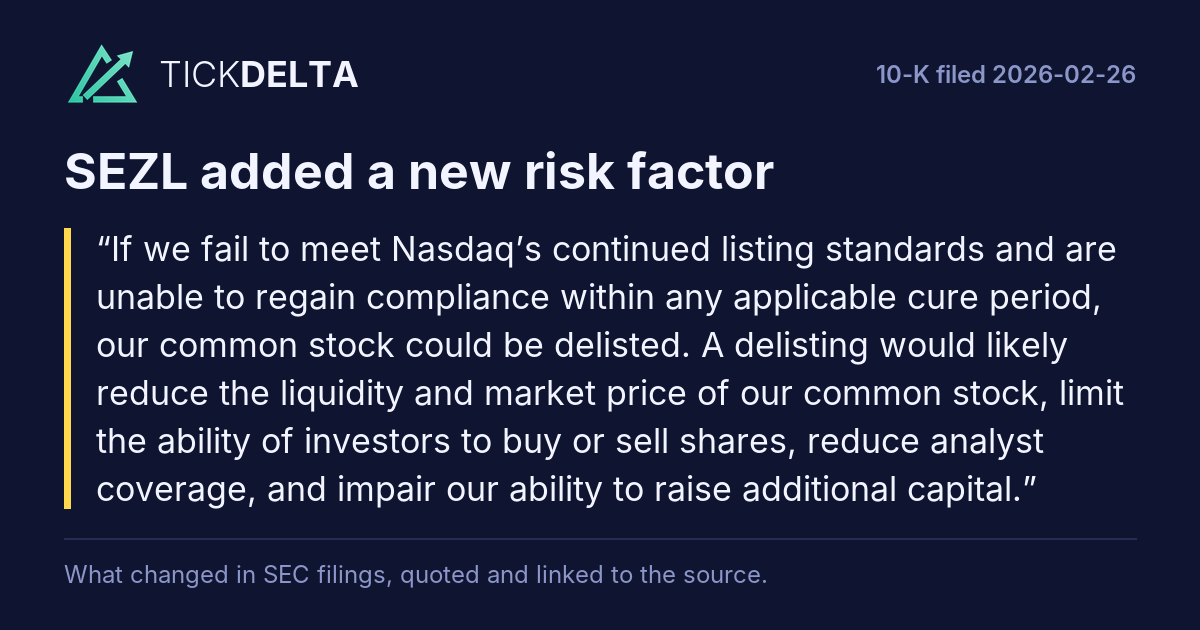
If we fail to meet Nasdaq’s continued listing standards and are unable to regain compliance within any applicable cure period, our common stock could be delisted. A delisting would likely reduce the liquidity and market price of our common stock, limit the ability of investors to buy or sell shares, reduce analyst coverage, and impair our ability to raise additional capital.
As described within our Management’s Report on Internal Control over Financial Reporting within this Annual Report on Form 10-K, management identified a material weakness in its internal control over financial reporting with respect to the design and effectiveness of controls to evaluate the appropriate classification of the cash flows related to our notes receivable. While we have designed a remediation plan, we will not be able to conclude whether the remediation of the material weakness was successful until sufficient time has passed to allow management to test the design and operational effectiveness of the enhanced controls. Not remediating the material weakness or not identifying additional control weaknesses could result in additional accounting errors or reporting delays that could negatively impact our reputation or stock price.
Paragraphs in the 10-Q filed Nov 5, 2026 that were not in the one before
New in the latest 10-Q
12 paragraphs in the 10-Q filed Nov 5, 2026 with nothing like
them in the 10-Q filed Aug 7, 2026 (at least half the words must differ; new numbers alone do not count).
Quoted exactly, grouped by the item heading above them. This is text that changed, not a judgement of how serious it is.
10-Q
• the possibility that Sezzle’s national bank charter application, or other applications associated with the national bank application may not be approved timely, if at all;
Read in the 10-Qopen_in_new
• the uncertain nature of the impact that a national bank charter may have on Sezzle's business;
Read in the 10-Qopen_in_new
Financial statements and notes
Under an arrangement with a third-party partner, our originating partner sells eligible long-term installment loans originated through the Sezzle Platform to three statutory trusts (the "Financing Entities") formed to purchase and hold these loans. Each Financing Entity is a variable interest entity and are substantially similar; therefore, we disclose information about them in the aggregate. Our variable interests consist of the servicing and ancillary fees we earn for servicing the loans and our obligations to repurchase loans upon breaches of certain representations and warranties made by us or our originating partner. As of September 30, 2026, the unpaid principal balance of loans held by the Financing Entities was approximately $ 24.4 million.
Read in the 10-Qopen_in_new
We are not the primary beneficiary of the Financing Entities because we do not have the power to direct the activities that most significantly impact their economic performance, namely the selection, pricing, and purchase of loans, which are directed by other parties. Our maximum exposure to loss is the amount we would pay to repurchase every loan owned by the Financing Entities under the representation and warranty provisions described above, which are not subject to a contractual cap. As of September 30, 2026, the carrying amounts of assets and liabilities related to our variable interests in the Financing Entities were not material, and our maximum exposure to loss was approximately $ 24.4 million, equal to the total unpaid principal balance of loans held by the Financing Entities. During the three and nine months ended September 30, 2026, we did not provide financial or other support to the Financing Entities that we were not contractually required to.
Read in the 10-Qopen_in_new
In the ordinary course of business, we are subject to various legal and regulatory matters, including inquiries, investigations, and demands from federal and state regulatory authorities concerning our business practices and compliance with applicable laws and regulations. The results of such matters often involve judgments, estimates, and inherent uncertainties, which cannot be predicted with certainty. In accordance with applicable accounting guidance, we establish an accrued liability for legal proceedings and claims when those matters present loss contingencies which are both probable and reasonably estimable. We disclose the nature of the contingency when management believes there is at least a reasonable possibility that the outcome may be material to our consolidated financial statements and, where feasible, an estimate of the possible loss. Based on currently available information, management does not believe that losses associated with any such matters are probable. While certain losses may be reasonably possible, we are unable to estimate the amount or range of potential losses due to the preliminary nature of the matters and uncertainties regarding their ultimate resolution.
Read in the 10-Qopen_in_new
Show the other 7
Beginning this quarter, TTV replaces Gross Merchandise Volume (“GMV”). Because our products have diversified, TTV includes platform volume related to SezzleCash and Sezzle Send, which GMV did not. Prior periods have been recast to reflect the expanded scope of TTV and adjustments to purchase-volume measurement.
Read in the 10-Qopen_in_new
As of September 30, 2026, we did not have any off-balance sheet arrangements that have or are reasonably likely to have a material current or future effect on our financial condition, changes in financial condition, revenues or expenses, results of operations, liquidity, cash requirements, or capital resources, except as follows:
Read in the 10-Qopen_in_new
Our originating partner originates and holds certain loans that are not recorded on our consolidated balance sheets. We service these loans and are required to purchase them from our originating partner when they are charged off. We maintain cash collateral with our originating partner in support of these obligations. We also pay our originating partner a variable fee based on the outstanding balance of these loans, and we are required to purchase the loans that remain outstanding upon expiration or termination of the program. As a result, these arrangements may require us to use cash, including if the credit performance of the loans deteriorates.
Read in the 10-Qopen_in_new
Risk Factors
Our applications for a national bank charter and federal deposit insurance may be delayed, denied, or approved subject to conditions, and even if approved, we may not realize the anticipated benefits of operating a bank.
Read in the 10-Qopen_in_new
On October 22, 2026, we submitted an application to the Office of the Comptroller of the Currency (the “OCC”) to charter a de novo national bank, Sezzle Bank, N.A. (the “Bank”), and an application to the Federal Deposit Insurance Corporation (the “FDIC”) for deposit insurance. We also expect to apply to the Board of Governors of the Federal Reserve System for approval for Sezzle Inc. to become a bank holding company. Regulatory approval of these applications is subject to a number of requirements, including minimum capital and liquidity requirements, compliance and risk management requirements, management and governance standards, and a determination that the Bank’s proposed activities are legally permissible, among others. The applications are also subject to public comment, and third parties may oppose them. Our applications may be denied, regulatory approval may be delayed or subject to conditions that we are unable or unwilling to satisfy, and there may be changes in applicable laws, regulatory policy, or supervisory expectations, including as a result of changes in agency priorities, that affect the review of our applications or the Bank’s operations. The Bank will not commence operations unless and until all required approvals are received and any conditions are satisfied, and until then we will continue to rely on our existing bank partner relationships.
Read in the 10-Qopen_in_new
If the Bank opens, it will be subject to extensive regulation, supervision, and examination by the OCC and the FDIC, and will introduce additional operational complexity, including the need to build and maintain bank-specific infrastructure, risk management, compliance, and reporting capabilities. Establishing and operating the Bank will require us to contribute significant capital to the Bank and is likely to result in other new costs, which may be significant and could reduce or offset some or all of the anticipated benefits of the bank charter. In addition, we have incurred, and will continue to incur, costs in pursuing the charter, which we may not recover if our applications are not approved or if we decide not to pursue them. For these and other reasons, we may be unable to fully realize the benefits, efficiencies, cost reductions, or funding advantages that we expect from obtaining a bank charter, and our business, financial condition, and results of operations may be adversely affected.
Read in the 10-Qopen_in_new
Other information
On August 27, 2026, Justin Krause, the Company’s Principal Accounting Officer, adopted a Rule 10b5-1 trading arrangement (the “Krause Plan”) that was intended to satisfy the affirmative defense conditions of Rule 10b5-1(c). The Krause Plan provides for the potential sale of up to 36,000 shares of the Company’s common stock, between an estimated start date of November 26, 2026, until termination of the Krause Plan on November 25, 2027, or earlier if all transactions under the Krause Plan are completed.
Read in the 10-Qopen_in_new
The 10-Q's risk factors against the 10-K
Item 1A of the 10-Q filed Nov 5, 2026 against Item 1A of the 10-K filed Feb 26, 2026.
A 10-Q repeats only the risks that changed, so a 10-K paragraph that is missing from it is not counted as removed.
Added is a paragraph with nothing like it in the 10-K, Reworded a sentence that is in both with several words changed,
Quiet changes a sentence in both where one to four words changed and one is a hedge or a modal
(cut words struck through, new words highlighted).
Text on the page, not a score; each links to the filing at sec.gov.
What the 10-Q itself says about its risk factors:There have been no material changes to the risk factors described in Part I, Item 1A. Risk Factors of our Annual Report on Form 10-K for the year ended December 31, 2025, except as follows:
Read in the 10-Qopen_in_new
Added10-Q Nov 5, 2026 vs 10-K Feb 26, 2026
Our applications for a national bank charter and federal deposit insurance may be delayed, denied, or approved subject to conditions, and even if approved, we may not realize the anticipated benefits of operating a bank.
Read it in the 10-Q at sec.govopen_in_new
Added10-Q Nov 5, 2026 vs 10-K Feb 26, 2026
On October 22, 2026, we submitted an application to the Office of the Comptroller of the Currency (the “OCC”) to charter a de novo national bank, Sezzle Bank, N.A. (the “Bank”), and an application to the Federal Deposit Insurance Corporation (the “FDIC”) for deposit insurance. We also expect to apply to the Board of Governors of the Federal Reserve System for approval for Sezzle Inc. to become a bank holding company. Regulatory approval of these applications is subject to a number of requirements, including minimum capital and liquidity requirements, compliance and risk management requirements, management and governance standards, and a determination that the Bank’s proposed activities are legally permissible, among others. The applications are also subject to public comment, and third parties may oppose them. Our applications may be denied, regulatory approval may be delayed or subject to conditions that we are unable or unwilling to satisfy, and there may be changes in applicable laws, regulatory policy, or supervisory expectations, including as a result of changes in agency priorities, that affect the review of our applications or the Bank’s operations. The Bank will not commence operations unless and until all required approvals are received and any conditions are satisfied, and until then we will continue to rely on our existing bank partner relationships.
Read it in the 10-Q at sec.govopen_in_new
Added10-Q Nov 5, 2026 vs 10-K Feb 26, 2026
If the Bank opens, it will be subject to extensive regulation, supervision, and examination by the OCC and the FDIC, and will introduce additional operational complexity, including the need to build and maintain bank-specific infrastructure, risk management, compliance, and reporting capabilities. Establishing and operating the Bank will require us to contribute significant capital to the Bank and is likely to result in other new costs, which may be significant and could reduce or offset some or all of the anticipated benefits of the bank charter. In addition, we have incurred, and will continue to incur, costs in pursuing the charter, which we may not recover if our applications are not approved or if we decide not to pursue them. For these and other reasons, we may be unable to fully realize the benefits, efficiencies, cost reductions, or funding advantages that we expect from obtaining a bank charter, and our business, financial condition, and results of operations may be adversely affected.
Read it in the 10-Q at sec.govopen_in_new
We qualify as an “emerging growth company,” as defined in the JOBS Act. For so long as we remain an emerging growth company, we are permitted and plan to rely on exemptions from certain disclosure requirements that are applicable to other public companies that are not emerging growth companies. These provisions include, but are not limited to: being permitted to have only two years of audited financial statements and only two years of related management’s discussion and analysis of financial condition and results of operations disclosure; an exemption from compliance with the auditor...
In the 10-K filed Feb 27, 2025open_in_new
We have a limited operating history. Since launching the Sezzle Platform in August 2017, our activities have principally involved raising money to develop our software, products and services (including the Sezzle Platform), as well as adding merchants to the Sezzle Platform and expanding our service offerings to an increasing base of consumers. Similar to many early stage companies, we have accumulated substantial net losses until 2023 when we achieved profitability for the first time. Our operating expenses may increase in the foreseeable future as we seek to continue to grow our...
In the 10-K filed Feb 27, 2025open_in_new
Some of our competitors are substantially larger than we are, which gives those competitors advantages we do not have, such as a more diversified product, a broader consumer and merchant base, the ability to reach more consumers, the ability to cross-sell their products, operational efficiencies, the ability to cross-subsidize their offerings through their other business lines, more versatile technology platforms, the ability to acquire competitors, broad-based local distribution capabilities, and lower-cost funding. Our competitors may also have longer operating histories, more extensive...
In the 10-K filed Feb 27, 2025open_in_new
Certified B Corporation status is a certification by a third party, B Lab, which requires us to consider the impact of our decisions on our workers, customers, supplier, community and the environment. We believe that certified B Corporation status has allowed us to build credibility and trust among our customers. We must satisfy the re-certification requirements when applying for B Certification renewal every three years. We are currently under audit to re-certify as a B Corporation or elect to forego recertification. Any change in our status could create the perception that we are more...
In the 10-K filed Feb 27, 2025open_in_new
Sources
Item 1A of each 10-K and 10-Q on EDGAR, quoted exactly. Each paragraph links to the filing at sec.gov.
Also
10-K change: what was reworded or cut, section by section.
Work with it
Excel workbook · CSV. Google Sheet that stays up to date: paste =IMPORTDATA("https://tickdelta.com/company/SEZL/export.csv") into a cell.