Reworded10-Q 2026-08-26 vs 10-K 2026-06-09
SJMJ.M. Smucker
The Company: The J. M. Smucker Company (“Company,” “registrant,” “we,” “us,” or “our”), often referred to as Smucker’s (a registered trademark), was established in 1897 and incorporated in Ohio in 1921. 10-K, Item 1
- Headquarters
- Orrville, OH
- CEO
- Mark T. Smucker
- Next results
- around Nov 24, 2026
6 paragraphs in Risk Factors of the 10-K filed Jun 9, 2026 with nothing like them in the 10-K filed Jun 18, 2025. Quoted exactly. Paragraphs that were only edited are under 10-K change.
Compared with the Risk Factors in the latest 10-K of the other 31 Consumer staples companies: a paragraph with at least half its words the same at another company is called similar, and the companies are listed under it. A paragraph most of them have is marked boilerplate. No line means no other company has one like it. This counts text; it does not say how serious a risk is.
In particular, the anticipated benefits of our acquisition of Hostess Brands depend in part on our ability to maintain operational stability and continue executing ongoing optimization initiatives. The Hostess Brands business has been substantially integrated into our operations; however, managing a larger and more complex organization requires continued management attention. We may encounter execution-related challenges or be affected by adverse economic, market, consumer trends, or other conditions that could limit our ability to fully realize the anticipated long-term benefits of the acquisition, which could adversely affect our results of operations or cash flows, delay or reduce the accretive impact of the transaction, and negatively impact the market price of our common shares.
Read in the 10-K ↗
employees who leave or to offer employment to potential replacements on reasonable terms, each of which may adversely affect our business and financial results.
Read in the 10-K ↗
We could be subject to adverse publicity or claims from consumers or other stakeholders.
Read in the 10-K ↗
Market perceptions and stakeholder engagement may impact our stock price and business.
Our stock price may be influenced by a variety of factors, including stakeholder sentiment regarding our industry or Company and differing perspectives on our strategy, governance, or capital allocation. Stakeholders may from time to time engage with us or express perspectives on these matters, which may require management and Board attention and could impact public perceptions about the Company. These factors could adversely affect our business, financial condition, and results of operations.
Read in the 10-K ↗
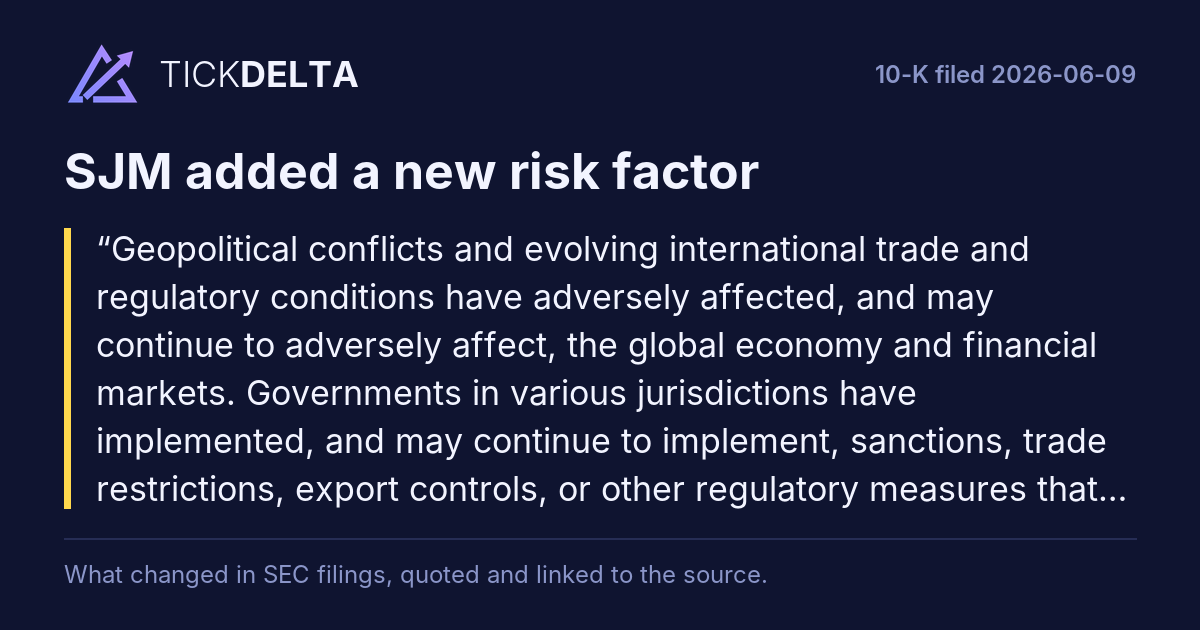
Geopolitical conflicts and evolving international trade and regulatory conditions have adversely affected, and may continue to adversely affect, the global economy and financial markets. Governments in various jurisdictions have implemented, and may continue to implement, sanctions, trade restrictions, export controls, or other regulatory measures that can disrupt global supply chains and increase costs. While we do not have operations in regions experiencing geopolitical conflict, these conditions have contributed to, and may continue to contribute to, the volatility in the availability and cost of raw materials, transportation, and energy. Prolonged or escalating geopolitical conflicts could also result in cyber incidents, further supply chain disruptions, reduced consumer confidence and demand, foreign currency exchange rate volatility, and additional barriers to international trade. Any of these factors could adversely affect our business, financial condition, results of operations, or cash flows, and may exacerbate other risks described in this section.
Read in the 10-K ↗
New in the latest 10-Q
16 paragraphs in the 10-Q filed Aug 26, 2026 with nothing like them in the 10-Q filed Feb 26, 2026 (at least half the words must differ; new numbers alone do not count). Quoted exactly, grouped by the item heading above them. This is text that changed, not a judgement of how serious it is.
Financial statements and notes
Three Months Ended July 31, Dollars in millions 2026 2025 ────────────────────────────────────────────────────────────────────────────────────────────────────────────────────────────────────────── Net income (loss) $ 324.3 $ (43.9) Other comprehensive income (loss): Foreign currency translation adjustments (7.3) (1.0) Cash flow hedging derivative activity, net of tax 2.4 2.4 Pension and other postretirement benefit plans activity, net of tax (0.2) 0.3 Available-for-sale securities activity, net of tax 0.1 0.3 Total Other Comprehensive Income (Loss) (5.0) 2.0 Comprehensive Income (Loss) $ 319.3 $ (41.9)
Read in the 10-Q ↗
Three Months Ended July 31, Dollars in millions 2026 2025 ────────────────────────────────────────────────────────────────────────────────────────────────────────────────────────────────────────────────────────────────── Operating Activities Net income (loss) $ 324.3 $ (43.9) Adjustments to reconcile net income (loss) to net cash provided by (used for) operations: Depreciation 69.6 85.0 Amortization 57.9 50.2 Share-based compensation expense 12.2 9.0 Deferred income tax expense (benefit) (0.4) 24.0 Other noncash adjustments – net 11.4 12.7 Changes in assets and liabilities: Trade receivables 40.1 (24.3) Inventories (61.1) (177.3) Other current assets (13.8) 53.0 Accounts payable 60.9 (33.2) Accrued liabilities (26.0) 76.2 Income and other taxes (31.7) (41.1) Other – net (17.7) (0.9) Net Cash Provided by (Used for) Operating Activities 425.7 (10.6) Investing Activities Additions to property, plant, and equipment (88.4) (84.3) Proceeds from disposal of property, plant, and equipment 0.3 12.9 Collateral received (pledged) for derivative cash margin accounts 2.0 (126.7) Other – net 0.3 0.2 Net Cash Provided by (Used for) Investing Activities (85.8) (197.9) Financing Activities Short-term borrowings (repayments) – net (230.8) 300.6 Quarterly dividends paid (116.8) (114.4) Purchase of treasury shares (5.7) (4.6) Other – net (0.7) (3.6) Net Cash Provided by (Used for) Financing Activities (354.0) 178.0 Effect of exchange rate changes on cash (1.3) (0.1) Net increase (decrease) in cash and cash equivalents (15.4) (30.6) Cash and cash equivalents at beginning of period 58.6 69.9 Cash and Cash Equivalents at End of Period $ 43.2 $ 39.3
Read in the 10-Q ↗
Basic earnings per share is calculated by dividing net income (loss) available to common shareholders by the weighted-average number of common shares outstanding during the period. Under the treasury stock method, the diluted earnings per share calculation includes potential common shares assumed to be issued, which reflects the potential dilution that would occur if any outstanding options or warrants were exercised or restricted stock becomes vested.
Read in the 10-Q ↗
Three Months Ended July 31, 2026 2025 ─────────────────────────────────────────────────────────────────────────────────────────────────────────────────────────────────────────────────────────────── Net income (loss) $ 324.3 $ (43.9) Weighted-average common shares outstanding – assuming dilution: Weighted-average common shares outstanding 106.8 106.6 Add: Dilutive effect of stock options — — Add: Dilutive effect of restricted shares, restricted stock units, and performance units 0.3 — Weighted-average common shares outstanding – assuming dilution 107.1 106.6 Net income (loss) per common share $ 3.04 $ (0.41) Net income (loss) per common share – assuming dilution $ 3.03 $ (0.41)
Read in the 10-Q ↗
During the first three months of 2026, we recognized a net loss, and as a result, excluded the anti-dilutive effect of stock-based awards from the computation of diluted earnings per share.
Read in the 10-Q ↗
The effective income tax rates for the three months ended July 31, 2026 and 2025, were 24.2 and 22.3 percent, respectively. During the three months ended July 31, 2026 and 2025, the effective income tax rates varied from the U.S. statutory income tax rate of 21.0 percent, primarily due to state income taxes.
Read in the 10-Q ↗
Tariff Refunds: In April 2026, we initiated claims for refunds on tariffs previously paid under the International Emergency Economic Powers Act (“IEEPA”) on certain imported goods. During the first quarter of 2027, we received refunds of approximately $ 115.0, which were recognized in cost of products sold, and related interest income of approximately $ 4.0, which was recognized in interest expense - net, in the Condensed Statement of Consolidated Income (Loss). As of July 31, 2026, substantially all requested refunds have been received.
Read in the 10-Q ↗
During the first three months of 2027, we continued to operate in a dynamic and evolving external environment, including geopolitical, macroeconomic, and policy developments, as well as changing consumer behavior, which may continue to affect our business during the remainder of 2027. Despite these challenges, we delivered strong results and demonstrated continued momentum across the Company. Our performance was driven by the strength of our differentiated portfolio, disciplined execution against our strategic priorities, and continued investment in our brands and capabilities.
Read in the 10-Q ↗
To support continued growth and navigate these evolving market conditions, we remain focused on executing our company-wide transformation initiative, which is designed to translate our continuous improvement mindset into sustainable productivity gains. These efforts are intended to expand our profit margins while enabling reinvestment in the Company to support future growth and cost savings.
Read in the 10-Q ↗
We continue to closely monitor ongoing geopolitical conflicts and evolving international trade and regulatory conditions, including the potential impact of tariffs and any other policy actions. Further escalation of these developments could significantly disrupt economic activity, global supply chains, and transportation networks, while contributing to inflationary pressures, higher energy costs, and broader economic slowdowns. In addition, supply chain disruptions could result from shipping delays, supply and demand imbalances, labor shortages, and other operational challenges. We continue to work closely with our customers and external business partners, taking proactive measures to support safety, maintain business continuity, and maximize product availability.
Read in the 10-Q ↗
Given these uncertainties, the impact of inflation, tariffs, supply chain disruptions, and labor availability and attrition on our business, results of operations, financial condition, and liquidity could be difficult to predict. We will continue to monitor these factors as conditions evolve.
Read in the 10-Q ↗
Operating income increased $466.0 in the first three months of 2027, primarily reflecting the increase in gross profit, partially offset by an increase in selling, distribution, and administrative (“SD&A”) expenses.
Read in the 10-Q ↗
reflecting a moderation in input cost inflation during the current year and lower inventory levels, as well as favorable changes in accounts payable and trade receivables driven by the timing of spend, cash payments, sales, and collections, partially offset by an unfavorable impact related to the timing of settling our derivative instruments.
Read in the 10-Q ↗
Tariff Refunds: In April 2026, we initiated claims for refunds on tariffs previously paid under IEEPA on certain imported goods. During the first quarter of 2027, we received refunds of approximately $115.0, which were recognized in cost of products sold, and related interest income of approximately $4.0, which was recognized in interest expense - net, in the Condensed Statement of Consolidated Income (Loss). As of July 31, 2026, substantially all requested refunds have been received.
Read in the 10-Q ↗
Three Months Ended July 31, 2026 2025 ──────────────────────────────────────────────────────────────────────────────────────────────────────────────────────────────────────────────────── Gross profit reconciliation: Gross profit $ 979.6 $ 474.7 Change in net cumulative unallocated derivative gains and losses (29.4) 253.1 Cost of products sold – special project costs — 15.4 Adjusted gross profit $ 950.2 $ 743.2 Operating income reconciliation: Operating income $ 511.6 $ 45.6 Amortization 57.9 50.2 Change in net cumulative unallocated derivative gains and losses (29.4) 253.1 Cost of products sold – special project costs — 15.4 Other special project costs 0.6 6.0 Adjusted operating income $ 540.7 $ 370.3 Net income (loss) reconciliation: Net income (loss) $ 324.3 $ (43.9) Income tax expense (benefit) 103.6 (12.6) Amortization 57.9 50.2 Change in net cumulative unallocated derivative gains and losses (29.4) 253.1 Cost of products sold – special project costs — 15.4 Other special project costs 0.6 6.0 Adjusted income before income taxes $ 457.0 $ 268.2 Income taxes, as adjusted 110.5 64.8 Adjusted income $ 346.5 $ 203.4 Weighted-average shares outstanding – assuming dilution (A) 107.1 106.8 Adjusted earnings per share – assuming dilution (A) $ 3.24 $ 1.90
Read in the 10-Q ↗
Market risk
• our ability to maintain operational stability and successfully achieve the benefits associated with ongoing optimization initiatives of the Sweet Baked Snacks business, including the risk that the business may not achieve anticipated operating or financial results;
Read in the 10-Q ↗
The 10-Q's risk factors against the 10-K
Item 1A of the 10-Q filed Aug 26, 2026 against Item 1A of the 10-K filed Jun 9, 2026.
A 10-Q repeats only the risks that changed, so a 10-K paragraph that is missing from it is not counted as removed.
Added is a paragraph with nothing like it in the 10-K, Reworded a sentence that is in both with several words changed,
Quiet changes a sentence in both where one to four words changed and one is a hedge or a modal
(cut words struck through, new words highlighted and underlined).
Text on the page, not a score; each links to the filing at sec.gov.
Work on SJM in a spreadsheet:
Excel workbook (a sheet per section, ten years by column, charts, links to the filings) ·
CSV.
For a Google Sheet that stays up to date, paste =IMPORTDATA("https://tickdelta.com/company/SJM/export.csv") into a cell.