SLM Corp SLM
New risk paragraphs, branching off last year
Each branch is a paragraph in Risk Factors with nothing like it in the 10-K filed Feb 20, 2025. A box jumps to the paragraph as filed, below.
Paragraphs with nothing like them in last year's 10-K
31 paragraphs in Risk Factors of the 10-K filed Feb 19, 2026 with nothing like them in the 10-K filed Feb 20, 2025. Quoted exactly. Paragraphs that were only edited are under 10-K change.
•Our deposit funding base is primarily concentrated in online deposit products, including high-yield savings accounts, money market accounts, and certificates of deposit. This concentration subjects us to risks that could adversely affect our liquidity, funding costs, and overall financial condition.
•Our origination expansion initiative and strategic partnership funding model are new and untested and may expose us to a broad range of potential risks.
Moreover, given H.R. 1’s changes to government-supported higher education funding and repayment plans, and the current federal administration’s deregulatory posture, we expect that our competition will increase as various lending institutions, FinTechs, and other competitors enter or re-enter the Private Education Loan market with the intent of disrupting and/or capturing newly created or existing market share (including through new student loan offerings or refinancing of existing loans). We compete based on our brand, products, origination capability,
institutional relationships, student loan industry and underwriting expertise, and customer service. To the extent our competitors compete more aggressively or effectively, position themselves to capture more opportunity from H.R. 1, or offer new, novel, or more successful products or services, we could lose market share to them and/or our existing loans could be subject to consolidation or refinancing risk.
In addition, other macroeconomic factors such as high unemployment, recession, inflation, stagflation, wars, trade wars, or tariffs may also negatively impact loan applicants’ or borrowers’ ability to meet our credit standards or repay credit obligations. See “—MACROECONOMIC RISK—A deterioration in economic or macroeconomic
Our deposit funding base is primarily concentrated in online deposit products, including high-yield savings accounts, money market accounts, and certificates of deposit. This concentration subjects us to risks that could adversely affect our liquidity, funding costs, and overall financial condition.
Show the other 10
Additionally, competition has increased from institutions not subject to the same regulatory restrictions as domestic banks and bank holding companies, including FinTech companies that may offer bank-like products or services that compete directly with our deposit products and services or that offer other types of cash management products, such as stablecoins, non-fungible tokens, digital currencies, and cryptocurrencies. Increased competition for deposits could cause our cost of funds to increase, which could negatively impact our loan pricing and net interest margin. For example, the Guiding and Establishing National Innovation for U.S. Stablecoins Act of 2025 (GENIUS Act) provides a legal framework for stablecoins to be issued in the United States, which may allow new and existing competitors to compete for funds that may have otherwise been deposited with banks, such as the Bank. See also “—LIQUIDITY RISK” in this Item 1A.
Because we offer an array of financial and higher educational focused products and services to borrowers, consumers, investors, and depositors, our financial performance is closely tied to the level of consumer and market sentiment, business activity, labor demand, the demand for higher education products and services, and the demand for deposit accounts. A prolonged period of economic weakness, volatility, slow growth, or a deterioration in macroeconomic conditions in the United States and/or globally could result in higher loan defaults, increased net charge-offs, changes to our provision for credit losses, lower deposit levels or deposit demand, liquidity issues, and/ or reduced demand for new labor, higher education, higher education products, and/or private student loans, which could have a material adverse effect on our financial condition and results of operations.
A number of factors could disrupt capital markets, reduce consumer and market sentiment, business activity, demand for or funding of higher education, and weaken the labor market, including, but not limited to:
•Monetary policy actions, such as changes to interest rates by the Federal Reserve or other central banks, and increases in the U.S. fiscal deficit or debt-to-GDP ratio;
•Fiscal policy actions, including changes to applicable tax codes, at both the federal and state level;
•Geopolitical conflicts or instabilities, such as wars, or increased tensions between major economies, or changes to immigration and visa policies;
•U.S. government stalemates, which may lead to government shutdowns, developments related to the federal debt ceiling, or credit-rating downgrades;
•Concerns over a potential recession or a recession, which may lead to changes in consumer and business spending patterns, credit risks, and liquidity concerns;
•Technology-driven disruption of certain industries, including those resulting from advances in AI, robotics, and digital assets;
•Lower demand for higher education caused by shifts in demographics, the labor market, technology-driven disruption and AI, reduced education funding, reduced access to higher education providers, and decreased immigration or access to student visas; and
•Shifts in consumer behavior, including changes in deposit practices and payment patterns.
Decreases in overall business activity, sudden and/or unexpected changes in economic or macroeconomic conditions, and changes in customer behavior may lead to increases in our charge-off rates, reduce our ability to recover previously charged-off debt, and decrease the reliability of our internal processes and models, including those used to estimate our allowance for credit losses and higher education demand projections. Unexpected variations in key inputs and assumptions may cause actual losses to diverge from model projections, increasing reliance on management’s judgment and potentially resulting in adverse impacts to our financial results. See also “—CREDIT RISK”, “—INTEREST RATE RISK”, and “—LIQUIDITY RISK” in this Item 1A.
prospects. Restrictions or limitations on our operations, or other directives, imposed by our regulators may be confidential and thus, in some instances, we may not be permitted to publicly disclose the actions.
The current federal administration has implemented significant changes in federal priorities and has taken steps to change the operations, structure, and policy focus of various federal agencies, as well as regulatory priorities, policy approaches and interpretations of existing laws by those federal agencies. The full and complete impact of the current federal administration’s deregulatory policies is unclear and new developments could have significant implications for bank supervision compliance, litigation strategy, and consumer protection laws. It is also possible the expected changes in regulation do not occur or are reversed by a subsequent federal administration, or the regulatory measures that are ultimately enacted deliver significant competitive advantages to financial services that are structured differently or serve different markets than the Company and the Bank.
our employees, or our vendors, or public opinion of the broader student loan industry or other relevant industries generally, could damage our reputation and business and adversely impact the price of our common stock or other securities.
Our future success depends, in part, on our ability to underwrite and approve loans, process loan applications and payments, and provide other customer services, in a safe, automated manner with high-quality service standards. The volume of loan originations we are able to process is reliant on the systems and processes we have
The development and use of AI presents risks and challenges that may adversely impact our business.
We are in the initial phases of integrating AI into our business operations with the objective of enhancing employee productivity, client outreach, and customer experience in general. In addition, certain vendors and third parties may incorporate AI technologies into business processes, services, or products that we utilize. The adoption and use of AI introduces a range of risks and challenges to our business.
The legal and regulatory landscape governing AI is highly dynamic and continues to evolve rapidly in the United States and internationally, including through the development of regulatory frameworks specifically targeting AI. Recent federal executive actions have signaled a shift in the regulatory landscape for AI in the United States. These actions direct federal agencies to promote a unified national approach to AI oversight, including the potential preemption of conflicting state laws and the establishment of federal standards. While these executive actions do not currently impose direct obligations on private financial institutions, future regulatory developments or agency actions could impact our adoption and governance of AI technologies, as well as our oversight of third-party vendors. Additionally, individual states continue to explore their own laws and regulations related to the use and application of AI. As the legal and regulatory framework for AI continues to evolve, we may face increased, shifting or conflicting compliance requirements, which may require operational adjustments or strategic considerations related to our or our vendors’ use and implementation of AI, which could in turn increase our compliance costs and the risk of non-compliance.
Further, the use of AI models could result in the inadvertent disclosure of confidential company information, infringement of intellectual property rights, or other adverse outcomes. The complexity and opacity of many AI models may also make it difficult to fully assess and mitigate these risks. As a result, our use of AI, or the use of AI by our vendors or third parties, could expose us to liability, regulatory or legal consequences, and reputational harm and, therefore, could materially adversely affect our business, financial condition, and/or results of operations.
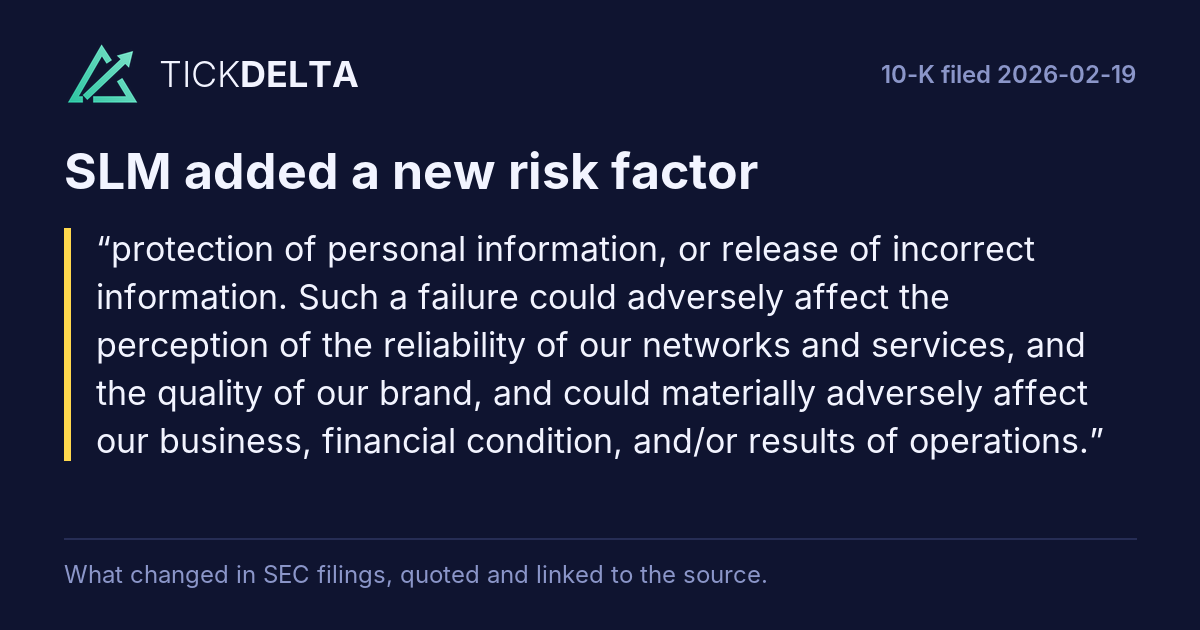
protection of personal information, or release of incorrect information. Such a failure could adversely affect the perception of the reliability of our networks and services, and the quality of our brand, and could materially adversely affect our business, financial condition, and/or results of operations.
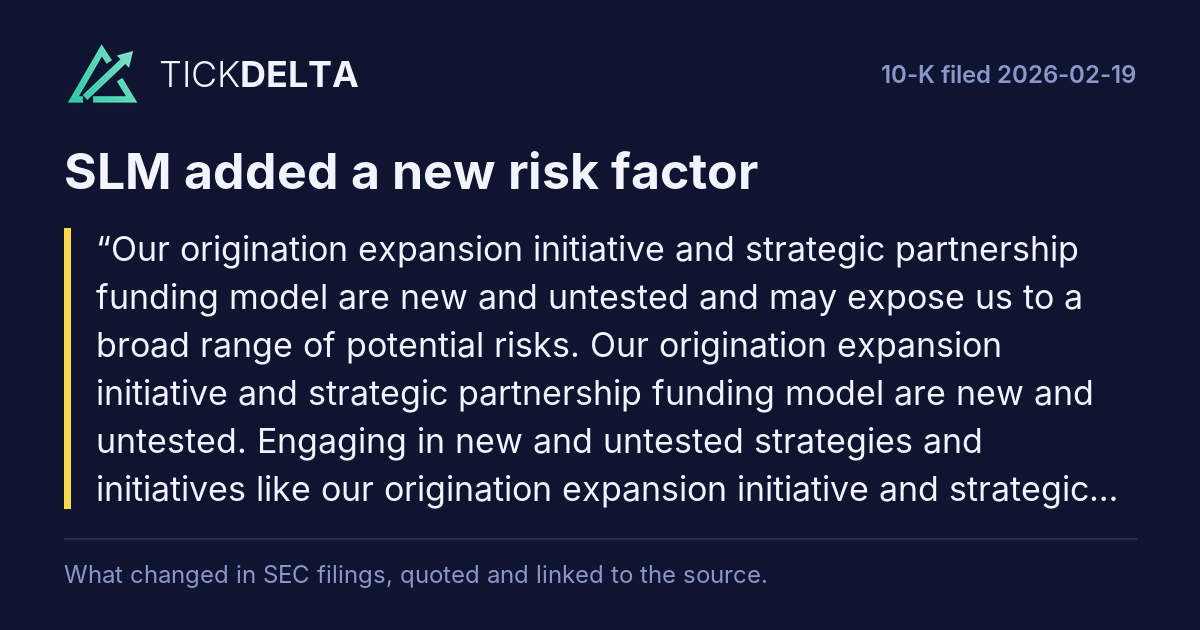
Our origination expansion initiative and strategic partnership funding model are new and untested and may expose us to a broad range of potential risks.
Our origination expansion initiative and strategic partnership funding model are new and untested. Engaging in new and untested strategies and initiatives like our origination expansion initiative and strategic partnership funding model could expose the Company to potential risks including, but not limited to, risks associated with the creation, expansion, growth, and scaling of these initiatives, as well as our reliance on third parties. Our new strategies and initiatives may increase our exposure to execution, operational, concentration, and counterparty risks. We may depend on a limited number of strategic partners, private credit sources, and external demand for higher education products and services, which could increase margin pressures, expenditures, and pose potential liquidity and concentration risks.
If we are unable to secure additional strategic partners, capture new opportunities related to the origination expansion initiative, or access additional sources of private credit, our ability to achieve our strategic objectives, including the anticipated growth or earnings potential of these strategies, could be limited. Our reliance on third parties, including strategic partners, higher education institutions, and other counterparties—may expose us to risks if such parties fail to fulfill their contractual obligations or our agreements with them are terminated unexpectedly. The simultaneous creation and management of multiple new strategic partnerships and initiatives may further increase operational complexity and risk.
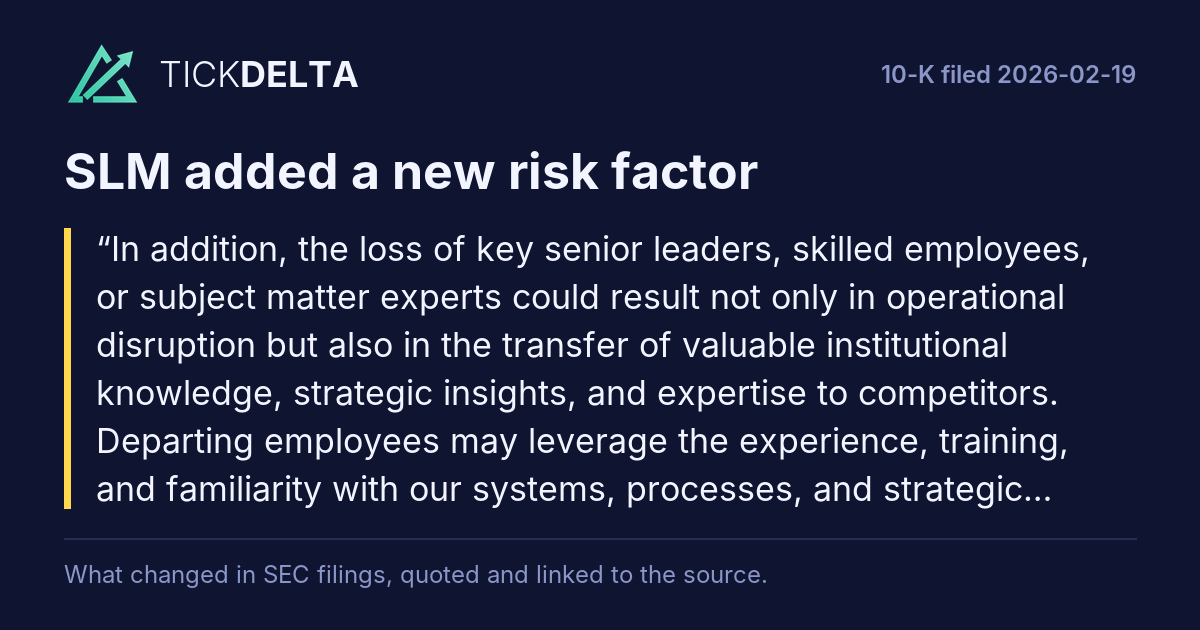
In addition, the loss of key senior leaders, skilled employees, or subject matter experts could result not only in operational disruption but also in the transfer of valuable institutional knowledge, strategic insights, and expertise to competitors. Departing employees may leverage the experience, training, and familiarity with our systems, processes, and strategic priorities gained during their employment to compete more effectively against us on behalf of a new employer. Even when subject to confidentiality and other restrictive covenants, the risk that such individuals could use or disclose proprietary know‑how, intentionally or unintentionally, may increase competitive pressures and adversely affect our business, financial condition, and results of operations.
Paragraphs in the 10-Q filed Oct 22, 2026 that were not in the one before
New in the latest 10-Q
31 paragraphs in the 10-Q filed Oct 22, 2026 with nothing like them in the 10-Q filed Jul 23, 2026 (at least half the words must differ; new numbers alone do not count). Quoted exactly, grouped by the item heading above them. This is text that changed, not a judgement of how serious it is.
10-Q
As of September 30, 2026, there were 182,821,173 shares of common stock outstanding.
Read in the 10-Q
Shares repurchased related to employee stock-based compensation plans — — (7,903) (7,903) — — — — — (74) (74)
Read in the 10-Q
(2) The above table excludes the initial allowance and immediate charge-off of $ 19.1 million of loans previously charged off by unconsolidated Private Education Loan Securitizations that were purchased by the Company during the three months ended September 30, 2026 following the exercise of optional clean-up calls.
Read in the 10-Q
(2) The above table excludes the initial allowance and immediate charge-off of $ 19.1 million of loans previously charged off by unconsolidated Private Education Loan Securitizations that were purchased by the Company during the nine months ended September 30, 2026 following the exercise of optional clean-up calls.
Read in the 10-Q
On August 31, 2026, we entered into the Secured Warehouse Facility with a consortium of financial institutions, including the Bank. The Secured Warehouse Facility is intended to provide financing for the acquisition and holding of eligible Private Education Loans prior to their disposition through sale or other financing transactions, including sale to strategic partners.
Read in the 10-Q
Show the other 26
Under the Secured Warehouse Facility, we may borrow up to an aggregate principal amount of $ 1.5 billion for the period between August 31, 2026 and February 28, 2027 and $ 500 million between March 1, 2027 and August 31, 2027, subject to borrowing base requirements, eligibility criteria, concentration limits, and other customary conditions. Borrowings under the Secured Warehouse Facility are secured by substantially all of the assets held by the warehouse vehicle, including the financed Private Education Loan portfolio and related collections.
Read in the 10-Q
The Secured Warehouse Facility matures with respect to the third-party financial institutions on August 30, 2027. Until such date, we may make borrowings and repayments under the facility, subject to the terms of the Secured Warehouse Facility agreement. All outstanding borrowings become due and payable on the applicable maturity date, unless repaid earlier in accordance with the terms of the Secured Warehouse Facility.
Read in the 10-Q
Borrowings under the Secured Warehouse Facility bear interest at rates based on either a commercial paper rate or daily compounded SOFR plus a spread of 1.10 percent. The benchmark rate applicable to a particular borrowing is determined by the funding source of the lender providing such advance, as specified in the Secured Warehouse Facility agreement. As of September 30, 2026, outstanding borrowings under the Secured Warehouse Facility accrued interest at a weighted-average rate of 4.75 percent. We are also subject to certain unused commitment fees and other customary fees.
Read in the 10-Q
As of September 30, 2026, we had $ 900 million of borrowings outstanding and $ 600 million of additional borrowing capacity available under the Secured Warehouse Facility. The pledged loans continue to be recognized on our consolidated balance sheet because the transaction did not qualify for sale treatment.
Read in the 10-Q
The Secured Warehouse Facility contains customary representations and warranties, affirmative and negative covenants, eligibility requirements, and events of default. Upon the occurrence of certain events of default, the lenders may accelerate repayment obligations and exercise remedies against the pledged collateral.
Read in the 10-Q
At this time, the Company is unable to predict the outcome of this matter or estimate the possible loss or range of loss, if any, that may result from this action.
Read in the 10-Q
In October 2026, we initiated a restructuring program to better align the Company’s workforce and resources with its strategic priorities, reduce costs, and improve operational efficiency. The restructuring program involves a reduction of our workforce by less than 5 percent, contract termination costs, and certain other exit costs to improve our cost structure prospectively. In connection with these actions, we estimate total restructuring expenses to be between $ 16 million and $ 18 million, most of which are cash charges related to employee severance and other termination benefits. We expect to substantially complete execution of the restructuring program, and to incur substantially all of the associated charges, by the end of the second quarter of 2027.
Read in the 10-Q
In September 2026, we entered into a new strategic partnership with a leading global investment firm and sold an initial $143 million of Private Education Loans, including $129 million of principal and $14 million of capitalized interest. Under this strategic partnership, we will sell Private Education Loans while maintaining the relationships with customers, retaining servicing for the sold loans, and earning ongoing fees for providing service and program management, including industry expertise.
Read in the 10-Q
Net interest income after provisions for credit losses 126 194 (68) (35) 720 773 (53) (7)
Read in the 10-Q
Three Months Ended September 30, 2026 Compared with Three Months Ended September 30, 2025
Read in the 10-Q
Nine Months Ended September 30, 2026 Compared with Nine Months Ended September 30, 2025
Read in the 10-Q
(2) The above table excludes the initial allowance and immediate charge-off of $19.1 million of loans previously charged off by unconsolidated Private Education Loan Securitizations that were purchased by the Company during the three and nine months ended September 30, 2026 following the exercise of optional clean-up calls.
Read in the 10-Q
The percentage of loans in an extended grace forbearance remained relatively consistent at 1.1 percent and 1.0 percent at September 30, 2026 and September 30, 2025, respectively.
Read in the 10-Q
(3) The above table excludes the initial allowance and immediate charge-off of $19.1 million of loans previously charged off by unconsolidated Private Education Loan Securitizations that were purchased by the Company during the three and nine months ended September 30, 2026 following the exercise of optional clean-up calls.
Read in the 10-Q
On August 31, 2026, we entered into the Secured Warehouse Facility with certain financial institutions. The Secured Warehouse Facility is intended to provide financing for the acquisition and holding of eligible Private Education Loans prior to their disposition through sale or other financing transactions, including sale to strategic partners.
Read in the 10-Q
Under the Secured Warehouse Facility, we may borrow up to an aggregate principal amount of $1.5 billion for the period between August 31, 2026 and February 28, 2027 and $500 million between March 1, 2027 and August 31, 2027, subject to borrowing base requirements, eligibility criteria, concentration limits, and other customary conditions. Borrowings under the Secured Warehouse Facility are secured by substantially all of the assets held by the warehouse vehicle, including the financed Private Education Loan portfolio and related collections.
Read in the 10-Q
The Secured Warehouse Facility matures with respect to third-party financial institutions on August 30, 2027. Until such date, we may make borrowings and repayments under the facility, subject to the terms of the Secured Warehouse Facility agreement. All outstanding borrowings become due and payable on the applicable maturity date, unless repaid earlier in accordance with the terms of the Secured Warehouse Facility.
Read in the 10-Q
Borrowings under the Secured Warehouse Facility bear interest at rates based on either a commercial paper rate or daily compounded SOFR plus a spread of 1.10 percent. The benchmark rate applicable to a particular borrowing is determined by the funding source of the lender providing such advance, as specified in the Secured Warehouse Facility agreement. As of September 30, 2026, outstanding borrowings under the Secured Warehouse Facility accrued interest at
Read in the 10-Q
a weighted-average rate of 4.75 percent. We are also subject to certain unused commitment fees and other customary fees.
Read in the 10-Q
As of September 30, 2026, we had $900 million of borrowings outstanding and $600 million of additional borrowing capacity available under the Secured Warehouse Facility. The pledged loans continue to be recognized on our consolidated balance sheet because the transaction did not qualify for sale treatment.
Read in the 10-Q
The Secured Warehouse Facility contains customary representations and warranties, affirmative and negative covenants, eligibility requirements, and events of default. Upon the occurrence of certain events of default, the lenders may accelerate repayment obligations and exercise remedies against the pledged collateral.
Read in the 10-Q
Other information
The following individual adopted a “Rule 10b5-1 trading arrangement” (as that term is defined in Item 408 of Regulation S-K) during the third quarter of fiscal year 2026:
Read in the 10-Q
Name and Title Character of Trading Arrangement(1) Date Adopted Duration(2) Aggregate Number of Shares of Common Stock to be Sold Pursuant to Trading Arrangement Nicolas Jafarieh, Rule 10b5-1 July 30, 2026 November 3, 2026 to November 10, 2027 90,000 EVP & Chief Legal, Government Affairs and Communications Officer(3)
Read in the 10-Q
(1) The trading arrangement is intended to satisfy the affirmative defense of Rule 10b5-1(c), as amended (the “Rule”).
Read in the 10-Q
(2) The trading arrangement permits transactions through and including the earlier to occur of (a) the completion of all sales or (b) the date listed in the table. The trading arrangement marked as a “Rule 10b5-1 Trading Arrangement” only permits transactions upon expiration of the applicable mandatory cooling-off period under the Rule.
Read in the 10-Q
(3) The trading arrangement provides for the potential sale of up to 90,000 shares of common stock, subject to specified price conditions.
Read in the 10-Q
The 10-Q's risk factors against the 10-K
Item 1A of the 10-Q filed Oct 22, 2026 against Item 1A of the 10-K filed Feb 19, 2026.
A 10-Q repeats only the risks that changed, so a 10-K paragraph that is missing from it is not counted as removed.
Added is a paragraph with nothing like it in the 10-K, Reworded a sentence that is in both with several words changed,
Quiet changes a sentence in both where one to four words changed and one is a hedge or a modal
(cut words struck through, new words highlighted).
Text on the page, not a score; each links to the filing at sec.gov.
What the 10-Q itself says about its risk factors:Our business activities involve a variety of risks. Readers should carefully consider the risk factors disclosed in Part I, Item 1A. “Risk Factors” of our 2025 Form 10-K.
Read in the 10-Q
1 paragraph in the 10-Q's Item 1A, and none of them adds, rewords or quietly edits a paragraph of the 10-K's.
Phrases used for the first time
Two-word phrases in Risk Factors of the 10-K filed Feb 19, 2026 that are in none of the 1 earlier 10-Ks stored, back to Feb 20, 2025
Where each one is used
- strategic partnerships: •New lines of business, strategic partnerships, and/or initiatives and our ability to successfully begin or make new acquisitions, strategic partnerships, and/or initiatives are subject to significant risks.
- current federal: Moreover, given H.R. 1’s changes to government-supported higher education funding and repayment plans, and the current federal administration’s deregulatory posture, we expect that our competition will increase as various lending institutions, FinTechs, and other competitors enter or re-enter the Private Education...
- macroeconomic conditions: •A deterioration in economic or macroeconomic conditions, or instability in the macroeconomic environment, could have a material adverse effect on our business, financial condition, and/or results of operations.
- origination expansion: •Our origination expansion initiative and strategic partnership funding model are new and untested and may expose us to a broad range of potential risks.
- expansion initiative: •Our origination expansion initiative and strategic partnership funding model are new and untested and may expose us to a broad range of potential risks.
- strategic partnership: •New lines of business, strategic partnerships, and/or initiatives and our ability to successfully begin or make new acquisitions, strategic partnerships, and/or initiatives are subject to significant risks.
- federal administration: Moreover, given H.R. 1’s changes to government-supported higher education funding and repayment plans, and the current federal administration’s deregulatory posture, we expect that our competition will increase as various lending institutions, FinTechs, and other competitors enter or re-enter the Private Education...
- partnership funding: •Our origination expansion initiative and strategic partnership funding model are new and untested and may expose us to a broad range of potential risks.
Used at least twice, small words left out. Counted, not picked: a phrase can be new because the company renamed something.
What was taken out
9 paragraphs of last year's Risk Factors with nothing like them now. The longest are quoted.
Sources
Item 1A of each 10-K and 10-Q on EDGAR, quoted exactly. Each paragraph links to the filing at sec.gov.
Also
10-K change: what was reworded or cut, section by section.
Work with it
Excel workbook · CSV. Google Sheet that stays up to date: paste =IMPORTDATA("https://tickdelta.com/company/SLM/export.csv") into a cell.