On August 13, 2026, the Company entered into a definitive agreement for the divestiture of the Disposal Group. The transaction remains subject to the satisfaction or waiver of customary closing conditions, including but not limited to receipt of certain regulatory approvals, and is expected to be completed within twelve months. See Note 18, Subsequent Event, for additional information.
Read in the 10-Qopen_in_new
As of July 26, 2026, "Inventories" in the Balance Sheets excluded amounts classified as held for sale. See Note 2, Business Held for Sale, for additional information.
Read in the 10-Qopen_in_new
As of July 26, 2026, "Other intangible assets, net" in the Balance Sheets excluded amounts classified as held for sale. See Note 2, Business Held for Sale, for additional information.
Read in the 10-Qopen_in_new
The Company terminated the 2019 Credit Agreement in the second quarter of fiscal year 2027 and concurrently entered into the 2026 Credit Agreement, as defined and described below.
Read in the 10-Qopen_in_new
On July 6, 2026, the Company, with certain of its domestic subsidiaries as guarantors, entered into a credit agreement (the "2026 Credit Agreement") with the lenders party thereto, the letter of credit issuers party thereto, and Morgan Stanley Senior Funding, Inc., as administrative agent and swing line lender, consisting of a $ 360.0 million revolving credit facility (the “2026 Revolving Loan Facility”), which was undrawn, and an uncommitted incremental term loan facility (the “Incremental Loan Facility” and, together with the 2026 Revolving Loan Facility, the “2026 Revolving Credit Facility”). The Incremental Loan Facility plus any additional increase to the 2026 Revolving Loan Facility is capped at a maximum principal amount equal to the greater of (x) $ 332.0 million and (y) 100 % of Consolidated EBITDA (as defined in the 2026 Credit Agreement), plus an unlimited amount, so long as the pro forma Consolidated First Lien Net Leverage Ratio (as defined in the 2026 Credit Agreement) is less than 3.50 :1.00. The proceeds of the 2026 Revolving Credit Facility may be used by the Company for
Read in the 10-Qopen_in_new
working capital needs and general corporate purposes, including, without limitation, refinancing of existing indebtedness and funding of transaction costs, permitted acquisitions and other permitted investments.
Read in the 10-Qopen_in_new
The 2026 Revolving Loan Facility matures on July 6, 2031 (the “Maturity Date”) with a springing maturity on the date that is 91 days prior to the scheduled maturity in respect of the Company’s 2030 Notes (as defined below) to the extent that, as of such date, (i) the outstanding aggregate principal amount of the 2030 Notes (and any indebtedness that refinances the 2030 Notes and, in each case, to the extent not defeased) exceeds the greater of (x) $ 50.0 million and (y) 25 % of Consolidated EBITDA, and (ii) the sum of available and undrawn commitments under the 2026 Revolving Loan Facility plus unrestricted cash and cash equivalents of the Company and its restricted subsidiaries (without reduction to availability for the outstanding but undrawn letters of credit) is less than the aggregate principal amount of the 2030 Notes outstanding.
Read in the 10-Qopen_in_new
As of July 26, 2026, the Company was in compliance with the financial covenants in the 2026 Credit Agreement.
Read in the 10-Qopen_in_new
As of July 26, 2026, the Company continues to maintain a full valuation allowance on deferred tax assets in France and on certain Canadian net operating loss carryforwards. The Company also continues to maintain a partial valuation allowance on certain Canadian research and development tax credit carryforwards and certain U.S. deferred tax assets that management believes will not be realized.
Read in the 10-Qopen_in_new
As of July 26, 2026, operating lease right-of-use assets and operating lease liabilities excluded amounts classified as held for sale. See Note 2, Business Held for Sale, for additional information.
Read in the 10-Qopen_in_new
On July 1, 2026, a purported stockholder class action was filed against Semtech in Delaware Chancery Court. The action challenges Article II Section 2.10(b) and Section 2.10(c) of Semtech’s Amended and Restated Bylaws which, among other processes, require a stockholder to make a Consent Record Date Request in writing in the proper form, which the Board must act on in no less than 20 days (the “Subject Provisions”). Plaintiff further contends that the Board wrongfully refused a stockholder demand to amend the Subject Provisions and seeks a declaration of the court that the Subject Provisions are invalid and unenforceable under Delaware law. The Company intends to defend the claims vigorously.
Read in the 10-Qopen_in_new
On August 13, 2026, the Company entered into a definitive agreement to sell its cellular module business to Compal Electronics, Inc. for approximately $ 62.0 million in an all-cash transaction, subject to customary adjustments. The transaction remains subject to the satisfaction or waiver of customary closing conditions, including but not limited to receipt of certain regulatory approvals. See Note 2, Business Held for Sale, for additional details.
Read in the 10-Qopen_in_new
On July 6, 2026, the Company, with certain of its domestic subsidiaries as guarantors, entered into the 2026 Credit Agreement, as defined and discussed below, consisting of a $360.0 million revolving credit facility, which was undrawn as of closing and as of the end of the second quarter of fiscal year 2027, and an uncommitted incremental term loan facility.
Read in the 10-Qopen_in_new
On August 13, 2026, the Company entered into a definitive agreement to sell its cellular module business to Compal Electronics, Inc. ("Compal") for approximately $62.0 million in an all-cash transaction, subject to customary adjustments. The transaction remains subject to the satisfaction or waiver of customary closing conditions, including but not limited to receipt of certain regulatory approvals. See Note 2, Business Held for Sale, for additional information.
Read in the 10-Qopen_in_new
There was no goodwill impairment in the second quarter and first six months of fiscal year 2027.
Read in the 10-Qopen_in_new
Goodwill impairment was $42.0 million in the second quarter and first six months of fiscal year 2026, primarily due to reduced earnings forecasts associated with the IoT Connected Services reporting unit, included in the IoT Systems and Connectivity operating segment.
Read in the 10-Qopen_in_new
Management’s estimates of the appropriate valuation allowance in any jurisdiction involve a number of assumptions and judgments, including the amount and timing of future taxable income. Key factors supporting the conclusion to release a portion of the valuation allowance in the second quarter of fiscal year 2027 included current fiscal year-to-date profitability, sustained cumulative profitability over the last three years, and reasonable expectations of future period profitability both in the near and long term. These factors, amongst others, provided adequate positive evidence in the second quarter to support the conclusion that sufficient taxable income will be generated in the future and a portion of the valuation allowance is no longer warranted. Should future results differ from management’s estimates as of July 26, 2026, it is possible there could be future adjustments to the valuation allowances that would result in an increase or decrease in tax expense in the period such changes in estimates were made.
Read in the 10-Qopen_in_new
On July 6, 2026, the Company, with certain of its domestic subsidiaries as guarantors, entered into the 2026 Credit Agreement with the lenders party thereto, the letter of credit issuers party thereto, and Morgan Stanley Senior Funding, Inc., as administrative agent and swing line lender, consisting of a $360.0 million revolving credit facility (the “2026 Revolving Loan Facility”), which was undrawn, and an uncommitted incremental term loan facility (the “Incremental Loan Facility” and, together with the 2026 Revolving Loan Facility, the “2026 Revolving Credit Facility”). The Incremental Loan Facility plus any additional increase to the 2026 Revolving Loan Facility is capped at a maximum principal amount equal to the greater of (x) $332.0 million and (y) 100% of Consolidated EBITDA (as defined in the 2026 Credit Agreement), plus an unlimited amount, so long as the pro forma Consolidated First Lien Net Leverage Ratio (as defined in the 2026 Credit Agreement) is less than 3.50:1.00. The proceeds of the 2026 Credit Facility may be used by the Company for the working capital needs and general corporate purposes, including, without limitation, refinancing of existing indebtedness and funding of transaction costs, permitted acquisitions and other permitted investments.
Read in the 10-Qopen_in_new
The 2026 Revolving Loan Facility matures on July 6, 2031 (the “Maturity Date”) with a springing maturity on the date that is 91 days prior to the scheduled maturity in respect of the Company’s 2030 Notes (as defined below) to the extent that, as of such date, (i) the outstanding aggregate principal amount of the 2030 Notes (and any indebtedness that refinances the 2030 Notes and, in each case, to the extent not defeased) exceeds the greater of (x) $50.0 million and (y) 25% of Consolidated EBITDA, and (ii) the sum of available and undrawn commitments under the 2026 Revolving Loan Facility plus unrestricted cash and cash equivalents of the Company and its restricted subsidiaries (without reduction to availability for the outstanding but undrawn letters of credit) is less than the aggregate principal amount of the 2030 Notes outstanding.
Read in the 10-Qopen_in_new
the 2026 Revolving Credit Facility to settle the obligation. The 2027 Notes were initially issued pursuant to an exemption from the registration requirements of the Securities Act afforded by Section 4(a)(2) of the Securities Act.
Read in the 10-Qopen_in_new
Risk Factors
The pending divestiture of our cellular module business creates significant risks and uncertainties that could adversely affect our business, financial condition, and results of operations.
Read in the 10-Qopen_in_new
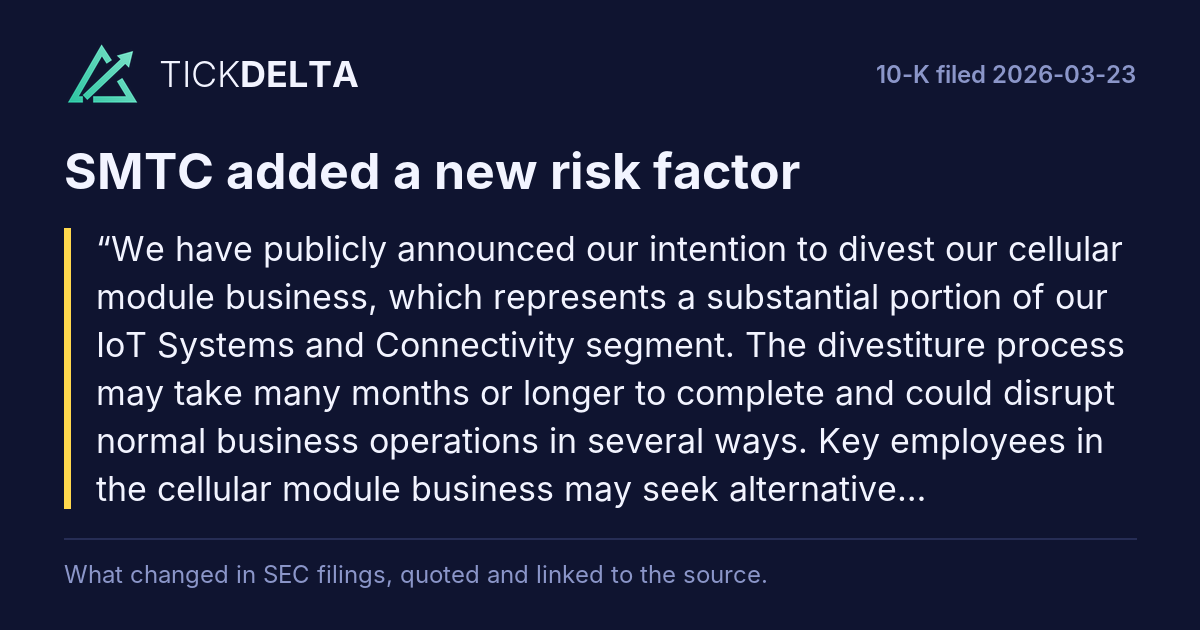
On August 13, 2026, we entered into a definitive agreement to sell our cellular module business to Compal. The cellular module business represents a substantial portion of our IoT Systems and Connectivity segment. The transaction is expected to close during the fourth quarter of our fiscal year 2027, but completion may be delayed beyond that period. The announcement and pendency of the divestiture may create uncertainty among employees, customers, suppliers and other business partners regarding the future of the cellular module business and our remaining operations. Key employees may seek alternative employment as a result, which could disrupt customer relationships and product development programs and cause us to incur additional retention costs.
Read in the 10-Qopen_in_new
Customers of our cellular module business may defer new design wins, accelerate qualification of alternative suppliers, shift business to competitors to reduce supply chain risk or cancel existing projects or programs that incorporate our products, which could reduce revenue and profitability prior to the closing. Suppliers and other business partners may similarly seek to modify or terminate their relationships with the cellular module business or with us as a result of the announcement or pendency of the divestiture.
Read in the 10-Qopen_in_new
Our senior management team and board of directors must devote substantial time and attention to the divestiture process, which could detract from our core semiconductor businesses and other strategic initiatives. In addition, the definitive agreement may restrict our ability to take certain actions with respect to the cellular module business pending completion of the divestiture without Compal’s consent, which could prevent us from pursuing business opportunities or responding effectively to competitive pressures and industry developments.
Read in the 10-Qopen_in_new
We may be unable to complete the divestiture, or may face delays in completing it, as a result of a failure to obtain required regulatory approvals or third-party consents in a timely manner or at all, the imposition of conditions on any such approval, a failure to satisfy the closing conditions contemplated by the definitive agreement, or adverse changes in general economic conditions. If the divestiture is not completed, we would have incurred significant transaction-related costs without realizing the anticipated benefits, and the adverse effects described above may nevertheless have occurred. We also may be subject to additional obligations or liabilities under the definitive agreement in connection with a termination of the transaction.
Read in the 10-Qopen_in_new
The cellular module business shares systems, facilities, personnel and other resources with our other businesses. Separating those resources and establishing standalone capabilities requires significant planning and investment prior to the closing and may result in additional costs and operational challenges following the closing. We may also be required to provide, or depend on Compal to provide, certain transition services for a period after the closing. Any failure to separate these operations successfully, or difficulties in providing or obtaining transition services, could disrupt our remaining operations. We may also retain certain liabilities associated with the cellular module business or incur liabilities under obligations related to the divestiture, any of which could adversely affect our financial condition. In addition, the consideration we receive may be less than the carrying value of the net assets of the cellular module business, and we may be required to record impairment or other charges in connection with the classification of the business as held for sale or the completion of the divestiture.
Read in the 10-Qopen_in_new
If the divestiture of our cellular module business is completed, our remaining operations will be more concentrated in certain semiconductor end markets and applications, potentially increasing the volatility of our operating results. We also may not realize the anticipated strategic, financial or other benefits of the divestiture, or such benefits may take longer to realize than expected. Any of the foregoing could have a material adverse effect on our business, financial condition and results of operations.
Read in the 10-Qopen_in_new
Item 6
thereto as subsidiary guarantors, the lenders party thereto, the letter of credit issuers party thereto, and Morgan Stanley Senior Funding,
Read in the 10-Qopen_in_new