SNASnap-on
- Employees
- 13,000
- Headquarters
- Kenosha, WI
- CEO
- Nicholas T. Pinchuk
- Next results
- around Feb 4, 2027
2 paragraphs in Risk Factors of the 10-K filed Feb 12, 2026 with nothing like them in the 10-K filed Feb 13, 2025. Quoted exactly. Paragraphs that were only edited are under 10-K change.
Compared with the Risk Factors in the latest 10-K of the other 81 Industrials companies: a paragraph with at least half its words the same at another company is called similar, and the companies are listed under it. A paragraph most of them have is marked boilerplate. No line means no other company has one like it. This counts text; it does not say how serious a risk is.
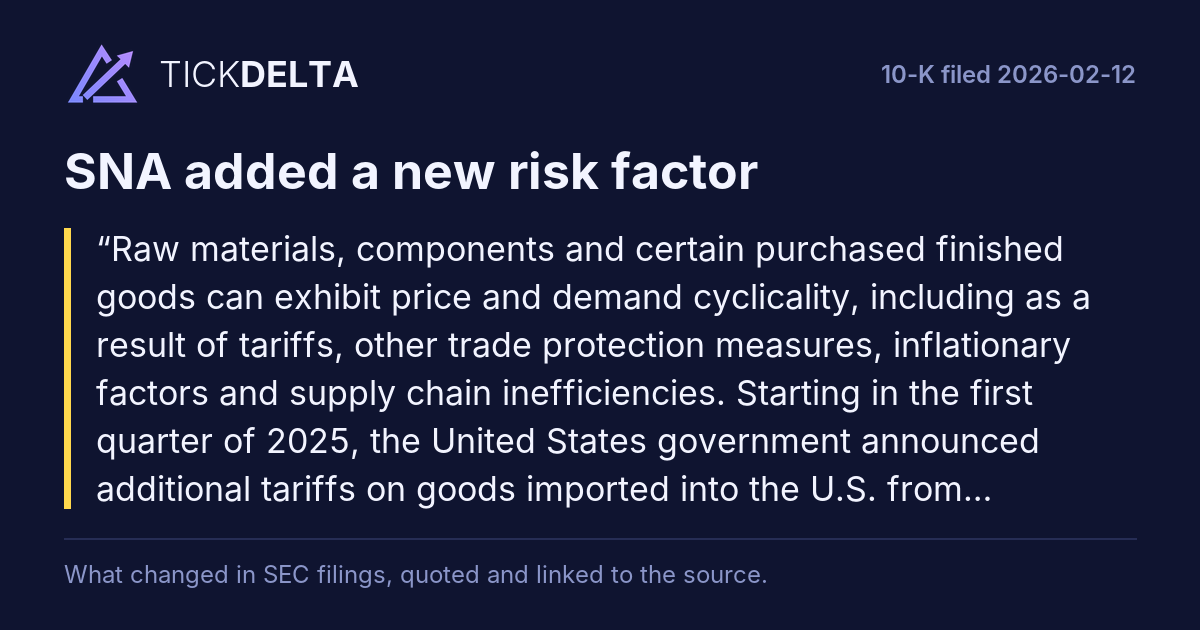
Raw materials, components and certain purchased finished goods can exhibit price and demand cyclicality, including as a result of tariffs, other trade protection measures, inflationary factors and supply chain inefficiencies. Starting in the first quarter of 2025, the United States government announced additional tariffs on goods imported into the U.S. from numerous countries and multiple nations countered with reciprocal tariffs and other actions in response. While Snap-on is relatively advantaged in the tariff environment, generally manufacturing products in the markets where they are sold, the company’s costs can be affected by trade policies. Unexpected variability associated with these and other factors has resulted, and in the future could result, in an increase in product costs and require Snap-on to increase prices or reduce costs to maintain margins.
Read in the 10-K ↗
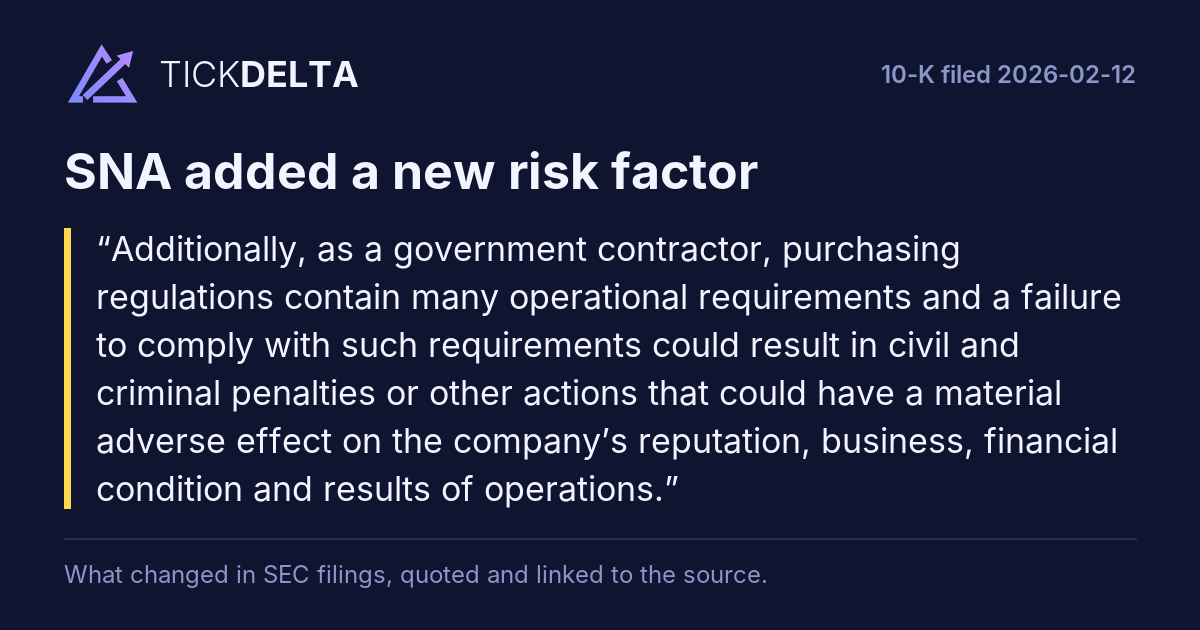
Additionally, as a government contractor, purchasing regulations contain many operational requirements and a failure to comply with such requirements could result in civil and criminal penalties or other actions that could have a material adverse effect on the company’s reputation, business, financial condition and results of operations.
Read in the 10-K ↗
New in the latest 10-Q
5 paragraphs in the 10-Q filed Oct 22, 2026 with nothing like them in the 10-Q filed Jul 23, 2026 (at least half the words must differ; new numbers alone do not count). Quoted exactly, grouped by the item heading above them. This is text that changed, not a judgement of how serious it is.
Financial statements and notes
Three Months Ended Nine Months Ended October 3, September 27, October 3, September 27,
Read in the 10-Q ↗
Three Months Ended Nine Months Ended October 3, September 27, October 3, September 27,
Read in the 10-Q ↗
Three Months Ended Nine Months Ended October 3, September 27, October 3, September 27,
Read in the 10-Q ↗
See Note 4, Receivables, for additional information on finance and contract receivables.
Read in the 10-Q ↗
Other information
In accordance with the disclosure requirement set forth in Item 408(a) of Regulation S-K, during the quarterly period ended
Read in the 10-Q ↗
The 10-Q's risk factors against the 10-K
Item 1A of the 10-Q filed Oct 22, 2026 against Item 1A of the 10-K filed Feb 12, 2026.
A 10-Q repeats only the risks that changed, so a 10-K paragraph that is missing from it is not counted as removed.
Added is a paragraph with nothing like it in the 10-K, Reworded a sentence that is in both with several words changed,
Quiet changes a sentence in both where one to four words changed and one is a hedge or a modal
(cut words struck through, new words highlighted and underlined).
Text on the page, not a score; each links to the filing at sec.gov.
This 10-Q has no Item 1A (Risk Factors) text of its own, so there is nothing to compare. Many companies leave it out when their risks have not changed.
Work on SNA in a spreadsheet:
Excel workbook (a sheet per section, ten years by column, charts, links to the filings) ·
CSV.
For a Google Sheet that stays up to date, paste =IMPORTDATA("https://tickdelta.com/company/SNA/export.csv") into a cell.