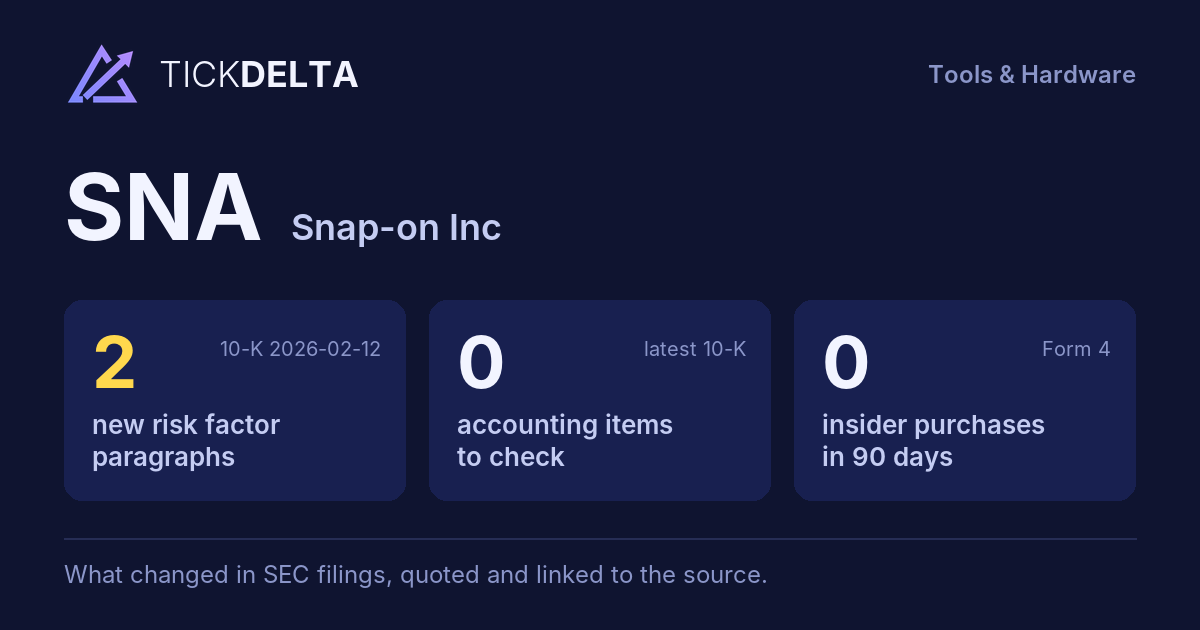
Screener / SEC EDGAR /CIK 0000091440 /10-K filed Feb 12, 2026, compared with Feb 13, 2025 /Numbers from the XBRL of the 10-Ks
NYSE Industrials · Tools & Hardware

Snap-on SNA

Compare with peers Embed
The 10-K against last year's

129 changes: 9 added, 7 removed, 113 reworded

10-K Feb 12, 2026 vs Feb 13, 2025

10-K 0000091440-26-000045 (Feb 12, 2026) vs 10-K 0000091440-25-000010 (Feb 13, 2025) Not compared: Accounting Policies.

The paragraph that changed most in each section

The redline

Marked against last year's 10-K: cut words struck through, new words highlighted.

MD&A219 words changed in this paragraph; it is 45% similar to last year's version.
Based on forward-looking capital market expectations, Snap-on selected an expected return on plan assets assumption for its U.S. pension plans of 7.5%, the same rate used in 2024, 2025, to be used in determining pension expense for 2025. In estimating 2026. The process for determining the domestic overall expected long-term return on plan assets, Snap-on utilizes assets begins by establishing long-term assumptions for core economic variables such as U.S. Gross Domestic Product (GDP) growth and inflation, and long-term assumptions for market variables such as interest rates, credit spreads, earnings growth, and equity valuations. When developing these variables, economic relationships and market histories are applied to a nominal returns forecasting method. For forecast of future conditions. In addition to this valuation component, the total return calculation also factors in fundamentals such as coupons, dividend yields and earnings growth, among others by each asset class, future returns are estimated by identifying the premium of riskier asset classes over lower risk alternatives. The methodology constructs expected returns using a “building block” approach to the individual components of total return. These forecasts are stated in both nominal and real (after inflation) terms. This process first considers the long-term historical return premium based on the longest set of data available for each respective asset class. These premiums, calculated using the geometric mean, are then adjusted based on current relative valuation levels, macro-economic conditions, and the expected alpha related to active investment management. The asset return assumption is also adjusted by any expected outperformance related to active investment management and an implicit expense load for estimated administrative and investment-related investment related expenses. Risk and correlation assumptions are developed based on historical analysis as well as an assessment of future conditions. Since asset allocation is a key determinant of expected investment returns, the current and expected mix of plan assets are also considered when setting the assumption.

Source: Item 7, 10-K 0000091440-26-000045 vs Item 7, 10-K 0000091440-25-000010

Risk Factors102 words changed in this paragraph; it is 73% similar to last year's version.
Snap-on’s supply of raw materials and purchased components are generally available from numerous suppliers, and the company continuously works to expand its supplier base to ensure availability. The principal raw material used in the manufacture of our products is steel, which we purchase in competitive, price-sensitive markets. To meet Snap-on’s high quality standards, a portion of our steel needs include specialized alloys, which are available only from a limited group of approved suppliers. Additionally, certain electronic components are sourced from a finite set of suppliers. Some of these specialized materials and components have been, and in the future may be, in short supply, particularly in the event of mill shutdowns or production cut backs. In addition, outbreaks of infectious diseases, weather events, armed conflicts, government actions (including those affecting trade) trade), armed conflicts, weather events, outbreaks of infectious diseases or other circumstances beyond our control could also impact the availability of raw materials and components. Physical risks of climate change may also impact the availability and cost of materials, sources and supply of energy and could also increase operating costs. Raw materials, components and certain purchased finished goods can exhibit price and demand cyclicality, including as a result of tariffs, other trade protection measures, inflationary factors, and supply chain inefficiencies. Associated unexpected variability has resulted, and in the future could result, in an increase in product costs and require Snap-on to increase prices or reduce costs to maintain margins.

Source: Item 1A, 10-K 0000091440-26-000045 vs Item 1A, 10-K 0000091440-25-000010

Legal Proceedings65 words changed in this paragraph; it is 72% similar to last year's version.
In the ordinary course of business, Snap-on is subject to legal disputes that are being litigated and/or settled. The accompanying Consolidated Statements of Earnings for the year ended January 3, 2026, include a benefit in “Operating expenses” of $ 22.0 million for the settlement of a legal matter (the “2025 legal settlement”). In addition, the accompanying Consolidated Statement of Earnings for the year ended December 28, 2024, include benefits a benefit in “Operating expenses” of $ 22.5 million million, for the final payments received associated with a separate legal matter; the final payments related to this matter were received in the three months ended June 29, 2024. (the “2024 legal payments”). Although it is not possible to predict the outcome of legal matters, management believes that the results of all legal matters will not have a material impact on Snap-on’s consolidated financial position, results of operations or cash flows.

Source: Item 3, via Note 15 – Commitments and Contingencies, 10-K 0000091440-26-000045 vs Item 3, via Note 15 – Commitments and Contingencies, 10-K 0000091440-25-000010

Sentences and paragraphs added, removed or reworded

Every change, by type

Sentences and paragraphs of SNA's Risk Factors and MD&A, 10-K Feb 12, 2026 against 10-K Feb 13, 2025. Each links to the text at sec.gov.

AddedRisk Factors
Raw materials, components and certain purchased finished goods can exhibit price and demand cyclicality, including as a result of tariffs, other trade protection measures, inflationary factors and supply chain inefficiencies. Starting in the first quarter of 2025, the United States government announced additional tariffs on goods imported into the U.S. from numerous countries and multiple nations countered with reciprocal tariffs and other actions in response. While Snap-on is relatively advantaged in the tariff environment, generally manufacturing products in the markets where they are sold, the company’s costs can be affected by trade policies. Unexpected variability associated with these and other factors has resulted, and in the future could result, in an increase in product costs and require Snap-on to increase prices or reduce costs to maintain margins.
Read it in 10-K Feb 12, 2026 at sec.gov
AddedRisk Factors
Additionally, as a government contractor, purchasing regulations contain many operational requirements and a failure to comply with such requirements could result in civil and criminal penalties or other actions that could have a material adverse effect on the company’s reputation, business, financial condition and results of operations.
Read it in 10-K Feb 12, 2026 at sec.gov
AddedMD&A
•Enhancing the franchise network, where we continued to focus on raising franchisee productivity and improving coverage, increasing new product introductions, and refining the selling process with programs to amplify the power of our mobile van channel;
Read it in 10-K Feb 12, 2026 at sec.gov
AddedMD&A
•Further extending to critical industries, where we continued targeting places where tasks require repeatability and reliability, building a deep understanding of the work, and providing specialized productivity solutions for critical activities; and
Read it in 10-K Feb 12, 2026 at sec.gov
AddedMD&A
Snap-on’s 2025 fiscal year contained 53 weeks of operating results with the extra week occurring in the fourth quarter. Snap-on’s 2024 and 2023 fiscal years each contained 52 weeks of operating results. The impact of the additional week of operations in fiscal 2025 was not material to Snap-on’s full year or fourth quarter total revenues or net earnings.
Read it in 10-K Feb 12, 2026 at sec.gov
AddedMD&A
As disclosed in Part I, Item 1A: Risk Factors, the company’s business is subject to risks related to, among other factors, tariffs and additional trade protection measures put in place by the United States or other countries, as well as U.S. international trade relations, including those with China, Canada, the European Union and other nations. Starting in the first quarter of 2025, the United States government announced additional tariffs on goods imported into the U.S. from numerous countries and multiple nations countered with reciprocal tariffs and other actions in response. While the company is relatively advantaged in the tariff environment, generally manufacturing products in the markets where they are sold, its costs can be affected by trade policies. In that regard, in the fourth quarter and for the year ended January 3, 2026, Snap-on mitigated the effects of incremental tariffs.
Read it in 10-K Feb 12, 2026 at sec.gov
AddedMD&A
The effects of the benefits from the 2025 legal settlement and the 2024 legal payments (collectively, the “legal items”) were included in operating expenses, operating earnings before financial services, and operating earnings in 2025 and 2024, respectively.
Read it in 10-K Feb 12, 2026 at sec.gov
Show the other 1
AddedMD&A
During the fourth quarter of 2025, Snap-on refined its footprint and aspects of its go-to-market strategy within the Commercial & Industrial Group. These activities included the sale of a building for a net gain of $15.9 million, the retirement of certain trademarks at a cost of $8.9 million, and restructuring charges of $2.5 million (collectively, the “2025 footprint actions”). The 2025 footprint actions resulted in a net benefit to operating expenses of $4.5 million.
Read it in 10-K Feb 12, 2026 at sec.gov

Sources

The two latest 10-Ks on EDGAR, section by section. Each change links to the text at sec.gov.

Also

New risk factors: paragraphs with nothing like them last year, quoted in full.

Work with it

Excel workbook · CSV. Google Sheet that stays up to date: paste =IMPORTDATA("https://tickdelta.com/company/SNA/export.csv") into a cell.

Next:Related parties