Snap Inc SNAP
New risk paragraphs, branching off last year
Each branch is a paragraph in Risk Factors with nothing like it in the 10-K filed Feb 5, 2025. A box jumps to the paragraph as filed, below.
Paragraphs with nothing like them in last year's 10-K
22 paragraphs in Risk Factors of the 10-K filed Feb 5, 2026 with nothing like them in the 10-K filed Feb 5, 2025. Quoted exactly. Paragraphs that were only edited are under 10-K change.
continue to increase as our user base and user engagement grows and may seriously harm our business if we are unable to grow our revenues faster than the cost of utilizing the services of Google Cloud, AWS, or similar providers.
We may not be successful in our strategy and investments for our physical products, which could seriously harm our business. We believe in computing that naturally integrates our digital experience with the physical world. We are investing in the future of augmented reality, and in 2025 we announced that we would release our next generation of Spectacles in 2026. We expect that our strategy for and investments in our physical products, including wearables and our firmware and operating system, will continue to be a complex, evolving, and a long-term initiative that will involve the development of new and emerging technologies, including reliance on and collaboration with developers and partners. However, this ecosystem may not develop at pace with our expectations, and market acceptance and adoption of features, products, and services we build, or expect to build, is uncertain. We also regularly evaluate our product roadmaps and make strategic shifts as our understanding of the technological challenges and market landscape evolve. In addition, we have limited experience with consumer hardware products, which may allow other companies to compete more effectively than us.
We may be unsuccessful in our research and product development efforts, including if we are unable to develop relationships with key participants in the augmented reality ecosystem or to develop products that operate effectively with adjacent technologies, products, systems, networks, or standards. Our efforts in our physical products may also divert resources and management attention from other parts of our business. We expect to continue to make significant investments in augmented reality and other related technologies to support these efforts, and our ability to support these efforts is dependent on other parts of our business. In addition, as these initiatives evolve, we may be subject to a variety of current or new laws and regulations in the U.S. and internationally, including in the areas of privacy, security, safety, ecodesign, AI, competition, content regulation, tariffs, export controls, consumer protection, and e-commerce, which may delay or impede the development of our products and services, increase our operating costs, require significant management attention, or otherwise seriously harm our business. These may also include consumer finance regulation and other consumer protection laws that inhibit our ability to implement our preferred distribution models for our physical products in some countries. As a result of these and other factors, our strategy for and investments in our physical products, including wearables, may not be successful in the foreseeable future, or at all, which could seriously harm our business.
Our ability to generate non-advertising revenue depends on retaining, expanding, and effectively monetizing our total user base, including by increasing the number of subscribers to Snapchat+ and finding ways to monetize our other products and services. We must convince prospective subscribers of the benefits of Snapchat+ and our existing subscribers of the continuing value of Snapchat+. Our ability to attract new subscribers, retain existing subscribers, and engage active subscribers depends in large part on our ability to continue to maintain, improve, and introduce new features available on Snapchat+. We may in the future adjust our subscription pricing and plans which may not be well-received by our community and could negatively impact our ability to attract and retain subscribers or generate revenue. If we fail to offer compelling product offerings with competitive pricing that users perceive to be of value, our ability to grow or sustain the reach of Snapchat+, attract and retain subscribers, and monetize our products and services may be adversely affected. In
addition, our efforts to create other non-advertising revenue products and services may not be successful and may seriously impact our business.
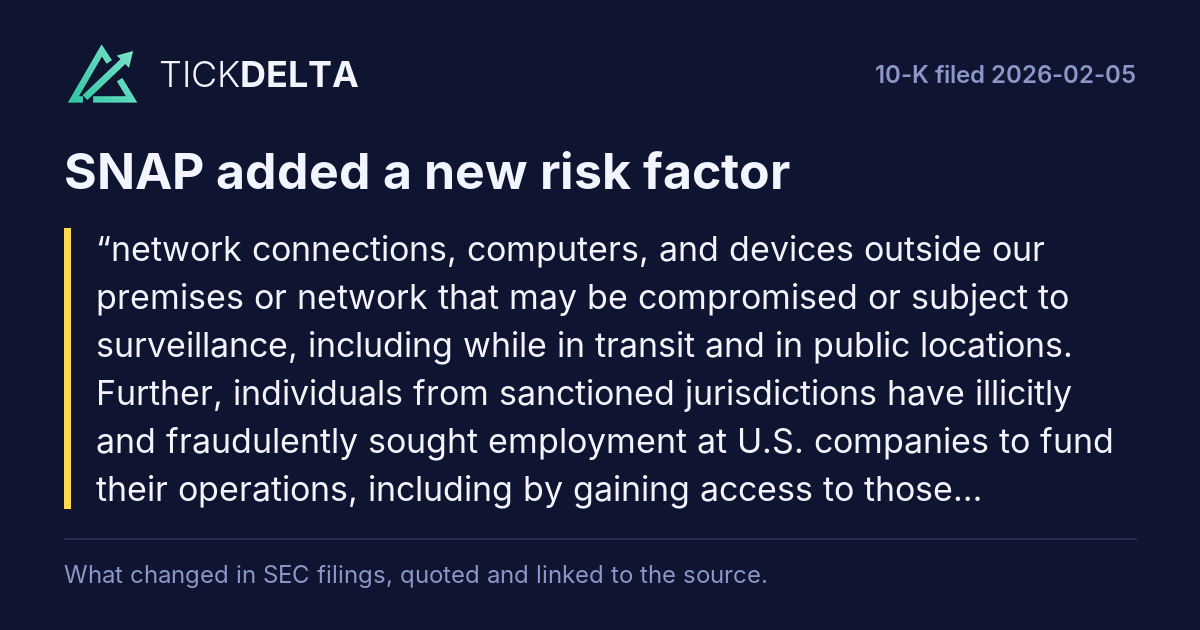
network connections, computers, and devices outside our premises or network that may be compromised or subject to surveillance, including while in transit and in public locations. Further, individuals from sanctioned jurisdictions have illicitly and fraudulently sought employment at U.S. companies to fund their operations, including by gaining access to those companies’ sensitive information or anything else of monetary value. While we maintain various measures designed to prevent this from occurring, if we were found to have willfully or knowingly employed any such individuals, we could face criminal liability.
Show the other 11
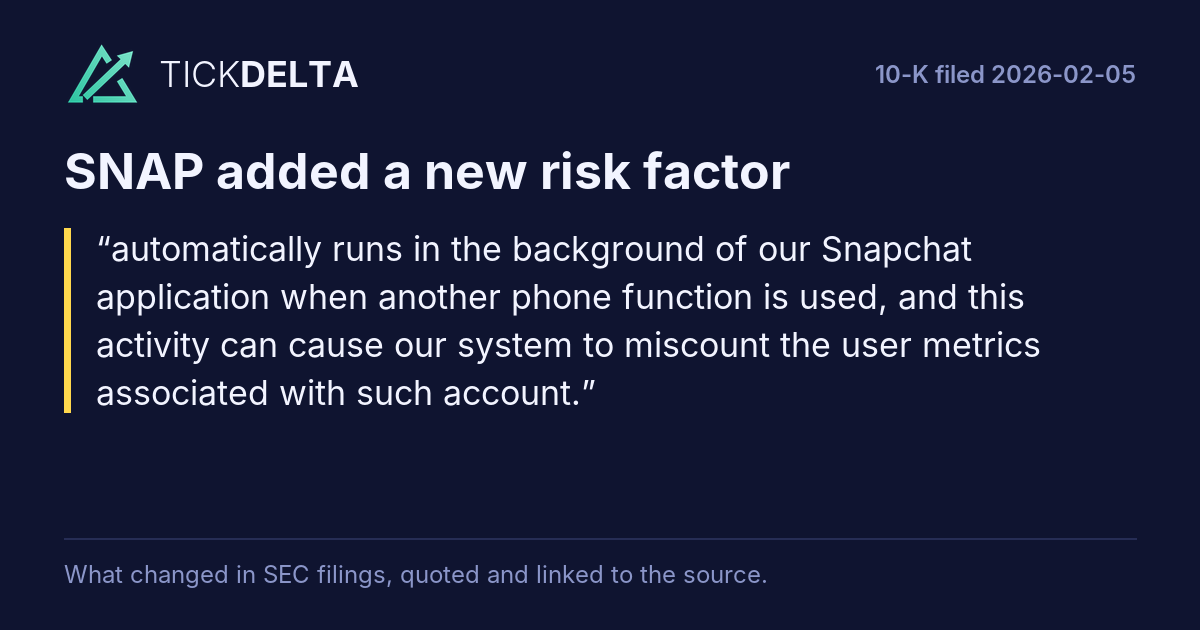
automatically runs in the background of our Snapchat application when another phone function is used, and this activity can cause our system to miscount the user metrics associated with such account.
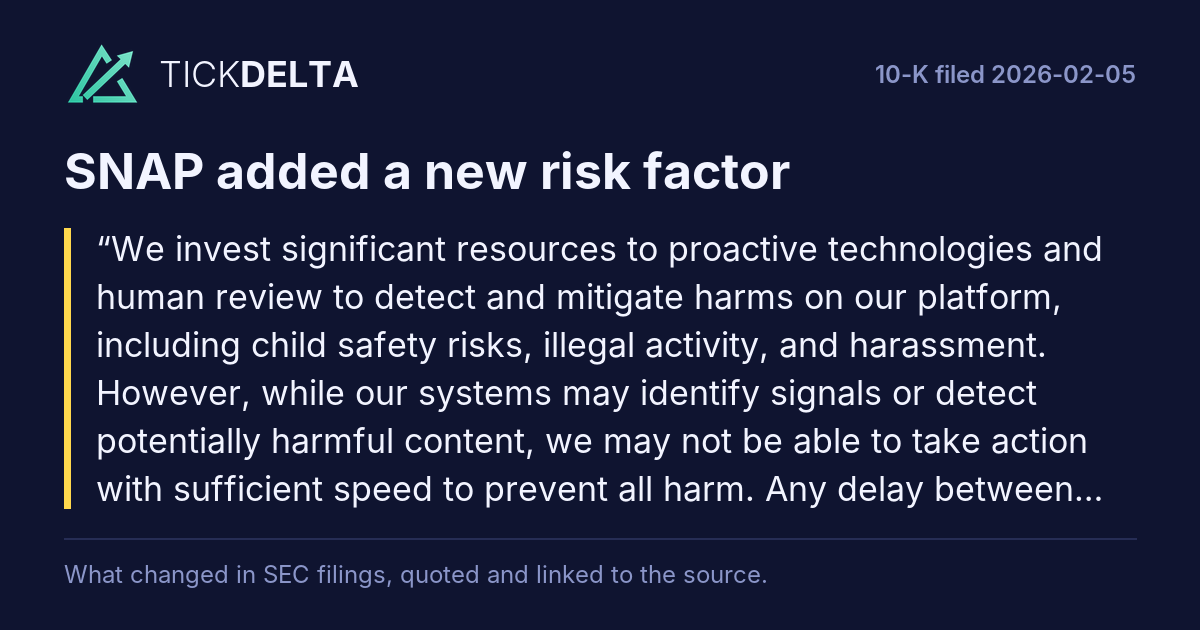
We invest significant resources to proactive technologies and human review to detect and mitigate harms on our platform, including child safety risks, illegal activity, and harassment. However, while our systems may identify signals or detect potentially harmful content, we may not be able to take action with sufficient speed to prevent all harm. Any delay between detection and action could expose our users to risk and subject us to increased legal and regulatory scrutiny. Furthermore, in our attempt to rapidly mitigate harms, we may make mistakes, such as erroneously removing legitimate content or disabling the accounts of users who have not violated our policies. Such actions can frustrate our users and harm our reputation.
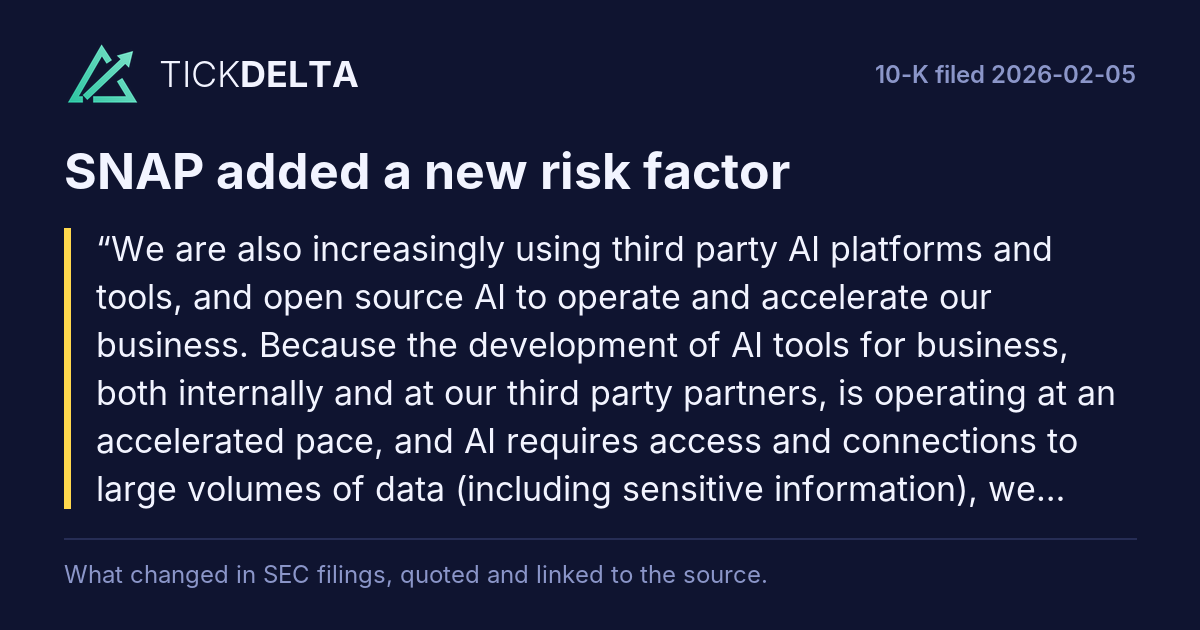
We are also increasingly using third party AI platforms and tools, and open source AI to operate and accelerate our business. Because the development of AI tools for business, both internally and at our third party partners, is operating at an accelerated pace, and AI requires access and connections to large volumes of data (including sensitive information), we could experience misconfigurations, errors, bug, vulnerabilities, privacy incidents, security incidents, and AI-specific risks like prompt injection, all of which could result in litigation, regulatory investigations, or enforcements, and require us to expend significant resources, all of which could seriously harm our business. There is also no guarantee that these AI platforms and tools will provide the intended benefits to our business.
•modifications or changes to our products and services by us, our partners, or other companies in our industry because of new and proposed laws and regulations, corporate strategy, or litigation;
Providing our products to our users is costly, and we expect our expenses, including those related to people, research and development, and hosting, to grow in the future. This expense growth will continue as we broaden our user
As discussed in these risk factors, substantially all of our network infrastructure is provided by third parties, including Google Cloud and AWS. We also rely on third parties for other technology related services, including certain AI functions. For example, in December 2025, we entered into a strategic partnership to integrate Perplexity’s conversational AI search engine into our platform. This and other third-party integrations subject us to several operational and financial risks, particularly as our partners’ ability to scale their infrastructure to meet the demands of our global community remains unproven. If Perplexity or other third-party AI providers experience service outages, significant latency, or otherwise fail to scale their systems to meet our traffic demands, users may experience a degraded version of our products and services, which could result in a negative user experience, decreased engagement, and a loss of trust. Furthermore, our ability to recognize revenue from such partnerships may be contingent on specific milestones and actions taken by us and our partners that may be outside of our direct control. These steps may not materialize as expected, on our projected timeline, or at all. In addition, if these partners do not meet their contractual obligations, alter or terminate arrangements, fail to pay, or if our relationships with such partners deteriorate, our business could be seriously harmed. Even if these milestones are reached and the revenue recognized, the integrated features may not deliver the experience we or our community expect. Any disruption or failure in the services we receive from these providers, including as a result of financial or other difficulties faced by these providers, could seriously harm our business.
enforcement actions, which could require additional financial and management resources, any may result in costly sanctions against our company.
Additionally, we may be subject to evolving regulations regarding advertising, particularly those concerning minors, which vary across jurisdictions. In the U.S., the FTC and other regulators enforce strict standards against deceptive or unfair commercial practices. The future evolution of our advertising products may increase our exposure to regulatory scrutiny. If we are unable to implement models that comply with the diverse regulations in every jurisdiction, and if users disagree with our advertising policies, our brand and reputation may be harmed.
Any violation of existing or future regulatory orders or consent decrees, or new regulatory investigations or proceedings, could subject us to substantial monetary fines and other penalties that could seriously harm our business.
For example, we may be, and other companies currently are, the subject of litigation in the United States and elsewhere alleging copyright infringement in connection with the acquisition, distribution, and use of copyrighted materials for AI training as well as potential reproduction of copyrighted materials in AI outputs. There can be no assurances that favorable final outcomes (e.g., that such actions will be considered fair use) will be obtained in these cases. In addition, plaintiffs may seek, and we may become subject to, preliminary or provisional rulings in the course of any such litigation, including potential preliminary injunctions requiring us to change or cease related features, functionalities, products, or services. We may decide to settle such lawsuits and disputes on terms that are unfavorable to us. Similarly, if any litigation to which we are a party is resolved adversely, we may be subject to an unfavorable judgment that may not be reversed upon appeal. The terms of such a settlement or judgment may require us to change or cease some or all of our operations or pay substantial amounts to the other parties, including statutory damages to large numbers of copyright holders.
We believe we have meritorious defenses to these lawsuits, and plan to defend them vigorously, but litigation is inherently uncertain and an unfavorable outcome, including substantial potential damages, penalties, fines and injunctive
•make it difficult to obtain favorable terms for any necessary future financing for working capital, capital expenditures, debt service requirements, or other purposes;
•adversely affect our liquidity and result in a material adverse effect on our financial condition upon repayment of the indebtedness;
•require us to dedicate a substantial portion of our cash flow from operations to service and repay the indebtedness, reducing the amount of cash flow available for other purposes;
•increase our vulnerability to the impact of adverse economic conditions, including rising interest rates (which can make refinancing existing indebtedness more difficult or costly); and
•negatively impact our credit rating, which could limit our ability to obtain additional financing in the future and adversely affect our business.
Paragraphs in the 10-Q filed Nov 5, 2026 that were not in the one before
New in the latest 10-Q
38 paragraphs in the 10-Q filed Nov 5, 2026 with nothing like them in the 10-Q filed Aug 4, 2026 (at least half the words must differ; new numbers alone do not count). Quoted exactly, grouped by the item heading above them. This is text that changed, not a judgement of how serious it is.
10-Q
Beginning with our Quarterly Report on Form 10-Q to be filed for the first quarter of 2027, we plan to transition to global MAU as our primary audience metric. This change will include the replacement of global DAU with global MAU, as well as the discontinuation of regional DAU and regional ARPU. While DAU remains an important measure of engagement, we no longer believe it is the best primary measure of long-term value. MAU represents the scale of our community, while engagement and monetization metrics reflect the depth and value of our service. Daily engagement has historically been stable as a percentage of monthly engagement, but we do not intend to optimize Snapchat around daily use at the expense of long-term value for our community. A longer-term horizon better aligns our reported metrics with the product and safety decisions that strengthen relationships, create lasting utility, and support broader, more durable audience growth. Alongside global MAU, we are introducing global MAU-based ARPU as our primary monetization metric. The following describes these user metrics both prior to and after our planned transition.
Read in the 10-Q
We define a Monthly Active User, or MAU, as a registered and logged-in Snapchat user who visits Snapchat through our applications or websites at least once during the 30-day period ending on the calendar month-end. We calculate average MAUs for a particular quarter by calculating the average of the MAUs as of each calendar month-end in that quarter. Beginning in the first quarter of 2027, we plan to update the definition of MAU to include any registered and logged-in Snapchat user who visits at least one Snapchat-branded product through our applications or websites, which under the updated definition will include users who access our products through Apple Watch. Historically, MAU attributable to Apple Watch users has not been material. Additionally, beginning in the first quarter of 2027, MAU will be calculated using activity during the last 30 days of the quarter. Accordingly, reported quarterly MAU will represent the number of active users as of quarter end rather than an average of monthly active users during the quarter. We believe this measurement period provides a more current view of our trajectory and improves comparability with peers. The impact of these changes to our historical MAU definition would have resulted in a less than 1% change to our historical MAU in the third quarter of 2026 and would have resulted in similarly immaterial changes in our historical MAUs in each quarter from the first quarter of 2024 to the second quarter of 2026.
Read in the 10-Q
Financial statements and notes
In August 2026, the 2026 Capped Call Transactions expired in connection with the maturity of the 2026 Notes. As of September 30, 2026, the remaining Capped Call Transactions were out-of-the-money.
Read in the 10-Q
On June 9, 2026 and September 7, 2026, two Dutch claim foundations filed related collective actions against Snap in the Amsterdam District Court purportedly on behalf of Snapchat users in the Netherlands, with one foundation also asking the court to allow users across the European Union to opt into the proceedings. The lawsuits allege violations of European Union and Dutch privacy, digital services, artificial intelligence, consumer protection, product liability, tort, and other laws, including in connection with personalized advertising, allegedly addictive features, minor safety, allegedly illegal content, and our My AI chatbot. The lawsuits seek declaratory and injunctive relief and monetary damages.
Read in the 10-Q
• Common shares outstanding was 1,718 million as of September 30, 2026, compared to 1,711 million as of September 30, 2025.
Read in the 10-Q
Show the other 33
• Total common shares outstanding plus shares underlying stock-based awards was 1,932 million as of September 30, 2026, compared to 1,861 million as of September 30, 2025.
Read in the 10-Q
ecosystem, our customers and their budgets with us, user engagement, other user metrics, and our business, financial condition, and results of operations.
Read in the 10-Q
In the first quarter of 2027, among other changes to our user metrics, we plan to transition to global MAU as our primary audience metric. For a description of these changes, see the “Note Regarding User Metrics and Other Data” included elsewhere in this Quarterly Report on Form 10-Q.
Read in the 10-Q
underlying trends in our business that could otherwise be masked by the effect of the expenses that we exclude in Adjusted EBITDA.
Read in the 10-Q
(1) Stock-based compensation expense and depreciation and amortization expense may not agree to reported GAAP amounts due to restructuring charges.
Read in the 10-Q
Risk Factors
As our business and the ways in which users engage with our platform evolve, we may change or supplement the user metrics we use to evaluate our performance. These changes may include changes to the definitions or calculation methods for DAUs or MAUs, the measurement period, the Snapchat-branded surfaces included in the metrics, or the methodology used to attribute users to geographic regions. In connection with our planned transition to global MAU as our primary audience metric beginning with the first quarter of 2027, these changes may cause our reported metrics, growth rates, and regional trends to differ from previously reported amounts and may make period-over-period comparisons more difficult.
Read in the 10-Q
If we report both existing and revised user metrics during a transition period, investors, advertisers, and other stakeholders may interpret the metrics differently or reach different conclusions about our operating performance. If we modify or discontinue regional user metrics, analysts may also rely on third-party or other indirect estimates that may not be comparable to our reported metrics, which could make it more difficult to evaluate regional engagement and monetization.
Read in the 10-Q
If MAU is measured based on user activity during only the final 30 days of a quarter, that measurement period may not capture user engagement throughout the full quarter. Service outages, connectivity issues, product launches, holidays, seasonality, or other unusual events during that period could cause reported MAU to be unrepresentative of underlying engagement and make period-over-period comparisons more difficult.
Read in the 10-Q
future. Most advertisers do not have long-term advertising commitments with us, and our efforts to establish long-term commitments may not succeed.
Read in the 10-Q
Furthermore, in April 2021, Apple issued an iOS update that imposed heightened restrictions on our access and use of user data by allowing users to more easily opt-out of tracking of activity across devices. Additionally, Google has in the past implemented privacy controls on its Android devices and may in the future make changes to those privacy controls
Read in the 10-Q
• changes in the definitions, measurement periods, geographic attribution, or included surfaces used for our audience metrics that make historical, regional, or advertiser comparisons more difficult;
Read in the 10-Q
products and features to function with the variety of existing mobile operating systems, hardware, and standards, impacting the popularity of such products, and we expect this trend to continue.
Read in the 10-Q
interruption in the services provided to us, could lead to a decline in user engagement, which could seriously harm our business.
Read in the 10-Q
sufficient revenue, operating margin, or other value to justify our investments, any of which may seriously harm our business in the short-term, long-term, or both.
Read in the 10-Q
As we expand our physical-products strategy, including through SPECS physical stores and other retail spaces, we may face risks associated with constructing, operating and leasing physical retail locations, including customer, employee, or visitor injuries; property damage; security or safety incidents; lease and landlord obligations; inventory risks; and compliance with building, accessibility, health and safety, and other applicable requirements. These risks could result in liability, litigation, insurance claims, repair or remediation costs, and reputational harm.
Read in the 10-Q
reputation may be seriously harmed. Our advertisers and partners may also be less willing to allocate their budgets or resources to Snapchat, which could seriously harm our business. In addition, we calculate average DAUs for a particular quarter by adding the number of DAUs on each day of that quarter and dividing that sum by the number of days in that quarter, and we calculate average MAU for a particular quarter by calculating the average of the MAUs as of each calendar month-end in that quarter. These calculations may mask any individual days or months within the quarter that are significantly higher or lower than the quarterly average. Beginning in the first quarter of 2027, we will calculate MAU based on user activity during only the final 30 days of a quarter, and that measurement period may not capture user engagement throughout the full quarter.
Read in the 10-Q
Under certain of these laws, we could face temporary or definitive bans on data processing and other corrective actions, substantial monetary fines, or private litigation related to processing of personal data brought by classes of data subjects or consumer protection organizations authorized to represent their interests. The transfer of personal data continues
Read in the 10-Q
some instances, provide for civil penalties and a private right of action for violations, which may increase the likelihood and cost of regulatory actions and litigation under these laws, and could seriously harm our business.
Read in the 10-Q
We have failed and in the future may fail, or be perceived to have failed, in our efforts to comply with our privacy, security, and data protection obligations. Moreover, despite our efforts, our personnel or third parties with whom we work have failed and may in the future fail to comply with such obligations, which could negatively impact our business operations. If we or the third parties on which we rely fail, or are perceived to have failed, to address or comply with
Read in the 10-Q
engagement and our business may be seriously harmed. In addition, we may expend significant resources to launch new products that we are unable to monetize, which may seriously harm our business.
Read in the 10-Q
Providing our products to our users is costly, and we expect our expenses, including those related to people, research and development, and hosting, to grow in the future. This expense growth will continue as we broaden our user
Read in the 10-Q
service, we could incur liability or be required to make significant changes to our products, business practices, or operations, and our business could be seriously harmed.
Read in the 10-Q
Some of our competitors are involved in similar lawsuits and have been subject to liability verdicts at the trial court level and entered into significant settlements.
Read in the 10-Q
In August 2026, Meta entered into a settlement with a coalition of state attorneys general, as well as a parallel settlement with the Texas attorney general, involving minimum payments of over $12 billion (and potentially over $18 billion if certain industry contingencies are met) as well as significant restrictions on the design, features and operation of Facebook and Instagram, including requirements relating to age verification, time limits, notifications and other features intended to address alleged harms to minors. Certain terms of the settlement are intended to establish standards to be adopted more broadly across the social media industry, including through potential settlements with other companies.
Read in the 10-Q
If Snap were subject to similar verdicts or settlements, we could be required to make substantial monetary payments and/or agree to significant changes to Snapchat, including requirements similar to those imposed on Meta. These requirements could limit our ability to develop, offer or monetize certain products and services, require significant changes to our existing products and services, increase our compliance and operating costs, reduce user engagement and adversely affect our ability to attract and retain users and advertisers. Our financial resources are substantially more limited than Meta’s, and unfavorable outcomes could seriously harm our business. Additionally, the actions of certain participants in our industry may encourage or affect legal proceedings against us or cause us to reconsider our litigation strategies.
Read in the 10-Q
Restrictions may not apply uniformly across the industry or to all competing products and services, which could place us at a competitive disadvantage relative to companies or products or services not subject to comparable requirements. We cannot reliably predict whether or when we and/or others in our industry will become subject to such verdicts or settlements, or the nature or scope of any resulting obligations.
Read in the 10-Q
U.S. dollar, these impacts may become material. In addition, as our international operations and sales continue to grow, we are subject to a variety of risks inherent in doing business internationally, including:
Read in the 10-Q
if we are subject to enforcement actions such as fines, civil penalties, injunctions, mandatory product recalls, or failure to obtain regulatory clearances or approvals.
Read in the 10-Q
The Convertible Notes are convertible at the option of the holder. In the event the conditions for optional conversion of the Convertible Notes due in 2027, 2028, or 2030 are met before the close of business on the business day
Read in the 10-Q
These exclusive forum provisions may limit a stockholder’s ability to bring an action in a judicial forum that it finds favorable for disputes with us or our directors, officers, or other employees, which may discourage lawsuits against us
Read in the 10-Q
Other information
On November 4, 2026, the Compensation Committee of our board of directors approved an amendment to our 2017 Equity Incentive Plan (the “2017 Plan”) to increase the number of shares of our Class A common stock available for award grants under the 2017 Plan by 45,000,000 shares (the “Share Reserve Increase”). A description of the material features of the 2017 Plan is set forth in Part III, Item 11 of our Annual Report on Form 10-K for the year ended December 31, 2025 filed with the Securities and Exchange Commission on February 5, 2026 under the heading “Employee Benefit Plans - 2017 Equity Incentive Plan,” which description is incorporated herein by reference.
Read in the 10-Q
The Share Reserve Increase was also approved by written consent on November 4, 2026 by holders of an aggregate of 231,626,943 shares of our Class C common stock, representing an aggregate of over 99% of the voting power of our outstanding capital stock.
Read in the 10-Q
Item 6
10.1+ Employment Agreement, by and between Snap Group Limited Singapore Branch and Ronan Harris, dated September 22, 2026.
Read in the 10-Q
The 10-Q's risk factors against the 10-K
Item 1A of the 10-Q filed Nov 5, 2026 against Item 1A of the 10-K filed Feb 5, 2026.
A 10-Q repeats only the risks that changed, so a 10-K paragraph that is missing from it is not counted as removed.
Added is a paragraph with nothing like it in the 10-K, Reworded a sentence that is in both with several words changed,
Quiet changes a sentence in both where one to four words changed and one is a hedge or a modal
(cut words struck through, new words highlighted).
Text on the page, not a score; each links to the filing at sec.gov.
Show the other 20
The first 25 of 111 are shown (at most 12 of each type).
Phrases used for the first time
Two-word phrases in Risk Factors of the 10-K filed Feb 5, 2026 that are in none of the 1 earlier 10-Ks stored, back to Feb 5, 2025
Where each one is used
- retaliatory countermeasures: Our advertising customers range from small businesses to well-known brands, including advertising resellers. Many of our customers spend a relatively small portion of their overall advertising budget with us, but some customers have devoted meaningful budgets that contribute more significantly to our total revenue....
- senior notes: Operating our business requires a significant amount of cash, and we may not have sufficient cash flow from our business to pay the senior notes and convertible senior notes, and any other debt when due, which may seriously harm our business.
- fluctuating interest: •the political, economic, and macroeconomic climate and the status of the advertising industry in general, including impacts related to labor shortages and disruptions, supply chain disruptions, banking instability, tariffs and retaliatory countermeasures implemented by the United States or other governments,...
- action lawsuits: From time to time, we are involved in class action lawsuits and other litigation matters that are expensive and time-consuming and could seriously harm our business.
- securities class: Similarly, because we have a large number of stockholders, class action lawsuits on securities theories typically claim enormous monetary damages in the aggregate even if the alleged loss per stockholder is small. For example, in November 2021, we, and certain of our officers, were named as defendants in a...
- inflation fluctuating: •the political, economic, and macroeconomic climate and the status of the advertising industry in general, including impacts related to labor shortages and disruptions, supply chain disruptions, banking instability, tariffs and retaliatory countermeasures implemented by the United States or other governments,...
- action litigation: Laws and regulations focused on privacy, security, and data protection, including data breach notification laws, personal data privacy laws, consumer protection laws, wiretapping laws, invasion of privacy laws, and other similar laws have imposed obligations on companies that collect personal data, including...
- notes due: Our ability to make principal or interest payments on, or to refinance our senior notes due in 2033 and 2034, or collectively, the Senior Notes, and our convertible senior notes due in 2025, 2026, 2027, 2028, and 2030 (collectively, the Convertible Notes, and together with the Senior Notes, the Notes) and any other...
Used at least twice, small words left out. Counted, not picked: a phrase can be new because the company renamed something.
What was taken out
11 paragraphs of last year's Risk Factors with nothing like them now. The longest are quoted.
Sources
Item 1A of each 10-K and 10-Q on EDGAR, quoted exactly. Each paragraph links to the filing at sec.gov.
Also
10-K change: what was reworded or cut, section by section.
Work with it
Excel workbook · CSV. Google Sheet that stays up to date: paste =IMPORTDATA("https://tickdelta.com/company/SNAP/export.csv") into a cell.