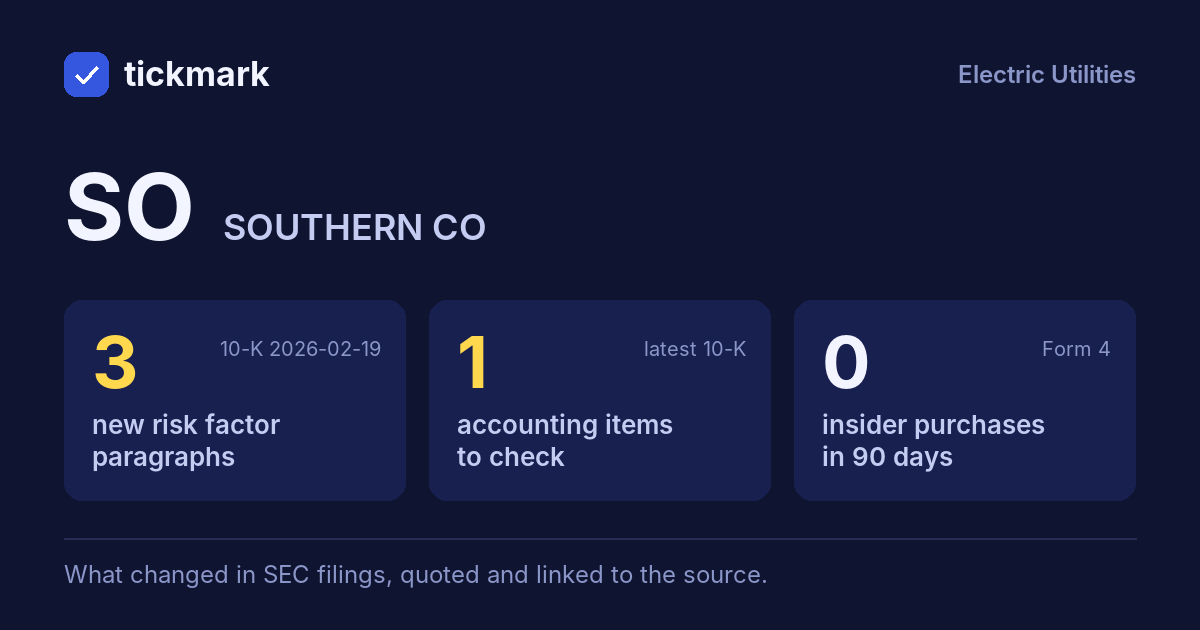
Marked against last year's 10-K:
cut words struck through, new words highlighted and underlined.
MD&A 322 words changed in this paragraph; it is 37% similar to last year's version.
On In May 9, 2024, the EPA published the final GHG rules (2024 GHG Rules) to establish GHG emissions standards for existing fossil fuel-fired steam electric generating units and new fossil fuel-fired combustion turbines and combined cycle generation facilities, which requires facilities. The 2024 GHG limits for subcategories of both new and existing units. The new rules Rules do not include standards for existing fossil fuel-fired combustion turbines and or combined cycle generation facilities, which have been deferred to a future rulemaking. Requirements for facilities. Under the 2024 GHG Rules, existing coal-fired units are based on technologies such as carbon capture and sequestration (CCS) and natural gas co-firing. States have 24 months after the rule's publication to submit state plans for existing units. The rule allows states to consider remaining useful life and other factors to specify alternative, unit-specific emissions limits and compliance timelines for existing units, as needed to address reliability and other concerns. Existing source compliance will for steam generating units would begin as early as January 1, 2030, depending on the subcategory. The final rule incorporates some limited reliability mechanisms including a provision subcategory for short-term grid emergencies the affected unit, and a "reliability assurance mechanism" that allows for a one-time, up to one year, extension of existing coal unit retirement dates specified in an approved state plan. The the standards for new combustion turbines and combined cycles include subcategories for low, intermediate, and base load operations. Compliance with new source standards begins when the unit comes online, with requirements for CCS carbon capture and sequestration (CCS) beginning on January 1, 2032. The EPA also simultaneously repealed the Affordable Clean Energy rule. Numerous industry groups, electric generators, and states have filed petitions for review challenging the rule in the U.S. Court of Appeals for the D.C. Circuit. A total of eight stay motions were filed seeking a stay of the rule pending judicial review, which were denied by the U.S. Court of Appeals for the D.C. Circuit on July 19, 2024. On February 5, 2025, the EPA filed a motion in the U.S. Court of Appeals for the D.C. Circuit requesting a 60-day abeyance of the challenges so that the new Trump Administration can determine how to proceed with the litigation. On October 16, 2024, the U.S. Supreme Court denied emergency stay applications filed by numerous industry groups, electric generators, and states. The ultimate impact of the final rules and associated legal matters cannot be determined at this time; however, it may result in significant compliance costs.
Source: Item 7, 10-K 0000092122-26-000006 vs Item 7, 10-K 0000092122-25-000018
Risk Factors 310 words changed in this paragraph; it is 40% similar to last year's version.
The traditional electric operating companies are experiencing projected demand that significantly exceeds recent experience, creating the need for new power generating resources and transmission facilities. The majority of this demand is driven by the power needs and projected power needs of data centers to serve an increasingly digital economy and to support artificial intelligence. Other demands are coming from new industrial facilities with advanced manufacturing processes for products such products as electric vehicles and batteries. Ensuring that incremental revenues from Extending service to these projected new demands cover incremental costs and risks will be critical customers necessitates significant capital expenditures, which in turn requires sufficient access to continuing the traditional electric operating companies' value proposition to customers. The new nature sources of these industries, capital. These additional capital spending needs, the increased concentration of business within a single industry based on emerging technologies, and uncertainties on the actual capacity required to satisfy the projected new demands of these new industries may impact creates risks for the traditional electric operating companies. Ensuring that incremental revenues from these projected new demands cover incremental costs and risks is critical to continuing the traditional electric operating companies' value proposition to customers. In particular, Georgia Power has agreed to file its next base rate case in a manner that will ensure the incremental revenue from large load customers has downward pressure, on a levelized basis, of at least $556 million per year for the years 2029, 2030, and 2031. See Note 2 to the financial statements under "Georgia Power – Integrated Resource Plans – Certification Requests" in Item 8 herein for additional information. While electric service agreements with new large load customers (including data centers) typically include provisions such as early termination payments, minimum bills, and financial security, these and other contractual provisions may not fully protect the traditional electric operating companies against all risks. Changes in industry practice or advances in the related technologies could reduce the demand for electricity to power data centers or other large load facilities. Additionally, these industries may experience a business downturn, which could cause the loss of current or potential customers or may weaken the financial condition and creditworthiness of existing customers. If anticipated demand growth does not materialize, the traditional electric operating companies could experience unrecovered capital investments made to serve expected load. Conversely, if demand grows more rapidly than projected, the traditional electric operating companies may face challenges in securing adequate generation and transmission capacity and maintaining service reliability.
Source: Item 1A, 10-K 0000092122-26-000006 vs Item 1A, 10-K 0000092122-25-000018
Legal Proceedings 297 words changed in this paragraph; it is 54% similar to last year's version.
In 2010, the DOE, through a cooperative agreement with SCS, agreed to fund $270 million of the Kemper County energy facility through the grants awarded to the project by the DOE under the Clean Coal Power Initiative Round 2. In 2016, additional DOE grants in the amount of $137 million were awarded to the Kemper County energy facility. In 2018, Mississippi Power filed with the DOE its request for property closeout certification under the contract related to the $387 million of total grants received. In 2020, Mississippi Power and Southern Company executed an agreement with the DOE completing Mississippi Power's request, which enabled Mississippi Power to proceed with full dismantlement of the abandoned gasifier-related assets and site restoration activities. In connection with the DOE closeout discussions, in 2019, the Civil Division of the Department of Justice informed Southern Company and Mississippi Power of a civil investigation related to the DOE grants. In August 2023, the U.S. District Court for the Northern District of Georgia unsealed a civil action in which defendants Southern Company, SCS, and Mississippi Power were alleged to have violated certain provisions of the False Claims Act by fraudulently inducing the DOE to disburse funds pursuant to the grants. The federal government declined to intervene in the action. Later in 2023, the plaintiff, a former SCS employee, filed an amended complaint, again alleging certain violations of the False Claims Act. The plaintiff sought to recover all damages incurred personally and on behalf of the federal government caused by the defendants' alleged violations, as well as treble damages and attorneys' fees, among other relief. In February 2024, the defendants moved to dismiss the amended complaint. In August 2024, the court granted the defendants' motion in part and denied it in part, dismissing the plaintiff's False Claims Act count along with its accompanying treble damages and attorneys' fees but allowing the employment retaliation claim to proceed. In October 2024, the plaintiff requested interlocutory appeal of the court's decision, which was denied on February 25, 2025, and the defendants asserted counterclaims for conversion and misappropriation of trade secrets. In November 2024, the defendants filed a motion for judgment on the pleadings on the plaintiff's employment retaliation claim. In December 2024, the plaintiff filed a motion to dismiss the defendants' counterclaims. On July 15, 2025, the court denied the plaintiff's motion to dismiss the defendants' counterclaims and the defendants' motion for judgment on the pleadings. On August 6, 2025, the plaintiff asserted a counterclaim against the defendants. On September 8, 2025, the defendants renewed their motion for judgment on the pleadings. On November 12, 2025, the parties reached an agreement in principle to resolve the lawsuit. On January 20, 2026, the court entered an order dismissing the lawsuit. The resolution does not have a material impact on Southern Company's or Mississippi Power's financial statements.
Source: Item 3, via Note 3 – CONTINGENCIES, COMMITMENTS, AND GUARANTEES, 10-K 0000092122-26-000006 vs Item 3, via Note 3 – CONTINGENCIES, COMMITMENTS, AND GUARANTEES, 10-K 0000092122-25-000018
Accounting Policies 131 words changed in this paragraph; it is 40% similar to last year's version.
Georgia Power has entered into a PPA with Mississippi Power, which commenced in 2024, and several PPAs with Southern Power and one PPA with Mississippi Power for capacity and energy. Georgia Power's total expenses associated with these PPAs were $203 million, $143 million, are included in purchased power, affiliates on its statements of income. Mississippi Power's and $151 million in 2024, 2023, and 2022, respectively. Southern Power's total revenues from all associated with these PPAs with Georgia Power, included in wholesale revenue affiliates on Southern Power's consolidated statements of income, were $149 million, $145 million, and $154 million for 2024, 2023, and 2022, respectively. Included within these revenues were affiliate PPAs accounted for as operating leases, which totaled $121 million, $116 million, and $116 million for 2024, 2023, and 2022, respectively. Mississippi Power's total revenues from its PPA with Georgia Power, which commenced in 2024, were $60 million in 2024 and are included in wholesale revenue revenues, affiliates on Mississippi Power's their respective statements of income. See Notes 2 and 9 for additional information.
Source: Item 8, Note 1 – SUMMARY OF SIGNIFICANT ACCOUNTING POLICIES, 10-K 0000092122-26-000006 vs Item 8, Note 1 – SUMMARY OF SIGNIFICANT ACCOUNTING POLICIES, 10-K 0000092122-25-000018