tickdelta
Sign in

Tickdelta is free for now. Sign up and get Pro free

← Screener

Utilities · Electric Utilities · NYSE

SOSouthern Company

Compare with peers → Embed
The 10-K against last year's

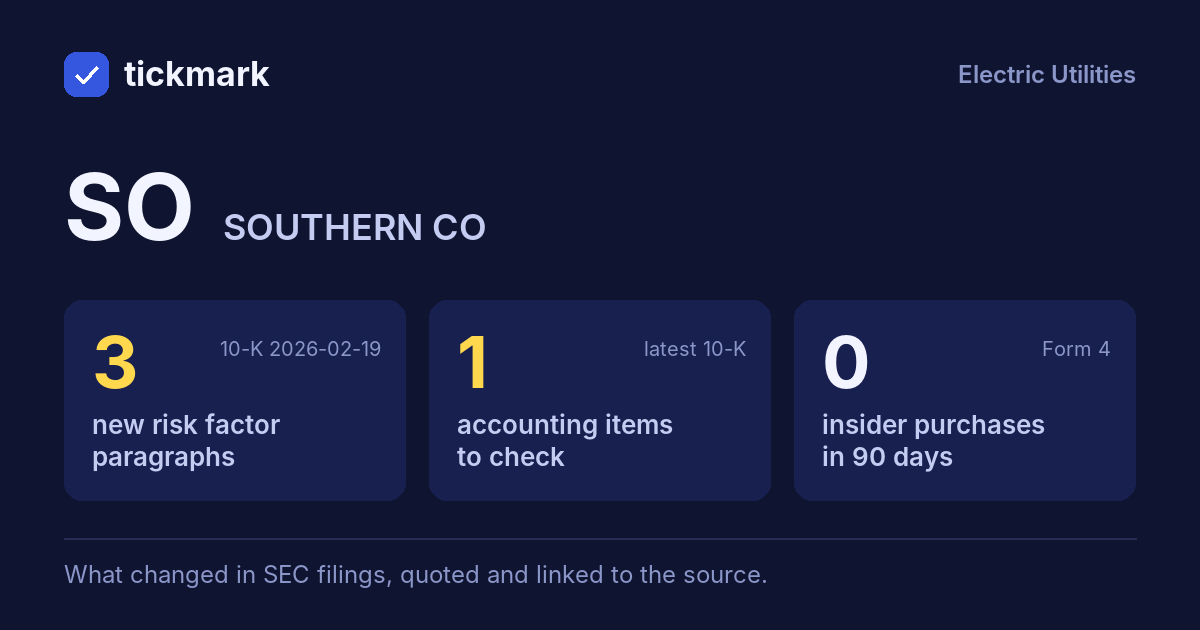
432 changes: 49 added, 48 removed, 331 reworded, 4 quiet changes

10-K Feb 19, 2026 vs Feb 20, 2025
Risk FactorsRedline ↓
13.2%
of the text changed · 11,759 words now
32.5%
of the text changed · 39,408 words now
Legal ProceedingsRedline ↓
28.3%
of the text changed · 3,681 words now
Accounting PoliciesRedline ↓
13.2%
of the text changed · 8,197 words now

10-K 0000092122-26-000006 (2026-02-19) vs 10-K 0000092122-25-000018 (2025-02-20)

The redline

The paragraph that changed most in each section

Marked against last year's 10-K: cut words struck through, new words highlighted and underlined.

MD&A 322 words changed in this paragraph; it is 37% similar to last year's version.
On In May 9, 2024, the EPA published the final GHG rules (2024 GHG Rules) to establish GHG emissions standards for existing fossil fuel-fired steam electric generating units and new fossil fuel-fired combustion turbines and combined cycle generation facilities, which requires facilities. The 2024 GHG limits for subcategories of both new and existing units. The new rules Rules do not include standards for existing fossil fuel-fired combustion turbines and or combined cycle generation facilities, which have been deferred to a future rulemaking. Requirements for facilities. Under the 2024 GHG Rules, existing coal-fired units are based on technologies such as carbon capture and sequestration (CCS) and natural gas co-firing. States have 24 months after the rule's publication to submit state plans for existing units. The rule allows states to consider remaining useful life and other factors to specify alternative, unit-specific emissions limits and compliance timelines for existing units, as needed to address reliability and other concerns. Existing source compliance will for steam generating units would begin as early as January 1, 2030, depending on the subcategory. The final rule incorporates some limited reliability mechanisms including a provision subcategory for short-term grid emergencies the affected unit, and a "reliability assurance mechanism" that allows for a one-time, up to one year, extension of existing coal unit retirement dates specified in an approved state plan. The the standards for new combustion turbines and combined cycles include subcategories for low, intermediate, and base load operations. Compliance with new source standards begins when the unit comes online, with requirements for CCS carbon capture and sequestration (CCS) beginning on January 1, 2032. The EPA also simultaneously repealed the Affordable Clean Energy rule. Numerous industry groups, electric generators, and states have filed petitions for review challenging the rule in the U.S. Court of Appeals for the D.C. Circuit. A total of eight stay motions were filed seeking a stay of the rule pending judicial review, which were denied by the U.S. Court of Appeals for the D.C. Circuit on July 19, 2024. On February 5, 2025, the EPA filed a motion in the U.S. Court of Appeals for the D.C. Circuit requesting a 60-day abeyance of the challenges so that the new Trump Administration can determine how to proceed with the litigation. On October 16, 2024, the U.S. Supreme Court denied emergency stay applications filed by numerous industry groups, electric generators, and states. The ultimate impact of the final rules and associated legal matters cannot be determined at this time; however, it may result in significant compliance costs.

Source: Item 7, 10-K 0000092122-26-000006 vs Item 7, 10-K 0000092122-25-000018

Risk Factors 310 words changed in this paragraph; it is 40% similar to last year's version.
The traditional electric operating companies are experiencing projected demand that significantly exceeds recent experience, creating the need for new power generating resources and transmission facilities. The majority of this demand is driven by the power needs and projected power needs of data centers to serve an increasingly digital economy and to support artificial intelligence. Other demands are coming from new industrial facilities with advanced manufacturing processes for products such products as electric vehicles and batteries. Ensuring that incremental revenues from Extending service to these projected new demands cover incremental costs and risks will be critical customers necessitates significant capital expenditures, which in turn requires sufficient access to continuing the traditional electric operating companies' value proposition to customers. The new nature sources of these industries, capital. These additional capital spending needs, the increased concentration of business within a single industry based on emerging technologies, and uncertainties on the actual capacity required to satisfy the projected new demands of these new industries may impact creates risks for the traditional electric operating companies. Ensuring that incremental revenues from these projected new demands cover incremental costs and risks is critical to continuing the traditional electric operating companies' value proposition to customers. In particular, Georgia Power has agreed to file its next base rate case in a manner that will ensure the incremental revenue from large load customers has downward pressure, on a levelized basis, of at least $556 million per year for the years 2029, 2030, and 2031. See Note 2 to the financial statements under "Georgia Power – Integrated Resource Plans – Certification Requests" in Item 8 herein for additional information. While electric service agreements with new large load customers (including data centers) typically include provisions such as early termination payments, minimum bills, and financial security, these and other contractual provisions may not fully protect the traditional electric operating companies against all risks. Changes in industry practice or advances in the related technologies could reduce the demand for electricity to power data centers or other large load facilities. Additionally, these industries may experience a business downturn, which could cause the loss of current or potential customers or may weaken the financial condition and creditworthiness of existing customers. If anticipated demand growth does not materialize, the traditional electric operating companies could experience unrecovered capital investments made to serve expected load. Conversely, if demand grows more rapidly than projected, the traditional electric operating companies may face challenges in securing adequate generation and transmission capacity and maintaining service reliability.

Source: Item 1A, 10-K 0000092122-26-000006 vs Item 1A, 10-K 0000092122-25-000018

Legal Proceedings 297 words changed in this paragraph; it is 54% similar to last year's version.
In 2010, the DOE, through a cooperative agreement with SCS, agreed to fund $270 million of the Kemper County energy facility through the grants awarded to the project by the DOE under the Clean Coal Power Initiative Round 2. In 2016, additional DOE grants in the amount of $137 million were awarded to the Kemper County energy facility. In 2018, Mississippi Power filed with the DOE its request for property closeout certification under the contract related to the $387 million of total grants received. In 2020, Mississippi Power and Southern Company executed an agreement with the DOE completing Mississippi Power's request, which enabled Mississippi Power to proceed with full dismantlement of the abandoned gasifier-related assets and site restoration activities. In connection with the DOE closeout discussions, in 2019, the Civil Division of the Department of Justice informed Southern Company and Mississippi Power of a civil investigation related to the DOE grants. In August 2023, the U.S. District Court for the Northern District of Georgia unsealed a civil action in which defendants Southern Company, SCS, and Mississippi Power were alleged to have violated certain provisions of the False Claims Act by fraudulently inducing the DOE to disburse funds pursuant to the grants. The federal government declined to intervene in the action. Later in 2023, the plaintiff, a former SCS employee, filed an amended complaint, again alleging certain violations of the False Claims Act. The plaintiff sought to recover all damages incurred personally and on behalf of the federal government caused by the defendants' alleged violations, as well as treble damages and attorneys' fees, among other relief. In February 2024, the defendants moved to dismiss the amended complaint. In August 2024, the court granted the defendants' motion in part and denied it in part, dismissing the plaintiff's False Claims Act count along with its accompanying treble damages and attorneys' fees but allowing the employment retaliation claim to proceed. In October 2024, the plaintiff requested interlocutory appeal of the court's decision, which was denied on February 25, 2025, and the defendants asserted counterclaims for conversion and misappropriation of trade secrets. In November 2024, the defendants filed a motion for judgment on the pleadings on the plaintiff's employment retaliation claim. In December 2024, the plaintiff filed a motion to dismiss the defendants' counterclaims. On July 15, 2025, the court denied the plaintiff's motion to dismiss the defendants' counterclaims and the defendants' motion for judgment on the pleadings. On August 6, 2025, the plaintiff asserted a counterclaim against the defendants. On September 8, 2025, the defendants renewed their motion for judgment on the pleadings. On November 12, 2025, the parties reached an agreement in principle to resolve the lawsuit. On January 20, 2026, the court entered an order dismissing the lawsuit. The resolution does not have a material impact on Southern Company's or Mississippi Power's financial statements.

Source: Item 3, via Note 3 – CONTINGENCIES, COMMITMENTS, AND GUARANTEES, 10-K 0000092122-26-000006 vs Item 3, via Note 3 – CONTINGENCIES, COMMITMENTS, AND GUARANTEES, 10-K 0000092122-25-000018

Accounting Policies 131 words changed in this paragraph; it is 40% similar to last year's version.
Georgia Power has entered into a PPA with Mississippi Power, which commenced in 2024, and several PPAs with Southern Power and one PPA with Mississippi Power for capacity and energy. Georgia Power's total expenses associated with these PPAs were $203 million, $143 million, are included in purchased power, affiliates on its statements of income. Mississippi Power's and $151 million in 2024, 2023, and 2022, respectively. Southern Power's total revenues from all associated with these PPAs with Georgia Power, included in wholesale revenue affiliates on Southern Power's consolidated statements of income, were $149 million, $145 million, and $154 million for 2024, 2023, and 2022, respectively. Included within these revenues were affiliate PPAs accounted for as operating leases, which totaled $121 million, $116 million, and $116 million for 2024, 2023, and 2022, respectively. Mississippi Power's total revenues from its PPA with Georgia Power, which commenced in 2024, were $60 million in 2024 and are included in wholesale revenue revenues, affiliates on Mississippi Power's their respective statements of income. See Notes 2 and 9 for additional information.

Source: Item 8, Note 1 – SUMMARY OF SIGNIFICANT ACCOUNTING POLICIES, 10-K 0000092122-26-000006 vs Item 8, Note 1 – SUMMARY OF SIGNIFICANT ACCOUNTING POLICIES, 10-K 0000092122-25-000018

Every change, by type

Sentences and paragraphs added, removed or reworded

Sentences and paragraphs of SO's Risk Factors and MD&A, 10-K 2026-02-19 against 10-K 2025-02-20. Each links to the text at sec.gov.

RemovedRisk Factors
The SEC adopted new rules relating to the disclosure of climate-related matters, but has stayed their effectiveness pending judicial review. If these rules, or similar rules, become effective, the Registrants could incur increased costs to comply with these new rules and could face increased risk of litigation related to disclosures made pursuant to the rules.

Read it in 10-K 2025-02-20 at sec.gov ↗

RemovedRisk Factors
gas could likewise result in increased costs to the Southern Company system and affect the demand for natural gas as well as the prices charged to customers and the competitive position of natural gas.

Read it in 10-K 2025-02-20 at sec.gov ↗

RemovedRisk Factors
interconnect facilities to transmission grids; and increased financing costs as a result of changes in interest rates or as a result of project delays.

Read it in 10-K 2025-02-20 at sec.gov ↗

RemovedMD&A
On May 7, 2024, the Alabama PSC approved a decrease to Rate ECR from 3.270 cents per KWH to 3.015 cents per KWH, or approximately $135 million annually, effective with July 2024 billings. On December 3, 2024, the Alabama PSC approved an additional reduction to Rate ECR from 3.015 cents per KWH to 2.600 cents per KWH, or $218 million annually, effective with January 2025 billings.

Read it in 10-K 2025-02-20 at sec.gov ↗

RemovedMD&A
On October 24, 2024, Alabama Power entered into an agreement to acquire all of the equity interests in Tenaska Alabama Partners, L.P. for a total purchase price of approximately $622 million, subject to working capital adjustments. Tenaska Alabama Partners, L.P. owns and operates the Lindsay Hill Generating Station, an approximately 855-MW combined cycle generation facility in Autauga County, Alabama. On October 30, 2024, Alabama Power filed a petition for a CCN with the Alabama PSC for authorization to procure additional generating capacity through the acquisition of the Lindsay Hill Generating Station. Alabama Power expects to complete the acquisition by the end of the third quarter 2025. The ultimate outcome of this matter cannot be determined at this time.

Read it in 10-K 2025-02-20 at sec.gov ↗

RemovedMD&A
Georgia Power placed Plant Vogtle Units 3 and 4 in service on July 31, 2023 and April 29, 2024, respectively. During the second quarter 2024, following Unit 4's in-service date, Southern Nuclear evaluated the remaining expected site demobilization costs and other contractor obligations and reduced the remaining estimate to complete forecast by approximately $21 million, including the impact of joint owner cost-sharing. Accordingly, Georgia Power recorded a pre-tax credit to income of approximately $21 million ($16 million after tax), including the joint owner agreement impacts, in the second quarter 2024 to recognize forecasted capital costs previously charged to income. Georgia Power's share of the remaining project capital cost forecast, including completion of site demobilization and remaining contractor obligations, is $69 million. See Note 2 to the financial statements under "Georgia Power – Nuclear Construction – Cost and Schedule" for additional information.

Read it in 10-K 2025-02-20 at sec.gov ↗

RemovedMD&A
Georgia Power included in retail rate base $5.462 billion of construction and capital costs as well as $647 million of associated retail rate base items effective with the April 29, 2024 in-service date for Unit 4, pursuant to the approved Prudency Stipulation. Annual retail base revenues increased approximately $730 million and the average retail base rates were adjusted by approximately 5% (net of the elimination of the NCCR tariff described below) effective May 1, 2024.

Read it in 10-K 2025-02-20 at sec.gov ↗

Show the other 8
RemovedMD&A
Further, as included in the approved Prudency Stipulation, since commercial operation for Unit 4 was not achieved by March 31, 2024, Georgia Power's ROE used to determine the NCCR tariff and calculate AFUDC was reduced to zero effective April 1, 2024. Effective May 1, 2024, following commercial operation for Unit 4, Georgia Power's NCCR tariff was eliminated.

Read it in 10-K 2025-02-20 at sec.gov ↗

RemovedMD&A
On December 17, 2024, in accordance with the terms of the 2022 ARP, the Georgia PSC approved tariff adjustments effective January 1, 2025 that resulted in a net increase in rates of $306 million. Georgia Power is required to file its next general base rate case by July 1, 2025. See Note 2 to the financial statements under "Georgia Power – Rate Plans – 2022 ARP" for additional information.

Read it in 10-K 2025-02-20 at sec.gov ↗

RemovedMD&A
As included in the 2022 IRP final order, Georgia Power initiated a request for proposals (RFP) of up to 8,500 MWs of capacity from a variety of resources with expected CODs or delivery commencement dates between 2028 and 2030. The RFP included Georgia Power-owned proposals. In conjunction with those proposals, Georgia Power entered into agreements for engineering, procurement, and construction through January 2025. Winning participants are expected to be notified in June 2025, and the Georgia PSC is anticipated to render a decision related to the certification of the winning submissions in the fourth quarter 2025. Depending on the outcomes of the RFP and certification processes, Georgia Power could spend up to $14 billion, excluding AFUDC, on approved Georgia Power-owned proposals and related transmission investments through 2029. The ultimate outcome of this matter cannot be determined at this time.

Read it in 10-K 2025-02-20 at sec.gov ↗

RemovedMD&A
On April 16, 2024, the Georgia PSC approved Georgia Power's updated IRP as modified by a stipulation among Georgia Power, the staff of the Georgia PSC, and certain intervenors (2023 IRP Update). The 2023 IRP Update includes the authority to develop, own, and operate up to 1,400 MWs from three simple cycle combustion turbines at Plant Yates with the recoverable costs not to exceed the certified amount, which was approved by the Georgia PSC on August 20, 2024. With this approval, the Georgia PSC recognized the potential for circumstances beyond Georgia Power's control that could cause the project costs to exceed the certified amount, in which case Georgia Power would provide documentation to the Georgia PSC to explain and justify potential recovery of additional reasonable and prudent costs. Georgia Power is required to file semi-annual construction monitoring

Read it in 10-K 2025-02-20 at sec.gov ↗

RemovedMD&A
The 2025 IRP requests approval of investments related to the continued reliable hydro operations of nine facilities, as well as the authority to develop, own, and operate a projected incremental 16 MWs from Plant Goat Rock Units 3 through 6.

Read it in 10-K 2025-02-20 at sec.gov ↗

RemovedMD&A
On April 26, 2024, Mississippi Power filed its 2024 IRP with the Mississippi PSC. The Mississippi PSC did not note any deficiencies within the prescribed 120-day review period; therefore, the filing is concluded. The 2024 IRP included a schedule to retire Plant Watson Unit 4 (268 MWs) and Plant Greene County Units 1 and 2 (206 MWs based on 40% ownership) and to retire early Plant Daniel Units 1 and 2 (502 MWs based on 50% ownership), all by the end of 2028, which is consistent with the completion of Mississippi Power's affiliate PPA with Georgia Power. On January 9, 2025, Mississippi Power notified the Mississippi PSC of its intent to extend the retirement date of Plant Daniel Unit 2 and potentially extend the retirement dates of other fossil steam units beyond their current 2028 retirement dates in order to serve recently signed economic development loads of approximately 600 MWs.

Read it in 10-K 2025-02-20 at sec.gov ↗

RemovedMD&A
On November 8, 2024, Mississippi Power entered into an agreement with FP&L to acquire FP&L's 50% ownership interest in Plant Daniel Units 1 and 2. This acquisition will include a payment by FP&L to Mississippi Power of between $35 million and $38 million, which represents an estimate of the incremental cost to Mississippi Power to assume ownership of FP&L's interest, based on the timing of the completion of the transaction. On January 7, 2025, the Mississippi PSC approved Mississippi Power's request for (i) the inclusion of the acquired assets and the associated costs at Plant Daniel in Mississippi Power's retail rate base, upon completion of the transaction, (ii) the establishment of a new regulatory liability account in which all of the proceeds to be paid by FP&L will be recorded, and (iii) Mississippi Power's ability to amortize that regulatory liability by charging certain expenditures against it. The completion of the transaction is subject to the satisfaction or waiver of certain conditions, including, among other customary closing conditions, approval by the Florida PSC.

Read it in 10-K 2025-02-20 at sec.gov ↗

RemovedMD&A
On May 28, 2024, the FERC issued an order accepting Mississippi Power's request for an $8 million increase in annual wholesale base revenues under the MRA tariff, effective May 29, 2024, subject to refund. On December 23, 2024, Mississippi Power and Cooperative Energy filed a settlement agreement with the FERC. The settlement agreement provides for (i) a $1 million increase in annual wholesale base revenues and a refund to customers of approximately $4 million, (ii) a rate escalation of 2.5% on an annual basis in periods subsequent to December 31, 2024 and continuing through the end of the Shared Services Agreement (SSA) on December 31, 2035, and (iii) a waiver of rights by Mississippi Power and Cooperative Energy to file for any changes in non-fuel rates through the end of the term of the SSA. The settlement agreement is subject to approval by the FERC.

Read it in 10-K 2025-02-20 at sec.gov ↗

Next Related parties →