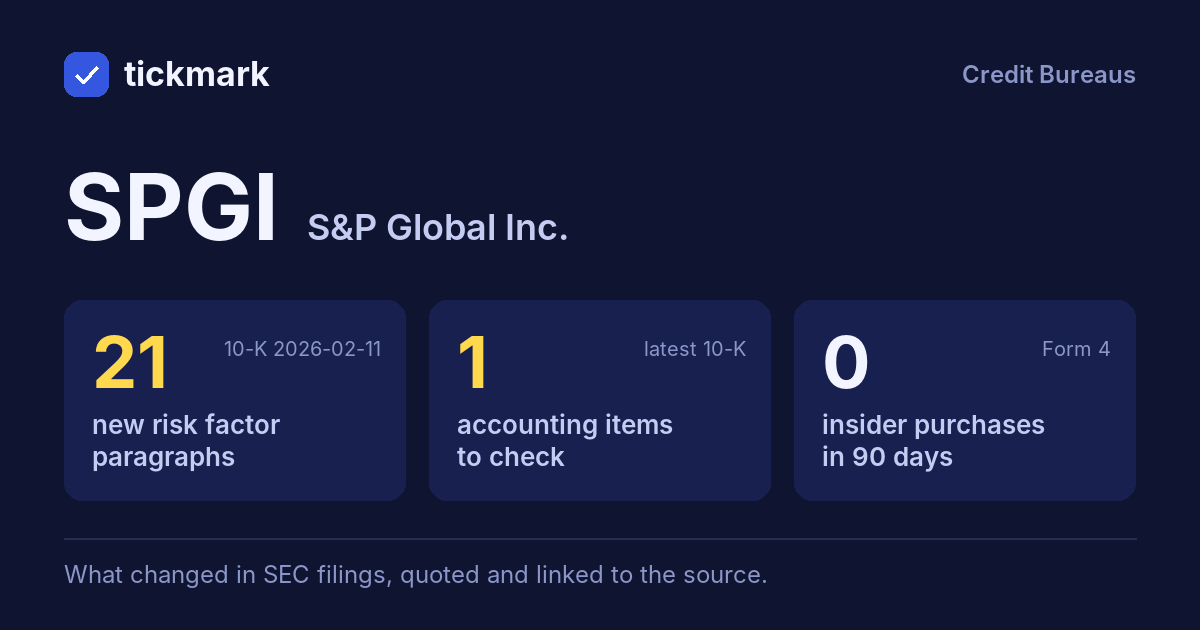
Sentences and paragraphs of SPGI's Risk Factors and MD&A, 10-K 2026-02-11 against 10-K 2025-02-11.
Each links to the text at sec.gov.
AddedRisk Factors
AI is a rapidly evolving technology that is fundamentally changing the way data is gathered, produced, protected, licensed, processed, and consumed. Given the importance of data to our products and services, AI continues to be an increasingly important part of our business and industry. While we have established a Company-wide AI strategy to drive our approach to data protection, licensing and AI integration in our processes, products and services, AI creates a number of evolving risks and opportunities and can exacerbate other risks, including those described herein:
Read it in 10-K 2026-02-11 at sec.gov ↗
AddedRisk Factors
•AI technologies used in our products and processes may incorporate or reproduce third-party content in their outputs, which may expose us to risks associated with infringing, misappropriating or otherwise violating others’ intellectual property rights, including the trademarks, copyrights, patents and other intellectual property rights of third parties, including from our competitors or nonpracticing entities which may expose us to protracted and expensive litigation and may materially and adversely affect our business going forward. We may also be unable to protect our data from unintended use or access by third-party AI systems.
Read it in 10-K 2026-02-11 at sec.gov ↗
AddedRisk Factors
•We consider many of our products and services to be proprietary, and our success depends, in part, on protecting our intellectual property, proprietary information, and technology. We rely on a variety of measures to maintain, protect and enforce our intellectual property portfolio, including trademark and patent protection, trade secret laws, legal misappropriation doctrines, confidentiality procedures and contractual restrictions, all of which provide only limited protection. In particular, such measures may not prevent infringement, violation, misuse or misappropriation of our intellectual property rights or proprietary or confidential information. For example, we routinely face unauthorized use of our indices and price assessments, and our efforts to stop such uses require significant time and expense, and are not always successful.
Read it in 10-K 2026-02-11 at sec.gov ↗
AddedRisk Factors
•There can be no assurance that any future patent, trademark, or other intellectual property registrations will be issued for our pending or future applications or that any of our current or future patents, trademarks or other intellectual property rights will be valid, enforceable, sufficiently broad in scope, provide adequate protection of our technology or other proprietary rights, or provide us with any competitive advantage. Any additional investment in protecting our intellectual property rights through additional trademark, patent or other intellectual property filings could be time consuming and expensive, both in terms of application and maintenance costs. We make business decisions about whether and where to seek patent, copyright, and trademark protection for a particular technology and when to rely upon trade secret protection, and the approach we select may ultimately prove to be inadequate. Businesses we acquire may also have intellectual property portfolios which increase the complexity of managing our intellectual property portfolio and protecting our competitive position. Failure to obtain, protect and maintain our intellectual property adequately could harm the value of, and revenue generated by, such assets as well as harm our reputation and affect our ability to compete effectively.
Read it in 10-K 2026-02-11 at sec.gov ↗
AddedRisk Factors
•We cannot guarantee that we will be successful in maintaining, protecting, or enforcing the confidentiality of our trade secrets or that our confidentiality and non-disclosure agreements for such trade secrets will provide sufficient protection of our trade secrets, know-how, or other proprietary information in the event of any unauthorized use, misappropriation, or other disclosure. Enforcing a claim that a party illegally disclosed or misappropriated a trade secret or know-how is difficult, fact-intensive, expensive, and time-consuming, and the outcome is unpredictable. In addition, trade secrets and know-how can be difficult to protect and some courts inside and outside the U.S. are less willing or unwilling to protect trade secrets and know-how. Further, these agreements do not prevent our competitors from independently developing product or service offerings that are substantially equivalent or superior to our offerings. If any of our trade secrets were to be lawfully obtained or independently developed by a competitor or other third party, we would have no right to prevent them from using that technology or information to compete with us, and
Read it in 10-K 2026-02-11 at sec.gov ↗
Show the other 16
AddedRisk Factors
We have been, and may in the future be, subject to intellectual property disputes, which are costly to defend and could harm our business and operating results.
Read it in 10-K 2026-02-11 at sec.gov ↗
AddedRisk Factors
Our success depends, in part, on our ability to operate our business without infringing, misappropriating or otherwise violating third-party intellectual property rights. We have been, and may in the future be, subject to claims and litigation alleging that we or our products or services infringe, misappropriate or otherwise violate others’ intellectual property rights, including the trademarks, copyrights, patents and other intellectual property rights of third parties, including from our competitors or nonpracticing entities. We may also learn of possible infringement, misappropriation or other violation of our trademarks, copyrights, patents and other intellectual property. Patent and other intellectual property litigation may be protracted and expensive, and the results are difficult to predict and may result in significant settlement costs or payment of substantial damages. Furthermore, a successful claimant could secure a judgment that requires us to stop offering some products or services or prevents us from conducting our business as we have historically done or may desire to do in the future. We might also be required to seek a license and pay royalties for the use of such intellectual property, which may not be available on commercially acceptable terms, or at all. Alternatively, we may be required to modify our products and services, which could require significant effort and expense and may ultimately not be successful.
Read it in 10-K 2026-02-11 at sec.gov ↗
AddedRisk Factors
•We have at times experienced outages and other disruptions due to internal system or human errors and could in the future be subject to outages or other disruptions due to similar errors. While we have taken steps to address these
Read it in 10-K 2026-02-11 at sec.gov ↗
AddedRisk Factors
•We, and certain types of information we collect, compile, store, use, process, transfer, publish and sell, are subject to laws and regulations governing the protection of personal and sensitive information in the various jurisdictions in
Read it in 10-K 2026-02-11 at sec.gov ↗
AddedMD&A
On April 29, 2025, we announced that our Board of Directors decided to pursue a full separation of our Mobility segment, creating a new publicly traded company. The transaction, which would be implemented through the spin-off of shares of the new company to S&P Global shareholders, is expected to be tax-free for U.S. federal income tax purposes for S&P Global shareholders and is expected to be completed mid-2026, subject to the satisfaction of customary legal and regulatory requirements and approvals.
Read it in 10-K 2026-02-11 at sec.gov ↗
AddedMD&A
Our industry-leading benchmarks, differentiated data, and solutions provide a unique value proposition that provide customers with the ability to make more confident decisions and stay a step ahead. Our strategy focuses on three key objectives: to Advance market leadership, Expand high-growth adjacencies, and Amplify enterprise capabilities and integration of AI. In 2026, we are focused on delivering on these key strategic priorities.
Read it in 10-K 2026-02-11 at sec.gov ↗
AddedMD&A
•Delivering market-leading value proposition through best-in-class products, including world-class benchmarks and highly differentiated data, that are transforming the user experience, accelerating innovation, and optimizing go-to-market to enhance client retention and growth; and
Read it in 10-K 2026-02-11 at sec.gov ↗
AddedMD&A
•Expanding trusted, enduring client relationships through differentiated products and best-in-class client experiences that meet clients’ evolving needs.
Read it in 10-K 2026-02-11 at sec.gov ↗
AddedMD&A
•Accelerating in high-growth adjacencies such as private markets, energy expansion, supply chain intelligence, wealth, and decentralized finance, alongside leading-edge AI and technology, such as blockchain and quantum computing.
Read it in 10-K 2026-02-11 at sec.gov ↗
AddedMD&A
•Enabling growth, innovation, and operating leverage through our integrated operating model that removes siloes across enterprise data, enterprise technology, and client coverage teams.
Read it in 10-K 2026-02-11 at sec.gov ↗
AddedMD&A
•Driving cutting-edge innovation, in line with client expectations, by integrating and scaling new technology and AI into our products and our operations, and leveraging strategic collaborations and new potential commercial models;
Read it in 10-K 2026-02-11 at sec.gov ↗
AddedMD&A
•Enhancing our data estate by continuing to add differentiated data sets at scale, thereby enabling new revenue, efficiency, and time-to-market;
Read it in 10-K 2026-02-11 at sec.gov ↗
AddedMD&A
•Leveraging technology, process and skills innovation to empower our people, enhance productivity, and deliver enterprise impact via a people-forward culture, skills focus, people + AI process redesign, and aligned incentives; and
Read it in 10-K 2026-02-11 at sec.gov ↗
AddedMD&A
We believe that delivering on our key strategic priorities will create shareholder value through long-term profitable growth and we expect to continue to deliver targeted capital return to shareholders.
Read it in 10-K 2026-02-11 at sec.gov ↗
AddedMD&A
On October 10, 2025, the Company and CME Group completed the sale of OSTTRA to Kohlberg Kravis Roberts & Co. (“KKR”), a leading global investment firm. The terms of the deal for OSTTRA equaled total enterprise value at $3.1 billion, subject to customary purchase price adjustments, which will be divided evenly between the Company and CME Group pursuant to the 50/50 joint venture. We received proceeds from the sale of $1.5 billion in cash ($1.4 billion after-tax), subject to purchase price adjustments. During the year ended December 31, 2025, we recorded a pre-tax gain of $270 million ($187 million after-tax) for the Company, including the impact of accumulated other comprehensive income related to our investment.
Read it in 10-K 2026-02-11 at sec.gov ↗
AddedMD&A
On January 5, 2026, the OECD issued administrative guidance outlining a framework under which U.S.-parented groups may be excluded from the application of the OECD’s global minimum tax rules. Each member jurisdiction will need to adopt this guidance into local law, and the timing and manner of adoption may vary. We are continuing to monitor developments related to this guidance and will evaluate the impact on our financial statements as additional information becomes available.
Read it in 10-K 2026-02-11 at sec.gov ↗