Paragraph 193 · 48% changed
Every version of it
Screener
/
SEC EDGAR
/CIK 0000064040
/10-K filed Feb 11, 2026, compared with Feb 11, 2025
/Numbers from the XBRL of the 10-Ks
NYSE
Financials · Credit Bureaus
S&P Global SPGI
The 10-K against last year's
237 changes: 51 added, 34 removed, 150 reworded, 2 quiet changes
10-K Feb 11, 2026 vs Feb 11, 2025
Risk Factors
26.8%
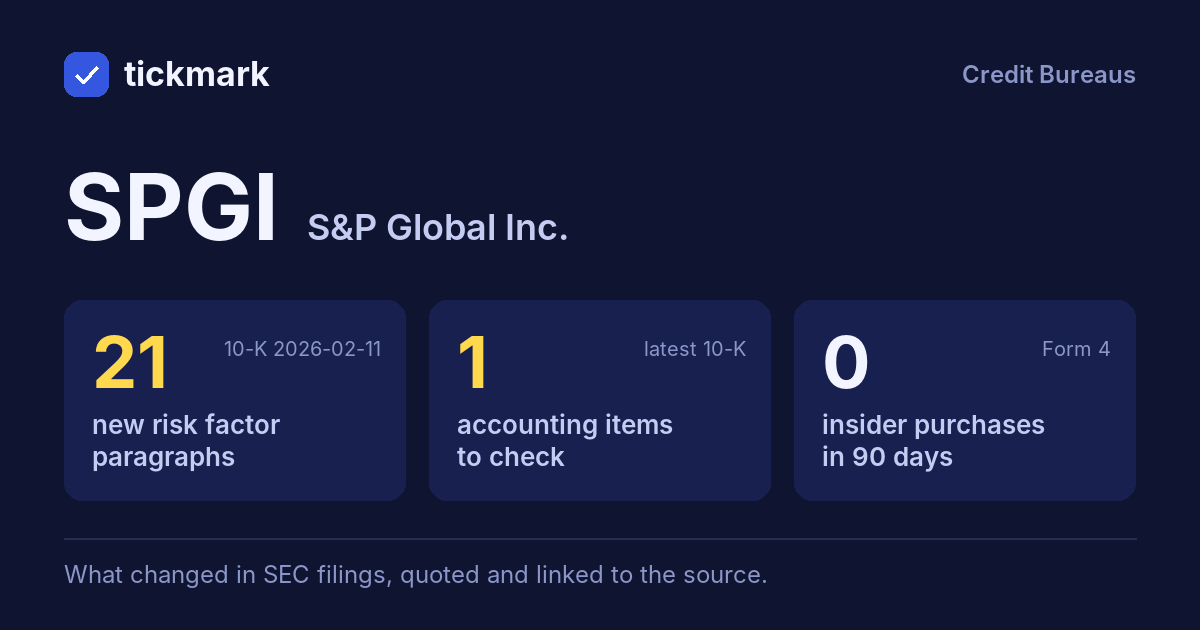
of the text changed · 15,211 words now · 21 new paragraphs, 8 gone
MD&A
24.1%
of the text changed · 21,017 words now · 30 new paragraphs, 26 gone
Legal Proceedings
21.8%
of the text changed · 1,254 words now
Accounting Policies
9.7%
of the text changed · 5,999 words now
10-K 0000064040-26-000013 (Feb 11, 2026) vs 10-K 0000064040-25-000052 (Feb 11, 2025)
Every paragraph, and how much of it changed
One bar per paragraph, in the order of the 10-K. Height and colour show the share of its words not in the closest paragraph a year earlier; the tallest bars are new paragraphs.
Risk Factors
200 paragraphs · 21 new · 101 reworded · 8 gone · 10-K Feb 11, 2026 against Feb 11, 2025
New paragraph
Reworded (5% of its words or more)
Same or nearly
Paragraph 32 · 46% changed
Every version of it
Paragraph 29 · 46% changed
Every version of it
Paragraph 33 · 46% changed
Every version of it
Paragraph 45 · 44% changed
Every version of it
•Our products and services contain intellectual property delivered through a variety of digital and other media. Our ability to achieve anticipated results depends in part on our ability to defend our intellectual property rights against infringement and misappropriation. Our business, financial condition or results of operations could be materially and adversely affected by inadequate or changing legal and technological protections for intellectual property and proprietary rights in some jurisdictions and markets. For example, the legal landscape with respect to AI is rapidly evolving, and we do not yet know whether intellectual property laws and regulations in the jurisdictions markets in which we operate will enable us to effectively protect our intellectual property rights from unintended use by AI. Additionally, we do business in a number of countries included on the Priority Watch List maintained by the Office of the United States Trade Representative which are currently thought to afford less protection to intellectual property rights generally than some other jurisdictions. The lack of strong patent and other intellectual property protection in jurisdictions in which we operate increases our vulnerability regarding unauthorized disclosure or use of our intellectual property and undermines our competitive position. In addition, even in jurisdictions where there are strong protections for intellectual property rights, our ability to enforce our intellectual property rights may be impacted by the number of competitors attempting to infringe or misappropriate our intellectual property. operate.
Paragraph 6 · 40% changed
Every version of it
•The cyber threats we and our third-party service providers (including our vendors) vendors, data partners and distribution partners) face are rapidly evolving and are becoming increasingly sophisticated and include denial of service attacks, ransomware, spyware, misinformation, phishing/smishing/vishing attacks, business compromise attacks,
Paragraph 25 · 40% changed
Every version of it
Paragraph 41 · 38% changed
Every version of it
Paragraph 193 · 48% changed
Every version of it
10-K Feb 11, 2025Climate change and the transition to renewable energy and a net zero economy pose operational, commercial and regulatory risks.
10-K Feb 11, 2026
Sustainability and energy expansion matters pose operational, commercial and regulatory risks.
Paragraph 32 · 46% changed
Every version of it
10-K Feb 11, 2025AI is an emerging technology that is fundamentally changing the way data is gathered, produced, protected, licensed, processed, and consumed. Given the importance of data to our products and services, AI continues to be an increasingly important part of our business and industry. We have established a Company-wide AI strategy to drive our approach to data protection, licensing and AI integration in our processes, products and services. We have made significant investments in various AI initiatives. However, the AI landscape is complex and rapidly evolving, and new and enhanced laws and regulations (or inadequate laws or regulations), governmental or regulatory scrutiny, competition from established or emerging companies, litigation, ethical concerns, cybersecurity concerns, intellectual property concerns, or other complications could materially and adversely impact our ability to protect our data and intellectual property, to develop and offer products and services that effectively use AI, to compete with other AI products or services, to improve efficiency of existing products or services through the effective use of AI to remain competitive, or to incorporate AI in our internal operations, or could materially increase our burden and cost of research, development and regulatory compliance. As discussed in the risk factor entitled “The markets in which we operate continuously change to adapt to customer needs. Our inability to innovate and compete with new or enhanced products and services of our competitors could impact our profitability,” competitors are deploying AI in ways that could materially reduce demand for our products and services. Additionally, we may be unable to protect our data from unintended use or access by third-party AI systems. For additional risks related to intellectual property rights, see the risk factor entitled “Our ability to protect our intellectual property rights could impact our competitive position.” The development, testing and deployment of AI systems requires continued investment and may materially increase the cost profile of our offerings due to the nature of the
10-K Feb 11, 2026
•The AI landscape is complex and rapidly evolving, and new and enhanced laws and regulations (or inadequate laws or regulations), novel application of existing laws to AI technology, governmental or regulatory scrutiny, litigation and ethical concerns could materially and adversely impact our ability to protect our data and intellectual property, to develop and offer products and services that effectively use AI, to compete with other AI products or services, to improve efficiency of existing products or services through the effective use of AI to remain competitive, or to incorporate AI in our internal operations, or could materially increase our burden and cost of research, development and regulatory compliance.
Paragraph 29 · 46% changed
Every version of it
10-K Feb 11, 2025•From time to time, the data from our suppliers has errors, is delayed, has design defects, is unavailable on acceptable terms or is not available at all. While such issues have not materially adversely affected us to date, the future occurrence of any such issue could have a material adverse effect on our business, financial condition or results of operations.
10-K Feb 11, 2026
•Our ability to produce and develop products and services with AI capabilities is dependent upon the products and services of other suppliers, including certain data, software and service suppliers. Our products and services with AI capabilities may rely on third-party AI providers for certain capabilities and infrastructure. If any such providers were to limit, discontinue or materially alter the terms of our access, we may be unable to obtain comparable data from other sources in a timely or cost-effective manner, or at all. To the extent we rely on third-party AI models, the providers may discontinue such models or their model capabilities may become insufficient or obsolete. While such issues have not materially adversely affected us to date, the future occurrence of any such issue could have a material adverse effect on our business, financial condition or results of operations.
Paragraph 33 · 46% changed
Every version of it
10-K Feb 11, 2025•We, and certain types of information we collect, compile, use, and publish, are subject to numerous U.S. federal and state laws and non-U.S. regulations governing the protection of personal and confidential information of our clients, employees and products in the jurisdictions in which we operate. Further, global privacy, data localization, data maintenance, data transfer and data protection legislation, regulatory, enforcement, and policy activity are rapidly and continually evolving and creating a complex regulatory compliance environment. There is also increasing concern among certain privacy and data protection advocates, government regulators, litigators, and the press regarding marketing and privacy matters as well as data protection, particularly as they relate to individual privacy, threats to personal information, and perceived national security interests. Costs and adaptation of our business practices to comply with and implement the increasing privacy-related and data protection, data maintenance and transfer restriction measures have been, and we expect will continue to be, significant, particularly as the laws and regulations across jurisdictions change frequently and sometimes conflict. In addition, such measures, as well as any associated inquiries or investigations or any other government actions, increase our operating costs and require significant management time and attention, and may result in negative publicity and subject us to costs that may harm our business, including fines or damages as well as demands or orders that we modify or cease existing business practices.
10-K Feb 11, 2026
•We do not yet know whether intellectual property laws and regulations in the jurisdictions in which we operate will enable us to effectively protect our intellectual property rights from unintended use by AI. Third parties could also use our data with AI tools to create their own insights and potentially supplant our products and services. We are also subject to a variety of evolving laws and regulations regarding AI in an increasing number of jurisdictions. Further, global AI legislation, regulatory, enforcement, and policy activity is rapidly and continually evolving and creating a complex regulatory compliance environment. Such measures increase our operating costs and require significant management time and attention and may result in negative publicity and subject us to significant costs that may harm our business, including fines or damages as well as demands or orders that we modify or cease existing business practices. The integration of AI in our products and services may increase the risks of improper processing of personal data, further exacerbating such risks.
Paragraph 45 · 44% changed
Every version of it
10-K Feb 11, 2025
•Our products contain intellectual property delivered through a variety of digital and other media. Our ability to achieve anticipated results depends in part on our ability to defend our intellectual property rights against infringement and misappropriation. Our business, financial condition or results of operations could be materially and adversely affected by inadequate or changing legal and technological protections for intellectual property and proprietary rights in some jurisdictions and markets. For example, the legal landscape with respect to AI is rapidly evolving, and we do not yet know whether intellectual property laws and regulations in the jurisdictions in which we operate will enable us to effectively protect our intellectual property rights from unintended use by AI. Additionally, we do business in a number of countries included on the Priority Watch List maintained by the Office of the United States Trade Representative which are currently thought to afford less protection to intellectual property rights generally than some other jurisdictions. The lack of strong patent and other intellectual property protection in jurisdictions in which we operate increases our vulnerability regarding unauthorized disclosure or use of our intellectual property and undermines our competitive position. In addition, even in jurisdictions where there are strong protections for intellectual property rights, our ability to enforce our intellectual property rights may be impacted by the number of competitors attempting to infringe or misappropriate our intellectual property.
10-K Feb 11, 2026
•Our products and services contain intellectual property delivered through a variety of digital and other media. Our ability to achieve anticipated results depends in part on our ability to defend our intellectual property rights against infringement and misappropriation. Our business, financial condition or results of operations could be materially and adversely affected by inadequate or changing legal and technological protections for intellectual property and proprietary rights in jurisdictions and markets in which we operate.
Paragraph 6 · 40% changed
Every version of it
10-K Feb 11, 2025
•The cyber threats we and our third-party service providers (including our vendors) face are rapidly evolving and are
10-K Feb 11, 2026
•The cyber threats we and our third-party service providers (including our vendors, data partners and distribution partners) face are rapidly evolving and are becoming increasingly sophisticated and include denial of service attacks, ransomware, spyware, misinformation, phishing/smishing/vishing attacks, business compromise attacks,
Paragraph 25 · 40% changed
Every version of it
10-K Feb 11, 2025The development, maintenance, sale and support of our products and services are dependent upon the knowledge, experience and ability of our highly skilled, educated and trained key personnel. Accordingly, our business is dependent on successfully attracting, retaining and training talented employees and navigating key management transitions (including in our executive leadership team) in a highly competitive business environment. Our ability to attract and retain talented employees is dependent on a number of factors, including prevailing market conditions and compensation packages offered by companies competing for the same talent. While we offer competitive salary and benefit packages, intense competition for talent within our markets is driving difficulties in attracting and retaining skilled employees. Key management transitions, such as the recent changes to our executive leadership team, involve inherent risk, and such transition periods can be disruptive and may result in a loss of personnel with deep institutional or technical knowledge. If we are less successful in our recruiting efforts, or if we are unable to attract, retain or train key qualified personnel or to navigate key management transitions, our ability to develop and deliver successful products and services or achieve strategic goals may be adversely affected, which could have a material adverse effect on our business and results of operations.
10-K Feb 11, 2026
•In order to remain competitive, we have made significant investments in various AI initiatives. There is no guarantee that these investments will lead to the development of products and services that achieve market acceptance, profit or the level of profitability that we expect or have experienced historically. The continued enhancement of AI within our products, services and processes depends in part on our ability to attract and retain talented employees with critical AI and data science experience, which is dependent on a number of factors, including prevailing market conditions and compensation packages offered by companies competing for the same talent. While we offer competitive salary and benefit packages, intense competition for talent with critical AI and data science experience is driving difficulties in attracting and retaining skilled employees. If we are less successful in our recruiting efforts, or if we are unable to attract, retain or train key qualified personnel, our ability to develop and deliver on our investments in our various AI initiatives may be adversely affected.
Paragraph 41 · 38% changed
Every version of it
10-K Feb 11, 2025•Our products contain intellectual property delivered through a variety of digital and other media. Our ability to achieve anticipated results depends in part on our ability to defend our intellectual property rights against infringement and misappropriation. Our business, financial condition or results of operations could be materially and adversely affected by inadequate or changing legal and technological protections for intellectual property and proprietary rights in some jurisdictions and markets. For example, the legal landscape with respect to AI is rapidly evolving, and we do not yet know whether intellectual property laws and regulations in the jurisdictions in which we operate will enable us to effectively protect our intellectual property rights from unintended use by AI. Additionally, we do business in a number of countries included on the Priority Watch List maintained by the Office of the United States Trade Representative which are currently thought to afford less protection to intellectual property rights generally than some other jurisdictions. The lack of strong patent and other intellectual property protection in jurisdictions in which we operate increases our vulnerability regarding unauthorized disclosure or use of our intellectual property and undermines our competitive position. In addition, even in jurisdictions where there are strong protections for intellectual property rights, our ability to enforce our intellectual property rights may be impacted by the number of competitors attempting to infringe or misappropriate our intellectual property.
10-K Feb 11, 2026
•We have filed for patents in the U.S. and in certain international jurisdictions, but such protections can be expensive and may not be available in all countries in which we operate or in which we seek to enforce such rights, or may be difficult to enforce in practice. We have filed for trademark registrations and participated in trademark enforcement and trademark oppositions in the U.S. and certain international jurisdictions to protect our brand, good will and reputation. These efforts cannot ensure registrations will be issued, our trademark rights will be enforced, or violations of our trademark rights will be appropriately resolved. We do business in a number of countries included on the Priority Watch List and/or Watch Lists maintained by the Office of the United States Trade Representative which are currently thought to afford less protection to intellectual property rights generally than some other jurisdictions. The lack of strong patent and other intellectual property protection in jurisdictions in which we operate increases our vulnerability regarding unauthorized disclosure or use of our intellectual property and undermines our competitive position. In addition, even in jurisdictions where there are strong protections for intellectual property rights, our ability to enforce our intellectual property rights may be impacted by the number of competitors or other third parties attempting to infringe or misappropriate our intellectual property, and the time and resources required to defend against such unauthorized uses.
MD&A
307 paragraphs · 30 new · 112 reworded · 26 gone · 10-K Feb 11, 2026 against Feb 11, 2025
New paragraph
Reworded (5% of its words or more)
Same or nearly
Paragraph 19 · 45% changed
We are a global, diversified, and highly differentiated provider of credit ratings, benchmarks, data, analytics and workflow solutions in the global capital, commodity energy and commodity, and automotive markets. Our purpose mission is to accelerate progress. We seek to deliver on this purpose in line with our core values of integrity, discovery and partnership. Advancing Essential Intelligence.
Paragraph 197 · 44% changed
Paragraph 91 · 37% changed
The Organization for Economic Co-operation and Development (“OECD”) introduced an international tax framework under Pillar Two which includes that provides for a global minimum tax of 15%. This framework has been 15%, which is implemented by several jurisdictions, including through local legislation in participating jurisdictions. The effects of Pillar Two taxes enacted in jurisdictions in which we operate, with effect from January 1, 2024, and many other jurisdictions, including jurisdictions operate have been reflected in which we operate, are in the process of implementing it. The effect of enacted Pillar Two taxes has been included in the our results disclosed and did not have a significant material impact on our consolidated financial statements. The Company continues to monitor jurisdictions that are expected to implement Pillar Two in the future, and it is in the process of evaluating the potential impact of the enactment of Pillar Two by such jurisdictions on its consolidated financial statements.
Paragraph 232 · 37% changed
The Organization for Economic Co-operation and Development (“OECD”) introduced an international tax framework under Pillar Two which includes that provides for a global minimum tax of 15%. This framework has been 15%, which is implemented by several jurisdictions, including through local legislation in participating jurisdictions. The effects of Pillar Two taxes enacted in jurisdictions in which we operate, with effect from January 1, 2024, and many other jurisdictions, including jurisdictions operate have been reflected in which we operate, are in the process of implementing it. The effect of enacted Pillar Two taxes has been included in the our results disclosed and did not have a significant material impact on our consolidated financial statements. The Company continues to monitor jurisdictions that are expected to implement Pillar Two in the future, and it is in the process of evaluating the potential impact of the enactment of Pillar Two by such jurisdictions on its consolidated financial statements.
Paragraph 195 · 37% changed
Operating profit decreased 71%. increased 20%. Excluding the impact of a higher gain on dispositions employee severance charges in 2022 2023 of 79 19 percentage points, a liability write-off in 2024 of 4 percentage points and higher acquisition-related costs in 2023 of 4 percentage points, partially
Paragraph 156 · 35% changed
The EU UK ESG Ratings Regulation will start applying mid-2026 Regulatory Framework is expected to apply in full from June 2028 and could impose new regulatory requirements regarding some of Ratings' ancillary and other services.
Paragraph 85 · 33% changed
Paragraph 136 · 33% changed
Billed issuance was up in 2024 as continued favorable market conditions 2025 due to increases in high yield, investment grade and structured finance. Tightening borrowing spreads drove issuers to capitalize on tightening borrowing spreads. Refinancing continued to drive high-yield, refinancing in high yield, while M&A and other non-refinancing activity also AI-related issuance drove billed issuance increases in investment grade and bank loans. grade. Structured finance billed issuance increases were driven primarily by new CLO issuance.
Paragraph 19 · 45% changed
10-K Feb 11, 2025
We are a provider of credit ratings, benchmarks, analytics and workflow solutions in the global capital, commodity and automotive markets. Our purpose is to accelerate progress. We seek to deliver on this purpose in line with our core values of integrity, discovery and partnership.
10-K Feb 11, 2026
We are a global, diversified, and highly differentiated provider of benchmarks, data, analytics and workflow solutions in the global capital, energy and commodity, and automotive markets. Our mission is Advancing Essential Intelligence.
Paragraph 197 · 44% changed
10-K Feb 11, 2025In 2024, Mobility delivered revenue growth within the Dealer and Financial businesses. The Manufacturing business was unfavorably impacted by lower non-subscription revenue primarily due to weakness in recall activity.
10-K Feb 11, 2026
All three business lines contributed to revenue growth in 2025 with the Dealer and Financial businesses being the most significant drivers, followed by the Manufacturing business. Non-subscription revenue growth was unfavorably impacted by the tightening of the Manufacturing businesses’ discretionary budgets due to market conditions around tariffs and uncertainty around EV adoption; together with lower recall activity.
Paragraph 91 · 37% changed
10-K Feb 11, 2025
The Organization for Economic Co-operation and Development (“OECD”) introduced an international tax framework under Pillar Two which includes a global minimum tax of 15%. This framework has been implemented by several jurisdictions, including jurisdictions in which we operate, with effect from January 1, 2024, and many other jurisdictions, including jurisdictions in which we operate, are in the process of implementing it. The effect of enacted Pillar Two taxes has been included in the results disclosed and did not have a significant impact on our consolidated financial statements. The Company continues to monitor jurisdictions that are expected to implement Pillar Two in the future, and it is in the process of evaluating the potential impact of the enactment of Pillar Two by such jurisdictions on its consolidated financial statements.
10-K Feb 11, 2026
The Organization for Economic Co-operation and Development (“OECD”) introduced an international tax framework under Pillar Two that provides for a global minimum tax of 15%, which is implemented through local legislation in participating jurisdictions. The effects of Pillar Two taxes enacted in jurisdictions in which we operate have been reflected in our results and did not have a material impact on our consolidated financial statements.
Paragraph 232 · 37% changed
10-K Feb 11, 2025
The Organization for Economic Co-operation and Development (“OECD”) introduced an international tax framework under Pillar Two which includes a global minimum tax of 15%. This framework has been implemented by several jurisdictions, including jurisdictions in which we operate, with effect from January 1, 2024, and many other jurisdictions, including jurisdictions in which we operate, are in the process of implementing it. The effect of enacted Pillar Two taxes has been included in the results disclosed and did not have a significant impact on our consolidated financial statements. The Company continues to monitor jurisdictions that are expected to implement Pillar Two in the future, and it is in the process of evaluating the potential impact of the enactment of Pillar Two by such jurisdictions on its consolidated financial statements.
10-K Feb 11, 2026
The Organization for Economic Co-operation and Development (“OECD”) introduced an international tax framework under Pillar Two that provides for a global minimum tax of 15%, which is implemented through local legislation in participating jurisdictions. The effects of Pillar Two taxes enacted in jurisdictions in which we operate have been reflected in our results and did not have a material impact on our consolidated financial statements.
Paragraph 195 · 37% changed
10-K Feb 11, 2025
Operating profit decreased 71%. Excluding the impact of a higher gain on dispositions in 2022 of 79 percentage points, higher
10-K Feb 11, 2026
Operating profit increased 20%. Excluding the impact of higher employee severance charges in 2023 of 19 percentage points, a liability write-off in 2024 of 4 percentage points and higher acquisition-related costs in 2023 of 4 percentage points, partially
Paragraph 156 · 35% changed
10-K Feb 11, 2025
The EU ESG Ratings Regulation will start applying mid-2026 and could impose new regulatory requirements regarding some of Ratings' ancillary and other services.
10-K Feb 11, 2026
The UK ESG Ratings Regulatory Framework is expected to apply in full from June 2028 and could impose new regulatory requirements regarding some of Ratings' ancillary and other services.
Paragraph 85 · 33% changed
10-K Feb 11, 2025Corporate Unallocated Expense — Corporate Unallocated expense includes costs for corporate functions, select initiatives, unoccupied office space and Kensho, included in selling and general expenses. Corporate Unallocated expense decreased 39% compared to 2023. Excluding the impact of a loss on disposition in 2023 of 8 percentage points, higher IHS Markit merger costs in 2023 of 5 percentage points, higher employee severance costs in 2023 of 1 percentage points, higher lease impairments in 2023 of 1 percentage point and higher disposition-related costs in 2023 of 1 percentage point, Corporate Unallocated expense increased 23% primarily due to higher incentives and compensation costs.
10-K Feb 11, 2026
costs in 2023 of 5 percentage points, higher employee severance costs in 2023 of 1 percentage point, higher lease impairments in 2023 of 1 percentage point and higher disposition-related costs in 2023 of 1 percentage point, Corporate Unallocated expense increased 23% primarily due to higher incentives and compensation costs.
Paragraph 136 · 33% changed
10-K Feb 11, 2025
Billed issuance was up in 2024 as continued favorable market conditions drove issuers to capitalize on tightening borrowing spreads. Refinancing continued to drive high-yield, while M&A and other non-refinancing activity also drove billed issuance increases in investment grade and bank loans. Structured finance billed issuance increases were driven primarily by new CLO issuance.
10-K Feb 11, 2026
Billed issuance was up in 2025 due to increases in high yield, investment grade and structured finance. Tightening borrowing spreads drove refinancing in high yield, while AI-related issuance drove billed issuance increases in investment grade. Structured finance billed issuance increases were driven primarily by new CLO issuance.
A paragraph is matched with the one last year that shares the most of its words; under half in common makes it new. The paragraphs shown are the 8 reworded the most in each section.
The paragraph that changed most in each section
The redline
Marked against last year's 10-K: cut words struck through, new words highlighted.
MD&A366 words changed in this paragraph; it is 35% similar to last year's version.
Revenue increased 14% 8% driven by increases at all of our reportable segments, partially offset by a decrease at Engineering Solutions due to its sale on May 2, 2023. segments. The increase at Ratings was driven by growth in both non-transaction and transaction revenue and non-transaction revenue. Transaction Non-transaction revenue increased primarily due to growth in corporate bond ratings revenue and bank loan ratings revenue driven by increased issuance volumes due to higher refinancing activity. Non-transaction revenue increased due to an increase in surveillance revenue and an increase in new entity credit revenue at our Crisil subsidiary. Transaction revenue increased due to higher corporate bond ratings revenue, partially offset by lower bank loan ratings revenue. An increase in structured finance revenue driven by increased collateralized loan obligations (“CLOs”) issuance also contributed to transaction revenue growth. The increase at Market Intelligence was primarily due to subscription revenue growth for work flow solutions at Enterprise Solutions, data feed products within Data and Advisory Solutions, RatingsXpress®, RatingsDirect® and Credit in Data, Analytics within Credit & Risk Solutions and Market Intelligence Desktop products. Revenue growth at Commodity Insights was primarily due to continued demand for market data and market insights products. The increase at Indices was primarily due to higher asset-linked fees revenue, higher over-the-counter derivatives revenue, higher exchange-traded derivative revenue and higher data subscription revenue. The increase at Mobility was primarily due to new business growth within the Dealer business and strong underwriting volumes within the Financial business. Revenue at Market Intelligence which was favorably impacted by the acquisition of Visible Alpha in May of 2024 and unfavorably impacted With Intelligence in November of 2025, growth for work flow solutions in Enterprise Solutions and growth in RatingsXpress® and RatingsDirect®, partially offset by the divestitures unfavorable impact of the sale of Fincentric and the PrimeOne business in August of 2024 2024. The increase at Indices was primarily due to higher asset-linked fees revenue, higher exchange-traded derivative revenue and November of 2024, respectively. Revenue higher data subscription revenue. The increase at Commodity Insights Energy was favorably impacted primarily due to continued demand for market data and market insights products driven by the acquisition of World Hydrogen Leaders expanded product offerings to our existing customers under enterprise use contracts, an increase in May of 2024. Revenue sales usage-based royalties revenue and an increase in conference revenue driven by increased attendance at CERAWeek in 2025. The increase at Mobility was favorably impacted primarily due to growth within the Dealer and Financial businesses driven by continued new business growth within the acquisition Dealer business, strong underwriting volumes and market share growth within the Financial business and the favorable impact of Market Scan in February of 2023. improved contract terms. Foreign exchange rates had a favorable impact of less than 1 percentage point.
Source: Item 7, 10-K 0000064040-26-000013 vs Item 7, 10-K 0000064040-25-000052
Risk Factors268 words changed in this paragraph; it is 34% similar to last year's version.
AI is an emerging a rapidly evolving technology that is fundamentally changing the way data is gathered, produced, protected, licensed, processed, and consumed. Given the importance of data to our products and services, AI continues to be an increasingly important part of our business and industry. We While we have established a Company-wide AI strategy to drive our approach to data protection, licensing and AI integration in our processes, products and services. We have made significant investments in various services, AI initiatives. However, the AI landscape is complex creates a number of evolving risks and rapidly evolving, opportunities and new and enhanced laws and regulations (or inadequate laws or regulations), governmental or regulatory scrutiny, competition from established or emerging companies, litigation, ethical concerns, cybersecurity concerns, intellectual property concerns, or can exacerbate other complications could materially and adversely impact our ability to protect our data and intellectual property, to develop and offer products and services that effectively use AI, to compete with other AI products or services, to improve efficiency of existing products or services through the effective use of AI to remain competitive, or to incorporate AI in our internal operations, or could materially increase our burden and cost of research, development and regulatory compliance. As discussed in the risk factor entitled “The markets in which we operate continuously change to adapt to customer needs. Our inability to innovate and compete with new or enhanced products and services of our competitors could impact our profitability,” competitors are deploying AI in ways that could materially reduce demand for our products and services. Additionally, we may be unable to protect our data from unintended use or access by third-party AI systems. For additional risks related to intellectual property rights, see the risk factor entitled “Our ability to protect our intellectual property rights could impact our competitive position.” The development, testing and deployment of AI systems requires continued investment and may materially increase the cost profile of our offerings due to the nature of the risks, including those described herein:
Source: Item 1A, 10-K 0000064040-26-000013 vs Item 1A, 10-K 0000064040-25-000052
Legal Proceedings205 words changed in this paragraph; it is 32% similar to last year's version.
Moreover, various government and self-regulatory agencies frequently make inquiries and conduct investigations into our compliance with applicable laws and regulations, including those related to our regulated products and services, antitrust matters and other matters, such as ESG. For example, as a nationally recognized statistical rating organization ("NRSRO") registered with the SEC under Section 15E of the Exchange Act, S&P Global Ratings is in ongoing communication with the staff of the SEC regarding compliance with its extensive obligations under the federal securities laws. On September 3, 2024, as part of an industry-wide investigation into off-channel communications by the SEC, S&P Global Ratings, and certain other NRSROs, reached a settlement to resolve violations of recordkeeping rules. This matter was previously disclosed by S&P Global. In the SEC’s order, the SEC recognized S&P Global Ratings’ remedial acts and its cooperation with the SEC staff. As part of the resolution, S&P Global Ratings paid a penalty of $20 million. S&P Global previously accrued that amount in its consolidated financial statements for the second quarter of 2024. Although S&P Global seeks to promptly address any compliance issues that it detects or that the staff of the SEC or another regulator raises, there can be no assurance that the SEC or another regulator will not seek remedies against S&P Global for one or more compliance deficiencies. Any of these proceedings, investigations or inquiries could ultimately result in adverse judgments, damages, fines, penalties or activity restrictions, which could adversely impact our consolidated financial condition, cash flows, business or competitive position.
Source: Item 3, via Note 13 – Commitments and Contingencies, 10-K 0000064040-26-000013 vs Item 3, via Note 13 – Commitments and Contingencies, 10-K 0000064040-25-000052
Accounting Policies122 words changed in this paragraph; it is 35% similar to last year's version.
In November of 2023, 2024, the FASB issued accounting guidance which requires that expands reportable segment disclosure requirements primarily through enhanced disclosures an entity disclose, in the notes to financial statements, additional information about significant segment expenses. specific expense categories. The amendments in this update are effective for fiscal years annual reporting periods beginning after December 15, 2023, 2026, and for interim reporting periods within fiscal years beginning after December 15, 2024, with early adoption permitted. 2027. We adopted are currently evaluating the impact of this guidance and on the amendments have been applied retrospectively to all prior periods presented in the financial statements. As a result of the adoption of this guidance, we enhanced our disclosures about significant expenses regularly provided to the chief operating decision maker and included in the segment’s measure of profit or loss to assess segment performance and allocate resources. See Note 12 – Segment and Geographic Information for additional information. Company’s disclosures.
Source: Item 8, Note 1 – Accounting Policies, 10-K 0000064040-26-000013 vs Item 8, Note 1 – Accounting Policies, 10-K 0000064040-25-000052
Sentences and paragraphs added, removed or reworded
Every change, by type
Sentences and paragraphs of SPGI's Risk Factors and MD&A, 10-K Feb 11, 2026 against 10-K Feb 11, 2025. Each links to the text at sec.gov.
Quiet changes are sentences kept from last year with one to four words changed, at least one of them a hedge, a modal or a qualifier (may, could, will, not, significant, material…). A year or date rolling forward is not counted.
The full word list
adverse, adversely, all, although, anticipate, anticipates, any, approximately, believe, believes, can, cannot, certain, could, expect, expects, generally, however, if, intend, intends, largely, likely, many, material, materially, may, might, most, must, never, no, not, possible, primarily, probable, should, significant, significantly, some, substantial, substantially, unlikely, will, would
Quiet changesRisk Factors
In addition, such measures, as well as any associated inquiries or investigations or any other government actions, increase our operating costs and require significant management time and attention, and may result in negative publicity and subject us to significant costs that may harm our business, including fines or damages as well as demands or orders that we modify or cease existing business practices.
Read it in 10-K Feb 11, 2026 at sec.gov
Quiet changesMD&A
To conduct our operations, in certain instances, our Mobility business also moves data across national borders and consequently can be subject to a variety of evolving and developing laws and regulations regarding privacy, data protection, and data security in an increasing number of jurisdictions.
Read it in 10-K Feb 11, 2026 at sec.gov
Sources
The two latest 10-Ks on EDGAR, section by section. Each change links to the text at sec.gov.
Also
New risk factors: paragraphs with nothing like them last year, quoted in full.
Work with it
Excel workbook · CSV. Google Sheet that stays up to date: paste =IMPORTDATA("https://tickdelta.com/company/SPGI/export.csv") into a cell.