Form 10-K for the Fiscal Year Ended December 31, 2020
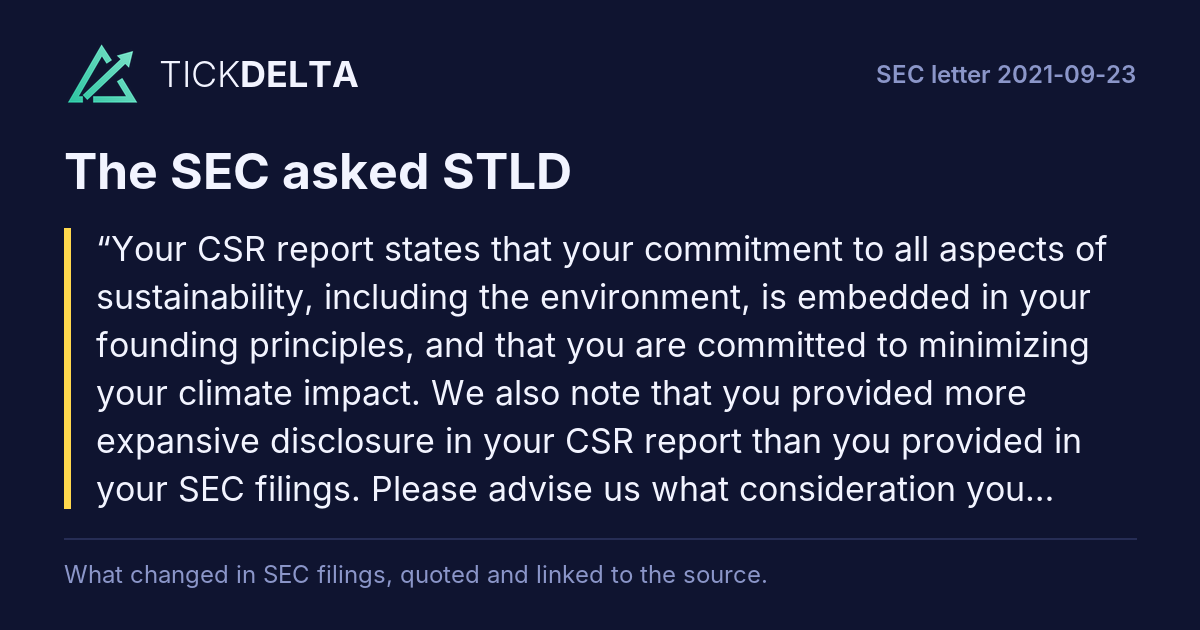
Your CSR report states that your commitment to all aspects of sustainability, including the environment, is embedded in your founding principles, and that you are committed to minimizing your climate impact. We also note that you provided more expansive disclosure in your CSR report than you provided in your SEC filings.Rest of the question
Please advise us what consideration you gave to providing the same type of climate-related disclosure in your SEC filings as you provided in your CSR report.
The Company respectfully acknowledges the Staff’s comment. Since the Company’s founding, sustainability has been part of the Company’s long-term value creation, as demonstrated by its dedication to its people, communities, and environment. The Company’s core strategic pillars of Culture and
Innovation have driven its team to focus on resource sustainability and next-generation technologies and processes.Read in the reply ↗Rest of the answer
To this end, the Company employs a circular manufacturing model and only produces steel using electric arc furnace (“EAF”) technology, which uses recycled ferrous scrap from manufacturing and end-of life items, such as automobiles, appliances, and machinery, as the primary raw material, and generates a mere fraction of the greenhouse gas emissions produced and energy intensity required by traditional blast furnace steelmaking technology, which dominates global steelmaking. The Company evaluates its greenhouse gas emissions by regularly reviewing furnace performance and efficiency. The Company analyzes the latest available technologies to also determine whether greenhouse gas emissions can be minimized.
The Company’s greenhouse gas mitigation strategy is integral to its overarching sustainability program to address climate-related considerations.
In determining climate-related disclosures in the Company’s
SEC filings, it considers all available information to determine any disclosures required in its Business, Risk Factors, Legal Proceedings, and Management’s Discussion and Analysis of Financial Condition and Results of Operations (“MD&A”) sections of its
Form 10-K, in each case in accordance with Regulation S-K, Regulation S-X, Exchange Act Rule 12b-20, and the SEC 2010 Guidance
Regarding Disclosure Related Climate Change (the “2010 Guidance”).
Given the Company’s commitment to sustainability, it provided relevant climate-related disclosures in the Business section of its Form 10-K. It further recognized that there are many uncertainties surrounding the impact of climate change on its business, including any regulation or legislation, and provided additional disclosures in the Risk Factors section of its Form 10-K, as deemed appropriate. Based on a comprehensive consideration of available information, the Company determined that there were no known trends, events, demands, commitments or uncertainties that were reasonably likely to have a material effect on the financial condition or operating performance of the Company, that any known trends were not reasonably likely to have such a material effect, and that the information it disclosed in the MD&A section of its Form 10-K consisted of the material information it believed promoted an understanding of its financial condition, liquidity and capital resources, changes in financial condition, and results of operations. The Company believed that the disclosures in the MD&A section of its Form 10-K enabled investors to see the Company through the eyes of management, enhanced overall financial disclosure and provided context within which financial information should be analyzed, and provided information about the quality of, and potential variability of, the Company’s earnings and cash flow, so that investors could ascertain the likelihood that past performance is indicative of future performance. Additionally, based on conversations with its equity investor base, the Company provided relevant governance-related sustainability disclosures directly in its Proxy Statement.
The Company, in considering climate-related discourse in its future SEC filings, will continue to consider all relevant facts and circumstances that may require disclosure. It will continue to follow the 2010 Guidance, as well as all other current and future rules and guidance related to climate-related disclosure.
First report after the company's reply of 2021-10-14: 10-Q filed 2021-11-02 ↗, against the 10-Q filed 2021-07-26 ↗.
Tickdelta does not hold the text of both reports, so they are not compared here.
To the extent material, discuss the indirect consequences of climate-related regulation or business trends, such as the following: • decreased demand for goods or services that produce significant greenhouse gas emissions or are related to carbon-based energy sources; • increased demand for goods or services that result in lower emissions than competing products; • increased competition to develop innovative newRest of the question
products and services that result in lower emissions; and • any anticipated reputational risks resulting from operations or products that produce material greenhouse gas emissions.
The Company respectfully acknowledges the Staff’s comment and confirms that it did not experience during the periods covered by the Form 10-K, or reasonably expect at the time of the filing of the Form 10-K, any material indirect consequences of climate-related regulation or business trends, including those specifically listed in the Comment Letter. The Company only produces steel using EAF technology, which generates a mere fraction of the greenhouse gas emissions produced and energy intensity required by traditional blast furnace steelmaking technology.Read in the reply ↗Rest of the answer
Although the Company’s products are produced by a technology that generates lower greenhouse gas emissions than many of its competitors, it has not experienced significant price premiums for such products. In the event the Company experiences any material indirect consequences of climate-related regulation or business trends, or reasonably expects any such material indirect consequences of climate-related regulation or business trends, it will, in future filings, discuss such material indirect consequences, including those, if any, noted above.
First report after the company's reply of 2021-10-14: 10-Q filed 2021-11-02 ↗, against the 10-Q filed 2021-07-26 ↗.
Tickdelta does not hold the text of both reports, so they are not compared here.
If material, discuss the significant physical effects of climate change on your operations and results. This disclosure may include quantification of material weather-related damages to your property or operations and any weather-related impacts on the cost or availability of insurance.
and confirms that it did not experience any material physical effects of climate change on its operations and results, during the periods covered by the Form 10-K. The Company has not experienced any material weather-related damages to its property or operations. In addition, the Company has not experienced a lack of availability or a material increase in its insurance programs.Read in the reply ↗Rest of the answer
In the event the Company experiences any such material items, it will, in future filings, discuss the significant physical effects of climate change on its operations and results, which may include, if applicable, quantification of material weather-related damages to its property or operations and any weather-related impacts on the cost or availability of insurance.
First report after the company's reply of 2021-10-14: 10-Q filed 2021-11-02 ↗, against the 10-Q filed 2021-07-26 ↗.
Tickdelta does not hold the text of both reports, so they are not compared here.
If material, provide disclosure about your purchase or sale of carbon credits or offsets and any material effects on your business, financial condition, and results of operations. We remind you that the company and its management are responsible for the accuracy and adequacy of their disclosures, notwithstanding any review, comments, action or absence of action by the staff.
and confirms that it did not engage in purchases or sales of carbon credits or offsets during the periods covered by the Form 10-K.
*****
If you have any further questions or comments concerning these responses, please contact the undersigned by telephone at 260.969.3567. Read in the reply ↗
First report after the company's reply of 2021-10-14: 10-Q filed 2021-11-02 ↗, against the 10-Q filed 2021-07-26 ↗.
Tickdelta does not hold the text of both reports, so they are not compared here.
We note your response to prior comment 2, and reissue our comment. Your statement that you have not experienced any material indirect consequences of climate-related regulation or business trends appears to be conclusory without providing sufficient detail. Please provide us with additional support for your conclusion, including with regard to the individual items noted in our prior comment.
The Company respectfully acknowledges the Staff’s comment and confirms that it did not experience during the periods covered by the Form 10-K, or reasonably expect at the time of the filing of the Form 10-K, any material indirect consequences of climate-related regulation or business trends, including those specifically listed in the Staff’s prior comment 2.Read in the reply ↗Rest of the answer
The Company maintains a robust program of internal controls over financial reporting, including financial statement and other disclosures, consistent with the Committee of Sponsoring Organizations of the Treadway Commission (2013 framework) (the COSO criteria), and the Sarbanes-Oxley Act of 2002. Effective internal controls and procedures are in place to ensure full and fair disclosure of material information pertaining to the Company’s business is accurate, complete, timely and understandable, in accordance with the requirements of the SEC, the Nasdaq Stock Market and applicable law.
The Company’s annual reports are prepared under the direction of its Chief Financial Officer, and is supervised and reviewed by its Vice President and Corporate Controller and its Financial
Accounting and Reporting Director, all of which are familiar with SEC reporting requirements. On a routine basis, information is sought from each reporting division to understand overall operating results, any current or anticipated business trends and significant unusual or infrequent transactions or events (which includes any significant weather-related events) in their respective operations.
When unusual or infrequent transactions or events are identified, follow-up discussions may include, among others, the Company’s Senior Executives, Vice Presidents and General Managers for the impacted reporting division, and other employees at the reporting division. Based upon a clear understanding of the reporting divisions overall operating results, business trends and significant unusual or infrequent transactions or events, the necessity for financial or other disclosures is evaluated based upon current financial and other disclosure guidance, which are reviewed by the Financial Accounting and
Reporting Director and the Vice President and Corporate Controller, prior to being provided to our external auditors.
Once the annual report has been drafted and internally reviewed by the Company’s Director of Financial Accounting and Reporting, Vice President and Corporate Controller and Chief Financial Officer, it is then distributed to the Company’s external auditors and legal counsel for further review. Finally, prior to issuance, the relevant annual report is then provided to the Company’s full Board of Directors for review and signing.
During the period covered by the Form 10-K, the Company did not experience or reasonably expect to experience any material decreased demand for goods or services that produce significant greenhouse gas emissions or are related to carbon-based energy sources. Steel remains a vital component of the United States infrastructure and defense programs. The Company attributed any decreased demand in steel during 2020 to COVID-19 and related shutdowns. The Company also did not experience or reasonably expect to experience any material increased demand for goods or services that result in lower emissions than competing products. The Company believes that its circular manufacturing model, by which end-of-life steel products are recycled and used as a raw material in its steel manufacturing process is important to some customers, it is not a driver of any material increased demand.
The Company also did not experience or reasonably expect to experience any material increased competition to develop innovative new products and services that result in lower emissions. At the time of filing the Form 10-K, the Company had not received requests from customers or potential customers to develop new products that result in lower emissions and which would have a material impact on the Company. Finally, given the Company’s use of technology that generates lower greenhouse gas emissions than many of its competitors, it did not anticipate any material reputational risks resulting from operations or products that produce material greenhouse gas emissions.
The Company will continue to employ its robust program to ensure it has effective disclosure controls and procedures to provide full and fair disclosure of material information pertaining to the
Company’s business. As part of that program, it will continue to evaluate current and anticipated business trends and disclose any material indirect consequences of any such business trends or climate-related regulation in its future SEC filings.
First report after the company's reply of 2021-11-19: 10-K filed 2022-02-28 ↗, against the 10-K filed 2021-03-01 ↗.
Tickdelta does not hold the text of both reports, so they are not compared here.
Your response to prior comment 2 indicates that your products are produced by technology that generates lower greenhouse gas emissions than many of your competitors, yet you have not experienced significant price premiums for your products. Please describe how you analyzed prices and determined whether premiums were significant.Rest of the question
Please also tell us what consideration you gave to providing disclosure regarding opportunities resulting from increased demand for goods that generate lower greenhouse gas emissions than competing products.
and confirms that during the periods covered by the Form 10-K it did not charge a price premium due to its products being produced by a technology that generates lower greenhouse gas emissions than many of its competitors. As stated on page 33 of the Form 10-K, the Company charges premium prices for certain grades of steel, product dimension, certain smaller volumes and for value-added processing or coating of its steel products.Read in the reply ↗Rest of the answer
No price premium is achieved relative to the Company’s competitors due to the Company’s products being produced using technology that generates lower greenhouse gas emissions. The Company refers the Staff to the Company’s response to Question 1 of this Comment Letter for a discussion regarding its controlled process for coming to this conclusion, and for our consideration to providing disclosure regarding opportunities resulting from increased demand for goods that generate lower greenhouse gas emissions than competing products.
First report after the company's reply of 2021-11-19: 10-K filed 2022-02-28 ↗, against the 10-K filed 2021-03-01 ↗.
Tickdelta does not hold the text of both reports, so they are not compared here.
Your response to prior comment 3 indicates that you have not experienced any material weather-related damages to your property or operations, or a lack of availability or material increase in your insurance programs. Please provide information in support of your conclusions. Describe the weather-related damages you have experienced and the impact on your business, financial condition, and results of operations.Rest of the question
Explain how you analyzed materiality and, to the extent you quantified amounts such as weather-related damages and/or changes in the cost or availability of insurance, please provide us with your quantification analysis.
The Company respectfully acknowledges the Staff’s comment.
The Company did not experience any weather-related damages to its property or operations in 2020 or 2019. In 2018, the Company’s idled scrap recycling facility located in Wilmington, North Carolina experienced damages related to Hurricane Florence in the aggregate amount of $2.2 million, of which insurance covered all but the $500,000 deductible.Read in the reply ↗Rest of the answer
Given that the facility was idled, it had no impact on the Company’s business operations, and an exceedingly insignificant impact on its financial condition and results of operations.
The $2.2 million in damages represents only .02% of total assets and only .05% of the net book value of property, plant and equipment at December 31, 2018, and the $500,000 loss represents only .03% of 2018 pretax income.
Throughout the period covered by the Company’s Form 10-K, the Company was able to maintain consistent insurance coverage limits. During this period, the Company’s cost of insurance increased by only .18% of pretax income in 2019, and by only .30% of pretax income in 2020, each increase being insignificant to the Company’s results of operations. Additionally, during the Company’s discussions with its insurance brokers during this timeframe, weather-related concerns were not raised as a topic that were driving insurance costs.
*****
If you have any further questions or comments concerning these responses, please contact the undersigned by telephone at 260.969.3567.
First report after the company's reply of 2021-11-19: 10-K filed 2022-02-28 ↗, against the 10-K filed 2021-03-01 ↗.
Tickdelta does not hold the text of both reports, so they are not compared here.
Also in this review: closing letter, 2022-01-20