Screener / SEC EDGAR /CIK 0001013934 /10-K filed Feb 27, 2026, compared with Feb 27, 2025 /Numbers from the XBRL of the 10-Ks
Nasdaq Consumer discretionary · Educational Services

Strategic Education, Inc. STRA

Compare with peers Embed
New in the 10-K 16 paragraphs with nothing like them in the 10-K filed Feb 27, 2025 New in the 10-Q 29 paragraphs not in the 10-Q filed Jul 29, 2026 10-Q against the 10-K 13 risk factor paragraphs and sentences added or reworded

New risk paragraphs, branching off last year

Each branch is a paragraph in Risk Factors with nothing like it in the 10-K filed Feb 27, 2025. A box jumps to the paragraph as filed, below.

16 new

Paragraphs with nothing like them in last year's 10-K

Quoted exactly

16 paragraphs in Risk Factors of the 10-K filed Feb 27, 2026 with nothing like them in the 10-K filed Feb 27, 2025. Quoted exactly. Paragraphs that were only edited are under 10-K change.

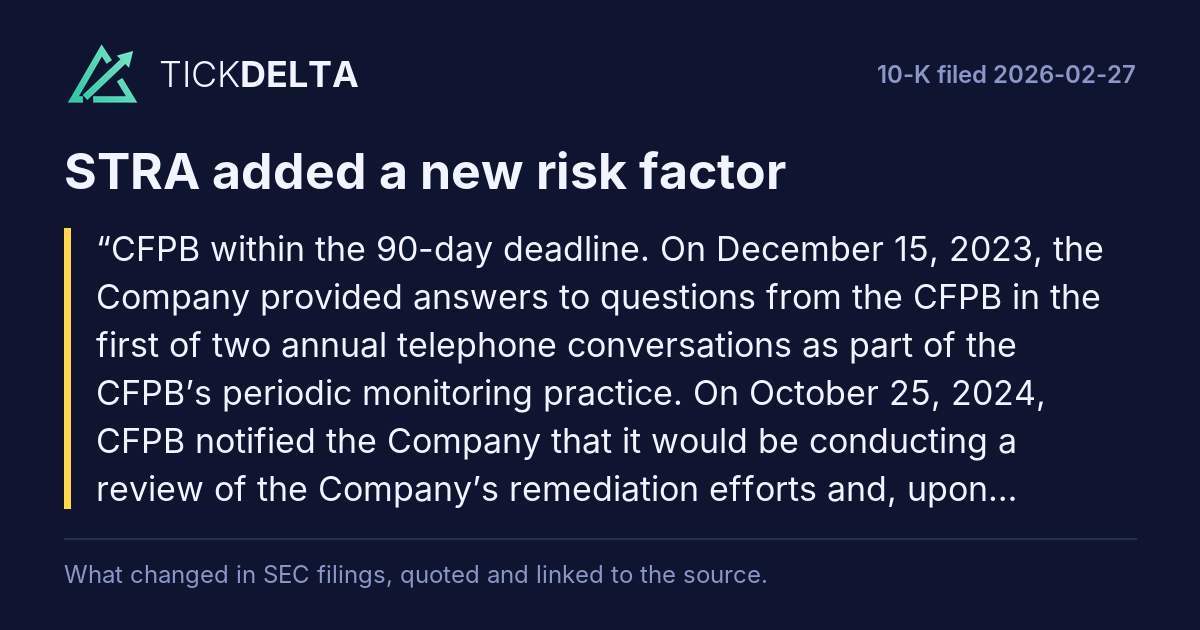
CFPB within the 90-day deadline. On December 15, 2023, the Company provided answers to questions from the CFPB in the first of two annual telephone conversations as part of the CFPB’s periodic monitoring practice. On October 25, 2024, CFPB notified the Company that it would be conducting a review of the Company’s remediation efforts and, upon completion, will determine whether it will close the 2022 exam.

Read in the 10-K

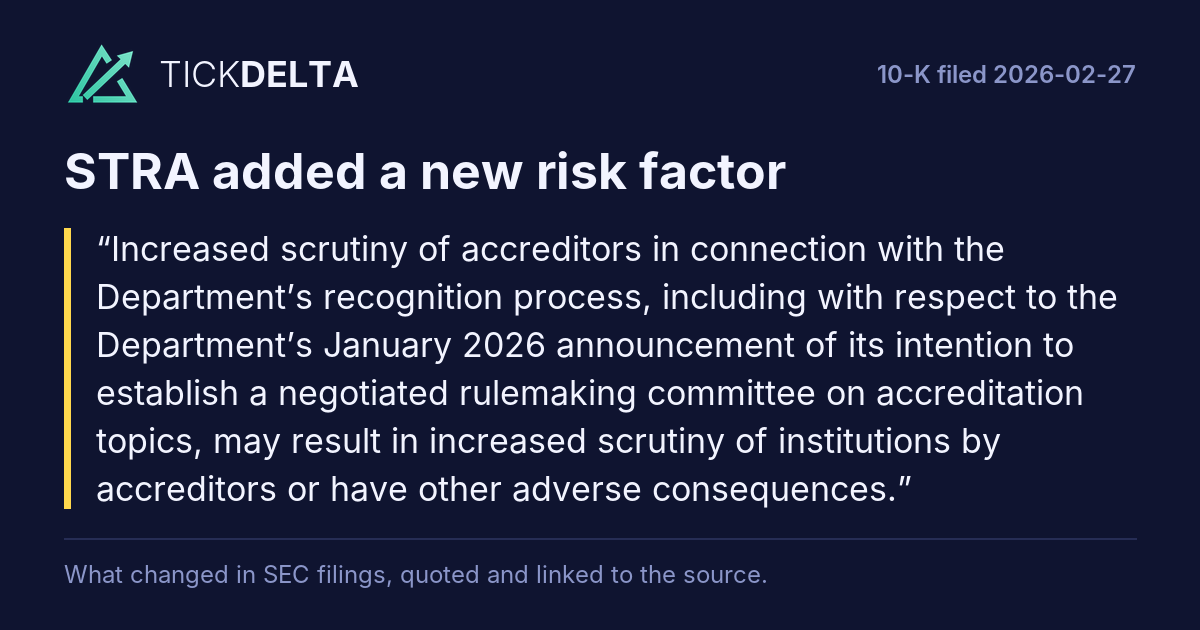
Increased scrutiny of accreditors in connection with the Department’s recognition process, including with respect to the Department’s January 2026 announcement of its intention to establish a negotiated rulemaking committee on accreditation topics, may result in increased scrutiny of institutions by accreditors or have other adverse consequences.

Read in the 10-K

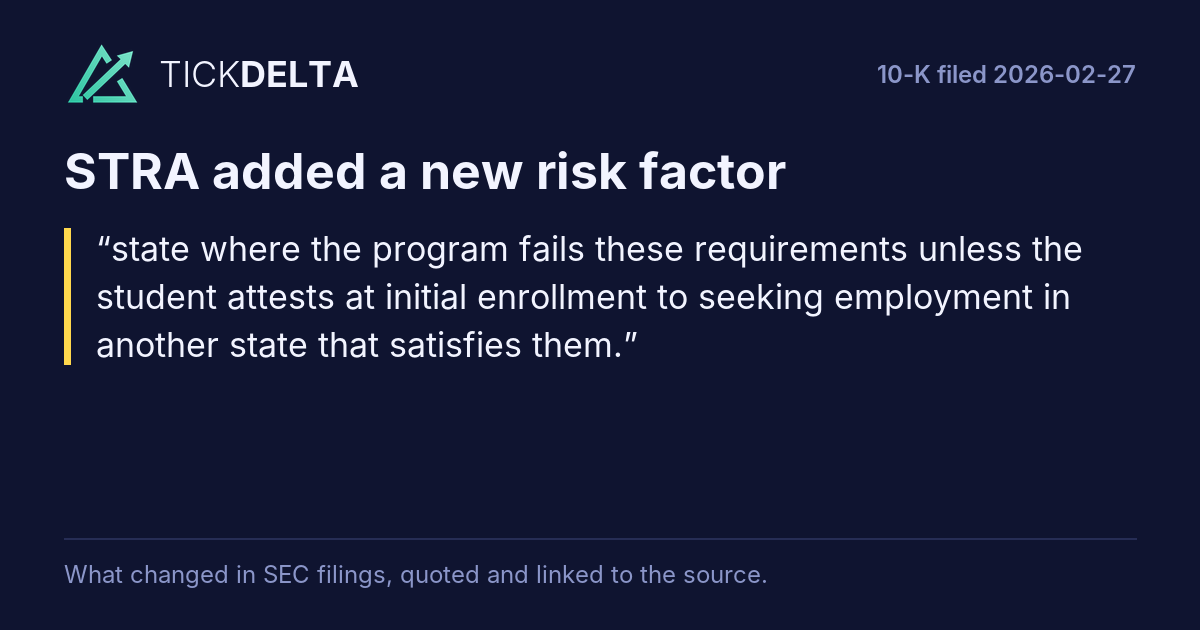
state where the program fails these requirements unless the student attests at initial enrollment to seeking employment in another state that satisfies them.

Read in the 10-K

The National Council for State Authorization Reciprocity Agreements (“NC-SARA”) considers potential policy changes each year. Past proposals, including more stringent standards for participation of for-profit institutions or exclusion of for-profit institutions from participation, were not adopted, but illustrate the risk that future changes could materially adversely affect Capella University, Strayer University, and the Company. For example, exclusion from SARA would require seeking authorization in each state, increasing costs and risking denials in some jurisdictions. NC-SARA began its 2025 policy modification process in January 2025 with a call for proposals. In September 2025, NC-SARA announced approval of nine policy changes by all four regional compacts, later adopted by the NC-SARA board. The next modification process is expected to begin in January 2026. Adoption of proposals affecting institutional participation could have a material adverse effect on Capella University, Strayer University, and the Company.

Read in the 10-K

The One Big Beautiful Bill Act was signed into law on July 4, 2025 and makes changes to federal student loan repayment plans, among other things. Between September 2025 and November 2025, a negotiated rulemaking committee met and reached consensus on proposed Department regulations to implement the OBBBA’s federal student loan-related changes, and the Department released proposed regulations on January 29, 2026 for public comment through March 2, 2026. OBBBA and regulatory provisions that change repayment plans could affect borrowers’ ability to repay their student loans and could result in an increased number of borrowers defaulting on their student loans, including among our graduates.

Read in the 10-K
Show the other 7

The Higher Education Act prohibits an institution that participates in Title IV programs from engaging in “substantial misrepresentation” of the nature of its educational program, its financial charges, or the employability of its graduates. The Department of Education has issued various regulations over the years that defined misrepresentation, including as it relates to BDTR claims.

Read in the 10-K

On October 2, 2025, the U.S. District Court for the Northern District of Texas upheld the 2023 Gainful Employment Rule, rejecting challenges from plaintiff cosmetology schools and associations. Accordingly, the 2023 Gainful Employment Rule remains in effect; programs failing the metrics for two of three consecutive years risk losing federal student aid. Plaintiffs filed a notice to appeal in November 2025.

Read in the 10-K

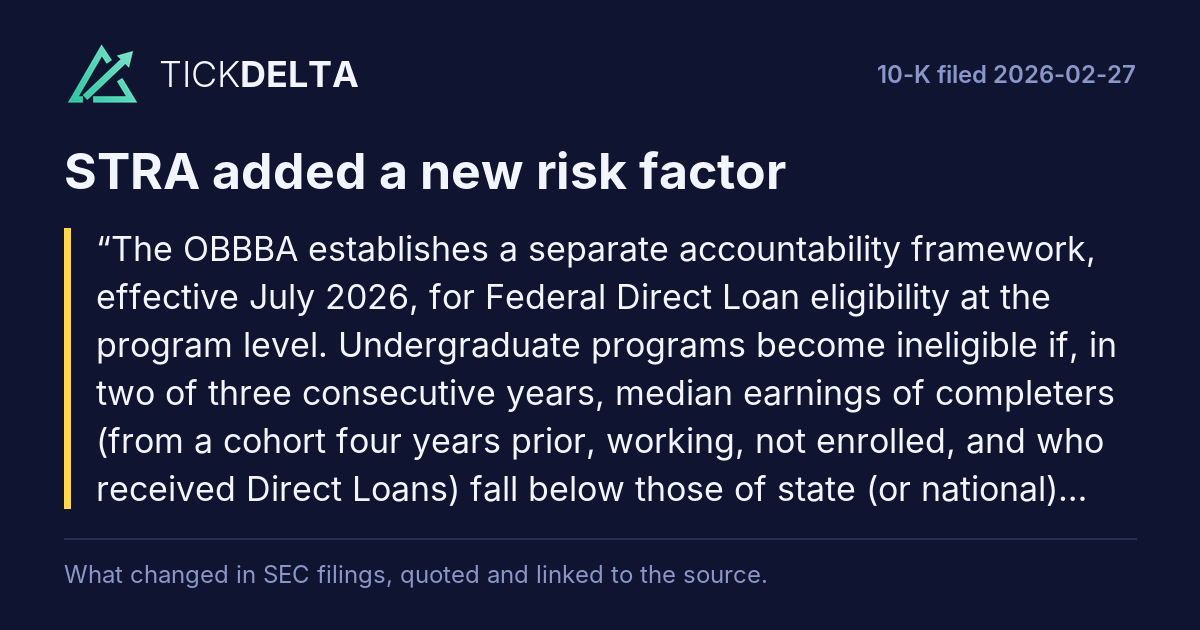
The OBBBA establishes a separate accountability framework, effective July 2026, for Federal Direct Loan eligibility at the program level. Undergraduate programs become ineligible if, in two of three consecutive years, median earnings of completers (from a cohort four years prior, working, not enrolled, and who received Direct Loans) fall below those of state (or national) working adults aged 25-34 with only a high school diploma. Graduate/professional programs become ineligible if completers’ median earnings fall below those of working adults aged 25-34 with only a bachelor’s degree, using Census data and the lesser of state or national comparators in the field or overall (with national fallback if fewer than 50% of students are in-state). Small cohorts (less than 30) may be aggregated. One-year failures trigger risk notifications; an appeals process is required, with eligibility continuing during appeals. Ineligible programs may reapply after two years per Secretary-established rules.

In January 2026, the Department convened a negotiated rulemaking committee to consider, among other things, institutional and programmatic accountability (including with respect to low earnings outcomes, gainful employment, and financial value transparency); the committee reached consensus on the accountability package. The Department intends to publish final rules effective July 2026 (for OBBBA-related provisions) and July 2027 (for gainful employment-related provisions).

Read in the 10-K

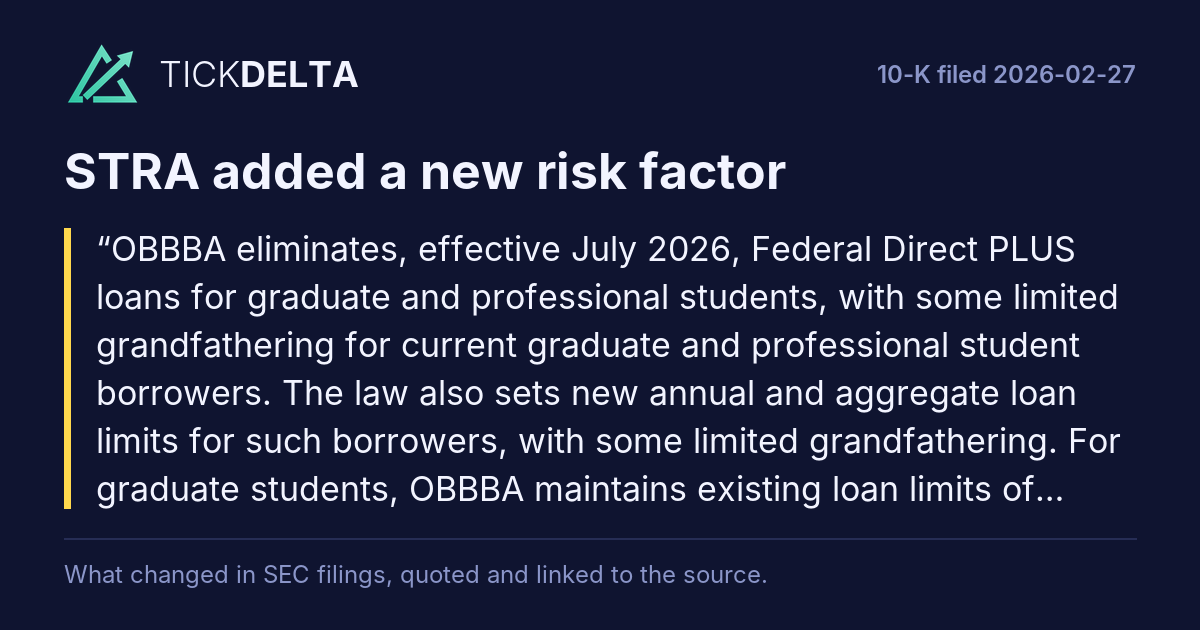
OBBBA eliminates, effective July 2026, Federal Direct PLUS loans for graduate and professional students, with some limited grandfathering for current graduate and professional student borrowers. The law also sets new annual and aggregate loan limits for such borrowers, with some limited grandfathering. For graduate students, OBBBA maintains existing loan limits of $20,500 annually for unsubsidized loans in the Direct Loan Program; for professional students enrolled on or after July 1, 2026, OBBBA raises the annual limits to $50,000. For graduate students who are not and have not been professional students, the new aggregate graduate loan limit is $100,000, irrespective of any undergraduate borrowing. With respect to graduate students who are or have been professional students, the aggregate graduate loan limit is generally $200,000 minus the amounts borrowed for the professional degree program. With respect to professional students, the aggregate graduate loan limit is generally $200,000 minus certain other previously borrowed amounts, including certain subsidized loans and amounts borrowed as a graduate student, if applicable. OBBBA also created a lifetime maximum aggregate amount for Title IV loans that a student may borrow of $257,500 (other than a loan made to the student as a parent borrower on behalf of a dependent student). OBBBA provides institutions the opportunity to limit the amount of loans a student may borrow in an academic year as long as any such limit is applied consistently to all students enrolled in such program of study. Additionally, OBBBA requires that the amount of loan funds available under a student’s annual loan eligibility must be reduced in direct proportion to the degree to which that student is not enrolled on a full-time basis during an academic year; the Department initially indicated in July 2025 that it planned to release a schedule of reductions for public comment later in 2025, which institutions would be required to use for students who enrolled less than full-time for academic years 2026-27 and beyond. However, in connection with negotiated rulemaking, consensus was reached in November 2025 on regulatory text that would establish loan eligibility at the time of disbursement using an agreed calculation for less than full-time students, and proposed regulations were released in January 2026.

Effective July 2026, students with a Student Aid Index that equals or exceeds twice the maximum Pell Grant amount will be ineligible for Pell Grants. A student will also be ineligible for a Federal Pell Grant during any period for which the student receives grant aid from a non-federal source (including states, institutional aid, or private sources) in an amount that equals or exceeds the student’s cost of attendance. Additionally, OBBBA creates Workforce Pell Grants effective July 2026 for students enrolled in eligible workforce programs. Eligible workforce programs must meet a specific definition, including that they are accredited, short-term, career-focused programs (150 to 600 clock hours of instruction over 8 to 15 weeks), which prepare students to pursue one or more certificate or degree programs. In addition, they must be approved by the state governor, aligned with high-demand, high-skill or high-wage jobs, have at least 70% completion and job placement rates, and tuition must be less than the value-added earnings of graduates who received the Workforce Pell Grant. Workforce Pell Grants may not be combined with a regular Pell grant.

Changes in the availability of Title IV funds could affect students’ ability to fund their education and thus may have a material adverse effect on our enrollment, financial condition, results of operations, and cash flows.

Read in the 10-K

University or Strayer University to incur costs of litigation and costs to modify its online classrooms and other uses of technology.

Read in the 10-K

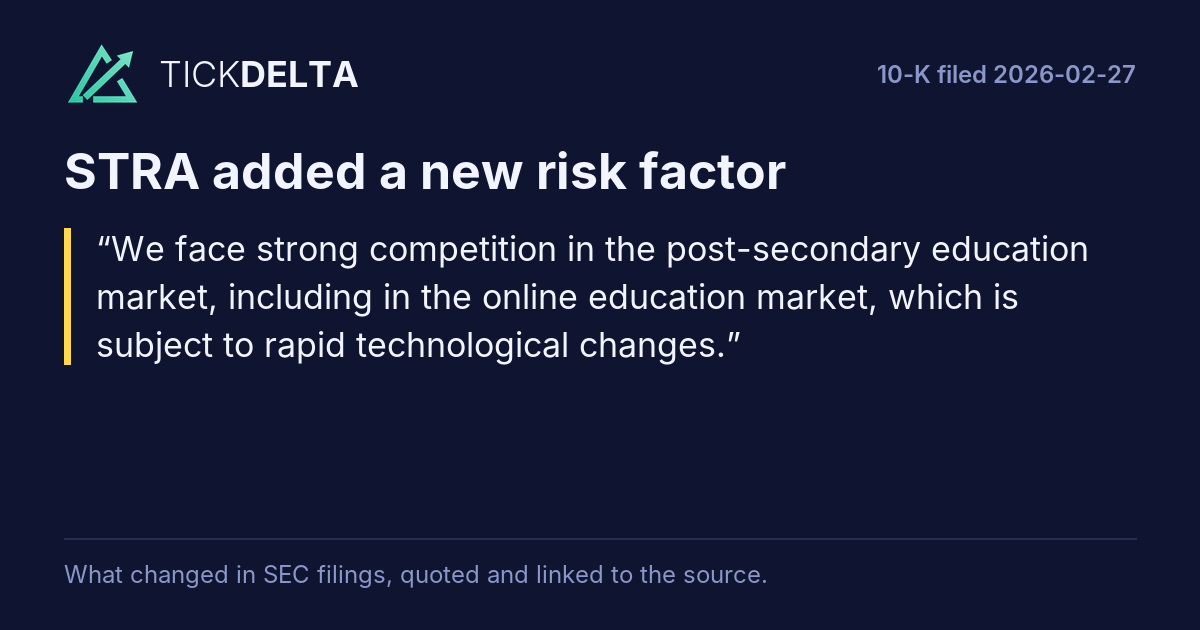
We face strong competition in the post-secondary education market, including in the online education market, which is subject to rapid technological changes.

Read in the 10-K

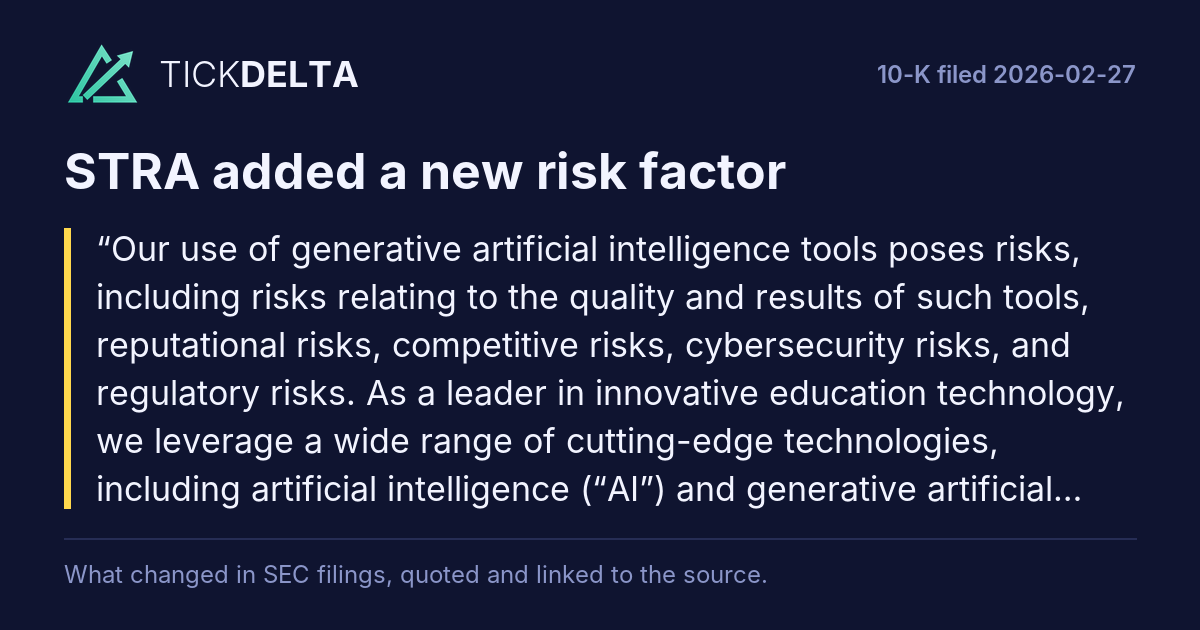
Our use of generative artificial intelligence tools poses risks, including risks relating to the quality and results of such tools, reputational risks, competitive risks, cybersecurity risks, and regulatory risks.

As a leader in innovative education technology, we leverage a wide range of cutting-edge technologies, including artificial intelligence (“AI”) and generative artificial intelligence (“GAI Tools”) to enhance our employees’ and students’ experiences, as well as to increase productivity and efficiency. GAI Tools are becoming more prevalent across many industries, including higher education. Despite our policies and practices carefully designed to provide for human oversight and compliance with existing higher education regulations as well as evolving AI-related laws and regulations, our use of these emerging technologies presents several risks. First, the effectiveness of GAI Tools depends heavily on the quality of the algorithms, the training data they use, and the nature of prompts. There is a risk that GAI Tools might generate inaccurate, biased, or misleading content, which could result in litigation, liability, and/or reputational damage. Second, the rapid pace of technological development in GAI Tools could lead to new or increased competition or render obsolete certain technologies or tools we use or develop. If we fail to keep pace with GAI Tool-related developments, we might become less competitive. Third, there is risk that use of GAI Tools may be found to infringe on third party intellectual property rights or may contribute to violations of data privacy laws. Fourth, the rapid evolution and increased adoption of AI technologies may increase our cybersecurity risks. Fifth, the regulatory environment for GAI Tools is rapidly evolving. New or existing legislation or regulations might impose restrictions on how GAI Tools can be used, requiring us to adapt our tools, incur increased compliance costs, or face various penalties for non-compliance, including potential disgorgement of data and associated capabilities from the models. These risks could adversely impact our business, financial condition, and results of operations, as well as our reputation.

Read in the 10-K

Paragraphs in the 10-Q filed Nov 5, 2026 that were not in the one before

New in the latest 10-Q

29 paragraphs in the 10-Q filed Nov 5, 2026 with nothing like them in the 10-Q filed Jul 29, 2026 (at least half the words must differ; new numbers alone do not count). Quoted exactly, grouped by the item heading above them. This is text that changed, not a judgement of how serious it is.

Financial statements and notes

Impairment of goodwill and intangible assets includes impairment charges related to the Company’s acquisition of Torrens University and associated assets in Australia and New Zealand. See Note 7 for additional information.

Read in the 10-Q

(1) For the three and nine months ended September 30, 2026, all stock awards were excluded from the diluted loss per share calculation because the Company reported a net loss and their inclusion would have been anti-dilutive. The anti-dilutive shares excluded represent the weighted-average gross number of shares underlying all potentially dilutive stock awards, including awards that would have been anti-dilutive regardless of the Company’s net loss.

Read in the 10-Q

The Company recorded net losses related to the early termination of leases of approximately $ 0.2 million during the three and nine months ended September 30, 2026. These net losses reflect the reduction of the lease liability for payments that will no longer be required and the corresponding adjustment to the related right‑of‑use asset, if any, net of cash payments made in connection with the early termination. These right-of-use lease asset impairments, fixed asset impairments, loss on assets

Read in the 10-Q

classified as held for sale, and net losses from early lease terminations are included in Restructuring costs on the unaudited condensed consolidated statements of income (loss).

Read in the 10-Q

During the third quarter of 2026, the Company concluded that continued declines in ANZ student enrollment, additional migration-related policies announced by the Australian government that extended uncertainty regarding the duration of existing international enrollment regulatory constraints, with no indication of whether or when these constraints would be eased, and a shortfall in ANZ’s financial performance relative to its operating plan collectively represented a triggering event that warranted an interim quantitative impairment assessment of the goodwill and indefinite-lived intangible assets assigned to the ANZ reporting unit as of September 30, 2026.

Read in the 10-Q
Show the other 24

To assess goodwill for impairment, the Company utilized a combination of an income approach and a market approach to determine the fair value of the ANZ reporting unit. The income approach consisted of a discounted cash flow model that included projections of future cash flows for the reporting unit, calculating a terminal value, and discounting such cash flows by a risk adjusted rate of return. The market approach was based on revenue multiples derived from a group of selected guideline public companies operating in the education sector. The Company believes that the most critical assumptions and estimates used in determining the estimated fair value of the ANZ reporting unit include, but are not limited to, the amounts and timing of expected future cash flows, revenue growth, operating margins, the discount rate, the terminal growth rate, and, for the market approach, the selection of guideline public companies and their related revenue multiples. The assumptions used in determining the expected future cash flows consider various factors such as historical operating trends, particularly in student enrollment and pricing, anticipated economic and regulatory conditions, reasonable expectations for planned business expansion opportunities, and long-term operating strategies and initiatives. The discount rate is based on the Company’s assumption of a prudent investor’s required rate of return for assuming the risk of investing in the ANZ reporting unit. The terminal growth rate reflects the sustainable operating income a reporting unit could generate in a perpetual state as a function of revenue growth, inflation, and future margin expectations. The guideline public companies used in the market approach were selected based on their similarity to the ANZ reporting unit, including consideration of industry, service offerings, and other relevant factors. The Company believes that these assumptions are consistent with a reasonable market participant view while employing the concept of highest and best use of the asset. These fair value measurements are based on significant unobservable inputs and therefore represent Level 3 measurements within the fair value hierarchy.

Read in the 10-Q

Based on the results of this quantitative impairment assessment, the Company concluded that the carrying value of the ANZ reporting unit exceeded its estimated fair value by $ 127.0 million. Accordingly, the Company recognized a goodwill impairment charge of $ 127.0 million during the three and nine months ended September 30, 2026, representing the full excess of carrying value over fair value, as this amount did not exceed the total goodwill allocated to the reporting unit. The impairment charge is included in the Impairment of goodwill and intangible assets line on the unaudited condensed consolidated statements of income (loss). No events or circumstances occurred in the three and nine months ended September 30, 2026 to indicate an impairment to goodwill within the Company’s other reporting units. There were no impairment charges related to goodwill recorded during the three and nine months ended September 30, 2025.

Read in the 10-Q

In connection with the interim impairment assessment described above, the Company also performed a quantitative impairment assessment of the ANZ indefinite-lived trade name intangible asset as of September 30, 2026. The Company used an income-based approach to determine the fair value of the ANZ trade name. The income approach consisted of a discounted cash flow model, using the relief from royalty method, which included a projection of future revenues for ANZ, identifying a royalty rate, calculating a terminal value, and discounting such cash flows by a risk adjusted rate of return.

Read in the 10-Q

The Company believes that the most critical assumptions and estimates used in determining the estimated fair value of the ANZ trade name include, but are not limited to, the amounts and timing of future revenue growth rates, the royalty rate, the discount rate, and the terminal growth rate. The assumptions used in determining the expected future revenue growth rates consider various factors such as historical operating trends, particularly in student enrollment and pricing, anticipated economic and regulatory conditions, reasonable expectations for planned business expansion opportunities, and long-term operating strategies and initiatives. The royalty rate is based on the Company’s assumption of what a reasonable market participant would pay to license the ANZ trade name, expressed as a percentage of revenues. The discount rate is based on the Company’s assumption of a prudent investor’s required rate of return for assuming the risk of investing in a particular company. The terminal growth rate reflects the sustainable revenue growth the business could generate in a perpetual state as a function of inflationary expectations. The Company believes that these assumptions are consistent with a reasonable market participant view while employing the concept of highest and best use of the asset. These fair value measurements are based on significant unobservable inputs and therefore represent Level 3 measurements within the fair value hierarchy.

Read in the 10-Q

The Company’s effective income tax rate was 27.6 % and ( 12.6 )% for the three months ended September 30, 2025 and 2026, respectively, and 28.6 % and 514.8 % for the nine months ended September 30, 2025 and 2026, respectively. The rate for the three months ended September 30, 2026 reflects income tax expense recognized on a pre-tax loss, primarily attributable to a non-deductible goodwill impairment charge recorded during the quarter. The impairment charge was also the primary driver of the higher effective income tax rate for the nine months ended September 30, 2026.

Read in the 10-Q

decisions for purposes of the False Claims Act in connection with federal grants and contracts.” Various lawsuits challenging Executive Order 14173 were filed in federal district court. Although the U.S. District Court for the District of Maryland initially granted a preliminary injunction enjoining portions of the executive order, the U.S. Court of Appeals for the Fourth Circuit stayed the injunction and, on February 6, 2026, vacated the injunction and remanded the case to the district court. After the district court denied another injunction, plaintiffs voluntarily dismissed the complaint without prejudice “in light of specific representations made by the government... about the narrow scope of the Executive Orders challenged in this case and the decision of the Fourth Circuit accepting those representations and recognizing that narrow scope” (i.e., that the Executive Orders did not seek to establish new law related to DEI). The district court terminated the case on June 30, 2026.

Read in the 10-Q

On July 23, 2026, the Department announced its rescission of several disparate-impact provisions from the Title VI implementing regulations. The Department indicated the action aligns with President Trump’s April 23, 2025 Executive Order 14281 “Restoring Equality of Opportunity and Meritocracy” which ordered agencies, among other matters, to “deprioritize enforcement of all statutes and regulations to the extent they include disparate-impact liability” and the Attorney General to “initiate appropriate action to repeal or amend the implementing regulations for Title VI of the Civil Rights Act of 1964 for all agencies to the extent they contemplate disparate-impact liability.” On October 19, 2026, the U.S. Supreme Court granted certiorari in Association for Education Fairness v. Montgomery County Board of Education, Docket No. 26-12, on the question “whether a plaintiff alleging that a school district implemented facially-neutral admissions criteria for a racially discriminatory purpose must show that the criteria produced a disparate impact on the targeted racial group before a court may consider evidence of discriminatory intent.”

Read in the 10-Q

On October 1, 2026, the Australian Government announced that the National Code of Practice for Providers of Education and Training to Overseas Students 2018 was amended to impose a longer transfer restriction period for international students, affecting onshore transfers from other providers.

Read in the 10-Q

Separately, during the third quarter of 2026, a new representative proceeding was commenced against Torrens. The proceeding alleges that Torrens underpaid casual academics by failing to pay them separately for marking and other tasks. The Company intends to defend against these claims vigorously and is unable to predict the outcome or financial impact of this proceeding at this time. Accordingly, no provision has been recognized. Refer to Note 16 - Litigation - within the footnotes to the unaudited condensed consolidated financial statements for additional information regarding these matters.

Read in the 10-Q

sources. Management regularly reviews its estimates and judgments for reasonableness and may modify them in the future. Actual results may differ from these estimates under different assumptions or conditions.

Read in the 10-Q

Taken together, we determined these developments represented a triggering event that warranted an interim impairment assessment of the goodwill assigned to the ANZ reporting unit and the ANZ trade name in advance of our annual testing date of October 1, 2026. We elected to bypass a qualitative impairment assessment and proceeded directly to a quantitative impairment assessment using September 30, 2026 as the assessment date.

Read in the 10-Q

To assess goodwill, we utilized a combination of an income approach and a market approach to determine the fair value of the ANZ reporting unit. The income approach consisted of a discounted cash flow model using a forecast period of 10 years, a discount rate of 11.5%, and a terminal growth rate of 3.0%. The market approach was based on revenue multiples of 1.30x to 1.50x derived from a group of selected guideline public companies operating in the education sector. Our conclusion of fair value for the ANZ reporting unit reflects a weighting of 75% for the income approach and 25% for the market approach, as we believe the income approach provides a more reliable indication of fair value for the reporting unit, with the market approach serving as corroborative support. We believe that the most critical assumptions and estimates used in determining the estimated fair value of the ANZ reporting unit include the amounts and timing of expected future cash flows, revenue growth, operating margins, the discount rate, the terminal growth rate, and, for the market approach, the selection of guideline public companies and their related revenue multiples. Refer to Note 7 - Goodwill and Intangible Assets - within the footnotes to the unaudited condensed consolidated financial statements for additional information regarding the methodology and nature of these assumptions.

Read in the 10-Q

Based on the results of this quantitative impairment assessment, we concluded that the carrying value of the ANZ reporting unit exceeded its estimated fair value by $127.0 million. Accordingly, we recognized a goodwill impairment charge of $127.0 million during the three and nine months ended September 30, 2026, representing the full excess of carrying value over fair value, as this amount did not exceed the total goodwill allocated to the reporting unit.

Read in the 10-Q

We also performed a quantitative impairment assessment of the ANZ trade name as of September 30, 2026. We used an income-based approach to determine the fair value of the ANZ trade name. The income approach consisted of a discounted cash flow model, using the relief from royalty method, with a forecast period of 10 years, a discount rate of 12.0%, a royalty rate of 2.5%, and a terminal growth rate of 3.0%. Based on the results of this assessment, we concluded that the carrying value of the ANZ trade name exceeded its estimated fair value by $7.1 million. Accordingly, we recognized an impairment charge of $7.1 million related to the ANZ trade name during the three and nine months ended September 30, 2026.

Read in the 10-Q

As of September 30, 2026, following these impairment charges, the ANZ reporting unit had $408.5 million of remaining goodwill and $60.0 million of remaining indefinite-lived intangible assets. As these impairment charges reduced the carrying value of the ANZ reporting unit’s goodwill and the ANZ trade name to their respective estimated fair values, no headroom remains. If ANZ’s operating performance does not progress in line with our projections, or if the discount rate, terminal growth rate, royalty rate, revenue projections, operating margins, or revenue multiples change adversely, the remaining goodwill and/or trade name could become further impaired in future periods. Management will continue to assess these assets for impairment in future quarters.

Read in the 10-Q

No events or circumstances occurred in the three and nine months ended September 30, 2026 to indicate an impairment to goodwill or indefinite-lived intangible assets related to any of our other reporting units.

Read in the 10-Q

Impairment of goodwill and intangible assets. Impairment of goodwill and intangible assets includes goodwill and indefinite-lived intangible asset impairment charges recorded in the third quarter of 2026 related to the Company’s acquisition of Torrens University and associated assets in Australia and New Zealand.

Read in the 10-Q

to higher revenue, partially offset by higher technology-related costs, corporate expenses, and increased investments in branding initiatives.

Read in the 10-Q

Impairment of goodwill and intangible assets. Impairment of goodwill and intangible assets includes goodwill and indefinite-lived intangible asset impairment charges recorded in the third quarter of 2026 related to the Company’s acquisition of Torrens University and associated assets in Australia and New Zealand.

Read in the 10-Q

• goodwill and intangible asset impairment charges related to the Company’s acquisition of Torrens University and associated assets in Australia and New Zealand;

Read in the 10-Q

(2) Reflects an impairment of goodwill and intangible assets related to the Company’s acquisition of Torrens University and associated assets in Australia and New Zealand.

Read in the 10-Q

(5) For the three and nine months ended September 30, 2026, approximately 433,000 and 446,000, respectively, incremental shares attributable to stock awards were excluded from the diluted share count for GAAP purposes because their impact would have been anti-dilutive due to the net losses for the periods.

Read in the 10-Q

(3) For the three and nine months ended September 30, 2026, approximately 433,000 and 446,000, respectively, incremental shares attributable to stock awards were excluded from the diluted share count for GAAP purposes because their impact would have been anti-dilutive due to the net losses for the periods.

Read in the 10-Q

Risk Factors

We are required to assess goodwill and indefinite-lived intangible assets for impairment at least annually. In the third quarter of 2026, we recognized impairment charges related to the Company’s acquisition of Torrens University and associated assets in Australia and New Zealand. We recorded a goodwill impairment charge of $127.0 million during the three and nine months ended September 30, 2026 in connection with our assessment that the carrying value of the ANZ reporting unit exceeded its estimated fair value. We also recognized an impairment charge of $7.1 million related to the ANZ trade name during the three and nine months ended September 30, 2026. As a result, there is no remaining cushion between the carrying values of the ANZ reporting unit’s goodwill and the ANZ trade name and their respective estimated fair values, such that any further decline in ANZ’s projected cash flows or other key assumptions underlying these estimates could result in additional impairment charges. Any future impairment charges could have a material impact on operating results and statements of financial position of the Company.

Read in the 10-Q

The 10-Q's risk factors against the 10-K

Item 1A of the 10-Q filed Nov 5, 2026 against Item 1A of the 10-K filed Feb 27, 2026. A 10-Q repeats only the risks that changed, so a 10-K paragraph that is missing from it is not counted as removed. Added is a paragraph with nothing like it in the 10-K, Reworded a sentence that is in both with several words changed, Quiet changes a sentence in both where one to four words changed and one is a hedge or a modal (cut words struck through, new words highlighted). Text on the page, not a score; each links to the filing at sec.gov.

Added10-Q Nov 5, 2026 vs 10-K Feb 27, 2026
We are required to assess goodwill and indefinite-lived intangible assets for impairment at least annually. In the third quarter of 2026, we recognized impairment charges related to the Company’s acquisition of Torrens University and associated assets in Australia and New Zealand. We recorded a goodwill impairment charge of $127.0 million during the three and nine months ended September 30, 2026 in connection with our assessment that the carrying value of the ANZ reporting unit exceeded its estimated fair value. We also recognized an impairment charge of $7.1 million related to the ANZ trade name during the three and nine months ended September 30, 2026. As a result, there is no remaining cushion between the carrying values of the ANZ reporting unit’s goodwill and the ANZ trade name and their respective estimated fair values, such that any further decline in ANZ’s projected cash flows or other key assumptions underlying these estimates could result in additional impairment charges. Any future impairment charges could have a material impact on operating results and statements of financial position of the Company.

Read it in the 10-Q at sec.gov

Added10-Q Nov 5, 2026 vs 10-K Feb 27, 2026
• compliance with a variety of domestic and foreign laws and regulations, including interpretations of employment laws and modern awards that result in additional compensation obligations, including retroactive amounts;

Read it in the 10-Q at sec.gov

Added10-Q Nov 5, 2026 vs 10-K Feb 27, 2026
On June 29, 2026, the Department released final regulations on the accountability packages, which it named the Student Tuition and Transparency System (STATS) and Earnings Accountability rule. Most provisions take effect July 1, 2027. Certain changes take effect earlier, including changes relating to reporting obligations beginning July 1, 2026, and, effective August 31, 2026, amendments to program participation agreements to incorporate the STATS and Earnings Accountability framework as a condition of Direct Loan eligibility. The accountability packages implement the OBBBA’s separate accountability framework for Federal Direct Loan eligibility at the program level, with separate frameworks based on program type and in certain cases cohort size. One-year failures of the relevant metrics trigger risk notifications (i.e., warnings to students and prospective students that the program could become ineligible for the Direct Loan program based on future earnings premium measures). Programs that fail the relevant metrics in two out of three consecutive years become ineligible for Federal Direct Loans, and ineligible programs may reapply after two years per Secretary-established rules. Institutions may appeal Department determinations that a program has failed on the basis of an error in the Department’s calculation of the program’s earnings premium measure, and program eligibility continues during the appeal process. The final regulations also permit an institution with a one-year failure of the relevant metrics to conduct a voluntary “orderly program closure” with the Secretary’s approval under which it would meet certain program discontinuation requirements in exchange for retaining Direct Loan eligibility for the lesser of three years or the program’s full-time length, while currently enrolled students complete their program. If more than half of an institution’s Title IV recipients or more than half of its Title IV, HEA funds are from failing programs in two out of any three consecutive award years, the Department will place the institution on a provisional program participation status and each of the institution’s failing programs will be ineligible for all Title IV, HEA funds (including, for example, Pell Grants). The Department has indicated it intends to publish the first round of metrics in the 2027-2028 award year, with program sanctions first going into effect in 2028-2029. Additionally, to harmonize with existing rules, the final regulations rescind some aspects of the existing gainful employment regulation, including the debt/earnings calculations.

Read it in the 10-Q at sec.gov

Reworded10-Q Nov 5, 2026 vs 10-K Feb 27, 2026
Adoption The adoption of proposals affecting institutional participation certain proposals, including those described above, to the extent they affect the ability of institutions to participate in the agreements, could have a material adverse effect on Capella University, Strayer University, and the Company.

Read it in the 10-Q at sec.govThe 10-K sentence

Reworded10-Q Nov 5, 2026 vs 10-K Feb 27, 2026
The occurrence of any of Risk Factors” in our Annual Report on Form 10-K for the following risks year ended December 31, 2025, which could materially harm affect our business, adversely affect the market price of our common stock and could cause you to suffer a partial or complete loss of your investment.

Read it in the 10-Q at sec.govThe 10-K sentence

Show the other 8
Reworded10-Q Nov 5, 2026 vs 10-K Feb 27, 2026
Capella University is registered as a private institution with the Minnesota Office of Higher Education, as required for most post-secondary private institutions granting associate-level or higher degrees in Minnesota and as required to participate in Title IV programs. post-

Read it in the 10-Q at sec.govThe 10-K sentence

Reworded10-Q Nov 5, 2026 vs 10-K Feb 27, 2026
As described in this report and in Note 21, Litigation, and in the consolidated financial statements appearing in Part II, Item 8 of this report, our Annual Report on Form 10-K for the year ended December 31, 2025, the Department of Education has begun to adjudicate BDTR claims and in some cases may seek recoupment of discharged claims from institutions.

Read it in the 10-Q at sec.govThe 10-K sentence

Reworded10-Q Nov 5, 2026 vs 10-K Feb 27, 2026
A proprietary institution may lose its eligibility to participate in the federal Title IV student financial aid program if it derives more than 90% of its revenues, on a cash basis, from “federal education assistance” (i.e., all federal funds, including DOD military tuition assistance and VA veterans education benefits funds) for two consecutive fiscal years. U.S.

Read it in the 10-Q at sec.govThe 10-K sentence

Reworded10-Q Nov 5, 2026 vs 10-K Feb 27, 2026
Further, the continuing eligibility of our academic programs will be affected by factors beyond management’s control such as changes in our graduates’ employment and income levels, changes in student borrowing levels, increases in interest rates, and various other factors.

Read it in the 10-Q at sec.govThe 10-K sentence

Reworded10-Q Nov 5, 2026 vs 10-K Feb 27, 2026
However, in connection with negotiated rulemaking, consensus was reached in November 2025 on regulatory text that would establish loan eligibility at the time of disbursement using an agreed calculation for less than full-time students, and proposed final implementing regulations were released in January on May 1, 2026.

Read it in the 10-Q at sec.govThe 10-K sentence

Phrases used for the first time

Two-word phrases in Risk Factors of the 10-K filed Feb 27, 2026 that are in none of the 1 earlier 10-Ks stored, back to Feb 27, 2025

gai tools ×8pell grant ×4accountability metrics ×3employment rule ×3median earnings ×3programs failing ×3loan eligibility ×3federal civil ×3rights laws ×3graduate students ×3aggregate graduate ×3graduate loan ×3loan limit ×3workforce pell ×3programs loss ×2education issued ×2
Where each one is used
  • gai tools: As a leader in innovative education technology, we leverage a wide range of cutting-edge technologies, including artificial intelligence (“AI”) and generative artificial intelligence (“GAI Tools”) to enhance our employees’ and students’ experiences, as well as to increase productivity and efficiency. GAI Tools are...
  • pell grant: Effective July 2026, students with a Student Aid Index that equals or exceeds twice the maximum Pell Grant amount will be ineligible for Pell Grants. A student will also be ineligible for a Federal Pell Grant during any period for which the student receives grant aid from a non-federal source (including states,...
  • accountability metrics: Our failure to comply with the Department of Education’s gainful employment regulations effective July 1, 2024, as well as Congressionally legislated accountability metrics effective July 2026, could result in heightened disclosure requirements and loss of Title IV eligibility.
  • employment rule: On September 27, 2023, the Department of Education issued final gainful employment regulations, effective July 1, 2024 (the “2023 Gainful Employment Rule”). The rule requires programs to pass two independent metrics to maintain Title IV eligibility: (1) a debt-to-earnings ratio, where annual debt payments must not...
  • median earnings: On September 27, 2023, the Department of Education issued final gainful employment regulations, effective July 1, 2024 (the “2023 Gainful Employment Rule”). The rule requires programs to pass two independent metrics to maintain Title IV eligibility: (1) a debt-to-earnings ratio, where annual debt payments must not...
  • programs failing: On October 2, 2025, the U.S. District Court for the Northern District of Texas upheld the 2023 Gainful Employment Rule, rejecting challenges from plaintiff cosmetology schools and associations. Accordingly, the 2023 Gainful Employment Rule remains in effect; programs failing the metrics for two of three consecutive...
  • loan eligibility: The OBBBA establishes a separate accountability framework, effective July 2026, for Federal Direct Loan eligibility at the program level. Undergraduate programs become ineligible if, in two of three consecutive years, median earnings of completers (from a cohort four years prior, working, not enrolled, and who...
  • federal civil: The failure by Capella University or Strayer University to comply with Federal civil rights laws could result in sanctions and other liability.

The 10-K at sec.gov

Used at least twice, small words left out. Counted, not picked: a phrase can be new because the company renamed something.

What was taken out

26 paragraphs of last year's Risk Factors with nothing like them now. The longest are quoted.

Across all companies
The Higher Education Act prohibits an institution that participates in Title IV programs from engaging in “substantial misrepresentation” of the nature of its educational program, its financial charges, or the employability of its graduates. Final regulations that defined misrepresentation to include “any statement that has the likelihood or tendency to mislead under the circumstances” and “any statement that omits information in such a way as to make the statement false, erroneous, or misleading” were scheduled to take effect July 1, 2017 but, after a series of delays, became effective...
In the 10-K filed Feb 27, 2025
On January 16, 2024, NC-SARA initiated its 2024 policy manual modification process with a call for proposals for SARA policy changes. The call for proposals ended February 2, 2024 and yielded 50 proposed changes to NC-SARA policies, some of which, if adopted, could significantly alter the distance education reciprocity agreements. Such proposals include that an institution may be denied participation in SARA if it violates any requirement related to state authorization, accreditation, or participation in federal Title IV financial aid programs; and that an institution may be denied...
In the 10-K filed Feb 27, 2025
As a result of the Fifth Circuit’s August 7, 2023 nationwide injunction of the 2022 Borrower Defense to Repayment Regulations, the Department announced that while it will not adjudicate any borrower defense applications under the 2022 Borrower Defense to Repayment Regulations unless and until the effective date is reinstated, it will continue to adjudicate applications under a prior version of the rule if required pursuant to a court ordered settlement. For the Sweet post-class applicants, the Department agreed to adjudicate such claims under the 2016 BDTR Rule, and, if the Department does...
In the 10-K filed Feb 27, 2025
On June 23, 2022, the Department of Education released proposed Title IX regulations for public comment, and on October 4, 2022, the Department of Education’s Office for Civil Rights released a resource document for students and institutions addressing pregnancy and related conditions. On April 19, 2024, the Department of Education released its final rule regarding the implementation of Title IX (the “2024 Title IX Rule”). The 2024 Title IX Rule applies to all forms of sex-based harassment (not only sexual harassment); clarifies that Title IX’s prohibition against sex discrimination...
In the 10-K filed Feb 27, 2025

Sources

Item 1A of each 10-K and 10-Q on EDGAR, quoted exactly. Each paragraph links to the filing at sec.gov.

Also

10-K change: what was reworded or cut, section by section.

Work with it

Excel workbook · CSV. Google Sheet that stays up to date: paste =IMPORTDATA("https://tickdelta.com/company/STRA/export.csv") into a cell.

Next:10-K change
Esc

Type a ticker such as AAPL, a name, an investor such as Buffett, or a topic such as tariffs. ↑ ↓ to move, Enter to open.