tickdelta
Sign in

Tickdelta is free for now. Sign up and get Pro free

← Screener

SWKStanley Black & Decker

Industrials · Tools & Hardware · NYSE

Stanley Black & Decker, Inc. ("the Company") was founded in 1843 by Frederick T. Stanley and incorporated in Connecticut in 1852. 10-K, Item 1

Employees
43,500
Headquarters
New Britain, CT
CEO
Christopher John Nelson
Next results
around Feb 3, 2027
Compare with peers → Embed

When the SEC's staff reviews a filing, it writes to the company with numbered questions, and the company answers each one in a letter. SEC publishes the exchange once the review is over, at least 20 business days later. Below: what the staff asked SWK, and the company's answer to each question, quoted from the letters. A question is not an accusation; most reviews end with the company adding detail to its next filing.

Form 10-K for the Year Ended December 28, 2024

2025-04-01 to 2025-09-17 · 5 questions · 4 letters from the SEC, 6 from the company
Review closed 2025-09-17
Results discussion (MD&A)InventoryNon-GAAP measuresRevenueSegmentsGoodwill and impairmentIncome taxesPensions
Results of Operations · Certain Items Impacting Earnings and Non-GAAP Financial Measures, page 32
SEC asked
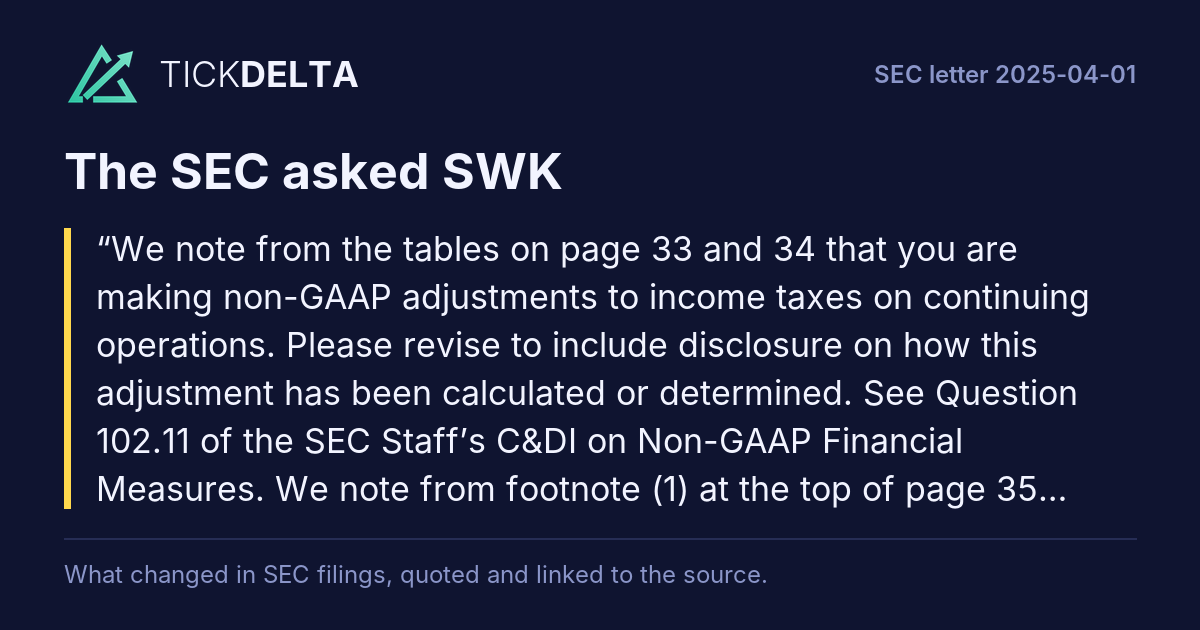
We note from the tables on page 33 and 34 that you are making non-GAAP adjustments to income taxes on continuing operations. Please revise to include disclosure on how this adjustment has been calculated or determined. See Question 102.11 of the SEC Staff’s C&DI on Non-GAAP Financial Measures.
Rest of the question

We note from footnote (1) at the top of page 35, that the adjustment for “footprint rationalization” costs in 2024 primarily relates to accelerated depreciation of manufacturing and distribution center equipment of $48.9 million and other facility exit and re-configuration costs of $45.2 million. Please tell us specifically which facilities had exit costs in 2024 and explain to us why these exit and re-configuration costs are not accounted for as restructuring costs in accordance with ASC 420 and 2. disclosed in Note N to the financial statements. As part of your response, please similarly address the 2023 facility exit costs included in this adjustment. 3. Please tell us how the non-cash asset write-downs of $44 million included in footnote (1) differ from the assets that are included as “asset impairment charges” in footnote (7) and are separately presented on the face of the income statement. As part of your response, please tell us where the asset write-downs referred to in footnote (1) are presented in your income statement. 4. We note from your disclosure in footnote (4) that the adjustment for “other, net” includes deal-related costs, net of income related to providing transition services to previously divested businesses. Please explain to us in more detail the nature of this amount as well as the amount of the offsetting income. Also, please tell us how this adjustment differs from your adjustment titled “transition service costs related to previously divested businesses.” Consolidated Results, page 35 5. We note that in your discussion of both consolidated results and segment results, your explanation of the changes in certain line items or profitability measures, such as gross profit, SG&A, income taxes, and segment profit, relate only to non-GAAP amounts and you do not explain the changes in the comparable GAAP amount. In order to avoid undue prominence of the non-GAAP financial measures, please revise your results of operations section in the future to clearly discuss the reasons for the changes in significant income statement line items and segment profitability measures (computed on a GAAP basis) prior to discussing any related non-GAAP amounts. In this regard, you should also discuss the changes in cost of sales line item as part of your gross profit disclosure. See guidance in Question 102.10 of the SEC Staff's C&DI on Non-GAAP Financial Measures. Business Segment Results, page 37 6. We note from your disclosure on page 37, that in regards to your discussion of the Tools and Outdoor segment, you disclose that excluding Non-GAAP adjustments of $143.1 million and $196.7 million in 2024 and 2023, respectively, segment profit amounted to 10.1% of net sales in 2024 compared to 6.6% of net sales in 2023, primarily due to supply chain transformation benefits and lower inventory destocking costs, which were partially offset by growth investments. We also note that your earnings release furnished on Form 8-K on February 5, 2025 includes tables disclosing a non-GAAP segment profit amount for both segments. Please explain to us the nature and amount of each these non-GAAP adjustments to segment profit and tell us how management uses these adjusted amounts. Corporate Overhead, page 38 We note your disclosure on page 38 that excluding Non-GAAP adjustments of $23.4 million, $50.9 million, and $64.5 million in 2024, 2023, and 2022, respectively, the Corporate Overhead element of SG&A was $247.2 million, $261.3 million, and $229.5 million in 2024, 2023, and 2022, respectively. Please explain to us the nature of these non-GAAP adjustments and revise to include all disclosures required by Item 7. 10(e) of Regulation S-K as they apply to your disclosure of Non-GAAP Corporate Overhead. Please note that in accordance with Question 100.01 of the SEC Staff’s C&DI on Non-GAAP Financial Measures, non-GAAP adjustments must not include any costs considered normal, recurring, cash operating expenses. As part of your response, please include your proposed revised disclosure. Notes to the Audited Financial Statements Note M. Other Costs and Expenses, page 95 8. We note your disclosure that Other, net is primarily comprised of intangible asset amortization expense, currency-related gains or losses, environmental remediation expense, deal costs and related consulting costs, and certain pension gains or losses. In light if the significance of this line item on the statement of operations, please revise your note to separately state the material amounts comprising this line item. See guidance in Item 5-03 of Regulation S-X. Note O. Business Segments and Geographic Areas, page 96 9. We note that the reconciliation of segment profit to earnings from continuing operations before income taxes includes an amount for corporate overhead. We also note from your disclosure on page 98 that corporate overhead includes the corporate overhead element of SG&A, which is not allocated to the business segments. Please provide for us, and revise future filings to provide, a more detailed description of the nature of all significant items included in this amount. See guidance in ASC 280-1050-31. Note P. Income Taxes, page 99 10. We note that in the reconciliation of the U.S. federal statutory income tax provision to Income taxes on continuing operations in the Consolidated Statements of Operations, there is a significant amount for capital loss in the year ended December 28, 2024. Please explain to us the nature of this amount. Exhibit 99.1 Earnings Release, page 1 11. We note that you have disclosed organic growth as a percentage, such as in the 2nd bullet on page 1 which states that Fourth Quarter Revenues of $3.7 Billion, Flat Versus Prior Year With 3% Organic Growth* Offset by Infrastructure Divestiture and Currency. Please note that disclosure of organic revenue or organic growth, even disclosed as a percentage or ratio, is considered a non-GAAP measure. Please revise to include a reconciliation quantifying how this amount is calculated or determined. Exhibit 99.2 Financial statements and supporting schedules contained in earnings release, We note that on page 12, 15 and 16 of Exhibit 99.2, you disclose total segment profit and then show total segment profit less corporate overhead which results in an amount described as “total.” Please note that disclosure of the combined amount of segment profit measures of your two segments outside the notes to the financial statements is 12. considered a non-GAAP financial measure and should be accompanied by the disclosures required by Item 10(e) of Regulation S-K. We also note that you reduce this total segment profit measure by corporate overhead, creating another total which appears to represent another non-GAAP financial measure. Please explain to us how management uses these non-GAAP financial measures and revise to include the disclosures required by Item 10(e) of Regulation S-K. Please note that any adjustments included in these non-GAAP financial measures must not include normal cash operating expenses under the guidance in Question 100.01 of the SEC Staff’s C&DI on Non-GAAP Financial Measures. Please provide us with your intended revised disclosure including the reconciliations of these amounts to the most comparable GAAP amount.

SWK answered
The Company acknowledges the Staff’s comment and advises the Staff that the income taxes attributable to its Non-GAAP adjustments are determined by calculating income taxes on pre-tax earnings, both inclusive and exclusive of Non-GAAP adjustments, taking into consideration the nature of the Non-GAAP adjustments and the applicable statutory income tax rates. The Company will revise its disclosures prospectively commencing with the Form

10-Q for the quarter ended March 29, 2025 to explain how the income taxes attributable to its Non-GAAP adjustments have been determined. Read in the reply ↗
In its next report

First report after the company's reply of 2025-04-29: 10-Q filed 2025-04-30 ↗, against the 10-Q filed 2024-10-29 ↗.

Tickdelta does not hold the text of both reports, so they are not compared here.
SEC asked (2)
We note from your response to our prior comment 3 that the non-cash asset writedowns of $44 million in 2023 included in footnote (1) related to tooling and inventory (predominantly raw materials and WIP) driven primarily by the closure of the Fort Worth, Texas manufacturing site.
Rest of the question

Please note that it is not appropriate to adjust non- GAAP financial measures for inventory charges as they represent normal, recurring costs of operations. Please revise future filings accordingly.

SWK answered
The Company acknowledges the Staff’s comment and advises the Staff that the non-cash asset write-downs of $44 million in 2023 were discrete adjustments specifically driven by the unique nature of the Fort Worth, Texas plant. Following its acquisition of the Craftsman brand in 2017, the Company launched an unprecedented initiative to design and construct an innovative plant that heavily leveraged new automation technology and equipment to manufacture Craftsman mechanics hand tools of the future.
Rest of the answer

However, as a result of unanticipated challenges related to the new automation technology and equipment, the Company was ultimately unable to fully ramp production at this site as originally expected. As a result of the Company’s decision to close the Fort Worth plant in March 2023, certain non-converted inventory (raw materials and WIP) and tooling equipment specific to the Fort Worth operations were no longer viable or useable elsewhere in the Company’s operations and were written down. The Company does not anticipate incurring similar charges in the future and will not adjust its Non-GAAP financial measures for such charges prospectively in future filings, as requested by the Staff.

Read in the reply ↗
Results of Operations, page 31
SEC asked (3)
We note your summary of pre-tax Non-GAAP adjustments on page 33. Please tell us the nature of the costs included in the line item titled “Complexity Reduction & Operational Excellence” and explain to us how they differ from Strategic Sourcing & Operational Excellence costs. Also, please explain to us why these are not considered normal recurring operating costs of business.
Rest of the question

See guidance in Question 100.01 of the C&DI on Non-GAAP Financial Measures.

SWK answered
The Company acknowledges the Staff’s comment and advises the Staff that the supply chain transformation costs included in the summary table of pre-tax Non-GAAP adjustments on page 33 of the Form 10-Q are presented based on the four value streams of the transformation described on page 30 of the Form 10-Q, as follows: Material Productivity (also referred to as Strategic Sourcing), Operational Excellence, Footprint Rationalization, and Complexity Reduction.
Rest of the answer

Furthermore, the costs associated with each of these value streams are included in the appropriate income statement caption based on the nature of the underlying costs, with manufacturing-related costs classified in cost of sales in gross profit and distribution-related and other costs in SG&A.

The costs included in the line item titled “Complexity Reduction & Operational Excellence” in the first quarter of 2025 primarily related to third-party consulting fees to provide expertise in identifying business model changes and quantifying related cost savings opportunities within its Engineered Fastening business, which was not part of prior assessments conducted at the onset of the supply chain transformation, developing a detailed program and related governance, and assisting the Company with the implementation of actions necessary to achieve the identified operating model changes and related cost savings.

The costs included in the line item titled “Strategic Sourcing & Operational Excellence” in the first quarter of 2025 primarily related to costs of temporary resources dedicated to supporting these value streams, specifically the transformation of manufacturing sites into COEs, as further discussed in the response to Comment #1 above, and the implementation of new sourcing capabilities across the Company’s businesses. These temporary resources will be exited or placed into different roles within the Company’s ongoing operations at the conclusion of the respective transformation project activities.

Furthermore, the discrete transformation costs described above are not expected to recur after 2025, which is consistent with the expected timing of completing the supply chain transformation as disclosed on page 30 of the Form 10-Q (and page 31 of the Form 10-K). However, given the complexities of executing footprint actions, including potential external factors beyond the Company’s control, the Company anticipates incurring additional charges beyond 2025 relating to targeted footprint actions (primarily site closures).

Given the significance of the supply chain transformation, which represents a significant shift in the Company’s operating model, and the unique nature of the discrete and incremental costs related to the individual value streams and underlying initiatives, the Company has concluded that the above costs are appropriate Non-GAAP adjustments and do not represent normal recurring operating costs. In addition, the Company believes excluding these discrete costs from its Non-GAAP financial measures provides investors with meaningful and helpful information to evaluate the Company’s operating results relative to prior periods and the Company’s competitors.

Consistent with past practice, the Company will include additional disclosure in its future filings to explain the nature of any significant amounts presented in its summary table of pre-tax Non-GAAP adjustments.

Read in the reply ↗
In its next report

First report after the company's reply of 2025-05-21: 10-Q filed 2025-07-29 ↗, against the 10-Q filed 2024-10-29 ↗.

Tickdelta does not hold the text of both reports, so they are not compared here.

Results of Operations · Certain Items Impacting Earnings, page 32
SEC asked
We note from your response to our prior comment 2 that the closure of the Ft. Worth site and related inventory and tooling charges were a result of your inability to fully ramp production using new automation technology and equipment. As a result, the inventory and tooling were no longer viable or usable elsewhere in the Company’s operations. Please tell us more about the decision to close the Ft.
Rest of the question

Worth plant, including what specifically led to the closure during 2023, and describe any broad effects this decision had on your operations. As part of your response, please clarify why this inventory and tooling could not be used elsewhere in the company or sold to 1. a third party. In addition, please quantify the amount of the charge incurred related to each type of inventory and tooling equipment.

SWK answered
The Company acknowledges the Staff’s comment and advises the Staff that the Fort Worth, Texas plant was specifically designed and constructed to support a new customer program to produce certain mechanics hand tools in the U.S., which were previously manufactured offshore for the customer by a 3rd party company, and re-brand such products from the customer’s private label to Craftsman.
Rest of the answer

The objectives of the program were to: (a) re-shore the manufacturing of the mechanics hand tools and produce at a lower cost (or comparable cost to offshore manufacturing) by leveraging innovative manufacturing technology, equipment, and automation at the Fort Worth plant, and (b) market the products (primarily combo kits and sets comprised of ratchets, sockets and/or wrenches, along with the related accessories) under the newly re-designed Craftsman brand (following the Company’s acquisition of the brand) with a focus on “Made in the USA”.

To achieve objective (a) above, the Fort Worth plant implemented a first-of-its-kind manufacturing system, including a new metal forming process that had previously not been used in the hand tools industry and automation technology, which was expected to result in meaningful process and cost efficiencies (e.g. higher material yield, less scrap, lower energy needs, reduced number of process steps and labor hours). The new metal forming process also required specialized machinery, equipment, and tooling, which was only able to be used at the Fort Worth plant. The Company faced many challenges in implementing the manufacturing system and applying the new metal forming process to the production of hand tools, and also experienced delays and other constraints in installing and testing the specialized machinery and equipment due in part to COVID-19 and supply chain disruptions. As a result, the Company was ultimately unable to fully ramp production and achieve a sustainable operation that could consistently meet the required timelines and product cost commitment of the customer program. In March 2023, the Company announced the closure of the Fort Worth plant and discontinued the customer-specific product portfolio. Given the unique nature of the Fort Worth plant and the customer-specific product portfolio of the program, the Company’s decision to close the plant did not have a broad effect on its remaining operations. Furthermore, the Company has not employed this metal forming process, or the related specialized machinery, equipment, and tooling, at any of its other sites subsequent to the Fort Worth closure.

As previously noted, the non-cash asset write-downs in 2023 driven by the Fort Worth closure related to inventory (predominantly non-converted raw materials and WIP) and tooling equipment. The inventory write-off totaled approximately $26 million. Of the total write-off, approximately $21 million represented raw materials and WIP relating to specialized steel only useable for the new metal forming process at Fort Worth, non-kitted components and accessories that were not individually saleable products, and custom product packaging for the canceled Craftsman “Made in the USA” program that could no longer be used. The remaining inventory write-off related to losses driven by the liquidation of the remaining finished goods upon cancellation of this unique customer program. Separately, the write-off of tooling, which was unrelated and classified outside of inventory, totaled approximately $14 million and related to specialized and consumable tooling, which supported the new metal forming process and the re-designed Craftsman “Made in the USA” tool branding, that could not be used elsewhere in the Company’s operations or by a third party.

As noted in its previous response letter, the Company does not anticipate incurring similar charges in the future given the unique nature of the Fort Worth plant and circumstances leading to the closure, as described above.

Read in the reply ↗
In its next report

First report after the company's reply of 2025-08-06: 10-Q filed 2025-11-04 ↗, against the 10-Q filed 2024-10-29 ↗.

Tickdelta does not hold the text of both reports, so they are not compared here.

Results of Operations · Certain Items Impacting Earnings, page 32
SEC asked
We note your response to our prior comment, and continue to believe that the adjustment to your non-GAAP financial measures for the write-off of inventory related to the closure of the Ft. Worth site is not appropriate as those costs represent normal, recurring costs of operations. See Question 100.01 in the Compliance & Disclosure Interpretations on Non-GAAP Financial Measures.
Rest of the question

Please revise future filings accordingly.

SWK answered
The Company respectfully acknowledges the Staff’s comment and while the Company respectfully disagrees with the Staff’s comment, it will remove the above-referenced adjustment for the write-off of inventory related to the closure of the Fort Worth site from its non-GAAP measures when the relevant period is presented in future filings. Read in the reply ↗
In its next report

First report after the company's reply of 2025-09-09: 10-Q filed 2025-11-04 ↗, against the 10-Q filed 2024-10-29 ↗.

Tickdelta does not hold the text of both reports, so they are not compared here.

Also in this review: company letter, 2025-04-07, company letter, 2025-07-14, closing letter, 2025-09-17
Form 10-K for the Year Ended December 31, 2022

2023-11-28 to 2024-01-08 · 9 questions · 2 letters from the SEC, 2 from the company
Review closed 2024-01-08
Non-GAAP measuresResults discussion (MD&A)AcquisitionsGoodwill and impairmentLegal and contingenciesLiquidity and cashRevenueSegmentsIncome taxes
Results of Operations · Certain Items Impacting Earnings and Non-GAAP Financial Measures, page 31
SEC asked (1)
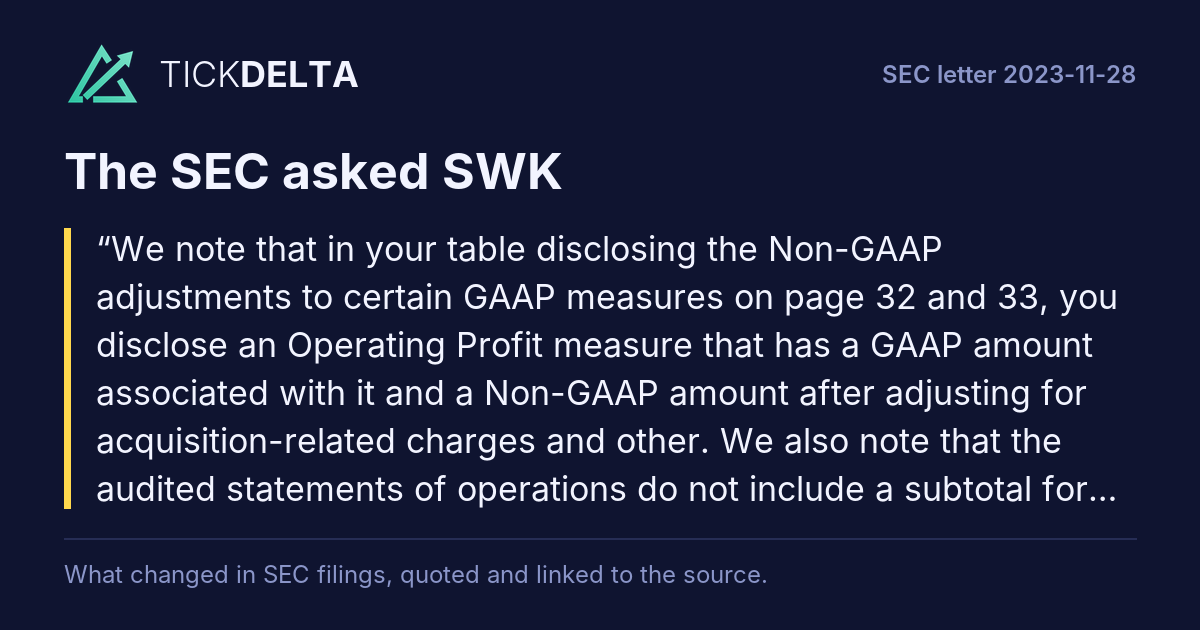
We note that in your table disclosing the Non-GAAP adjustments to certain GAAP measures on page 32 and 33, you disclose an Operating Profit measure that has a GAAP amount associated with it and a Non-GAAP amount after adjusting for acquisition-related charges and other.
Rest of the question

We also note that the audited statements of operations do not include a subtotal for Operating Profit, and it appears that the amount disclosed in MD&A has been calculated from the statement of operations as Net Sales less Cost of Sales (Gross Profit) less SG&A and provision for credit losses. It appears in calculating this Operating Profit measure, referred to as “GAAP” in your MD&A section, you have excluded at a minimum, asset impairment charges, restructuring charges, and intangible asset amortization charges, all of which are considered operating expenses under GAAP. In light of the exclusion of these expenses, this Operating Profit measure would be considered a Non-GAAP measure, should be retitled to avoid being confused with GAAP Operating Profit and needs to include all disclosures required by Item 10(e) of Regulation S-K. Please revise accordingly. Your disclosures in your Form 10-Q and earnings releases on Form 8-K should be similarly revised. See also Question 100.05 of the SEC's Compliance and Disclosure Interpretation on Non-GAAP Financial Measures.

SWK answered
The Company acknowledges the Staff’s comment and advises the Staff that the Company will revise the table disclosing the non-GAAP adjustments to remove the Operating Profit measure prospectively commencing with the Form 10-K for the year ended December 30, 2023. Refer to Comment #8 below for the Company’s response to revising its earnings releases on Form 8-K. Read in the reply ↗
In its next report

First report after the company's reply of 2023-12-08: 10-K filed 2024-02-27 ↗, against the 10-K filed 2023-02-23 ↗.

Tickdelta does not hold the text of both reports, so they are not compared here.

Results of Operations · Certain Items Impacting Earnings and Non-GAAP Financial Measures, page 31
SEC asked (2)
We note from your table on page 32 that you adjust certain GAAP measures for acquisition related and other charges to present corresponding non-GAAP measures. We further note that these adjustments to SG&A include integration-related costs and a voluntary retirement program. Please provide us more detail as to the nature and amounts related to these charges.
Rest of the question

Additionally, we note that you include a similar Non-GAAP table in your Form 10-Q reports. You disclose that the Non-GAAP adjustments to Gross profit primarily pertain to footprint actions and other costs associated with the supply chain transformation, and the Non-GAAP adjustments to SG&A primarily related to costs of providing transition services for previously divested businesses and supply chain transformation costs. Please provide us more detail as to the nature of the footprint actions and supply chain transformation costs. Specifically, please tell us why you believe these costs are appropriate non-GAAP adjustments and do not represent normal operating costs.

SWK answered
The Company acknowledges the Staff’s comment and advises the Staff that the acquisition-related and other charges recorded to Selling, general and administrative (“SG&A”) in 2022 were primarily related to integration-related costs totaling $85 million and voluntary retirement program costs totaling $33 million. The integration-related costs were primarily driven by multiple initiatives to integrate the MTD and Excel acquisitions, which approximated $2.1 billion in total purchase price and represented strategically significant additions to the Company’s existing outdoor category.
Rest of the answer

The initiatives included integrating the organizations and shared processes, as well as harmonizing key IT applications and infrastructure. The costs associated with the voluntary retirement program, which was executed as part of a broader restructuring to right-size the Company’s corporate and support functions to align with a more focused portfolio due to pending divestitures, related to separation benefits provided to eligible employees who voluntarily retired from the Company.

The acquisition-related and other charges recorded to Gross profit and SG&A in 2023 were primarily related to production and distribution footprint rationalization actions and other costs associated with a supply chain transformation to enable these rationalization actions and to integrate and globalize product value streams, which represents a significant shift in the Company’s operating model. The footprint actions executed as part of the rationalization include targeted site closures and facility consolidations, which resulted in incremental costs to exit these sites, primarily related to non-cash asset-related charges. The initiatives enabling the footprint rationalization and value stream integration and globalization include strategic sourcing, complexity reduction, and facility optimization. Given the significance of the supply chain transformation and the unique nature of the associated costs, the Company has concluded that these costs are appropriate non-GAAP adjustments and do not represent normal operating costs. As a result, the Company believes excluding these discrete transformation costs from its non-GAAP measures provides investors with meaningful and helpful information to evaluate the Company’s operating results relative to prior periods and the Company’s competitors.

Read in the reply ↗
In its next report

First report after the company's reply of 2023-12-08: 10-K filed 2024-02-27 ↗, against the 10-K filed 2023-02-23 ↗.

Tickdelta does not hold the text of both reports, so they are not compared here.

2023 Outlook, page 37
SEC asked (3)
We note your disclosure that the difference between 2023 diluted earnings per share outlook and the diluted earnings per share range, excluding charges, is approximately $1.15 to $1.65, consisting of acquisition-related charges and other charges primarily due to supply chain transformation under the Global Cost Reduction Program. We also note similar disclosures in your 10-Q filings.
Rest of the question

Please provide us more information about the nature and amount of each of these types of adjustments. Specifically, please tell us why you believe that these represent appropriate non-GAAP adjustments and are not normal recurring expenses. See Question 100.01 of the SEC's Compliance and Disclosure Interpretations on Non-GAAP Financial Measures.

SWK answered
The Company acknowledges the Staff’s comment and advises the Staff that the Company has considered the guidance set forth in Question 100.01 of the Compliance and Disclosure Interpretations on Non-GAAP Financial Measures. The Company advises the Staff that the acquisition-related charges referenced in 2023 Outlook related to the integration costs for the MTD and Excel acquisitions, as further discussed in response to Comment #2 above.
Rest of the answer

Of the $1.15 to $1.65 range disclosed in 2023 Outlook, these estimated integration-related costs approximated $0.20 to $0.25.

The charges related to the supply chain transformation under the Global Cost Reduction Program referenced in 2023 Outlook related primarily to the footprint rationalization actions and other transformation costs, as further discussed in response to Comment #2 above. Of the $1.15 to $1.65 range disclosed in 2023 Outlook, these estimated footprint rationalization and transformation costs approximated $0.80 to $1.20.

The Company has concluded that these costs represent appropriate non-GAAP adjustments due to: (a) the substantial integration activities required for the MTD and Excel acquisitions, particularly given the size and complexity of these businesses, and (b) the significance of the supply chain transformation and related footprint rationalization actions. Furthermore, as these costs are not representative of the Company’s ongoing operating cost structure, the Company believes excluding these costs from its non-GAAP measures is relevant to aid analysis and understanding of the Company’s results and business trends relative to past performance and the Company’s competitors.

Read in the reply ↗
In its next report

First report after the company's reply of 2023-12-08: 10-K filed 2024-02-27 ↗, against the 10-K filed 2023-02-23 ↗.

Tickdelta does not hold the text of both reports, so they are not compared here.

Audited Financial Statements · Statement of Cash Flows, page 66
SEC asked (4)
We note that the reconciliation included within the operating activities section of your statement of cash flow begins with a line for net earnings from continuing operations, followed by a line for net earnings from discontinued operations. Please revise future filings to begin your reconciliation with net income. Refer to guidance in ASC 230-1045-29.
SWK answered
The Company acknowledges the Staff’s comment and advises the Staff that the Company will revise the reconciliation included within the operating activities section of its statement of cash flows to begin with net income prospectively commencing with the Form 10-K for the year ended December 30, 2023. Read in the reply ↗
In its next report

First report after the company's reply of 2023-12-08: 10-K filed 2024-02-27 ↗, against the 10-K filed 2023-02-23 ↗.

Tickdelta does not hold the text of both reports, so they are not compared here.

Notes to the Audited Financial Statements · Note P. Business Segments and Geographic Areas, page 105
SEC asked (5)
We note that the Tools & Outdoor segment is comprised of Power Tools Group (PTG), Hand Tools, Accessories & Storage (HTAS), and Outdoor Power Equipment (Outdoor) businesses, and the Industrial Segment is comprised of Engineered Fastening and Infrastructure businesses.
Rest of the question

We also note that you have provided disaggregated revenue for each of the two businesses in the Industrial Segment, as well as by geographic areas for consolidated revenue. Further we note from your second quarter 2023 earnings call, that you discuss revenue by “strategic business unit performance” which includes revenue trends for outdoor, hand tools, storage solutions and power tools. Please tell us what consideration you gave to disclosing additional revenue information by these businesses in the Tools & Outdoor segment, or other product categories, within the notes to your financial statements. Refer to guidance in ASC 606-10-55-89 through 55-91 and ASC 280-10-50-40.

SWK answered
The Company acknowledges the Staff’s comment and advises the Staff that the Company considered the guidance in ASC 280-10-50-40 when determining its disclosures related to the disaggregation of revenue, which states that a public entity shall report the revenues from external customers for each product and service or each group of similar products and services unless it is impracticable to do so.
Rest of the answer

The Company also considered the guidance in ASC 606-10-55-89 through 55-91, which provides that the extent to which a company’s revenue is disaggregated depends on the facts and circumstances of the company’s contracts with customers.

The Company advises the Staff that the Company believes that there are no significant differences in the nature of the goods sold or the customer contracts that exist across the product categories within the Tools & Outdoor segment that would necessitate additional disaggregated revenue disclosures. Furthermore, the Company believes the additional revenue trend information for outdoor, power tools, and hand tools, accessories and storage, as presented in the second quarter 2023 earnings call, may be meaningful to investors in order to provide additional context on current market dynamics, but the Company’s Chief Operating Decision Maker does not use information at this level in evaluating the financial performance of its operating segments, as discussed in ASC 606-10-55-90. The Company further notes that its existing segment disclosures include additional information relating to the Tools & Outdoor segment, including the types of products sold, which do not vary meaningfully in terms of types of customer contracts or timing of transfer of goods, as well as the sales levels of its two largest customers.

The Company will continue to evaluate the disclosure of disaggregated revenue in future filings, but believes its current disclosures provide the appropriate level of revenue information in accordance with ASC 606-10-55-89 through 55-91 and ASC 280-10-50-40.

Read in the reply ↗
In its next report

First report after the company's reply of 2023-12-08: 10-K filed 2024-02-27 ↗, against the 10-K filed 2023-02-23 ↗.

Tickdelta does not hold the text of both reports, so they are not compared here.

Note Q. Income Taxes, page 108
SEC asked (6)
We note from your disclosure in Note Q, that the intra-entity asset transfer of intellectual property had a significant effect on your effective tax rate in both 2021 and 2022. Additionally, you disclose that the increase in intangible deferred tax assets relates to the intra-entity asset transfer of certain intangible assets between two of your foreign subsidiaries Please tell us, and revise future filings to
Rest of the question

disclose, the details of this IP transfer, including the nature of any estimates and assumptions related to the valuation of this transaction.

SWK answered
The Company acknowledges the Staff’s comment and advises the Staff that the Company will revise its disclosures relating to the intra-entity asset transfer of intellectual property within Note Q prospectively commencing with the Form 10-K for the year ended December 30, 2023, as follows:

“The increase in intangible deferred tax assets relates to an intra-entity asset transfer of certain intangible assets from a wholly-owned, non-U.S. subsidiary to another wholly-owned, non-U.S. subsidiary located in the United Kingdom in order to better align with current and future business operations.
Rest of the answer

The transfer resulted in a step-up in tax basis driven by the fair value of the transferred intellectual property (“IP”), which was determined using an income approach taking into consideration future revenue projections, royalty rates and discount rates. The Company expects to realize the deferred tax asset recorded as a result of the IP transfer and will periodically assess such realizability. The tax-deductible amortization related to the transferred IP will be recognized over a 20-year period.”

Read in the reply ↗
In its next report

First report after the company's reply of 2023-12-08: 10-K filed 2024-02-27 ↗, against the 10-K filed 2023-02-23 ↗.

Tickdelta does not hold the text of both reports, so they are not compared here.

Note S. Contingencies, page 112
SEC asked (7)
We note your disclosure in Note S of several environmental and other ongoing contingencies. We also note that in Item 3. Legal Proceedings on page 24, you disclose two investigations with the SEC and/or DOJ, in which you disclose that the Company does not believe that these matters will have a material impact on its financial condition or results of operations, although it is possible that a loss related to these
Rest of the question

matters may be incurred. In light of this potential loss contingency, it appears that these matters should be included as a loss contingency in your notes to the financial statements in accordance with ASC 450-20-50. As applicable, please revise future filings accordingly. Exhibit 99.2 Financial statements and supporting schedules contained in Stanley Black & Decker, Inc.'s October 27, 2023 press release, page 8

SWK answered
The Company acknowledges the Staff’s comment and advises the Staff that the Company will revise its disclosures within Note S prospectively commencing with the Form 10-K for the year ended December 30, 2023, to include the two investigations with the SEC and/or DOJ, as disclosed in Item 3. Legal Proceedings, as well as any other potential loss contingency requiring disclosure in accordance with ASC 450-20-50.

Exhibit 99.2 Financial statements and supporting schedules contained in Stanley Black & Decker, Inc.’s October 27, 2023 press release, page 8 Read in the reply ↗
In its next report

First report after the company's reply of 2023-12-08: 10-K filed 2024-02-27 ↗, against the 10-K filed 2023-02-23 ↗.

Tickdelta does not hold the text of both reports, so they are not compared here.

Note S. Contingencies, page 112
SEC asked (8)
We note that your statements of operations presented on page 8 of your earning release, include the presentation of an Operating Profit subtotal. In light of the fact that this subtotal appears to exclude charges for asset impairment and restructuring and potentially other operating expenses included in the “other-net” line item, it does not represent a measure calculated in accordance with GAAP.
Rest of the question

Please remove this subtotal from your statements of operations or alternatively clearly label as a Non-GAAP measure and include the disclosures required by Item 10(e) of Regulation S-K.

SWK answered
The Company acknowledges the Staff’s comment and advises the Staff that the Company will remove the Operating Profit subtotal prospectively commencing with its earnings release on Form 8-K for the fourth quarter of 2023. Read in the reply ↗
In its next report

First report after the company's reply of 2023-12-08: 10-K filed 2024-02-27 ↗, against the 10-K filed 2023-02-23 ↗.

Tickdelta does not hold the text of both reports, so they are not compared here.

Results of Operations · Certain Items Impacting Earnings and Non-GAAP Financial Measures, page 31
SEC asked
We note your response to our prior comments 2 and 3. Please provide us further detail as to the amount and nature of the costs incurred that are part of your "supply chain transformation" adjustments in 2023. In this regard, it is not clear what is meant by "footprint rationalization actions" or "complexity reduction" and the type of costs that are included in these items.
Rest of the question

Also, please revise future filings to quantify the amount of the adjustments related to each type of activity. For example, related to the 2022 reconciliation, please disclose the amount related to integration related costs as well as the voluntary retirement program.

SWK answered
The Company acknowledges the Staff’s comment and advises the Staff that the adjustments related to the supply chain transformation program totaled $194 million during the nine months ended September 30, 2023. As previously disclosed, the supply chain transformation consists of four main value streams: footprint rationalization, complexity reduction, strategic sourcing, and operational excellence.

The footprint rationalization value stream relates to the transformation of the Company’s manufacturing and distribution network from a decentralized and inefficient system of sites built through
Rest of the answer

years of acquisitions to a strategically focused supply chain. The specific actions under footprint rationalization will include: (a) site closures to reduce capacity, (b) site transformations into manufacturing centers of excellence to integrate and globalize product value streams, and (c) re-configuration of the Company’s distribution network, including closure of certain distribution sites tied to previously acquired businesses, to create an integrated hub and spoke model with strategically located regional sites to reduce delivery times to customers. Of the $194 million of total charges disclosed above, approximately $118 million relates to transfers and closures of targeted manufacturing sites in 2023, which was driven by non-cash asset write-downs of $58 million (predominantly production equipment and tooling), non-cash inventory write-downs of $28 million (predominantly raw materials and WIP), severance charges for impacted employees of $12 million, and facility exit and re-configuration expenses of $20 million (predominantly site remediation and decommissioning costs, contract termination penalties, equipment and inventory transfer costs, and temporary incremental rent incurred while the distribution network is being re-configured, as described above).

The complexity reduction value stream is primarily comprised of a SKU reduction initiative, which aims to reduce the total quantity of unique product SKUs by approximately 40%, and a product platforming strategy to standardize engineering and design across product categories and to maximize shared components and assembly. These complexity reduction initiatives also facilitate the footprint rationalization described above. The Company incurred $8 million of costs in 2023 related to these initiatives, which was primarily related to third-party consultant fees to assist the Company with identifying and quantifying these opportunities and designing a plan to achieve the related benefits.

The remaining value streams of the program relate to strategic sourcing and operational excellence, which are focused on: (a) identifying and quantifying opportunities to source more efficiently and designing and helping to implement the capabilities to source in a new integrated manner across all of the Company’s businesses, and (b) identifying and quantifying opportunities to re-design in-plant operations following footprint rationalization or supply chain changes, or other opportunities to re-balance plants. The Company incurred $68 million of costs in 2023 related to these value streams, driven by third-party consultant fees, which provided expertise in identifying and quantifying the cost savings opportunities across these value streams, developing a detailed program and related governance, and assisting the Company with the implementation of actions necessary to achieve the identified savings.

The value streams and underlying initiatives described above represent a significant shift in the Company’s operating model and the Company believes the related costs required to achieve the objectives of the supply chain transformation are not representative of the Company’s ongoing operating cost structure.

The Company further advises the Staff that the Company will revise its future filings to quantify the amount of the non-GAAP adjustments related to each type of activity.

Read in the reply ↗
In its next report

First report after the company's reply of 2023-12-28: 10-K filed 2024-02-27 ↗, against the 10-K filed 2023-02-23 ↗.

Tickdelta does not hold the text of both reports, so they are not compared here.

Also in this review: closing letter, 2024-01-08

Form 10-K for the Fiscal Year Ended January 2, 2021

2021-04-26 to 2022-02-01 · 31 questions · 6 letters from the SEC, 5 from the company
Review closed 2022-02-01
ClimateResults discussion (MD&A)AcquisitionsNon-GAAP measuresRisk factorsSegmentsControlsCritical estimatesDerivatives and hedgingLiquidity and cash
Notes to Consolidated Financial Statements · J. Capital Stock, page 93
SEC asked
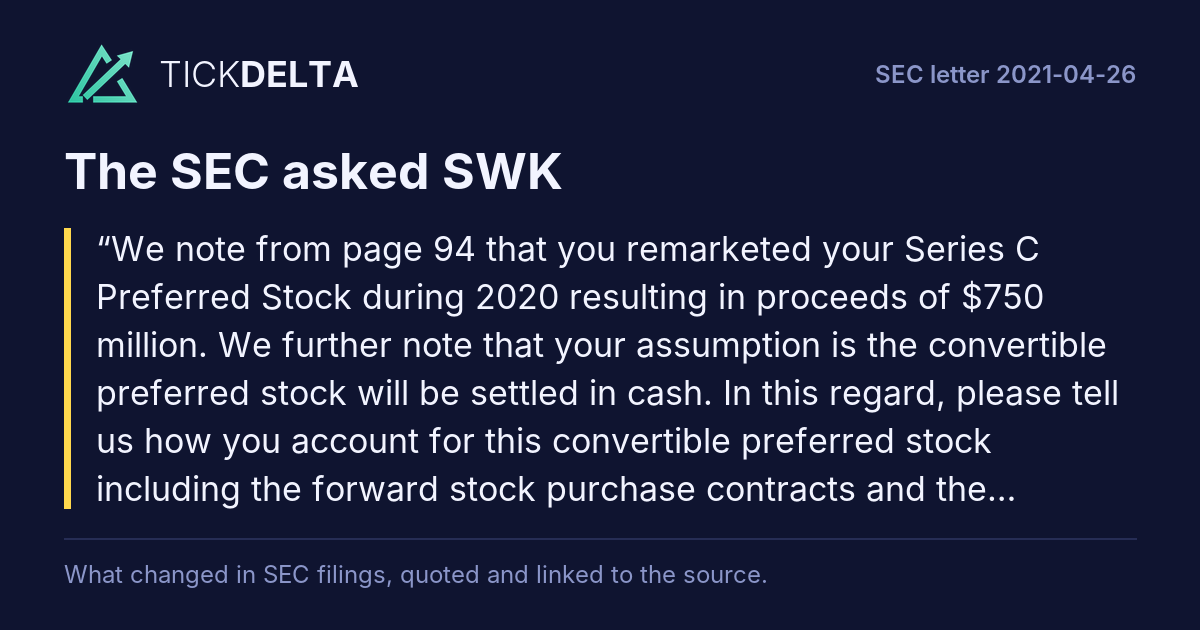
We note from page 94 that you remarketed your Series C Preferred Stock during 2020 resulting in proceeds of $750 million. We further note that your assumption is the convertible preferred stock will be settled in cash.
Rest of the question

In this regard, please tell us how you account for this convertible preferred stock including the forward stock purchase contracts and the references to GAAP that supports the basis for your conclusions. We remind you that the company and its management are responsible for the accuracy and adequacy of their disclosures, notwithstanding any review, comments, action or absence of action by the staff.

SWK answered
In May 2017, the Company issued equity units for a total notional amount of $750 million, which consisted of three-year forward stock purchase contracts obligating holders to purchase a maximum number of 5.4 million shares of the Company’s common stock on May 15, 2020 (“2020 Purchase Contracts”), and the issuance of 0% Series C Cumulative Perpetual Convertible Preferred Stock, without par, with a liquidation preference of $1,000 per share (“Series C Preferred Stock”).
Rest of the answer

The Series C Preferred Stock was pledged as collateral to support holders’ obligations under the 2020 Purchase Contracts and could be remarketed. Furthermore, the Series C Preferred Stock has no maturity or mandatory redemption date and remains outstanding unless converted by the holders or redeemed by the Company.

Classification of the 2020 Purchase Contracts and Series C Preferred Stock

The 2020 Purchase Contracts and Series C Preferred Stock were accounted for as freestanding instruments, as defined in ASC 480, since each instrument met the criteria of being (a) legally detachable, such that each component could be separated and transferred to different parties, and (b) separately exercisable. Both instruments were classified in permanent equity based on the Company’s evaluation of each contract’s terms and features in accordance with relevant guidance as follows.

The Company first assessed whether the 2020 Purchase Contracts and the Series C Preferred Stock met the requirements to be classified as liabilities at inception under the provisions of ASC 480-10-25. The Company concluded that the Series C Preferred Stock did not require liability accounting at inception under ASC 480-10-25 because it is not a share mandatorily redeemable at a specified date or upon an event that is certain to occur, and it does not embody an unconditional obligation of the Company to issue a variable number of shares of the Company’s common stock.

The Company also concluded that the 2020 Purchase Contracts did not require liability accounting at inception under ASC 480-10-25 because: (1) it did not embody an obligation (nor was it indexed to an obligation) to repurchase the Company’s shares by transferring assets; rather, it represented an obligation of the Company to issue common stock; (2) it was not puttable by the holder for cash and the underlying common stock was not redeemable; and (3) it did not embody an obligation of the Company to issue a variable number of shares in which the monetary value of the obligation at inception was based solely or predominantly on: (a) a fixed monetary amount known at inception, (b) variations in something other than the fair value of the Company’s common shares, or (c) variations inversely related to changes in the fair value of the Company’s common shares. Specifically, with respect to the 2020 Purchase Contracts, the Company evaluated the settlement provision pursuant to ASC 480-10-25-14 and concluded that at inception, it was probable that the Company’s share price would be at or below the reference price, which would result in the issuance of a fixed number of shares upon settlement. Accordingly, the settlement obligation of the 2020 Purchase Contracts was not considered predominantly based on a fixed monetary amount known at inception.

The Company further considered the guidance outlined in ASC 815 to determine: (1) whether embedded features (conversion, call option) in the Series C Preferred Stock required bifurcation and (2) whether the 2020 Purchase Contracts met the definition of a derivative and if so, whether it should receive a scope exception from derivative accounting pursuant to ASC 815-10-15-74(a).

To determine whether the embedded features required bifurcation, the Company first evaluated the substantive terms and features of the Series C Preferred Stock and concluded that the nature of the host contract was equity-like based on the relative weighting of the factors outlined in ASC 815-15-25-17C and ASC 815-15-25-17D. Consequently, the Company concluded that the embedded conversion feature of the Series C Preferred Stock did not require bifurcation under ASC 815-15-25-1 as the embedded feature was clearly and closely related to the equity host. Furthermore, the embedded call option did not require bifurcation as the feature did not meet the definition of a derivative given that (a) the call option requires physical settlement, and (b) the underlying asset – the Series C Preferred Stock – is not readily convertible into cash (i.e., it is not publicly traded and is not actively traded in a secondary market) and therefore, would not be considered net settleable.

Lastly, the Company concluded that the Series C Preferred Stock did not require temporary equity classification per SEC Staff guidance in ASC 480-10-S99-3A as the preferred stock was not redeemable: (1) at a fixed or determinable date; (2) at the option of the holder; or (3) upon the occurrence of an event that is not solely within the control of the Company. The Company also analyzed the conversion option pursuant to the equity classification guidance in ASC 815-40-25 to ensure it had the ability to settle in shares (if it chooses to do so) upon the holders’ exercise of the conversion feature. Because the Company could satisfy its conversion obligation to deliver shares and controls the ability to settle in shares, the Series C Preferred Stock did not require temporary equity classification.

With respect to the 2020 Purchase Contracts, the Company determined that it met the definition of a derivative pursuant to ASC 815-10-15-83 as it had all of the characteristics of a derivative (i.e., underlying, notional amount, no or small initial net investment, net settlement). While the 2020 Purchase Contracts met the definition of a derivative, ASC 815-10-15-74(a) provides an exception from derivative accounting for derivatives that: (1) are indexed to the Company’s own common stock under ASC 815-40-15 and (2) qualify for classification within stockholders’ equity under ASC 815-40-25.

The Company evaluated the 2020 Purchase Contracts under the two-step approach in ASC 815-40-15 and concluded that none of the exercise contingencies or settlement provisions would preclude the 2020 Purchase Contracts from being considered indexed to the Company’s own stock. Furthermore, the Company evaluated the detailed conditions in paragraphs ASC 815-40-25-7 through 25-35 and ASC 815-40-55-2 through 55-6 and concluded that the 2020 Purchase Contracts should be classified and accounted for in permanent equity as the Company had the ability to settle in shares and had a sufficient amount of authorized and unissued common stock to issue upon settlement.

May 2020 Remarketing

In May 2020, the Company successfully remarketed its Series C Preferred Stock resulting in cash proceeds of $750 million, which were applied to satisfy in full the related holders’ obligations to purchase common shares under the 2020 Purchase Contracts. As a result, the Company issued 5,463,750 common shares in May 2020 upon settlement of the 2020 Purchase Contracts. The remarketing resulted in the modification of certain terms of the Series C Preferred Stock, as permitted by the original terms of the security and outlined in the prospectus, including the conversion rate, dividend rate and earliest redemption date. The remarketed Series C Preferred Stock continues to have no maturity or mandatory redemption date and will remain outstanding unless converted by holders or redeemed by the Company. Subsequent to remarketing, holders have the option to convert the Series C Preferred Stock into common stock beginning on May 15, 2020, and the Company has the election, upon conversion, to deliver cash, common stock, or a combination thereof. The Company does not have the right to redeem the Series C Preferred Stock prior to May 15, 2021.

The Company concluded that the remarketing should be accounted for prospectively on the basis that: (a) the remarketing represented a transaction between new and existing preferred stockholders, and not a legal exchange between existing holders of the Series C Preferred Stock and the Company; (b) the remarketing itself, and resulting change in terms, was pursuant to the original terms of the security and contemplated upon issuance of the equity units with the intention of generating proceeds from new investors to the existing holders equal to the liquidation preference amount to satisfy their obligations under the 2020 Purchase Contracts; and (c) based on the economics of the remarketing and modified terms, there was no change in the fair value of the preferred stock and the liquidation preference remained $1,000 per share, which was equivalent to the carrying amount of the Series C Preferred Stock and the proceeds paid by new investors.

Subsequent to the remarketing, the Company evaluated the Series C Preferred Stock (with modified terms) pursuant to the relevant guidance it considered at inception, as analyzed above, and concluded that the instrument continues to meet all the requirements for permanent equity classification.

Read in the reply ↗
In its next report

First report after the company's reply of 2021-05-06: 10-Q filed 2021-07-27 ↗, against the 10-Q filed 2020-10-27 ↗.

Tickdelta does not hold the text of both reports, so they are not compared here.

Notes to Consolidated Financial Statements · J. Capital Stock, page 93
SEC asked
We note your response to our prior comment where you indicated that you evaluated the settlement provisions and concluded that, at inception, it was probable that your share price would be at our below the reference price, which would result in the issuance of a fixed number of shares upon settlement.
Rest of the question

Based on our analysis of your share price at the time of issuance of both the 2017 and 2019 equity units, and the reference prices contained in both of those equity unit agreements, it appears this conclusion is based on the fact that you believe it was probable at inception that your share price would remain the same or decline upon settlement three years later. Please provide the following information about the assumptions and the related outputs obtained from the analysis you performed for both the 2017 and 2019 equity unit issuances: • Tell us why an equity growth assumption was not used in your baseline analyses and why you believe this assumption is reasonable. • Explain how the equity growth assumption was incorporated in your sensitivity analyses and how the sensitivity and baseline analyses interact to arrive at your overall conclusion. For example, explain whether and how the baseline and sensitivity analyses are weighted. • The output from the model and assumptions utilized, including the illustrative probability distribution, and the actual probability that your share price will be less than or equal to the reference price in each of the contracts. • Tell us whether you performed an overall analysis to evaluate the output from the model. For example, tell us how you evaluated whether it was a reasonable conclusion that it was probable that your share price would remain the same or decline three years later in both 2017 and 2019 at the time of the equity unit issuances. Explain if this outcome was consistent with other internal projections you were making about your share price, such as for compensation or other related projections or valuations. We may have further comment upon receipt of your response.

SWK answered
The Company evaluated the three-year forward stock purchase contracts (“Purchase Contracts”) included in the 2017 and 2019 equity units in accordance with ASC 480-10-25 and concluded that liability accounting was not required at inception for either instrument. Specifically, with respect to ASC 480-10-25-14(a), the Company utilized a statistical model and sensitivity analyses to provide a basis for its conclusion that the settlement obligations of the Purchase Contracts were not based solely or predominantly on a fixed monetary value known at inception.
Rest of the answer

The purpose of the overall analyses was to determine a reasonable range of probabilities at inception of the Company’s share price being above the reference prices at settlement, which would result in the Company being required to deliver a variable number of shares with a fixed monetary value to settle the Purchase Contracts. Therefore, for purposes of these analyses, the Company was not forecasting that its share price would remain the same or decline over the three-year periods. Rather, the focus was to determine a reasonable range of probabilities of the Company’s share price being above the reference prices at settlement. The Company acknowledges that its previous response to the Staff’s initial comment could have been clearer on this point.

United States Securities and Exchange Commission Page 2

Please provide the following information about the assumptions and the related outputs obtained from the analysis you performed for both the 2017 and 2019 equity unit issuances:

•Tell us why an equity growth assumption was not used in your baseline analyses and why you believe this assumption is reasonable.

•Explain how the equity growth assumption was incorporated in your sensitivity analyses and how the sensitivity and baseline analyses interact to arrive at your overall conclusion. For example, explain whether and how the baseline and sensitivity analyses are weighted.

•The output from the model and assumptions utilized, including the illustrative probability distribution, and the actual probability that your share price will be less than or equal to the reference price in each of the contracts.

•Tell us whether you performed an overall analysis to evaluate the output from the model. For example, tell us how you evaluated whether it was a reasonable conclusion that it was probable that your share price would remain the same or decline three years later in both 2017 and 2019 at the time of the equity unit issuances. Explain if this outcome was consistent with other internal projections you were making about your share price, such as for compensation or other related projections or valuations.

The Company performed a baseline calculation using a statistical model and related sensitivity analyses on certain assumptions to provide a basis for its conclusion that the settlement obligations of the Purchase Contracts were not based solely or predominantly on a fixed monetary value known at inception. The Company did not incorporate an equity growth assumption in the baseline models given the inherent uncertainty in selecting or projecting a return on its share price over a three-year period, but did consider equity growth in its sensitivity analyses. The Company’s share price can fluctuate for many reasons, including operational performance, market factors, and overall stock market performance, and has historically experienced sustained periods of both share price growth and decline. As part of its overall analyses, the Company performed sensitivities using (i) an equity growth assumption that approximated its entity-specific cost of equity, and (ii) changes to its volatility assumptions.

Refer to the following table for the assumptions utilized and the results of the Company’s analyses for the 2017 and 2019 equity units.

2017 Equity Units 2019 Equity Units

Reference Price (Issue Price) $138.10 $159.45

Volatility 19.0% - 24.0% 25.0% - 30.0%

Dividend Yield 1.7% 1.7%

Equity Growth 0.0% - 7.5% 0.0%

Term 36.0 months 36.0 months

Probability Range > Reference Price 37.0% - 64.1% 35.9% - 36.7%

For the 2017 equity units, the Company notes that while not determinative to its accounting conclusion at inception, the Company’s share price in May 2020 upon settlement of the Purchase Contracts was below the reference price.

For the 2019 equity units, the Company performed a qualitative assessment of the equity growth assumption, which considered the results of the previous sensitivity analysis performed for the 2017 equity units, and reached the same conclusion that the monetary value of the settlement obligation related to the Purchase Contracts was not based solely or predominantly on a fixed monetary amount known at inception. In connection with the preparation of this response, the Company performed a sensitivity calculation for the 2019 equity units using similar growth assumptions and noted that the range of probabilities of its share price being above the reference price at settlement was 35.9% to 57.1%, which is consistent with the range quantified for the 2017 equity units.

As discussed previously, the Company utilized a baseline statistical model and sensitivity analyses to provide a basis for its conclusion under ASC 480-10-25-14(a) that the settlement obligations of the Purchase Contracts were not based solely or predominantly on a fixed monetary value known at inception. The purpose of the Company’s overall analyses was to determine a reasonable range of probabilities at inception of its share price being above the reference prices at

United States Securities and Exchange Commission Page 3 settlement, which would result in the Company being required to deliver a variable number of shares with a fixed monetary value to settle the Purchase Contracts. The probabilities produced by the models provided quantitative data that supported the Company’s conclusion that its settlement obligations of the Purchase Contracts were not based solely or predominantly on a fixed monetary value known at inception. Lastly, the outcome of the Company’s overall analyses has no correlation to any internal projections used for compensation or valuation purposes as the Company does not forecast its share price.

Read in the reply ↗
In its next report

First report after the company's reply of 2021-06-10: 10-Q filed 2021-07-27 ↗, against the 10-Q filed 2020-10-27 ↗.

Tickdelta does not hold the text of both reports, so they are not compared here.

Notes to Consolidated Financial Statements · Note J - Capital Stock, page 93
SEC asked (1)
We continue to evaluate your response to prior comment 1 and may have additional comments.
SWK answered

No numbered answer found in the reply. Read the reply ↗

In its next report

First report after the company's reply of 2021-08-03: 10-Q filed 2021-11-12 ↗, against the 10-Q filed 2020-10-27 ↗.

Tickdelta does not hold the text of both reports, so they are not compared here.

Earnings Per Share, page 93
SEC asked (2)
We note your disclosure on page 77 that diluted earnings per share include the impact of common stock equivalents using the treasury stock method when the effect is dilutive. We also note pursuant to the terms of both your May 2017 and November 2019 equity units, that in the event of an unsuccessful remarketing of the convertible preferred stock, the holder is deemed to have automatically delivered shares of the
Rest of the question

convertible preferred stock in full satisfaction of the holders obligation to pay the purchase price for the shares to be issued under the related stock purchase contracts. As it relates to the May 2017 and November 2019 equity units, please tell us how, at inception, you concluded that a successful remarketing of the convertible preferred stock was probable. Please refer to the guidance in ASC 260-10-55-9.

SWK answered
The shares associated with the forward stock purchase contracts (“Purchase Contracts”) included in the 2017 and 2019 equity units were reflected in the Company’s diluted earnings per share calculation using the treasury stock method pursuant to ASC 260-10-55-9. Per the terms of the equity units, the convertible preferred stock could be remarketed, and holders could participate in the remarketing or separately pay cash to settle their obligations under the Purchase Contracts.
Rest of the answer

In the event of an unsuccessful remarketing, the shares of the convertible preferred stock would be delivered to the Company to satisfy the holders’ obligations under the Purchase Contracts unless holders separately cash settle the Purchase Contracts.

In evaluating the guidance in ASC 260-10-55-9 for the Purchase Contracts and reaching its conclusion that the treasury stock method is appropriate, the Company assessed and concluded, at inception of the 2017 and 2019 equity units and on

United States Securities and Exchange Commission Page 2 an ongoing basis, that a remarketing of the convertible preferred stock would be successful based on: (a) the Company’s past experience with successful remarketing transactions, and (b) the Company’s ability to modify certain terms of the convertible preferred stock, including the conversion rate, dividend rate and earliest redemption date. The Company has successfully remarketed multiple debt instruments in the past that were part of equity unit structures and has never experienced a failed remarketing. In addition, the Company maintains strong investment grade credit ratings, has a long track record of successfully accessing capital markets during all market cycles and works with a well-capitalized and diverse group of investors.

Read in the reply ↗
In its next report

First report after the company's reply of 2021-08-03: 10-Q filed 2021-11-12 ↗, against the 10-Q filed 2020-10-27 ↗.

Tickdelta does not hold the text of both reports, so they are not compared here.

Earnings Per Share, page 93
SEC asked (3)
We note that in May 2020, you successfully remarketed the Series C preferred stock, and the remarketing caused an increase in the dividend rate and a reset of the conversion rate, as more fully discussed in your 8-K filed May 15, 2020.
Rest of the question

In evaluating how, at inception, you concluded that a successful remarketing of the convertible preferred stock was probable, please tell us how you evaluated the likely magnitude of the modifications to the preferred stock terms that would be required to result in a successful remarketing. Please refer to the guidance in ASC 470-50-40-10 through 12.

SWK answered
There is no specific authoritative guidance addressing how to evaluate amendments to equity-classified preferred shares for purposes of determining whether an amendment should be accounted for as an extinguishment or a modification. Furthermore, it is not clear whether an issuer is required to assess whether a remarketing transaction is a modification or an extinguishment of the original instrument because the remarketing itself, and resulting change in terms, would be pursuant to the original terms of the instrument and contemplated upon issuance of the instrument with the intention of
Rest of the answer

resetting the existing terms of the original instrument to current market terms.

Nonetheless, the Company evaluated at inception whether a modification of any terms upon a successful remarketing of the equity-classified convertible preferred stock should be accounted for as an extinguishment or a modification. The accounting guidance outlined in ASC 470-50 specifically addresses modifications and extinguishments of debt instruments. The Company also considered comments made by the SEC Staff at the 2014 AICPA National Conference on Current SEC and PCAOB Developments in which the Staff discussed examples of accounting policies that could be applied based on the prevailing facts and circumstances. As part of its evaluation, the Company deemed it most appropriate to assess qualitative factors, including the business purpose and expected economics of the remarketing, and the legal form of the transaction.

As previously noted, a remarketing of the convertible preferred stock, and the resulting change in terms, is pursuant to the original terms of the security and contemplated upon issuance of the equity units. The purpose of a remarketing is to generate proceeds from new investors to the existing holders in order to satisfy the existing holders’ obligations under the Purchase Contracts. A remarketing is not intended to raise additional capital for the Company or fundamentally change the nature of the existing convertible preferred stock, but merely to reset the existing terms of the convertible preferred stock to current market terms. The market would determine the magnitude of the modifications to the terms in order to achieve the same economics for the holder and maintain a liquidation preference of $1,000 per share. Furthermore, while not determinative, the Company notes that any change in existing terms upon a successful remarketing would not result in a legal exchange between existing holders of the convertible preferred stock and the Company. Therefore, the Company concluded at inception that a remarketing of the convertible preferred stock should be accounted for prospectively as a modification.

Read in the reply ↗
In its next report

First report after the company's reply of 2021-08-03: 10-Q filed 2021-11-12 ↗, against the 10-Q filed 2020-10-27 ↗.

Tickdelta does not hold the text of both reports, so they are not compared here.

After reviewing your response to these comments, we may have additional comments. Item 1 · Business, page 3
SEC asked (1)
We note your statement in your CSR report that your commitment to environmental sustainability remains core to the way you operate, particularly with regard to climate, waste and water. We also note that you provided more expansive disclosure in your CSR report than you provided in your SEC filings.
Rest of the question

Please advise us what consideration you gave to providing the same type of climate-related disclosure in your SEC filings as you provided in your CSR report.

SWK answered
The Company’s Disclosure and Reporting Committee meets on a quarterly basis to ensure all material impacts, either quantitatively or qualitatively, to the Company’s business, capital expenditures, results of operations, financial condition and competitive position are appropriately disclosed in its SEC filings. The Disclosure and Reporting Committee considers the Company’s strategy, operations, legal and compliance risk, among other areas, in the context of the Company’s business, operating results and financial condition, against the applicable disclosure requirements under the U.S.
Rest of the answer

securities laws and regulations to determine if all SEC and U.S. GAAP requirements have been properly disclosed. Based on the importance of the Company’s social responsibility to its overall strategy, the Company previously expanded its disclosures within the “Business” section in its Form 10-K for the fiscal year ended January 2, 2021 as follows:

“The Company’s growth and acquisition strategy is interdependent with its social responsibility strategy focused on workforce upskilling, product innovation, and environmental preservation including mitigating the impacts of climate change. These are core business issues that ensure the long-term viability of the Company, its customers, suppliers, and communities. The Company has established environmental, social and corporate governance targets embodied in its 2030 Corporate Social Responsibility (“CSR”) strategy that include upskilling 10 million makers and creators, enhancing 500 million lives through purpose driven product innovation, becoming carbon-positive, landfill-free, and reducing water use in water stressed and scarce areas. The carbon positive target includes third-party approved science-based targets to reduce absolute scope 1 and 2 greenhouse gas emissions by greater than 100% by 2030, and to reduce supply chain emissions by 35%. The Company’s CSR strategy considers all life-cycle stages including material procurement from supply chain partners, product design, manufacturing, distribution and transportation, product use, product service and end-of-life. Refer to section "Human Capital Management" for additional information regarding the Company's commitment to upskilling its employees and improving diversity, equity and inclusion.”

The Company has not identified any matters discussed in its CSR report that would materially impact, either quantitatively or qualitatively, the Company’s business, capital expenditures, results of operations, financial condition and competitive position that required disclosure in its Form 10-K for the fiscal year ended January 2, 2021. Much of the information in the CSR report is provided by the Company on a voluntary basis in order to provide transparency to a broad group of stakeholders. We are aware that increased public awareness and concern regarding environmental risks, including global climate change, may result in more international, regional and/or federal requirements or industry standards to reduce or mitigate global warming and other environmental risks. At present, there continues to be a lack of consistent climate legislation, and as a result, we do not believe that there is any material existing climate legislation that is likely to have a material impact on the Company. The Company will continue to monitor climate change as well as climate legislation and regulation enacted to determine if there are material impacts, either quantitatively or qualitatively, to the Company’s business, capital expenditures, results of operations, financial condition and competitive position that would require disclosure in its SEC filings.

Read in the reply ↗
In its next report

First report after the company's reply of 2021-11-10: 10-Q filed 2021-11-12 ↗, against the 10-Q filed 2020-10-27 ↗.

Tickdelta does not hold the text of both reports, so they are not compared here.

After reviewing your response to these comments, we may have additional comments. Item 1 · Business, page 3
SEC asked (2)
We note that you discuss certain potential impacts of environmental laws and regulations. Please identify material existing climate change-related legislation, regulations, and international accords and any material effect on your business, financial condition, and results of operations.
SWK answered
There are no existing climate change-related legislation, regulations, or international accords that materially affect the Company’s business, financial condition, and results of operations at this time. The Company will continue to monitor this to determine if there is a material impact in the future that would require disclosure in its SEC filings. Read in the reply ↗
In its next report

First report after the company's reply of 2021-11-10: 10-Q filed 2021-11-12 ↗, against the 10-Q filed 2020-10-27 ↗.

Tickdelta does not hold the text of both reports, so they are not compared here.

After reviewing your response to these comments, we may have additional comments. Item 1 · Business, page 3
SEC asked (3)
To the extent material, discuss the indirect consequences of climate-related regulation or business trends, such as the following: • decreased demand for goods or services that produce significant greenhouse gas emissions or are related to carbon-based energy sources; • increased demand for goods that result in lower emissions than competing products; • increased competition to develop innovative new products that
Rest of the question

result in lower emissions; • increased demand for generation and transmission of energy from alternative energy sources; and • any anticipated reputational risks resulting from operations or products that produce material greenhouse gas emissions.

SWK answered
There have been no indirect consequences of climate-related regulations or business trends that have materially impacted the Company’s business, capital expenditures, results of operations, financial condition and competitive position. The Company will continue to monitor this to determine if there is a material impact in the future that would require disclosure in its SEC filings. Read in the reply ↗
In its next report

First report after the company's reply of 2021-11-10: 10-Q filed 2021-11-12 ↗, against the 10-Q filed 2020-10-27 ↗.

Tickdelta does not hold the text of both reports, so they are not compared here.

After reviewing your response to these comments, we may have additional comments. Item 1 · Business, page 3
SEC asked (4)
If material, discuss the significant physical effects of climate change on your operations and results. This disclosure may include the following: • severity of weather, such as floods, hurricanes, extreme fires, and water availability and quality; • quantification of material weather-related damages to your property or operations; and • any weather-related impacts on the cost or availability of insurance.
SWK answered
There have been no significant physical effects of climate change on the Company’s operations and results. However, the Company has identified severe weather events due to climate change as a potential material risk to its operations and results within the “Risk Factors” section of its Form 10-K for the fiscal year ended January 2, 2021. The Company will continue to monitor this to determine if there is a material impact in the future that would require additional disclosure in its SEC filings. Read in the reply ↗
In its next report

First report after the company's reply of 2021-11-10: 10-Q filed 2021-11-12 ↗, against the 10-Q filed 2020-10-27 ↗.

Tickdelta does not hold the text of both reports, so they are not compared here.

After reviewing your response to these comments, we may have additional comments. Item 1 · Business, page 3
SEC asked (5)
If material, provide disclosure about your purchase or sale of carbon credits or offsets and any material effects on your business, financial condition, and results of operations. Item 1A
SWK answered
The Company’s purchase or sale of carbon credits or offsets are not material to its business, financial condition, and results of operations. The Company will continue to monitor this to determine if there is a material impact in the future that would require disclosure in its SEC filings. Read in the reply ↗
In its next report

First report after the company's reply of 2021-11-10: 10-Q filed 2021-11-12 ↗, against the 10-Q filed 2020-10-27 ↗.

Tickdelta does not hold the text of both reports, so they are not compared here.

Risk Factors, page 9
SEC asked (6)
Disclose the material effects of transition risks related to climate change that may affect your business, financial condition, and results of operations, such as policy and regulatory changes that could impose operational and compliance burdens, market trends that may alter business opportunities, credit risks, or technological changes.
SWK answered
The Company’s view is that the last paragraph of the risk factor noted below within the “Risk Factors” section of its Form 10-K for the fiscal year ended January 2, 2021 identifies material effects of transition risks related to climate change that may affect its business and financial results.

“The Company’s results of operations could be negatively impacted by inflationary or deflationary economic conditions which could affect the ability to obtain raw materials, component parts, freight, energy, labor and sourced finished goods in a timely and cost-effective manner.

……In addition, many
Rest of the answer

of the Company’s products incorporate battery technology. As other industries begin to adopt similar battery technology for use in their products or increase their current consumption of battery technology, the increased demand could place capacity constraints on the Company’s supply chain. In addition, increased demand for battery technology may also increase the costs to the Company for both the battery cells as well as the underlying raw materials. If the Company is unable to mitigate any possible supply constraints, related increased costs or drive alternative technology through innovation, its profitably and financial results could be negatively impacted.”

Read in the reply ↗
In its next report

First report after the company's reply of 2021-11-10: 10-Q filed 2021-11-12 ↗, against the 10-Q filed 2020-10-27 ↗.

Tickdelta does not hold the text of both reports, so they are not compared here.

Notes to Consolidated Financial Statements · Note J - Capital Stock, page 93
SEC asked (7)
We continue to evaluate your responses to comments from our May 28, 2021 and July 22, 2021 letters and may have additional comments.
SWK answered
In our responses to the Staff’s previous comments, the Company outlined its accounting assessment relating to the equity units issued in May 2017 and November 2019. The Company’s accounting analysis at inception began with its assessment of the unit of account. As previously discussed, the forward stock purchase contracts and convertible preferred stock were accounted for as freestanding instruments, as defined in ASC 480, since each instrument was legally detachable and separately exercisable.
Rest of the answer

The Company evaluated each instrument separately and concluded at inception that both instruments should be classified in permanent equity based on the nature of the underlying terms and features. Furthermore, the Company concluded at inception that the shares associated with the forward stock purchase contracts should be reflected in diluted earnings per share (“EPS”) using the treasury stock method pursuant to ASC 260-10-55-9 based on its assessment that the convertible preferred stock would be successfully remarketed, resulting in the Company receiving the requisite cash proceeds in satisfaction of the forward stock purchase contracts.

Upon further reflection and consideration of the nature of the equity unit structure and the economic linkage between the forward stock purchase contracts and convertible preferred stock, the Company determined that its original conclusion at inception that the two instruments represented separate units of account was made in error. The determination of whether two or more freestanding instruments should be combined requires judgment and depends on the specific facts and circumstances. While both instruments are legally detachable and separately exercisable, the Company has concluded that the forward stock purchase contracts and convertible preferred stock should be combined and accounted for as a single unit of account. The instruments share similar risks given that the forward stock purchase contracts are indexed to and settled in the Company’s common stock while the value of the convertible preferred stock is impacted by changes in the share price of the Company’s common stock. In addition, the settlement amounts reflected in the make-whole provision of the forward stock purchase contracts in the event of a fundamental change provide evidence of linked economics between the forward stock purchase contracts and convertible preferred stock.

In making the determination that the forward stock purchase contracts and convertible preferred stock should be combined, the Company considered the combination guidance in ASC 815 and the indicators outlined in ASC 815-10-25-6. The Company notes that this guidance addresses situations in which individual instruments that do not meet the definition of a derivative should be combined and viewed as a unit in order to determine whether the combination of the instruments meets the definition of a derivative for purposes of applying ASC 815. As such, the Company concluded that the combination guidance in ASC 815 does not apply to the Company’s equity units given that forward stock purchase contracts meet the definition of a derivative.

The Company further considered the basic combination concepts that were discussed pre-Codification in Emerging Issues Task Force (“EITF”) 02-2, When Certain Contracts That Meet the Definition of Financial Instruments Should Be Combined for Accounting Purposes, which were very similar to the combination criteria outlined in ASC 815-10-25-6. The Company acknowledges that EITF 02-2 was never finalized and therefore, is not authoritative. However, the Company believes the guidance in EITF 02-2 is appropriate to be considered in determining whether the forward stock purchase contracts and convertible preferred stock should be combined for accounting purposes. Accordingly, the Company determined that its equity units substantially met the four conditions outlined in EITF 02-2 given that the forward stock purchase contracts and convertible preferred stock: (a) were transacted with the same counterparty, (b) were entered into in contemplation of one another, (c) share the same underlying, and (d) were structured as a single transaction (e.g. combined equity unit).

Based on its assessment of the facts and circumstances in the aggregate, considering the economic linkage between the forward stock purchase contracts and convertible preferred stock, the Company believes that combining the two instruments in the equity unit is appropriate and provides the most relevant information to users of its financial statements.

The combined instrument represents mandatorily convertible preferred stock with an embedded conversion feature. The Company assessed the guidance outlined in ASC 815-15-25-17A and determined that the substance of the relevant terms and features of the host contract were more equity-like than debt-like. Furthermore, the Company concluded that bifurcation of the embedded conversion feature is not required under ASC 815 because the economic characteristics and risks of the conversion feature are clearly and closely related to those of the host equity contract. Therefore, the Company concludes that the combined instrument should be classified in equity.

Furthermore, as a result of the above reassessment, the Company concludes that the shares associated with the combined instrument should be reflected in diluted earnings per share under the if-converted method pursuant to ASC 260-10-45-40. Accordingly, the Company will correct its diluted earnings per share on a prospective basis beginning in its Form 10-Q for the third quarter of 2021 as the historical periods impacted are not materially misstated. The Company will include the following disclosure in its Form 10-Q for the third quarter of 2021:

“Beginning in the third quarter of 2021, the Company is including the shares underlying the forward stock purchase contracts in the denominator of its diluted earnings per share calculation utilizing the if-converted method, which represents a correction of an error of previously applying the treasury stock method. The change is not material to the third quarter of 2021 or previously reported financial statements.”

Read in the reply ↗
In its next report

First report after the company's reply of 2021-11-10: 10-Q filed 2021-11-12 ↗, against the 10-Q filed 2020-10-27 ↗.

Tickdelta does not hold the text of both reports, so they are not compared here.

Notes to Consolidated Financial Statements · Note J - Capital Stock, page 93
SEC asked (8)
We note the existence of a fundamental change make whole provision related to the forward purchase contract, as outlined further on page S-61 of your final prospectus supplement dated May 15, 2017. Please tell us how you evaluated the make whole provision under ASC 815-40 to determine that the forward purchase commitment met the requirements for permanent equity classification.
SWK answered
The purpose of the make-whole provision is to compensate the holder of the forward stock purchase contract for lost benefits of the investment (including the time value of the remaining term) in the event of certain fundamental change events that would result in early settlement. As noted above, the make-whole provision in the forward stock purchase contracts in the event of a fundamental change provides a settlement amount that links to the economics of the convertible preferred stock.
Rest of the answer

Accordingly, the make-whole provision may preclude equity classification when evaluating the forward stock purchase contracts as a freestanding instrument under ASC 815-40. However, based on the Company’s reassessment of the unit of account for the equity units as further discussed above in response to Comment #7, the forward stock purchase contracts are considered an embedded derivative in the convertible preferred stock that do not require bifurcation and derivative accounting.

Read in the reply ↗
In its next report

First report after the company's reply of 2021-11-10: 10-Q filed 2021-11-12 ↗, against the 10-Q filed 2020-10-27 ↗.

Tickdelta does not hold the text of both reports, so they are not compared here.

Notes to Consolidated Financial Statements · Note J - Capital Stock, page 93
SEC asked (9)
We note that a holder of the corporate units can transform the corporate units into treasury units and shares of convertible preferred stock, as outlined further on page S-20 of your final prospectus supplement dated May 15, 2017. Please respond to the following: • Tell us the business purpose for allowing the corporate units to be transformed into treasury units and shares of convertible preferred stock.
Rest of the question

• Tell us whether you are aware of any holders of corporate units transforming their corporate units into treasury units and shares of convertible preferred stock. • Clarify whether a holder that transformed their corporate units into treasury units and shares of convertible preferred stock becomes subject to the modified terms of the convertible preferred stock after a successful remarketing.

SWK answered
The ability to transform corporate units into treasury units and shares of convertible preferred stock provides holders with flexibility to separate the forward stock purchase contracts from the convertible preferred stock.

•Tell us whether you are aware of any holders of corporate units transforming their corporate units into treasury units and shares of convertible preferred stock.

The Company is not aware of any holders of corporate units transforming their corporate units into treasury units and shares of convertible preferred stock.

•Clarify whether a holder that transformed their
Rest of the answer

corporate units into treasury units and shares of convertible preferred stock becomes subject to the modified terms of the convertible preferred stock after a successful remarketing.

Yes, a holder that transforms their corporate units into treasury units and shares of convertible preferred stock becomes subject to the modified terms of the convertible preferred stock after a successful remarketing, as outlined on page S-16 of the final prospectus supplement.

Read in the reply ↗
In its next report

First report after the company's reply of 2021-11-10: 10-Q filed 2021-11-12 ↗, against the 10-Q filed 2020-10-27 ↗.

Tickdelta does not hold the text of both reports, so they are not compared here.

Earnings Per Share, page 93
SEC asked (10)
We note your response to prior comment 2 regarding the remarketing of the convertible preferred stock. Please respond to the following: • Tell us the business purpose for the optional remarketing window, as discussed on page S-12 of your final prospectus supplement dated May 15, 2017.
Rest of the question

• Tell us whether you have historically remarketed your instruments under the optional remarketing window, or under the final remarketing period. As part of your response, please outline the factors you would consider in deciding which period to remarket the instruments. • Please clarify whether you are required to conduct a final remarketing of the convertible preferred stock or whether it is optional. In this regard, we note page 98 of your Form 10-K indicates that the Series D preferred stock “can be remarketed.” • To the extent known, please tell us what percentage of the existing holders of the convertible preferred stock acquire the remarketed preferred stock and how many pay cash for that acquisition.

SWK answered
The optional remarketing window provides the Company with flexibility to access capital markets at different times in order to achieve full liquidation preference value.

•Tell us whether you have historically remarketed your instruments under the optional remarketing window, or under the final remarketing period. As part of your response, please outline the factors you would consider in deciding which period to remarket the instruments.

The Company has historically remarketed similar instruments under the final remarketing period.
Rest of the answer

As noted above, the Company has flexibility to access capital markets either during the optional remarketing window or final remarketing window. In deciding which period to remarket its instruments, the Company would generally consider the macroeconomic conditions in the market, including liquidity and cost factors.

•Please clarify whether you are required to conduct a final remarketing of the convertible preferred stock or whether it is optional. In this regard, we note page 98 of your Form 10-K indicates that the Series D preferred stock “can be remarketed.”

Yes, the Company is required to conduct a final remarketing, as outlined on pages S-58 and S-59 of the final prospectus supplement. The Company will revise its disclosure prospectively beginning in the third quarter 2021 Form 10-Q.

•To the extent known, please tell us what percentage of the existing holders of the convertible preferred stock acquire the remarketed preferred stock and how many pay cash for that acquisition.

The Company does not have visibility to either: (1) the percentage of existing holders of the convertible preferred stock, if any, who acquired the remarketed convertible preferred stock, or (2) the number of existing holders, if any, who paid cash to acquire the remarketed convertible preferred stock.

Read in the reply ↗
In its next report

First report after the company's reply of 2021-11-10: 10-Q filed 2021-11-12 ↗, against the 10-Q filed 2020-10-27 ↗.

Tickdelta does not hold the text of both reports, so they are not compared here.

Form 10-Q for the Fiscal Quarter Ended July 3, 2021 · Other, net, page 42
SEC asked (11)
We refer to your presentation of Other, net, "excluding acquisition-related and other charges." Please revise to identify the resulting measure as a non-GAAP financial measure and provide the disclosures required by Item 10(e) of Regulation S-K.
SWK answered
The Company will expand its disclosures (as underlined below) within the “Results of Operations” under subsection “Certain Items Impacting Earnings” of Management’s Discussion and Analysis of Financial Condition and Results of Operations prospectively beginning in the third quarter 2021 Form 10-Q as follows:

“The Company has provided a discussion of its results both inclusive and exclusive of acquisition-related and other charges.
Rest of the answer

Organic growth is also utilized to describe results aside from the impacts of foreign currency fluctuations, acquisitions during their initial 12 months of ownership, and divestitures. The results and measures, including gross profit, selling, general, and administrative (“SG&A), Other, net, and segment profit, on a basis excluding acquisition-related and other charges, and organic growth are Non-GAAP financial measures. The Company considers the use of Non-GAAP financial measures relevant to aid analysis and understanding of the Company’s results and business trends aside from the material impact of these items and ensures appropriate comparability to operating results of prior periods.”

Read in the reply ↗
In its next report

First report after the company's reply of 2021-11-10: 10-Q filed 2021-11-12 ↗, against the 10-Q filed 2020-10-27 ↗.

Tickdelta does not hold the text of both reports, so they are not compared here.

Results of Operations · Business Segment Results, page 43
SEC asked (12)
We note that you discuss segment profit for each reporting segment "excluding acquisition related and other charges." It appears that based on the calculation in Note Q, Business Segments and Geographic Areas, segment profit already excludes restructuring charges; as such, please clarify the expenses that comprise "acquisition related and other charges" and include in your response why restructuring charges are
Rest of the question

being excluded from segment profit when such expenses do not appear to be allocated to your reporting segments per Note Q.

SWK answered
The Company will add disclosures within the “Results of Operations” under subsection “Certain Items Impacting Earnings” of Management’s Discussion and Analysis of Financial Condition and Results of Operations prospectively beginning in the third quarter 2021 Form 10-Q as follows:

“The Company’s operating results at the consolidated level as discussed below include and exclude acquisition-related and other charges impacting gross profit, SG&A, and Other, net.
Rest of the answer

The Company’s business segment results as discussed below include and exclude acquisition-related and other charges impacting gross profit and SG&A.”

The existing disclosures immediately following this paragraph clarify the acquisition-related and other charges impacting gross profit, SG&A, and Other, net.

The Company will revise its disclosures within the “Results of Operations” under subsection “Business Segment Results” of Management’s Discussion and Analysis of Financial Condition and Results of Operations prospectively beginning in the third quarter 2021 Form 10-Q as follows to clarify segment profit does not include restructuring charges:

“The Company’s reportable segments are aggregations of businesses that have similar products, services and end markets, among other factors. The Company utilizes segment profit, which is defined as net sales minus cost of sales and SG&A inclusive of the provision for credit losses (aside from corporate overhead expense), and segment profit as a percentage of net sales to assess the profitability of each segment. Segment profit excludes the corporate overhead expense element of SG&A, other, net (inclusive of intangible asset amortization expense), loss on sales of businesses, restructuring charges, interest expense, interest income, income taxes and share of net earnings or losses of equity method investment. Corporate overhead is comprised of world headquarters facility expense, cost for the executive management team and expenses pertaining to certain centralized functions that benefit the entire Company but are not directly attributable to the businesses, such as legal and corporate finance functions. Refer to Note O, Restructuring Charges, for the amount of restructuring charges attributable to each segment.”

Read in the reply ↗
In its next report

First report after the company's reply of 2021-11-10: 10-Q filed 2021-11-12 ↗, against the 10-Q filed 2020-10-27 ↗.

Tickdelta does not hold the text of both reports, so they are not compared here.

Form 8-K furnished July 27, 2021 · Exhibit 99.1, page 1
SEC asked (13)
Your bullet point disclosure at the top of Exhibit 99.1 discloses certain items "excluding charges," such as gross margin, operating margin, and earnings per share." You reconcile these measures to the nearest GAAP measures on pages 12 and 13 of Exhibit 99.2.
Rest of the question

In this regard, please address the following: • revise to clearly state that all measures excluding acquisition-related charges and other are non-GAAP measures; • provide all disclosures required by Item 2.02 of Form 8-K and Item 10(e)(1)(i) of Regulation S-K including disclosure regarding the usefulness of all non-GAAP measures reported in your Form 8-K and how management uses such measures; and • revise to title your non-GAAP measures on pages 12 through 15 of Exhibit 99.2 as non-GAAP rather than normalized to appropriately reconcile to the header of these pages and the discussion as revised in accordance with the bullets above.

SWK answered
The Company clearly denoted with an “*” all measures excluding acquisition-related charges are Non-GAAP measures beginning in the third quarter 2021 Form 8-K furnished on October 28, 2021.

•provide all disclosures required by Item 2.02 of Form 8-K and Item 10(e)(1)(i) of Regulation S-K including disclosure regarding the usefulness of all non-GAAP measures reported in your Form 8-K and how management uses such measures; and

The Company clearly denoted with an “*” all measures excluding acquisition-related charges and other are Non-GAAP measures and provided a reference to the existing
Rest of the answer

disclosure on page 6 containing 1) the statements why management believes that presentation of the non-GAAP financial measures provides useful information to investors and 2) the reference to the reconciliation to the comparable GAAP measure. In addition, the title “Non-GAAP Financial Measures” was added to the existing disclosure for clarification. Furthermore, the placement of the reconciliation of GAAP EPS outlook and adjusted EPS outlook was changed to immediately follow the adjusted EPS outlook discussion. These revisions were made beginning in the third quarter 2021 Form 8-K furnished on October 28, 2021.

•revise to title your non-GAAP measures on pages 12 through 15 of Exhibit 99.2 as non-GAAP rather than normalized to appropriately reconcile to the header of these pages and the discussion as revised in accordance with the bullets above.

The Company revised its titles as non-GAAP rather than normalized beginning in the third quarter 2021 Form 8-K furnished on October 28, 2021 on pages 12 through 15 of Exhibit 99.2.

Read in the reply ↗
In its next report

First report after the company's reply of 2021-11-10: 10-Q filed 2021-11-12 ↗, against the 10-Q filed 2020-10-27 ↗.

Tickdelta does not hold the text of both reports, so they are not compared here.

Item 1 · Business, page 3
SEC asked (1)
We note your response to prior comment 2. Please explain in greater detail how you determined that pending or existing climate change-related legislation, regulations, and international accords do not materially impact your business, financial condition, and result of operations and are not expected to.
Rest of the question

Please tell us how you considered providing disclosure regarding the difficulties involved in assessing the timing and effect of pending climate change-related regulation.

SWK answered
The Company’s Corporate Environmental, Health and Safety (“EHS”) team actively monitors and assesses current and emerging climate change-related legislation, regulations, and international accords. Current regulations are always included in the Company’s climate -related risk assessments and considered relevant because failure to comply could lead to significant risks, including loss of market access, fines, and damaged brand reputation.
Rest of the answer

Emerging regulations are always included in the climate-related risk assessments as well and considered relevant because proposed regulations may eventually become current regulations. The Corporate EHS team meets with certain members of the Company’s Disclosure and Reporting Committee monthly to monitor the impact of current and emerging climate change-related legislation, regulations, and international accords and the impact on the Company’s business, financial condition, and result of operations. As a result of these discussions, the Disclosure and Reporting Committee is currently monitoring the impact of carbon tax. Total carbon taxes paid globally in 2020 were approximately $750 thousand, which the Company concluded was not material for disclosure. The Company has not experienced difficulty in assessing the timing and effect of pending climate change-related regulation due to the aforementioned robust review process between the EHS team and members of the Company’s Disclosure and Reporting Committee.

The Company is currently in the process of drafting the 2021 Form 10-K and continues to monitor and consider climate change legislation and regulation and whether there is a material impact to its business, financial condition, and result of operations that requires disclosure.

Read in the reply ↗
In its next report

First report after the company's reply of 2021-12-21: 10-K filed 2022-02-22 ↗, against the 10-K filed 2021-02-18 ↗.

Tickdelta does not hold the text of both reports, so they are not compared here.

Item 1 · Business, page 3
SEC asked (2)
Your response to prior comment 3 appears to be conclusory in nature without providing sufficient detail regarding the indirect consequences of climate change-related regulation or business trends, including the specific items noted in our comment. Please describe the indirect consequences of climate change you considered in your response and explain how you concluded they were not material.
SWK answered
On a monthly basis, the Company has a robust comprehensive review process of its results at both consolidated and business group levels and includes the month-to-date, quarter-to-date and year-to-date actual results of operations, comparative prior year periods, and the operating plan. Significant variances versus the comparative period and operating plan and any changes from expected results are investigated. The Company has identified electrification as an emerging trend and business opportunity following the recent growth in the Company’s outdoor business.
Rest of the answer

The Company has not identified any other decreases or increases in demand or business trends resulting from indirect consequences of climate-related regulation during its monthly reviews to date including the following:

•decreased demand for goods or services that produce significant greenhouse gas emissions or are related to carbon-based energy sources;

•increased demand for goods that result in lower emissions than competing products;

•increased competition to develop innovative new products that result in lower emissions; or

•increased demand for generation and transmission of energy from alternative energy sources.

The Company publishes an annual Environmental, Social, and Governance report, which provides sustainable practices, metrics, business information and plans for growth, to transparently communicate the Company’s purpose to investors, customers, and suppliers. Additionally, the Company communicates its initiatives and contribution to the transition to a low-carbon economy by including its 2030 Corporate Social Responsibility (“CSR”) strategy in the Form 10-K. Finally, the Company gauges its performance and reputation in strategically addressing climate-related issues by conducting various peer review surveys. These activities serve to address and mitigate potential reputational concerns, and to date no reputational concerns have been identified through interactions with investors, customers, and suppliers or as a result of the peer review surveys.

The Company is currently in the process of drafting the 2021 Form 10-K and continues to monitor and consider the indirect consequences of climate change – related regulation and business trends and whether there is a material impact to its business, financial condition, and result of operations that requires disclosure.

Read in the reply ↗
In its next report

First report after the company's reply of 2021-12-21: 10-K filed 2022-02-22 ↗, against the 10-K filed 2021-02-18 ↗.

Tickdelta does not hold the text of both reports, so they are not compared here.

Item 1 · Business, page 3
SEC asked (3)
We note your response to prior comment 4, and partially reissue our comment. Please provide additional information in support of your conclusions, and address each of the elements of our prior comment. To the extent you quantified amounts, such as weatherrelated damages and/or the cost and availability of insurance, please provide these and explain how you analyzed materiality.
SWK answered
The Company’s global operations are exposed to the effects of potential physical climate change, including wind, flooding related to severe weather, tornadoes, and droughts. The Company’s facilities and suppliers located in the United States, Japan, China, France, Israel, Australia, Chile, Mexico, Thailand, Brazil, and Taiwan are potentially exposed to coastal wind or flood zone areas as well as interior tornadoes or droughts resulting from a lack of precipitation. The Company’s operations can be disrupted or halted due to the degree of a severe weather event.
Rest of the answer

The degree of weather-related impacts vary year to year. During 2020, there was one weather-related event at the Company’s Wuxi, China location resulting in water and flood damages of approximately $700 thousand due to heavy rains.

Historically, the Company’s insurance premiums have primarily increased as a result of acquired companies and adjustments for normal market conditions. The Company has not experienced any challenges in obtaining insurance due to weather-related events or otherwise, and its insurance programs cover its property assets worldwide. The Company has experienced property losses due to weather events over the years, however the most significant climate-related insurance claim was only $4 million due to a 2011 flood event in Thailand.

The Company has not identified any material weather-related damages after considering both quantitative and qualitative factors noted above.

Read in the reply ↗
In its next report

First report after the company's reply of 2021-12-21: 10-K filed 2022-02-22 ↗, against the 10-K filed 2021-02-18 ↗.

Tickdelta does not hold the text of both reports, so they are not compared here.

Item 1 · Business, page 3
SEC asked (4)
Your response to comment 4 states, in part, that you have identified severe weather events due to climate change as a potential material risk to your operations and results within the Risk Factors section of your Form 10-K. However, this disclosure appears to relate to importing products in a timely and cost-effective manner.
Rest of the question

Revise to provide more expansive disclosure regarding the significant physical effects of climate change, such as effects on the severity of weather.

SWK answered
To clarify our prior response to comment 4, the specific risk factor referred to addressing the significant physical effects of climate change, such as effects on the severity of weather is as follows:

“The performance of the Company may suffer from business disruptions with catastrophic losses affecting distribution centers and other infrastructure, or other costs associated with information technology, system implementations, or cyber security risks.”

“The Company’s operations are significantly dependent on infrastructure, notably certain distribution centers and security alarm monitoring
Rest of the answer

facilities, which are concentrated in various geographic locations. Factors that are hard to predict or are beyond the Company’s control, like weather (including any potential effects of climate change), natural disasters, supply and commodity shortages, fire, explosions, acts or threats of war or terrorism, political unrest, cybersecurity breaches, sabotage, generalized labor unrest or public health crises, including pandemics, could damage or disrupt the Company’s infrastructure, or that of its suppliers or distributors. If the Company does not effectively plan for or respond to disruptions in its operations, or cannot quickly repair damage to its information, production or supply systems, the Company may be late in delivering or unable to deliver products and services to its customers, and the quality and safety of its products and services might be negatively affected. If a material or extended disruption occurs, the Company may lose its customers’ or business partners’ confidence or suffer damage to its reputation, and long-term consumer demand for its products and services could decline. Although the Company maintains business interruption insurance, it may not fully protect the Company against all adverse effects that could result from significant disruptions. These events could materially and adversely affect the Company’s product sales, financial condition and results of operations.”

The Company is currently in the process of drafting the 2021 Form 10-K and continues to monitor and consider the physical effects of climate change, including the effects on the severity of weather, and whether there is a material impact to its business, financial condition, and result of operations that requires disclosure.

Read in the reply ↗
In its next report

First report after the company's reply of 2021-12-21: 10-K filed 2022-02-22 ↗, against the 10-K filed 2021-02-18 ↗.

Tickdelta does not hold the text of both reports, so they are not compared here.

Item 1 · Business, page 3
SEC asked (5)
We note your response to prior comment 5. Please tell us about your purchases and sales of carbon credits or offsets and provide us with additional detail supporting your statement regarding materiality, including quantitative information.
SWK answered
The Company purchased 253,701 MWh of renewable energy certificates (RECs) for approximately $350 thousand in 2020 to mitigate the impact of carbon tax noted in response 1. In addition, the Company sourced 14,902 MWh of renewable energy in bundled electricity contracts and retained 24,657 MWhs from its hydropower plant located in Windsor, CT costing $18 thousand per year for external REC management.
Rest of the answer

The purchase of RECs through a recognized commodity broker continues to ensure the Company maintains an average 8% year over year absolute reduction in carbon emissions against its 2015 baseline as part of its 2030 CSR strategy. The Company’s purchase of carbon credits or offsets are not material to its business, financial condition, and results of operations.

Read in the reply ↗
In its next report

First report after the company's reply of 2021-12-21: 10-K filed 2022-02-22 ↗, against the 10-K filed 2021-02-18 ↗.

Tickdelta does not hold the text of both reports, so they are not compared here.

Item 1A · Risk Factors, page 9
SEC asked (6)
Your response to prior comment 6 cites risk factor disclosure relating to increased demand for battery technology. Please describe what other risks related to energy transition are relevant in light of your industry and business operations (such as those noted in our prior comment), and explain how you considered providing disclosure.
Rest of the question

Please also explain how you evaluated the materiality of their effects on your business, financial condition, and results of operations.

SWK answered
The Company’s CSR report describes the actions it is proactively taking to reduce greenhouse gas emissions and promote sustainability in its operations. As part of this transition, the Company is purchasing RECs to mitigate the impact of carbon tax and the Company is also assessing expanding its use of solar panels as an alternative energy source.
Rest of the answer

The Company is currently in the process of drafting the 2021 Form 10-K and continues to monitor and consider climaterelated risks, including the risk of not being able to mitigate the impact of carbon tax through future purchases of RECs and solar panels, and the effect on its business, financial condition, and results of operations.

Read in the reply ↗
In its next report

First report after the company's reply of 2021-12-21: 10-K filed 2022-02-22 ↗, against the 10-K filed 2021-02-18 ↗.

Tickdelta does not hold the text of both reports, so they are not compared here.

Notes to Consolidated Financial Statements · Note J - Capital Stock, page 93
SEC asked (7)
We note your response to prior comment 7 where you state that your original conclusion that the equity units issued in May 2017 and November 2019 represented separate units of account was an error, and instead should be combined and accounted for as a single unit of account.
Rest of the question

Your response also states that as a result of your reassessment of the unit of account for the equity units, you concluded that the shares associated with the combined instrument should be reflected in diluted earnings per share under the if-converted method, instead of the treasury stock method that has been reflected since the issuance of the equity units. Please respond to the following: • Please clarify whether you believe the earnings per share error of applying the treasury stock method existed based on your original accounting for the convertible preferred stock and the forward purchase contract (which together form the equity units) separately as two units of account. • Explain in more detail how the authoritative literature referenced in your response demonstrates there was an error in your original determination that the convertible preferred stock and forward purchase contract should be treated as separate units of account. • Tell us whether you had a contemporaneously documented accounting policy for determining the unit of account at the time the equity units were originally issued. If so, please tell us the documented policy and explain the specific information that was overlooked or inappropriately analyzed in concluding that the equity units should have been accounted for as a single unit of account. • To the extent you have had an accounting policy related to determining the unit of account, tell us whether the accounting policy has been consistently applied for all other historical transactions in which the policy would apply, and provide an example of when you have applied the accounting policy and determined a single unit of account was appropriate. • In your response you state the equity units substantially met the four criteria outlined in the EITF 02-2 discussions, When Certain Contracts That Meet the Definition of Financial Instruments Should Be Combined for Accounting Purposes, notwithstanding the fact that EITF 02-2 was never finalized and thus is not authoritative. The fourth criteria in EITF 02-2 is that the structure of the arrangement does not serve a substantive business purpose that is fundamentally unrelated to the accounting. Tell us whether you believe the ability to legally detach and separately exercise the forward contract had any substantive business purpose unrelated to achieving a desired accounting outcome. If so, tell us why you believe it is appropriate to analogize to this non-authoritative guidance when it states that all of the four criteria should be met to combine contracts for accounting purposes.

SWK answered
Based on its original accounting of the forward stock purchase contracts and convertible preferred stock as separate units of account, the Company agrees that the use of the treasury stock method is not appropriate for the equity units under ASC 260-10-55-9 due to the economic linkage of the two instruments as further discussed below. The Company’s application of the treasury stock method based on separate units of account was an error.
Rest of the answer

The Company addresses the materiality and internal control implications of this error under comments #8 and #9 below.

As discussed in our prior responses, the Company originally concluded that the forward stock purchase contracts and convertible preferred stock should be accounted for separately since each instrument was legally detachable and separately exercisable. The unit of account assessment at inception only considered the guidance in ASC 480 to determine whether the forward stock purchase contracts and convertible preferred stock met the definition of freestanding instruments based on the terms of the instruments. The Company failed to consider the authoritative literature in ASC 815, as well as the non-authoritative guidance in EITF 02-2, to determine whether it was appropriate at inception to combine the two freestanding instruments and account for them as a single unit of account. As discussed below, upon further reflection of the economic substance of the equity unit and discussions with the SEC Staff, the Company reassessed all of the accounting conclusions related to this instrument. This included its unit of account conclusion at inception, taking into account the consideration of relevant combining guidance, and concluded that combining the forward stock purchase contracts and convertible preferred stock is appropriate for its 2017 and 2019 equity units and provides the most relevant information to users of its financial statements. The Company addresses the materiality and internal control implications of its unit of account error under comments #8 and #9 below.

Based on the Company’s original accounting assessment under separate units of account, the forward stock purchase contracts and convertible preferred stock were classified in equity based on an evaluation of each contract’s terms and features in accordance with applicable guidance, including ASC 815. However, the Company’s accounting assessment at inception did not properly evaluate the indexation guidance in ASC 815 relating to the make-whole provision of the forward stock purchase contracts. Upon a more detailed review, the Company determined that the settlement amounts reflected in the make-whole provision in the event of a fundamental change provide evidence of linked economics between the forward stock purchase contracts and convertible preferred stock. Accordingly, the make-whole provision would require asset or liability classification when evaluating the forward stock purchase contracts as a freestanding instrument under ASC 815-40. The Company addresses the materiality and internal control implications of this classification error under comments #8 and #9 below.

With respect to EPS, the Company originally concluded that the shares associated with the forward stock purchase contracts should be reflected in the Company’s diluted earnings per share calculation using the treasury stock method based on a “legal form” evaluation of the terms of the instrument and interpretation of available guidance, including ASC 260-10-55-9. Specifically, the terms of the instrument do not permit a holder to tender the convertible preferred stock to the Company in the event of a successful remarketing. Furthermore, the Company concluded at inception and on an ongoing basis that the convertible preferred stock would be successfully remarketed in which case a holder would not be permitted to tender the convertible preferred stock and the Company would receive the requisite cash proceeds in satisfaction of the forward stock purchase contracts. The Company also concluded at inception that a remarketing of the convertible preferred stock should be accounted for as a modification given that: (a) the business purpose of a remarketing is to reset original terms to current market terms in order to generate proceeds from new investors to satisfy existing holders’ obligations under the forward stock purchase contracts, (b) the expected economics of a remarketing would maintain a liquidation preference of $1,000 per share, and (c) a remarketing would not result in a legal exchange between existing holders of the convertible preferred stock and the Company. Therefore, the Company previously determined in its judgment that applying the treasury stock method was appropriate in light of the contractual terms of the instrument and relevant facts and circumstances.

Based on discussions with the SEC Staff, the Company determined that a more robust assessment of the economic substance of the instruments and remarketing transaction was warranted, which would likely result in a different conclusion under ASC 260-10-55-9. Specifically, although a holder is not permitted to tender the convertible preferred stock to the Company upon a successful remarketing, a holder who elects to participate in the remarketing is, in substance, tendering the convertible preferred stock to satisfy their obligations under the forward stock purchase contracts. In addition, given the extent of modifications that can be made to the convertible preferred stock in a remarketing, the original convertible preferred stock is effectively surrendered by the original holder upon a successful remarketing in satisfaction of their obligations under the forward stock purchase contracts and the proceeds received in the remarketing represent the issuance of new convertible preferred stock to new investors. Therefore, as a result of its reassessment of the economic linkage of the instruments and the remarketing transaction, the Company has concluded that under ASC 260-10-55-9, it would be more appropriate to reflect the shares underlying the forward stock purchase contracts in diluted earnings per share using the if-converted method. This conclusion has been confirmed by the SEC Staff.

Given the Company’s reassessment of the economic linkage between the instruments in the application of the EPS guidance above, as well as the fact that it failed to consider the combining guidance in ASC 815 and EITF 02-2 as part of its original accounting assessment, the Company believed it was required to reassess the unit of account for the equity units as a whole. As noted above, for EPS purposes the forward stock purchase contracts and convertible preferred stock represent a single instrument given that the convertible preferred stock is effectively surrendered to settle the forward stock purchase contracts. As further explained in its prior response, the Company has concluded as a result of its reassessment that the forward stock purchase contracts and convertible preferred stock should be combined and accounted for as a single unit of account based on the economic linkage between the instruments and the combination criteria outlined in ASC 815 and EITF 02-2. The instruments share similar risks as the forward stock purchase contracts are indexed to and settled in the Company’s common stock while the value of the convertible preferred stock is impacted by changes in the share price of the Company’s common stock. In addition, the settlement amounts reflected in the make-whole provision of the forward stock purchase contracts in the event of a fundamental change provide evidence of linked economics between the forward stock purchase contracts and convertible preferred stock. Lastly, the Company’s revised conclusion on EPS treatment under ASC 260-10-55-9 indicates that the overall equity unit represents a single instrument given that the convertible preferred stock is effectively surrendered upon a successful remarketing to settle the forward stock purchase contracts. As a result, the instruments would no longer be considered separately exercisable under the “freestanding financial instrument” definition in ASC 480.

As communicated in its prior response, the Company has determined that its original conclusion at inception that the two instruments represented separate units of account was made in error. The Company failed to consider the factors above and properly evaluate the combining guidance in ASC 815 and EITF 02-2 in its original accounting assessment. As a result of its reassessment, the Company concluded that the equity units should be accounted for as a single of unit of account and that the combined instrument represents mandatorily convertible preferred stock with an embedded conversion feature. The combined instrument would be classified in equity based on the substance of the relevant terms and features of the host contract and the economic characteristics of the embedded features being clearly and closely related to those of the host contract. Furthermore, the shares associated with the combined instrument should be reflected in diluted earnings per share under the if-converted method pursuant to ASC 260-10-45-40.

While there is no change in reported amounts for equity classification associated with the unit of account error, the Company acknowledges that had it appropriately presented and reported the forward stock purchase contracts and convertible preferred stock as separate units of account in its historical financial statements, there would be different financial reporting. Specifically, the financial statements would have reflected different presentation on the balance sheet of the forward stock purchase contracts outside of equity and the effect on the income statement of marking the forward stock purchase contract (which would be an asset or liability) to market. As a result, basic EPS would have also been adjusted to reflect the mark-to-market accounting impacts. For diluted EPS purposes, the effect of the mark-to-market accounting impact would be removed from the numerator of the diluted EPS calculation and the shares related to the forward stock purchase contracts would be added to the denominator of the diluted EPS calculation if the combined effect of that numerator adjustment and the additional shares in the denominator from the forward stock purchase contracts was dilutive. The Company has reflected the change of applying the if-converted method in its diluted earnings per share in its Form 10-Q for the third quarter of 2021 and has concluded that the effect of applying the if-converted method on previously reported periods was not material, as addressed in response to comment #8 below.

• Explain in more detail how the authoritative literature referenced in your response demonstrates there was an error in your original determination that the convertible preferred stock and forward purchase contract should be treated as separate units of account.

As noted above, the Company’s assessment of the unit of account at inception only considered the guidance in ASC 480 and failed to consider the combining guidance in ASC 815 and EITF 02-2 to determine whether it was appropriate to combine the two freestanding instruments and account for them as a single unit of account. In light of the factors discussed above, the Company believes that a more robust assessment of the unit of account was required, including the consideration at inception of the indicators outlined in ASC 815-10-25-6, as well as the similar combination criteria in EITF 02-2, to determine whether the forward purchase contracts and convertible preferred stock should be evaluated as a unit.

As noted in our prior response, the combining guidance in ASC 815 is more relevant in assessing whether individual instruments that do not meet the definition of a derivative should be combined and viewed as a unit in order to determine whether the combination of the instruments meets the definition of a derivative for purposes of applying ASC 815. However, the Company also notes that ASC 815-10-25-6 makes reference to structured transactions that may have been executed in an effort to circumvent generally accepted accounting principles more broadly. Although the Company clearly had business purposes for the structure of the equity units issued in 2017 and 2019, as previously explained to the SEC Staff in discussions and further addressed below, the Company believes that the application of the combining guidance in ASC 815 is not limited only to assessing contracts for purposes of derivative accounting and is appropriate to consider for the 2017 and 2019 equity units.

Furthermore, the Company acknowledges that while EITF 02-2 is not authoritative, practice exists in applying the combining guidance in EITF 02-2 in circumstances where the economic substance of separate contracts suggests that accounting for them on a combined basis is more appropriate. The SEC Staff noted as part of the EITF 02-2 discussions that the Staff will continue to challenge the accounting for transactions for which it appears that multiple contracts have been used to circumvent generally accepted accounting principles. The Company believes that given the economic linkage between the forward stock purchase contracts and convertible preferred stock, its impacts should be evaluated under the combining guidance to determine the unit of account for the 2017 and 2019 equity units.

As part of its reassessment of the unit of account, the Company concluded that its equity units met the combination criteria outlined in ASC 815 and EITF 02-2 as follows:

ASC 815-10-25-6 provides that the following indicators should be considered in the aggregate and, if present, cause separate transactions to be viewed as a unit:

▪They are entered into contemporaneously and in contemplation of one another.

▪They are entered into with the same counterparty.

▪They relate to the same risk.

▪There is no substantive business purpose for structuring the transactions separately.

The basic concepts related to combination in EITF 02-2 are similar to those in ASC 815-10-25-6. The Company therefore assessed both and determined that its 2017 and 2019 equity units met the criteria outlined in ASC 815 and EITF 02-2 given that the forward stock purchase contracts and convertible preferred stock: (a) were entered into in contemplation of one another, (b) were transacted with the same counterparty, (c) share the same underlying, and (d) while there was a business purpose to allow the two instruments to be separated to provide holders with flexibility, the ability to separate the two instruments did not serve a “substantive” business purpose (refer to further analysis below).

Furthermore, an assessment of the economic substance of the equity unit and remarketing event under ASC 260-10-55-9, as discussed above, would presume that the convertible preferred stock is surrendered to settle the forward stock purchase contracts. As a result, the two instruments are not separately exercisable and would not meet the definition of a “freestanding financial instrument” under ASC 480, which would preclude accounting for the instruments separately.

• Tell us whether you had a contemporaneously documented accounting policy for determining the unit of account at the time the equity units were originally issued. If so, please tell us the documented policy and explain the specific information that was overlooked or inappropriately analyzed in concluding that the equity units should have been accounted for as a single unit of account.

The Company had a contemporaneously documented accounting policy for determining the unit of account at inception of the equity units. However, the policy was based on a separate policy used for a traditional hybrid unit structure with non-convertible debt hosts. The policy for the equity units issued in 2017 failed to address the relevant facts resulting from the change in structure, in which the conversion option was embedded in the equity host and should have been updated to require additional analysis of the combining guidance outlined in ASC 815 and EITF 02-2 to properly consider the impacts of the economic linkage between the forward stock purchase contracts and convertible preferred stock on the unit of account assessment.

• To the extent you have had an accounting policy related to determining the unit of account, tell us whether the accounting policy has been consistently applied for all other historical transactions in which the policy would apply, and provide an example of when you have applied the accounting policy and determined a single unit of account was appropriate.

The Company has consistently applied its accounting policy related to traditional unit structures with non-convertible debt hosts for all other historical transactions in which that policy would apply. Prior to the change in structure of the equity units in 2017, the Company’s historical unit structure transactions were comprised of forward stock purchase contracts with a traditional non-convertible debt host. Therefore, the new policy required related to the 2017 and 2019 equity units would not result in a change to the original conclusions reached on unit of account for the Company’s historical transactions as the instruments in those previously issued unit structures were not economically linked and did not share similar risks. It is important to note that the equity units issued in 2017 and 2019 were fundamentally different from historical unit structure transactions due to the fact that the host instrument changed from debt to preferred stock and that the conversion option was embedded in the preferred stock equity host. This change in structure created economic linkage and shared risk between the forward stock purchase contracts and convertible preferred stock, given that both instruments were indexed to and impacted by changes in the share price of the Company’s common stock.

• In your response you state the equity units substantially met the four criteria outlined in the EITF 02-2 discussions, When Certain Contracts That Meet the Definition of Financial Instruments Should Be Combined for Accounting Purposes, notwithstanding the fact that EITF 02-2 was never finalized and thus is not authoritative. The fourth criteria in EITF 02-2 is that the structure of the arrangement does not serve a substantive business purpose that is fundamentally unrelated to the accounting. Tell us whether you believe the ability to legally detach and separately exercise the forward contract had any substantive business purpose unrelated to achieving a desired accounting outcome. If so, tell us why you believe it is appropriate to analogize to this non-authoritative guidance when it states that all of the four criteria should be met to combine contracts for accounting purposes.

The terms of the 2017 and 2019 equity units allowed holders to transform corporate units into treasury units and shares of convertible preferred stock at their discretion. The business purpose of this structure was to provide holders with flexibility to separate the forward stock purchase contracts from the convertible preferred stock. However, in light of the Company’s reassessment above regarding the economic linkage between the forward stock purchase contracts and convertible preferred stock, the Company concluded that the ability to separate the instruments did not serve a substantive business purpose.

Read in the reply ↗
In its next report

First report after the company's reply of 2021-12-21: 10-K filed 2022-02-22 ↗, against the 10-K filed 2021-02-18 ↗.

Tickdelta does not hold the text of both reports, so they are not compared here.

Notes to Consolidated Financial Statements · Note J - Capital Stock, page 93
SEC asked (8)
We note your response to prior comment 7 where you state that the effect of the errors is not material and thus will be reflected prospectively beginning in the September 30, 2021 Form 10-Q. Please provide us with a materiality analysis that includes the following: • The forward purchase contract error assuming your original accounting based on two units of account for the equity units was not in error.
Rest of the question

• The impact of the errors related to the use of the treasury stock method and the forward purchase contracts as equity instruments on each quarterly period. • An analysis of whether the errors would be material absent an expectation that analysts would revise their earnings per share expectations and management compensation goals would have been adjusted had the if-converted method been applied since issuance of the equity units. • An analysis that addresses the qualitative nature of the errors given they appear to result from a structured transaction designed to achieve a certain impact on earnings per share.

SWK answered
The Company has provided this information supplementally to the SEC Staff on December 21, 2021. Read in the reply ↗
In its next report

First report after the company's reply of 2021-12-21: 10-K filed 2022-02-22 ↗, against the 10-K filed 2021-02-18 ↗.

Tickdelta does not hold the text of both reports, so they are not compared here.

Notes to Consolidated Financial Statements · Note J - Capital Stock, page 93
SEC asked (9)
We note your response to prior comment 8 where you acknowledge the make-whole provision related to the forward purchase contract would preclude equity classification when evaluating the forward purchase contracts as freestanding instruments under ASC 815-40.
Rest of the question

Please provide us with an assessment of the control deficiency that appears to have existed in your original evaluation of the forward purchase contracts as separate units of account. While we understand that you now believe the equity units are a single unit of account and therefore would not result in an error since you believe the embedded derivative guidance would be applied and the forward purchase contract would be clearly and closely related to the host contract, it appears nonetheless that a control weakness existed related to the forward purchase contract. Please provide us with your assessment of that control weakness and what impacts, coupled with the earnings per share control deficiency already identified, and any other control deficiencies identified unrelated to this matter, but identified as part of your ICFR assessment, would have had on management’s report on internal controls.

SWK answered

No numbered answer found in the reply. Read the reply ↗

In its next report

First report after the company's reply of 2021-12-21: 10-K filed 2022-02-22 ↗, against the 10-K filed 2021-02-18 ↗.

Tickdelta does not hold the text of both reports, so they are not compared here.

Results of Operations · Business Segment Results, page 43
SEC asked (10)
We note your response to prior comment 12 and your disclosures that acquisition-related and other charges primarily relate to functional transformation initiatives, restructuring, deal costs and facility-related costs for year to date 2021 and primarily to a cost reduction program, security business transformation and margin resiliency initiatives among other items for 2020.
Rest of the question

Please further tell us the nature of and quantify the functional transformation costs, security business transformation and margin resiliency initiative components in your acquisition related and other charges adjustments. Further, tell us how you considered Item 10(e)(1)(ii)(B) of Regulation S-K in determining it was appropriate to include these components.

SWK answered
In 2021, as disclosed, acquisition-related and other charges totaled $116 million, including $68 million recorded in selling, general and administrative expenses of which $35 million related to functional transformation initiatives, $25 million was acquisition-related and $8 million related to a cost reduction program.
Rest of the answer

The functional transformation initiatives related to one-time costs to improve the efficiency and outsourcing of certain back-office functions.

In 2020, as disclosed, acquisition-related and other charges totaled $320 million, including $145 million recorded in selling, general and administrative expenses of which $50 million related to a cost reduction program, $48 million related to margin resiliency initiatives, $37 million related to security business transformation and $10 million was acquisition-related. The costs related to the security business transformation were one-time costs associated with repositioning and transformation of the cost structure and efficiency of the Security business operating model. The costs related to margin resiliency initiatives were one-time costs associated with multiple projects and initiatives to lower operating costs and identify opportunities to improve the Company’s gross margins.

The Company has concluded it was appropriate to include these components in accordance with Item 10(e)(1)(ii)(B) of Regulation S-K due to the one-time nature of these components as described above and the period of time over which the costs were incurred, which has not exceeded a two-year period and is not expected to exceed a two-year period.

Read in the reply ↗
In its next report

First report after the company's reply of 2021-12-21: 10-K filed 2022-02-22 ↗, against the 10-K filed 2021-02-18 ↗.

Tickdelta does not hold the text of both reports, so they are not compared here.

Results of Operations · Business Segment Results, page 43
SEC asked (11)
We note your responses to prior comments 10, 11 and 12. Please revise your 10-Q MD&A discussion to provide the reconciliations required by Item 10(e)(1)(i)(B) of Regulation S-K as previously requested in prior comment 11.
Rest of the question

In this regard, we believe it would be meaningful to an investor to easily understand "Certain Items Impacting Earnings" by providing these reconciliations as you have in Exhibit 99.2 of your earnings release furnished on October 28, 2021.

SWK answered
The Company will include reconciliations similar to Exhibit 99.2 of its earnings release furnished on October 28, 2021 in the MD&A section within its prospective filings commencing with the 2021 Form 10-K. Read in the reply ↗
In its next report

First report after the company's reply of 2021-12-21: 10-K filed 2022-02-22 ↗, against the 10-K filed 2021-02-18 ↗.

Tickdelta does not hold the text of both reports, so they are not compared here.

Form 8-K furnished October 28, 2021 · Exhibit 99.1, page 6
SEC asked (12)
We note your reference to page 6 in the response to prior comment 13. Such disclosure defines your non-GAAP measures as "organic sales growth," "operating profit," and "free cash flow." However, page 1 references non-GAAP measures titled "organic growth," "operating margin," "diluted EPS excluding charges," and "adjusted EPS." Please revise your disclosures to either consistently label your non-GAAP measures or
Rest of the question

include the alternative labels in your disclosure on page 6. Additionally, revise your narrative disclosure to include your non-GAAP measure of diluted EPS excluding charges and revise to also include management's usefulness of your non-GAAP Outlook measures including adjusted EPS.

SWK answered
The Company will revise its Non-GAAP disclosure as follows in its Form 8-K covering the period ended January 1, 2022 as follows:

“Organic sales growth, or organic growth, is defined as the difference between total current and prior year sales less the impact of companies acquired and divested in the past twelve months and any foreign currency impacts divided by prior year sales. Operating profit is defined as sales less cost of sales and selling, general and administrative expenses. Operating margin is operating profit as a percentage of sales.
Rest of the answer

Operating profit and operating margin are shown both inclusive and exclusive of acquisition-related and other charges. Management uses operating profit and its percentage of net sales operating margin as key measures to assess the performance of the Company as a whole, as well as the related measures at the segment level. Diluted EPS, excluding charges, or adjusted EPS, is diluted GAAP EPS excluding the impacts of acquisition-related and other charges. Free cash flow is defined as cash flow from operations less capital and software expenditures. Management considers free cash flow an important indicator of its liquidity, as well as its ability to fund future growth and to provide a return to the shareowners, and is useful information for investors. Free cash flow does not include deductions for mandatory debt service, other borrowing activity, discretionary dividends on the Company’s common and preferred stock and business acquisitions, among other items. Free cash flow conversion is defined as free cash flow divided by net income. The Non-GAAP statement of operations and business segment information, as is reconciled to GAAP on pages 12 through 15., is considered relevant to aid analysis of the Company’s profit and earnings results aside from the material impact of the acquisition-related and other charges. The Company considers the use of the Non-GAAP financial measures above relevant to aid analysis and understanding of the Company’s results, business trends and outlook measures aside from the material impact of acquisition-related and other charges and ensures appropriate comparability to operating results of prior periods.”

Read in the reply ↗
In its next report

First report after the company's reply of 2021-12-21: 10-K filed 2022-02-22 ↗, against the 10-K filed 2021-02-18 ↗.

Tickdelta does not hold the text of both reports, so they are not compared here.

SEC letter of 2022-01-21 ↗ no reply letter on EDGAR
Notes to Consolidated Financial Statements · Note J - Capital Stock, page 93
SEC asked
We have considered the materiality analysis provided in your December 21, 2021 response letter regarding the errors you identified related to the unit of account and using the treasury stock method for earnings per share for the equity units. Based on the information and analysis provided, we object to your conclusion that there is not a material misstatement in the historical financial statements.
Rest of the question

Accordingly, please restate your historical financial statements, including the Form 10-K for the fiscal year ended January 2, 2021. Please ensure the restated filings include transparent disclosure describing each of the errors, and clear disclosure about the control deficiencies that led to the material weakness in each of the amended filings.

SWK answered

No reply letter found.

In its next report

First report after the SEC's letter of 2022-01-21: 10-K filed 2022-02-22 ↗, against the 10-K filed 2021-02-18 ↗.

Tickdelta does not hold the text of both reports, so they are not compared here.

Also in this review: request for more time, 2021-10-04, request for more time, 2021-10-26, closing letter, 2022-02-01

From the SEC's correspondence on EDGAR: staff letters (form UPLOAD) and company letters (form CORRESP), 30 letters filed since 2021-04-26. Questions and answers are matched by their numbers; topics come from words in each question. The reports are compared word for word (same form, before the first SEC letter against the first report after the company's reply). No AI.

Work on SWK in a spreadsheet: Excel workbook (a sheet per section, ten years by column, charts, links to the filings) · CSV. For a Google Sheet that stays up to date, paste =IMPORTDATA("https://tickdelta.com/company/SWK/export.csv") into a cell.