Form 10-K for the Year Ended December 28, 2024
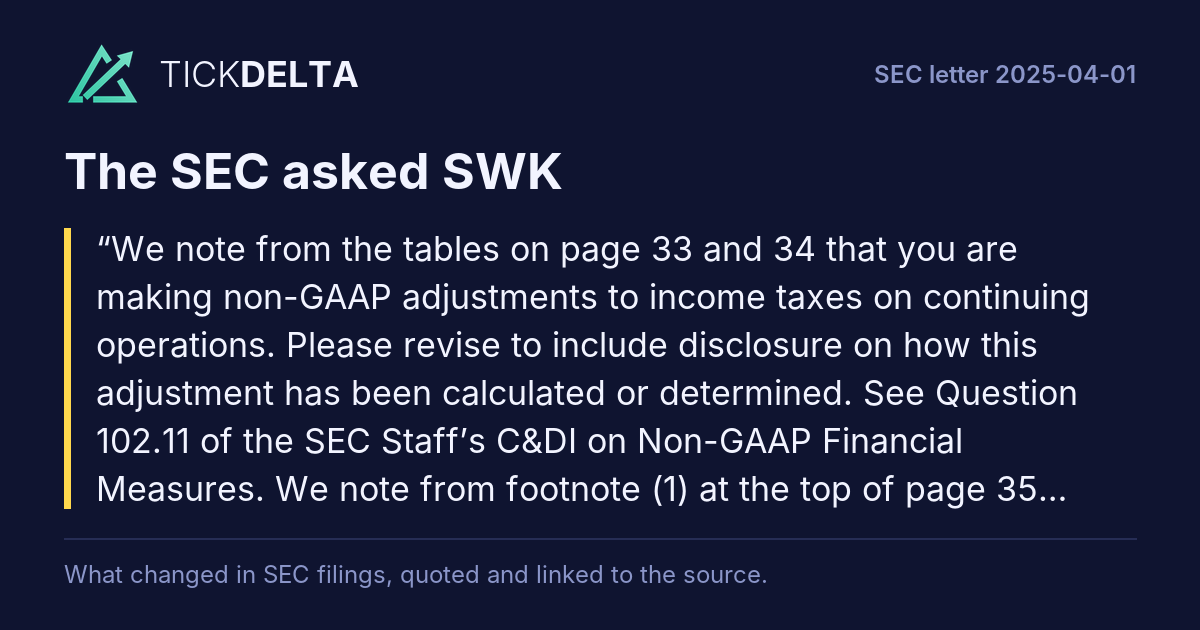
We note from the tables on page 33 and 34 that you are making non-GAAP adjustments to income taxes on continuing operations. Please revise to include disclosure on how this adjustment has been calculated or determined. See Question 102.11 of the SEC Staff’s C&DI on Non-GAAP Financial Measures.Rest of the question
We note from footnote (1) at the top of page 35, that the adjustment for “footprint rationalization” costs in 2024 primarily relates to accelerated depreciation of manufacturing and distribution center equipment of $48.9 million and other facility exit and re-configuration costs of $45.2 million. Please tell us specifically which facilities had exit costs in 2024 and explain to us why these exit and re-configuration costs are not accounted for as restructuring costs in accordance with ASC 420 and 2. disclosed in Note N to the financial statements. As part of your response, please similarly address the 2023 facility exit costs included in this adjustment. 3. Please tell us how the non-cash asset write-downs of $44 million included in footnote (1) differ from the assets that are included as “asset impairment charges” in footnote (7) and are separately presented on the face of the income statement. As part of your response, please tell us where the asset write-downs referred to in footnote (1) are presented in your income statement. 4. We note from your disclosure in footnote (4) that the adjustment for “other, net” includes deal-related costs, net of income related to providing transition services to previously divested businesses. Please explain to us in more detail the nature of this amount as well as the amount of the offsetting income. Also, please tell us how this adjustment differs from your adjustment titled “transition service costs related to previously divested businesses.” Consolidated Results, page 35 5. We note that in your discussion of both consolidated results and segment results, your explanation of the changes in certain line items or profitability measures, such as gross profit, SG&A, income taxes, and segment profit, relate only to non-GAAP amounts and you do not explain the changes in the comparable GAAP amount. In order to avoid undue prominence of the non-GAAP financial measures, please revise your results of operations section in the future to clearly discuss the reasons for the changes in significant income statement line items and segment profitability measures (computed on a GAAP basis) prior to discussing any related non-GAAP amounts. In this regard, you should also discuss the changes in cost of sales line item as part of your gross profit disclosure. See guidance in Question 102.10 of the SEC Staff's C&DI on Non-GAAP Financial Measures. Business Segment Results, page 37 6. We note from your disclosure on page 37, that in regards to your discussion of the Tools and Outdoor segment, you disclose that excluding Non-GAAP adjustments of $143.1 million and $196.7 million in 2024 and 2023, respectively, segment profit amounted to 10.1% of net sales in 2024 compared to 6.6% of net sales in 2023, primarily due to supply chain transformation benefits and lower inventory destocking costs, which were partially offset by growth investments. We also note that your earnings release furnished on Form 8-K on February 5, 2025 includes tables disclosing a non-GAAP segment profit amount for both segments. Please explain to us the nature and amount of each these non-GAAP adjustments to segment profit and tell us how management uses these adjusted amounts. Corporate Overhead, page 38 We note your disclosure on page 38 that excluding Non-GAAP adjustments of $23.4 million, $50.9 million, and $64.5 million in 2024, 2023, and 2022, respectively, the Corporate Overhead element of SG&A was $247.2 million, $261.3 million, and $229.5 million in 2024, 2023, and 2022, respectively. Please explain to us the nature of these non-GAAP adjustments and revise to include all disclosures required by Item 7. 10(e) of Regulation S-K as they apply to your disclosure of Non-GAAP Corporate Overhead. Please note that in accordance with Question 100.01 of the SEC Staff’s C&DI on Non-GAAP Financial Measures, non-GAAP adjustments must not include any costs considered normal, recurring, cash operating expenses. As part of your response, please include your proposed revised disclosure. Notes to the Audited Financial Statements Note M. Other Costs and Expenses, page 95 8. We note your disclosure that Other, net is primarily comprised of intangible asset amortization expense, currency-related gains or losses, environmental remediation expense, deal costs and related consulting costs, and certain pension gains or losses. In light if the significance of this line item on the statement of operations, please revise your note to separately state the material amounts comprising this line item. See guidance in Item 5-03 of Regulation S-X. Note O. Business Segments and Geographic Areas, page 96 9. We note that the reconciliation of segment profit to earnings from continuing operations before income taxes includes an amount for corporate overhead. We also note from your disclosure on page 98 that corporate overhead includes the corporate overhead element of SG&A, which is not allocated to the business segments. Please provide for us, and revise future filings to provide, a more detailed description of the nature of all significant items included in this amount. See guidance in ASC 280-1050-31. Note P. Income Taxes, page 99 10. We note that in the reconciliation of the U.S. federal statutory income tax provision to Income taxes on continuing operations in the Consolidated Statements of Operations, there is a significant amount for capital loss in the year ended December 28, 2024. Please explain to us the nature of this amount. Exhibit 99.1 Earnings Release, page 1 11. We note that you have disclosed organic growth as a percentage, such as in the 2nd bullet on page 1 which states that Fourth Quarter Revenues of $3.7 Billion, Flat Versus Prior Year With 3% Organic Growth* Offset by Infrastructure Divestiture and Currency. Please note that disclosure of organic revenue or organic growth, even disclosed as a percentage or ratio, is considered a non-GAAP measure. Please revise to include a reconciliation quantifying how this amount is calculated or determined. Exhibit 99.2 Financial statements and supporting schedules contained in earnings release, We note that on page 12, 15 and 16 of Exhibit 99.2, you disclose total segment profit and then show total segment profit less corporate overhead which results in an amount described as “total.” Please note that disclosure of the combined amount of segment profit measures of your two segments outside the notes to the financial statements is 12. considered a non-GAAP financial measure and should be accompanied by the disclosures required by Item 10(e) of Regulation S-K. We also note that you reduce this total segment profit measure by corporate overhead, creating another total which appears to represent another non-GAAP financial measure. Please explain to us how management uses these non-GAAP financial measures and revise to include the disclosures required by Item 10(e) of Regulation S-K. Please note that any adjustments included in these non-GAAP financial measures must not include normal cash operating expenses under the guidance in Question 100.01 of the SEC Staff’s C&DI on Non-GAAP Financial Measures. Please provide us with your intended revised disclosure including the reconciliations of these amounts to the most comparable GAAP amount.
The Company acknowledges the Staff’s comment and advises the Staff that the income taxes attributable to its Non-GAAP adjustments are determined by calculating income taxes on pre-tax earnings, both inclusive and exclusive of Non-GAAP adjustments, taking into consideration the nature of the Non-GAAP adjustments and the applicable statutory income tax rates. The Company will revise its disclosures prospectively commencing with the Form
10-Q for the quarter ended March 29, 2025 to explain how the income taxes attributable to its Non-GAAP adjustments have been determined. Read in the reply ↗
First report after the company's reply of 2025-04-29: 10-Q filed 2025-04-30 ↗, against the 10-Q filed 2024-10-29 ↗.
Tickdelta does not hold the text of both reports, so they are not compared here.
We note from your response to our prior comment 3 that the non-cash asset writedowns of $44 million in 2023 included in footnote (1) related to tooling and inventory (predominantly raw materials and WIP) driven primarily by the closure of the Fort Worth, Texas manufacturing site.Rest of the question
Please note that it is not appropriate to adjust non- GAAP financial measures for inventory charges as they represent normal, recurring costs of operations. Please revise future filings accordingly.
The Company acknowledges the Staff’s comment and advises the Staff that the non-cash asset write-downs of $44 million in 2023 were discrete adjustments specifically driven by the unique nature of the Fort Worth, Texas plant. Following its acquisition of the Craftsman brand in 2017, the Company launched an unprecedented initiative to design and construct an innovative plant that heavily leveraged new automation technology and equipment to manufacture Craftsman mechanics hand tools of the future.Read in the reply ↗Rest of the answer
However, as a result of unanticipated challenges related to the new automation technology and equipment, the Company was ultimately unable to fully ramp production at this site as originally expected. As a result of the Company’s decision to close the Fort Worth plant in March 2023, certain non-converted inventory (raw materials and WIP) and tooling equipment specific to the Fort Worth operations were no longer viable or useable elsewhere in the Company’s operations and were written down. The Company does not anticipate incurring similar charges in the future and will not adjust its Non-GAAP financial measures for such charges prospectively in future filings, as requested by the Staff.
We note your summary of pre-tax Non-GAAP adjustments on page 33. Please tell us the nature of the costs included in the line item titled “Complexity Reduction & Operational Excellence” and explain to us how they differ from Strategic Sourcing & Operational Excellence costs. Also, please explain to us why these are not considered normal recurring operating costs of business.Rest of the question
See guidance in Question 100.01 of the C&DI on Non-GAAP Financial Measures.
The Company acknowledges the Staff’s comment and advises the Staff that the supply chain transformation costs included in the summary table of pre-tax Non-GAAP adjustments on page 33 of the Form 10-Q are presented based on the four value streams of the transformation described on page 30 of the Form 10-Q, as follows: Material Productivity (also referred to as Strategic Sourcing), Operational Excellence, Footprint Rationalization, and Complexity Reduction.Read in the reply ↗Rest of the answer
Furthermore, the costs associated with each of these value streams are included in the appropriate income statement caption based on the nature of the underlying costs, with manufacturing-related costs classified in cost of sales in gross profit and distribution-related and other costs in SG&A.
The costs included in the line item titled “Complexity Reduction & Operational Excellence” in the first quarter of 2025 primarily related to third-party consulting fees to provide expertise in identifying business model changes and quantifying related cost savings opportunities within its Engineered Fastening business, which was not part of prior assessments conducted at the onset of the supply chain transformation, developing a detailed program and related governance, and assisting the Company with the implementation of actions necessary to achieve the identified operating model changes and related cost savings.
The costs included in the line item titled “Strategic Sourcing & Operational Excellence” in the first quarter of 2025 primarily related to costs of temporary resources dedicated to supporting these value streams, specifically the transformation of manufacturing sites into COEs, as further discussed in the response to Comment #1 above, and the implementation of new sourcing capabilities across the Company’s businesses. These temporary resources will be exited or placed into different roles within the Company’s ongoing operations at the conclusion of the respective transformation project activities.
Furthermore, the discrete transformation costs described above are not expected to recur after 2025, which is consistent with the expected timing of completing the supply chain transformation as disclosed on page 30 of the Form 10-Q (and page 31 of the Form 10-K). However, given the complexities of executing footprint actions, including potential external factors beyond the Company’s control, the Company anticipates incurring additional charges beyond 2025 relating to targeted footprint actions (primarily site closures).
Given the significance of the supply chain transformation, which represents a significant shift in the Company’s operating model, and the unique nature of the discrete and incremental costs related to the individual value streams and underlying initiatives, the Company has concluded that the above costs are appropriate Non-GAAP adjustments and do not represent normal recurring operating costs. In addition, the Company believes excluding these discrete costs from its Non-GAAP financial measures provides investors with meaningful and helpful information to evaluate the Company’s operating results relative to prior periods and the Company’s competitors.
Consistent with past practice, the Company will include additional disclosure in its future filings to explain the nature of any significant amounts presented in its summary table of pre-tax Non-GAAP adjustments.
First report after the company's reply of 2025-05-21: 10-Q filed 2025-07-29 ↗, against the 10-Q filed 2024-10-29 ↗.
Tickdelta does not hold the text of both reports, so they are not compared here.
We note from your response to our prior comment 2 that the closure of the Ft. Worth site and related inventory and tooling charges were a result of your inability to fully ramp production using new automation technology and equipment. As a result, the inventory and tooling were no longer viable or usable elsewhere in the Company’s operations. Please tell us more about the decision to close the Ft.Rest of the question
Worth plant, including what specifically led to the closure during 2023, and describe any broad effects this decision had on your operations. As part of your response, please clarify why this inventory and tooling could not be used elsewhere in the company or sold to 1. a third party. In addition, please quantify the amount of the charge incurred related to each type of inventory and tooling equipment.
The Company acknowledges the Staff’s comment and advises the Staff that the Fort Worth, Texas plant was specifically designed and constructed to support a new customer program to produce certain mechanics hand tools in the U.S., which were previously manufactured offshore for the customer by a 3rd party company, and re-brand such products from the customer’s private label to Craftsman.Read in the reply ↗Rest of the answer
The objectives of the program were to: (a) re-shore the manufacturing of the mechanics hand tools and produce at a lower cost (or comparable cost to offshore manufacturing) by leveraging innovative manufacturing technology, equipment, and automation at the Fort Worth plant, and (b) market the products (primarily combo kits and sets comprised of ratchets, sockets and/or wrenches, along with the related accessories) under the newly re-designed Craftsman brand (following the Company’s acquisition of the brand) with a focus on “Made in the USA”.
To achieve objective (a) above, the Fort Worth plant implemented a first-of-its-kind manufacturing system, including a new metal forming process that had previously not been used in the hand tools industry and automation technology, which was expected to result in meaningful process and cost efficiencies (e.g. higher material yield, less scrap, lower energy needs, reduced number of process steps and labor hours). The new metal forming process also required specialized machinery, equipment, and tooling, which was only able to be used at the Fort Worth plant. The Company faced many challenges in implementing the manufacturing system and applying the new metal forming process to the production of hand tools, and also experienced delays and other constraints in installing and testing the specialized machinery and equipment due in part to COVID-19 and supply chain disruptions. As a result, the Company was ultimately unable to fully ramp production and achieve a sustainable operation that could consistently meet the required timelines and product cost commitment of the customer program. In March 2023, the Company announced the closure of the Fort Worth plant and discontinued the customer-specific product portfolio. Given the unique nature of the Fort Worth plant and the customer-specific product portfolio of the program, the Company’s decision to close the plant did not have a broad effect on its remaining operations. Furthermore, the Company has not employed this metal forming process, or the related specialized machinery, equipment, and tooling, at any of its other sites subsequent to the Fort Worth closure.
As previously noted, the non-cash asset write-downs in 2023 driven by the Fort Worth closure related to inventory (predominantly non-converted raw materials and WIP) and tooling equipment. The inventory write-off totaled approximately $26 million. Of the total write-off, approximately $21 million represented raw materials and WIP relating to specialized steel only useable for the new metal forming process at Fort Worth, non-kitted components and accessories that were not individually saleable products, and custom product packaging for the canceled Craftsman “Made in the USA” program that could no longer be used. The remaining inventory write-off related to losses driven by the liquidation of the remaining finished goods upon cancellation of this unique customer program. Separately, the write-off of tooling, which was unrelated and classified outside of inventory, totaled approximately $14 million and related to specialized and consumable tooling, which supported the new metal forming process and the re-designed Craftsman “Made in the USA” tool branding, that could not be used elsewhere in the Company’s operations or by a third party.
As noted in its previous response letter, the Company does not anticipate incurring similar charges in the future given the unique nature of the Fort Worth plant and circumstances leading to the closure, as described above.
First report after the company's reply of 2025-08-06: 10-Q filed 2025-11-04 ↗, against the 10-Q filed 2024-10-29 ↗.
Tickdelta does not hold the text of both reports, so they are not compared here.
We note your response to our prior comment, and continue to believe that the adjustment to your non-GAAP financial measures for the write-off of inventory related to the closure of the Ft. Worth site is not appropriate as those costs represent normal, recurring costs of operations. See Question 100.01 in the Compliance & Disclosure Interpretations on Non-GAAP Financial Measures.Rest of the question
Please revise future filings accordingly.
The Company respectfully acknowledges the Staff’s comment and while the Company respectfully disagrees with the Staff’s comment, it will remove the above-referenced adjustment for the write-off of inventory related to the closure of the Fort Worth site from its non-GAAP measures when the relevant period is presented in future filings. Read in the reply ↗
First report after the company's reply of 2025-09-09: 10-Q filed 2025-11-04 ↗, against the 10-Q filed 2024-10-29 ↗.
Tickdelta does not hold the text of both reports, so they are not compared here.
Also in this review: company letter, 2025-04-07, company letter, 2025-07-14, closing letter, 2025-09-17