tickdelta
Sign in

Tickdelta is free for now. Sign up and get Pro free

← Screener

SWKStanley Black & Decker

Industrials · Tools & Hardware · NYSE
Compare with peers → Embed
SEC comment letters, last 20 years

2 reviews of SWK's filings by SEC staff

UPLOAD and CORRESP
ReviewsRead ↓
2
latest letter 2025-04-01
Questions asked
14
each answered in the company's own letter
No closing letter
0
reviews without a letter saying the staff completed it

When the SEC's staff reviews a filing, it writes to the company with numbered questions, and the company answers each one in a letter. SEC publishes the exchange once the review is over, at least 20 business days later. A question is not an accusation; most reviews end with the company adding detail to its next filing.

Form 10-K for the Year Ended December 28, 2024

2025-04-01 to 2025-09-17 · 5 questions · 4 letters from the SEC, 6 from the company
Review closed 2025-09-17
Results discussion (MD&A)InventoryNon-GAAP measuresRevenueSegmentsGoodwill and impairmentIncome taxesPensions
Results of Operations · Certain Items Impacting Earnings and Non-GAAP Financial Measures, page 32
SEC asked
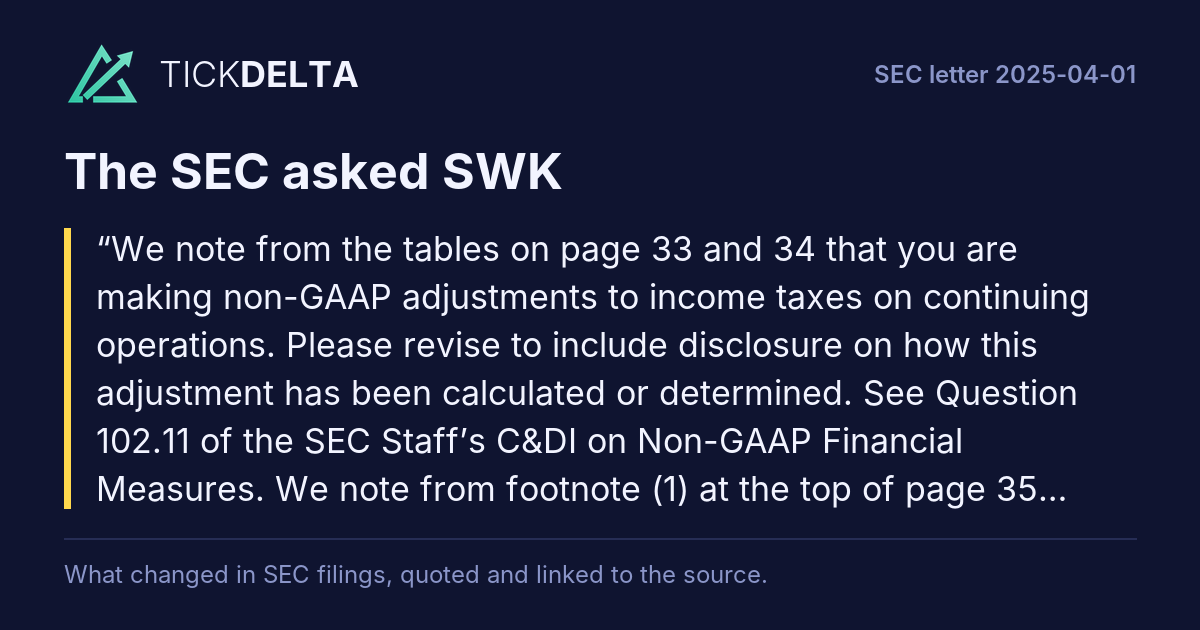
We note from the tables on page 33 and 34 that you are making non-GAAP adjustments to income taxes on continuing operations. Please revise to include disclosure on how this adjustment has been calculated or determined. See Question 102.11 of the SEC Staff’s C&DI on Non-GAAP Financial Measures.
Rest of the question

We note from footnote (1) at the top of page 35, that the adjustment for “footprint rationalization” costs in 2024 primarily relates to accelerated depreciation of manufacturing and distribution center equipment of $48.9 million and other facility exit and re-configuration costs of $45.2 million. Please tell us specifically which facilities had exit costs in 2024 and explain to us why these exit and re-configuration costs are not accounted for as restructuring costs in accordance with ASC 420 and 2. disclosed in Note N to the financial statements. As part of your response, please similarly address the 2023 facility exit costs included in this adjustment. 3. Please tell us how the non-cash asset write-downs of $44 million included in footnote (1) differ from the assets that are included as “asset impairment charges” in footnote (7) and are separately presented on the face of the income statement. As part of your response, please tell us where the asset write-downs referred to in footnote (1) are presented in your income statement. 4. We note from your disclosure in footnote (4) that the adjustment for “other, net” includes deal-related costs, net of income related to providing transition services to previously divested businesses. Please explain to us in more detail the nature of this amount as well as the amount of the offsetting income. Also, please tell us how this adjustment differs from your adjustment titled “transition service costs related to previously divested businesses.” Consolidated Results, page 35 5. We note that in your discussion of both consolidated results and segment results, your explanation of the changes in certain line items or profitability measures, such as gross profit, SG&A, income taxes, and segment profit, relate only to non-GAAP amounts and you do not explain the changes in the comparable GAAP amount. In order to avoid undue prominence of the non-GAAP financial measures, please revise your results of operations section in the future to clearly discuss the reasons for the changes in significant income statement line items and segment profitability measures (computed on a GAAP basis) prior to discussing any related non-GAAP amounts. In this regard, you should also discuss the changes in cost of sales line item as part of your gross profit disclosure. See guidance in Question 102.10 of the SEC Staff's C&DI on Non-GAAP Financial Measures. Business Segment Results, page 37 6. We note from your disclosure on page 37, that in regards to your discussion of the Tools and Outdoor segment, you disclose that excluding Non-GAAP adjustments of $143.1 million and $196.7 million in 2024 and 2023, respectively, segment profit amounted to 10.1% of net sales in 2024 compared to 6.6% of net sales in 2023, primarily due to supply chain transformation benefits and lower inventory destocking costs, which were partially offset by growth investments. We also note that your earnings release furnished on Form 8-K on February 5, 2025 includes tables disclosing a non-GAAP segment profit amount for both segments. Please explain to us the nature and amount of each these non-GAAP adjustments to segment profit and tell us how management uses these adjusted amounts. Corporate Overhead, page 38 We note your disclosure on page 38 that excluding Non-GAAP adjustments of $23.4 million, $50.9 million, and $64.5 million in 2024, 2023, and 2022, respectively, the Corporate Overhead element of SG&A was $247.2 million, $261.3 million, and $229.5 million in 2024, 2023, and 2022, respectively. Please explain to us the nature of these non-GAAP adjustments and revise to include all disclosures required by Item 7. 10(e) of Regulation S-K as they apply to your disclosure of Non-GAAP Corporate Overhead. Please note that in accordance with Question 100.01 of the SEC Staff’s C&DI on Non-GAAP Financial Measures, non-GAAP adjustments must not include any costs considered normal, recurring, cash operating expenses. As part of your response, please include your proposed revised disclosure. Notes to the Audited Financial Statements Note M. Other Costs and Expenses, page 95 8. We note your disclosure that Other, net is primarily comprised of intangible asset amortization expense, currency-related gains or losses, environmental remediation expense, deal costs and related consulting costs, and certain pension gains or losses. In light if the significance of this line item on the statement of operations, please revise your note to separately state the material amounts comprising this line item. See guidance in Item 5-03 of Regulation S-X. Note O. Business Segments and Geographic Areas, page 96 9. We note that the reconciliation of segment profit to earnings from continuing operations before income taxes includes an amount for corporate overhead. We also note from your disclosure on page 98 that corporate overhead includes the corporate overhead element of SG&A, which is not allocated to the business segments. Please provide for us, and revise future filings to provide, a more detailed description of the nature of all significant items included in this amount. See guidance in ASC 280-1050-31. Note P. Income Taxes, page 99 10. We note that in the reconciliation of the U.S. federal statutory income tax provision to Income taxes on continuing operations in the Consolidated Statements of Operations, there is a significant amount for capital loss in the year ended December 28, 2024. Please explain to us the nature of this amount. Exhibit 99.1 Earnings Release, page 1 11. We note that you have disclosed organic growth as a percentage, such as in the 2nd bullet on page 1 which states that Fourth Quarter Revenues of $3.7 Billion, Flat Versus Prior Year With 3% Organic Growth* Offset by Infrastructure Divestiture and Currency. Please note that disclosure of organic revenue or organic growth, even disclosed as a percentage or ratio, is considered a non-GAAP measure. Please revise to include a reconciliation quantifying how this amount is calculated or determined. Exhibit 99.2 Financial statements and supporting schedules contained in earnings release, We note that on page 12, 15 and 16 of Exhibit 99.2, you disclose total segment profit and then show total segment profit less corporate overhead which results in an amount described as “total.” Please note that disclosure of the combined amount of segment profit measures of your two segments outside the notes to the financial statements is 12. considered a non-GAAP financial measure and should be accompanied by the disclosures required by Item 10(e) of Regulation S-K. We also note that you reduce this total segment profit measure by corporate overhead, creating another total which appears to represent another non-GAAP financial measure. Please explain to us how management uses these non-GAAP financial measures and revise to include the disclosures required by Item 10(e) of Regulation S-K. Please note that any adjustments included in these non-GAAP financial measures must not include normal cash operating expenses under the guidance in Question 100.01 of the SEC Staff’s C&DI on Non-GAAP Financial Measures. Please provide us with your intended revised disclosure including the reconciliations of these amounts to the most comparable GAAP amount.

SWK answered
The Company acknowledges the Staff’s comment and advises the Staff that the income taxes attributable to its Non-GAAP adjustments are determined by calculating income taxes on pre-tax earnings, both inclusive and exclusive of Non-GAAP adjustments, taking into consideration the nature of the Non-GAAP adjustments and the applicable statutory income tax rates. The Company will revise its disclosures prospectively commencing with the Form

10-Q for the quarter ended March 29, 2025 to explain how the income taxes attributable to its Non-GAAP adjustments have been determined. Read in the reply ↗
In its next report

First report after the company's reply of 2025-04-29: 10-Q filed 2025-04-30 ↗, against the 10-Q filed 2024-10-29 ↗.

Tickdelta does not hold the text of both reports, so they are not compared here.
SEC asked (2)
We note from your response to our prior comment 3 that the non-cash asset writedowns of $44 million in 2023 included in footnote (1) related to tooling and inventory (predominantly raw materials and WIP) driven primarily by the closure of the Fort Worth, Texas manufacturing site.
Rest of the question

Please note that it is not appropriate to adjust non- GAAP financial measures for inventory charges as they represent normal, recurring costs of operations. Please revise future filings accordingly.

SWK answered
The Company acknowledges the Staff’s comment and advises the Staff that the non-cash asset write-downs of $44 million in 2023 were discrete adjustments specifically driven by the unique nature of the Fort Worth, Texas plant. Following its acquisition of the Craftsman brand in 2017, the Company launched an unprecedented initiative to design and construct an innovative plant that heavily leveraged new automation technology and equipment to manufacture Craftsman mechanics hand tools of the future.
Rest of the answer

However, as a result of unanticipated challenges related to the new automation technology and equipment, the Company was ultimately unable to fully ramp production at this site as originally expected. As a result of the Company’s decision to close the Fort Worth plant in March 2023, certain non-converted inventory (raw materials and WIP) and tooling equipment specific to the Fort Worth operations were no longer viable or useable elsewhere in the Company’s operations and were written down. The Company does not anticipate incurring similar charges in the future and will not adjust its Non-GAAP financial measures for such charges prospectively in future filings, as requested by the Staff.

Read in the reply ↗
Results of Operations, page 31
SEC asked (3)
We note your summary of pre-tax Non-GAAP adjustments on page 33. Please tell us the nature of the costs included in the line item titled “Complexity Reduction & Operational Excellence” and explain to us how they differ from Strategic Sourcing & Operational Excellence costs. Also, please explain to us why these are not considered normal recurring operating costs of business.
Rest of the question

See guidance in Question 100.01 of the C&DI on Non-GAAP Financial Measures.

SWK answered
The Company acknowledges the Staff’s comment and advises the Staff that the supply chain transformation costs included in the summary table of pre-tax Non-GAAP adjustments on page 33 of the Form 10-Q are presented based on the four value streams of the transformation described on page 30 of the Form 10-Q, as follows: Material Productivity (also referred to as Strategic Sourcing), Operational Excellence, Footprint Rationalization, and Complexity Reduction.
Rest of the answer

Furthermore, the costs associated with each of these value streams are included in the appropriate income statement caption based on the nature of the underlying costs, with manufacturing-related costs classified in cost of sales in gross profit and distribution-related and other costs in SG&A.

The costs included in the line item titled “Complexity Reduction & Operational Excellence” in the first quarter of 2025 primarily related to third-party consulting fees to provide expertise in identifying business model changes and quantifying related cost savings opportunities within its Engineered Fastening business, which was not part of prior assessments conducted at the onset of the supply chain transformation, developing a detailed program and related governance, and assisting the Company with the implementation of actions necessary to achieve the identified operating model changes and related cost savings.

The costs included in the line item titled “Strategic Sourcing & Operational Excellence” in the first quarter of 2025 primarily related to costs of temporary resources dedicated to supporting these value streams, specifically the transformation of manufacturing sites into COEs, as further discussed in the response to Comment #1 above, and the implementation of new sourcing capabilities across the Company’s businesses. These temporary resources will be exited or placed into different roles within the Company’s ongoing operations at the conclusion of the respective transformation project activities.

Furthermore, the discrete transformation costs described above are not expected to recur after 2025, which is consistent with the expected timing of completing the supply chain transformation as disclosed on page 30 of the Form 10-Q (and page 31 of the Form 10-K). However, given the complexities of executing footprint actions, including potential external factors beyond the Company’s control, the Company anticipates incurring additional charges beyond 2025 relating to targeted footprint actions (primarily site closures).

Given the significance of the supply chain transformation, which represents a significant shift in the Company’s operating model, and the unique nature of the discrete and incremental costs related to the individual value streams and underlying initiatives, the Company has concluded that the above costs are appropriate Non-GAAP adjustments and do not represent normal recurring operating costs. In addition, the Company believes excluding these discrete costs from its Non-GAAP financial measures provides investors with meaningful and helpful information to evaluate the Company’s operating results relative to prior periods and the Company’s competitors.

Consistent with past practice, the Company will include additional disclosure in its future filings to explain the nature of any significant amounts presented in its summary table of pre-tax Non-GAAP adjustments.

Read in the reply ↗
In its next report

First report after the company's reply of 2025-05-21: 10-Q filed 2025-07-29 ↗, against the 10-Q filed 2024-10-29 ↗.

Tickdelta does not hold the text of both reports, so they are not compared here.

Results of Operations · Certain Items Impacting Earnings, page 32
SEC asked
We note from your response to our prior comment 2 that the closure of the Ft. Worth site and related inventory and tooling charges were a result of your inability to fully ramp production using new automation technology and equipment. As a result, the inventory and tooling were no longer viable or usable elsewhere in the Company’s operations. Please tell us more about the decision to close the Ft.
Rest of the question

Worth plant, including what specifically led to the closure during 2023, and describe any broad effects this decision had on your operations. As part of your response, please clarify why this inventory and tooling could not be used elsewhere in the company or sold to 1. a third party. In addition, please quantify the amount of the charge incurred related to each type of inventory and tooling equipment.

SWK answered
The Company acknowledges the Staff’s comment and advises the Staff that the Fort Worth, Texas plant was specifically designed and constructed to support a new customer program to produce certain mechanics hand tools in the U.S., which were previously manufactured offshore for the customer by a 3rd party company, and re-brand such products from the customer’s private label to Craftsman.
Rest of the answer

The objectives of the program were to: (a) re-shore the manufacturing of the mechanics hand tools and produce at a lower cost (or comparable cost to offshore manufacturing) by leveraging innovative manufacturing technology, equipment, and automation at the Fort Worth plant, and (b) market the products (primarily combo kits and sets comprised of ratchets, sockets and/or wrenches, along with the related accessories) under the newly re-designed Craftsman brand (following the Company’s acquisition of the brand) with a focus on “Made in the USA”.

To achieve objective (a) above, the Fort Worth plant implemented a first-of-its-kind manufacturing system, including a new metal forming process that had previously not been used in the hand tools industry and automation technology, which was expected to result in meaningful process and cost efficiencies (e.g. higher material yield, less scrap, lower energy needs, reduced number of process steps and labor hours). The new metal forming process also required specialized machinery, equipment, and tooling, which was only able to be used at the Fort Worth plant. The Company faced many challenges in implementing the manufacturing system and applying the new metal forming process to the production of hand tools, and also experienced delays and other constraints in installing and testing the specialized machinery and equipment due in part to COVID-19 and supply chain disruptions. As a result, the Company was ultimately unable to fully ramp production and achieve a sustainable operation that could consistently meet the required timelines and product cost commitment of the customer program. In March 2023, the Company announced the closure of the Fort Worth plant and discontinued the customer-specific product portfolio. Given the unique nature of the Fort Worth plant and the customer-specific product portfolio of the program, the Company’s decision to close the plant did not have a broad effect on its remaining operations. Furthermore, the Company has not employed this metal forming process, or the related specialized machinery, equipment, and tooling, at any of its other sites subsequent to the Fort Worth closure.

As previously noted, the non-cash asset write-downs in 2023 driven by the Fort Worth closure related to inventory (predominantly non-converted raw materials and WIP) and tooling equipment. The inventory write-off totaled approximately $26 million. Of the total write-off, approximately $21 million represented raw materials and WIP relating to specialized steel only useable for the new metal forming process at Fort Worth, non-kitted components and accessories that were not individually saleable products, and custom product packaging for the canceled Craftsman “Made in the USA” program that could no longer be used. The remaining inventory write-off related to losses driven by the liquidation of the remaining finished goods upon cancellation of this unique customer program. Separately, the write-off of tooling, which was unrelated and classified outside of inventory, totaled approximately $14 million and related to specialized and consumable tooling, which supported the new metal forming process and the re-designed Craftsman “Made in the USA” tool branding, that could not be used elsewhere in the Company’s operations or by a third party.

As noted in its previous response letter, the Company does not anticipate incurring similar charges in the future given the unique nature of the Fort Worth plant and circumstances leading to the closure, as described above.

Read in the reply ↗
In its next report

First report after the company's reply of 2025-08-06: 10-Q filed 2025-11-04 ↗, against the 10-Q filed 2024-10-29 ↗.

Tickdelta does not hold the text of both reports, so they are not compared here.

Results of Operations · Certain Items Impacting Earnings, page 32
SEC asked
We note your response to our prior comment, and continue to believe that the adjustment to your non-GAAP financial measures for the write-off of inventory related to the closure of the Ft. Worth site is not appropriate as those costs represent normal, recurring costs of operations. See Question 100.01 in the Compliance & Disclosure Interpretations on Non-GAAP Financial Measures.
Rest of the question

Please revise future filings accordingly.

SWK answered
The Company respectfully acknowledges the Staff’s comment and while the Company respectfully disagrees with the Staff’s comment, it will remove the above-referenced adjustment for the write-off of inventory related to the closure of the Fort Worth site from its non-GAAP measures when the relevant period is presented in future filings. Read in the reply ↗
In its next report

First report after the company's reply of 2025-09-09: 10-Q filed 2025-11-04 ↗, against the 10-Q filed 2024-10-29 ↗.

Tickdelta does not hold the text of both reports, so they are not compared here.

Also in this review: company letter, 2025-04-07, company letter, 2025-07-14, closing letter, 2025-09-17
Form 10-K for the Year Ended December 31, 2022

2023-11-28 to 2024-01-08 · 9 questions · 2 letters from the SEC, 2 from the company
Review closed 2024-01-08
Non-GAAP measuresResults discussion (MD&A)AcquisitionsGoodwill and impairmentLegal and contingenciesLiquidity and cashRevenueSegmentsIncome taxes
Results of Operations · Certain Items Impacting Earnings and Non-GAAP Financial Measures, page 31
SEC asked (1)
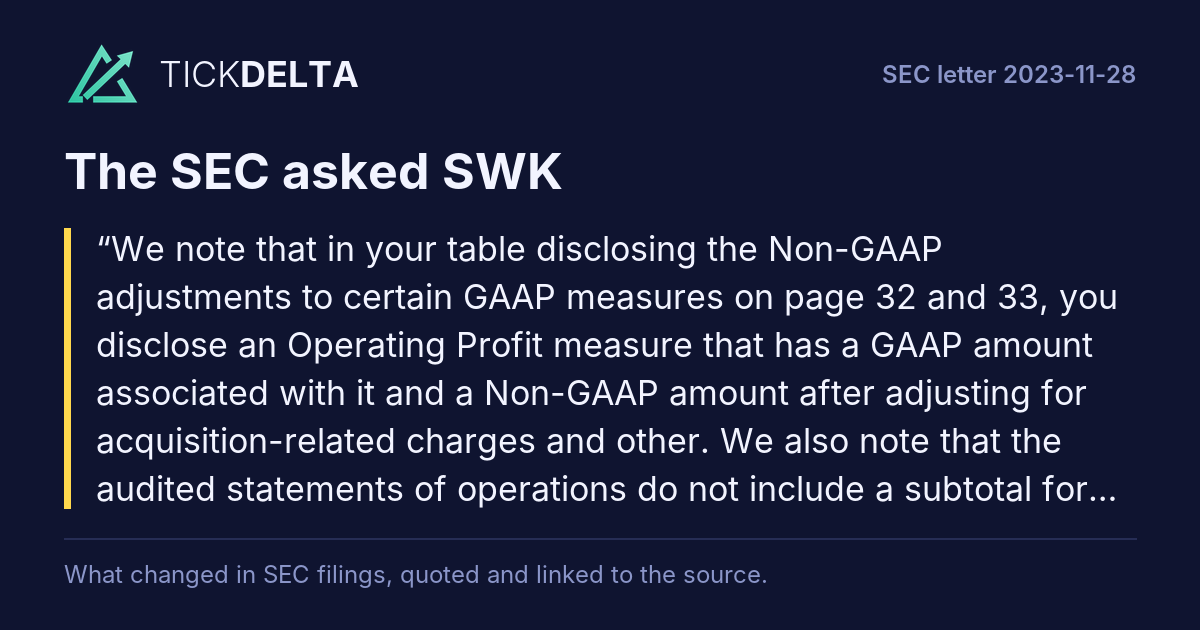
We note that in your table disclosing the Non-GAAP adjustments to certain GAAP measures on page 32 and 33, you disclose an Operating Profit measure that has a GAAP amount associated with it and a Non-GAAP amount after adjusting for acquisition-related charges and other.
Rest of the question

We also note that the audited statements of operations do not include a subtotal for Operating Profit, and it appears that the amount disclosed in MD&A has been calculated from the statement of operations as Net Sales less Cost of Sales (Gross Profit) less SG&A and provision for credit losses. It appears in calculating this Operating Profit measure, referred to as “GAAP” in your MD&A section, you have excluded at a minimum, asset impairment charges, restructuring charges, and intangible asset amortization charges, all of which are considered operating expenses under GAAP. In light of the exclusion of these expenses, this Operating Profit measure would be considered a Non-GAAP measure, should be retitled to avoid being confused with GAAP Operating Profit and needs to include all disclosures required by Item 10(e) of Regulation S-K. Please revise accordingly. Your disclosures in your Form 10-Q and earnings releases on Form 8-K should be similarly revised. See also Question 100.05 of the SEC's Compliance and Disclosure Interpretation on Non-GAAP Financial Measures.

SWK answered
The Company acknowledges the Staff’s comment and advises the Staff that the Company will revise the table disclosing the non-GAAP adjustments to remove the Operating Profit measure prospectively commencing with the Form 10-K for the year ended December 30, 2023. Refer to Comment #8 below for the Company’s response to revising its earnings releases on Form 8-K. Read in the reply ↗
In its next report

First report after the company's reply of 2023-12-08: 10-K filed 2024-02-27 ↗, against the 10-K filed 2023-02-23 ↗.

Tickdelta does not hold the text of both reports, so they are not compared here.

Results of Operations · Certain Items Impacting Earnings and Non-GAAP Financial Measures, page 31
SEC asked (2)
We note from your table on page 32 that you adjust certain GAAP measures for acquisition related and other charges to present corresponding non-GAAP measures. We further note that these adjustments to SG&A include integration-related costs and a voluntary retirement program. Please provide us more detail as to the nature and amounts related to these charges.
Rest of the question

Additionally, we note that you include a similar Non-GAAP table in your Form 10-Q reports. You disclose that the Non-GAAP adjustments to Gross profit primarily pertain to footprint actions and other costs associated with the supply chain transformation, and the Non-GAAP adjustments to SG&A primarily related to costs of providing transition services for previously divested businesses and supply chain transformation costs. Please provide us more detail as to the nature of the footprint actions and supply chain transformation costs. Specifically, please tell us why you believe these costs are appropriate non-GAAP adjustments and do not represent normal operating costs.

SWK answered
The Company acknowledges the Staff’s comment and advises the Staff that the acquisition-related and other charges recorded to Selling, general and administrative (“SG&A”) in 2022 were primarily related to integration-related costs totaling $85 million and voluntary retirement program costs totaling $33 million. The integration-related costs were primarily driven by multiple initiatives to integrate the MTD and Excel acquisitions, which approximated $2.1 billion in total purchase price and represented strategically significant additions to the Company’s existing outdoor category.
Rest of the answer

The initiatives included integrating the organizations and shared processes, as well as harmonizing key IT applications and infrastructure. The costs associated with the voluntary retirement program, which was executed as part of a broader restructuring to right-size the Company’s corporate and support functions to align with a more focused portfolio due to pending divestitures, related to separation benefits provided to eligible employees who voluntarily retired from the Company.

The acquisition-related and other charges recorded to Gross profit and SG&A in 2023 were primarily related to production and distribution footprint rationalization actions and other costs associated with a supply chain transformation to enable these rationalization actions and to integrate and globalize product value streams, which represents a significant shift in the Company’s operating model. The footprint actions executed as part of the rationalization include targeted site closures and facility consolidations, which resulted in incremental costs to exit these sites, primarily related to non-cash asset-related charges. The initiatives enabling the footprint rationalization and value stream integration and globalization include strategic sourcing, complexity reduction, and facility optimization. Given the significance of the supply chain transformation and the unique nature of the associated costs, the Company has concluded that these costs are appropriate non-GAAP adjustments and do not represent normal operating costs. As a result, the Company believes excluding these discrete transformation costs from its non-GAAP measures provides investors with meaningful and helpful information to evaluate the Company’s operating results relative to prior periods and the Company’s competitors.

Read in the reply ↗
In its next report

First report after the company's reply of 2023-12-08: 10-K filed 2024-02-27 ↗, against the 10-K filed 2023-02-23 ↗.

Tickdelta does not hold the text of both reports, so they are not compared here.

2023 Outlook, page 37
SEC asked (3)
We note your disclosure that the difference between 2023 diluted earnings per share outlook and the diluted earnings per share range, excluding charges, is approximately $1.15 to $1.65, consisting of acquisition-related charges and other charges primarily due to supply chain transformation under the Global Cost Reduction Program. We also note similar disclosures in your 10-Q filings.
Rest of the question

Please provide us more information about the nature and amount of each of these types of adjustments. Specifically, please tell us why you believe that these represent appropriate non-GAAP adjustments and are not normal recurring expenses. See Question 100.01 of the SEC's Compliance and Disclosure Interpretations on Non-GAAP Financial Measures.

SWK answered
The Company acknowledges the Staff’s comment and advises the Staff that the Company has considered the guidance set forth in Question 100.01 of the Compliance and Disclosure Interpretations on Non-GAAP Financial Measures. The Company advises the Staff that the acquisition-related charges referenced in 2023 Outlook related to the integration costs for the MTD and Excel acquisitions, as further discussed in response to Comment #2 above.
Rest of the answer

Of the $1.15 to $1.65 range disclosed in 2023 Outlook, these estimated integration-related costs approximated $0.20 to $0.25.

The charges related to the supply chain transformation under the Global Cost Reduction Program referenced in 2023 Outlook related primarily to the footprint rationalization actions and other transformation costs, as further discussed in response to Comment #2 above. Of the $1.15 to $1.65 range disclosed in 2023 Outlook, these estimated footprint rationalization and transformation costs approximated $0.80 to $1.20.

The Company has concluded that these costs represent appropriate non-GAAP adjustments due to: (a) the substantial integration activities required for the MTD and Excel acquisitions, particularly given the size and complexity of these businesses, and (b) the significance of the supply chain transformation and related footprint rationalization actions. Furthermore, as these costs are not representative of the Company’s ongoing operating cost structure, the Company believes excluding these costs from its non-GAAP measures is relevant to aid analysis and understanding of the Company’s results and business trends relative to past performance and the Company’s competitors.

Read in the reply ↗
In its next report

First report after the company's reply of 2023-12-08: 10-K filed 2024-02-27 ↗, against the 10-K filed 2023-02-23 ↗.

Tickdelta does not hold the text of both reports, so they are not compared here.

Audited Financial Statements · Statement of Cash Flows, page 66
SEC asked (4)
We note that the reconciliation included within the operating activities section of your statement of cash flow begins with a line for net earnings from continuing operations, followed by a line for net earnings from discontinued operations. Please revise future filings to begin your reconciliation with net income. Refer to guidance in ASC 230-1045-29.
SWK answered
The Company acknowledges the Staff’s comment and advises the Staff that the Company will revise the reconciliation included within the operating activities section of its statement of cash flows to begin with net income prospectively commencing with the Form 10-K for the year ended December 30, 2023. Read in the reply ↗
In its next report

First report after the company's reply of 2023-12-08: 10-K filed 2024-02-27 ↗, against the 10-K filed 2023-02-23 ↗.

Tickdelta does not hold the text of both reports, so they are not compared here.

Notes to the Audited Financial Statements · Note P. Business Segments and Geographic Areas, page 105
SEC asked (5)
We note that the Tools & Outdoor segment is comprised of Power Tools Group (PTG), Hand Tools, Accessories & Storage (HTAS), and Outdoor Power Equipment (Outdoor) businesses, and the Industrial Segment is comprised of Engineered Fastening and Infrastructure businesses.
Rest of the question

We also note that you have provided disaggregated revenue for each of the two businesses in the Industrial Segment, as well as by geographic areas for consolidated revenue. Further we note from your second quarter 2023 earnings call, that you discuss revenue by “strategic business unit performance” which includes revenue trends for outdoor, hand tools, storage solutions and power tools. Please tell us what consideration you gave to disclosing additional revenue information by these businesses in the Tools & Outdoor segment, or other product categories, within the notes to your financial statements. Refer to guidance in ASC 606-10-55-89 through 55-91 and ASC 280-10-50-40.

SWK answered
The Company acknowledges the Staff’s comment and advises the Staff that the Company considered the guidance in ASC 280-10-50-40 when determining its disclosures related to the disaggregation of revenue, which states that a public entity shall report the revenues from external customers for each product and service or each group of similar products and services unless it is impracticable to do so.
Rest of the answer

The Company also considered the guidance in ASC 606-10-55-89 through 55-91, which provides that the extent to which a company’s revenue is disaggregated depends on the facts and circumstances of the company’s contracts with customers.

The Company advises the Staff that the Company believes that there are no significant differences in the nature of the goods sold or the customer contracts that exist across the product categories within the Tools & Outdoor segment that would necessitate additional disaggregated revenue disclosures. Furthermore, the Company believes the additional revenue trend information for outdoor, power tools, and hand tools, accessories and storage, as presented in the second quarter 2023 earnings call, may be meaningful to investors in order to provide additional context on current market dynamics, but the Company’s Chief Operating Decision Maker does not use information at this level in evaluating the financial performance of its operating segments, as discussed in ASC 606-10-55-90. The Company further notes that its existing segment disclosures include additional information relating to the Tools & Outdoor segment, including the types of products sold, which do not vary meaningfully in terms of types of customer contracts or timing of transfer of goods, as well as the sales levels of its two largest customers.

The Company will continue to evaluate the disclosure of disaggregated revenue in future filings, but believes its current disclosures provide the appropriate level of revenue information in accordance with ASC 606-10-55-89 through 55-91 and ASC 280-10-50-40.

Read in the reply ↗
In its next report

First report after the company's reply of 2023-12-08: 10-K filed 2024-02-27 ↗, against the 10-K filed 2023-02-23 ↗.

Tickdelta does not hold the text of both reports, so they are not compared here.

Note Q. Income Taxes, page 108
SEC asked (6)
We note from your disclosure in Note Q, that the intra-entity asset transfer of intellectual property had a significant effect on your effective tax rate in both 2021 and 2022. Additionally, you disclose that the increase in intangible deferred tax assets relates to the intra-entity asset transfer of certain intangible assets between two of your foreign subsidiaries Please tell us, and revise future filings to
Rest of the question

disclose, the details of this IP transfer, including the nature of any estimates and assumptions related to the valuation of this transaction.

SWK answered
The Company acknowledges the Staff’s comment and advises the Staff that the Company will revise its disclosures relating to the intra-entity asset transfer of intellectual property within Note Q prospectively commencing with the Form 10-K for the year ended December 30, 2023, as follows:

“The increase in intangible deferred tax assets relates to an intra-entity asset transfer of certain intangible assets from a wholly-owned, non-U.S. subsidiary to another wholly-owned, non-U.S. subsidiary located in the United Kingdom in order to better align with current and future business operations.
Rest of the answer

The transfer resulted in a step-up in tax basis driven by the fair value of the transferred intellectual property (“IP”), which was determined using an income approach taking into consideration future revenue projections, royalty rates and discount rates. The Company expects to realize the deferred tax asset recorded as a result of the IP transfer and will periodically assess such realizability. The tax-deductible amortization related to the transferred IP will be recognized over a 20-year period.”

Read in the reply ↗
In its next report

First report after the company's reply of 2023-12-08: 10-K filed 2024-02-27 ↗, against the 10-K filed 2023-02-23 ↗.

Tickdelta does not hold the text of both reports, so they are not compared here.

Note S. Contingencies, page 112
SEC asked (7)
We note your disclosure in Note S of several environmental and other ongoing contingencies. We also note that in Item 3. Legal Proceedings on page 24, you disclose two investigations with the SEC and/or DOJ, in which you disclose that the Company does not believe that these matters will have a material impact on its financial condition or results of operations, although it is possible that a loss related to these
Rest of the question

matters may be incurred. In light of this potential loss contingency, it appears that these matters should be included as a loss contingency in your notes to the financial statements in accordance with ASC 450-20-50. As applicable, please revise future filings accordingly. Exhibit 99.2 Financial statements and supporting schedules contained in Stanley Black & Decker, Inc.'s October 27, 2023 press release, page 8

SWK answered
The Company acknowledges the Staff’s comment and advises the Staff that the Company will revise its disclosures within Note S prospectively commencing with the Form 10-K for the year ended December 30, 2023, to include the two investigations with the SEC and/or DOJ, as disclosed in Item 3. Legal Proceedings, as well as any other potential loss contingency requiring disclosure in accordance with ASC 450-20-50.

Exhibit 99.2 Financial statements and supporting schedules contained in Stanley Black & Decker, Inc.’s October 27, 2023 press release, page 8 Read in the reply ↗
In its next report

First report after the company's reply of 2023-12-08: 10-K filed 2024-02-27 ↗, against the 10-K filed 2023-02-23 ↗.

Tickdelta does not hold the text of both reports, so they are not compared here.

Note S. Contingencies, page 112
SEC asked (8)
We note that your statements of operations presented on page 8 of your earning release, include the presentation of an Operating Profit subtotal. In light of the fact that this subtotal appears to exclude charges for asset impairment and restructuring and potentially other operating expenses included in the “other-net” line item, it does not represent a measure calculated in accordance with GAAP.
Rest of the question

Please remove this subtotal from your statements of operations or alternatively clearly label as a Non-GAAP measure and include the disclosures required by Item 10(e) of Regulation S-K.

SWK answered
The Company acknowledges the Staff’s comment and advises the Staff that the Company will remove the Operating Profit subtotal prospectively commencing with its earnings release on Form 8-K for the fourth quarter of 2023. Read in the reply ↗
In its next report

First report after the company's reply of 2023-12-08: 10-K filed 2024-02-27 ↗, against the 10-K filed 2023-02-23 ↗.

Tickdelta does not hold the text of both reports, so they are not compared here.

Results of Operations · Certain Items Impacting Earnings and Non-GAAP Financial Measures, page 31
SEC asked
We note your response to our prior comments 2 and 3. Please provide us further detail as to the amount and nature of the costs incurred that are part of your "supply chain transformation" adjustments in 2023. In this regard, it is not clear what is meant by "footprint rationalization actions" or "complexity reduction" and the type of costs that are included in these items.
Rest of the question

Also, please revise future filings to quantify the amount of the adjustments related to each type of activity. For example, related to the 2022 reconciliation, please disclose the amount related to integration related costs as well as the voluntary retirement program.

SWK answered
The Company acknowledges the Staff’s comment and advises the Staff that the adjustments related to the supply chain transformation program totaled $194 million during the nine months ended September 30, 2023. As previously disclosed, the supply chain transformation consists of four main value streams: footprint rationalization, complexity reduction, strategic sourcing, and operational excellence.

The footprint rationalization value stream relates to the transformation of the Company’s manufacturing and distribution network from a decentralized and inefficient system of sites built through
Rest of the answer

years of acquisitions to a strategically focused supply chain. The specific actions under footprint rationalization will include: (a) site closures to reduce capacity, (b) site transformations into manufacturing centers of excellence to integrate and globalize product value streams, and (c) re-configuration of the Company’s distribution network, including closure of certain distribution sites tied to previously acquired businesses, to create an integrated hub and spoke model with strategically located regional sites to reduce delivery times to customers. Of the $194 million of total charges disclosed above, approximately $118 million relates to transfers and closures of targeted manufacturing sites in 2023, which was driven by non-cash asset write-downs of $58 million (predominantly production equipment and tooling), non-cash inventory write-downs of $28 million (predominantly raw materials and WIP), severance charges for impacted employees of $12 million, and facility exit and re-configuration expenses of $20 million (predominantly site remediation and decommissioning costs, contract termination penalties, equipment and inventory transfer costs, and temporary incremental rent incurred while the distribution network is being re-configured, as described above).

The complexity reduction value stream is primarily comprised of a SKU reduction initiative, which aims to reduce the total quantity of unique product SKUs by approximately 40%, and a product platforming strategy to standardize engineering and design across product categories and to maximize shared components and assembly. These complexity reduction initiatives also facilitate the footprint rationalization described above. The Company incurred $8 million of costs in 2023 related to these initiatives, which was primarily related to third-party consultant fees to assist the Company with identifying and quantifying these opportunities and designing a plan to achieve the related benefits.

The remaining value streams of the program relate to strategic sourcing and operational excellence, which are focused on: (a) identifying and quantifying opportunities to source more efficiently and designing and helping to implement the capabilities to source in a new integrated manner across all of the Company’s businesses, and (b) identifying and quantifying opportunities to re-design in-plant operations following footprint rationalization or supply chain changes, or other opportunities to re-balance plants. The Company incurred $68 million of costs in 2023 related to these value streams, driven by third-party consultant fees, which provided expertise in identifying and quantifying the cost savings opportunities across these value streams, developing a detailed program and related governance, and assisting the Company with the implementation of actions necessary to achieve the identified savings.

The value streams and underlying initiatives described above represent a significant shift in the Company’s operating model and the Company believes the related costs required to achieve the objectives of the supply chain transformation are not representative of the Company’s ongoing operating cost structure.

The Company further advises the Staff that the Company will revise its future filings to quantify the amount of the non-GAAP adjustments related to each type of activity.

Read in the reply ↗
In its next report

First report after the company's reply of 2023-12-28: 10-K filed 2024-02-27 ↗, against the 10-K filed 2023-02-23 ↗.

Tickdelta does not hold the text of both reports, so they are not compared here.

Also in this review: closing letter, 2024-01-08

From the SEC's correspondence on EDGAR: staff letters (form UPLOAD) and company letters (form CORRESP), 30 letters filed since 2021-04-26. Questions and answers are matched by their numbers; topics come from words in each question. The reports are compared word for word (same form, before the first SEC letter against the first report after the company's reply). No AI.

Next in Owners and insiders Insider trades →