tickdelta
Sign in

Tickdelta is free for now. Sign up and get Pro free

← Screener

TECHBio-Techne

Health care · Biotechnology · Nasdaq
Compare with peers → Embed
SEC comment letters, last 20 years

2 reviews of TECH's filings by SEC staff

UPLOAD and CORRESP
ReviewsRead ↓
2
latest letter 2017-02-22
Questions asked
13
each answered in the company's own letter
No closing letter
0
reviews without a letter saying the staff completed it

When the SEC's staff reviews a filing, it writes to the company with numbered questions, and the company answers each one in a letter. SEC publishes the exchange once the review is over, at least 20 business days later. A question is not an accusation; most reviews end with the company adding detail to its next filing.

Form 10-K for the Fiscal Year Ended June 30, 2016

2017-02-22 to 2017-05-16 · 8 questions · 2 letters from the SEC, 2 from the company
Review closed 2017-05-16
Results discussion (MD&A)Executive payInventoryNon-GAAP measuresIncome taxes
Notes to Consolidated Financial Statements · Note 4. Inventories, page 44
SEC asked (1)
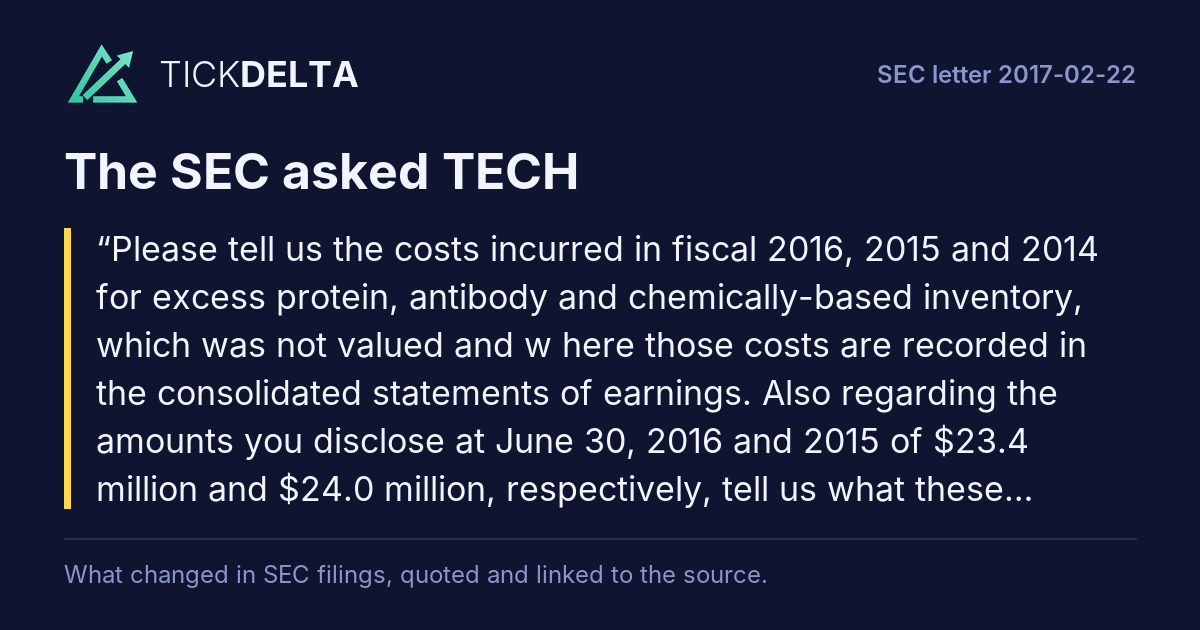
Please tell us the costs incurred in fiscal 2016, 2015 and 2014 for excess protein, antibody and chemically-based inventory, which was not valued and w here those costs are recorded in the consolidated statements of earnings. Also regarding the amounts you disclose at June 30, 2016 and 2015 of $23.4 million and $24.0 million, respectively, tell us what these amounts represent and their relevance.
Rest of the question

Finally tell us the amount recognized in net sales during fiscal 2016, 2015 and 2014 of inventory sold that was not valued.

TECH answered
The Company incurred costs of $1.2 million in fiscal year 2016, $1.1 million in fiscal year 2015, and $0.9 million in 2014 for excess protein, antibody and chemically-based inventory, which was not valued. These costs were recorded within the cost of sales line on the consolidated statements of earnings.

The Company recorded inventory reserves of $23.4 million at June 30, 2016 and $24.0 million at June 30, 2015. The inventory reserves represent the cumulative write-down of inventory to the lower of cost or market at the close of a fiscal period.
Rest of the answer

The write-down of inventory creates a new cost basis that subsequently is not marked-up based on changes in underlying facts and circumstances. The following is disclosed in our Critical Accounting Policies (page 31) and Note 1 (page 39) of the June 30, 2016 Form 10-K:

“To meet strict customer quality standards, the Company has established a highly controlled manufacturing process for proteins, antibodies and its chemically-based products. These products require the initial manufacture of multiple batches to determine if quality standards can be consistently met. In addition, the Company will produce larger batches of established products than current sales requirements due to economies of scale. The manufacturing process for these products, therefore, has and will continue to produce quantities in excess of forecasted usage. The Company values its manufactured protein and antibody inventory based on a two-year forecast and its chemically-based products on a five year forecast. Inventory quantities in excess of the forecast are not valued due to uncertainty over salability.”

As we discussed in our March 8, 2006 response to a comment letter received by us dated February 28, 2006, the most important factors in producing proteins, antibodies and our chemically-based products are quality and consistency. Customers who use the products in scientific experiments rely on the Company's product to be of the highest quality and of consistent purity and activity. If the products do not meet these standards, it could result in inconclusive or erroneous experiment results, and could affect conclusions made by the customer during the experiment and/or could result in the expense of repeating the experiment.

Once a new product has been developed and the procedures and protocols for manufacturing the product have been established, the Company produces two to three lots (batches) of each product in order to determine that the product can be made consistently. If these lots meet strict quality control standards they will become inventory on hand, most likely resulting in excess inventory on hand.

Manufacturing of an established product can result in differing quantities of finished product. Because the manufacturing process is scientific in nature, many factors can affect the yield obtained from a particular manufactured lot of product, including temperature, quality of raw materials, the person manufacturing the product and/or the equipment used. This means that at the start of the manufacturing process, it is not known how much finished product will result. In addition, because of the large number of proteins and antibodies the Company offers, it is more efficient to produce larger lots of each product in order to reduce the number of lots needed to be manufactured in a particular time period.

The manufacturing process for proteins, antibodies, and chemically-based products, therefore, has produced, and may continue to produce, quantities in excess of forecasted usage. This is a result of the above noted variables involved in the manufacturing process.

The reserve is primarily comprised of new products and/or slow moving products for which the likelihood of selling all or a majority of the inventory on hand is highly uncertain. At the time many of these products are developed, there may be no market or a very limited market for them because of the limited scientific knowledge of their biological function and activity. Subsequently, scientific interest may increase appreciably as more research is conducted and published. This is a process that occurs over multiple years and, as a result, may lead to significant increases in sales of these products. Since we are on the leading edge with the development and release of new proteins and antibodies associated with those proteins, it is very difficult to predict whether a market for them will ever develop. Accordingly, we assign little or no value to new products at the time of their initial release as we cannot estimate sales beyond two-year to five-year horizon. Although stability of products is not guaranteed, many of our products remain stable for a period beyond the two-year to five year-horizon. Therefore, each year we do record some sales of products for which the associated inventory has not been valued. These sales were less than 3% of consolidated net sales during each of the fiscal years ended June 30, 2016, 2015, and 2014. The Company concluded that these sales were immaterial to our consolidated financial statements.

In future 10-K filings, the Company will expand our disclosure regarding valuation of inventories to include discussion of the lower of cost or market adjustment recorded and the amount of net sales recognized on inventory that was not valued to include the substance of the following paragraph:

“The company records a lower of cost or market adjustment to cost of sales for those quantities that are in excess of the manufactured protein and antibody two-year forecast and the chemically-based products five year forecast. For the years ended June 30, 20XX, 20XX, and 20XX the amount recognized in net sales of inventory sold that was not valued is not material.”

The Company considers sales of inventory that was not valued representing 10% or more of our consolidated net sales to be material for the Company. We will include expanded disclosures if sales exceed that threshold.

Read in the reply ↗
In its next report

First report after the company's reply of 2017-03-23: 10-Q filed 2017-05-10 ↗, against the 10-Q filed 2017-02-09 ↗.

Tickdelta does not hold the text of both reports, so they are not compared here.
Management’s Discussion and Analysis of Financial Condition and Results of Operations · Results of Operations, page 14
SEC asked (2)
Please tell us why you refer to adjusted financial measures rather than to non-GAAP financial measures as it appears from disclosure in your earnings release that you believe the adjusted financial measures represent non-GAAP financial measures.
TECH answered
As disclosed in our earnings release, the Company believes that the adjusted financial measures represent non-GAAP financial measure. Therefore, in future filings we will confirm the titles of these financial measure between the press release and related Form 10-Q. Future Form 10-Q filings will disclose these financial measures as “Non-GAAP adjusted financial measures”. Read in the reply ↗
In its next report

First report after the company's reply of 2017-03-23: 10-Q filed 2017-05-10 ↗, against the 10-Q filed 2017-02-09 ↗.

Tickdelta does not hold the text of both reports, so they are not compared here.

Management’s Discussion and Analysis of Financial Condition and Results of Operations · Results of Operations, page 14
SEC asked (3)
Please explain to us how each of your adjusted financial measures:  is helpful in assessing your ongoing operating results;  facilitates your internal comparisons to historical operating results; and  facilitates comparisons to competitors' operating results.
Rest of the question

In your response, indicate how the adjustments to arrive at adjusted financial measures relate to assessing ongoing results and facilitate your internal comparisons to historical operating results. In this regard, amortization of intangible assets you acquire and stockbased compensation appear to be ongoing expenses. Also in your response, provide us some examples as to how adjusted financial measures facilitate comparisons to competitors.

TECH answered
, indicate how the adjustments to arrive at adjusted financial measures relate to assessing ongoing results and facilitate your internal comparisons to historical operating results. In this regard, amortization of intangible assets you acquire and stock-based compensation appear to be ongoing expenses.
Rest of the answer

Also in your response, provide us some examples as to how adjusted financial measures facilitate comparisons to competitors.

Response

We believe that reporting non-GAAP adjusted net earnings enhances the comparability of our results between periods and provides additional information and transparency to investors on adjustments and other items that are not indicative of the Company’s current and future operating performance.

Since the beginning of fiscal year 2014, the Company has undergone radical transformative changes. These changes have included nine acquisitions which resulted in a significant amount of acquired inventory and intangible assets as well as acquisition-related expenses, including contingent consideration. These expenses can vary significantly from period to period based on current activity. The Company excluded amortization of purchased intangible assets and purchase accounting adjustments, including costs recognized upon the sale of acquired inventory and acquisition-related expenses, from this measure because they occur as a result of specific events, and are not reflective of our internal investments, the costs of developing, producing, supporting and selling our products, and the other ongoing costs to support our operating structure

The Company’s non-GAAP adjusted net earnings also excludes stock based compensation expense. Stock based compensation expense can and has varied significantly from period to period as the Company continues to expand employee participation in the stock based compensation program and as a result of changes in valuation assumptions. Stock based compensation is excluded from non-GAAP adjusted earnings because of the nature of this charge, specifically the varying available valuation methodologies, subjective assumptions, and the variety of award types. Its exclusion facilities comparison of the Company’s operating results to peer companies.

In addition to traditional GAAP metrics, non-GAAP adjusted net earnings is one of the primary metrics used by management in evaluating the Company’s performance. For example, the Company uses non-GAAP net earnings to forecast future results, provide earnings guidance to investors, compensate employees, make strategic decisions and allocate Company resources.

We present non-GAAP adjusted net earnings in a manner that is transparent. The adjustments have been consistently applied period over period by the Company, and we have provided investors with relevant details for each adjustment to allow them to assess the usefulness of the adjustment. Further, analysts for our industry group base their third party consensus estimates on non-GAAP adjusted net earnings per share metrics. Additionally, the Company has performed benchmarking against the peer group companies identified in our proxy and noted similar adjustments for acquired intangible asset amortization, acquisition related charges, and share based compensation in the calculation of non-GAAP measures.

Read in the reply ↗
In its next report

First report after the company's reply of 2017-03-23: 10-Q filed 2017-05-10 ↗, against the 10-Q filed 2017-02-09 ↗.

Tickdelta does not hold the text of both reports, so they are not compared here.

Management’s Discussion and Analysis of Financial Condition and Results of Operations · Results of Operations, page 14
SEC asked (4)
Provide us a comparison of the effective tax rate determined in your GAAP financial statements to the effective rate you apply to adjustments to arrive at adjusted financial measures for the quarter and six months ended December 31, 2016, and explain to us the reason for the differences.
TECH answered
Our reported tax rate for 2016 and 2015 includes the tax rate impact of discrete tax items. Depending on the nature of discrete tax items, our reported tax rate may not be consistent on a period to period basis. The Company independently calculates a Non-GAAP adjusted tax rate to be applied to the identified Non-GAAP adjustments considering the impact of discrete items on these adjustments and the jurisdictional mix of the adjustments.
Rest of the answer

The following table summarizes the reported GAAP tax rate and the effective rate applied to adjustments to arrive at the adjusted financial measures for the quarter and six months ended December 31, 2016.

Second Quarter Ended December 31

Six Months Ended December 31

2016

2015

Reported GAAP tax rate

53.4%

26.9%

40.0%

27.8%

Non-GAAP adjusted tax rate applied to adjustments

28.6%

30.1%

30.0%

30.7%

The difference between the reported GAAP tax rate and Non-GAAP tax rate applied to the adjustments for the quarter and six months ended December 31, 2016 is primarily a result of the discrete income tax expenses recorded for the revaluation of contingent consideration. Contingent consideration, which is not tax deductible, represented $10.5 million and $12.4 million of the acquisition related expenses during the quarter and six months ended December 31, 2016.

The tax impact of the research and development credit and foreign adjustments represent discrete and other non-recurring charges which impact our reported GAAP tax rate and may not be consistent on a period to period basis. Historically, the Company considered the research and development credit an item that should be excluded from non-GAAP adjusted net earnings because it was not guaranteed and required annual approval by Congress. The Company concluded in fiscal year 2017 that this item should no longer be adjusted as it was permanently extended by Congress. The Company’s adjusted net earnings calculation for the six months ended December 31, 2016 reflects this change.

The Company will include expanded disclosures in future filings to further explain the reason for material differences between the GAAP tax rate and the effective rate applied to adjustments to arrive at the Non-GAAP financial measures.

Read in the reply ↗
In its next report

First report after the company's reply of 2017-03-23: 10-Q filed 2017-05-10 ↗, against the 10-Q filed 2017-02-09 ↗.

Tickdelta does not hold the text of both reports, so they are not compared here.

Certifications · Exhibits 31.1 and 31.2
SEC asked (5)
Please amend your certifications to properly reflect your current business name. The certifications state the company's name as Techne Corporation. This comment also applies to your Form 10-Q for the quarterly period ended September 30, 2016.
TECH answered
The Company has filed a Form 10-Q/A for the quarterly periods ended September 30, 2016 and December 31, 2016 to amend the certifications to state the company’s name as Bio-Techne Corporation. Read in the reply ↗
In its next report

First report after the company's reply of 2017-03-23: 10-Q filed 2017-05-10 ↗, against the 10-Q filed 2017-02-09 ↗.

Tickdelta does not hold the text of both reports, so they are not compared here.

Executive Compensation · Compensation Discussion and Analysis, page 18
SEC asked (6)
With respect to your Annual Goal-Based Cash Awards, please confirm that you will revise future filings, as applicable, to disclose the threshold, target and maximum level of achievement required for each metric and explain how actual performance relative to each metric factored into the actual payout.
TECH answered
In future filings with respect to the Company’s short-term cash incentive awards, the Company undertakes to disclose the threshold, target, and maximum level of achievement required for each metric and to explain how actual performance relative to each metric factors into actual payout of such awards. Read in the reply ↗
In its next report

First report after the company's reply of 2017-03-23: 10-Q filed 2017-05-10 ↗, against the 10-Q filed 2017-02-09 ↗.

Tickdelta does not hold the text of both reports, so they are not compared here.

Executive Compensation · Compensation Discussion and Analysis, page 18
SEC asked (7)
Please tell us why your Compensation Discussion and Analysis does not explain the basis for the bonus payments referenced in the final sentence of footnote 1 on page 30 of your definitive proxy statement. Also, explain to us where these bonus payments are reflected in your Summary Compensation Table.
TECH answered
The Company has reviewed the above-referenced disclosures and its records. The Company has determined that the bonus payments referenced in the final section of footnote 1 on page 30 of the Company’s definitive proxy statement should have described the short-term cash incentives earned for FY 2016 performance, which are accurately described in the “Non-Equity Incentive Plan Compensation” column of the Summary Compensation Table. Accordingly, the sentence should have read as follows: “On July 28, 2016, the Executive Compensation Committee approved the following cash incentive payments: Mr.
Rest of the answer

Kummeth in the amount of $1,221,097, Mr. Hippel in the amount of $421,660, Mr. Eansor in the amount of $282,110, Mr. Gavin in the amount of $136,278, and Mr. Gould in the amount of $145,463.” The Compensation Discussion and Analysis describes the bases for these short-term incentive compensation payments on pages 21 and 22.

***

We acknowledge that we are responsible for the adequacy and accuracy of the disclosure in the filing, that Staff comments or changes to disclosure in response to Staff comments do not foreclose the Commission from taking any action with respect to the filing, and that we may not assert Staff comments as a defense in any proceeding initiated by the Commission or any person under the federal securities laws of the United States.

On behalf of the company, I thank you for your consideration of our responses. Should the Staff have further questions or comments or need any further information or clarification, please do not hesitate to contact me.

Read in the reply ↗
In its next report

First report after the company's reply of 2017-03-23: 10-Q filed 2017-05-10 ↗, against the 10-Q filed 2017-02-09 ↗.

Tickdelta does not hold the text of both reports, so they are not compared here.

Management’s Discussion and Analysis of Financial Condition and Results of Operations · Results of Operations, page 14
SEC asked
Regarding your response to our prior comment 1 of our February 22, 2017 letter, please provide us proposed disclosure to be included in your future periodic reports and future earnings releases that explains how each of your adjusted financial measures:  is helpful in assessing your ongoing operating results specifically addressing your exclusion of amortization of intangible assets you acquire and stock-based
Rest of the question

compensation that appear to be ongoing expenses;  facilitates your internal comparisons to historical operating results; and  facilitates comparisons to competitors' operating results, which may not be determined in the same manner.

TECH answered
In future Form 10-Q filings, the Company will expand our disclosures regarding the use of non-GAAP financial measures include the substance of the following paragraphs. Similar disclosures will be included in future press releases and Form 10-K filings.

NON-GAAP FINANCIAL MEASURES

This Quarterly Report on Form 10-Q, including “Management’s Discussion and Analysis of Financial Condition and Results of Operation” in Item 2, contains financial measures that have not been calculated in accordance with accounting principles generally accepted in the U.S. (GAAP).
Rest of the answer

These non-GAAP measures include:

● Adjusted gross margin

● Adjusted net earnings

● Adjusted effected tax rate

We provide these measures as additional information regarding our operating results. We use these non-GAAP measures internally to evaluate our performance and in making financial and operational decisions, including with respect to incentive compensation. We believe that our presentation of these measures provides investors with greater transparency with respect to our results of operations and that these measures are useful for period-to-period comparison of results.

Our non-GAAP financial measures for adjusted gross margin and adjusted net earnings exclude the costs recognized upon the sale of acquired inventory, amortization of acquisition intangibles, and acquisition related expenses. The Company excludes amortization of purchased intangible assets and purchase accounting adjustments, including costs recognized upon the sale of acquired inventory and acquisition-related expenses, from this measure because they occur as a result of specific events, and are not reflective of our internal investments, the costs of developing, producing, supporting and selling our products, and the other ongoing costs to support our operating structure. Additionally, these amounts can vary significantly from period to period based on current activity.

The Company’s non-GAAP adjusted net earnings also excludes stock based compensation expense and certain adjustments to income tax expense. Stock based compensation is excluded from non-GAAP adjusted earnings because of the nature of this charge, specifically the varying available valuation methodologies, subjective assumptions, and the variety of award types. The Company independently calculates a non-GAAP adjusted tax rate to be applied to the identified non-GAAP adjustments considering the impact of discrete items on these adjustments and the jurisdictional mix of the adjustments. In addition, the tax impact of other discrete and non-recurring charges which impact our reported GAAP tax rate are adjusted from net earnings. We believe these tax items can significantly affect the period-over period assessment of operating results and not necessarily reflect costs and/or income associated with historical trends and future results.

The Company periodically reassesses the components of our non-GAAP adjustments for changes in how we evaluate our performance, changes in how we make financial and operational decisions, and considers the use of these measures by our competitors and peers to ensure the adjustments are still relevant and meaningful.

***

We acknowledge that we are responsible for the adequacy and accuracy of the disclosure in the filing, that Staff comments or changes to disclosure in response to Staff comments do not foreclose the Commission from taking any action with respect to the filing, and that we may not assert Staff comments as a defense in any proceeding initiated by the Commission or any person under the federal securities laws of the United States.

On behalf of the company, I thank you for your consideration of our responses. Should the Staff have further questions or comments or need any further information or clarification, please do not hesitate to contact me.

Read in the reply ↗
In its next report

First report after the company's reply of 2017-05-05: 10-Q filed 2017-05-10 ↗, against the 10-Q filed 2017-02-09 ↗.

Tickdelta does not hold the text of both reports, so they are not compared here.

Also in this review: closing letter, 2017-05-16
Form 10-K for the Fiscal Year Ended June 30, 2009

2009-12-15 to 2010-04-13 · 5 questions · 2 letters from the SEC, 2 from the company
Review closed 2010-04-13
Executive payRevenueResults discussion (MD&A)
Form 10-K for the fiscal year ended June 30, 2009 · Patents and Trademarks, page 7
SEC asked (1)
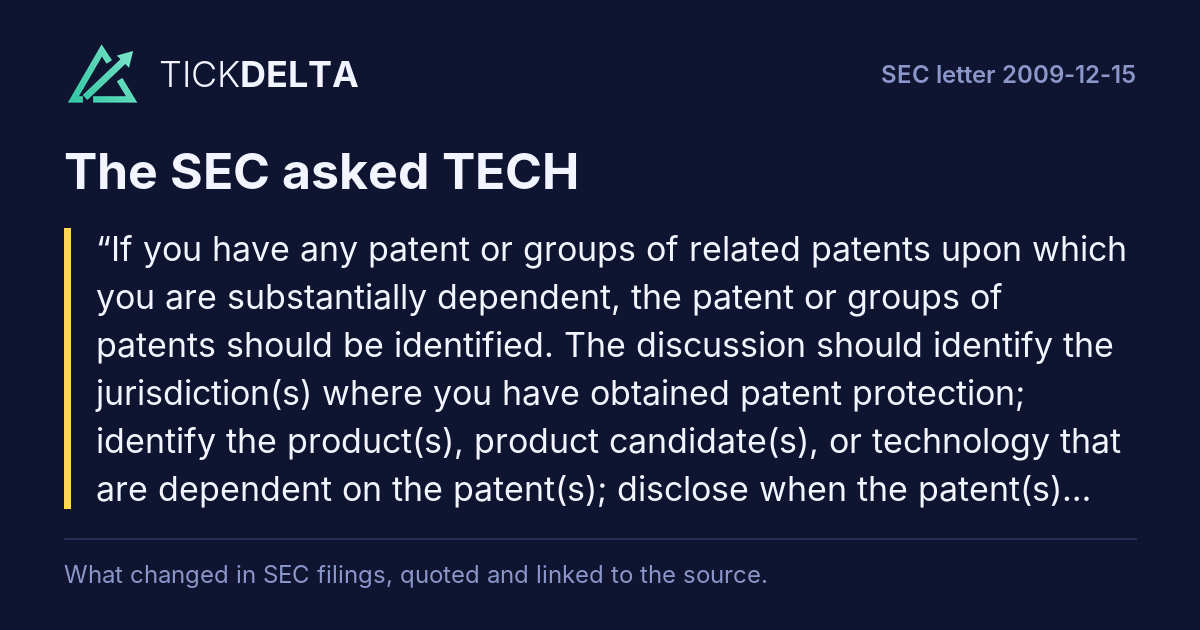
If you have any patent or groups of related patents upon which you are substantially dependent, the patent or groups of patents should be identified. The discussion should identify the jurisdiction(s) where you have obtained patent protection; identify the product(s), product candidate(s), or technology that are dependent on the patent(s); disclose when the patent(s) expire; and disclose whether you hold or license
Rest of the question

the patent(s).

TECH answered
The Company will add the following disclosure in its Form 10-K for the fiscal year ended June 30, 2010:

The Company is not substantially dependent on products for which it has obtained patent protection. Revenues from such products are not material to the Company's financial results.

Definitive Proxy Statement

Compensation Objectives, page 9. Read in the reply ↗
In its next report

First report after the company's reply of 2009-12-29: 10-Q filed 2010-02-08 ↗, against the 10-Q filed 2009-11-05 ↗.

Tickdelta does not hold the text of both reports, so they are not compared here.

Definitive Proxy Statement · Compensation Objectives, page 9
SEC asked (2)
We note the discussion does not disclose how the Executive Compensation Committee determines whether your executive compensation program is competitive with the local market. Please provide us with draft disclosure for your 2010 proxy statement that describes, as may be applicable, specifically how this determination is made.
Rest of the question

The discussion should: • identify compensation consultants and published surveys utilized; • identify the members of any peer group selected for such comparison and the criteria used to select the peer members; and • clarify whether the local market information is limited to other companies in your industry.

TECH answered
Expanded disclosures will be included in the Company's fiscal 2010 proxy statement as follows (subject to any changes prior to the completion of the final proxy in September 2010):

The Company's Executive Compensation Committee has not historically retained a compensation consultant in connection with its decisions and did not utilize consultants in establishing fiscal 2010 executive compensation.
Rest of the answer

The Executive Compensation Committee also does not compare the compensation of the Company's executives to any industry peer group because the Company's competitors are either privately-held or subsidiaries or divisions of large publicly-held companies that have complex and substantially more generous executive compensation programs for their officers. Although the Executive Compensation Committee uses local comparative data from a variety of industries to evaluate base salaries and total compensation, it is not a material component of its decision-making process. This comparative data is derived from locally-published business journals and newspaper reports that annually measure and rank compensation levels of chief executive and financial officers for public companies of various industries in the Company's geographical region.

At the beginning of each fiscal year, the Executive Compensation Committee assesses the base compensation and the potential compensation that the named executive officers could earn by achieving the Company's financial targets and their individual personal goals. As part of this assessment, the Chief Executive Officer makes recommendations to the Executive Compensation Committee regarding the base compensation to be paid to the executive officers that report to him. Such recommendations take into account internal pay equity, position within an internal compensation range, changes in responsibilities, local compensation levels for similar positions in all industries and duties and other factors the Chief Executive Officer considers important in establishing competitive compensation for the executives that report to him. Among these other factors is a philosophy that there should be a reasonable relationship between executive salaries and the average employee or mid-level manager salaries within an organization; the percentage increase in base salary for executives should not be greater than the percentage increase paid to a company's other employees; executive bonuses should be based on performance; and incentives should be long-term equity based arrangements that are tied to the long-term improvements in financial results and appreciation in the Company's stock price.

In making the final decisions regarding the type and amount of compensation to be paid to the named executive officers, the Executive Compensation Committee not only considers the Chief Executive Officer's recommendations but also conducts an independent review of local comparative data for all industries, considers internal pay equity and responsibilities and makes its own assessment as to the type and amount of compensation to be paid.

Read in the reply ↗
In its next report

First report after the company's reply of 2009-12-29: 10-Q filed 2010-02-08 ↗, against the 10-Q filed 2009-11-05 ↗.

Tickdelta does not hold the text of both reports, so they are not compared here.

Definitive Proxy Statement · Compensation Objectives, page 9
SEC asked (3)
In addition, we note your reference to “… paying base salaries which are on the moderate side of being competitive in its industry.” Please explain what this means and how it is measured. Your disclosure should be as specific as possible.
Rest of the question

Therefore, if the Executive Compensation Committee has a policy of paying your executive officers within a specified percentile range of the comparable salaries in your local market, please revise to disclose the specified range.

TECH answered
Expanded disclosures will be included in the Company's fiscal 2010 proxy statement as follows (subject to policy changes, if any, when the final proxy is drafted in September 2010):

The Executive Compensation Committee does not target a particular percentile range for the base salaries or total compensation for the Company's named executive officers, but typically approves compensation that is conservative compared to local data among a variety of industries.
Rest of the answer

The Company's compensation for its executives has been historically among the lowest among local public companies, including many that are smaller and less profitable than the Company. The Executive Compensation Committee feels that the compensation is, nevertheless, competitive due to the benefits and equity incentive plans available to all of the Company's employees. Although the Executive Compensation Committee considers the compensation levels implied by comparative data derived from locally published executive compensation reports, such comparative data is only one factor considered in the overall compensation decision-making process and is not a material factor. The Company's Chief Executive Officer waived an increase in his base compensation for fiscal years 2007 through 2009. No increase in base compensation was given to any named executive officer for fiscal 2010 as a result of a company-wide freeze on salary increases for all employees with annual salaries over $100,000.

Read in the reply ↗
In its next report

First report after the company's reply of 2009-12-29: 10-Q filed 2010-02-08 ↗, against the 10-Q filed 2009-11-05 ↗.

Tickdelta does not hold the text of both reports, so they are not compared here.

Performance-Based Bonus Plan, page 10
SEC asked (4)
We note that bonus payments are based upon the Executive Compensation Committee’s consideration of corporate goals and performance objectives and the qualitative performance of each officer during the previous year.
Rest of the question

The Compensation Discussion and Analysis does not disclose the budgeted revenues and earnings or the individual performance objectives the Executive Compensation Committee considered to determine your executive officers’ bonus payments. Please provide us with draft disclosure for your 2010 proxy statement which provides the following: • A more detailed specific description and quantification of each of the individual and corporate goals and performance objectives; • Confirmation that you will discuss the achievement of the objectives; and • A discussion of how the level of achievement will affect the actual bonuses to be paid. To the extent that these criteria are quantified, the discussion in your proxy statement should also be quantified. * * * * * Please respond to these comments within 10 business days or tell us when you will provide us with a response. Please furnish a letter that keys your response to our comments and provide the requested information. Detailed letters greatly facilitate our review. Please furnish the letter to us via EDGAR under the form type label CORRESP.

TECH answered
The Company competes in very competitive markets for both its biotechnology and hematology products. The Company has many larger and smaller competitors, none of which disclose specific budgeted revenue and earnings information on those segments of their business that compete directly with the Company's products. The Company believes that disclosure of its budgeted revenue and earnings could be of benefit to its competitors. Further, the Company's budgeted revenue and earnings are typically set at levels that are, at the time approved, a stretch to achieve.
Rest of the answer

In fact, the Company has not achieved its overall revenue and earnings budget in two of the past three years. Disclosure of budget information would most likely cause the Company to set budgeted revenue and earnings at lower levels, thus increasing the likelihood of attaining or exceeding them and therefore potentially increasing the amount of bonuses paid to executive officers. In addition, the stock market and market analysts measure the Company's success by direct comparison of current results to those of prior periods, not against the Company's internal budgets. Therefore, the Company has determined not to disclose its specific budgeted revenue and earnings amounts. The Company does disclose the average percentage of budgeted revenue and earnings achieved.

The structure of the Company's current executive bonus plan has been in place for a number of years and the Executive Compensation Committee is currently reviewing the plan, which could result in changes to the Company's executive bonus program.

Revised disclosure for the Company's performance-based bonus plan to be included in the Company's 2010 proxy statement follows (subject to changes to the executive bonus plan, if any, when the final proxy is drafted in September 2010):

Performance-based bonus plan. Under the Company's Executive Officers Incentive Bonus Plan, each executive officer may earn a potential bonus of up to 40% of his or her annual salary. The eligible bonus each executive officer could earn for fiscal 2010 was: Mr. Oland - $101,640, Mr. Melsen - $110,000 and Mr. Veronneau - $67,000.

The Plan provides that up to 70% of the eligible bonus is based upon achieving the Company's budgeted revenue and earnings for the fiscal year and up to 30% of the eligible bonus is based upon achievement of qualitative personal goals set for each named executive officer. The Executive Compensation Committee believes this bonus plan focuses the executives on sustaining high quality revenue growth, bringing new products to market, increasing market share and expanding market presence, as well as balancing increased research and development with expense control.

The Company's Board of Directors reviews, discusses and recommends changes to a preliminary operating plan and budget for the next fiscal year at its annual April meeting. The final fiscal year operating plan and budget is discussed, reviewed and approved at the annual July meeting of the Board of Directors. The Board of Directors considers both historical and prospective factors, including the competitive market, economic trends, and changes in government regulations and funding, when establishing budgeted revenue and earnings for a fiscal year. Bonuses are awarded on a prorated basis if revenue and earnings achieved average between 85% and 100% of budgeted revenue and earnings. The Executive Compensation Committee has determined that the Company's revenues and earnings were an average of __% of budget for fiscal 2010. Therefore, each executive officer earned __% of his eligible bonus for fiscal 2010.

The qualitative personal goals for the named executive officers are established annually by the Executive Compensation Committee taking into account each executive's responsibilities at the Company and the recommendations of the Chief Executive Officer as to the executives who report to him. Following each fiscal year end, the Executive Compensation Committee assesses the achievement of the personal goals by each named executive officer, which assessment includes the recommendations of the Chief Executive Officer as to the achievement of the personal goals of the executives who report to him.

The personal goals set for fiscal 2010 for Mr. Oland related to accomplishment of the Company's strategic and operational objectives and succession planning and personnel development. The Compensation Committee determined that Mr. Oland met __% of his personal goals and, therefore, earned an additional __% of his eligible bonus. The personal goals set for Mr. Melsen were related to operational objectives in the Company's accounting and finance, information systems, and facilities functions, as well as the financial performance and accomplishments of BiosPacific, Inc., the Company's sales subsidiary that services diagnostic customers. The Compensation Committee, with input from the Chief Executive Officer, determined that Mr. Melsen met __% of his personal goals and, therefore, Mr. Veronneau related to the strategic and operational achievements of the Company's Hematology Division. The Compensation Committee, with input from the Chief Executive Officer of the Company, determined that Mr. Veronneau met __% of his personal goals and, therefore, earned an additional __% of his eligible bonus.

The annual bonus is paid 50% in cash and 50% in stock options. The officer may elect to exchange all or a part of the cash portion of the bonus for additional stock options. If such an election is made, the officer is entitled to 1.7 times the value of the cash bonus in options. The number of options each executive officer receives is calculated based on the dollar value of the portion of the annual bonus to be paid in stock options divided by the closing share price at the date of grant. The options are granted under the Company's 1997 Incentive Stock Option Plan or 1998 Nonqualified Stock Option Plan and vest immediately with an exercise price equal to the closing price of the Company's stock on the date of grant. The stock option grant date is the date the Executive Compensation Committee determines the officer's aggregate bonus amount based on achievement of the budgeted revenue and earnings goals and the individual qualitative personal goals. For fiscal 2010, Mr. Oland earned and was paid a cash bonus of $_____ and was granted stock options in fiscal 2011 for ___ shares of Company stock. For fiscal 2010, Mr. Melsen earned and was paid a cash bonus of $_____ and For fiscal 2010, Mr. Veronneau earned and was paid a cash bonus of $_____ and was granted stock options in fiscal 2011 for ___ shares of Company stock.

************

We hope that we have adequately addressed your Comment Letter dated December 15, 2009.

Read in the reply ↗
In its next report

First report after the company's reply of 2009-12-29: 10-Q filed 2010-02-08 ↗, against the 10-Q filed 2009-11-05 ↗.

Tickdelta does not hold the text of both reports, so they are not compared here.

Definitive Proxy Statement · Performance-Based Bonus Plan
SEC asked
We note your response to comment 4 and reissue the comment in part. The Compensation Discussion and Analysis still does not disclose the budgeted revenues and earnings or the specific individual performance objectives the Executive Compensation Committee considered to determine your executive officers’ bonus payments.
Rest of the question

Please provide us with draft disclosure for your 2010 proxy statement which provides the following: • A more detailed specific description and quantification of each of the specific individual and corporate goals and performance objectives; • Confirmation that you will discuss the achievement of the objectives; and • A discussion of how the level of achievement will affect the actual bonuses to be paid. To the extent that these criteria are quantified, the discussion in your proxy statement should also be quantified. In this regard, we note your concern that disclosure of the specific budgeted revenues and earnings would be helpful to your competition, but you have not articulated why the information would be helpful and why its disclosure would be competitively harmful to the company. If you continue to believe that disclosure of additional information concerning your budgeted revenues and earnings is competitively harmful, please provide a comprehensive analysis supporting your conclusion that the disclosure of this information would cause competitive harm if it is disclosed. To avoid the disclosure of the sensitive information in the analysis when our comment letters are released publicly, you may submit a confidential treatment request pursuant to Rule 83. * * * * * Please respond to these comments within 10 business days or tell us when you will provide us with a response. Please furnish a letter that keys your response to our comments and provide the requested information. Detailed letters greatly facilitate our review. Please furnish the letter to us via EDGAR under the form type label CORRESP.

TECH answered
Revised disclosure for the Company's performance-based bonus plan to be included in the Company's 2010 proxy statement follows (subject to changes to the executive bonus plan, if any, when the final proxy is drafted in September 2010). The Company confirms it will discuss achievement of objectives by disclosing the percentage of accomplishment:

Performance-based bonus plan. Under the Company's Executive Officers Incentive Bonus Plan, each executive officer may earn a potential bonus of up to 40% of his or her annual salary.
Rest of the answer

The eligible bonus each executive officer could earn for fiscal 2010 was: Mr. Oland - $101,640, Mr. Melsen - $110,000 and Mr. Veronneau - $67,000.

The Plan provides that up to 70% of the eligible bonus is based upon achieving the Company's budgeted revenue and earnings for the fiscal year and up to 30% of the eligible bonus is based upon achievement of qualitative personal goals set for each named executive officer. The Executive Compensation Committee believes this bonus plan focuses the executives on sustaining high quality revenue growth, bringing new products to market, increasing market share and expanding market presence, as well as balancing increased research and development with expense control.

The Company's Board of Directors reviews, discusses and recommends changes to a preliminary operating plan and budget for the next fiscal year at its annual April meeting. The final fiscal year operating plan and budget is discussed, reviewed and approved at the annual July meeting of the Board of Directors. The Board of Directors considers both historical and prospective factors, including the competitive market, economic trends, and changes in government regulations and funding, when establishing budgeted revenue and earnings for a fiscal year. Bonuses are awarded on a prorated basis if revenue and earnings achieved average between 85% and 100% of budgeted revenue and earnings. Budgeted revenues and earnings for fiscal 2010 were $_______ and $________, respectively. Based upon actual revenues and earnings for fiscal 2010 of $______ and $________, respectively, the Executive Compensation Committee has determined that the Company's revenues and earnings were an average of __% of budget for fiscal 2010. Therefore, each executive officer earned __% (__% of budgeted revenues and earnings achieved times 70%) of his eligible bonus for fiscal 2010.

The personal goals for the named executive officers are generally qualitative in nature and position-specific. These personal goals are established annually by the Executive Compensation Committee taking into account each executive's responsibilities at the Company and the recommendations of the Chief Executive Officer as to the executives who report to him. Following each fiscal year end, the Executive Compensation Committee assesses the achievement of the personal goals by each named executive officer, which assessment includes the recommendations of the Chief Executive Officer as to the achievement of the personal goals of the executives who report to him.

The personal goals set for fiscal 2010 for Mr. Oland related to:

- accomplishment of the Company's strategic objectives; - succession planning; - leadership development; and - personnel matters.

The Compensation Committee determined that Mr. Oland met __% of his personal goals and, therefore, earned an additional __% of his eligible bonus (___% of personal goals achieved times 30%).

The personal goals set for fiscal 2010 for Mr. Melsen related to:

- objectives within the information systems function, including transition of department leadership, improvement of service levels and reduction in consulting costs; - the management of BiosPacific, Inc., the Company's sales subsidiary that services diagnostic customers, including succession planning and achievement of financials goals; - objectives within the research and development function, including administrative support, analysis of economic opportunities and communication and enhancement of knowledge regarding Company products and processes; and - objectives within the accounting and finance and facilities functions, including leadership development and operational efficiencies

The Compensation Committee, with input from the Chief Executive Officer, determined that Mr. Melsen met __% of his personal goals and, therefore, earned an additional __% of his eligible bonus (___% of personal goals achieved times 30%).

The personal goals set for fiscal 2010 for Mr. Veronneau related to the management of the Company's Hematology Division, including:

- the achievement of division revenue and pre-tax earnings and cost of goods targets of $_____, $_____, and $______, respectively; - the introduction of new hematology products; - the improvement of quality control programs; - regulatory compliance; and - personnel matters

The Compensation Committee, with input from the Chief Executive Officer of the Company, determined that Mr. Veronneau met __% of his personal goals and, therefore, earned an additional __% of his eligible bonus (__% of personal goals achieved times 30%).

The annual bonus is paid 50% in cash and 50% in stock options. The officer may elect to exchange all or a part of the cash portion of the bonus for additional stock options. If such an election is made, the officer is entitled to 1.7 times the value of the cash bonus in options. The number of options each executive officer receives is calculated based on the dollar value of the portion of the annual bonus to be paid in stock options divided by the closing share price at the date of grant. The options are granted under the Company's 1997 Incentive Stock Option Plan or 1998 Nonqualified Stock Option Plan and vest immediately with an exercise price equal to the closing price of the Company's stock on the date of grant. The stock option grant date is the date the Executive Compensation Committee determines the officer's aggregate bonus amount based on achievement of the budgeted revenue and earnings goals and the individual qualitative personal goals. For fiscal 2010, Mr. Oland earned __% of his eligible bonus, or $_______. He was paid a cash bonus of $_____ and was granted stock options in fiscal 2011 for ___ shares of Company stock. For fiscal 2010, Mr. Melsen earned __% of his eligible bonus or $______. He was paid a cash bonus of $_____ and was granted stock options in fiscal 2011 for ___ shares of Company stock. For fiscal 2010, Mr. Veronneau earned ___ % of his eligible bonus or $______. He was paid a cash bonus of $_____ and was granted stock options in fiscal 2011 for ___ shares of Company stock.

************

We hope that we have adequately addressed your Comment Letter dated January 28, 2010.

Read in the reply ↗
In its next report

First report after the company's reply of 2010-02-09: 10-Q filed 2010-05-07 ↗, against the 10-Q filed 2009-11-05 ↗.

Tickdelta does not hold the text of both reports, so they are not compared here.

Also in this review: closing letter, 2010-04-13

From the SEC's correspondence on EDGAR: staff letters (form UPLOAD) and company letters (form CORRESP), 24 letters filed since 2008-11-03. Questions and answers are matched by their numbers; topics come from words in each question. The reports are compared word for word (same form, before the first SEC letter against the first report after the company's reply). No AI.

Next in Owners and insiders Insider trades →