Screener / SEC EDGAR /CIK 0001717115 /10-K filed Feb 24, 2026, compared with Feb 24, 2025 /Numbers from the XBRL of the 10-Ks
Nasdaq Technology · Internet & Software Services

Tempus AI, Inc. TEM

Compare with peers Embed
New in the 10-K 32 paragraphs with nothing like them in the 10-K filed Feb 24, 2025 New in the 10-Q 52 paragraphs not in the 10-Q filed Jul 30, 2026 10-Q against the 10-K 34 risk factor paragraphs and sentences added or reworded

New risk paragraphs, branching off last year

Each branch is a paragraph in Risk Factors with nothing like it in the 10-K filed Feb 24, 2025. A box jumps to the paragraph as filed, below.

32 new

Paragraphs with nothing like them in last year's 10-K

Quoted exactly

32 paragraphs in Risk Factors of the 10-K filed Feb 24, 2026 with nothing like them in the 10-K filed Feb 24, 2025. Quoted exactly. Paragraphs that were only edited are under 10-K change.

Ethical, legal and social concerns related to the use of genetic information could reduce demand for our tests.

Genetic testing has raised ethical, legal and social issues regarding privacy rights and the appropriate uses of the resulting information. Governmental authorities could, for social or other purposes, limit or regulate the use of genetic information or genetic testing or prohibit testing for genetic predisposition to certain conditions, particularly for those that have no known cure. Similarly, these concerns may lead patients to refuse to use, or clinicians to be reluctant to order, hereditary tests even if permissible; they may also refuse genetic testing due to concerns regarding eligibility for life or other insurance. Ethical and social concerns may also influence U.S. and foreign patent offices and courts with regard to patent protection for technology relevant to our business. These and other ethical, legal and social concerns may limit market acceptance of our tests or reduce the potential markets for our tests, either of which could have an adverse effect on our business, financial condition or results of operations.

Read in the 10-K

by a treating physician and the patient meets the same clinical and treatment criteria required of nationally covered next-generation sequencing tests under the NGS NCD. An NGS test is typically not covered by Medicare when cancer patients do not have the above-noted indications for cancer under either an NCD or LCD.

Read in the 10-K

•Agentic AI is a type of AI that can function independently to actively achieve specific outcomes with limited human involvement through pre-programmed planning, reasoning, and decision execution.

Read in the 10-K

In April 2025, we entered into expanded multi-year strategic collaborations with AstraZeneca and Pathos for the development of a foundation model in the field of oncology. Under this collaboration, we will work together with AstraZeneca and Pathos to build the foundation model, which will incorporate our multi-modal de-identified oncology data, and once complete, the model will be shared among all three parties to advance their individual efforts to improve patient care. The development and deployment of foundation models could ultimately reduce demand for our Data and applications products, as once a company is able to utilize a foundation model to advance its business objectives, it may no longer have a need to license our de-identified data. Any significant decrease in the demand for, or value of, our Data and applications products would have a material adverse effect on our financial condition and results of operations. Also, there is no guarantee that our development efforts will be successful, or that the foundation model will achieve its intended purpose.

Read in the 10-K

•in the event the conditional conversion feature of the Notes is triggered, requiring us under applicable accounting rules to reclassify all or a portion of the outstanding principal of the Notes as a current rather than a long-term liability, which would result in a material reduction of our net working capital; and

Read in the 10-K
Show the other 8

application of consumer, health-related, and data protection laws, especially with respect to genetic samples and data, in the United States, the EU (including all countries in the EEA), and elsewhere are often uncertain, contradictory, and in flux.

Read in the 10-K

Since its enactment, there have been efforts to repeal, replace, and amend all or part of the ACA. For example, on July 4, 2025, the One Big Beautiful Bill Act, or OBBBA, was signed into law, which is expected to reduce Medicaid spending and enrollment by implementing work requirements for some beneficiaries, capping state-directed payments, reducing federal funding, and limiting provider taxes used to fund the program. The OBBBA also narrowed access to ACA marketplace exchange enrollment and declined to extend the ACA enhanced advanced premium tax credits, that expired at the end of 2025, which, among other provisions in the law, are anticipated to reduce the number of Americans with health insurance. Congress is also considering proposed legislation intended to further reduce healthcare costs with alternatives to replace the expired ACA subsidies. It is unclear how any additional healthcare reform measures will impact the ACA and our business.

Read in the 10-K

The current administration is pursuing policies to reduce regulations and expenditures across government agencies including at the Department of Health and Human Services, the FDA, CMS and related agencies. Such actions and policies may, among other things, significantly reduce U.S. medical device prices, potentially impacting manufacturers’ global pricing strategies and profitability, while increasing their operational costs and compliance risks.

Read in the 10-K

Our Notes and the issuance of shares of our Class A common stock upon conversion of the Notes, if any, may impact our financial results, result in dilution to our stockholders, create downward pressure on the price of our Class A common stock, and restrict our ability to raise additional capital or to engage in a beneficial takeover.

In July 2025, we issued $750.0 million in aggregate principal amount of Notes. We are subject to a variety of risks related to the Notes, such as:

•servicing our debt requires a certain level of cash flow or financing from other sources, and our ability to make scheduled payments of the principal and interest, or to refinance or repurchase our Notes depends on our future performance, which is subject to economic, financial, competitive and other factors beyond our control;

•our ability to refinance or repurchase our indebtedness will depend on the capital markets and our financial condition at such time, and if we are unable to engage in any of these activities or engage in these activities on desirable terms, we may be unable to meet the obligations of our Notes;

•if we deliver cash to noteholders upon conversion of their Notes, the payment of cash could adversely affect our liquidity;

•if shares of our Class A common stock are issued to the holders of the Notes upon conversion, there will be dilution to our stockholders’ equity and the market price of our Class A common stock may decrease due to the additional selling pressure in the market;

•certain provisions in the indentures governing the Notes may delay or prevent an otherwise beneficial takeover attempt of us; and

•we may from time to time seek to retire or purchase our outstanding debt, including the Notes, through cash purchases and/or exchanges for other securities, in open market purchases, privately negotiated transactions or otherwise. Such repurchases or exchanges, if any, will depend on prevailing market conditions, our liquidity requirements, contractual restrictions, and other factors. The amounts involved in any such transactions, individually or in the aggregate, may be material. Further, any such purchases or exchanges may result in us acquiring and retiring a substantial amount of such indebtedness, which could impact the trading liquidity of such indebtedness.

The conditional conversion feature of the Notes, if triggered, may adversely affect our financial condition and operating results.

In the event the conditional conversion feature of the Notes is triggered, holders of the Notes will be entitled to convert their Notes at any time during specified periods at their option. If one or more holders elect to convert their Notes, unless we elect to satisfy our conversion obligation by delivering solely shares of our Class A common stock (other than paying cash in lieu of delivering any fractional share), we would be required to settle a portion or all of our conversion obligation through the payment of cash, which could adversely affect our liquidity. In addition, even if holders do not elect to convert their Notes, we could be required under applicable accounting rules to reclassify all or a portion of the outstanding principal of the Notes as a current rather than long-term liability, which would result in a material reduction of our net working capital.

In connection with the issuance of the Notes, we entered into capped call transactions, or the Capped Call, with one of the initial purchasers and certain other financial institutions, or the option counterparties. The Capped Call cover, subject to customary adjustments, the number of shares of our Class A common stock initially underlying the Notes. The Capped Call Transactions are expected generally to reduce the potential dilution to our Class A common stock upon any conversion of Notes and/or offset any cash payments we are required to make in excess of the principal amount of converted Notes, as the case may be, with such reduction and/or offset subject to a cap.

In connection with establishing their initial hedges of the Capped Call the option counterparties or their respective affiliates likely entered into various derivative transactions with respect to our Class A common stock and/or purchased shares of our Class A common stock concurrently with or shortly after the pricing of the Notes, including with, or from, as the case may be, certain investors in the Notes. In addition, the option counterparties or their respective affiliates may modify their hedge positions by entering into or unwinding various derivatives with respect to our Class A common stock and/or purchasing or selling our Class A common stock or other securities of ours in secondary market transactions following the issuance of the Notes and prior to the maturity of the Notes (and are likely to do so during the 20 trading day period beginning on the 21st scheduled trading day prior to the maturity date of the Notes, or, to the extent we exercise the relevant election under the Capped Call, following any repurchase, redemption, or conversion of the Notes). The potential effect, if any, of these transactions and activities on the market price of our Class A common stock or the Notes will depend in part on market conditions and cannot be ascertained at this time. Any of these activities could adversely affect the value of our Class A common stock and the value of the Notes.

The option counterparties are financial institutions, and we will be subject to the risk that any or all of them might default under the Capped Call. Our exposure to the credit risk of the option counterparties will not be secured by any collateral.

Global economic conditions have from time to time resulted in the actual or perceived failure or financial difficulties of many financial institutions and could adversely affect the option counterparties’ performance under the Capped Call. If an option counterparty becomes subject to insolvency proceedings, we will become an unsecured creditor in those proceedings with a claim equal to our exposure at that time under the capped call transaction with such option counterparty. Our exposure will depend on many factors but, generally, an increase in our exposure will be correlated to an increase in the market price and in the volatility of our Class A common stock. In addition, upon a default by an option counterparty, we may suffer more dilution than we currently anticipate with respect to our Class A common stock. We can provide no assurances as to the financial stability or viability of the option counterparties.

In addition, the terms of the Capped Call may be subject to adjustment, modification or, in some cases, renegotiation in the event of certain corporate and other transactions. The Capped Call may not operate as we intend in the event that we are required to adjust the terms of such instruments as a result of transactions in the future or in the event of other unanticipated developments that may adversely affect the functioning of the Capped Call.

Read in the 10-K

•any action or proceeding asserting a claim of breach of a fiduciary duty owed to us or our stockholders by any of our current or former directors, officers or other employees, or any of our stockholders;

•any action or proceeding asserting a claim against us or any of our current or former directors, officers or other employees, or any of our stockholders, arising pursuant to any provision of the Nevada Revised Statutes, our articles of incorporation or bylaws, as each may be amended from time to time;

•any action or proceeding to interpret, apply, enforce or determine the validity of our articles of incorporation or bylaws, including any right, obligation or remedy thereunder;

•any internal action (as defined in NRS 78.046) and any action or proceeding as to which jurisdiction of the District Courts of the State of Nevada is conferred by Title 7 of the Nevada Revised Statutes; and

•any action asserting a claim against us or any of our directors, officers or other employees, or any of our stockholders, governed by the internal affairs doctrine, in all cases to the fullest extent permitted by law and subject to the court’s having personal jurisdiction over the indispensable parties named as defendant

Read in the 10-K

Although NRS 78.046 permits the articles of incorporation or bylaws of a Nevada corporation to require, to the extent not inconsistent with any applicable jurisdictional requirements and the laws of the United States, that any, all or certain actions must be brought solely or exclusively in a specified court, it is possible that a court of law could rule that this provision is inapplicable or unenforceable if it is challenged in a proceeding or otherwise. If a court were to find either exclusive forum provision contained in our second amended and restated articles of incorporation or amended and restated bylaws to be inapplicable or

Read in the 10-K

and to pay fees and expenses related thereto. For future acquisitions, joint ventures or investments, there can be no assurance that additional funds will be available on terms that are favorable to us, or at all.

Read in the 10-K

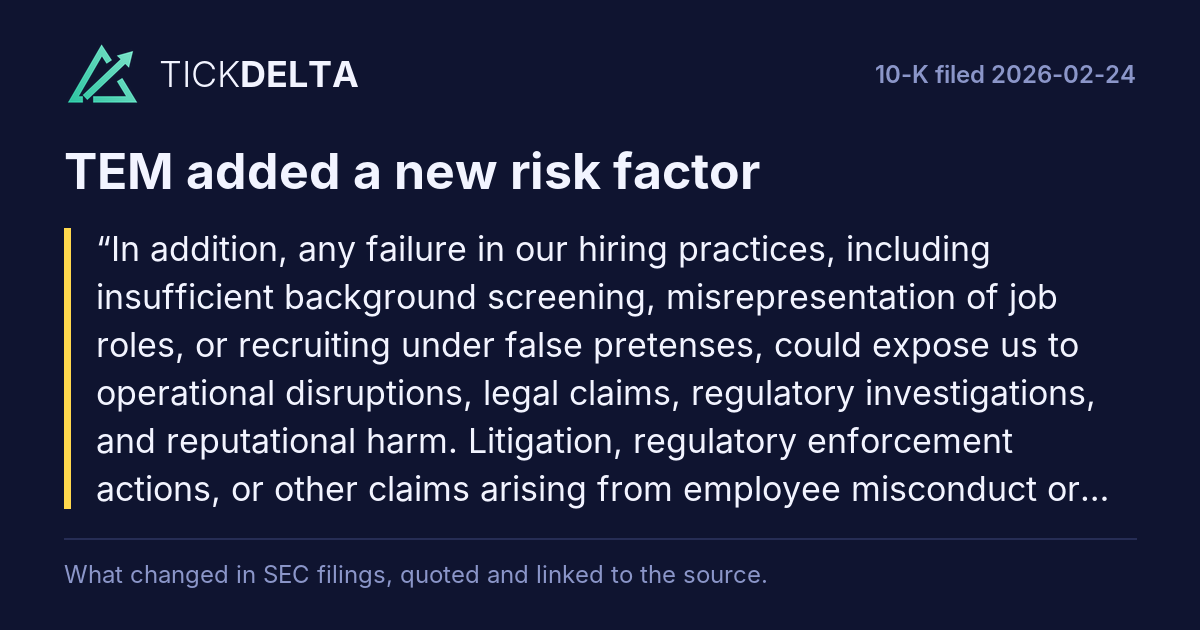
In addition, any failure in our hiring practices, including insufficient background screening, misrepresentation of job roles, or recruiting under false pretenses, could expose us to operational disruptions, legal claims, regulatory investigations, and reputational harm. Litigation, regulatory enforcement actions, or other claims arising from employee misconduct or improper hiring practices could result in significant costs, management distraction, and damage to our brand, financial condition, and results of operations.

Read in the 10-K

Paragraphs in the 10-Q filed Nov 2, 2026 that were not in the one before

New in the latest 10-Q

52 paragraphs in the 10-Q filed Nov 2, 2026 with nothing like them in the 10-Q filed Jul 30, 2026 (at least half the words must differ; new numbers alone do not count). Quoted exactly, grouped by the item heading above them. This is text that changed, not a judgement of how serious it is.

10-Q

(3) Deferred other income balances solely related to SB Tempus Corp. Refer to Note 7, Joint Venture.

Read in the 10-Q

(3) Deferred other income balances solely related to SB Tempus Corp. Refer to Note 7, Joint Venture.

Read in the 10-Q

The Company, based in Chicago, Illinois, was founded by Eric P. Lefkofsky, the Company’s CEO and Executive Chairman, and evolved from a business Mr. Lefkofsky founded called Bioin. Bioin originally was established as a limited liability company. Effective September 21, 2015, Bioin converted its legal form to a corporation organized and existing under the General Corporation Law of the State of Delaware. Bioin subsequently changed its legal name to Tempus Health, Inc. in September 2015, to Tempus Labs, Inc. in October 2016 and to Tempus AI, Inc. in December 2023. Effective August 7, 2025, the Company reincorporated, by conversion, from a Delaware corporation to a Nevada corporation.

Read in the 10-Q

The Company operates as one operating and reportable segment. The Company’s chief operating decision maker (“CODM”) is its chief executive officer, who reviews financial information for purposes of making operating decisions, assessing financial performance and allocating resources. The Company’s CODM evaluates financial information on a consolidated basis.

Read in the 10-Q

The CODM assesses performance and decides how to allocate resources based on consolidated net loss that is reported on the consolidated statements of operations and comprehensive loss. The CODM uses consolidated net loss to evaluate income generated from segment assets. Net loss is used to monitor budget versus actual results.

Read in the 10-Q
Show the other 47

Outside of the expenses reported on the consolidated statements of operations and comprehensive loss, the CODM regularly reviews personnel costs and cloud costs within selling, general, and administrative expenses, which the Company has identified as significant segment expenses.

Read in the 10-Q

The following summarizes the significant segment expenses reconciled to total selling, general and administrative expenses shown on the condensed consolidated statements of operations and comprehensive loss. Other selling, general, and administrative expenses include facilities, professional fees, marketing, travel and entertainment, depreciation and amortization, and stock-based compensation (see Note 11).

Read in the 10-Q

The Company uses the measurement alternative investment method to account for investments in which it does not exercise significant influence and that do not have readily determinable fair values. These investments are accounted for under the measurement alternative in accordance with ASC 321, whereby securities are measured at cost, less impairment, if any, and adjusted for observable price changes in orderly transactions for identical or similar securities of the same issuer. When observable price changes are identified, the carrying value of the related equity security is adjusted to reflect the observable transaction price as of the transaction date, with the resulting gains or losses recognized within Other income, net on the condensed consolidated statement of operations and comprehensive loss. The Company does not perform recurring fair value remeasurements of these equity securities absent such observable transactions or indicators of impairment. The Company classifies its measurement alternative investments as Level 3. The Company’s measurement alternative investments are recorded in Investment in related party and within Investments and other assets on the condensed consolidated balance sheets.

Read in the 10-Q

In accordance with ASC 985-20, Costs of Software to Be Sold, Leased, or Marketed, the Company expenses development costs for software to be sold or leased externally as research and development until technological feasibility has been established for a product, after which costs are capitalized up to the date the software is available for general release to customers. External-use software costs are recorded at cost less accumulated amortization in Capitalized software on the condensed consolidated balance sheets. Once available for general release, capitalized external use software development costs are amortized on a product basis at the greater of the ratio of current gross revenues to the total of current and anticipated future gross revenues or over the remaining estimated economic life of the product, which is typically three years.

Read in the 10-Q

On August 7, 2026 (the "Center Health Closing Date"), the Company completed its acquisition (the "Center Health Acquisition"), of Center Health Incorporated, a Delaware corporation ("Center Health"), pursuant to an Agreement and Plan of Merger and Reorganization whereby Center Health merged with and into a subsidiary of the Company that is a Delaware limited liability company, with the resulting Company being named Center Health Sub, LLC. The Center Health Acquisition provides access to Center Health's AI-enabled chronic disease management platform, which connects patients with providers and generates actionable insights across the entire care journey.

Read in the 10-Q

The following pro forma information shows the results of the Company's operations as though the acquisition had occurred as of the beginning of the comparable period, January 1, 2024 (in thousands):

Read in the 10-Q

For the three and nine months ended September 30, 2025, Paige contributed an immaterial amount in net revenue within Data and applications revenue and $2.4 million of net loss to the Company's consolidated results.

Read in the 10-Q

Pursuant to ASC 805, Business Combinations, the Company accounted for the Paige Acquisition as a business combination under the acquisition method of accounting.

Read in the 10-Q

On March 11, 2025, the Company acquired all of the issued and outstanding interests of Deep 6 AI, Inc. ("Deep 6"), a Delaware corporation (the "Deep 6 Acquisition"), that enables healthcare organizations to de-risk clinical trials, accelerate recruitment, and generate real-world evidence with speed and precision. Deep 6's AI-powered software matches patients to clinical trials by mining real-time structured and unstructured electronic medical record data across a broad ecosystem.

Read in the 10-Q

In 2015, the Company adopted the Tempus AI, Inc. 2015 Stock Plan (the “2015 Plan”), which has been amended and restated numerous times to increase the aggregate shares authorized to be issued to employees, consultants, and directors of the Company. As of December 31, 2023, there were 28,115,750 shares authorized under the 2015 Plan.

Read in the 10-Q

The Company granted 486,930 and 3,103,997 RSUs during the three and nine months ended September 30, 2026.

Read in the 10-Q

The Company granted 106,600 and 281,600 PSUs during the three and nine months ended September 30, 2026. Refer to Note 16 for further detail regarding the PSU grant to a non-employee.

Read in the 10-Q

The table below summarizes PSU activity for the nine months ended September 30, 2026:

Read in the 10-Q

Fair Value Outstanding at December 31, 2025 2,569,600 $53.32 Granted 281,600 $50.73 Vested and settled (831,648) $55.76 Forfeited (90,000) $53.32 Outstanding at September 30, 2026 1,929,552 $51.89 50% of the PSUs granted in 2025 (the “CRG PSUs”) are subject to a performance condition, which is based on the Company’s compound revenue growth ("CRG") during three overlapping performance periods (the "Performance Periods") - calendar year 2025 ("First Performance Period"), calendar years 2025 and 2026 ("Second Performance Period"), and calendar years 2025, 2026 and 2027 ("Third Performance Period" and, together with the First Performance Period and the Second Performance Period, the "Performance Periods") and subject to a service condition of a required period of continued employment from the vesting start date. 50% of the PSUs granted in 2025 (the “TSR PSUs”) are subject to a market condition, which is based on a comparison of the Company’s total shareholder return ("TSR") to the return of the Nasdaq Composite Index during each Performance Period and subject to a service condition of a required period of continued employment from the vesting start date. On February 20, 2026, the Company's board of directors certified the achievement of the performance condition related to the CRG PSUs and the market condition related to the TSR PSUs for the First Performance Period. As of September 30, 2026, the service condition for the TSR and CRG PSUs for the First Performance Period was met. Stock-based compensation is classified as follows in the accompanying condensed consolidated statements of operations for the three and nine months ended September 30, 2026 and 2025 (in thousands): Three Months Ended September 30, Nine Months Ended September 30, 2026 2025 2026 2025 ─────────────────────────────────────────────────────────────────────────────────────────────────────────────────────────────────────────────────────────────────────────────────────────── Cost of revenues, diagnostics $ 3,037 $ 1,631 $ 8,795 $ 4,086 Cost of revenues, data and applications 1,214 894 3,735 2,198 Technology research and development 7,954 5,463 26,101 12,067 Research and development 5,432 3,301 15,284 7,618 Selling, general and administrative 30,437 22,690 100,986 53,439 Total stock-based compensation $ 48,074 $ 33,979 $ 154,901 $ 79,408

Read in the 10-Q

The initial purchasers' discount and deferred financing fees on the 2032 Notes are amortized over the term of the underlying debt and unamortized amounts have been offset against the 2032 Notes, net in the condensed consolidated balance sheets. As of September 30, 2026, the net carrying amount of the 2032 Notes are as follows:

Read in the 10-Q

The initial purchasers' discount and deferred financing fees on the 2030 Notes are amortized over the term of the underlying debt and unamortized amounts have been offset against the 2030 Notes, net in the condensed consolidated balance sheets. As of September 30, 2026 and December 31, 2025, the net carrying amount of the 2030 Notes are as follows:

Read in the 10-Q

The original issue discount of $10.5 million and deferred financing fees of $2.6 million on the Term Loans are amortized over the term of the underlying debt and unamortized amounts have been offset against long-term debt in the condensed consolidated balance sheets. As a result of the repayment of the principal amount of the Additional Term Loan Facility in May 2026, as of September 30, 2026, the original issue discount was $0. As of December 31, 2025, the unamortized original issue discount was $3.3 million. As a result of the repayment of the principal amount of the Term Loan Facility in July 2025, the deferred financing fees is $0 as of September 30, 2026 and December 31, 2025.

Read in the 10-Q

The original issue discount of $2.0 million and deferred financing fees of $1.0 million on the Revolving Credit Facility are amortized over the term of the underlying debt and unamortized amounts are recorded in Investments and other assets in the condensed consolidated balance sheets. As of September 30, 2026, the unamortized original issue discount and deferred financing fees on the Revolving Credit Facility were both $0 as a result of the repayment of the principal amount of the Revolving Credit Facility in May 2026. As of December 31, 2025, the unamortized original issue discount and deferred financing fees on the Revolving Credit Facility was $1.6 million and $0.8 million, respectively.

Read in the 10-Q

During the nine months ended September 30, 2026, the Company made $9.3 million in interest payments.

Read in the 10-Q

(Level 1) Assets Marketable equity securities $150,211 $150,211 $ $ Liabilities Holdback liability $4,984 $4,984 $ $ Measurement Alternative Investments The Company uses the measurement alternative investment method to account for investments in which it does not exercise significant influence and that do not have readily determinable fair values. The Company's measurement alternative investments consist of investments in Pathos Series D Preferred Stock (refer to Note 16), a warrant to purchase 23,456,790 shares of Pathos

Read in the 10-Q

common stock (refer to Note 16), and other immaterial investments that are not related parties to the Company. These investments are accounted for under the measurement alternative in accordance with ASC 321, whereby securities are measured at cost, less impairment, if any, and adjusted for observable price changes in orderly transactions for identical or similar securities of the same issuer. The Company's measurement alternative investments are recorded in Investment in related party and within Investments and other assets on the condensed consolidated balance sheets. These investments are measured at fair value on a non-recurring basis and are classified as Level 3 investments.

Read in the 10-Q

The warrant to purchase shares of Pathos common stock is valued at $0 as there have been no observable price changes in orderly transactions for identical or similar securities of the same issuer. In both June 2026 and August 2026, Pathos paid $8.8 million of the data license fees in Pathos' Series D Preferred Stock (refer to Note 16), for a total of $17.5 million in Pathos' Series D Preferred Stock. The carrying value of the Company's measurement alternative investments as of September 30, 2026 and December 31, 2025 was $25.5 million and $8.0 million, respectively. There have been no cumulative upward or downward adjustments from observable price changes recorded. The Company recorded no impairment loss during the three and nine months ended September 30, 2026 and 2025.

Read in the 10-Q

The Company holds marketable equity securities, which are all publicly traded shares of Recursion Pharmaceuticals, Inc. (“Recursion”) Class A common stock and Personalis common stock.

Read in the 10-Q

16. RELATED PARTIES Strategic Investment The Company's Founder and Chief Executive Officer is a co-founder and serves as Executive Chairman of the board of Pathos AI, Inc. ("Pathos"). On August 19, 2021, the Company entered into a Master Agreement with Pathos, which was subsequently

Read in the 10-Q

amended on February 12, 2024 (as amended, the "Amended and Restated Master Agreement"), for the purpose of furthering the commercialization efforts of drug development. In connection therewith, the Company received a warrant to purchase 23,456,790 shares, or approximately 15% of the current outstanding equity in Pathos, for $0.0125 per share. The warrant will automatically exercise upon a change of control (as defined therein) or upon an IPO of Pathos’ securities. The Company also has an optional exercise election window during the last 10 days of the 20 year term of the warrant agreement. The Amended and Restated Master Agreement provides for an initial term of five years, measured from February 2024, with a subsequent five-year renewal provision unless the agreement is terminated. Either party may terminate the agreement after the initial five-year term by prior written notice to the other party.

Read in the 10-Q

On February 16, 2026, the Company entered into an Independent Contractor Agreement (the “Huerga Contractor Agreement”) with Iker Huerga, Chief Executive Officer of Pathos, pursuant to which Mr. Huerga agreed to assist the Company in negotiating, managing, and expanding a new commercial agreement (the "Commercial Agreement"). Compensation under the Huerga Contractor Agreement consists solely of RSUs and PSUs. Mr. Huerga will earn 25,000 RSUs for services rendered in 2025 and expected to be rendered in 2026. Mr. Huerga has the potential to earn an additional 175,000 PSUs based on milestones that include certain minimum purchase commitments. A special committee of disinterested directors of the Board of Directors approved Mr. Huerga's 175,000 PSUs on October 22, 2026.

Read in the 10-Q

The Company subleases a portion of office space to a related party on a month-to-month basis. Sublease income received from the related party was insignificant for the three months ended September 30, 2026 and 2025. Sublease income received from the related party was $0.2 million and $0.1 million for the nine months ended September 30, 2026 and 2025.

Read in the 10-Q

In October 2026, the Company executed a ninth amendment to the lease agreement for its Chicago, Illinois facility. The amendment expands the leased premises by 33,531 rentable square feet and extends the lease term through January 31, 2038, resulting in a preliminarily estimated remeasured right-of-use asset and lease liability of approximately $19.8 million.

Read in the 10-Q

On October 14, 2026, the Company and BMS entered into an SOW (the "Onco SOW") under the parties’ existing Master Services Agreement, dated August 22, 2018, as amended from time to time. Under the Onco SOW, the Company will (i) license to BMS certain multimodal records from the Company's de-identified oncology dataset, (ii) grant BMS access to the Company’s Lens software application to facilitate analysis of such data, and (iii) provide certain other data analysis and research-related services. The scope of BMS’s license to the de-identified oncology data under the Onco SOW includes BMS’s use of such data with Pathos’s drug development platform, which BMS has separately licensed from Pathos.

Read in the 10-Q

The Onco SOW has a term expiring on December 31, 2031. BMS will pay the Company $137.5 million in aggregate fixed payments over the term, with payments invoiced quarterly throughout. BMS may terminate the Onco SOW upon 12 months’ prior written notice and payment of a substantial termination fee.

Read in the 10-Q

Neurology Data and Agentic Tool License with Pathos, Including Sublicense Rights to BMS

Read in the 10-Q

On October 22, 2026, the Company and Pathos entered into an Order Form relating to neurology data and an agentic data analysis tool to be used by Pathos and Bristol-Myers Squibb Company (“BMS”) to support therapeutic product development (the “Neuro Order Form”) under the Amended and Restated Master Agreement. Pursuant to the Neuro Order Form, the Company will use commercially reasonable efforts to deliver and license to Pathos 500,000 de-identified records of patients diagnosed with Alzheimer’s disease or other specified neurological conditions, at a rate of 100,000 records during each year of the Neuro Order Form’s five-year term. The Company has also granted Pathos a license to an agentic tool that permits interrogation and analysis of the licensed data (the “Tempus Agent”). Pathos may use the licensed data and the Tempus Agent for its internal purposes and to assist BMS in its therapeutic development activities (as described more fully in the Side Letter).

Read in the 10-Q

In connection with the Neuro Order Form, Pathos will pay the Company aggregate fees of up to $55.0 million in cash, consisting of (i) $50.0 million in data license fees of $100 per delivered record, invoiced monthly, and (ii) $5.0 million for the availability of record updates, invoiced quarterly. Because the data license fees are based on the number of records delivered, the amount that the Company will earn under the Neuro Order Form will depend on its delivery of records during the five-year term.

Read in the 10-Q

Also on October 22, 2026, the Company, Pathos, and BMS entered into a side letter agreement relating to the Neuro Order Form (the "Side Letter"), which confirms the Company’s consent to the sublicense from Pathos to BMS of the data and Tempus Agent provided under the Neuro Order Form. The Side Letter also establishes that the Company will not license the applicable neurology data records to any third party other than BMS, Pathos, and certain subcontractors during the period beginning when an applicable record is first delivered to Pathos and ending 18 months after the later of (i) such delivery date and (ii) October 22, 2027.

Read in the 10-Q

• the expected timing of the closing of the Personalis acquisition, including receipt of Personalis stockholder approval and satisfaction of other closing conditions, whether we elect to pay any portion of the merger consideration in cash and the sources of funding for any such cash consideration, and the possibility that Personalis may terminate the Merger Agreement if our stock price falls below specified levels;

Read in the 10-Q

As part of the announced acquisition of Personalis, we have the option to pay up to 50% of the consideration paid. Any cash consideration could be funded from a combination of various sources.

Read in the 10-Q

Share sales and buybacks

In connection with our acquisition of Center Health, on August 7, 2026, we issued 255,885 shares of our Class A common stock to certain former shareholders of Center Health. We issued the shares in reliance on an exemption from registration provided for under Section 4(a)(2) of the Securities Act and/or Rule 506 of Regulation D promulgated thereunder as a transaction by an issuer not involving a public offering.

Read in the 10-Q

Other information

Effective November 1, 2026, Tom Schoenherr was appointed to serve as Chairman of our wholly-owned subsidiary, Ambry Genetics Corp., and will no longer serve as Chief Executive Officer, Diagnostics as of that date.

Read in the 10-Q

Item 6

3.1 Amended and Restated Articles of Incorporation of the Registrant. 10-Q 001-42130 3.2 November 4, 2025

Read in the 10-Q

3.2 Amended and Restated Bylaws of the Registrant. 10-Q 001-42130 3.2 August 8, 2025

Read in the 10-Q

10.1*^ Amendment, dated September 15, 2026 to Master Agreement by and between the Registrant and Recursion Pharmaceuticals, Inc., dated November 2, 2023.

Read in the 10-Q

10.2* Ninth Amendment to Agreement of Lease, dated as of October 13, 2026, by and between the Registrant and 3E 1907 LLC.

Read in the 10-Q

10.3†*# Amended and Restated Employment Agreement, by and between the Registrant and Tom Schoenherr, dated November 1, 2026.

Read in the 10-Q

32.1*+ Certification of Principal Executive Officer and Principal Financial Officer pursuant to 18 U.S.C Section 1350, as adopted pursuant to Section 906 of the Sarbanes-Oxley Act of 2002.

Read in the 10-Q

101. INS* Inline XBRL Instance Document – the instance document does not appear in the Interactive Data File as its XBRL tags are embedded within the Inline XBRL document.

Read in the 10-Q

101. SCH* Inline XBRL Taxonomy Extension Schema with Embedded Linkbase Document.

Read in the 10-Q

^ Certain portions of this exhibit (indicated by asterisks) have been omitted because they are not material and are the type that the registrant treats as private or confidential.

Read in the 10-Q

The 10-Q's risk factors against the 10-K

Item 1A of the 10-Q filed Nov 2, 2026 against Item 1A of the 10-K filed Feb 24, 2026. A 10-Q repeats only the risks that changed, so a 10-K paragraph that is missing from it is not counted as removed. Added is a paragraph with nothing like it in the 10-K, Reworded a sentence that is in both with several words changed, Quiet changes a sentence in both where one to four words changed and one is a hedge or a modal (cut words struck through, new words highlighted). Text on the page, not a score; each links to the filing at sec.gov.

Added10-Q Nov 2, 2026 vs 10-K Feb 24, 2026
Our business, financial condition and operating results are affected by a number of factors, whether currently known or unknown, including risks specific to us or the healthcare industry as well as risks that affect businesses in general. In addition to the information set forth in this Quarterly Report on Form 10-Q, you should consider carefully the factors discussed in Part I, Item 1A, “Risk Factors” in our Annual Report on Form 10-K for the fiscal year ended December 31, 2025, filed with the SEC on February 24, 2026. The risks and uncertainties disclosed in such Annual Report could materially adversely affect our business, financial condition, cash flows or results of operations and thus our stock price. Except as set forth below, during the third quarter of fiscal 2026, there were no material changes to our previously disclosed risk factors.

Read it in the 10-Q at sec.gov

Added10-Q Nov 2, 2026 vs 10-K Feb 24, 2026
These risk factors may be important to understanding other statements in this Quarterly Report and should be read in conjunction with the unaudited condensed consolidated financial statements and related notes in Part I, Item 1, “Financial Statements” and Part I, Item 2,“Management’s Discussion and Analysis of Financial Condition and Results of Operations” of this Quarterly Report. Because of such risk factors, as well as other factors affecting our financial condition and operating results, past financial performance should not be considered to be a reliable indicator of future performance, and investors should not use historical trends to anticipate results or trends in future periods.

Read it in the 10-Q at sec.gov

Added10-Q Nov 2, 2026 vs 10-K Feb 24, 2026
The proposed acquisition may not be completed, and the merger agreement may be terminated in accordance with its terms.

Read it in the 10-Q at sec.gov

Added10-Q Nov 2, 2026 vs 10-K Feb 24, 2026
The proposed acquisition is subject to a number of conditions that must be satisfied or waived prior to the completion of the proposed acquisition, including, among others, the approval by Personalis stockholders of the proposal to adopt the merger agreement, the receipt of requisite regulatory approvals and the approval for listing on Nasdaq of the shares of our Class A common stock issuable to Personalis stockholders pursuant to the merger agreement.

Read it in the 10-Q at sec.gov

Added10-Q Nov 2, 2026 vs 10-K Feb 24, 2026
These conditions to the completion of the proposed acquisition may not be satisfied or waived in a timely manner or at all, and, accordingly, the proposed acquisition may be delayed or may not be completed. In addition, if the proposed acquisition is not completed by April 20, 2027, which date may be extended to October 20, 2027 (and potentially to April 20, 2028) in certain circumstances, either we or Personalis may choose not to proceed with the proposed acquisition by terminating the merger agreement, and the parties can mutually decide to terminate the merger agreement at any time, before or after stockholder approval. Personalis may also terminate the merger agreement if, immediately prior to the closing, the volume-weighted average trading price of our Class A common stock is finally determined to be less than $46.00 per share based on the 15 consecutive trading days prior to but not including the last trading day prior to the closing. In addition, we and Personalis may elect to terminate the proposed acquisition in certain other circumstances as set forth in the merger agreement. If the merger agreement is terminated under specified circumstances, Personalis would be required to pay us a termination fee of approximately $76.8 million, and in certain circumstances, we would be required to pay Personalis a termination fee of the same amount.

Read it in the 10-Q at sec.gov

Show the other 15
Added10-Q Nov 2, 2026 vs 10-K Feb 24, 2026
Failure to complete the proposed acquisition could negatively impact the price of shares of our Class A common stock, as well as our business and results of operations.

Read it in the 10-Q at sec.gov

Added10-Q Nov 2, 2026 vs 10-K Feb 24, 2026
If the proposed acquisition is not completed for any reason, our business and results of operations may be adversely affected and, without realizing any of the benefits of having completed the proposed acquisition, we would be subject to a number of risks, including:

Read it in the 10-Q at sec.gov

Added10-Q Nov 2, 2026 vs 10-K Feb 24, 2026
• we may experience negative reactions from clients, vendors, and other third parties with whom we do business, which in turn could affect our business operations;

Read it in the 10-Q at sec.gov

Added10-Q Nov 2, 2026 vs 10-K Feb 24, 2026
• we will have expended time and resources that could otherwise have been spent on our existing business and the pursuit of other opportunities that could have been beneficial to us, and our ongoing business and results of operations may be adversely affected.

Read it in the 10-Q at sec.gov

Added10-Q Nov 2, 2026 vs 10-K Feb 24, 2026
Uncertainties associated with the proposed acquisition may cause a loss of our and Personalis’ management personnel and other key employees, which could adversely affect the business and operations of the combined company following the proposed acquisition.

Read it in the 10-Q at sec.gov

Added10-Q Nov 2, 2026 vs 10-K Feb 24, 2026
Each of us and Personalis depends on the experience and industry knowledge of its officers and other key employees to execute its business plans. The success of the combined company after the proposed acquisition will depend, in part, on its ability to retain key management personnel and other key employees. Our and Personalis’ current and prospective employees may experience uncertainty about their roles within the combined company following the proposed acquisition or other concerns regarding the timing and completion of the proposed acquisition or the operations of the combined company following the proposed acquisition, any of which may have an adverse effect on our and Personalis’ ability to retain or attract key management and other key personnel. If we or Personalis are unable to retain personnel, including our or Personalis’ key management, who are critical to the future operations of the companies, we and Personalis could face disruptions in our respective operations, loss of existing clients, loss of key information, expertise or know‑how and unanticipated additional recruitment and training costs. In addition, the loss of our and Personalis’ key personnel could diminish the anticipated benefits of the proposed acquisition.

Read it in the 10-Q at sec.gov

Added10-Q Nov 2, 2026 vs 10-K Feb 24, 2026
We are expected to incur significant costs in connection with the proposed acquisition and integration of the two companies, which may be in excess of those anticipated by us.

Read it in the 10-Q at sec.gov

Reworded10-Q Nov 2, 2026 vs 10-K Feb 24, 2026
Our 0.75% Convertible Senior Notes due 2030, or the 2030 Notes, and our 0.00% Convertible Senior Notes due 2032, or the 2032 Notes and, together with the 2030 Notes, the Notes, and the issuance of shares of our Class A common stock upon conversion of the Notes, if any, may impact our financial results, result in dilution to our stockholders, create downward pressure on the price of our Class A common stock, and restrict our ability to raise additional capital or to engage in a beneficial takeover.

Read it in the 10-Q at sec.govThe 10-K sentence

Reworded10-Q Nov 2, 2026 vs 10-K Feb 24, 2026
In connection with the issuance of the 2030 Notes and the 2032 Notes, we entered into capped call transactions, or the 2030 Capped Call and the 2032 Capped Call, respectively, and together the Capped Call Transactions, with one of the initial purchasers and certain other financial institutions, or the option counterparties.

Read it in the 10-Q at sec.govThe 10-K sentence

Reworded10-Q Nov 2, 2026 vs 10-K Feb 24, 2026
The Capped Call Transactions may not operate as we intend anticipate in the event that we are required to adjust the terms of such instruments are adjusted as a result of transactions in the future or in the event of other unanticipated developments that may adversely affect the functioning value of the Capped Call. Call Transactions to us.

Read it in the 10-Q at sec.govThe 10-K sentence

Reworded10-Q Nov 2, 2026 vs 10-K Feb 24, 2026
If an option counterparty becomes subject to insolvency proceedings, we will become an unsecured creditor in those proceedings with a claim equal to our exposure at that time under the capped call transaction Capped Call Transactions with such option counterparty.

Read it in the 10-Q at sec.govThe 10-K sentence

Quiet changes10-Q Nov 2, 2026 vs 10-K Feb 24, 2026
In addition, even if holders do not elect to convert their Notes, we could be required under applicable accounting rules to reclassify all or a any portion of the outstanding principal of the Notes as a current rather than long-term liability, which would result in a material reduction of our net working capital.

Read it in the 10-Q at sec.govThe 10-K sentence

The first 20 of 34 are shown (at most 12 of each type).

Phrases used for the first time

Two-word phrases in Risk Factors of the 10-K filed Feb 24, 2026 that are in none of the 1 earlier 10-Ks stored, back to Feb 24, 2025

diagnostics product ×13capped call ×12option counterparties ×7hereditary tests ×6second amended ×6hereditary testing ×4foundation model ×4armed conflict ×3million outstanding ×3principal amount ×3sales agents ×3ethical legal ×3social concerns ×3conditional conversion ×3conversion feature ×3carolina aliso ×3
Where each one is used
  • diagnostics product: •If we are unable to obtain or maintain adequate reimbursement for our Diagnostics product line outside of the United States, our ability to expand internationally will be compromised.
  • capped call: In connection with the issuance of the Notes, we entered into capped call transactions, or the Capped Call, with one of the initial purchasers and certain other financial institutions, or the option counterparties. The Capped Call cover, subject to customary adjustments, the number of shares of our Class A common...
  • option counterparties: In connection with the issuance of the Notes, we entered into capped call transactions, or the Capped Call, with one of the initial purchasers and certain other financial institutions, or the option counterparties. The Capped Call cover, subject to customary adjustments, the number of shares of our Class A common...
  • hereditary tests: Continued adoption and use of our Diagnostics product line will depend on several factors, including the prices we charge for our tests, the scope of coverage and amount of reimbursement available from third-party payers for our tests, the availability of clinical data that support the value of our tests and the...
  • second amended: As of December 31, 2025, we had indebtedness of $1.3 billion, comprising (i) $208.7 million under the convertible promissory note, as amended, or the Second Amended Note, that we issued to Google LLC, or Google, (ii) $206.0 million of senior secured term loans, or the Additional Term Loan Facility, and $100.0...
  • hereditary testing: We believe our commercial success is dependent upon our ability to continue to successfully market and sell our current Diagnostics products, including both Oncology testing (legacy Tempus) and Hereditary testing (legacy Ambry Genetics), to continue to grow our Data and applications business by expanding our...
  • foundation model: Our ability to maintain, expand and monetize our datasets is subject to a number of factors, many of which are outside of our control. With respect to data included in our Data and applications products, we rely on a combination of the statutory rights available to us as a HIPAA covered entity and as a Health...
  • armed conflict: •the impact of natural disasters, political and economic instability, including wars (such as the armed conflict between Russia and Ukraine and the hostilities in the Middle East), terrorism, and political unrest, epidemics or pandemics, boycotts, curtailment of trade and other business restrictions; and

The 10-K at sec.gov

Used at least twice, small words left out. Counted, not picked: a phrase can be new because the company renamed something.

What was taken out

34 paragraphs of last year's Risk Factors with nothing like them now. The longest are quoted.

Across all companies
Furthermore, on September 27, 2023, the Centers for Medicare and Medicaid Services (CMS) published calendar year 2024 preliminary payment determinations for new and reconsidered codes on the Medicare clinical laboratory fee schedule (CLFS), including new codes that may apply to tests we offer through our Genomics business. In doing so, CMS rejected the recommendations from experts on the Clinical Diagnostic Laboratory Test (CDLT) Advisory Panel and recommended reimbursement rates for several new procedure codes describing genomic profiling tests that are substantially below our costs to...
In the 10-K filed Feb 24, 2025
Penalties for violations of these laws vary. For instance, a single breach incident can result in findings of violations of multiple HIPAA provisions. Penalties for failure to comply with a requirement of HIPAA and HITECH vary significantly, and include civil monetary penalties for each provision of HIPAA that is violated and, in certain circumstances, criminal penalties, including imprisonment and/or additional fines. A person who knowingly obtains or discloses individually identifiable health information in violation of HIPAA may face additional fines and up to one-year imprisonment. The...
In the 10-K filed Feb 24, 2025
As a public company, we will incur significant legal, accounting and other expenses that we did not incur as a private company, which we expect to further increase after we are no longer an “emerging growth company.” The Sarbanes-Oxley Act, the Dodd-Frank Wall Street Reform and Consumer Protection Act, the Exchange Act, the listing requirements of the Nasdaq Stock Market and other applicable securities rules and regulations impose various requirements on public companies. Our management and other personnel devote a substantial amount of time to compliance with these requirements. Moreover,...
In the 10-K filed Feb 24, 2025
compensation in our periodic reports and proxy statements and exemptions from the requirements of holding a nonbinding advisory vote on executive compensation and stockholder approval of any golden parachute payments not previously approved. Pursuant to Section 107 of the JOBS Act, as an emerging growth company, we have elected to use the extended transition period for complying with new or revised accounting standards until those standards would otherwise apply to private companies. As a result, our condensed consolidated financial statements may not be comparable to the financial...
In the 10-K filed Feb 24, 2025

Sources

Item 1A of each 10-K and 10-Q on EDGAR, quoted exactly. Each paragraph links to the filing at sec.gov.

Also

10-K change: what was reworded or cut, section by section.

Work with it

Excel workbook · CSV. Google Sheet that stays up to date: paste =IMPORTDATA("https://tickdelta.com/company/TEM/export.csv") into a cell.

Next:10-K change
Esc

Type a ticker such as AAPL, a name, an investor such as Buffett, or a topic such as tariffs. ↑ ↓ to move, Enter to open.