Tecnoglass Holdings Inc. TGLS
New risk paragraphs, branching off last year
Each branch is a paragraph in Risk Factors with nothing like it in the 10-K filed Feb 28, 2025. A box jumps to the paragraph as filed, below.
Paragraphs with nothing like them in last year's 10-K
8 paragraphs in Risk Factors of the 10-K filed Mar 2, 2026 with nothing like them in the 10-K filed Feb 28, 2025. Quoted exactly. Paragraphs that were only edited are under 10-K change.
During 2025, Moody’s, S&P and Fitch, three of the main rating agencies worldwide, downgraded Colombia’s credit profile due to weakening public finances, with Moody’s lowering its rating to “Baa3” while keeping a stable outlook as fiscal metrics deteriorated beyond original plans, S&P cutting its sovereign rating to “BB” with a negative look, and Fitch also downgrading the long-term foreign currency rating to “BB” amid persistently large fiscal deficits, rising public debt and challenges in fiscal consolidation, mirroring market concerns over the country’s fiscal trajectory even as moderate growth continued and inflation pressures eased during the year. Colombia’s macroeconomic performance in 2025 showed a moderation in growth and inflation dynamics. Official data and projections indicate the country’s GDP is expected to increase around 2%-3%, while inflation closed at 5.1%, above the central bank’s 3% target, and similar to the 5.2% inflation rate of 2024. In addition, Colombia’s central bank (Banco de la República) is maintaining a restrictive monetary stance, raising its monetary policy interest rate 100 basis points to 10.25%, largely due to strong internal demand and cost pressures including significant labor cost increases from a higher minimum wage declared for 2026.
The United States has imposed import tariffs on certain steel and aluminum articles under Section 232 of the Trade Expansion Act of 1962, and these measures have been adjusted over time through proclamations and related administrative actions (including changes to product coverage, rates, exclusions and enforcement). In addition, on April 2, 2025, the President issued Executive Order 14257, which directed that imported articles be subject to an additional 10% ad valorem duty pursuant to a declared national emergency under the International Emergency Economic Powers Act (IEEPA), with specified effective dates. Multiple lawsuits have challenged the President’s authority to impose tariffs under IEEPA and stays and ongoing appeals have contributed to uncertainty regarding the ultimate outcome and any related changes to scope, duration, or potential refunds. The adoption, modification or escalation of these or other tariff regimes, as well as retaliatory measures by other countries, could materially and adversely affect our business, financial condition and results of operations.
Given that our primary manufacturing facilities are located in Colombia and approximately 94.8% of our sales for the fiscal year ended December 31, 2025, were generated in the United States, these tariffs directly increase our costs and may pressure our profit margins.
In response to these trade barriers, we have strategically shifted our supply chain to source U.S.-casted aluminum, which has allowed us to mitigate a portion of the financial impact. However, despite these mitigation efforts, any further escalation in tariff rates, the potential removal of U.S.-Colombia Trade Promotion Agreement benefits, or retaliatory measures by the Colombian government could still disrupt our supply chain and reduce our price competitiveness. Such developments could have a material adverse effect on our financial condition and results of operations.
The Russian invasion of Ukraine starting in February 2022 has contributed to elevated global tensions and the imposition of economic sanctions and trade restrictions between the United States, the European Union and other countries.
In addition, attacks and security threats in and around the Red Sea associated with Yemen’s Houthi group, and related military tensions involving the United States and certain allies, have disrupted maritime trade and affected shipping patterns for certain carriers, including through the Suez Canal corridor, resulting in rerouting, longer transit times and increased freight costs in certain periods.
Geopolitical instability in the Americas may also increase regional volatility. On January 3, 2026, U.S. forces captured Venezuelan President Nicolás Maduro in a military operation, which has heightened uncertainty regarding regional stability, diplomatic relations and sanctions policy.
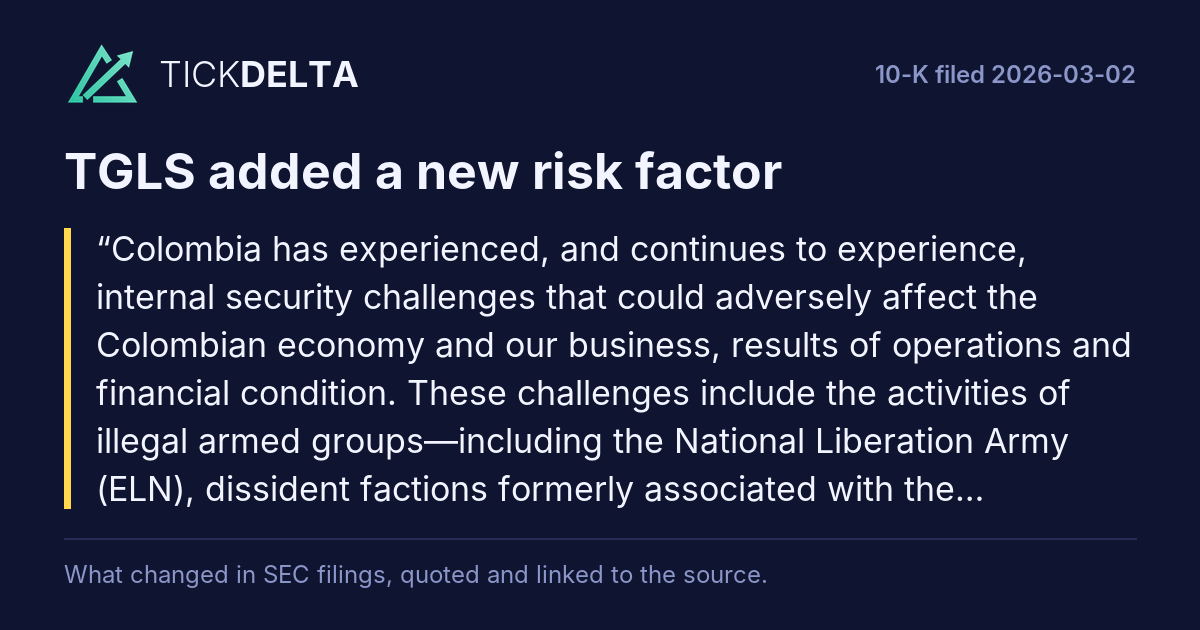
Colombia has experienced, and continues to experience, internal security challenges that could adversely affect the Colombian economy and our business, results of operations and financial condition. These challenges include the activities of illegal armed groups—including the National Liberation Army (ELN), dissident factions formerly associated with the Revolutionary Armed Forces of Colombia (FARC), paramilitary successor groups and criminal organizations involved in narcotrafficking—which in certain regions engage in intimidation, extortion, and attacks that can disrupt commerce, transportation and governmental presence. Although Colombia has implemented peace and related security initiatives over time, violence and criminal activity persist and may escalate, and the government’s evolving security strategy may affect operating conditions for businesses in Colombia. Any deterioration in security conditions could negatively affect demand in the construction industry, the safety and availability of our employees and contractors, our logistics and supply chain, and overall economic and foreign-exchange stability in Colombia.
Paragraphs in the 10-Q filed Nov 9, 2026 that were not in the one before
New in the latest 10-Q
3 paragraphs in the 10-Q filed Nov 9, 2026 with nothing like them in the 10-Q filed Aug 6, 2026 (at least half the words must differ; new numbers alone do not count). Quoted exactly, grouped by the item heading above them. This is text that changed, not a judgement of how serious it is.
Financial statements and notes
In August 2026, the Company entered into a $ 23,000 unsecured term loan (the “Land Acquisition Loan”) with one of the lenders under the Senior Secured Credit Facility to finance the acquisition of land in Fort Pierce, Florida. Borrowings bear interest at SOFR plus 1.25 %, which may not be lower than the spread under the Senior Secured Credit Facility, and are subject to that facility’s financial covenants. The loan is repayable in quarterly installments of $ 313 beginning September 30, 2028, with the remaining $ 20,500 due at maturity in August 2030, and must be prepaid if that lender ceases to participate in the Senior Secured Credit Facility. The Company incurred $ 122 of debt issuance costs, which were capitalized as deferred financing costs, are presented as a deduction from the related debt liability and are amortized over the term of the loan. These costs were deducted from the gross proceeds and presented net within “Proceeds from debt” in the condensed consolidated statements of cash flows.
Read in the 10-Q
The largest use of operating cash was related to income taxes, which used $40.4 million during the first nine months of 2026, compared with $7.8 million in the prior-year period. This primarily reflects payment of income taxes related to fiscal year 2025, under the applicable payment schedule, which more than offset the lower income tax provision recorded in 2026.. Additionally, trade accounts receivables used $20.7 million during the first nine months of 2026, compared with $33.0 million in the prior-year period, reflecting the continued high volume of large commercial installation projects, which typically have longer cash conversion cycles.
Read in the 10-Q
Market risk
As of September 30, 2026, we had $287.8 million of debt bearing interest at variable rates, primarily based on SOFR, of which $125.0 million was effectively converted to a fixed rate through interest rate hedging derivative financial instruments further described in Note 8 - Derivative Financial Instruments and Fair Value Measurements. Accordingly, $162.8 million of our variable-rate debt remained exposed to changes in interest rates. Based on the unhedged variable-rate debt outstanding as of September 30, 2026, a hypothetical 100 basis point increase in interest rates would increase our annual interest expense by approximately $1.6 million.
Read in the 10-Q
The 10-Q's risk factors against the 10-K
Item 1A of the 10-Q filed Nov 9, 2026 against Item 1A of the 10-K filed Mar 2, 2026.
A 10-Q repeats only the risks that changed, so a 10-K paragraph that is missing from it is not counted as removed.
Added is a paragraph with nothing like it in the 10-K, Reworded a sentence that is in both with several words changed,
Quiet changes a sentence in both where one to four words changed and one is a hedge or a modal
(cut words struck through, new words highlighted).
Text on the page, not a score; each links to the filing at sec.gov.
What the 10-Q itself says about its risk factors:There have been no material changes to the risk factors previously disclosed in Part 1, Item 1A of our Annual Report on Form 10-K for the year ended December 31, 2025.
Read in the 10-Q
1 paragraph in the 10-Q's Item 1A, and none of them adds, rewords or quietly edits a paragraph of the 10-K's.
Phrases used for the first time
Two-word phrases in Risk Factors of the 10-K filed Mar 2, 2026 that are in none of the 1 earlier 10-Ks stored, back to Feb 28, 2025
Where each one is used
- uncertainty regarding: The United States has imposed import tariffs on certain steel and aluminum articles under Section 232 of the Trade Expansion Act of 1962, and these measures have been adjusted over time through proclamations and related administrative actions (including changes to product coverage, rates, exclusions and...
- retaliatory measures: The United States has imposed import tariffs on certain steel and aluminum articles under Section 232 of the Trade Expansion Act of 1962, and these measures have been adjusted over time through proclamations and related administrative actions (including changes to product coverage, rates, exclusions and...
- tensions involving: Armed conflicts around the globe, including sanctions and heightened geopolitical tensions involving the United States, NATO allies and other countries, may adversely affect the results of our operations.
- january forces: Geopolitical instability in the Americas may also increase regional volatility. On January 3, 2026, U.S. forces captured Venezuelan President Nicolás Maduro in a military operation, which has heightened uncertainty regarding regional stability, diplomatic relations and sanctions policy.
- forces captured: Geopolitical instability in the Americas may also increase regional volatility. On January 3, 2026, U.S. forces captured Venezuelan President Nicolás Maduro in a military operation, which has heightened uncertainty regarding regional stability, diplomatic relations and sanctions policy.
- captured venezuelan: Geopolitical instability in the Americas may also increase regional volatility. On January 3, 2026, U.S. forces captured Venezuelan President Nicolás Maduro in a military operation, which has heightened uncertainty regarding regional stability, diplomatic relations and sanctions policy.
- venezuelan president: Geopolitical instability in the Americas may also increase regional volatility. On January 3, 2026, U.S. forces captured Venezuelan President Nicolás Maduro in a military operation, which has heightened uncertainty regarding regional stability, diplomatic relations and sanctions policy.
- president nicol: Geopolitical instability in the Americas may also increase regional volatility. On January 3, 2026, U.S. forces captured Venezuelan President Nicolás Maduro in a military operation, which has heightened uncertainty regarding regional stability, diplomatic relations and sanctions policy.
Used at least twice, small words left out. Counted, not picked: a phrase can be new because the company renamed something.
What was taken out
7 paragraphs of last year's Risk Factors with nothing like them now. The longest are quoted.
Sources
Item 1A of each 10-K and 10-Q on EDGAR, quoted exactly. Each paragraph links to the filing at sec.gov.
Also
10-K change: what was reworded or cut, section by section.
Work with it
Excel workbook · CSV. Google Sheet that stays up to date: paste =IMPORTDATA("https://tickdelta.com/company/TGLS/export.csv") into a cell.