Thor Industries Inc THO
New risk paragraphs, branching off last year
Each branch is a paragraph in Risk Factors with nothing like it in the 10-K filed Sep 24, 2025. A box jumps to the paragraph as filed, below.
Paragraphs with nothing like them in last year's 10-K
24 paragraphs in Risk Factors of the 10-K filed Sep 22, 2026 with nothing like them in the 10-K filed Sep 24, 2025. Quoted exactly. Paragraphs that were only edited are under 10-K change.
The market price of our common stock may experience significant volatility due to factors both related and unrelated to our operating performance, including changes in economic and industry conditions, interest rates and credit availability, trade and regulatory developments, competitive activity, investor expectations regarding our growth and profitability and other events beyond our control. Our stock price may also reflect expectations regarding our strategic initiatives, dividend rate and stock repurchase activity. If we fail to meet these or other market expectations, the price of our common stock could decline significantly.
Our success depends on our ability to develop, commercialize and market innovative products and technologies.
A key driver of our historical performance and growth has been our ability to maintain strong brands and develop and introduce innovative products at competitive costs that meet evolving consumer demand. Technological advances, changing consumer preferences and evolving governmental regulations may require us to modify our product offerings, including the continued development of lightweight, electric, hybrid, autonomous and connected recreational vehicles, as well as related digital services. The increasing integration of connected vehicle technologies, telematics and software-enabled features into our products may also expose us to additional product development costs, cybersecurity and data privacy risks, evolving regulatory requirements applicable to connected vehicles and potential liability associated with the performance, security or reliability of these technologies. Our ability to maintain or improve our market position depends on numerous factors beyond our control, including technological advancements, regulatory developments, infrastructure improvements (such as vehicle charging networks) and market acceptance of new technologies.
Successfully developing, manufacturing and commercializing new products and services requires significant investment and involves substantial uncertainty. Our investments in automation, product innovation and digital capabilities may not achieve their intended benefits or generate commercially successful products. New products may not achieve market acceptance, may reduce sales of existing products or may be introduced by competitors more successfully or at lower prices. If we fail to successfully develop, commercialize or adapt our products and services to evolving market conditions, our sales, profitability and competitive position could be materially adversely affected.
Our manufacturing operations require substantial quantities of raw materials and component parts, including aluminum, lumber, petroleum-based products, chassis, electronics, appliances, furniture and other components. The prices of these materials and components are subject to volatility due to inflation, changes in supply and demand, tariffs and trade policies, energy costs, transportation costs, labor costs, currency fluctuations and other economic factors beyond our control. Our ability to recover higher costs depends on market conditions, consumer demand, competitive pricing pressures and dealer acceptance of price increases. In periods of weakened demand or heightened competition, we may be unable to fully recover increased costs through higher selling prices. In addition, sustained increases in the cost of raw materials or component parts, or our inability to timely recover those increases through pricing or other cost-saving initiatives, could reduce gross margins and profitability and materially adversely affect our net sales, results of operations, cash flows and financial condition.
In addition, increased restrictions have been, and may in the future be, imposed on various products and chemicals utilized in the production of our vehicles. These include a class of chemicals known as per- and polyfluoroalkyl substances ("PFAS") and products containing, or capable of releasing, formaldehyde. PFAS are widely used in parts and materials that are incorporated into our products, and restrictions on PFAS may adversely affect our supply chain due to the potentially decreased availability, or unavailability, of PFAS-containing parts and materials. Likewise, many of the wood-based products, adhesives, and other materials used in our vehicle interiors can release formaldehyde. Recently adopted European Union restrictions establish formaldehyde emission limits for articles placed on the EU market after August 6, 2026 and for the interior of road vehicles placed on the EU market after August 6, 2027, and other jurisdictions, including the United States, impose similar formaldehyde emission standards on composite wood products. Compliance with these and similar future requirements may require changes to the materials we use, increase our material, testing and production costs, limit the availability of compliant materials from our suppliers or restrict our ability to sell certain products in affected markets, any of which could adversely affect our net sales, earnings and cash flows.
Cybersecurity incidents or technology disruptions could adversely affect our operations, financial condition and reputation.
Show the other 8
Our success depends on our ability to attract, develop and retain qualified employees and key management personnel.
Collective labor arrangements, additional unionization or work stoppages could increase our costs or disrupt our operations.
We also depend on suppliers and transportation providers with unionized workforces. Strikes, work stoppages or other labor disruptions involving our employees or these third parties have in the past, and could in the future, disrupt the manufacture, sale or distribution of our products and adversely affect our business and results of operations.
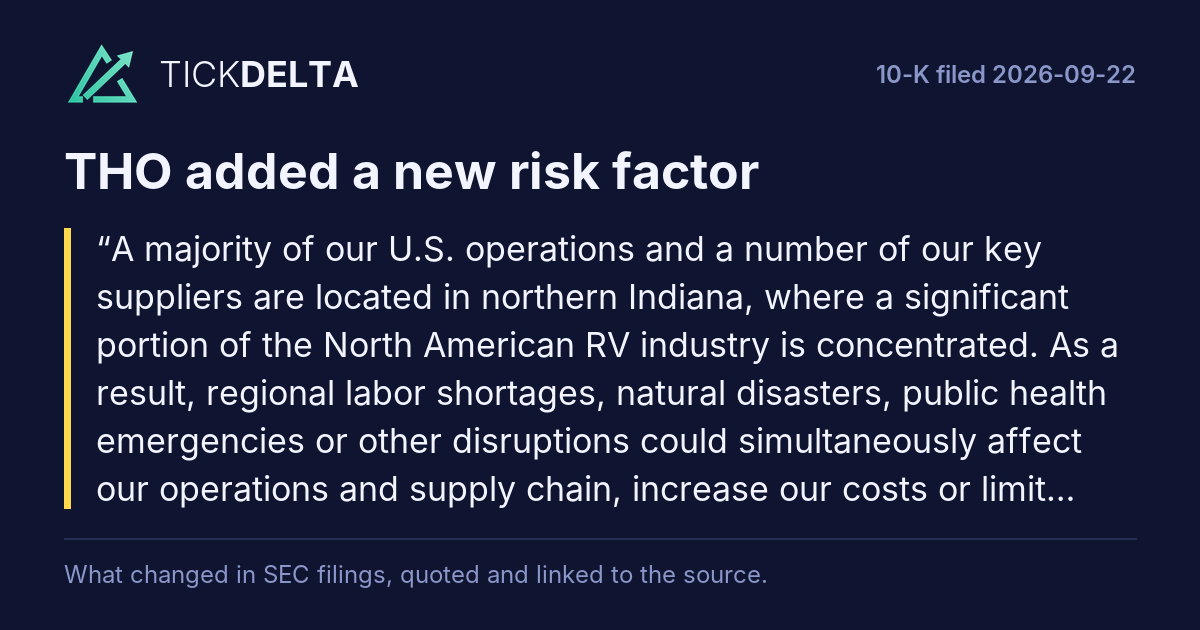
A majority of our U.S. operations and a number of our key suppliers are located in northern Indiana, where a significant portion of the North American RV industry is concentrated. As a result, regional labor shortages, natural disasters, public health emergencies or other disruptions could simultaneously affect our operations and supply chain, increase our costs or limit our ability to respond to changes in demand, which could adversely affect our results of operations.
Natural disasters and adverse weather conditions could adversely affect our operations and financial results.
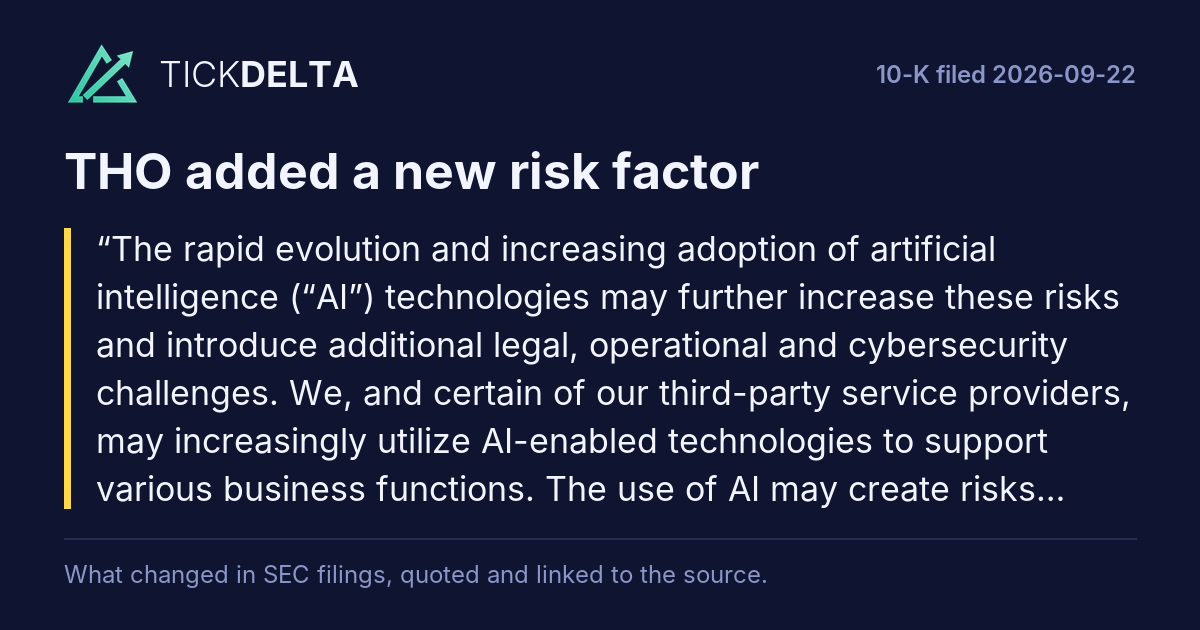
The rapid evolution and increasing adoption of artificial intelligence (“AI”) technologies may further increase these risks and introduce additional legal, operational and cybersecurity challenges. We, and certain of our third-party service providers, may increasingly utilize AI-enabled technologies to support various business functions. The use of AI may create risks associated with inaccurate, incomplete or biased outputs; unauthorized disclosure of confidential, proprietary or personal information; infringement or misappropriation of intellectual property rights; cybersecurity vulnerabilities and evolving regulatory requirements governing the development, deployment and use of AI technologies. In addition, third-party AI tools and service providers may not operate in accordance with our expectations or applicable legal and regulatory requirements, and we may have limited visibility into or control over their development, training methodologies, security practices or use of data.
As AI technologies continue to evolve, existing and new laws, regulations and industry standards governing AI, automated decision-making, transparency, accountability and data usage may impose additional compliance obligations, require changes to our business practices or increase our operating costs. Although we may establish governance frameworks, policies, employee training and other controls designed to promote the responsible use of AI technologies, these measures may not prevent misuse, unauthorized use, inaccurate outputs, regulatory noncompliance or other unintended consequences. Any actual or perceived failure to appropriately govern the use of AI technologies by us or our third-party providers could adversely affect our operations, financial condition, reputation or results of operations.
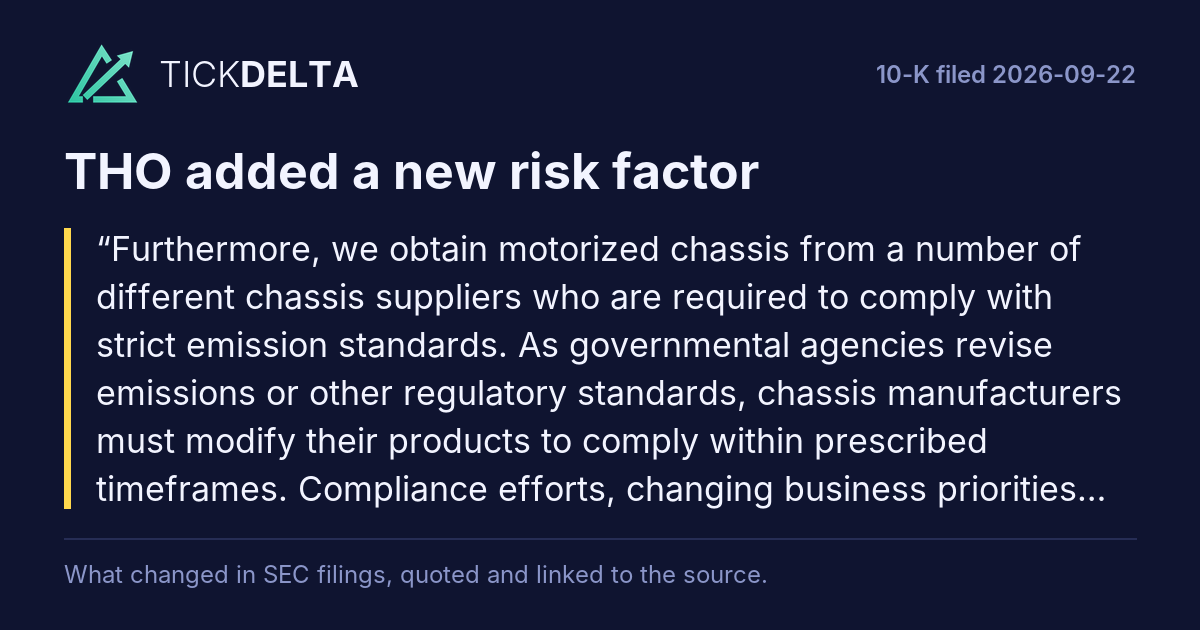
Furthermore, we obtain motorized chassis from a number of different chassis suppliers who are required to comply with strict emission standards. As governmental agencies revise emissions or other regulatory standards, chassis manufacturers must modify their products to comply within prescribed timeframes. Compliance efforts, changing business priorities or strategic decisions by chassis manufacturers could delay the introduction of compliant chassis, reduce available production capacity, limit the types or variety of chassis offered to the recreational vehicle industry or increase chassis costs. In the past, certain chassis manufacturers have experienced challenges meeting regulatory requirements or supplying sufficient quantities of compliant chassis. Changes to chassis specifications or product offerings may also require modifications to our engineering, manufacturing and production processes, resulting in additional costs, production inefficiencies or delays. If chassis manufacturers discontinue or reduce production of chassis used in our products, limit the availability of certain chassis configurations or significantly increase prices, we may incur additional costs, experience production disruptions or be unable to offer certain products, which could materially adversely affect our net sales, results of operations, cash flows and financial condition.
Evolving stakeholder expectations and regulatory requirements relating to environmental, social and governance matters could adversely affect our business.
We are subject to increasing expectations from investors, consumers, employees, regulators and other stakeholders regarding environmental stewardship, social responsibility, corporate governance, business ethics and other sustainability-related matters. These expectations continue to evolve and may differ among stakeholder groups and jurisdictions. Failure to appropriately manage or communicate these matters, comply with applicable regulatory requirements or meet evolving stakeholder expectations could adversely affect our reputation, employee recruitment and retention, access to capital and operating results. For example, our RV products are powered by gasoline and diesel engines or are required to be towed by gasoline or diesel-powered vehicles. Government policies, evolving regulatory requirements, consumer preferences, investor expectations and broader market developments relating to environmental matters may affect demand for our products, increase compliance costs, influence access to capital or require changes to our products, operations or supply chain.
Various investors, customers, lenders, employees, regulators and other stakeholders may evaluate our environmental, social and governance practices using differing standards, methodologies or expectations. These expectations may continue to evolve and may differ across jurisdictions or stakeholder groups. Failure to satisfy these evolving expectations, or differences between our practices and external stakeholder expectations, could adversely affect our reputation, customer and business relationships, ability to attract and retain employees, access to capital and results of operations.
We may be unable to adequately protect our intellectual property, and third parties may assert that our products or technologies infringe their intellectual property rights.
Our brands, trade names, trademarks, patents and other proprietary rights are important to our business, and we rely on a combination of intellectual property registrations, contractual protections and enforcement actions to protect them. These measures may not be adequate to prevent infringement, dilution or other unauthorized use of our intellectual property, and enforcing our rights can be costly, time-consuming and ultimately unsuccessful, particularly in jurisdictions where legal protections are less robust. Failure to adequately protect our intellectual property could diminish the value of our brands and adversely affect our competitive position and results of operations.
In addition, third parties have asserted, and may in the future assert, claims that our products, components or technologies infringe their patents or other intellectual property rights. As our products increasingly incorporate connectivity, software and other digital technologies, we may also receive demands to license patents, including patents claimed to be essential to industry technology standards. Defending against these claims, regardless of merit, can be costly and divert management attention, and an adverse outcome could require us to pay damages or ongoing royalties, cease manufacturing or selling certain products, redesign products or components or obtain licenses on unfavorable terms, any of which could adversely affect our business, financial condition and results of operations.
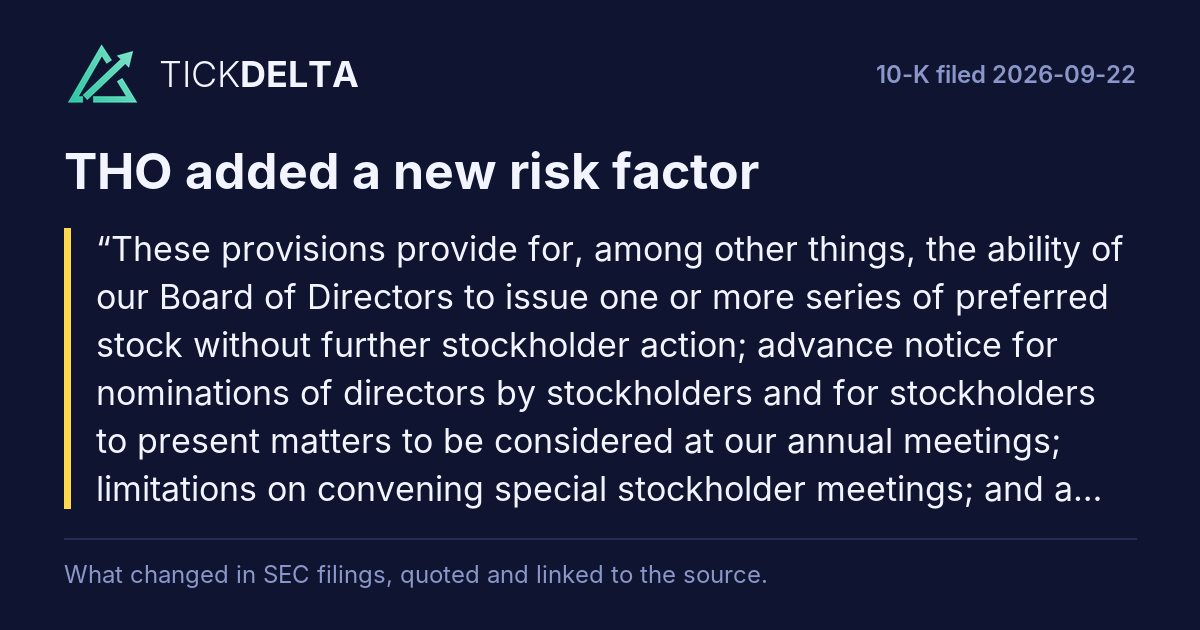
These provisions provide for, among other things, the ability of our Board of Directors to issue one or more series of preferred stock without further stockholder action; advance notice for nominations of directors by stockholders and for stockholders to present matters to be considered at our annual meetings; limitations on convening special stockholder meetings; and a requirement that a director may be removed without cause, and that certain “business combinations” not approved by 75% of the directors then in office may be approved, only by the affirmative vote of the holders of 75% of our shares entitled to vote generally in the election of directors, voting as a single class. In addition, Section 203 of the Delaware General Corporation Law prohibits us from engaging in a “business combination” with an “interested stockholder” for three years after the time at which a person became an interested stockholder unless certain conditions are met.
These provisions could discourage, delay or prevent a third party from acquiring us or otherwise discourage transactions that stockholders may consider favorable. As a result, these provisions could limit opportunities for our stockholders to receive a premium for their shares.
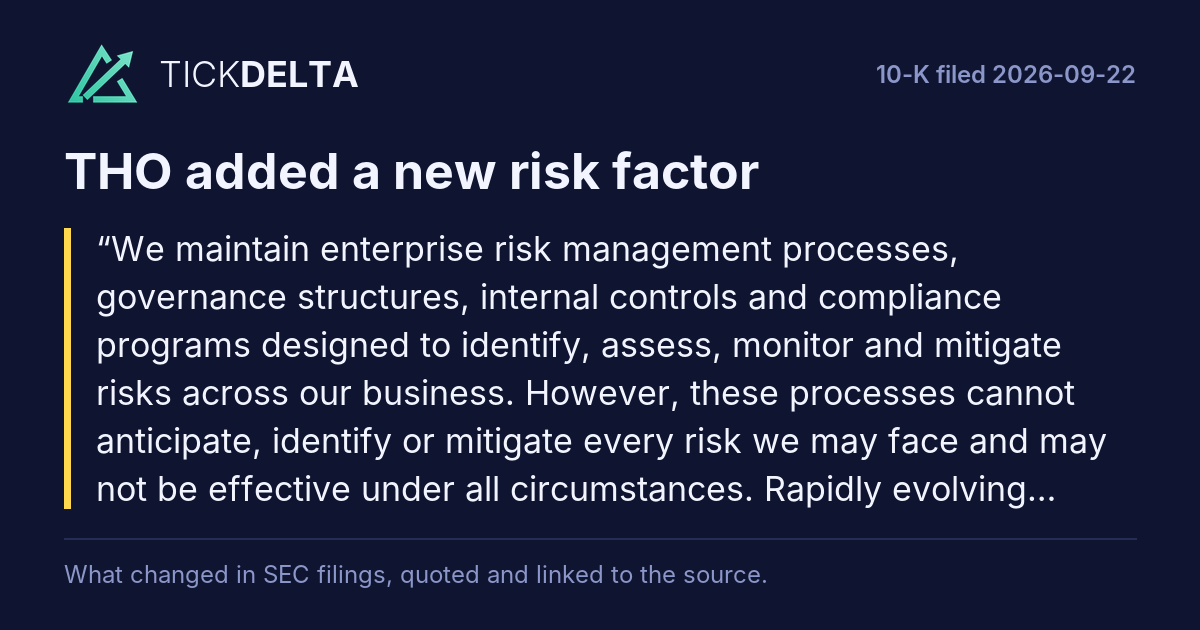
We maintain enterprise risk management processes, governance structures, internal controls and compliance programs designed to identify, assess, monitor and mitigate risks across our business. However, these processes cannot anticipate, identify or mitigate every risk we may face and may not be effective under all circumstances. Rapidly evolving business conditions, emerging technologies, changes in laws and regulations, human error, misconduct by employees or third parties, or other unforeseen events may expose us to risks that are unidentified, underestimated or inadequately managed. If our enterprise risk management processes fail to identify or appropriately respond to material risks in a timely manner, our business, financial condition, results of operations or reputation may be adversely affected.
Paragraphs in the 10-Q filed Jun 3, 2026 that were not in the one before
New in the latest 10-Q
6 paragraphs in the 10-Q filed Jun 3, 2026 with nothing like them in the 10-Q filed Mar 3, 2026 (at least half the words must differ; new numbers alone do not count). Quoted exactly, grouped by the item heading above them. This is text that changed, not a judgement of how serious it is.
Financial statements and notes
Since the date of the last annual impairment test performed as of May 31, 2025, the Company’s stock price has fluctuated and continues to trade at moderately lower prices compared to recent periods. We considered the fluctuation in share price in conjunction with other factors and do not believe that the current events and circumstances indicate that it is more likely than not that the fair value of any reporting unit is less than its respective carrying value. Since our last annual impairment test, the financial performance of certain reporting units with a smaller amount of excess fair value exceeding carrying value has generally tracked to expectations. Long-term expected financial performance has not changed for these reporting units. Additionally, cost saving measures have been implemented or are planned.
Read in the 10-Q
In addition to the VIE investments discussed above, at April 30, 2026 the Company holds additional immaterial investments accounted for under the equity method of accounting that are not VIEs. These are also reported as components of Equity investments in the Condensed Consolidated Balance Sheets.
Read in the 10-Q
Nonetheless, we have taken and continue to take a number of affirmative steps. We are actively engaging our vendors regarding the timing and extent of any tariff pass-through costs, including challenging pass-through charges that we believe are not properly supported, and, where possible, are sourcing alternative supply from lower-priced components. With respect to tariffs imposed under the International Emergency Economic Powers Act, we have filed refund claims with U.S. Customs and Border Protection for tariffs we paid as the importer of record and are pursuing recovery from third-party vendors that passed tariff costs through to us on imports for which they were the importer of record. The ultimate amount and timing of any refunds or supplier recoveries remain uncertain and will depend on the resolution of the matters described above, including the implementation of the Supreme Court’s February 2026 decision, related agency and judicial proceedings, and the outcome of our discussions with vendors.
Read in the 10-Q
The decreases in gross profit and the gross profit percentage were primarily due to unfavorable changes in North American Towable and European product mix toward lower-margin products in addition to absorbing increased material costs in the current-year period as compared to the prior-year period.
Read in the 10-Q
The slight increase in Selling, general and administrative expenses included consistent total compensation costs as increased deferred compensation costs were essentially offset by a reduction in employee separation costs and lower incentive compensation costs in the current period. Sales-related travel, advertising and promotional costs increased modestly in correlation with the net sales increase and legal and professional fees increased as well.
Read in the 10-Q
Show the other 1
Goodwill is not amortized but is tested for impairment annually as of May 31 of each fiscal year and whenever events or changes in circumstances indicate that an impairment may have occurred. For the Company’s May 31, 2025 annual impairment test, certain reporting units showed fair value exceeding carrying value by less than 25%. The aggregate value of goodwill in these reporting units is approximately 75% of the Company’s consolidated goodwill balance. Fair values are determined using discounted cash flow models, and these estimates are subject to significant management judgment, including the determination of many factors and inputs such as, but not limited to, sales growth rates, gross margin patterns, cost growth rates, terminal value assumptions and discount rates developed using market observable inputs and consideration of risk regarding future performance. Market multiples derived from selected guideline public companies are also utilized to evaluate the discounted cash flow models. Changes in any of these estimates can have a significant impact on the determination of fair value. Extended unfavorable macro-economic impacts such as extended global conflict, increased fuel prices or limitations on the availability of fuel, tariffs, higher interest rates, and/or deteriorating consumer confidence, along with other factors outside the Company’s control, such as decreases in dealer and end consumer demand, changes in consumer preferences or unexpected competition, could negatively impact the current and future performance of the reporting units and have a significant impact on estimated fair values. Changes in any of these estimates or other factors could potentially result in future material impairments in one or more of the Company’s reporting units. See Note 7 to the Condensed Consolidated Financial Statements for further information regarding goodwill and intangible assets.
Read in the 10-Q
The 10-Q's risk factors against the 10-K
Item 1A of the 10-Q filed Jun 3, 2026 against Item 1A of the 10-K filed Sep 24, 2025.
A 10-Q repeats only the risks that changed, so a 10-K paragraph that is missing from it is not counted as removed.
Added is a paragraph with nothing like it in the 10-K, Reworded a sentence that is in both with several words changed,
Quiet changes a sentence in both where one to four words changed and one is a hedge or a modal
(cut words struck through, new words highlighted).
Text on the page, not a score; each links to the filing at sec.gov.
Phrases used for the first time
Two-word phrases in Risk Factors of the 10-K filed Sep 22, 2026 that are in none of the 1 earlier 10-Ks stored, back to Sep 24, 2025
Where each one is used
- intellectual property: The rapid evolution and increasing adoption of artificial intelligence (“AI”) technologies may further increase these risks and introduce additional legal, operational and cybersecurity challenges. We, and certain of our third-party service providers, may increasingly utilize AI-enabled technologies to support...
- recent past: Due to the anticipated long-term interest in the RV lifestyle, a number of start-up companies in North America, and certain automotive manufacturers, in both North America and Europe, have in the recent past entered the RV industry and introduced products that directly compete with our products. If existing or new...
- evolving regulatory: A key driver of our historical performance and growth has been our ability to maintain strong brands and develop and introduce innovative products at competitive costs that meet evolving consumer demand. Technological advances, changing consumer preferences and evolving governmental regulations may require us to...
- require changes: In addition, increased restrictions have been, and may in the future be, imposed on various products and chemicals utilized in the production of our vehicles. These include a class of chemicals known as per- and polyfluoroalkyl substances ("PFAS") and products containing, or capable of releasing, formaldehyde. PFAS...
- third-party technology: We and others within the RV industry, including suppliers, dealers, cloud service providers, software vendors, managed service providers and other third-party technology providers, have been the target of cyber-attacks in the past, and such attacks are expected to continue and evolve in the future. While we...
- technology providers: We and others within the RV industry, including suppliers, dealers, cloud service providers, software vendors, managed service providers and other third-party technology providers, have been the target of cyber-attacks in the past, and such attacks are expected to continue and evolve in the future. While we...
- attract develop: Our success depends on our ability to attract, develop and retain qualified employees and key management personnel.
- property rights: The rapid evolution and increasing adoption of artificial intelligence (“AI”) technologies may further increase these risks and introduce additional legal, operational and cybersecurity challenges. We, and certain of our third-party service providers, may increasingly utilize AI-enabled technologies to support...
Used at least twice, small words left out. Counted, not picked: a phrase can be new because the company renamed something.
What was taken out
39 paragraphs of last year's Risk Factors with nothing like them now. The longest are quoted.
Sources
Item 1A of each 10-K and 10-Q on EDGAR, quoted exactly. Each paragraph links to the filing at sec.gov.
Also
10-K change: what was reworded or cut, section by section.
Work with it
Excel workbook · CSV. Google Sheet that stays up to date: paste =IMPORTDATA("https://tickdelta.com/company/THO/export.csv") into a cell.