Trinet Group, Inc. TNET
New risk paragraphs, branching off last year
Each branch is a paragraph in Risk Factors with nothing like it in the 10-K filed Feb 13, 2025. A box jumps to the paragraph as filed, below.
Paragraphs with nothing like them in last year's 10-K
14 paragraphs in Risk Factors of the 10-K filed Feb 12, 2026 with nothing like them in the 10-K filed Feb 13, 2025. Quoted exactly. Paragraphs that were only edited are under 10-K change.
Additionally, trade policies, including tariffs or other export or import restrictions, laws, and regulations, could directly or indirectly have a material adverse effect on our customers' businesses, as well as result in economic uncertainty and downturn more generally. For example, increased tariffs or other export or import restrictions, laws, and regulations, or even uncertainty with respect to such increases, could result in cost inflation or supply chain disruption, which could in turn result in companies reducing payroll expenses, delaying hiring or ceasing hiring practices, or cutting jobs. In addition, an economic downturn could result in a weakening of the market for our services as a result of fewer new companies being formed or funded, as well as a reluctance of companies to spend on PEO or ASO services. The results of any of these could negatively impact our revenue, as well as our ability to grow and retain clients, which could have a material adverse effect on our business, financial condition and results of operations.
To satisfy client expectations and regulatory requirements, we must timely and effectively identify and develop, or license and contract appropriate technologies and services, and incorporate such technologies and services into the solutions that we provide. We generally have limited visibility into the operations, strategies and future business plans of our customers, which stem from a variety of different industries and segments of the economy. Accordingly, it may be difficult to anticipate trends and tailor our services to our clients' evolving expectations, which could negatively affect our financial condition and results of operations.
•unforeseen liabilities or litigation resulting from the activities of the acquired business,
The market for our solutions is characterized by rapid technological advancements such as AI, including without limitation, AI systems performing the roles historically allocated to human HR resources, changes in customer requirements, frequent new product introductions and enhancements, and changing industry standards. To maintain our growth strategy, we must adapt and respond to technological advances and technological requirements of our clients, including leveraging AI in our solutions. For example, we have been developing TriNet Assistant, which we expect to launch in 2026, an AI HR tool where customers will be able to ask and receive responses to a broad spectrum of HR questions. There can be no assurances, however, that the leveraging of AI within our solutions will be successful. Our competitors and other third parties may incorporate AI into their products and offerings more quickly or more successfully than us, which could impair our ability to compete effectively, cause us to lose some or all of our investments in developing these solutions, and adversely affect our results of operations. Additionally, if the content, analyses, or recommendations that AI applications assist in producing are, or are alleged to be, inaccurate, deficient, or biased, our business, financial condition, and results of operations may be adversely affected. Further, the use of AI applications may result in cybersecurity incidents that implicate the personal data of customers analyzed within such applications. Any such cybersecurity incidents related to our use of AI applications to analyze personal data could adversely affect our reputation and results of operations.
We believe that providing insights and content from data, including AI and ML, will become increasingly important to the value that our solutions and services deliver to our clients are exploring how best to integrate generative AI technologies and develop and deploy capabilities that are beneficial to our clients and WSEs. In recent years, legislation that creates obligations with respect to the development and/or use of AI has been adopted or is under
Show the other 4
•cause us to modify how we earn interest from client funds, which could reduce the income we earn from those funds,
•a reduction in the number of WSEs employed by or a reduction in WSE hiring by existing clients,
•the overall performance of the equity markets, our competitors or our common stock,
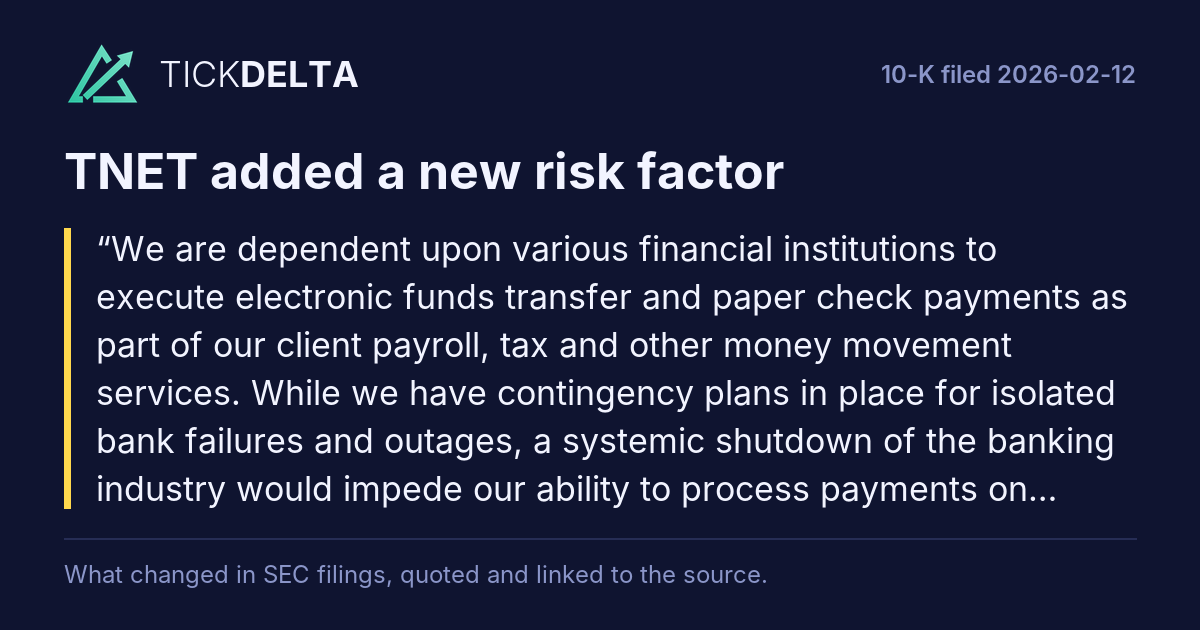
We are dependent upon various financial institutions to execute electronic funds transfer and paper check payments as part of our client payroll, tax and other money movement services. While we have contingency plans in place for isolated bank failures and outages, a systemic shutdown of the banking industry would impede our ability to process payments on behalf of our payroll, tax and other money movement services to clients and could have an adverse impact on our financial results and liquidity.
Our interest earned on funds held for clients may be impacted by changes in government regulations mandating the amount of tax withheld or timing of remittance or by political, economic or social factors.
We invest funds collected for clients but not yet remitted to applicable tax or regulatory agencies or to client employees in 2a-7 money market mutual funds and other cash equivalents. Nevertheless, such investments are subject to general market, interest rate, credit and liquidity risks. These risks may be exacerbated, individually or together, during periods of unusual financial market volatility.
We receive interest income from these invested client funds. A change in regulations either decreasing the amount of taxes to be withheld or allowing less time to remit taxes to applicable tax or regulatory agencies could adversely impact our interest income. Our failure to properly or timely remit taxes on behalf of our clients could result in fines, penalties and interest for which we could be responsible, and could material adversely affect our reputation, results of operation or financial condition.
Change in our credit ratings could adversely impact our results of operations and lower our profitability.
The Nationally Recognized Statistical Rating Organizations periodically evaluate our creditworthiness. Our credit ratings depend on our performance and can also be impacted by events beyond our control, such as macroeconomic and/or political factors of the U.S. and global economy. Failure to maintain our credit ratings could increase the cost of short-term borrowing which would lower our profitability, reduce our ability to obtain short-term borrowing periodically required by our business, and adversely impact our competitive position, results of operations, and financial condition.
Paragraphs in the 10-Q filed Oct 29, 2026 that were not in the one before
New in the latest 10-Q
10 paragraphs in the 10-Q filed Oct 29, 2026 with nothing like them in the 10-Q filed Jul 30, 2026 (at least half the words must differ; new numbers alone do not count). Quoted exactly, grouped by the item heading above them. This is text that changed, not a judgement of how serious it is.
10-Q
• repurchased approximately 2 million shares of our common stock through our existing stock repurchase program, and
Read in the 10-Q
Three Months Ended September 30, Nine Months Ended September 30, % Change 2026 2025 2026 2025 Q3 2026 YTD 2026
Read in the 10-Q
+4 S&M increased primarily due to higher compensation expenses as we continue to invest in our sales capacity.
Read in the 10-Q
+2 SD&P increased primarily due to higher compensation expenses as we continue to invest in our platform.
Read in the 10-Q
+1 D&A increased primarily to fixed asset and software additions as well as amortization of intangible assets from the recent Cocoon acquisition
Read in the 10-Q
Show the other 5
+4 S&M increased primarily due to higher compensation expenses as we continue to invest in our sales capacity.
Read in the 10-Q
+3 D&A increased primarily to fixed asset and software additions as well as amortization of intangible assets from the recent Cocoon acquisition.
Read in the 10-Q
-3 IE decreased due to lower outstanding debt balances during 2026 as a result of the 2025 paydown of the balance of our 2021 Credit Agreement.
Read in the 10-Q
respect to these matters, which are individually and in aggregate immaterial to our condensed consolidated financial statements.
Read in the 10-Q
On September 9, 2026, Paul Chamberlain, a member of the Board of Directors, adopted a new written trading plan intended to satisfy the affirmative defense conditions of Rule 10b5-1(c) under the Exchange Act (the “Chamberlain Plan”). The first possible trade date under the Chamberlain Plan is December 9, 2026, and the end date of the Chamberlain Plan is November 15, 2027 (subject to customary exceptions), for a duration of approximately one year. The aggregate number of shares currently expected to be sold pursuant to the Chamberlain Plan is 2,400.
Read in the 10-Q
The 10-Q's risk factors against the 10-K
Item 1A of the 10-Q filed Oct 29, 2026 against Item 1A of the 10-K filed Feb 12, 2026.
A 10-Q repeats only the risks that changed, so a 10-K paragraph that is missing from it is not counted as removed.
Added is a paragraph with nothing like it in the 10-K, Reworded a sentence that is in both with several words changed,
Quiet changes a sentence in both where one to four words changed and one is a hedge or a modal
(cut words struck through, new words highlighted).
Text on the page, not a score; each links to the filing at sec.gov.
This 10-Q has no Item 1A (Risk Factors) text of its own, so there is nothing to compare. Many companies leave it out when their risks have not changed.
Phrases used for the first time
Two-word phrases in Risk Factors of the 10-K filed Feb 12, 2026 that are in none of the 1 earlier 10-Ks stored, back to Feb 13, 2025
Where each one is used
- revolving credit: Our revolving credit facility and the indentures governing the 2029 Notes and the 2031 Notes contain, and any future indebtedness of ours would likely contain, a number of restrictive covenants that impose significant operating and financial restrictions on us subject to customary exceptions, including restricting...
- credit ratings: Change in our credit ratings could adversely impact our results of operations and lower our profitability.
- expected insurance: Under our risk-based health insurance policies, which make up the majority of our health plans and claims paid in 2025, we assume the risk of variability in future health claims costs for our enrollees and do not influence the use of covered services by enrollees, other than through the structural terms of such...
- global pandemic: Under our risk-based health insurance policies, which make up the majority of our health plans and claims paid in 2025, we assume the risk of variability in future health claims costs for our enrollees and do not influence the use of covered services by enrollees, other than through the structural terms of such...
- technological changes: SMBs can be particularly susceptible to changes in the level of overall economic activity in the markets in which they operate. These businesses are often exposed to credit and cash liquidity risks, including exposure as a result of the failure of their financial institutions, that larger businesses may be able to...
- import restrictions: Additionally, trade policies, including tariffs or other export or import restrictions, laws, and regulations, could directly or indirectly have a material adverse effect on our customers' businesses, as well as result in economic uncertainty and downturn more generally. For example, increased tariffs or other...
- restrictions laws: Additionally, trade policies, including tariffs or other export or import restrictions, laws, and regulations, could directly or indirectly have a material adverse effect on our customers' businesses, as well as result in economic uncertainty and downturn more generally. For example, increased tariffs or other...
- addition new: In addition, new services or upgrades may not be released according to schedule or may contain defects when released. If our new technologies and services perform poorly, or fail to satisfy regulatory requirements, we could experience client dissatisfaction, adverse publicity, loss of sales, and client claims...
Used at least twice, small words left out. Counted, not picked: a phrase can be new because the company renamed something.
What was taken out
18 paragraphs of last year's Risk Factors with nothing like them now. The longest are quoted.
Sources
Item 1A of each 10-K and 10-Q on EDGAR, quoted exactly. Each paragraph links to the filing at sec.gov.
Also
10-K change: what was reworded or cut, section by section.
Work with it
Excel workbook · CSV. Google Sheet that stays up to date: paste =IMPORTDATA("https://tickdelta.com/company/TNET/export.csv") into a cell.