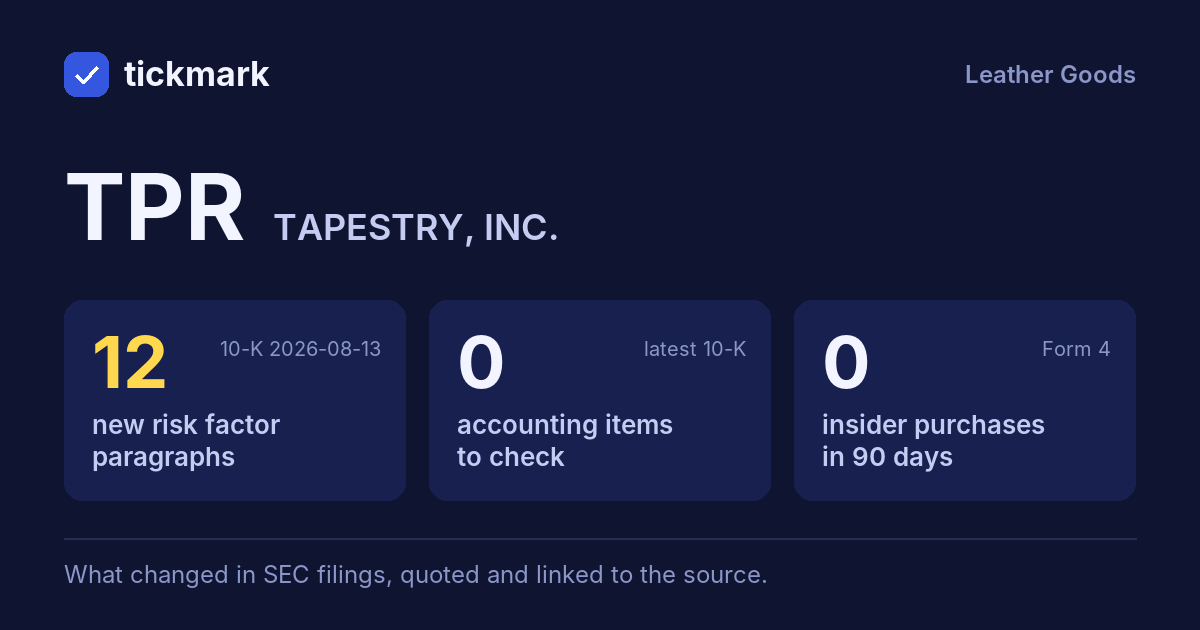
10-K 0001116132-26-000018 (2026-08-13) vs 10-K 0001116132-25-000019 (2025-08-14)
| Section | Compared text | Words now | Changed |
|---|
| Risk Factors | Item 1A | 12,557 |
18.1% |
| MD&A | Item 7 | 9,553 |
26.5% |
| Legal Proceedings | Item 3, via Note 13 – COMMITMENTS AND CONTINGENCIES | 527 |
15.2% |
| Accounting Policies | 10-K text, Note 3 – SIGNIFICANT ACCOUNTING POLICIES | 5,413 |
20.6% |
The redline: what was cut and what was added
In each section, the paragraph that changed most, marked against last year's 10-K:
cut words struck through, new words highlighted and underlined.
MD&A 212 words changed in this paragraph; it is 76% similar to last year's version.
On August 10, 2023, the Company entered into the Merger Agreement by and among the Company, Sunrise Merger Sub, Inc., a direct wholly owned subsidiary of Tapestry, and Capri. In order to finance the Capri Acquisition, on November 27, 2023, the Company issued $4.50 billion of U.S. dollar-denominated senior unsecured notes (the "Capri Acquisition USD Senior Notes") and €1.50 billion of Euro-denominated senior unsecured notes (the "Capri Acquisition EUR Senior Notes" and, together with the Capri Acquisition USD Senior Notes, the "Capri Acquisition Senior Notes") which, together with the $1.40 billion of delayed draw unsecured term loan facilities (the "Capri Acquisition Term Loan Facilities") executed on August 30, 2023, complete completed the expected financing for the Capri Acquisition. On April 22, 2024, the FTC filed a complaint against the Company and Capri in the United States District Court for the Southern District of New York seeking to enjoin the consummation of the Capri Acquisition, and on October 24, 2024, the Court issued its Opinion and Order granting the FTC's request for a preliminary injunction of the Merger, pending an administrative trial on the merits which was scheduled to begin on December 9, 2024. On October 28, 2024, the Company and Capri filed a Notice of Appeal with respect to the October 24, 2024 Opinion and Order. On November 6, 2024, the United States Court of Appeals for the Second Circuit entered an order setting an expedited briefing schedule for the appeal of the decision of the United States District Court of the Southern District of New York granting the preliminary injunction of the merger. On November 13, 2024, the Parties entered into a Termination Agreement (the “Termination Agreement”), pursuant to which the Parties agreed to terminate the Merger Agreement, including all schedules and exhibits thereto and all ancillary agreements contemplated thereby or entered pursuant thereto (the “Termination Date”), thereto, effective immediately. Pursuant to the Termination Agreement, the Company agreed to reimburse Capri for its expenses in an amount equal to $45.1 million in cash on November 14, 2024. The Parties also agreed to release each other from claims, demands, damages, actions, causes of action and liability relating to or arising out of the Merger Agreement and the transactions contemplated therein or thereby. Following termination of the Merger Agreement, the Parties and the FTC filed a stipulation withdrawing the appeal to the United States Court of Appeals for the Second Circuit on November 19, 2024 and the Second Circuit dismissed the appeal on November 20, 2024. The Parties and the FTC also filed a Joint Motion to dismiss the complaint in the administrative trial on November 15, 2024 and the FTC dismissed the complaint on December 4, 2024. On November 25, 2024, due to the termination of the Merger Agreement and pursuant to the terms of the indenture governing the Capri Acquisition Senior Notes, as supplemented, the Company redeemed all outstanding Capri Acquisition Senior Notes at a redemption price of 101% of the aggregate principal amount of such Capri Acquisition Senior Notes, plus accrued and unpaid interest to, but excluding, the date of redemption. In addition, the Capri Acquisition Term Loan Facilities were terminated concurrently with the execution of the Termination Agreement on November 13, 2024. Refer to Note 5, "Acquisitions and Divestitures" and Note 12, "Debt" for further information.
Source: Item 7, 10-K 0001116132-26-000018 vs Item 7, 10-K 0001116132-25-000019
Accounting Policies 202 words changed in this paragraph; it is 33% similar to last year's version.
In November 2023, September 2025, the Financial Accounting Standards Board (the "FASB") FASB issued Accounting Standards Update ("ASU") ASU No. 2023-07, "Segment Reporting (Topic 280): 2025-06, "Intangibles - Goodwill and Other - Internal-Use Software (Subtopic 350-40): Targeted Improvements to Reportable Segment Disclosures", the Accounting for Internal-Use Software", which expands reportable segment modernizes the accounting for the costs of software developed for internal use and clarifies related disclosure requirements, primarily through enhanced disclosures about significant segment expenses. requirements. The amendments remove all references to software development stages, requiring companies to start capitalizing software costs when (i) management has authorized and committed to funding the software project and (ii) it is probable that the project will require public entities be completed and the software will be used to disclose significant segment expenses that are regularly provided to perform the chief operating decision maker and included within segment profit and loss. function intended. The amendments will be effective for the Company's annual reporting periods beginning in fiscal year 2025 2029 and for interim periods beginning in within fiscal year 2026, with early 2029. Early adoption permitted, and will is permitted. The amendments may be applied retrospectively to all prior periods presented in the financial statements. either prospectively or retrospectively. The Company adopted is currently evaluating the ASU 2023-07 for fiscal year 2025. The adoption of ASU 2023-07 did not have an to determine its impact on the Company's its consolidated financial statements other than the new disclosure requirements. Refer to Note 17, "Segment Information", for additional information. and notes thereto.
Source: 10-K text, Note 3 – SIGNIFICANT ACCOUNTING POLICIES, 10-K 0001116132-26-000018 vs 10-K text, Note 3 – SIGNIFICANT ACCOUNTING POLICIES, 10-K 0001116132-25-000019
Risk Factors 191 words changed in this paragraph; it is 53% similar to last year's version.
On December 12, 2022, the E.U. member states also reached an agreement to implement the Organization for Economic Co-operation and Development’s (“OECD”) reform of international taxation known as Pillar Two Global Anti-Base Erosion Rules (“GloBE”), which broadly mirrors the Inflation Reduction Act by imposing a 15% global minimum tax on multinational companies, which was companies. These rules subject multinational companies to three possible tax mechanisms individually known as the Income Inclusion Rule (“IIR”), the Undertaxed Profits Rule (“UTPR”) and the Qualified Domestic Minimum Top-up Tax (“QDMTT”). The rules became effective on January 1, 2025. Based on the countries in which we do business, these rule changes did not have a material started to negatively impact the Company's effective tax rate beginning in fiscal 2025. Other countries are also implementing similar legislation with effective dates starting in fiscal 2026. On January 5, 2026, known as Qualifying Domestic Minimum Top-Up Tax ("QDMTT"). On June 26, 2025, the U.S. Treasury reached an agreement with the other G7 countries OECD published additional guidance regarding the application of GloBE rules to U.S. parented multinational enterprises ("U.S. MNEs"). Most notably, the agreement includes a full exclusion for excludes U.S. MNEs from the Undertaxed Profits Rule UTPR and Income Inclusion Rule, which are two of the three taxing mechanisms under GloBE. Given that the third mechanism, IIR; however, QDMTT is still in force, it is unclear what impact if any this agreement will have force based on current legislation. Based on the Company. Unless U.S. MNEs are likewise excluded from QDMTT, jurisdictions in which we operate and our current assessment of the Company believes QDMTT would have applicable rules, we do not expect these developments to result in a negative impact on its material increase to the Company's effective tax rate in fiscal 2026 and beyond. 2027 compared to fiscal 2026.
Source: Item 1A, 10-K 0001116132-26-000018 vs Item 1A, 10-K 0001116132-25-000019
Legal Proceedings 46 words changed in this paragraph; it is 90% similar to last year's version.
Following the previously disclosed termination of the proposed Merger Agreement, dated August 10, 2023, by and among the Company, Merger Sub and Capri, pursuant to which, among other things, Merger Sub would merge with and into Capri (the "Merger") with Capri surviving the Merger and continuing as a wholly owned subsidiary of the Company ("the Capri Acquisition") Acquisition"), two separate putative securities class actions were filed on December 23, 2024 and January 28, 2025, by plaintiff shareholders in the United States District Court for the District of Delaware against Capri and certain of its officers and against Tapestry and certain of its officers, alleging that during the respective class periods (between August 10, 2023 and October 24, 2024), Capri and Tapestry misrepresented and failed to disclose adverse facts about Capri’s business, operations, market dynamics, and the prospects for approval of the Capri Acquisition, which were known to defendants or recklessly disregarded by them. The complaints, which each allege violations of sections 10(b) and 20(a) of the Securities Exchange Act of 1934 and rule Rule 10b-5 promulgated thereunder, seek unspecified compensatory damages, costs and expenses, and equitable relief. On July 14, 2025, the Company moved to dismiss the complaint. On March 31, 2026, the United States District Court for the District of Delaware dismissed the complaint and claims without prejudice, and on April 30, 2026, the plaintiff shareholders filed an amendment. On June 15, 2026, the Company moved to dismiss the amended complaint. The Company intends to vigorously defend itself in these matters.
Source: Item 3, via Note 13 – COMMITMENTS AND CONTINGENCIES, 10-K 0001116132-26-000018 vs Item 3, via Note 13 – COMMITMENTS AND CONTINGENCIES, 10-K 0001116132-25-000019
Every change, by type
Sentences and paragraphs of TPR's Risk Factors and MD&A, 10-K 2026-08-13 against 10-K 2025-08-14.
Each links to the text at sec.gov.
AddedRisk Factors
On February 20, 2026, the U.S. Supreme Court ruled that tariffs collected under the International Emergency Economic Powers Act ("IEEPA") were invalid. The U.S. Court of International Trade subsequently ordered refunds for qualifying customs entries. CBP has established a phased administrative process for submitting refund claims for certain IEEPA tariffs. The Company paid approximately $117 million in IEEPA tariffs. During the fourth quarter of fiscal 2026, we received cash refunds related to the previously paid IEEPA tariffs of $2.1 million. In addition, as of June 27, 2026, we determined that the receipt of the remaining refunds of the previously paid IEEPA tariffs was probable. We estimate the amount of the probable refund to be $114.7 million, which was recorded as a receivable. Although the Company believes collection of the IEEPA tariffs is probable based on currently available information, the timing of cash receipts is dependent upon the execution of the refund process by the CBP and the U.S. Treasury Department.
Read it in 10-K 2026-08-13 at sec.gov ↗
AddedRisk Factors
Following the Supreme Court's decision, the U.S. Administration announced a 10% global tariff under Section 122 of the Trade Act of 1974 which became effective February 24, 2026, for a period of up to 150 days, which expired on July 24, 2026. On May 7, 2026, the CIT ruled the Section 122 tariffs were invalid. The government has appealed the ruling and the Company is awaiting a decision from the U.S. Court of Appeals. On July 23, 2026, the U.S. Administration announced the final remedy in
Read it in 10-K 2026-08-13 at sec.gov ↗
AddedRisk Factors
the Section 301 investigations relating to forced labor practices, imposing new tariff rates ranging from 10% to 12.5% on most imports from certain countries, effective upon the expiration of the temporary Section 122 tariffs.
Read it in 10-K 2026-08-13 at sec.gov ↗
AddedRisk Factors
The U.S. Supreme Court’s ruling did not impact any of the recently imposed tariffs, under either Section 122, Section 301, or Section 338 of the various trade statutes, nor does it prohibit the imposition of future tariffs through alternative trade authorities available to the U.S. administration. Accordingly, uncertainty with respect to tariffs remains ongoing, and U.S. import tariffs and international trade arrangements will continue to change, potentially without warning and to an extent or duration that is difficult to predict. Changing tariff rates and shifting trade policies have created significant uncertainty for suppliers, consumers, and us, and our efforts to mitigate the impacts of tariffs are time-consuming and costly and may not be effective. Our ability to navigate any uncertainty, changes or expansion in tariffs or other trade restrictions could have a material negative impact on our business, financial condition and results of operations. In addition, any negative perception of or sentiment towards the U.S., whether in response to changes in tariffs, trade policy or otherwise, could impact the perception of our Company.
Read it in 10-K 2026-08-13 at sec.gov ↗
AddedRisk Factors
We are also engaging in initiatives to harmonize the customer experience between our retail and outlet channels, by bringing select full price products into the outlet channel and enabling a single-cart checkout process for retail and outlet on our Coach brand e-commerce site. If we are unable to effectively execute our multi-channel strategy, along with our e-commerce and digital strategies, and provide reliable and unified experiences for our customers across all business channels and touchpoints, our reputation and ability to compete with other brands could suffer, which could adversely impact our business, results of operations and financial condition.
Read it in 10-K 2026-08-13 at sec.gov ↗
AddedRisk Factors
The successful implementation of the Company’s 2028 growth strategy, Amplify, is key to the long-term success of our business.
Read it in 10-K 2026-08-13 at sec.gov ↗
AddedRisk Factors
The Company introduced its 2028 growth strategy, Amplify, in the first quarter of fiscal 2026, which focuses on four key pillars: (i) Building Emotional Connections with Consumers; (ii) Fueling Fashion Innovation & Product Excellence; (iii) Delivering Compelling Experiences to Drive Global Growth; and (iv) Igniting the Power of Our People.
Read it in 10-K 2026-08-13 at sec.gov ↗
AddedRisk Factors
There is no assurance that we will be able to sustain such efforts in accordance with our plans, that such efforts will result in the intended or otherwise desirable outcomes or that such efforts, even if successfully sustained, will be effective in achieving long-term growth or increased profitability. Refer to Part II, Item 7, "Management's Discussion and Analysis of Financial Condition and Results of Operations" for further information regarding Amplify. If our incorporation of the initiatives under Amplify falls short, our business, financial condition and results of operations could be materially adversely affected.
Read it in 10-K 2026-08-13 at sec.gov ↗
AddedRisk Factors
The development, use, or misuse of AI technologies, and the failure to effectively adopt such technologies, may not be successful and could negatively impact our business.
Read it in 10-K 2026-08-13 at sec.gov ↗
AddedRisk Factors
We are increasingly integrating AI technologies, including generative AI and machine learning, across various aspects of our business, which presents evolving risks that may be difficult to predict or mitigate. AI technologies may produce inaccurate, biased, or unreliable outputs, cause or contribute to the violation of intellectual property rights, and may be prone to cybersecurity incidents or service interruptions. If our use of AI technologies produces deficient, inaccurate, controversial, or misleading outputs, or has other unintended consequences, we could be subject to legal liability, regulatory action, and competitive or reputational harm.
Read it in 10-K 2026-08-13 at sec.gov ↗
AddedRisk Factors
Use of AI by our employees or third-party service providers could increase the risk of exposure of our proprietary, confidential, sensitive or personal information. The use of AI or machine learning technologies by our third-party service providers in their business activities, whether or not known to us, could also expose us to risks, including use of AI tools in violation of agreements with us, use of unauthorized third-party data, inputting our valuable information into AI tools, or deployment of new AI tools without our approval, any of which may give rise to legal or regulatory violations, loss of IP rights, reputational harm, or issues relating to data privacy and data protection.
Read it in 10-K 2026-08-13 at sec.gov ↗
AddedRisk Factors
The regulatory landscape governing AI is rapidly evolving. Several jurisdictions around the globe, including the European Union and several U.S. states, have proposed or enacted laws governing AI, including the European Union AI Act and enacted or potential U.S. federal and state AI legislation. These obligations and restrictions may lead to regulatory fines or penalties for non-compliance, make it harder for us to conduct our business using AI, require us to change our business practices, or prevent or limit our use of AI. Further, we may be unable to quickly and successfully adapt to rapid change resulting from advancements in AI and similar technologies, or our competitors may have more success implementing and utilizing these technologies than we do, which could adversely affect our competitive position. Any of these factors could adversely affect our business, financial condition, and results of operations.
Read it in 10-K 2026-08-13 at sec.gov ↗
AddedMD&A
Tapestry, Inc. is a global house of iconic accessories and lifestyle brands uniting the magic of Coach and kate spade new york. Together, we stretch what’s possible – advancing brands further than they could go alone, expanding their reach to new geographies and generations. Inspired by our consumers, we create experiences and products that build lasting brand love and elevate everyday life.
Read it in 10-K 2026-08-13 at sec.gov ↗
AddedMD&A
•Build Emotional Connections with Consumers: The Company aims to drive new customer acquisition, with a focus on Gen Z consumers entering the market to build brand love and lifetime value.
Read it in 10-K 2026-08-13 at sec.gov ↗
AddedMD&A
•Ignite the Power of Our People: The Company aims to future-proof growth by continuing to develop a consumer-obsessed culture that is agile and always looking forward.
Read it in 10-K 2026-08-13 at sec.gov ↗
AddedMD&A
On February 20, 2026, the U.S. Supreme Court ruled that tariffs collected under the International Emergency Economic Powers Act ("IEEPA") were invalid. The U.S. Court of International Trade ("CIT") subsequently ordered refunds for qualifying customs entries, including applicable interest. U.S. Customs and Border Protection ("CBP") established a phased administrative process for submitting refund claims for certain IEEPA tariffs. The Company paid approximately $117 million in IEEPA tariffs. During the fourth quarter of fiscal 2026, the Company received cash refunds related to the previously paid IEEPA tariffs of $2.1 million, of which $2.0 million was recognized as a reduction to Cost of sales and $0.1 million as a reduction to Selling, general and administrative expenses. In addition, as of June 27, 2026, the Company applied the loss recovery model and determined that the receipt of the remaining refunds of the previously paid but not received IEEPA tariffs was probable. The
Read it in 10-K 2026-08-13 at sec.gov ↗
AddedMD&A
Company estimates the amount of the probable refund to be $114.7 million, of which $96.2 million was recognized as a reduction to Cost of sales, $9.5 million was recorded as Accrued liabilities and $9.0 million was applied as a reduction to tariffs that remained in Inventory.
Read it in 10-K 2026-08-13 at sec.gov ↗
AddedMD&A
Following the Supreme Court's decision, the U.S. Administration announced a 10% global tariff under Section 122 of the Trade Act of 1974 which became effective February 24, 2026, for a period of up to 150 days, which expired on July 24, 2026. On May 7, 2026, the CIT ruled the Section 122 tariffs were invalid. The government has appealed the ruling and the Company is awaiting a decision from the U.S. Court of Appeals. On July 23, 2026, the U.S. Administration announced the final remedy in the Section 301 investigations relating to forced labor practices, imposing new tariff rates ranging from 10% to 12.5% on most imports from certain countries, effective upon the expiration of the temporary Section 122 tariffs. The outlook for future trade policy remains uncertain. The Company continues to monitor these developments, assess their potential impact on its business and implement mitigation strategies where possible.
Read it in 10-K 2026-08-13 at sec.gov ↗
AddedMD&A
The conflict in the Middle East, which began during the third quarter of fiscal 2026, has contributed to heightened geopolitical uncertainty, including impacts to global supply chains and energy prices. The Company does not have directly operated stores in the Middle East and has a minimal distributor business which represented less than 1% of the Company’s total Net sales for fiscal 2026 and fiscal 2025. While the Company has not experienced a material impact to its operations or financial results, the Company continues to closely monitor the situation and the potential impact it may have on consumer sentiment in the Middle East and other geographies across the globe.
Read it in 10-K 2026-08-13 at sec.gov ↗
AddedMD&A
•IEEPA Tariff Refund - Total pre-tax income of $98.3 million related to recognized IEEPA tariff refunds which were related to products sold in fiscal 2026 net of estimated liabilities.
Read it in 10-K 2026-08-13 at sec.gov ↗
AddedMD&A
Effective in the first quarter of fiscal 2026, following the Stuart Weitzman Business Divestiture on August 4, 2025, the Company's reportable segments are Coach and Kate Spade. In fiscal 2026, prior to the completion of the sale on August 4, 2025, Stuart Weitzman Net sales were $14.6 million, Gross profit was $7.7 million and SG&A expenses were $8.7 million resulting in an Operating loss of $1.0 million. These results were considered as items affecting comparability in fiscal 2026. In fiscal 2025, Stuart Weitzman Net sales were $215.1 million, Gross profit was $118.4 million and SG&A expenses were $133.8 million resulting in an Operating loss of $15.4 million. Excluding items affecting comparability, Stuart Weitzman Net sales were $215.1 million, Gross profit was $118.4 million and SG&A expenses were $133.2 million resulting in an Operating loss of $14.8 million in fiscal 2025.
Read it in 10-K 2026-08-13 at sec.gov ↗
AddedMD&A
Items affecting comparability in the current or comparable periods, as applicable, include:
Read it in 10-K 2026-08-13 at sec.gov ↗
AddedMD&A
•IEEPA Tariff Refund - The Company recognized refunds of IEEPA tariffs which were related to products sold in fiscal 2026 net of estimated liabilities.
Read it in 10-K 2026-08-13 at sec.gov ↗
AddedMD&A
•Distribution Network Optimization Costs - The Company incurred Distribution Network Optimization Costs which consist of non-recurring costs, primarily related to optimizing its distribution centers. These costs mainly relate to the transition from our Ohio fulfillment center to a third-party facility in Pennsylvania.
Read it in 10-K 2026-08-13 at sec.gov ↗