tickdelta
Sign in

Tickdelta is free for now. Sign up and get Pro free

← Screener

TSNTyson Foods

Consumer staples · Meat Products · NYSE

Tyson Foods, Inc. and its subsidiaries (collectively, the “Company,” “we,” “us,” “our,” “Tyson Foods” or “Tyson”) (NYSE: TSN) is a world-class food company and recognized leader in protein. 10-K, Item 1

Employees
133,000
Headquarters
Springdale, AR
CEO
Donnie King
Next results
around Feb 1, 2027
Compare with peers → Embed

When the SEC's staff reviews a filing, it writes to the company with numbered questions, and the company answers each one in a letter. SEC publishes the exchange once the review is over, at least 20 business days later. Below: what the staff asked TSN, and the company's answer to each question, quoted from the letters. A question is not an accusation; most reviews end with the company adding detail to its next filing.

Form 10-K for the Fiscal Year Ended September 30, 2023

2024-02-22 to 2024-03-19 · 4 questions · 2 letters from the SEC, 2 from the company
Review closed 2024-03-19
Results discussion (MD&A)Liquidity and cashRevenueSegmentsLegal and contingencies
Management's Discussion and Analysis of Financial Condition and Results of Operations · Liquidity and Capital Resources, page 33
SEC asked (1)
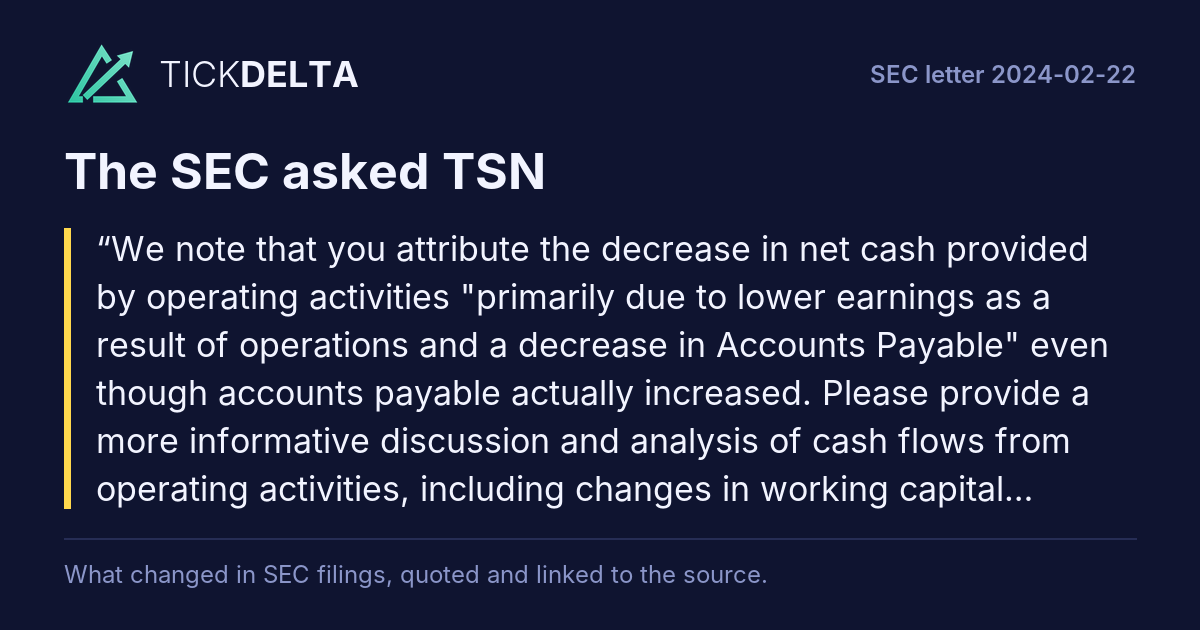
We note that you attribute the decrease in net cash provided by operating activities "primarily due to lower earnings as a result of operations and a decrease in Accounts Payable" even though accounts payable actually increased. Please provide a more informative discussion and analysis of cash flows from operating activities, including changes in working capital components, for the periods presented.
Rest of the question

In doing so, explain the underlying reasons and implications of material changes between periods to provide investors with an understanding of trends and variability in cash flows. Also ensure that your disclosures are not merely a recitation of changes evident from the financial statements. Please refer to Item 303(a) of Regulation S-K and SEC Release No. 33-8350.

TSN answered
In response to the Staff’s comment, the Company will continue to enhance its disclosure in future filings beginning with the Company’s quarterly report on Form 10-Q for the quarter ended March 30, 2024, as appropriate, to provide additional discussion of cash flows from operating activities, including material changes between periods and additional discussion of both the underlying reasons and implications underlying such changes.

Securities and Exchange Commission

With respect to the decrease in net cash provided by operating activities disclosed in our Form 10-K, cash provided by
Rest of the answer

operating activities decreased to $1,752 million in fiscal 2023 from $2,687 million in fiscal 2022. The primary drivers of the decrease were as follows:

•Lower earnings from operations - the Company had a net loss of $649 million in fiscal 2023 as compared to net income of $3,249 million in fiscal 2022. These amounts were partially offset by the impact of non-cash items in net income (loss) of $2,214 million and $1,542 million in fiscal 2023 and 2022, respectively.

•Decreased operating cash inflow from accounts payable - while accounts payable increased in fiscal 2023, as you noted, the resulting cash inflow of $47 million in fiscal 2023 was lower than the $302 million inflow in fiscal 2022, thus resulting in a decreased inflow of $255 million. This decrease was primarily due to lower raw material and feed ingredient costs at the end of fiscal 2023 as compared to the end of fiscal 2022 and spend management in response to lower earnings.

These decreases were partially offset by the following:

•Increased operating cash inflow from inventory – the Company had a cash outflow due to an increase in inventory of $1,195 million in fiscal 2022 compared to an inflow due to a decrease of inventory of $175 million in fiscal 2023, resulting in a net cash inflow change of $1,370 million. This increased inflow primarily related to inventory level management and the impact of lower raw material and feed ingredient commodity prices.

•Increased operating cash inflow from accounts receivable – the Company had a cash outflow due to an increase in accounts receivable of $176 million in fiscal 2022 compared to an inflow due to a decrease of accounts receivable of $136 million in fiscal 2023, resulting in a net cash inflow change of $312 million. This increased inflow was primarily due to the change in average sales price during the respective periods.

•Increased operating cash inflow due to a reduction in tax payments and annual incentives as a result of lower earnings, decreased legal payments and increased insurance proceeds received in fiscal 2023 as compared to fiscal 2022.

Read in the reply ↗
In its next report

First report after the company's reply of 2024-03-06: 10-Q filed 2024-05-06 ↗, against the 10-Q filed 2024-02-05 ↗.

Tickdelta does not hold the text of both reports, so they are not compared here.
Notes to Consolidated Financial Statements · Note 17: Segment Reporting, page 79
SEC asked (2)
We note that the net sales disclosed for your reportable segments are inclusive of intersegment sales. Please revise your presentation in future filings to disclose revenues from external customers for each reportable segment as required by ASC 280-10-5022(a). Show us what your revised net sales disclosures would have looked like for the historical periods presented.
Rest of the question

Also see the illustrative examples in ASC 280-10-55-48 and 55-49.

TSN answered
The Company acknowledges the Staff’s comment and respectfully submits that revenues from external customers for each reportable segment are included in the tables displaying disaggregated sales by major distribution channel contained in Note 17: Segment Reporting on page 82 of the Form 10-K. These tables, which are presented by segment, contain columns for sales to external customers disaggregated by the retail, foodservice, international, and industrial and other sales channels as well as a separate column for intersegment sales to disclose sales to non-external customers.
Rest of the answer

The tables present sales for fiscal years ended 2023, 2022 and 2021. For these reasons, the Company believes such presentation satisfies the requirements of ASC 280-10-50-22(a).

To provide more clarity, we will add “external” to the notes of the table associated with the retail, foodservice, international, and industrial and other columns of the table. See the proposed revision of our notes as follows (additional language is underlined):

(a)Includes external sales to consumer products and food retailers, such as grocery retailers, warehouse club stores, and internet-based retailers.

(b)Includes external sales to foodservice distributors, restaurant operators, hotel chains and noncommercial foodservice establishments such as schools, convenience stores, healthcare facilities and the military.

(c)Includes external sales to international markets related to internationally produced products or export sales of domestically produced products.

(d)Includes external sales to industrial food processing companies that further process our product to sell to end consumers and any remaining sales not included in the Retail, Foodservice or International categories. For fiscal 2023 and 2021, the Chicken segment included a $156 million and $545 million reduction in Other due to the recognition of legal contingency accruals, respectively.

Read in the reply ↗
In its next report

First report after the company's reply of 2024-03-06: 10-Q filed 2024-05-06 ↗, against the 10-Q filed 2024-02-05 ↗.

Tickdelta does not hold the text of both reports, so they are not compared here.

Note 20: Commitments and Contingencies, page 83
SEC asked (3)
Please address the following comments related to your contingencies: • We note your disclosure of several legal proceedings "for which the magnitude of the potential exposure could be material" to your financial statements.
Rest of the question

To the extent it is reasonably possible you will incur losses in excess of recorded accruals related to your contingencies, please provide the applicable disclosures required by ASC 45020-50-3 through -4, including the amount or range of reasonably possible losses in excess of recorded amounts. If an estimate of reasonably possible additional losses can be made and that amount, both for each individual matter and in the aggregate, is not material to your consolidated financial position, results of operations or cash flows, we will not object to a statement to that effect. Alternatively, if no amount of loss in excess of recorded accruals is believed to be reasonably possible, please state this in your disclosure. Although we recognize that there are a number of uncertainties and potential outcomes associated with loss contingencies, please note that ASC 450 does not require estimation of a reasonably possible range of loss with precision or certainty. • As noted on page 24 of your Form 10-Q for the quarterly period ended December 30, 2023, we note that you reached a proposed settlement of a wage rate litigation matter and recorded an accrual of $72.5 million. Please tell us how you determined an accrual was not necessary as of your September 30, 2023 fiscal year-end or, at a minimum, disclosure of the quantitative range of reasonably possible losses. Specifically discuss the events that transpired between your November 13, 2023 Form 10-K filing date and the December 22, 2023 settlement agreement date. In closing, we remind you that the company and its management are responsible for the accuracy and adequacy of their disclosures, notwithstanding any review, comments, action or absence of action by the staff.

TSN answered
The Company acknowledges the Staff’s comment and respectfully advises the Staff that, as described in the Company’s Form 10-K, for matters described that are probable and the financial impact is reasonably estimable, we have recorded accruals in the Company’s Consolidated Financial Statements. For matters for which an accrual is recorded, and the Company does not disclose a range above such accrual, the Company has concluded that the range of loss is not reasonably estimable.
Rest of the answer

Where the amount of loss is not probable, we have not recorded any accrual, and where the amount of loss or range of possible losses is not reasonably estimable, we have stated in our disclosure on Form 10-K that the amount of loss is not reasonably estimable.

The Company confirms its understanding of the point raised by the Staff in Comment 3 herein regarding the estimation of a reasonably possible range of loss. The Company also notes that we apply a similar analysis for matters where it is reasonably possible that the Company will incur losses in excess of recorded accruals related to reported contingencies. In response to the Staff’s comment, in future filings, as appropriate, for matters where an estimate of reasonably possible additional losses can be made and that amount, both for the individual matter and in the aggregate is not material to the Company’s consolidated financial position, results of operations or cash flows, the Company will state that fact. Alternatively, if the amount of loss in excess of recorded accruals or range of possible losses is not reasonably estimable, the Company will state that fact. To the extent it is reasonably possible the Company may incur losses in excess of recorded accruals, and an estimate of reasonably possible losses can be made and is material, we will provide the applicable disclosures noted in the Staff's comment.

•As noted on page 24 of your Form 10-Q for the quarterly period ended December 30, 2023, we note that you reached a proposed settlement of a wage rate litigation matter and recorded an accrual of $72.5 million. Please tell us how you determined an accrual was not necessary as of your September 30, 2023 fiscal year-end or, at a minimum, disclosure of the quantitative range of reasonably possible losses. Specifically discuss the events that transpired between your November 13, 2023 Form 10-K filing date and the December 22, 2023 settlement agreement date.

Response:

The Company acknowledges the Staff’s comment and respectfully advises the Staff that, as of September 30, 2023, no loss contingency accrual relating to the wage rate litigation matter was required in accordance with ASC 450 because the loss contingency was neither probable nor reasonably estimable at that time. In addition, a range of loss was not disclosed as it was not reasonably estimable.

Summary of Events Surrounding the Filing of the Form 10-K and the Proposed Settlement

The events leading up to and following the filing of our Form 10-K relating to the wage rate litigation are summarized below:

Prior to the filing of the Form 10-K

•On September 11, 2022, representatives of a putative class of employees at beef-processing and pork-processing plants in the United States filed a class action complaint against the Company and others in the United States District Court for the District of Colorado.

•On February 17, 2023, the Company filed a motion to dismiss the complaint.

•On September 27, 2023, the Court denied the Company’s motion to dismiss.

•On September 30, 2023, the Company’s fiscal year ended. The Company determined that a loss was not probable at this time because, despite the Court’s decision, the Company continued to believe that it had meritorious and valid arguments against class certification, and since the classes had not yet been defined or certified by the Court, the range of loss would not be reasonably estimable. Likewise, the Company continued to believe that it had meritorious and valid substantive defenses against the allegations that it could assert at summary judgment and at trial (see below).

•On November 3, 2023, the Company’s outside litigation counsel informed the Company that the plaintiffs had expressed interest in discussing a settlement and that they wanted to do so through a mediation. However, neither the Company nor the plaintiffs made a settlement offer at this time.

After the filing of the Form 10-K on November 13, 2023

•On November 15, 2023, the Company filed its answer to the complaint denying any liability. On this same day, the plaintiffs’ proposed mediator noted his availability for a possible mediation on December 12, 2023. The parties agreed to mediate on this date.

•On December 12, 2023, a mediation between the parties was held. The Company’s representatives did not seek or receive settlement authority based on the discussions during the mediation. The parties, however, continued their discussions through the mediator over the next week.

•On December 21, 2023, the mediator made a mediator’s proposal for the parties to settle at $72.5 million, and he provided the parties until 5:00 p.m. the next day to respond.

•On December 22, 2023, the Company’s CEO, believing that the settlement would be in the best interest of the Company and its shareholders, and understanding that it would avoid the uncertainty, risk, expense and distraction of protracted litigation, authorized the Company to accept the mediator’s proposal. Later that day, the mediator informed the Company that the plaintiffs had also accepted the mediator’s proposal.

•On February 5, 2024, the Company filed its Form 10-Q for the first quarter of fiscal 2024. As of the date of the filing of the Form 10-Q, the written settlement agreement had not yet been finalized. At this point, however, the Company believed that a loss in the amount of $72.5 million in this matter was probable and reasonably estimable, and therefore the Company recorded an accrual.

Analysis – No Accrual was Required and the Range of Loss was not Reasonably Estimable as of the Date of the Filing of the Form 10-K

As of both the fiscal year end, September 30, 2023, and the date of the filing of the Form 10-K on November 13, 2023, the Company was confident in its ability to defeat the lawsuit on the merits and believed that the evidence would show that the Company did not violate the antitrust laws with respect to the wages it paid to pork and beef plant workers during the alleged class period. Additionally, as a preliminary matter, the Company was confident that there was not a certifiable class for the litigation based on Wal-Mart Stores, Inc. v. Dukes, 564 U.S. 338 (2011), which directed trial courts to engage in a rigorous examination of evidence at the class certification stage to determine whether putative class plaintiffs could satisfy the requirements of Rule 23 of the Federal Rules of Civil Procedure. Like the putative class in the wage rate litigation, the proposed class in Dukes included a large number of lower-level employees holding different positions in different business locations across the country. As the Court explained—using words that the Company believes equally describe the wage rate litigation—“Here respondents wish to sue about literally millions of employment decisions at once. Without some glue holding the alleged reasons for all those decisions together, it will be impossible to say that examination of all the class members’ claims for relief will produce a common answer to the crucial question . . .”1 In Dukes, the Court determined that the plaintiffs’ experts had failed to provide the necessary “glue.”2 The same reasoning that applied in Dukes applies with equal force here, but even more so, because at the time of settlement, the wage rate litigation was still at the pleading stage. Accordingly, the Company did not yet know what expert analysis, if any, the plaintiffs would offer and to what segment of the proposed nationwide class, if any, it would apply.3 (“A regional pay disparity, for example, may be attributable to only a small set of Wal-Mart stores, and cannot by itself establish the uniform, store-by-store disparity upon which the plaintiffs’ theory of commonality depends.”). Based on the Court’s analysis in Dukes, the Company felt that it would have strong arguments to defeat class certification when the case reached the class certification stage.

As such, in line with the Company’s expectation that class certification would ultimately fail in this litigation matter—and that the Company would have meritorious substantive evidence to defeat the claims at summary judgment and at trial if a class were certified—the Company disclosed in its Form 10-K that “the Company has not recorded any liability for this matter as it does not believe a loss is probable or reasonably estimable at this time because the Company believes that it has valid and meritorious defenses against the allegations and because the case remains at the pleading stage and the classes have not yet been defined or certified by the court.” Although the Company was confident that the low end of the range was $0 at the time of the filing of the Form 10-K given these procedural and substantive arguments, the high end of the range was not reasonably estimable because of the uncertainty around (1) what losses, if any, might be probable by any individual plaintiffs that chose to proceed following a failure of class certification; and (2) the size and scope of any class that might be certified following a partial failure of class certification, and the amount of loss that such a partial class might be able to prove. For example, the Company could have been subject to lawsuits from various individual plaintiffs, and there could have been negotiated settlements or judgments with certain sub-classes, depending on how the plaintiffs proceeded in the event the class certification was denied in whole or in part. In arriving at the conclusion that no accrual amounts should be recorded, the Company also considered the guidance of ASC 450-20-30 that “when no amount within the range is a better estimate than any other amount, however, the minimum amount in the range shall be accrued.” Accordingly, the Company believes that it appropriately concluded that no accrual for this matter was required in its Form 10-K for fiscal year ended September 30, 2023.

1 Wal-Mart Stores, Inc. v. Dukes, 564 U.S. 338 (2011) at 352.

2 Id. at 356.

3 See id. at 357

As was described above, the Company’s settlement was reached as a result of mediation that had not been contemplated as of the end of fiscal year 2023, and was not scheduled until after the filing of the Company’s Form 10-K. As noted in the summary, the mediation did not commence until December 12, 2023, and the Company and plaintiffs only agreed to an in-principle settlement as of December 22, 2023. Therefore, the loss contingency was not probable or reasonably estimable until after the date of the filing of the Form 10-K.

* * * *

If you have any additional questions or comments, please do not hesitate to contact me or Adam Deckinger, General Counsel and Secretary, at (479) 290-5463.

Read in the reply ↗
In its next report

First report after the company's reply of 2024-03-06: 10-Q filed 2024-05-06 ↗, against the 10-Q filed 2024-02-05 ↗.

Tickdelta does not hold the text of both reports, so they are not compared here.

Note 17: Segment Reporting, page 79
SEC asked
We note your response to comment 2 indicates that "revenues from external customers for each reportable segment are included in the tables displaying disaggregated sales by major distribution channel." Although we acknowledge that investors are able to recalculate each reportable segment's revenues from external customers based on the information provided, it is unclear how the current presentation meets the
Rest of the question

explicit disclosure requirement of ASC 280-10-50-22(a). As the combined revenue presentation in your table on page 81 is not an ASC 280 disclosure requirement, please revise your presentation in future filings to separately disclose revenues from external customers for each reportable segment.

TSN answered
The Company acknowledges the Staff’s comment and respectfully submits that we will add a column labeled “Total External Customers” to the tables displaying disaggregated sales by segment and major distribution channel contained in our Segment footnote. See the proposed changes to our tables from Note 17: Segment Reporting on page 82 of the Form 10-K, which will be reflected similarly in future filings (additional language is underlined):

Securities and Exchange Commission

Twelve months ended September 30, 2023

Retail(a)

Foodservice(b)

International(c)

Industrial and Other(d)

Total
Rest of the answer

External Customers Intersegment Total Sales

Beef $ 8,947 $ 4,839 $ 2,633 $ 2,395 $ 18,814 $ 511 $ 19,325

Pork 1,677 477 1,235 1,338 4,727 1,041 5,768

Chicken 7,483 6,589 1,007 1,901 16,980 80 17,060

Prepared Foods 5,795 3,690 213 147 9,845 — 9,845

International/Other — — 2,515 — 2,515 — 2,515

Intersegment — — — — — (1,632) (1,632)

Total $ 23,902 $ 15,595 $ 7,603 $ 5,781 $ 52,881 $ — $ 52,881

Twelve months ended October 1, 2022

Total External Customers Intersegment Total

Beef $ 8,687 $ 4,940 $ 3,247 $ 2,439 $ 19,313 $ 541 $ 19,854

Pork 1,817 516 1,180 1,616 5,129 1,285 6,414

Chicken 7,194 6,475 1,131 1,996 16,796 165 16,961

Prepared Foods 5,587 3,751 191 160 9,689 — 9,689

International/Other — — 2,355 — 2,355 — 2,355

Intersegment — — — — — (1,991) (1,991)

Total $ 23,285 $ 15,682 $ 8,104 $ 6,211 $ 53,282 $ — $ 53,282

Twelve months ended October 2, 2021

Beef $ 8,779 $ 4,326 $ 2,720 $ 1,719 $ 17,544 $ 455 $ 17,999

Pork 1,787 474 1,173 1,563 4,997 1,280 6,277

Chicken 6,112 5,566 770 1,217 13,665 68 13,733

Prepared Foods 5,231 3,311 140 171 8,853 — 8,853

International/Other — — 1,990 — 1,990 — 1,990

Intersegment — — — — — (1,803) (1,803)

Total $ 21,909 $ 13,677 $ 6,793 $ 4,670 $ 47,049 $ — $ 47,049

(a) Includes external sales to consumer products and food retailers, such as grocery retailers, warehouse club stores, and internet-based retailers.

(b) Includes external sales to foodservice distributors, restaurant operators, hotel chains and noncommercial foodservice establishments such as schools, convenience stores, healthcare facilities and the military.

(c) Includes external sales to international markets related to internationally produced products or export sales of domestically produced products.

(d) Includes external sales to industrial food processing companies that further process our product to sell to end consumers and any remaining sales not included in the Retail, Foodservice or International categories. For fiscal 2023 and 2021, the Chicken segment included a $156 million and $545 million reduction in Other due to the recognition of legal contingency accruals, respectively.

* * * *

If you have any additional questions or comments, please do not hesitate to contact me or Adam Deckinger, General Counsel and Secretary, at (479) 290-5463.

Read in the reply ↗
In its next report

First report after the company's reply of 2024-03-15: 10-Q filed 2024-05-06 ↗, against the 10-Q filed 2024-02-05 ↗.

Tickdelta does not hold the text of both reports, so they are not compared here.

Also in this review: closing letter, 2024-03-19
Form 10-K for the fiscal year ended September 28, 2019

2020-01-28 to 2020-02-13 · 1 question · 1 letter from the SEC, 1 from the company
Review closed 2020-02-13
SegmentsResults discussion (MD&A)Inventory
Summary of Results · Cost of Sales 2019 vs. 2018, page 26
SEC asked
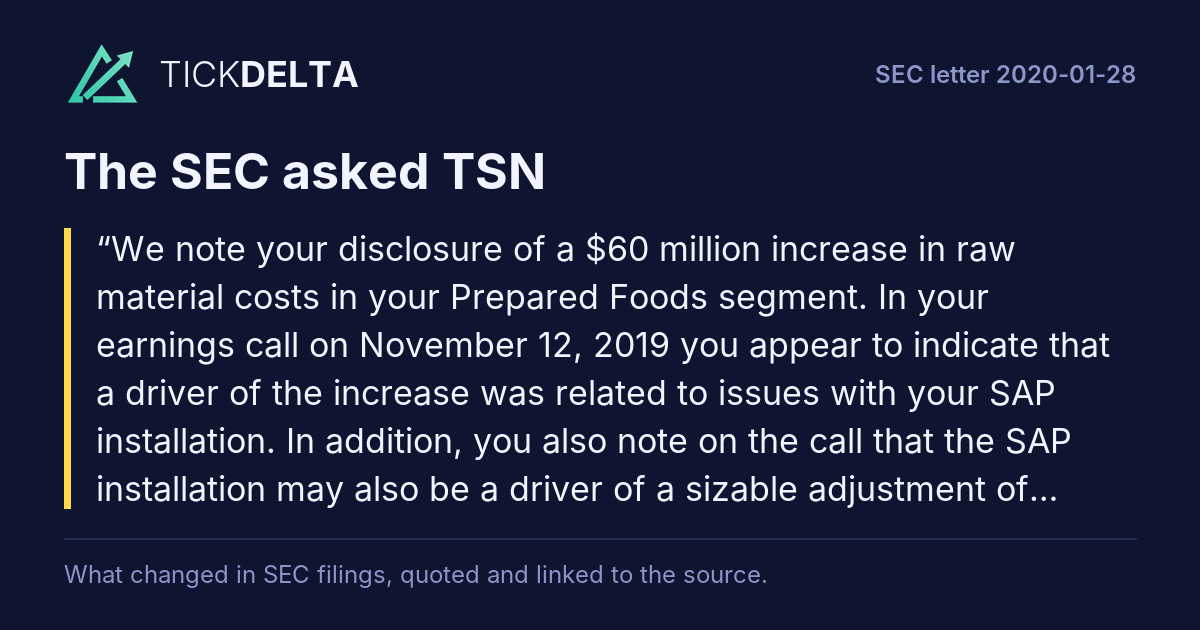
We note your disclosure of a $60 million increase in raw material costs in your Prepared Foods segment. In your earnings call on November 12, 2019 you appear to indicate that a driver of the increase was related to issues with your SAP installation. In addition, you also note on the call that the SAP installation may also be a driver of a sizable adjustment of your inventory levels.
Rest of the question

To help us better understand your statements in your earnings call and its related impact on your financial statements, please describe for us in greater detail the nature of the issue(s) associated with the the SAP installation and its related impact to your financial statements, including the effect on your inventory levels which notably increased in 2019. As part of your response, please tell us the periods affected and quantify the amount for each item identified. Please also tell us if the underlying implementation issues have been resolved or, if not, what your assessment of the potential impact is for future reporting periods.

TSN answered
To best organize our response, we have separated your comment into several subsections below.

I.

We note your disclosure of a $60 million increase in raw material costs in your Prepared Foods segment. In your earnings call on November 12, 2019 you appear to indicate that a driver of the increase was related to issues with your SAP installation.

The approximately $60 million increase in raw material costs in our Prepared Foods segment disclosed in our Form 10-K, filed on November 12, 2019, was related to fiscal 2019 vs fiscal 2018 meat commodity and ingredient cost inflation and was not
Rest of the answer

related to the impact of our SAP implementation.

As discussed in Mr. Glendinning’s prepared remarks on the November 12, 2019, earnings call, there was an approximately $40 million negative impact to operating income related to discounted sales and inventory write downs primarily related to issues associated with our SAP implementation and was a fourth quarter fiscal 2019 vs fourth quarter fiscal 2018 comparison.

On our November 12, 2019 earnings call, Peter T. Galbo asked about the performance of our Prepared Foods segment, referencing the impact of the approximately $60 million increase in raw material costs in fiscal 2019 vs 2018 (the “Galbo question”). In response, Mr. White explained that the overall performance of our Prepared Foods segment was impacted not only by the increase in raw material costs, but also by issues associated with our SAP implementation, as previously disclosed by Mr. Glendinning in his prepared remarks explaining that the SAP implementation negatively impacted operating income by approximately $40 million in the fourth quarter of fiscal 2019. Mr. White’s mention of a fourth quarter “adjustment” in response to the Galbo question was not a reference an accounting adjustment, but rather a reference to the approximately $40 million operating income impact associated with the SAP implementation.

II.

please describe for us in greater detail the nature of the issue(s) associated with the SAP installation

In April 2019, the Company began migrating three legacy ERP systems into one instance of SAP. The primary issue related to delays in generating detailed inventory batch-level reporting, which inhibited our ability to timely ship some inventory before it aged to an extent that it could no longer be sold for full list price. Because our inventory shelf-life is limited due to the nature of the product and customer specifications, this resulted in a larger amount of inventory being sold at a reduced price through discount channels and a larger amount of inventory write downs and donations.

III.

and its related impact to your financial statements

In the fourth quarter of fiscal 2019, due to the inventory issues related to our SAP implementation, we realized a negative operating income impact of approximately $40 million to our Prepared Foods and Chicken segments. The impact was approximately $15 million increase in discounted sales, approximately $20 million increase in write downs and approximately $5 million increase in donations.

IV.

including the effect on your inventory levels which notably increased in 2019.

The primary drivers for the increase to our inventory were not related to the SAP implementation. In fiscal 2019, our inventory levels increased in our Chicken segment and International/Other due to acquisitions, including Keystone Foods, accounting for approximately $260 million of inventory, and our Thai and European operations acquired from BRF S.A., accounting for approximately $200 million of inventory. Additionally, we attribute approximately $75 million of the increase in inventory to raw material cost inflation in our Prepared Foods segment. The remaining increase compared to fiscal 2018 that may have been associated with our SAP implementation is approximately $60 million.

V.

please tell us the periods affected

The period affected was the fourth quarter of fiscal 2019.

VI.

and quantify the amount for each item identified.

Addressed in response to subsections III and IV.

VII.

Please also tell us if the underlying implementation issues have been resolved or, if not, what your assessment of the potential impact is for future reporting periods.

We experienced a similar level of discounted sales, inventory write downs and donations during the first quarter of fiscal 2020 as we did in the fourth quarter of fiscal 2019, which was disclosed in our Form 10-Q for the first quarter of fiscal 2020 filed on February 6, 2020. While the issues have not yet been fully resolved and we are not able to project the full impact on future reporting periods, we expect to see improvements as we return to normal levels in resolving the operational issues resulting from the SAP implementation.

Read in the reply ↗
In its next report

First report after the company's reply of 2020-02-11: 10-Q filed 2020-05-04 ↗, against the 10-Q filed 2019-08-05 ↗.

Tickdelta does not hold the text of both reports, so they are not compared here.

Also in this review: closing letter, 2020-02-13

Form 10-K for the Fiscal Year Ended October 3, 2015

2016-03-07 to 2016-05-05 · 3 questions · 2 letters from the SEC, 3 from the company
Review closed 2016-05-05
SegmentsNon-GAAP measures
Notes to Consolidated Financial Statements · Note 17: Segment Reporting, page 80
SEC asked (1)
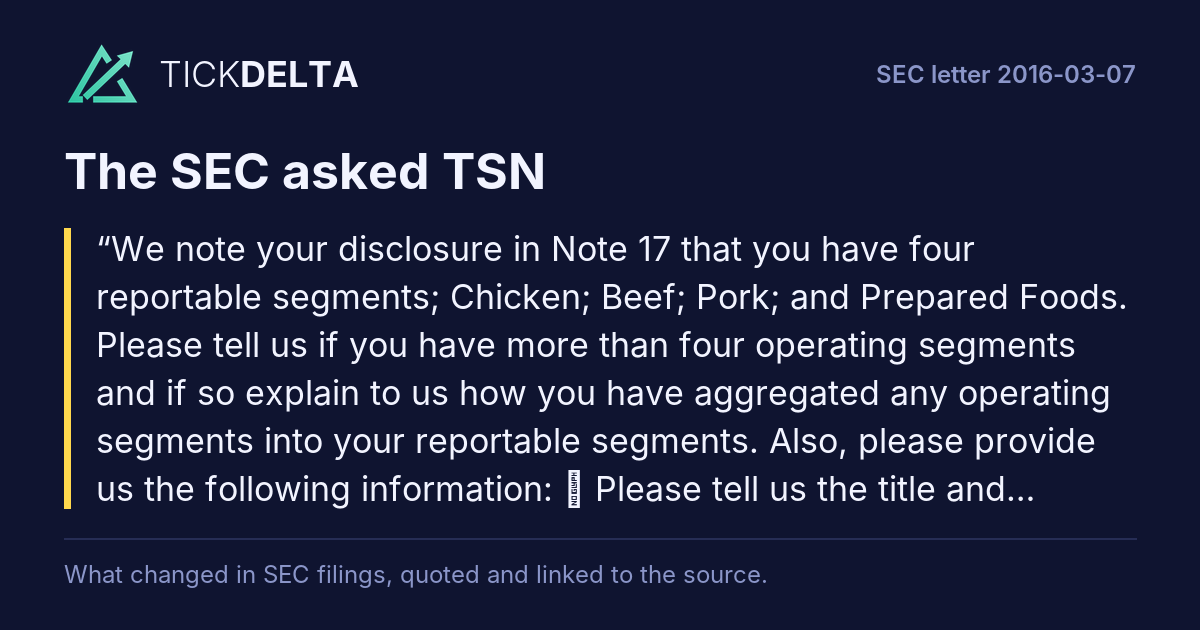
We note your disclosure in Note 17 that you have four reportable segments; Chicken; Beef; Pork; and Prepared Foods. Please tell us if you have more than four operating segments and if so explain to us how you have aggregated any operating segments into your reportable segments.
Rest of the question

Also, please provide us the following information:  Please tell us the title and describe the role of the CODM, as well as the names of those individuals that report to the CODM;  Identify and describe the role of each of your segment managers;  With regard to the Prepared Foods reportable segment, please tell us if there is any individual responsible for a subset of the segment such as Retail, Foodservice, or legacy operations and if so, explain who they report to;  Describe the information regularly provided to the CODM and how frequently it is prepared; and  Describe the information provided to the Board of Directors and how frequently it is prepared.

TSN answered
During the first three quarters of fiscal 2015, we operated in five operating segments: Chicken, Beef, Pork, Prepared Foods and International. Following divestitures in our International operating segment in fiscal 2015, we determined the International operating segment does not meet the quantitative thresholds for a reportable segment described in ASC 280-10-50-12. As a result, beginning with our 4th quarter of fiscal 2015, International is no longer considered a reportable segment (included in Other), and we now have four reportable segments.
Rest of the answer

We have not aggregated any operating segments into our reportable segments.

The Company applies the guidance prescribed in ASC Topic 280, Segment Reporting, in its determination that it has four reportable segments consistent with the management approach. This conclusion is supported by the manner in which the Company conducts its business activities and the way in which the Chief Operating Decision Maker (“CODM”) views and manages the business.

a.

Please tell us the title and describe the role of the CODM, as well as the names of those individuals that report to the CODM.

Donnie Smith is our President and Chief Executive Officer (CEO) and is the Company’s CODM. He has oversight responsibilities for all segments of the Company. Mr. Smith is directly accountable to our Board of Directors for the strategic operating direction and financial performance of the Company. He has responsibility for determining the allocation of resources to the segments to achieve the Company’s strategic plan and for evaluating the performance of each segment. The individuals, along with their titles, that report to Mr. Smith are the following (alphabetically):

Andy Callahan, President Retail Packaged Brands

Hal Carper, Executive Vice President Strategy & New Ventures

Sally Grimes, President International and Global Growth Officer

Tom Hayes, Chief Commercial Officer and President Foodservice

Donnie King, President North American Operations

Dennis Leatherby, Executive Vice President and Chief Financial Officer

Sara Lilygren, Executive Vice President Corporate Affairs

Mary Oleksiuk, Executive Vice President & Chief HR Officer

Mike Roetzel, Executive Vice President Operations Services

David Van Bebber, Executive Vice President & General Counsel

In addition, the individuals reporting to Donnie King, President North American Operations, are part of the Senior Leadership Team (SLT). The individuals, along with their titles, that report to Mr. King are the following (alphabetically):

Bernie Adcock, Chief Supply Chain Officer

Wes Morris, President Prepared Foods

Steve Stouffer, President Fresh Meats

Russell Tooley, Executive Vice President Business Process and Continuous Improvement

Noel White, President Poultry

The current organization structure is designed to achieve the business strategy as well as to allow for succession planning and development. Our strategy is to:

Accelerate growth of domestic value-added chicken sales, prepared food sales, and international chicken production

Innovate with products, services, and customer and consumer insights

Cultivate the development of our Team Members to support our growth and long-term future.

As part of the identification of the Company’s CODM, we considered whether any other senior executives, either individually or as a group, could also or alternatively be considered the CODM, and we determined that none should be. Although other members of our SLT participate in the resource allocation process from time to time, their expertise lies in their specific functional areas, and the resource allocation and operating decisions-making authority resides with our President and CEO.

b.

Identify and describe the role of each of your segment managers.

Chicken - Our Chicken operations primarily include our domestic operations related to raising and processing live chickens into fresh, frozen and value-added chicken products. These products are principally sold through retail, foodservice, and export sales channels. Noel White, President Poultry, through his Poultry team, is responsible for the operating activities, financial results and strategic direction of the Chicken segment.

Beef - Our Beef operations primarily include our operations related to processing live fed cattle and fabricating dressed beef carcasses into primal and sub-primal cuts and case-ready products. These products are principally sold through retail, foodservice, and export sales channels. Steve Stouffer, President Fresh Meats, through his Beef team, is responsible for the operating activities, financial results and strategic direction for the Beef operations in addition to his responsibilities for the Pork segment.

Pork - Our Pork operations primarily include our operations related to processing live market hogs and fabricating pork carcasses into primal and sub-primal cuts and case-ready products. These products are principally sold through retail, foodservice, and export sales channels. Steve Stouffer, President Fresh Meats, through his Pork team, is responsible for the operating activities, financial results and strategic direction for the Pork operations in addition to his responsibilities for the Beef segment.

Prepared Foods - Our Prepared Foods operations primarily include our operations related to manufacturing and marketing of frozen and refrigerated food products such as: pepperoni, bacon, breakfast sausage, turkey, lunchmeat, hot dogs, pizza crusts and toppings, flour and corn tortilla products, desserts, appetizers, prepared meals, ethnic foods, soups, sauces, side dishes, meat dishes, breadsticks and processed meats. These products are principally sold through retail, foodservice and export sales channels.

As described further in the following section, our current organization structure for Prepared Foods does not include a single manager reporting to either Mr. Smith or Mr. King that meets the definition of a segment manager based on the manner in which we manage our business or in which our CODM evaluates performance and allocates resources. Based on the importance of the Prepared Foods operations subsequent to the acquisition of The Hillshire Brands Company (Hillshire), Mr. Smith, our President and CEO, is responsible for the operating activities, financial results and strategic direction of the Prepared Foods operations. Consistent with this approach, Mr. Smith is the segment manager of our Prepared Foods segment.

Prior to our acquisition of Hillshire, our Prepared Foods segment manager was not our President and CEO, and we believe it is reasonable to expect in the future a leader or group of leaders other than our President and CEO would serve as our segment manager for Prepared Foods.

c.

With regard to the Prepared Foods reportable segment, please tell us if there is any individual responsible for a subset of the segment such as Retail, Foodservice, or legacy operations and if so, explain who they report to.

The Prepared Foods reportable segment is comprised of the legacy Tyson Prepared Foods operations and the entire legacy operations of Hillshire which we acquired in August 2014. Subsequent to the acquisition, we have been actively integrating and combining the operations of each of the legacy entities and we do not manage the Prepared Foods segment based on legacy operations.

Prepared Foods, along with some of our other operations, operates as a matrix organization. The retail sales channel is under the leadership of Andy Callahan, President Retail Packaged Brands, and the foodservice sales channel is under the leadership of Tom Hayes, Chief Commercial Officer and President Foodservice. Both Mr. Callahan and Mr. Hayes report to Mr. Smith, President and CEO. All of the products sold through these channels are produced at common production facilities under the leadership of Wes Morris, President Prepared Foods. Our current organization structure includes Mr. Smith’s management of the Prepared Foods operations through the Prepared Foods team (Mr. Callahan, Mr. Hayes and Mr. Morris) as they collectively work together based on the common production platform, comingled operations, and our focus on meeting consumer demand in either retail or foodservice channels. We manage our business, and our CODM evaluates performance and allocates resources, at the Prepared Foods level rather than at the sales channel level.

d.

Describe the information regularly provided to the CODM and how frequently it is prepared.

Weekly Margin Reports - Weekly estimates of sales, volume and operating income (dollars and % of sales) are prepared. These reports are matrix reports providing estimates both by reportable segment as well as individual business unit. These reports are distributed to the CODM, direct reports of the CODM, segment managers and corporate and business unit finance and accounting team members.

Weekly Gas Gauge - A report produced weekly that summarizes weekly margin reports, monthly closing adjustments, anticipated quarter-end adjustments and current quarter estimated earnings per share (EPS) for the total company. The report is prepared on a total company basis (one page). Supplemental detail information that is utilized to roll-up the total company results which are organized by reportable segment (sales and operating income) and business unit (operating income), are included.

Monthly Board Report - A monthly report is prepared for the CEO (for delivery to the Board of Directors). The report includes current business developments and the financial results of the month summarized for the total company - sales (dollars and volumes) and operating income (dollars and % of sales) as well as an expected result for the entire quarter. Summary detail (sales and operating income) is provided by reportable segment (no business unit financial results).

Monthly Finance Committee - We hold monthly Finance Committee meetings with the purpose of overseeing the capital allocation process. Our CODM is a member of the Finance Committee and attends these meetings. The materials reviewed in connection with these meetings include our capital allocation, approvals and capital spending based on our reportable segments as well as International, transportation and logistics and shared services.

Quarterly Business Review - Quarterly each business unit reviews its results with the segment manager, CEO, CFO and relevant finance and accounting representatives. The information includes financial results compared to prior period(s) and plan(s), current business activities and updated projections. The financial results are presented in a matrix format providing both reportable segment alignment as well as business unit alignment.

Quarterly Disclosure Committee - Our CEO is a member of our Disclosure Committee. We review our financial statements, operating segment results, bridge of earnings by operating segment as compared to prior year (quarter and year-to-date) and immediately preceding quarter, SG&A, working capital detail, debt and interest expense, significant accounting items, balance sheet accounts requiring significant judgment, capital approvals and spend (by operating segment) and sub-certification results.

e.

Monthly Board Report - The report includes current business developments and the financial results of the month are summarized for the total Company - sales (dollars and volumes) and operating income (dollars and % of sales) as well as an expected result for the entire current quarter. Summary detail (sales and operating income) is provided by reportable segment (no business unit financial results).

Quarterly CFO Report - Our CFO provides a quarterly presentation to the Board of Directors and reviews the current year results to date and projections for the remainder of the year. This information is presented in a matrix format providing both reportable segment alignment as well as business unit alignment.

Quarterly Audit Committee Report - Our audit committee receives a quarterly report that includes our financial statements, operating segment results, SG&A, working capital detail, debt and interest expense, significant accounting items, balance sheet accounts requiring significant judgment, capital approvals and spend (by operating segment) and sub-certification results.

Read in the reply ↗
In its next report

First report after the company's reply of 2016-03-18: 10-Q filed 2016-05-09 ↗, against the 10-Q filed 2016-02-05 ↗.

Tickdelta does not hold the text of both reports, so they are not compared here.

Exhibit 99.1
SEC asked (2)
We note your disclosure of the non-GAAP measures adjusted net income per share attributable to Tyson and adjusted operating income. Furthermore, your disclosure states that the presentation of these measures “helps investors to assess our financial performance from period to period and enhances understanding of our financial performance.” It appears your disclosures are overly general and therefore, not consistent
Rest of the question

with the objective of Item 10(e)(1)(i) of Regulation S-K. Please revise to include disclosure concerning the reasons why management believes that presentation of these non-GAAP financial measures provides useful information to investors in accordance with Instruction 2 to Item 2.02 of Form 8-K and Item 10(e)(1)(i) of Regulation S-K.

TSN answered
The Company confirms that to the extent adjusted net income per share attributable to Tyson (adjusted EPS) or adjusted operating income are disclosed in future earnings releases, the Company will include all of the disclosures required by Item 10(e)(1)(i) of Regulation S-K and Instruction 2 to Item 2.02 of Form 8-K.
Rest of the answer

An example of the Company’s proposed revised disclosures (using the Company’s first quarter of fiscal 2016 below as an example) is set forth below.

Adjusted net income per share attributable to Tyson (adjusted EPS) is presented as a supplementary measure of our financial performance that is not required by, or presented in accordance with, GAAP. We use adjusted EPS as an internal performance measurement and as one criterion for evaluating our performance relative to that of our peers. We believe adjusted EPS is meaningful to our investors to enhance their understanding of our financial performance and is frequently used by securities analysts, investors and other interested parties to compare our performance with the performance of other companies that report adjusted EPS. Further, we believe that adjusted EPS is a useful measure because it improves comparability of results of operations from period to period. Adjusted EPS should not be considered as a substitute for net income per share attributable to Tyson or any other measure of financial performance reported in accordance with GAAP. Investors should rely primarily on our GAAP results and use non-GAAP financial measures only supplementally in making investment decisions. Our calculation of adjusted EPS may not be comparable to similarly titled measures reported by other companies.

Adjusted operating income and adjusted operating margin are presented as supplementary measures of our operating performance that are not required by, or presented in accordance with, GAAP. We use adjusted operating income and adjusted operating margin as internal performance measurements and as two criteria for evaluating our performance relative to that of our peers. We believe adjusted operating income and adjusted operating margin are meaningful to our investors to enhance their understanding of our operating performance and are frequently used by securities analysts, investors and other interested parties to compare our performance with the performance of other companies that report adjusted operating income and adjusted operating margin. Further, we believe that adjusted operating income and adjusted operating margin are useful measures because they improve comparability of results of operations from period to period. Adjusted operating income and adjusted operating margin should not be considered as a substitute for operating income or operating margin or any other measure of operating performance reported in accordance with GAAP. Investors should rely primarily on our GAAP results and use non-GAAP financial measures only supplementally in making investment decisions. Our calculation of adjusted operating income and adjusted operating margin may not be comparable to similarly titled measures reported by other companies.

Read in the reply ↗
In its next report

First report after the company's reply of 2016-03-18: 10-Q filed 2016-05-09 ↗, against the 10-Q filed 2016-02-05 ↗.

Tickdelta does not hold the text of both reports, so they are not compared here.

Notes to Consolidated Financial Statements · Note 17: Segment Reporting, page 80
SEC asked
We note your response to prior comment 1 and request the following additional information:  With regard to the weekly margin reports referenced in your response to prior comment 1, please clarify the business units for which this report is prepared and tell us how these units relate to your operating segments.
Rest of the question

Your response should include the person(s) responsible for each such business unit including name and title.  We note that within the Prepared Foods segment, there are both Retail and Foodservice operations. In this regard, please tell us whether discrete financial information is available for each of the Retail and Foodservice sections of the Prepared Foods segment and if so, tell us who reviews the information. Please include whether such information is also provided to the CODM in your response.  With regard to your President, North American Operations, Donnie King, please tell us the types of operating decisions he is required to make given that multiple segment managers report to him. Your response should include the types of financial information and reports he reviews in connection with his role as President of North American Operations and how it differs from reports provided to and decisions made by the CODM, Donnie Smith. We may have further comment upon receipt of your response.

TSN answered
As discussed with the SEC Staff via a phone call yesterday, we respectfully request an additional week to finalize our response to your letter dated April 1, 2016. We expect to finalize our response on or before April 22, 2016. Please telephone me (479-290-4194) or either of my colleagues, Curt T. Calaway, Senior Vice President, Controller and Chief Accounting Officer (479-290-5576), or R. Read Hudson, Vice President, Associate General Counsel and Secretary (479-290-7023), with questions or comments. Read in the reply ↗
In its next report

First report after the company's reply of 2016-04-15: 10-Q filed 2016-05-09 ↗, against the 10-Q filed 2016-02-05 ↗.

Tickdelta does not hold the text of both reports, so they are not compared here.

Also in this review: company letter, 2016-04-22, closing letter, 2016-05-05

1 other letter: notices that a filing will not be reviewed, requests to declare a registration effective, and the like
  • 2017-05-18 · TSN: letter to the SEC · AdvancePierre Foods · Holdings, Inc. Schedule TO-T filed May · 9, 2017 by DVB Merger...

From the SEC's correspondence on EDGAR: staff letters (form UPLOAD) and company letters (form CORRESP), 18 letters filed since 2015-03-13. Questions and answers are matched by their numbers; topics come from words in each question. The reports are compared word for word (same form, before the first SEC letter against the first report after the company's reply). No AI.

Work on TSN in a spreadsheet: Excel workbook (a sheet per section, ten years by column, charts, links to the filings) · CSV. For a Google Sheet that stays up to date, paste =IMPORTDATA("https://tickdelta.com/company/TSN/export.csv") into a cell.