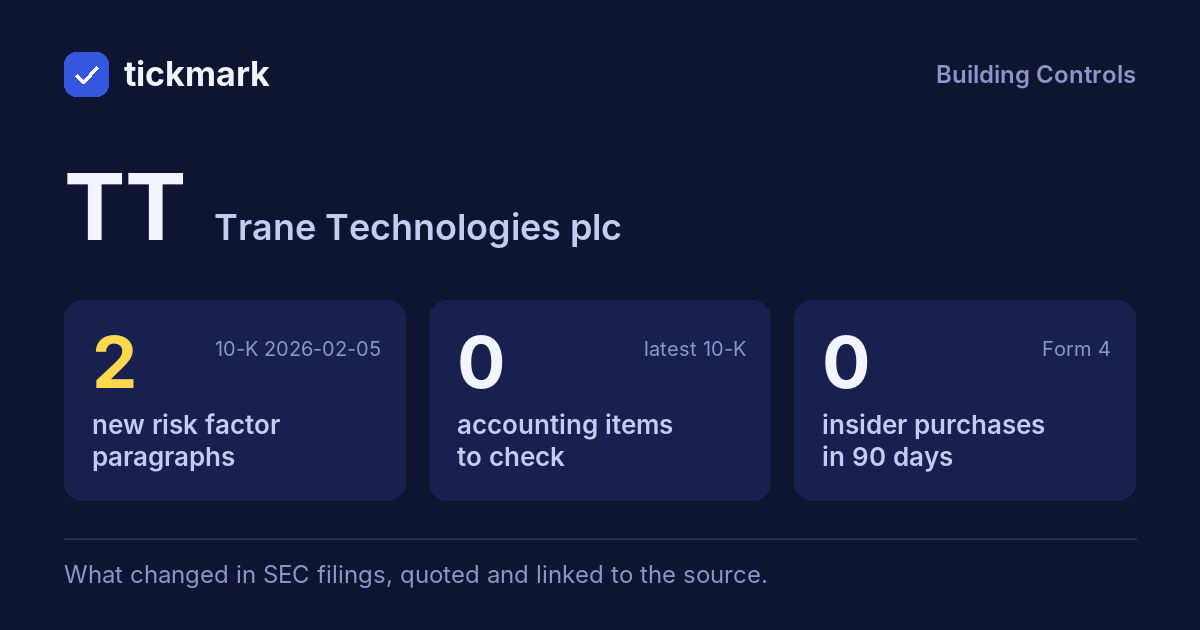
Sentences and paragraphs of TT's Risk Factors and MD&A, 10-K 2026-02-05 against 10-K 2025-02-06.
Each links to the text at sec.gov.
RemovedRisk Factors
On February 29, 2020 (Distribution Date), we completed our Reverse Morris Trust transaction (the Transaction) with Gardner Denver Holdings, Inc. (Gardner Denver, which changed its name to Ingersoll Rand Inc. (Ingersoll Rand) after the Transaction) whereby we distributed Ingersoll-Rand U.S. HoldCo, Inc., which contained our former Industrial segment (Ingersoll Rand Industrial) through a pro rata distribution (the Distribution) to shareholders of record as of February 24, 2020 (Spin-off Shareholders). Ingersoll Rand Industrial then merged with a wholly-owned subsidiary of Ingersoll Rand. Upon close of the Transaction, the Spin-off Shareholders received approximately 50.1% of the shares of Ingersoll Rand common stock on a fully-diluted basis and Gardner Denver shareholders retained approximately 49.9% of the shares of Ingersoll Rand on a fully diluted basis. As a result, Spin-off Shareholders received 0.8824 shares of Ingersoll Rand common stock with respect to each share of our stock owned as of February 24, 2020. In connection with the Transaction, we received a special cash payment of $1.9 billion.
Read it in 10-K 2025-02-06 at sec.gov ↗
RemovedRisk Factors
If the Distribution as part of our Reverse Morris Trust Transaction is determined to be taxable for Irish tax purposes, significant Irish tax liabilities may arise for the Spin-off Shareholders.
Read it in 10-K 2025-02-06 at sec.gov ↗
RemovedRisk Factors
We received an opinion from Irish Revenue regarding certain tax matters associated with the Distribution, as well as a legal opinion from our Irish counsel Arthur Cox LLP, regarding certain Irish tax consequences of the Distribution for the Spin-off Shareholders. For the Spin-off Shareholders who are not resident or ordinarily resident in Ireland for Irish tax purposes and who do not hold their shares in connection with a trade or business carried on by such Spin-off Shareholders through an Irish branch or agency, we consider, based on both opinions taken together, that no adverse Irish tax consequences for such Spin-off Shareholders should have arisen. These opinions relied on certain facts and assumptions and certain representations. Notwithstanding the opinion from Irish Revenue, Irish Revenue could ultimately determine on audit that the Distribution is taxable for Irish tax purposes, for example, if it determines that any of these facts, assumptions or representations are not correct or have been violated. A legal opinion represents the tax adviser's best legal judgment and is not binding on Irish Revenue or the courts and Irish Revenue or the courts may not agree with the legal opinion. In addition, the legal opinion is based on current law and cannot be relied upon if current law changes with retroactive effect. If the Distribution ultimately is determined to be taxable for Irish tax purposes, we and the Spin-off Shareholders could have significant Irish tax liabilities as a result of the
Read it in 10-K 2025-02-06 at sec.gov ↗
RemovedRisk Factors
Distribution, and there could be a material adverse impact on our business, financial condition, results of operations and cash flows in future reporting periods.
Read it in 10-K 2025-02-06 at sec.gov ↗
RemovedRisk Factors
If the Distribution together with certain related transactions do not qualify as tax-free under Sections 355 and 368(a) of the Internal Revenue Code, including as a result of subsequent acquisitions of stock of the Company or Ingersoll Rand, then the Company and the Spin-off Shareholders may be required to pay substantial U.S. federal income taxes, and Ingersoll Rand may be obligated to indemnify the Company for such taxes imposed on the Company.
Read it in 10-K 2025-02-06 at sec.gov ↗
RemovedRisk Factors
At the time of the Distribution, we received an opinion from our U.S. tax counsel Paul, Weiss, Rifkind, Wharton & Garrison LLP (Paul Weiss) substantially to the effect that, for U.S. federal income tax purposes, the Distribution together with certain related transactions undertaken in anticipation of the Distribution and taking into account the merger of Ingersoll Rand Industrial with the wholly-owned subsidiary of Ingersoll Rand will qualify as a tax-free transaction under Sections 368(a), 361 and 355 of the Internal Revenue Code (the Code), with the result that we and the Spin-off Shareholders will not recognize any gain or loss for U.S. federal income tax purposes as a result of the spin-off. The opinion of our counsel was based on, among other things, certain representations and assumptions as to factual matters made by Ingersoll Rand, Ingersoll Rand Industrial and the Company. The failure of any factual representation or assumption to be true, correct and complete in all material respects could adversely affect the validity of the opinion of counsel. An opinion of counsel represents counsel's best legal judgment, is not binding on the Internal Revenue Service (IRS) or the courts, and the IRS or the courts may not agree with the opinion. In addition, an opinion will be based on current law, and cannot be relied upon if current law changes with retroactive effect. If the Distribution, and/or related internal transactions in anticipation of the Distribution ultimately are determined to be taxable, we could incur significant U.S. federal income tax liabilities, which could cause a material adverse impact on our business, financial condition, results of operations and cash flows in future reporting periods, although if this determination resulted from certain actions taken by Ingersoll Rand Industrial or Ingersoll Rand, Ingersoll Rand would be required to bear the cost of any resultant tax liability pursuant to the terms of the Tax Matters Agreement dated February 29, 2020, among Ingersoll-Rand Plc, Ingersoll-Rand Lux International Holding Company S.à r.l, Ingersoll-Rand Services Company, Ingersoll-Rand U.S. HoldCo, Inc., and Gardner Denver Holdings, Inc. (Tax Matters Agreement).
Read it in 10-K 2025-02-06 at sec.gov ↗
RemovedRisk Factors
The Distribution will be taxable to the Company pursuant to Section 355(e) of the Code if there is a 50% or greater change in ownership of either the Company or Ingersoll Rand Industrial, directly or indirectly (including through such a change in ownership of Ingersoll Rand), as part of a plan or series of related transactions that include the Distribution. A Section 355(e) change of ownership would not make the Distribution taxable to the Spin-off Shareholders, but instead may result in corporate-level taxable gain to certain of our subsidiaries. Because the Spin-off Shareholders will collectively be treated as owning more than 50% of the Ingersoll Rand common stock following the merger, the merger alone should not cause the Distribution to be taxable to our subsidiaries under Section 355(e). However, Section 355(e) might apply if other acquisitions of stock of the Company before or after the merger, or of Ingersoll Rand before or after the merger, are considered to be part of a plan or series of related transactions that include the Distribution together with certain related transactions. If Section 355(e) applied, certain of our subsidiaries might recognize a very substantial amount of taxable gain, although if this applied as a result of certain actions taken by Ingersoll Rand Industrial, Ingersoll Rand or certain specified Ingersoll Rand stockholders, Ingersoll Rand would be required to bear the cost of any resultant tax liability under Section 355(e) pursuant to the terms of the Tax Matters Agreement.
Read it in 10-K 2025-02-06 at sec.gov ↗
RemovedRisk Factors
If the merger does not qualify as a tax-free reorganization under Section 368(a) of the Code, the Spin-off Shareholders may be required to pay substantial U.S. federal income taxes.
Read it in 10-K 2025-02-06 at sec.gov ↗
Show the other 5
RemovedRisk Factors
On the Distribution Date, we have received an opinion from Paul Weiss, and Ingersoll Rand received an opinion from their counsel Simpson Thacher & Bartlett LLP, substantially to the effect that the merger will qualify as a reorganization within the meaning of Section 368(a) of the Code with the result that U.S. holders of Ingersoll Rand Industrial common stock who received Ingersoll Rand common stock in the merger will not recognize any gain or loss for U.S. federal income tax purposes (except with respect to cash received in lieu of fractional shares of Ingersoll Rand common stock). These opinions were based upon, among other things, certain representations and assumptions as to factual matters made by Ingersoll Rand, the Company, Ingersoll Rand Industrial and the merger subsidiary used by Ingersoll Rand. The failure of any factual representation or assumption to be true, correct and complete in all material respects could adversely affect the validity of the opinions. An opinion of counsel represents counsel's best legal judgment, is not binding on the IRS or the courts, and the IRS or the courts may not agree with the opinion. In addition, the opinions are based on current law, and cannot be relied upon if current law changes with retroactive effect. If the merger were taxable, U.S. holders of the common stock of Ingersoll Rand Industrial would be considered to have made a taxable sale of their Ingersoll Rand Industrial common stock to Ingersoll Rand, and such U.S. holders of Ingersoll Rand Industrial would generally recognize taxable gain or loss on their receipt of Ingersoll Rand common stock in the merger.
Read it in 10-K 2025-02-06 at sec.gov ↗
RemovedMD&A
During the third quarter of 2024, we completed acquisitions of two businesses. One acquisition is a Commercial HVAC distributor with sales and service business in the United States. The second acquisition is a technology-focused acquisition that expands the Company's product offerings in the Transport Refrigeration business. The results of both acquisitions are reported within the Americas segment.
Read it in 10-K 2025-02-06 at sec.gov ↗
RemovedMD&A
On April 6, 2023, certain individual claimants filed a motion to dismiss the Chapter 11 cases (Claimant Motion to Dismiss). Subsequently, on May 15, 2023, the committee representing current asbestos claimants (the ACC) filed its own motion to dismiss the Chapter 11 cases (ACC Motion to Dismiss, and, together with the Claimant Motion to Dismiss, the Motions to Dismiss). Aldrich, Murray and the FCR filed responses in opposition to the Motions to Dismiss, and the Company filed papers joining in Aldrich and Murray's opposition. A hearing on the Motions to Dismiss was held on July 14, 2023. On December 28, 2023, the Bankruptcy Court entered an order denying the Motions to Dismiss. On January 11, 2024, the ACC and the individual claimants filed motions with the United States District Court for the District of North Carolina (the District Court) seeking leave to appeal the order denying the Motions to Dismiss (Motions for Leave to Appeal) and to certify the appeals directly to the Court of Appeals for the Fourth Circuit. At a hearing on February 9, 2024, the Bankruptcy Court granted the motions to certify direct appeals to the Fourth Circuit. On April 17, 2024, the Fourth Circuit entered an order denying the petitions for direct appeal. On May 1, 2024, the ACC and the individual claimants filed petitions with the Fourth Circuit seeking rehearing en banc. Aldrich and Murray opposed the petitions and the Fourth Circuit denied the petitions by order dated May 15, 2024. On May 28, 2024, Aldrich and Murray filed their response with the District Court in opposition to the Motions for Leave to Appeal. The FCR filed its response to the Motions for Leave to Appeal on May 29, 2024. The ACC and the individual claimants filed their replies in support of the Motions for Leave to Appeal on June 11, 2024.
Read it in 10-K 2025-02-06 at sec.gov ↗
RemovedMD&A
Interest expense for the year ended December 31, 2024 increased by 1.7% or $3.9 million compared with the same period of 2023 primarily due to the issuance of $500 million of 5.100% Senior Notes due in 2034. The increase in interest expense was partially offset by an increase in interest income from short-term investments purchased with proceeds from the debt issuance, which is reported in Other (income)/expense, net. We had no commercial paper outstanding as of December 31, 2024.
Read it in 10-K 2025-02-06 at sec.gov ↗
RemovedMD&A
We assess any contingent consideration included in the consideration paid of a business combination. The value recorded is based on estimates of future financial projections on revenue under various potential scenarios, in which a Monte Carlo simulation model runs many iterations based on comparable companies' revenue growth rates and their implied revenue volatilities. These cash flow projections are discounted with a risk adjusted rate. Each quarter until such contingent amounts are earned, the fair value of the liability is evaluated at each reporting period and adjusted as a component of operating expenses based on changes to the underlying assumptions. The estimates used to determine the fair value of the contingent consideration liability are subject to significant judgment, specifically revenue growth rates, implied revenue volatilities and discount rates.
Read it in 10-K 2025-02-06 at sec.gov ↗