Paragraphs with nothing like them in last year's 10-K
Quoted exactly
14 paragraphs in Risk Factors of the 10-K filed Nov 17, 2025
with nothing like them in the 10-K filed Nov 18, 2024. Quoted exactly.
Paragraphs that were only edited are under 10-K change.
•As we continue to grow our business, we will need to implement new systems and software successfully, otherwise our business and our financial condition and results of operations could be adversely affected;
As we continue to grow our business, we will need to implement new systems and software successfully, otherwise our business and our financial condition and results of operations could be adversely affected.
We will need to invest in improvements to our operational and IT systems and processes as part of our ongoing effort to improve the overall efficiency and competitiveness of our business, including improvements to prevent increasingly sophisticated cybersecurity incidents and improve standardization, systemization and automation to support growth. Transitioning to these new or upgraded processes and systems requires significant capital investments and personnel resources. Implementation is also highly dependent on the coordination of numerous employees, contractors and software and system providers. While these efforts have resulted in improvements to our operational systems, we expect to continue to incur expenses to implement additional improvements and upgrades to our systems. Many of these expenditures have been and may continue to be incurred in advance of the realization of any direct benefits to our business. Additionally, the effort to gain technological expertise, make use of data analytics, and develop new technologies in our business requires us to incur significant expenses. We cannot guarantee that we will be successful at improving our operational systems, adapting to changes in technology, including the successful utilization of data analytics, AI, and machine learning, or that our efforts will result in the anticipated benefits to us. In addition, the integration of emerging technologies, including data analytics, AI, and machine learning, into our systems and processes may require us to address rapidly developing laws and regulations governing AI. We may also experience difficulties in implementing or operating our new or upgraded operational or IT systems, including, but not limited to, ineffective or inefficient operations, significant system failures, system outages, delayed implementation and loss of system availability, which could lead to increased implementation and/or operational costs, loss or corruption of data, delayed shipments and interruptions of operations resulting in lost sales and/or profits. If our operational or IT system upgrades, improvements and associated implementation efforts are not successful or if we experience unexpected interruption in transition to new or upgraded processes or systems, our financial condition and results of operations could be adversely affected, and our business may become less competitive.
AI capabilities may indicate that it could be a significant disruptor in the synthetic biology industry. For example, AI may reduce customer demand for certain types of gene synthesis.
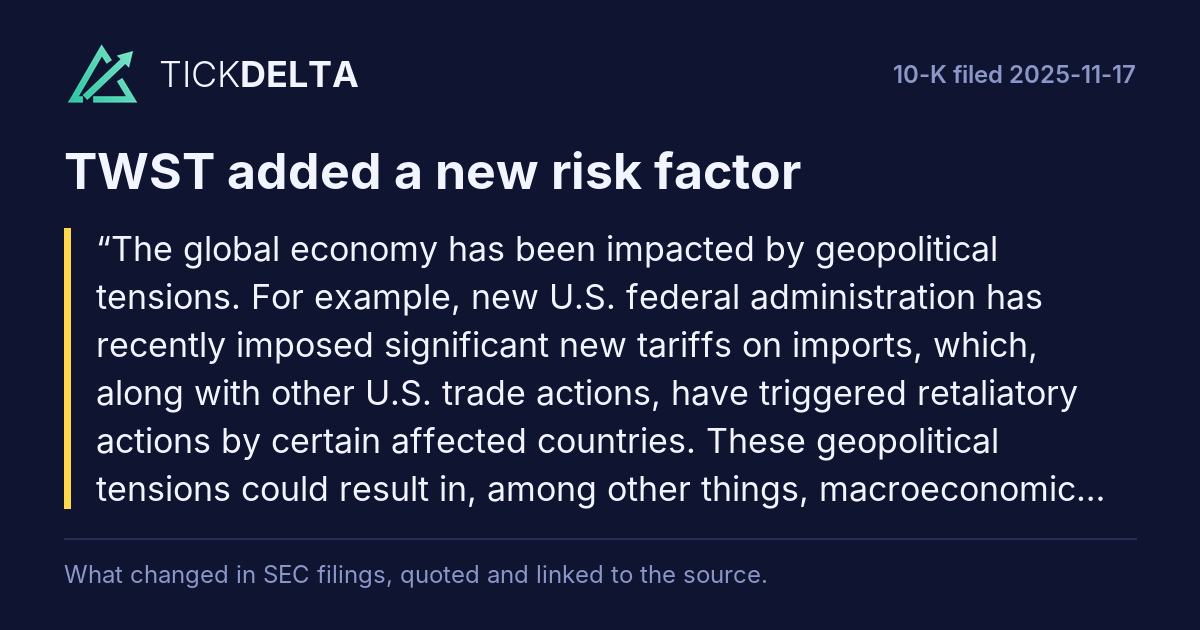
The global economy has been impacted by geopolitical tensions. For example, new U.S. federal administration has recently imposed significant new tariffs on imports, which, along with other U.S. trade actions, have triggered retaliatory actions by certain affected countries. These geopolitical tensions could result in, among other things, macroeconomic uncertainty, cyberattacks, supply chain disruptions, higher costs and changes to foreign exchange rates and financial markets. In addition, tariffs and trade restrictions may result in increased production costs and product pricing, supply chain disruptions, limited access to markets and uncertainty related to planning long-term investments and strategies. Additionally, the administration's halt on certain federal research grants may negatively impact our industry. Any prolonged reductions in such funding could slow innovation, delay collaborations and limit the adoption of new technologies that contribute to our business growth. If these or similar policy changes continue or expand, we may face increased costs or impact on the demand for our products. We are monitoring and evaluating any potential impacts that global economic conditions and other policy changes may have on our business, and we are considering ways in which we may offset any impacts. However, there is no assurance that we will be successful in mitigating the effects in the current environment. Although we cannot predict the full extent of these impacts, any such policy changes could adversely affect our business, financial condition and results of operations.
We may not achieve the anticipated benefits from the spin out of our DNA data storage application.
In May 2025, we completed the spin out of our DNA data storage application to a new independent company, Atlas Data Storage (“Atlas”), which allows us to focus on our synthetic biology, NGS and biopharma products and services. While we will retain an equity interest in Atlas and receive potential milestone payments and royalties on any future sales of Atlas’ products and services, we may not achieve some or all of the anticipated benefits of the spin out if Atlas’ technology development and commercialization efforts are not successful. In addition, the divestiture reduces business diversification and may prove not to be a superior alternative to the continued development of the DNA data storage application by us. Further, we are providing transition services to Atlas throughout a transition period, including use of some of our facilities and employee services which may
require significant time, attention and resources of our management and other employees, potentially diverting their attention from other aspects of our business.
Show the other 6
We are subject to data privacy and data protection laws, rules, and customer-imposed controls as a result of producing, collecting, processing, storing and transmitting confidential, personal and/or sensitive data in the course of our business. A significant number of countries where we operate have enacted privacy or data protection laws, rules and regulations, creating significant compliance challenges as we seek to maintain our global reach. In some cases, there are restrictions on the transfer of personal data outside the home country. More recently, privacy and data protection regulators are paying special attention to emerging issues linked to new digital technologies, such as the use of AI, biometrics, and surveillance technologies, which pose unique challenges to existing privacy and data protection paradigms. Any actual or perceived noncompliance could result in significant consequences, including, business interruption, sanctions and significant pecuniary fines, regulatory inquiries and investigations, adverse publicity, loss of competitive advantage and customer trust, as well as privacy litigation and civil lawsuits with damages, any of which may adversely affect our business, reputation and financial statements.
We may not be able to scale our manufacturing capacity to meet future demand, which could harm our business.
penalties, restraints on our business or reputational damage could have material adverse effects on our business and financial condition.
connection with any infringement claims, we could incur significant costs and expenses that could adversely affect our business, operating results, or financial condition.
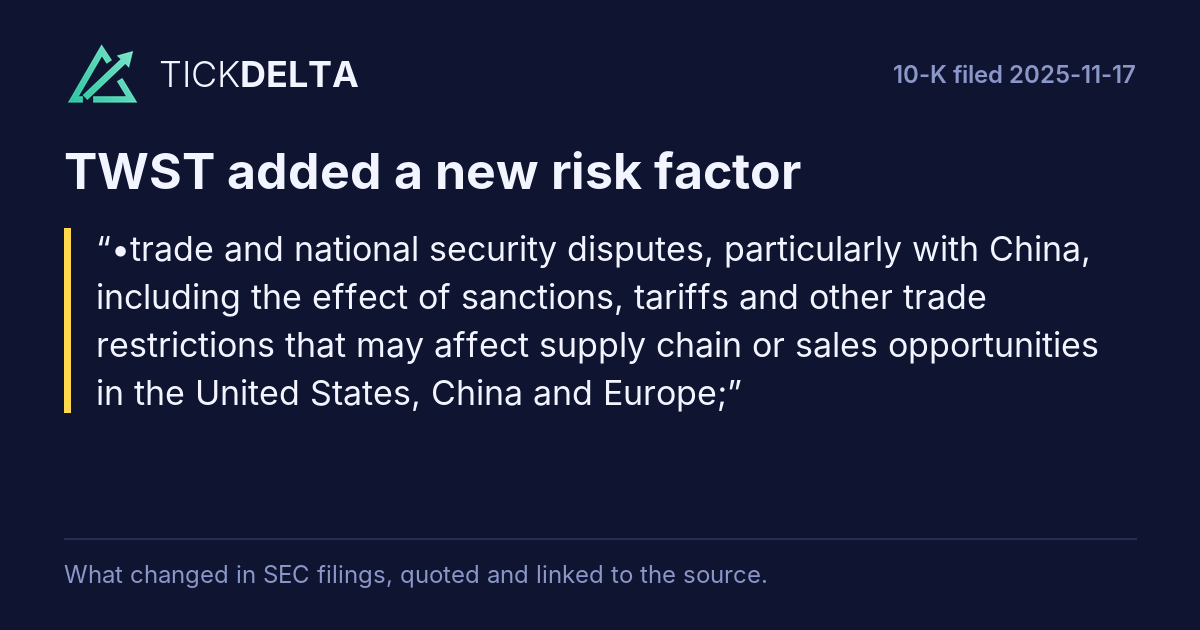
•trade and national security disputes, particularly with China, including the effect of sanctions, tariffs and other trade restrictions that may affect supply chain or sales opportunities in the United States, China and Europe;
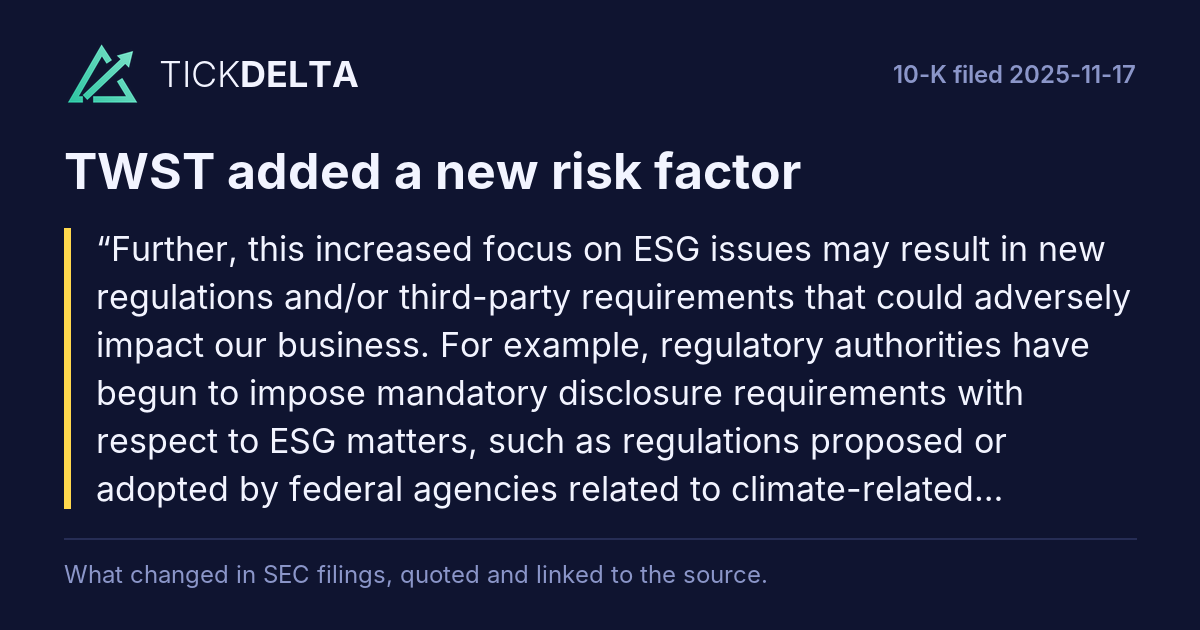
Further, this increased focus on ESG issues may result in new regulations and/or third-party requirements that could adversely impact our business. For example, regulatory authorities have begun to impose mandatory disclosure requirements with respect to ESG matters, such as regulations proposed or adopted by federal agencies related to climate-related disclosures, claims, practices or initiatives, the EU’s Corporate Sustainability Reporting Directive, and California’s Climate-Related Financial Risk Act and the Climate Corporate Data Accountability Act. If we fail to implement sufficient oversight or accurately capture and disclose on environmental matters, our reputation, business, operating results and financial condition may be materially adversely affected. In addition, enhancements to our processes and controls to reflect evolving reporting standards may be costly and require additional resources, and any allegation or perception that we have not taken sufficient action in these areas could negatively harm our reputation.
Paragraphs in the 10-Q filed Aug 3, 2026 that were not in the one before
New in the latest 10-Q
15 paragraphs in the 10-Q filed Aug 3, 2026 with nothing like
them in the 10-Q filed May 4, 2026 (at least half the words must differ; new numbers alone do not count).
Quoted exactly, grouped by the item heading above them. This is text that changed, not a judgement of how serious it is.
Financial statements and notes
In May 2025, the Company sold its DNA digital data storage business to Atlas Biosciences, Inc. ("Atlas") in exchange for 73.0 million shares of Atlas Series Seed-1 Preferred Stock, $ 2.5 million in cash, $ 2.0 million in promissory notes, contingent milestone payments of up to $ 75.0 million, and royalties on Atlas DNA data storage sales. The Company recorded a $ 48.8 million gain on the sale in fiscal year 2025.
Read in the 10-Qopen_in_new
The sale of the Company's DNA digital data storage business is intended to comply with Section 351 of the Internal Revenue Code and the Company recognized taxable gain to the extent of the value of “boot” received. Because of carryover tax attributes (definite lived net operating losses) and valuation allowance against its US federal and states deferred tax assets, there was no impact on the Company’s provision for income taxes for the three and nine months ended June 30, 2025.
Read in the 10-Qopen_in_new
As of June 30, 2026, the Company had reserved sufficient shares of common stock, with a par value of $ 0.00001 per share, for issuance upon exercise of outstanding stock options. Each share of common stock is
Read in the 10-Qopen_in_new
entitled to one vote. The holders of shares of common stock are also entitled to receive dividends whenever funds are legally available and when declared by the board of directors.
Read in the 10-Qopen_in_new
In June 2026, the Company entered into a Sales Agreement (the "Sales Agreement") with TD Securities (USA) LLC, as sales agent, pursuant to which the Company may offer and sell, from time to time, shares of its common stock having an aggregate offering price of up to $ 200.0 million through an at-the-market equity offering program (the "ATM Program"). The Company will pay the Sales Agent a commission of up to 3.0 % of the gross proceeds from each sale of shares under the Sales Agreement. The Company is not obligated to sell any shares under the Sales Agreement.
Read in the 10-Qopen_in_new
Show the other 10
The shares to be sold under the ATM Program are registered under the Company's automatic shelf registration statement on Form S-3ASR and related prospectus supplement, each filed with the SEC on June 18, 2026. The Form S-3ASR replaced the Company’s prior shelf registration statement and permits the Company to offer and sell, from time to time, common stock, preferred stock, debt securities, units and warrants in one or more offerings.
Read in the 10-Qopen_in_new
As of June 30, 2026, no shares had been sold under the ATM Program and the full $ 200.0 million capacity remained available.
Read in the 10-Qopen_in_new
In June 2026, we established an at-the-market equity offering program (the "ATM Program") under a Sales Agreement with TD Securities (USA) LLC, as sales agent, pursuant to which we may offer and sell shares of
Read in the 10-Qopen_in_new
our common stock having an aggregate offering price of up to $200.0 million from time to time. We are under no obligation to sell any shares under the ATM Program. As of June 30, 2026, no shares had been sold and the full $200.0 million of capacity remained available.
Read in the 10-Qopen_in_new
products and services facilitate DNA reading and sequencing workflows. The table below summarizes revenues by the new products:
Read in the 10-Qopen_in_new
We recognized gain on sale of business of $48.8 million related to the sale of our DNA digital data storage business during three and nine months ended June 30, 2025.
Read in the 10-Qopen_in_new
In June 2026, we entered into a Sales Agreement (the "Sales Agreement") with TD Securities (USA) LLC, as sales agent, pursuant to which we may offer and sell, from time to time, shares of its common stock having an aggregate offering price of up to $200.0 million through the ATM Program. We will pay the Sales Agent a commission of up to 3.0% of the gross proceeds from each sale of shares under the Sales Agreement. We are not obligated to sell any shares under the Sales Agreement.
Read in the 10-Qopen_in_new
The shares to be sold under the ATM Program are registered under our automatic shelf registration statement on Form S-3ASR and related prospectus supplement, each filed with the SEC on June 18, 2026. The Form S-3ASR replaced our prior shelf registration statement and permits us to offer and sell, from time to time, common stock, preferred stock, debt securities, units and warrants in one or more offerings.
Read in the 10-Qopen_in_new
As of June 30, 2026, no shares had been sold under the ATM Program and the full $200.0 million capacity remained available.
Read in the 10-Qopen_in_new
our data storage business of $2.5 million and the net impact of purchases and maturity of investments of $0.7 million.
Read in the 10-Qopen_in_new
The 10-Q's risk factors against the 10-K
Item 1A of the 10-Q filed Aug 3, 2026 against Item 1A of the 10-K filed Nov 17, 2025.
A 10-Q repeats only the risks that changed, so a 10-K paragraph that is missing from it is not counted as removed.
Added is a paragraph with nothing like it in the 10-K, Reworded a sentence that is in both with several words changed,
Quiet changes a sentence in both where one to four words changed and one is a hedge or a modal
(cut words struck through, new words highlighted).
Text on the page, not a score; each links to the filing at sec.gov.
Added10-Q Aug 3, 2026 vs 10-K Nov 17, 2025
In addition to the other information set forth in this Quarterly Report on Form 10-Q, you should carefully consider the risk factors and other cautionary statements described under the heading “Item 1A. Risk Factors” included in our Annual Report on Form 10-K filed with the SEC on November 17, 2025, which could materially affect our business, financial condition or future results. Additional risks and uncertainties not currently known to us or that we currently deem to be immaterial also may materially and adversely affect our business, financial condition or future results. There have been no material changes in our risk factors from those described in our Annual Report on Form 10-K. We may disclose changes to risk factors or additional risk factors from time to time in our future filings with the SEC.
Read it in the 10-Q at sec.govopen_in_new
Phrases used for the first time
Two-word phrases in Risk Factors of the 10-K filed Nov 17, 2025 that are in none of the 1 earlier 10-Ks stored, back to Nov 18, 2024
supply chain ×4policy changes ×4data analytics ×3anticipated benefits ×3storage application ×3protection laws ×3successfully otherwise ×2available acceptable ×2experience losses ×2drug industries ×2transition period ×2upgraded processes ×2operational systems ×2global economic ×2economic conditions ×2geopolitical tensions ×2
Where each one is used
- supply chain: In addition, we and our third-party providers are at heightened risk of theft or cyber attack of technology, data, and intellectual property through direct intrusion by private parties or foreign actors, including those affiliated with or controlled by nation-state actors. This includes attacks which could...
- policy changes: Adverse global economic conditions and U.S. policy changes could have a negative effect on our business, financial condition and results of operations.
- data analytics: We will need to invest in improvements to our operational and IT systems and processes as part of our ongoing effort to improve the overall efficiency and competitiveness of our business, including improvements to prevent increasingly sophisticated cybersecurity incidents and improve standardization, systemization...
- anticipated benefits: We will need to invest in improvements to our operational and IT systems and processes as part of our ongoing effort to improve the overall efficiency and competitiveness of our business, including improvements to prevent increasingly sophisticated cybersecurity incidents and improve standardization, systemization...
- storage application: We may not achieve the anticipated benefits from the spin out of our DNA data storage application.
- protection laws: A violation of data privacy or data protection laws could adversely harm our operating results and financial condition, damage our reputation or otherwise materially harm our business.
- successfully otherwise: •As we continue to grow our business, we will need to implement new systems and software successfully, otherwise our business and our financial condition and results of operations could be adversely affected;
- available acceptable: •We may require additional financing to achieve our goals, and such additional financing may not be available acceptable terms, or at all, which could have an adverse effect on our business;
The 10-K at sec.govopen_in_new
Used at least twice, small words left out. Counted, not picked: a phrase can be new because the company renamed something.
Our future revenue growth and market potential may depend on our ability to leverage our DNA synthesis platform together with our custom libraries and other proprietary tools, such as our antibody discovery and optimization platform, in adjacent businesses such as pharmaceutical biologics drug discovery and digital data storage in DNA. There can be no assurance that we can continue to utilize our biopharma services offerings to accelerate the lead identification and lead optimization steps of antibody discovery or to discover more effective antibody drugs. In addition, our technology may...
In the 10-K filed Nov 18, 2024open_in_new
Since our inception, substantially all of our resources have been dedicated to the development of our DNA synthesis platform and our sample preparation kit for NGS. We believe that we will continue to expend substantial resources for the foreseeable future as we continue to expand our production capabilities and enter additional markets we may choose to pursue, including new COVID-19 testing products, pharmaceutical biologics drug discovery and digital data storage in DNA. These expenditures are expected to include costs associated with research and development, increasing manufacturing...
In the 10-K filed Nov 18, 2024open_in_new
We believe that developing and maintaining our brand is important to our success and that our financial success is influenced by the perception of our brand by our customers. Furthermore, the importance of our brand recognition may become even greater to the extent that competitors offer more products similar to ours. Many factors, some of which are beyond our control, are important to maintaining our reputation and brand. These factors include our ability to comply with ethical, social, product, labor and environmental standards. Any actual or perceived failure in compliance with such...
In the 10-K filed Nov 18, 2024open_in_new
Sales to our customers are generally made on open credit terms. Management maintains an allowance for potential credit losses. If our customers’ cash flow, working capital, financial conditions or results of operations deteriorate, they may be unable or even unwilling to pay trade receivables owed to us promptly or at all. As a result, we could be exposed to a certain level of credit risk. If a major customer experiences, or a significant number of customers experience, financial difficulties, the effect on us could be material and have an adverse effect on our business, financial...
In the 10-K filed Nov 18, 2024open_in_new
Sources
Item 1A of each 10-K and 10-Q on EDGAR, quoted exactly. Each paragraph links to the filing at sec.gov.
Also
10-K change: what was reworded or cut, section by section.
Work with it
Excel workbook · CSV. Google Sheet that stays up to date: paste =IMPORTDATA("https://tickdelta.com/company/TWST/export.csv") into a cell.