Form 10-K
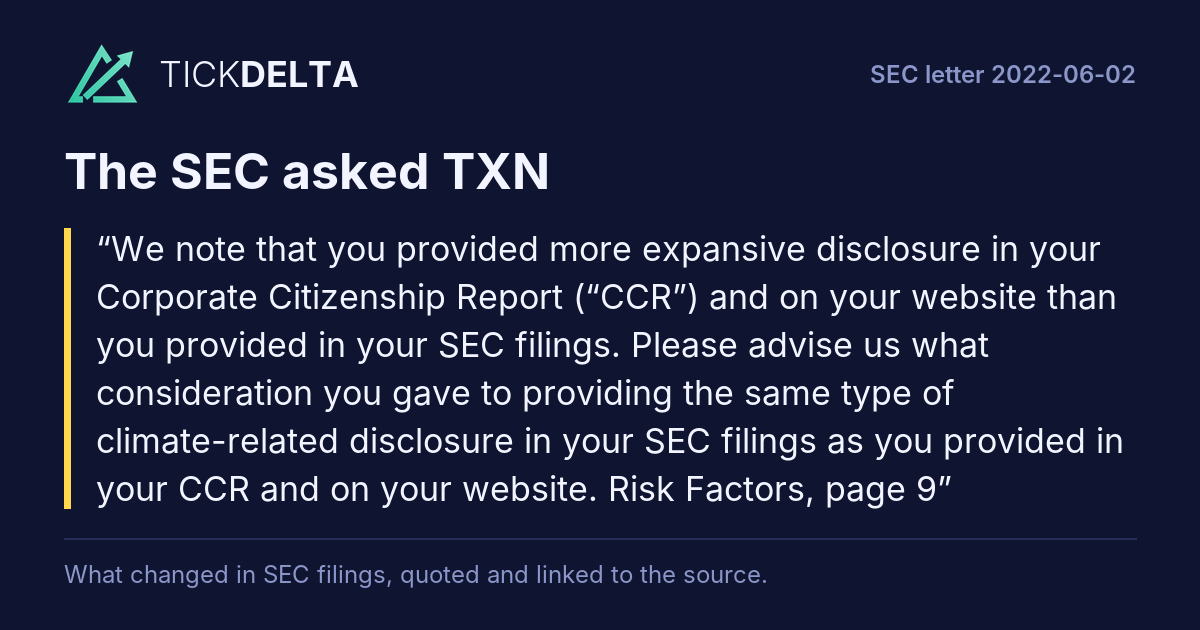
We note that you provided more expansive disclosure in your Corporate Citizenship Report (“CCR”) and on your website than you provided in your SEC filings. Please advise us what consideration you gave to providing the same type of climate-related disclosure in your SEC filings as you provided in your CCR and on your website. Risk Factors, page 9
As a publicly-traded, global manufacturing company with approximately 30,000 employees worldwide and over 100,000 customers, TI has a wide variety of stakeholders including employees, customers, suppliers, investors, community members, and others. TI’s teams solicit input from internal and external stakeholders throughout the year through regular engagement, and examine third-party sustainability assessments and benchmark disclosure trends and best practices.Read in the reply ↗Rest of the answer
TI then compares these inputs to company priorities to determine what topics and disclosures to include in the annual Corporate Citizenship Report. TI has published a Corporate Citizenship Report every year since 2010, and has been reporting on sustainability and environmental matters for several years before that. TI’s 2020 Corporate Citizenship Report (the
“2020 CCR”) addresses a range of topics that are important to various constituencies, including certain sustainability and environmental impact practices, and, together with TI’s website, speaks to TI’s broad audience of various stakeholders and provides disclosures on topics beyond those considered to have a material impact on the Company’s financial condition or results of operations as contemplated by SEC rules and regulations. As a result, the 2020 CCR and TI’s website include a wide variety of detailed information that is disclosed on a voluntary basis, and that is not required to be disclosed pursuant to applicable SEC rules and regulations. In fact, TI also explains in the 2020 CCR that the 2020 CCR includes “information that is not material to TI, but may be considered important to TI and to our stakeholders.”
TI prepares the information in its 2021 10-K and other SEC filings in accordance with Regulation S-K, Regulation S-X, Exchange Act Rule 12b-20, and the
SEC 2010 Guidance Regarding Disclosure Related Climate Change (the “2010 Guidance”). Additionally, in furtherance of TI’s disclosure controls and procedures, the appropriate TI subject matter experts and an internal cross-functional committee of senior management, some of whom are also included in the preparation and review of the 2020 CCR, meet on a quarterly basis and more frequently as appropriate for the preparation and review of TI’s SEC filings to confirm compliance with SEC disclosure requirements. As part of these processes,
TI concluded that for its 2021 10-K the climate-related disclosures in its 2020 CCR were not material to an understanding of its business or otherwise required by applicable SEC disclosure rules.
Even though the specific effects of climate change are not currently material to TI’s business under the SEC’s applicable disclosure standards for TI’s 2021 10-K, TI understands the potential effects of climate change and stakeholder interest in this topic. As it pertains to this question and the other questions below, we acknowledge our obligation to continuously review these matters as part of our ongoing disclosure controls and disclose climate-related matters in our SEC filings to the extent we determine it is required.
Risk Factors,
First report after the company's reply of 2022-06-29: 10-Q filed 2022-07-27 ↗, against the 10-Q filed 2022-04-27 ↗.
Tickdelta does not hold the text of both reports, so they are not compared here.
Disclose the material effects of transition risks related to climate change that may affect your business, financial condition, and results of operations, such as policy and regulatory changes that could impose operational and compliance burdens, market trends that may alter business opportunities, credit risks, or technological changes.Rest of the question
For example, your CCR appears to identify 300mm advanced analog manufacturing as a technological development related to climate change, noting its lower emissions and energy consumption versus older generation factories.
Like most companies,
TI is exposed to some transition risks related to climate change that may affect its business, financial condition, and results of operations.
TI considers transition risks as part of its risk management and SEC reporting processes, and as a result TI noted such transition risks relating to laws, rules, and regulations concerning climate change under the Risk Factors section of the 2021 10-K, within the Legal and Regulatory risks section.Read in the reply ↗Rest of the answer
There, TI disclosed that it is subject to complex laws, rules, and regulations affecting its domestic and international operations relating to, for example, the environment and climate change. As we noted in our 2021 10-K, if laws, rules, and regulations are or were to be amended or expanded, or new ones enacted, TI could incur greater compliance costs associated with climate change.
In addition to
TI’s SEC reporting process, TI assesses indirect consequences of climate-related regulation and business trends through both of its comprehensive business continuity program and enterprise risk management program, in which TI considers risks that could have a material impact to the Company’s financial condition or results of operations, including those risks associated with environmental issues.
These assessments are conducted with inputs from cross-functional subject matter experts and leaders within the Company who identify risks and opportunities, including with respect to policy and regulatory changes, reputational issues, market trends, credit risks, and technological changes. As an example, TI considers risks related to current and emerging regulations around the world. TI routinely monitors current, proposed, and emerging legislation, regulations, and policies in the regions in which TI operates, and assesses the current and potential impact of such regulations to TI’s operations. The evaluations performed through the business continuity program and enterprise risk management program are conducted regularly and when significant events occur. Through these processes, TI did not identify effects of any transition risks related to climate change that it believed would have a material impact to the Company’s financial condition or results of operations for TI’s 2021 10-K.
TI will continue to monitor the potential effects of transition risks related to climate change, including assessing whether specific regulatory, technological, market, or reputational risks attributable to climate-related developments present unique risks that are material to TI’s business, financial condition, or results of operations. If such risks are considered to have a material effect on its business, financial condition, or results of operations, TI will disclose such risks in future SEC filings, as required.
First report after the company's reply of 2022-06-29: 10-Q filed 2022-07-27 ↗, against the 10-Q filed 2022-04-27 ↗.
Tickdelta does not hold the text of both reports, so they are not compared here.
Disclose any material litigation risks related to climate change and explain the potential impact to the company.
TI does not have any material climate change-related litigation, and given the nature of TI’s business activities, TI does not expect such litigation to be a material risk. In compliance with Item 103 of Regulation S-K, TI discloses material legal proceedings in its Annual Reports on
Form 10-K and Quarterly Reports on Form 10-Q in the normal course. TI is involved in various inquiries and proceedings that arise in the ordinary course of business.Read in the reply ↗Rest of the answer
TI believes that the amount of its liability arising from climate change-related litigation, if any, will not have a material adverse effect upon TI’s financial condition, results of operations, or liquidity.
As part of TI’s
SEC reporting process, TI assesses the risk of material litigation, including litigation related to climate change, if any, by reviewing threatened or asserted claims against the Company and monitoring trends and developments in litigation and regulation. This continuing assessment involves coordination among litigation, environmental, and finance teams, who receive and review updates on pending litigation and regulatory matters on a regular basis, and communication with the appropriate senior management representatives to review and assess such developments. In addition, TI reviews its risk factor disclosures and identifies potentially material risks for consideration, including litigation risks. Based on these processes, TI has not identified material litigation risks related to climate change. Should this change and if TI becomes aware of material litigation risks related to climate change, TI will update its disclosures accordingly, as required.
First report after the company's reply of 2022-06-29: 10-Q filed 2022-07-27 ↗, against the 10-Q filed 2022-04-27 ↗.
Tickdelta does not hold the text of both reports, so they are not compared here.
It appears you have identified climate-related projects in your CCR, such as energy efficient projects to reduce greenhouse gas emissions. Tell us how you considered providing disclosure regarding past and future capital expenditures for climate-related projects. Include quantitative information for the periods covered by your Form 10-K and for future periods as part of your response.
In the 2020 CCR,
TI identified certain climate-related projects that illustrate actions that TI has taken or plans to take to reduce greenhouse gas emissions and operate a more sustainable business, and that would be of interest to a broad stakeholder audience that includes constituencies beyond investors, such as, employees, customers, suppliers, community members, and other interested parties.Read in the reply ↗Rest of the answer
The investment of resources and time in these projects is driven by a host of factors and considerations, and not necessarily by climate-related considerations alone.
In describing the various projects in the 2020 CCR, TI does not indicate that these projects were undertaken exclusively for the purpose of addressing climate change, nor does the inclusion of a project in the 2020 CCR imply that the cost of the project is material for
SEC reporting purposes. During the periods covered by the 2021 10-K, such capital expenditure projects identified in the 2020 CCR were not determined to be material. Please also reference the response to Comment 1, which further explains how TI determined the information in the 2020 CCR was not material, either individually or in the aggregate.
In considering materiality of an individual capital expenditure project, part of TI’s analysis involves considering the project’s cost as a percentage of TI’s total capital expenditures. In addition, TI considers whether the cost of the project is reasonably likely to result in a material impact to the Company’s financial condition or results of operations. Note that as stated in Page 11 of the 2020 CCR, TI implements more than 200 energy efficiency projects each year to reduce GHG emissions and energy costs. The largest of these projects, which related to the installation of fans resulting in energy savings, was a total expenditure of $1.2 million for
2021 (representing less than 0.05% of TI’s total capital expenditures for 2021 of $2.5 billion), and the total aggregate costs of such energy efficiency projects was approximately $6.8 million (or less than 0.28% of TI’s total capital expenditures for 2021 of $2.5 billion). However, none of these past or planned climate-related projects, individually or in the aggregate, involved material capital expenditures during the periods covered by the 2021 10-K, nor are they expected to require material future capital expenditures.
This assessment of materiality was based on TI’s internal process for reviewing and assessing capital expenditures, which involves a quarterly review of quantitative and qualitative information by senior management and leaders at the Company. In assessing whether a capital expenditure project is material, TI assesses the current and anticipated costs related to such project, and compares it to TI’s financial condition and results of operations, and determines whether it believes such expenditures have resulted in a material impact. Future business opportunities or circumstances may cause a change in the Company’s estimate of capital expenditures for climate-related projects.
In future filings, if applicable and material, TI will disclose capital expenditures, as required.
First report after the company's reply of 2022-06-29: 10-Q filed 2022-07-27 ↗, against the 10-Q filed 2022-04-27 ↗.
Tickdelta does not hold the text of both reports, so they are not compared here.
To the extent material, discuss the indirect consequences of climate-related regulation or business trends, such as the following: • decreased demand for goods or services that produce significant greenhouse gas emission or are related to carbon-based energy sources; • increased demand for goods that result in lower emissions than competing products; • increased competition to develop innovative new products thatRest of the question
result in lower emissions; • increased demand for generation and transmission of energy from alternative energy courses; • any anticipated reputational risk resulting from operations or products that produce material greenhouse gas emissions; and • potential climate-related opportunities, such as the development of semiconductors for use in technologies with lower energy consumption and greenhouse gas emissions.
With respect to its 2021 10-K, TI did not identify indirect consequences of climate-related regulation or business trends that had or are expected to have a material impact to the Company’s financial condition or results of operations. TI acknowledges the indirect consequences of climate change on its business, including those resulting from changes in regulation and other business trends, and has disclosed risks related to such consequences within the Risk Factors section of the 2021 10-K.Read in the reply ↗Rest of the answer
However, TI did not identify material indirect consequences during the periods covered by its 2021 10-K.
TI’s SEC reporting process, TI assesses indirect consequences of climate-related regulation and business trends through both of its comprehensive business continuity program and enterprise risk management program, in which TI considers risks that could have a material impact to the Company’s financial condition or results of operations, including those risks associated with environmental issues.
These assessments are conducted with inputs from cross-functional subject matter experts and leaders within the Company who identify risks and opportunities, including with respect to policy and regulatory changes, reputational issues, market trends, credit risks, and technological changes. As an example, TI considers risks related to current and emerging regulations. TI routinely monitors current, proposed, and emerging legislation, regulations, and policies in the regions in which TI operates, and assesses the current and potential impact of such regulations to TI’s operations. The evaluations performed through the business continuity program and enterprise risk management program are conducted regularly and when significant events occur. Through these processes, TI did not identify effects of any transition risks related to climate change that it believed would have a material impact to the Company’s financial condition or results of operations for TI’s 2021 10-K. Through these processes, TI did not identify material indirect consequences of climate-related regulation or business trends during the periods covered by its 2021 10-K.
Throughout the year, the Chief Executive Officer discusses risks with the Board, including TI’s approach to managing sustainability and other
ESG-related risks. TI’s Chief Financial Officer reviews the Company’s enterprise risk management process with the Audit Committee at least annually, and such information is also distributed to the Board. Where environmental, social, and governance (ESG)-related issues may have significance for TI, these matters are reviewed in the relevant Committee of the Board. TI believes this approach ensures that
ESG issues are overseen by the committee with the appropriate focus. For example, climate-related issues are reviewed with the Audit
Committee by the Vice President of Worldwide Environmental, Safety and Health. The Governance and Stockholder Relations (GSR) Committee of the Board also oversees ESG matters in connection with its responsibility to review public issues of interest to company stakeholders.
Management also provides updates to the
GSR Committee at least annually on shareholder policies and proposals regarding ESG matters that are relevant to the Company. As part of TI’s processes, various risks are assessed holistically for potential financial or strategic impact to the Company, taking into account the totality of the circumstances, including quantitative analyses of potential financial and operational impact as well as qualitative factors such as compliance with laws, pending regulations, and the potential effect on TI’s reputation. Management reviews each risk and opportunity and determines the course of action, as appropriate.
to monitor the indirect consequences of climate-related regulation or business trends, and, to the extent material to TI’s business, financial condition or results of operations, TI will disclose such consequences in future SEC filings, as required.
First report after the company's reply of 2022-06-29: 10-Q filed 2022-07-27 ↗, against the 10-Q filed 2022-04-27 ↗.
Tickdelta does not hold the text of both reports, so they are not compared here.
We note your disclosure that climate change might exacerbate natural occurrences such as severe weather or cause natural disasters to occur with greater frequency. Please discuss the physical effects of climate events on your operations and results, such as weatherrelated damages to your property or operations, and weather-related impacts on the cost or availability of insurance.Rest of the question
Include quantitative information with your response for each of the periods covered by your Form 10-K and explain whether increased amounts are expected in future periods. In addition, please discuss the potential for indirect weatherrelated impacts that have affected or may affect your major customers or suppliers.
During the periods covered by the 2021 10-K, TI did not experience physical effects of climate change that had a material impact to the Company’s financial condition or results of operations.
Like other global manufacturing companies, TI has facilities and other operations in locations subject to natural occurrences such as severe weather events that could disrupt operations in the various countries in which TI operates. As disclosed in the Risk Factors section of the 2021 10-K, climate change might exacerbate these occurrences or cause natural disasters to occur with greater frequency.Read in the reply ↗Rest of the answer
For instance, a natural disaster that results in a prolonged disruption, particularly where TI has principal manufacturing and design operations, may adversely affect TI’s results and financial condition. To illustrate with a quantitative example, in connection with a winter storm in Texas during February 2021, the largest expense at TI in connection with that storm was approximately $50 million in incremental utility costs, representing less than 1.0% of TI’s total cost of revenue of $5.97 billion in 2021. Consequently, this weather-related event was not material to TI during the periods covered by the 2021 10-K. This assessment is based on TI’s internal process for reviewing and assessing risks to TI, which involves a review of quantitative and qualitative information by the relevant subject matter experts and management, including in the context of TI’s overall financial condition and results of operations.
to insurance, TI has not experienced a lack of availability or a material increase in the cost of its insurance programs. As an illustrative example, in connection with a winter storm in Texas during February 2021, TI had approximately $200,000 of potentially insurable property damage overall and about $54 million of potentially insurable lost profit and fixed cost absorption overall relating to missed wafer starts in five fabrication facilities. Both of these potential claims were subject to a deductible, and neither was pursued under an insurance claim. For context, for 2021, the largest cost for insurance purchased by TI consisted of property insurance, with insurance premiums (excluding taxes and fees) costing about $29 million, and the amount spent by TI on insurance overall on an annual basis is approximately $34 million, or 0.4% of TI’s profit before income taxes for 2021 ($8.9 billion). Between 2019 and 2020, the amount spent by TI on insurance premiums (excluding taxes and fees) overall on an annual basis increased by approximately 10% from $29 million to $32 million, and between 2019 and 2020, increased by 6% from $32 million to $34 million. Accordingly, TI does not believe that any weather-related impacts on the cost or availability of insurance have caused or are reasonably likely to cause a material impact to TI’s financial condition or results of operation.
to the potential for indirect weather-related impacts that have affected or may affect TI’s major customers or suppliers, TI has not identified during the periods covered by the 2021 10-K any material risks relating to indirect weather-related impacts that would affect TI’s major customers or suppliers. This assessment is based, in part, on TI’s risk management processes, as well as
TI’s range of suppliers and customers (number and geography), breadth of portfolio and diversity and longevity of products and markets, all of which help mitigate the risk that any adverse weather event affecting a supplier or customer would have a material effect on TI as a whole. With respect to suppliers, TI purchases raw materials and supplies from numerous suppliers around the world. TI regularly assesses risks to its supply chain, whether anticipated (such as emerging regulations) or unexpected (such as natural disasters). TI also evaluates suppliers’ financial health and concentration to prevent or manage reputational issues, order fulfillment problems, shipping delays, or increased costs. To that end, TI requires that all suppliers maintain a business continuity plan in the event of a business interruption and make the contents of such plans available to TI upon request. TI also requires that suppliers communicate with TI and implement their business continuity plan within 24 hours of a triggering incident to maintain supply continuity. With respect to customers, the potential for indirect weather-related impacts that may affect TI’s major customers is potentially similar to that faced by other large global manufacturing companies with diversified offerings. The reach of TI’s market channels allows TI to sell its broad portfolio of approximately 80,000 products to over 100,000 customers.
More broadly, as a global organization, TI’s manufacturing footprint, supply chain and distribution network, together with its business continuity planning processes lessen the potential for an impact from climate-related physical risks such as weather-related damages to property or operations, and weather-related impacts on the cost or availability of insurance. TI operates an integrated multi-disciplinary business continuity program and enterprise risk management program which assess and manage risks at various levels of the organization to ensure that its businesses and operations are resilient. TI proactively monitors weather conditions that may become severe and impact its employees, facilities, or supply chain. The diversification of TI’s business operations, along with the actions that TI has already taken to ensure the efficiency of its operations, reduces TI’s exposure to physical climate-related risks. As a result of these processes,
TI did not identify material physical effects of climate change on its operations and results during the periods covered by the 2021
10-K.
to monitor the physical effects of climate change, and in the event TI experiences any such effects, TI will, in future filings, discuss the material physical effects of climate change on its operations and results, as required.
First report after the company's reply of 2022-06-29: 10-Q filed 2022-07-27 ↗, against the 10-Q filed 2022-04-27 ↗.
Tickdelta does not hold the text of both reports, so they are not compared here.
We note your disclosure on page 12 regarding the potential costs of compliance with laws and regulations, including those relating to the environment and climate change. Tell us about and quantify any compliance costs related to climate change for each of the periods covered by your Form 10-K and explain whether increased amounts are expected to be incurred in future periods.
Although annual costs of compliance with laws and regulations, including those relating to the environment and climate change, are expected to increase in future years with additional regulation in the United States and internationally, those compliance costs have not, to date, been material to TI.
Generally, TI’s actual and anticipated potential costs related to compliance with new climate change-related laws and/or regulations have largely comprised, and are anticipated to comprise, of costs related to its existing internal compliance programs, existing voluntary climate change-relatedRead in the reply ↗Rest of the answer
data gathering and reporting program, and outside fees for third parties TI engages. More specifically, incremental costs associated with climate change that TI has incurred generally include those for outside consultants, attorneys, as well as increased time allocations of various TI personnel, such as ESH, legal, accounting, IT and finance personnel, in connection with TI’s voluntary efforts and/or preparation for greenhouse gas emission and other similar reporting mandates.
For instance, while not mandated by any existing regulatory program, TI initiated a voluntary comprehensive climate change scenario analysis in 2021 to identify and assess potential risks to TI and opportunities associated with climate change. TI anticipates that this type of analysis could be an example of the type of incremental compliance cost associated with climate change in the future. To further illustrate with a quantitative example, with respect to assessing climate scenario analysis for purposes of TI’s voluntary reporting, not including increased time allocations of personnel outside of dedicated sustainability matters, the largest cost of engaging with a third-party consultant in 2021 to conduct the scenario analysis referenced above was approximately $240,000, representing less than 0.1% of TI’s operating and administrative costs and expenses of approximately $1.7 billion in 2021. Based on these considerations, the incremental cost is not material relative to the Company’s financial condition or results of operations.
In assessing whether there are material compliance costs related to new laws and/or regulations in response to climate change, TI assesses in part the current and anticipated costs related to compliance with such laws and/or regulations, and evaluates the impact to TI’s financial condition and results of operations,. TI does not believe these compliance costs have had a material impact to the Company’s financial condition or results of operations.
TI acknowledges that there is a potential risk that we could incur greater compliance costs arising from compliance with future laws or regulations in response to climate change (as noted in the Company’s risk factor titled “Risk Factors – Legal and regulatory risks
- Our operations could be affected by the complex laws, rules and regulations to which our business is subject.”). Should laws, rules and regulations be amended or expanded, or new ones enacted, TI could incur materially greater compliance costs associated with climate change. Some of these complex laws, rules and regulations –may particularly affect TI in the jurisdictions in which we manufacture products, especially if, for example, such laws and regulations require the addition or elimination of a material or process to or from our current manufacturing processes. As we further explain, a substitute for a prohibited material or process might not be available, or might not be available at reasonable cost. Such costs as they relate to future laws or regulations are currently unknown because such laws or regulations have yet to be created. TI believes it has adequately addressed the potential risk for compliance with future laws or regulations related to climate change in its risk factor described above.
As new laws and regulations become effective, TI will continue to assess the materiality of their impact and whether such impact would require disclosure under SEC rules and regulations.
First report after the company's reply of 2022-06-29: 10-Q filed 2022-07-27 ↗, against the 10-Q filed 2022-04-27 ↗.
Tickdelta does not hold the text of both reports, so they are not compared here.
If material, please provide disclosure about any purchase or sale of carbon credits or offsets and any material effects on your business, financial condition, and results of operations. Include quantitative information for the periods covered by your Form 10-K and for future periods as part of your response.
TI did not engage in purchases or sales of carbon credits or offsets during the periods covered by the 2021 10-K. Read in the reply ↗
First report after the company's reply of 2022-06-29: 10-Q filed 2022-07-27 ↗, against the 10-Q filed 2022-04-27 ↗.
Tickdelta does not hold the text of both reports, so they are not compared here.
We note your response to prior comment two. Please describe the specific transition risks you have considered, including those identified in our comment, and tell us about your evaluation of the material effects of such risks, providing support for your determinations of materiality.
As part of the processes noted in TI’s response to Comment 2 of the Company’s Initial Response Letter, TI did not identify any effects of transition risks that it believed would have a material impact on the Company’s financial condition or results of operations.
One of the transition risks TI considered is the effect of changing policies and regulations that could impose operational and compliance burdens.Read in the reply ↗Rest of the answer
Some laws, rules, and regulations may affect TI in the jurisdictions in which TI manufactures products, particularly if such laws and regulations require the use of abatement equipment beyond what TI currently employs or require the addition or elimination of a material or process to or from TI’s current manufacturing processes, which can increase our operating costs or require capital expenditures, or if such laws and regulations impose costs, fees, or reporting requirements on the direct or indirect use of energy, natural resources, or materials or gases used or emitted into the environment in connection with the manufacture of TI products. TI routinely monitors regulations and policies in the regions in which we operate to identify proposed revisions and amendments to such regulations and policies. Although compliance costs related to climate change are expected to increase in future years with additional regulation expected in the United
States and internationally, the impact of unknown or yet-to-be enacted laws and regulations cannot be predicted. In assessing materiality related to existing policy and regulatory changes in response to climate change, TI has assessed, in part, the current and anticipated costs related to compliance with such laws and regulations, and evaluated the impact to TI’s financial condition and results of operations. TI has interpreted “compliance costs” in this comment letter (and the Staff’s prior Comment 7) to mean the necessary costs incurred to comply with existing laws and regulations applicable to the Company with respect to climate change. For example, TI is required to annually report certain greenhouse gas emissions data to the Environmental Protection Agency. Similarly, the
SEC’s Guidance Regarding Disclosure Related to Climate Change outlines how SEC disclosure requirements apply to climate change matters. These requirements involve mostly costs for internal personnel, including personnel whose primary responsibilities fall outside of dedicated environmental sustainability matters, such as legal, accounting and finance personnel and, in some instances, external service provider fees and other miscellaneous expenses. During the periods covered by the 2021 10-K, TI determined that these compliance costs did not have a material impact to the Company’s financial condition or results of operations. In support of this assessment, TI notes that its total compliance costs related to climate change were estimated to represent less than 1.0% of the Company’s total selling, general, and administrative expenses for each of the years ended December 31, 2021 ($1.7 billion), 2020 ($1.6 billion) and 2019
($1.6 billion).
Another transition risk TI considered includes reputational risk resulting from increased attention on operations or products that produce greenhouse gas emissions. Assessment of this transition risk involved consideration of the potential for increased stakeholder concern or negative feedback that adversely affects TI’s reputation, which could result in loss of market share. The products that TI produces, semiconductors, which are electronic components that serve as the building blocks inside modern electronic systems and equipment, are not producers of greenhouse gas emissions in and of themselves. Also, semiconductors play a role in helping reduce the impact on the environment by, for example, making electric motors smarter and more efficient which helps reduce energy consumption, electrifying vehicles for a cleaner environment and sensing water and gas leaks that preserve natural resources. Operationally, as a manufacturer of billions of semiconductors a year, TI values manufacturing semiconductors efficiently and with a commitment to continuous improvement. TI’s investments in 300-millimeter advanced manufacturing facilities help to extend the Company’s cost advantage and give TI greater control of its supply chain, and at the same time, they enable the Company to reduce emissions per chip, and increase water and energy efficiency. Additionally, TI gauges its reputation in strategically addressing climate-related issues by engaging with its broad stakeholder base that includes investors, customers, suppliers, and employees. These activities serve to address and mitigate potential reputational concerns, and, to date, no significant reputational concerns have been identified through these interactions. Similarly, TI’s long history of annual sustainability and climate reporting helps to mitigate the reputation risk that other companies that may not disclose as often or with as much information may experience. In consideration of the above factors, during the periods covered by the 2021 10-K, TI determined that the reputational risk associated with increased attention on climate change did not have a material impact to the Company’s financial condition or results of operations.
Finally, another transition risk TI considered includes market trends that may alter business opportunities. TI considers the market’s increasing development of new technologies with lower energy consumption and lower greenhouse gas emissions to potentially alter business opportunities for TI in light of those technologies’ potential use of semiconductors. In particular, market opportunities exist and may grow in connection with electric vehicles, solar panels, charging infrastructure, and other such new and alternative technologies. However, these opportunities are driven by a host of complex factors occurring in a broad and dynamic global context, in which climate change considerations are one of many factors in play. For instance, even assuming a significant rate of adoption of semiconductors in technologies with lower energy consumption and greenhouse gas emissions, it is anticipated to be a number of years before any such technology would be expected to displace established technologies in which semiconductors are not used. Similarly, advances in the global supply chain and electrical grid infrastructure would be needed to keep pace with the supply chain, manufacturing, and repair demands required to see one or all of the current alternative technologies outpace current technologies.
Also, the demand for rare earth minerals used in such technologies could temper growth until further design or innovation can overcome resource and budgetary constraints. Moreover, in the absence of multi-jurisdictional regulatory mandates requiring adoption of such new technologies, the fractious regulatory environment at a domestic and international level will continue to be a potential inhibitor to broad and consistent adoption of such technologies, and consequently, for demand for semiconductor products in such technologies. In consideration of the above factors, during the periods covered by the 2021 10-K, TI determined that these market trends did not have a material impact to the Company’s financial condition or results of operations.
TI will continue to monitor the potential effects of transition risks related to climate change. If such risks are considered to have a material effect on its business, financial condition, or results of operations, TI will disclose such risks in future SEC filings, as required.
First report after the company's reply of 2022-08-01: 10-Q filed 2022-10-26 ↗, against the 10-Q filed 2022-04-27 ↗.
Tickdelta does not hold the text of both reports, so they are not compared here.
We note that your response to prior comment four includes quantitative information solely in relation to 2021, and accordingly reissue it in part. Please provide us with quantitative information regarding past and future capital expenditures for climate-related projects for each of the periods covered by your Form 10-K and for future periods.
TI acknowledges the Staff’s comment, and confirms that for the reasons explained in more detail in Comment 4 of the Company’s Initial Response
Letter, climate-related projects referenced in the Company’s Initial Response Letter and below, individually and in the aggregate, did not involve material amounts of capital expenditures during the periods covered by the 2021 10-K, nor are they expected to require material amounts of capital expenditures in future periods.
As requested by the Staff, TI respectfully submits that in regard to capital expenditures for energy efficiency projects toRead in the reply ↗Rest of the answer
reduce greenhouse gas emissions and energy costs referenced in the Company’s Corporate Citizenship Reports for 2021, 2020, and 2019, the aggregate amounts of such projects were estimated to represent less than 1.0% of the Company’s total capital expenditures for each of the years ended
December 31, 2021 ($2.5 billion), 2020 ($649 million), and 2019 ($847 million). For 2022, TI anticipates a similar level of expenditures for such projects in proportion to the Company’s total capital expenditures.
Apart from these projects, TI manufactures billions of chips per year and believes it is critical for TI to drive efficiencies in the Company’s fabrication process. As TI continues to expand its 300-millimeter manufacturing facilities and related advanced technology in these facilities, which are being designed and operated to optimize energy efficiency, the efficiencies recognized will continue to positively impact the
Company’s environmental footprint.
First report after the company's reply of 2022-08-01: 10-Q filed 2022-10-26 ↗, against the 10-Q filed 2022-04-27 ↗.
Tickdelta does not hold the text of both reports, so they are not compared here.
Your response to prior comment five appears to be conclusory in nature without providing sufficient detail regarding the indirect consequences of climate-related regulation or business trends, including the specific items noted in our comment, and your assessment thereof. Please more fully describe the indirect consequences of climate change and tell us how you concluded they were not material.Rest of the question
Provide support for your assessment, such as the quantitative analyses and qualitative factors referenced in your response.
With respect to the 2021 10-K, TI did not identify any indirect consequences of climate-related regulation or business trends that had or are reasonably expected to have a material impact to the Company’s financial condition or results of operations. TI acknowledges and has disclosed actual and potential risks related to the indirect consequences of climate-related regulation or business trends within the Risk Factors section of the 2021 10-K.Read in the reply ↗Rest of the answer
However, TI did not identify material indirect consequences during the periods covered by its 2021 10-K.
by the Staff, set forth below is TI’s response to each of the individual items referenced in the Staff’s prior comment 5:
• decreased demand for goods or services that produce significant greenhouse gas emission or are related to carbon-based energy sources;
• increased demand for goods that result in lower emissions than competing products;
TI did not experience decreased demand for goods or services as a result of customers indicating that TI’s products produce significant greenhouse gas emissions or are related to carbon-based energy sources, nor increased demand for goods that result in lower emissions than competing products. During the periods covered by the 2021 10-K, the Company attributed changes in demand to broad-based demand across industrial, automotive and personal electronics markets (in 2021), to global impacts from the COVID-19 pandemic (in 2020), and to an uncertain macro-economy that impacted our customers’ end demand (in 2019). The Company continuously monitors demand for TI products and the reason for changes through a wide variety of means, which includes communicating regularly with customers, monitoring forecasts, sales, shipment volumes, channel mix, and inventory levels, among other factors. TI has observed that of its over 100,000 customers, there are customers that consider energy or emissions-related criteria such as energy intensity when selecting TI products. However, TI notes that there are many underlying business reasons that can impact demand for TI products, which can include product portfolio breadth, the strength and reach of channels to market, technological innovation, product development execution, technical support, customer service, quality, reliability, price, and manufacturing capacity and capabilities, among other factors. To date, there is not a significant discernable demand related to whether TI’s products produce significant greenhouse gas emissions or are related to carbon-based energy sources, nor a discernable trend of customers changing their demand for products for the purpose of achieving lower emissions than competing products.
Instead, TI believes long term secular growth is driven by increase semiconductor content per system, especially in the industrial and automotive markets, combined with TI’s competitive advantages. These competitive advantages include the breadth of the Company’s portfolio, the reach of our market channels, the Company’s strong manufacturing footprint, and the diversity and longevity of the
Company’s products, markets, and customer positions. As such, TI believes these are the important and primary drivers and considerations to TI customers in their product selection and design-in process.
competition to develop innovative new products that result in lower emissions;
TI has a long-standing commitment to be innovative and responsible and have sustainable manufacturing with a focus on improving energy efficiency, reducing greenhouse gas emissions, reducing waste, and reusing more water. For example, in its Corporate Citizenship Report for 2021, TI reported a year-end goal by 2025 of a 50% reduction in energy intensity per chip from a 2015 base year, and reported progress by year-end 2021 of a 33% reduction in energy intensity per chip. TI believes these efforts result in less energy used in connection with the manufacturing of TI products, and therefore, fewer associated emissions. While there is some level of demand for products that use less energy for the purpose of achieving lower emissions, and some related competition among manufacturers to produce such products, TI faces competition to develop technological solutions that help serve all of our customers’ semiconductor needs, which include energy efficiency needs apart from lowering emissions. For example, customers of TI’s Analog Power business look to TI to help solve key power efficiency design challenges such as increasing power density, extending battery life and enhancing power and signal integrity. These power solutions help customers lower costs, decrease system size and make systems safer, among other things, in addition to any climate change-related benefits. Beyond power management, TI’s broad portfolio of approximately 80,000 products helps TI’s customers accurately sense, condition, measure and transmit data, and provides the core control or processing in their electronic systems. As TI disclosed in the Risk Factors section of the 2021 10-K, within the ”Risks related to our business and industry” section, TI faces intense technological and pricing competition in the markets in which TI operates. TI expects this competition will continue to increase from large competitors and from small competitors serving niche markets, and also from emerging companies, particularly in Asia, that sell products into the same markets in which TI operates.
Certain competitors possess sufficient financial, technical and management resources to develop and market products that may compete favorably against TI’s products, and consolidation among TI competitors may allow them to compete more effectively. As such, while the development of innovative new products that result in lower emissions may be a subject of increasing competition, based on the Company’s experience,
TI believes the other factors described above play a larger role in the competitive dynamics in TI’s business.
demand for generation and transmission of energy from alternative energy sources;
As a component manufacturer of semiconductor products, the demand for generation and transmission of energy from alternative energy sources is not a risk that is particularly relevant or impactful to the Company’s business because the manufacturing of semiconductor components does not involve the generation or transmission of energy. As such, during the periods covered by the 2021 10-K, TI did not experience an increased demand for generation and transmission of energy from alternative sources as it relates specifically to TI products or services.
As reported in its Corporate Citizenship Report for 2021, TI has taken a range of actions to reduce emissions, which include the use of alternative gases and chemicals, installation of emissions abatement devices, the purchase of electricity from renewable energy sources, the optimization of product manufacturing, shipping and distribution, the avoidance of unnecessary business travel, and the subsidization of employee commuting at certain sites. TI has also reported a long-term goal by year-end 2025 of a 25% reduction in absolute scope 1 and scope 2 emissions from a 2015 base year, and reported progress by year-end 2021 of an 18.6% reduction of greenhouse gas emissions.
• potential climate-related opportunities, such as the development of semiconductors for use in technologies with lower energy consumption and greenhouse gas emissions.
TI considers the market’s increasing development of new technologies with lower energy consumption and lower greenhouse gas emissions, to potentially alter business opportunities for TI in light of those technologies’ potential use of semiconductors. In particular, market opportunities exist and may grow in connection with electric vehicles, solar panels, charging infrastructure, and other such new and alternative technologies.
However, these opportunities are driven by a host of complex factors occurring in a broad and dynamic global context, in which climate considerations are one of many factors in play. We respectfully refer the Staff to Comment 1 in this letter, which discusses in further detail the factors supporting this assessment, including timing considerations relating to the adoption of such technologies, advances needed to support expected demands, potential limiting factors such as the demand for rare earth minerals and the absence of multi-jurisdictional regulatory mandates, as well as the availability of other clean energy alternatives.
• any anticipated reputational risk resulting from operations or products that produce material greenhouse gas emissions.
reputational risk resulting from increased attention on operations or products that produce greenhouse gas emissions. We respectfully refer the Staff to Comment 1 in this letter, which discusses in further detail the factors supporting this assessment, including the role semiconductors play in helping reduce the impact on the environment, TI’s investments in 300-millimeter advanced manufacturing facilities, how TI gauges its performance and reputation in strategically addressing climate-related issues by engaging with its broad stakeholder base, and TI’s long history of annual sustainability and climate reporting.
For all the reasons discussed above in each of the items requested to be addressed by the Staff, during the periods covered by the 2021 10-K, TI believes it has not experienced any material indirect consequences of climate-related regulation or business trends. Further, TI does not expect that any such consequences (should they materialize) are reasonably likely to have a material impact to the Company’s financial condition or results of operations.
to monitor the indirect consequences of climate-related regulation or business trends, and, to the extent material to TI’s business, financial condition or results of operations, TI will disclose such consequences in future SEC filings, as required.
First report after the company's reply of 2022-08-01: 10-Q filed 2022-10-26 ↗, against the 10-Q filed 2022-04-27 ↗.
Tickdelta does not hold the text of both reports, so they are not compared here.
We note your response to prior comment six. Please further address the following: • Include the quantification requested by our comment on an aggregate basis, rather than for a quantitative or illustrative example, for each of the periods covered by your Form 10-K and explain whether increased amounts are expected in future periods.Rest of the question
• Clarify your quantification regarding the cost of insurance premiums and insurance overall in each of the years 2019, 2020, and 2021. • Your response indicates that you incurred "$54 million of potentially insurable lost profit and fixed cost absorption overall relating to missed wafer starts in five fabrication facilities" as a result of the winter storm in Texas, which was subject to a deductible and not pursued under an insurance claim. Tell us whether your decision not to pursue an insurance claim was related to anticipated potential effects on the future cost and/or availability of insurance.
the Staff’s comment, and confirms that during the periods covered by the 2021 10-K, TI did not experience any physical effects of climate change that had a material impact to the Company’s financial condition or results of operations.
to weather-related damages to TI’s property or operations, such amounts were estimated to represent less than 2.0% of the Company’s total cost of revenue for each of the years ended December 31, 2021 ($6 billion), 2020 ($5.2 billion), and 2019 ($5.2 billion).Read in the reply ↗Rest of the answer
Costs related to any past weather events are not expected to increase significantly in future periods.
to the cost or availability of insurance, the cost of insurance premiums were estimated to represent less than 1.0% of the Company’s profit before income taxes for each of the years ended December 31, 2021 ($8.9 billion), 2020 ($6.0 billion), and 2019 ($5.7 billion).
To clarify the Company’s quantification regarding the cost of insurance premiums, the aggregate amount spent by TI on insurance premiums on an annual basis was approximately $29 million in 2019, $32 million in 2020, and $34 million in 2021, as described in Comment
6 of the Company’s Initial Response Letter. These items included the cost of premiums as quoted for insurance coverage for certain items such as property, casualty, and certain other risks. The cost of insurance overall, which includes these premiums, as well as taxes and certain fees, actually paid, was approximately less than $1 million higher for each year.
to the potentially insurable claims described in Comment 6 of the Company’s Initial Response Letter, TI’s decision not to pursue that insurance claim was not related to the anticipated potential effects on the future cost or availability of insurance. It was a business decision that was driven by a variety of factors, primarily the administrative effort involved in pursuing the claim in light of the likelihood of recoverability and, if successful, the relatively small net difference between the total estimated insurable amount of the event and the applicable deductible.
For the reasons explained in more detail in Comment 6 of the Company’s Initial Response Letter, and above, TI does not believe that any weather-related impacts on the cost or availability of insurance have caused or are reasonably likely to cause a material impact to TI’s financial condition or results of operation. TI will continue to monitor the physical effects of climate change, and in the event TI experiences any such effects, TI will, in future filings, discuss the material physical effects of climate change on its operations and results, as required.
First report after the company's reply of 2022-08-01: 10-Q filed 2022-10-26 ↗, against the 10-Q filed 2022-04-27 ↗.
Tickdelta does not hold the text of both reports, so they are not compared here.
Please revise your response to prior comment seven to quantify your compliance costs related to climate change on an aggregate basis, rather than for a quantitative example, for each of the periods covered by your Form 10-K.
the Staff’s comment and notes that TI’s total compliance costs related to climate change were estimated to represent less than 1.0% of the Company’s total selling, general, and administrative expenses for each of the years ended December 31, 2021 ($1.7 billion), 2020 ($1.6 billion) and 2019 ($1.6 billion).Read in the reply ↗Rest of the answer
TI has interpreted “compliance costs” in this comment letter (and the Staff’s prior Comment 7) to mean the necessary costs incurred to comply with laws and regulations applicable to the Company with respect to climate change.
If and when new laws and regulations related to climate change are enacted, TI will assess the materiality of their impact and whether such impact would require disclosure under SEC rules and regulations.
First report after the company's reply of 2022-08-01: 10-Q filed 2022-10-26 ↗, against the 10-Q filed 2022-04-27 ↗.
Tickdelta does not hold the text of both reports, so they are not compared here.
Also in this review: closing letter, 2022-08-23