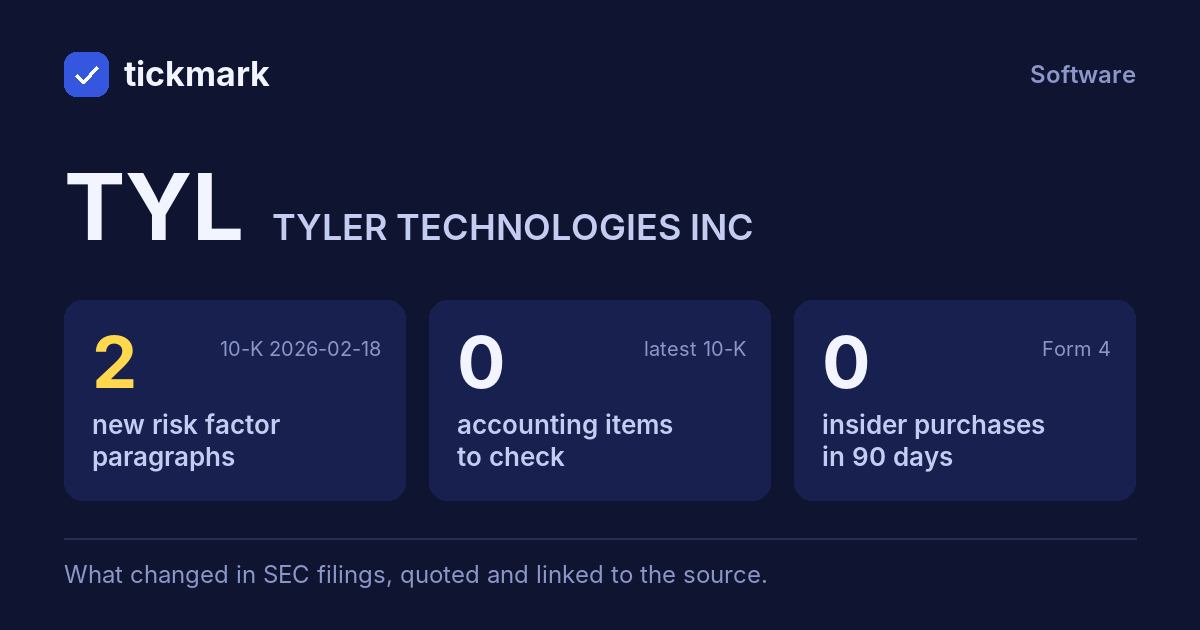
Sentences and paragraphs of TYL's Risk Factors and MD&A, 10-K 2026-02-18 against 10-K 2025-02-19.
Each links to the text at sec.gov.
AddedRisk Factors
We must timely adapt to and implement technological changes to be remain competitive.
Read it in 10-K 2026-02-18 at sec.gov ↗
AddedRisk Factors
•Announcements of technological innovations, new products, or new contracts by us or our competitors, including uncertainties surrounding new and evolving artificial intelligence tools that could be perceived automate functions that may reduce the demand for certain products and services
Read it in 10-K 2026-02-18 at sec.gov ↗
AddedMD&A
On December 2, 2025, we acquired Edu.Link, Inc. (“Edulink”). Edulink is a SaaS company focused on educator evaluation, performance management, professional development, and compliance tracking geared specifically to the unique needs of K-12 schools. The total cash purchase price, net of cash acquired of $716,000, was approximately $37.3 million, subject to certain post-closing adjustments, including holdbacks of $2.5 million.
Read it in 10-K 2026-02-18 at sec.gov ↗
AddedMD&A
On November 19, 2025, we acquired CloudGavel, LLC (“CG”). CG is a SaaS company specializing in cloud electronic warrant solutions that allows for real time interaction for judges and law enforcement personnel. The total cash purchase price, net of cash acquired of $147,000, was approximately $16.6 million, subject to certain post-closing adjustments, including holdbacks of $2.9 million.
Read it in 10-K 2026-02-18 at sec.gov ↗
AddedMD&A
On July 28, 2025, we acquired Emergency Networking, Inc. (“EN”). EN is a SaaS company specializing in cloud-native software for fire departments and emergency medical services agencies. The total cash purchase price, net of cash acquired of $497,000, was approximately $19.4 million, subject to certain post-closing adjustments, including holdbacks of $2.5 million.
Read it in 10-K 2026-02-18 at sec.gov ↗
AddedMD&A
On January 31, 2025, we acquired MyGov, LLC (“MyGov”), a provider of SaaS platform solutions for community development. The total cash purchase price, net of cash acquired of $215,000, was approximately $18.2 million.
Read it in 10-K 2026-02-18 at sec.gov ↗
AddedMD&A
ARR was $2.06 billion and $1.86 billion for the periods ending December 31, 2025, and 2024, respectively. ARR increased approximately 11% compared to the prior period primarily due to an increase in subscriptions revenue resulting from an ongoing shift toward SaaS arrangements for both new and existing clients and expansion in transaction-based fee arrangements.
Read it in 10-K 2026-02-18 at sec.gov ↗
AddedMD&A
Any adverse change in these factors or changes in estimates could have a significant impact on the recoverability of goodwill or other intangible assets.
Read it in 10-K 2026-02-18 at sec.gov ↗
Show the other 6
AddedMD&A
Professional services revenue decreased 8% compared to the prior period. The decrease is primarily due to loss reserves related to agencies within two state governments. The remainder of the decrease in professional services revenues compared to the prior period is related to an intentional reduction in custom development work as well as efficiencies in the delivery of professional services.
Read it in 10-K 2026-02-18 at sec.gov ↗
AddedMD&A
In 2025, the cost of subscriptions, maintenance and professional services grew 3% compared to the prior period. The increase is primarily due to a $25.4 million increase in merchant fees and other third-party fees related to higher transaction volumes, a $21.0 million increase in hosting costs, and a $4.8 million increase in stock-based compensation expense. The increase was partially offset by the redeployment of resources to research and development due to continued migration of clients to our SaaS products and the consolidation of versions of on-premises software products with support obligations.
Read it in 10-K 2026-02-18 at sec.gov ↗
AddedMD&A
The increase of 21% in the ES segment operating income in 2025 is primarily due to the $215.0 million increase in subscription revenues as a result of the ongoing shift toward SaaS arrangements for both new and existing clients, along with growth in certain transaction-based revenues from new and existing customers. The increase is partially offset by lower revenues of $34.0 million compared to prior period from software licenses, maintenance, and professional services, including a loss reserve of approximately $9.7 million of remaining exposure related to a contract dispute previously disclosed. Also partially offsetting the increase in segment operating income is an increase in total personnel expense of $22.1 million and an increase in total hosting costs of $18.2 million compared to the prior period.
Read it in 10-K 2026-02-18 at sec.gov ↗
AddedMD&A
The decrease of 9% in the PT segment operating income in 2025 is primarily due to loss reserves of approximately $10.7 million for two state contracts, primarily impacting lower revenue from professional services, as well as higher merchant fees. Somewhat offsetting the decline in the PT segment operating income is an increase in subscription revenues compared to prior period.
Read it in 10-K 2026-02-18 at sec.gov ↗
AddedMD&A
See Note 2 “Segment and Related Information” for a reconciliation between our operating segment and consolidated financial results for the periods presented.
Read it in 10-K 2026-02-18 at sec.gov ↗
AddedMD&A
On July 4, 2025, the reconciliation bill, commonly referred to as the One Big Beautiful Bill Act (“OBBBA”) was signed into law. The OBBBA includes a broad range of tax reform provisions that may affect our Company. The OBBBA allows an elective deduction for domestic Research and Development (“R&D”), a reinstatement of elective 100% first-year bonus depreciation, and a more favorable tax rate on Foreign-Derived Deduction Eligible Income and income from non-U.S. subsidiaries (“Net CFC Tested Income”), among other provisions. In 2025, we recognized the effects of the OBBBA, which resulted in a $72.9 million decrease in our deferred tax asset associated with capitalized research and experimental expenditures and a corresponding reduction in current income tax liabilities. The legislation did not have a material impact on our income tax expense for 2025.
Read it in 10-K 2026-02-18 at sec.gov ↗