RemovedRisk Factors
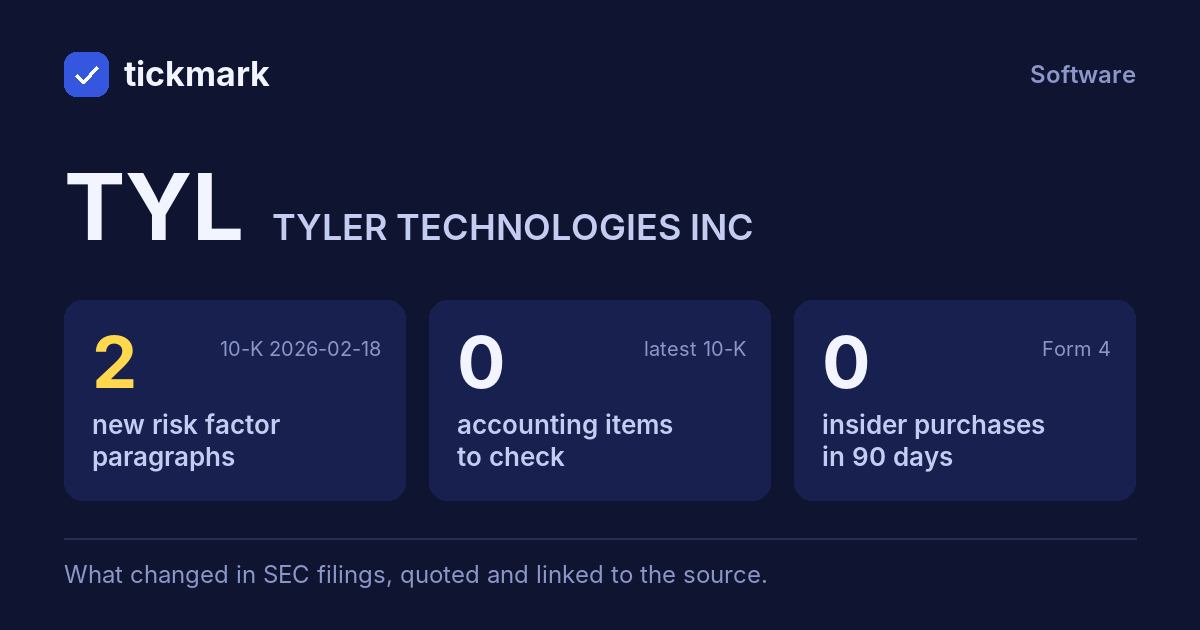
TYLTyler Technologies
Tyler Technologies, Inc. (“Tyler” or “Company”) is a leading provider of integrated software and technology management solutions for the public sector. 10-K, Item 1
- Employees
- 7,800
- Headquarters
- Plano, TX
- CEO
- H. Lynn Moore Jr
- Next results
- around Feb 10, 2027
10-K 0000860731-26-000016 (2026-02-18) vs 10-K 0000860731-25-000007 (2025-02-19)
| Section | Compared text | Words now | Changed |
|---|---|---|---|
| Risk Factors | Item 1A | 7,812 | 7.4% |
| MD&A | Item 7 | 7,658 | 26.1% |
| Legal Proceedings | Item 3 | 185 | 4.7% |
| Accounting Policies | 10-K text (note not found) | 0 | not compared |
The redline: what was cut and what was added
In each section, the paragraph that changed most, marked against last year's 10-K:
cut words struck through, new words highlighted and underlined.
MD&A 176 words changed in this paragraph; it is 35% similar to last year's version.
Goodwill and Other Intangible Assets. We perform an impairment assessment annually on October 1, or more frequently if indicators of potential impairment exist, which includes evaluating qualitative and quantitative factors to assess the likelihood of an impairment of each reporting unit’s goodwill. If the conclusion of an impairment assessment is that it is more likely than not that the fair value of Qualitative factors include general economic conditions, market conditions, actual or expected financial performance, a sustained decrease in share price or other changes in the reporting unit is more than its carrying value, goodwill is not considered impaired, units that are judgmentally weighted. Quantitative factors may include estimates of future revenues, operating costs, and we are not required to perform capital costs, growth rates, and discount rates reflecting the quantitative goodwill impairment test. If the conclusion judgmental assessment of an impairment assessment is that it is more likely than not that the fair value is less than its carrying value, we perform the quantitative goodwill impairment test, which compares the fair value of the reporting unit to its carrying value. Impairments, if any, are based on the excess of the carrying amount over the fair value. There have been no impairments to goodwill risk in any of the periods presented. See Note 8, “Goodwill and Other Intangible Assets,” for additional information. those assumptions.
Source: Item 7, 10-K 0000860731-26-000016 vs Item 7, 10-K 0000860731-25-000007
Risk Factors 79 words changed in this paragraph; it is 86% similar to last year's version.
Many of our product and service offerings incorporate proprietary information, trade secrets, know-how, and other intellectual property rights. We rely on a combination of contracts, contract rights, copyrights, and trade secret laws to establish and protect our proprietary rights in our technology. We cannot be certain that we have taken all appropriate steps to deter misappropriation of our intellectual property, including to the extent our data is consumed by generative artificial intelligence technology. There has also been an apparent evolution a recent change in the legal standards and regulations that courts and the U.S. patent office may apply in favorably evaluating software patent rights. rights (see the United States Patent and Trademark Office Memorandum dated December 5, 2025 to the Patent Examining Corp from Charles Kim, Deputy Commissioner for Patents regarding the advance notice of change to the Manual of Patent Examining Procedure in light of Ex Parte Desjardins, Appeal No. 2024-000567 (PTAB September 26, 2025, Appeals Review Panel Decision)). We are not currently involved in any material intellectual property litigation; however, we may be a party to such litigation in the future to protect our proprietary information, trade secrets, know-how, and other intellectual property rights. We cannot assure you provide assurance that third parties will not assert infringement or misappropriation claims against us with respect to current or future products. Any claims or litigation, with or without merit, could be time-consuming, costly, and a diversion to divert the time and attention of management. Any such claims and litigation could also cause product shipment delays or require us to enter into royalty or licensing arrangements. Such royalty or licensing arrangements, if required, may not be available on terms acceptable to us, if at all. Therefore, litigation to defend and enforce our intellectual property rights could have a material adverse effect on our business, regardless of the final outcome of such litigation.
Source: Item 1A, 10-K 0000860731-26-000016 vs Item 1A, 10-K 0000860731-25-000007
Legal Proceedings 13 words changed in this paragraph; it is 95% similar to last year's version.
The client was unresponsive to our outreach for several months, and on August 23, 2022, we filed a lawsuit to enforce our rights and remedies under the applicable contractual arrangement. The client subsequently asked us to negotiate directly with the client to attempt to resolve the dispute. The negotiations were not successful, and on March 20, 2024, we reinitiated our lawsuit. A December 2025 mediation did not result in a resolution of the dispute. Although we believe our products and services were delivered in accordance with the terms of our contract and that we are entitled to payment in connection with the termination for convenience, at this time the matter remains unresolved. We can provide no assurances that we will not incur additional costs as we pursue our rights and remedies under the contract.
Source: Item 3, 10-K 0000860731-26-000016 vs Item 3, 10-K 0000860731-25-000007
Every change, by type
Sentences and paragraphs of TYL's Risk Factors and MD&A, 10-K 2026-02-18 against 10-K 2025-02-19. Each links to the text at sec.gov.
RemovedRisk Factors
RemovedRisk Factors
RemovedRisk Factors
RemovedRisk Factors
RemovedRisk Factors
RemovedRisk Factors
RemovedRisk Factors
RemovedMD&A
RemovedMD&A
RemovedMD&A
RemovedMD&A
RemovedMD&A
Work on TYL in a spreadsheet:
Excel workbook (a sheet per section, ten years by column, charts, links to the filings) ·
CSV.
For a Google Sheet that stays up to date, paste =IMPORTDATA("https://tickdelta.com/company/TYL/export.csv") into a cell.