tickdelta
Sign in

Tickdelta is free for now. Sign up and get Pro free

← Screener

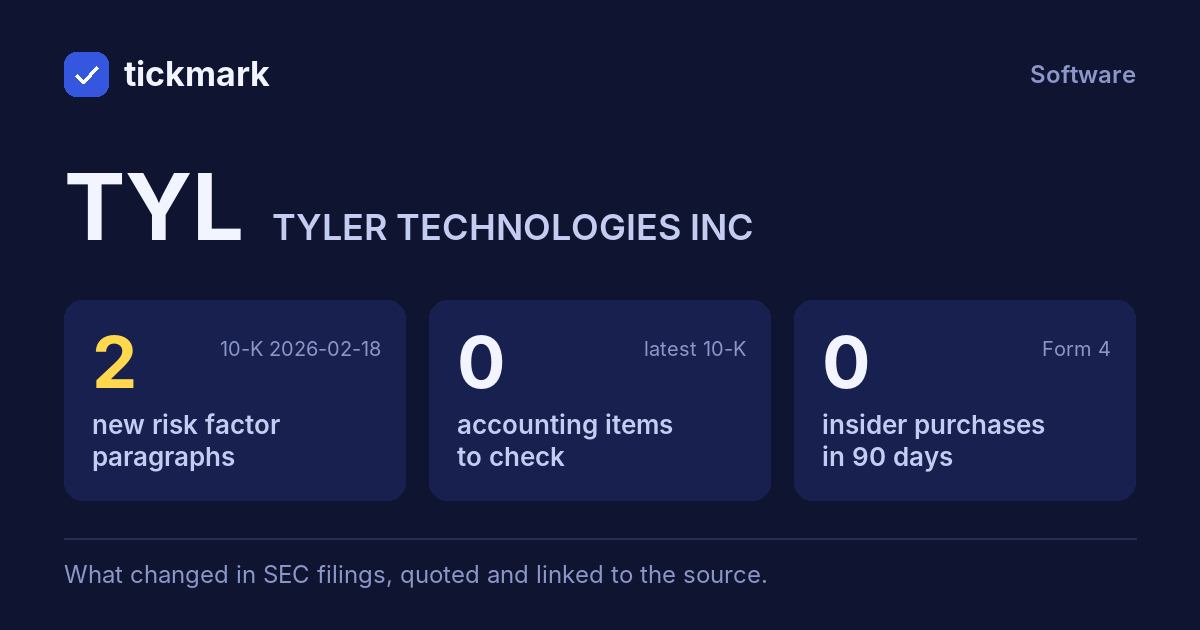
TYLTyler Technologies

Technology · Software · NYSE

Tyler Technologies, Inc. (“Tyler” or “Company”) is a leading provider of integrated software and technology management solutions for the public sector. 10-K, Item 1

Employees
7,800
Headquarters
Plano, TX
CEO
H. Lynn Moore Jr
Next results
around Feb 10, 2027
Compare with peers → Embed

When the SEC's staff reviews a filing, it writes to the company with numbered questions, and the company answers each one in a letter. SEC publishes the exchange once the review is over, at least 20 business days later. Below: what the staff asked TYL, and the company's answer to each question, quoted from the letters. A question is not an accusation; most reviews end with the company adding detail to its next filing.

Form 10-K for the Fiscal Year Ended December 31, 2024

2025-04-07 to 2025-05-05 · 1 question · 1 letter from the SEC, 1 from the company
Review closed 2025-05-05
RevenueNon-GAAP measuresSegmentsResults discussion (MD&A)Income taxes
Management’s Discussion and Analysis of Financial Condition and Results of Operations · Analysis of Results of Operations and Other, page 32
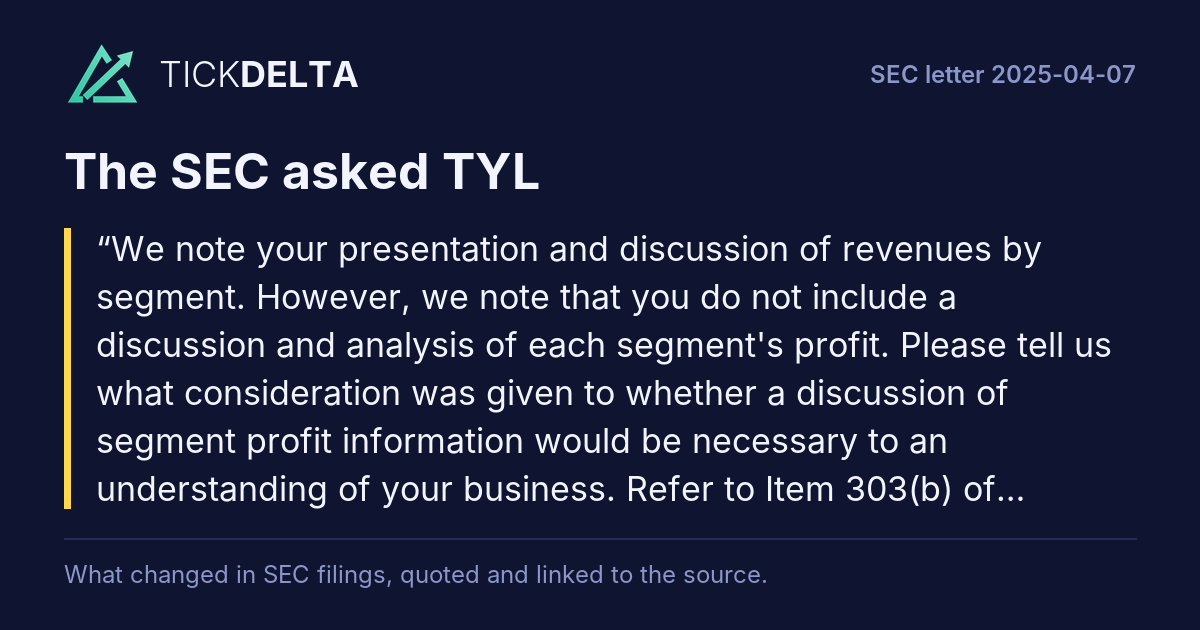
SEC asked
We note your presentation and discussion of revenues by segment. However, we note that you do not include a discussion and analysis of each segment's profit. Please tell us what consideration was given to whether a discussion of segment profit information would be necessary to an understanding of your business. Refer to Item 303(b) of Regulation S-K.
Rest of the question

Consolidated Financial Statements Note (2) Segment and Related Information, page F-16 You disclose that the primary measure used by the chief operating decision maker (“CODM”) is segment income or loss from operations; however, we note that you also present segment gross profit. Please tell us whether the CODM receives segment gross profit for each reportable segment and how it is used. If the CODM uses more 2. than one measure of segment profit or loss, such as segment gross profit and segment operating income, to assess segment performance and to decide how to allocate resources, tell us which of the reported segment profit or loss measures is required to be disclosed in accordance with ASC 280-10-50-28A. In this regard, the measure required to be disclosed is that which management believes is determined in accordance with the measurement principles most consistent with those used in measuring the corresponding amounts in the consolidated financial statements. Additional measures may be disclosed pursuant to ASC 280-10-50-28A through 5028C. 3. In connection with your response to the preceding comment, if both segment gross profit and segment operating income are used by the CODM and will be disclosed: • Please tell us how you considered the disclosures required by ASC 280-10-5029(f) for segment gross profit; and • Please tell us what consideration was given to identifying the additional measure of segment profit or loss as non-GAAP and providing the disclosures required by Item 10(e)(1)(i) of Regulation S-K in the filing. 4. Please revise future filings to reconcile the total of the reportable segments’ amount for each measure of profit or loss to consolidated income before income taxes. Refer to ASC 280-10-50-30(b) and ASC 280-10-50-28C. The reconciliation should include a single amount for the subtotal of the reportable segments’ measures of profit or loss with a reconciliation of that amount to consolidated income before income taxes. In this regard, the segment note currently includes a Corporate column which appears to result in the presentation of non-GAAP measures of consolidated segment gross profit and consolidated segment operating income. Similarly revise to reconcile other total reportable segments’ amounts to consolidated amounts, such as the total of the reportable segments’ assets to consolidated assets. Refer to ASC 280-10-50-30. 5. Please provide us with proposed disclosure that is responsive to the concerns noted in the comments above.

TYL answered
The Company respectfully acknowledges the Staff’s comment and advises that we considered including a discussion of segment profit information but initially did not think it was material to an understanding of our business as revenue is presented by segment and expense drivers are similar. We acknowledge that a discussion of segment profit information may help investors better understand our business and for future filings, we will include a table presenting segment operating income for each segment with a related discussion.
Rest of the answer

Please see the proposed presentation included in the response to Comment 5 below.

Read in the reply ↗
In its next report

First report after the company's reply of 2025-04-17: 10-Q filed 2025-04-25 ↗, against the 10-Q filed 2024-10-23 ↗.

Tickdelta does not hold the text of both reports, so they are not compared here.
Also in this review: closing letter, 2025-05-05
Form 10-K for the Fiscal Year Ended December 31, 2022

2023-08-31 to 2023-09-18 · 4 questions · 1 letter from the SEC, 1 from the company
Review closed 2023-09-18
RevenueResults discussion (MD&A)AcquisitionsNon-GAAP measuresIncome taxesGoodwill and impairment
Management's Discussion and Analysis of Financial Condition and Results of Operations · 2022 Compared to 2021, page 32
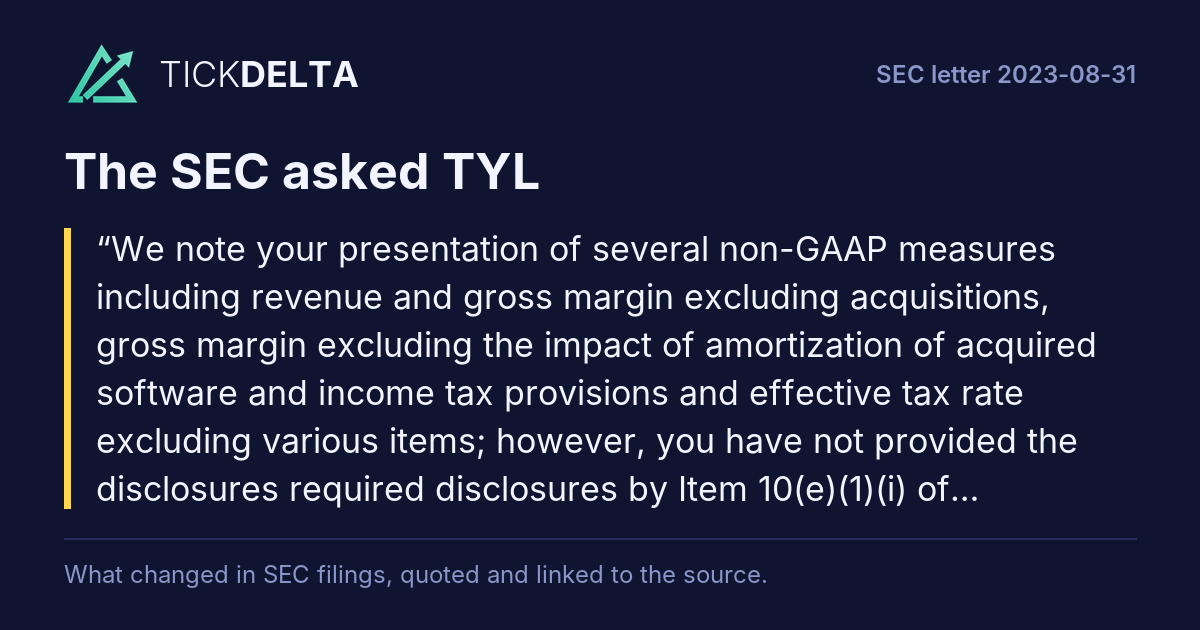
SEC asked (1)
We note your presentation of several non-GAAP measures including revenue and gross margin excluding acquisitions, gross margin excluding the impact of amortization of acquired software and income tax provisions and effective tax rate excluding various items; however, you have not provided the disclosures required disclosures by Item 10(e)(1)(i) of Regulation S-K nor have you labelled these items as non-GAAP.
Rest of the question

Please revise to provide the required disclosures or alternatively incorporate the quantitative impact of these items in your discussion of the changes in the respective line items. Revenues, page 33

TYL answered
The Company acknowledges the Staff’s comment that several non-GAAP measures, including revenue and gross margin excluding acquisitions, gross margin excluding the impact of amortization of acquired software and income tax provisions and effective tax rate excluding various items, should be identified as non-GAAP measures and reconciled to the most directly comparable GAAP measure with equal or greater prominence.
Rest of the answer

In future filings, we will revise the relevant Management’s Discussion and Analysis of Financial Condition and Results of Operations disclosures as follows:

We will discontinue the presentation of the line item captions “Less revenue from recent acquisitions” and “Total revenue excluding acquisitions,” and therefore only reflect total GAAP revenues for the relevant tables for each revenue type. We also acknowledge the Staff’s comment to incorporate the quantitative impact of these items in our discussion on changes and we will update the written text to focus our discussion on changes including the dollar impact of recent acquisitions for each revenue category, and provide further explanations of changes compared to the same prior year period.

In addition, we will discontinue the presentation of the table labeled “Gross margin by revenue type, excluding the incremental impact of recent acquisitions.” We also will update the written text to focus our discussion on changes including the dollar impact of recent acquisitions for each gross margin percentage by revenue category, and provide further explanations of changes compared to the same prior year period.

For disclosures related to amortization of acquired software, income tax provision, and effective tax rate excluding various items, the written text below the relevant tables will include discussion of the total GAAP changes for the period and such measures will be identified as non-GAAP measures and reconciled to the most directly comparable GAAP measure with equal or greater prominence.

Read in the reply ↗
In its next report

First report after the company's reply of 2023-09-13: 10-Q filed 2023-11-01 ↗, against the 10-Q filed 2023-07-26 ↗.

Tickdelta does not hold the text of both reports, so they are not compared here.

Management's Discussion and Analysis of Financial Condition and Results of Operations · 2022 Compared to 2021, page 32
SEC asked (2)
We note your presentation of several revenue line items excluding acquisitions. We also note the footnotes indicate that the amounts exclude the "incremental impact as a result of not having the recent acquisition for a full fiscal year." Please explain to us how the 2022 adjustments were calculated and explain why the 2021 revenue amounts are not adjusted considering that there was a significant acquisition in
Rest of the question

2021. In this regard, the total subscription revenue excluding acquisitions for 2021 is presented as $784,435; however, based on the preceding table that amount includes $368,917 in revenue from acquisitions in that year.

TYL answered
The Company acknowledges the Staff comment and respectfully explains that in our December 31, 2022, Form 10-K, we reflected the 2022 impact of recent acquisitions in a tabular format for revenue and gross margin explanations in order to explain the changes in each category on an “organic basis” (i.e., excluding “incremental impact as a result of not having the recent acquisition for a full fiscal year”) versus on a non-organic basis.
Rest of the answer

When deriving amounts on an “organic basis,” we adjusted for the incremental amounts impacting the current period to be comparable with the base-level prior period. The incremental amounts were calculated for the periods that were not included in the prior year. For example, NIC was acquired on April 21, 2021, with approximately eight months of revenues included in the fiscal period 2021 and 12 months of revenues included in the fiscal period 2022. Therefore, the incremental amounts adjusted for in fiscal 2022 were approximately 4 months (i.e., revenue for the period January 1, 2022 - April 21, 2022) in order to be comparable with the base level of eight months of revenue included in fiscal 2021 (i.e., revenue for the period April 21, 2021 – December 31, 2021). No adjustments were reflected in the tables for 2021 because fiscal 2021 is the base-level period.

We acknowledge the Staff’s comment and in future filings we will discontinue the presentation of the line item captions “Less revenue from recent acquisitions” and “Total revenue excluding acquisitions,” and therefore only reflect total GAAP revenues for the relevant tables for each revenue type. We also will update the written text to focus our discussion on changes including the dollar impact of recent acquisitions for each revenue category, and provide further explanations of changes on an organic basis as compared to the same prior year period.

Read in the reply ↗
In its next report

First report after the company's reply of 2023-09-13: 10-Q filed 2023-11-01 ↗, against the 10-Q filed 2023-07-26 ↗.

Tickdelta does not hold the text of both reports, so they are not compared here.

Annualized Recurring Revenues, page 34
SEC asked (3)
We note this measure is calculated based on quarter-end total recurring revenue multiplied by four and that recurring revenue includes transaction-based revenue. However, it is not clear how you consider transaction-based revenue to be recurring as it would appear amounts could change period to period as a result of volume fluctuations and seasonality.
Rest of the question

In this regard, you indicated in your earnings call for the six months ended June 30, 2023 that transaction revenues are typically the highest in the second quarter coinciding with peak outdoor seasons and tax deadlines and at a seasonal low in the fourth quarter with fewer business days and less activity around the holidays. Please revise to disclose how you account for transaction-based revenue in the measure, noting estimates and assumptions used and the limitations that result, as well as how volatile amounts may be period to period and the impact of seasonality. Further, revise to disclose whether ARR is indicative of future revenue and if not, how it may differ. Also, revise to disclose why ARR is useful to investors and indicate how management uses ARR in managing or monitoring company performance. Refer to Release No. 33-10751.

TYL answered
The Company acknowledges the Staff’s comment and respectfully advises the Staff that the Company’s ARR is based on actual quarter-to-date revenues generated and reported in our statement of operations and related disaggregated revenue disclosure. The Company’s ARR does not include additional assumptions or estimates for the base revenues used in the calculation. The Company’s clients are government agencies who, among other sources, rely on collecting transaction-based fees from citizens to fund their operations.
Rest of the answer

For planning purposes, our clients consider these fees recurring, with some seasonality. Because a portion of our revenues are generated from these fees, the Company also considers them to be recurring, with some seasonality, and prices them accordingly.

In future filings, we will revise our ARR disclosures to include the following:

“Annualized recurring revenues (ARR) are calculated by annualizing the current quarter's recurring revenues from maintenance and subscriptions as reported in our statement of operations. Management believes ARR is an important measure of the value of our existing client base, as well as a measure of the effectiveness of the strategies we deploy to drive revenue growth over time. ARR is a useful metric monitored by our peers and investors in the technology industry, which we believe offers insight to the stability of our maintenance and subscription revenues to be recognized within the year, which are considered recurring in nature, with some seasonality.

Subscriptions revenue primarily consists of revenues derived from our SaaS arrangements and transaction-based fees, which relate to digital government services, e-filing transactions, and payment processing. These revenues are considered recurring because revenues from these sources are expected to re-occur in similar annual amounts for the term of our relationship with the client. Transaction-based fees are generally the result of multi-year contracts with our clients that result in fees generated by payment transactions and digital government services and are collected on a recurring basis during the contract term. Transaction-based fees have historically been the highest in the second quarter, which coincides with peak outdoor seasons and tax deadlines of our clients, and lowest in the fourth quarter due to fewer business days and fewer transactions around holidays. Because ARR is an annualized revenue amount, the metric can fluctuate from quarter to quarter due to this seasonality.”

Read in the reply ↗
In its next report

First report after the company's reply of 2023-09-13: 10-Q filed 2023-11-01 ↗, against the 10-Q filed 2023-07-26 ↗.

Tickdelta does not hold the text of both reports, so they are not compared here.

Note (1) Summary of Significant Accounting Policies · Goodwill, page F-16
SEC asked (4)
You disclose here and on page 30 that you "performed qualitative assessments for the remaining reporting units in which we determined that it [was] not more likely than not that the fair value exceeded the carrying value...".
Rest of the question

This appears to suggest that the carrying value of these reporting units could exceed the fair value, and does not appear to be consistent with the rest of the sentence, which indicates you did not perform a Step 1 quantitative impairment test. We also note that you disclose that you performed qualitive assessments for certain recently acquired reporting units; however the audit report indicates that quantitative assessments were performed. Please revise to address these inconsistencies.

TYL answered
The Company respectfully acknowledges the Staff’s comment and advises that for future filings, we will revise our disclosure as follows:

“During the fourth quarter, as part of our annual impairment test as of October 1, we performed qualitative assessments for all reporting units except for reporting units containing recent acquisitions.
Rest of the answer

As a result of these qualitative assessments, we determined that it was more likely than not that the fair value exceeded the carrying value; therefore, we did not perform a Step 1 quantitative impairment test.

We performed quantitative assessments for the reporting units containing the recently acquired data and insights, digital government and payments solutions, and development platform solutions, and concluded no impairment existed as of our annual assessment date. Approximately $1.7 billion, or 70%, of total goodwill as of December 31, 2022, related to these reporting units, which, as a result of the recency of these acquisitions, do not have significant excess fair values over carrying values. Our annual goodwill impairment analysis did not result in an impairment charge. During 2022, we recorded no impairment to goodwill because no triggering events or change in circumstances indicating a potential impairment had occurred as of period-end.”

We acknowledge that the Company is responsible for the accuracy and adequacy of our disclosures, notwithstanding any review, comments, action or absence of action by the Staff. If you have any questions or require any additional information with respect to the foregoing, please contact me via email at brian.miller@tylertech.com or by telephone at (972) 713-3720. My fax number is (972) 713-3741.

Read in the reply ↗
In its next report

First report after the company's reply of 2023-09-13: 10-Q filed 2023-11-01 ↗, against the 10-Q filed 2023-07-26 ↗.

Tickdelta does not hold the text of both reports, so they are not compared here.

Also in this review: closing letter, 2023-09-18

Form 10-K for the Fiscal Year Ended December 31, 2017

2018-09-17 to 2018-10-02 · 3 questions · 1 letter from the SEC, 1 from the company
Review closed 2018-10-02
Revenue
Revenue Recognition · Software Licenses and Royalties, page 6
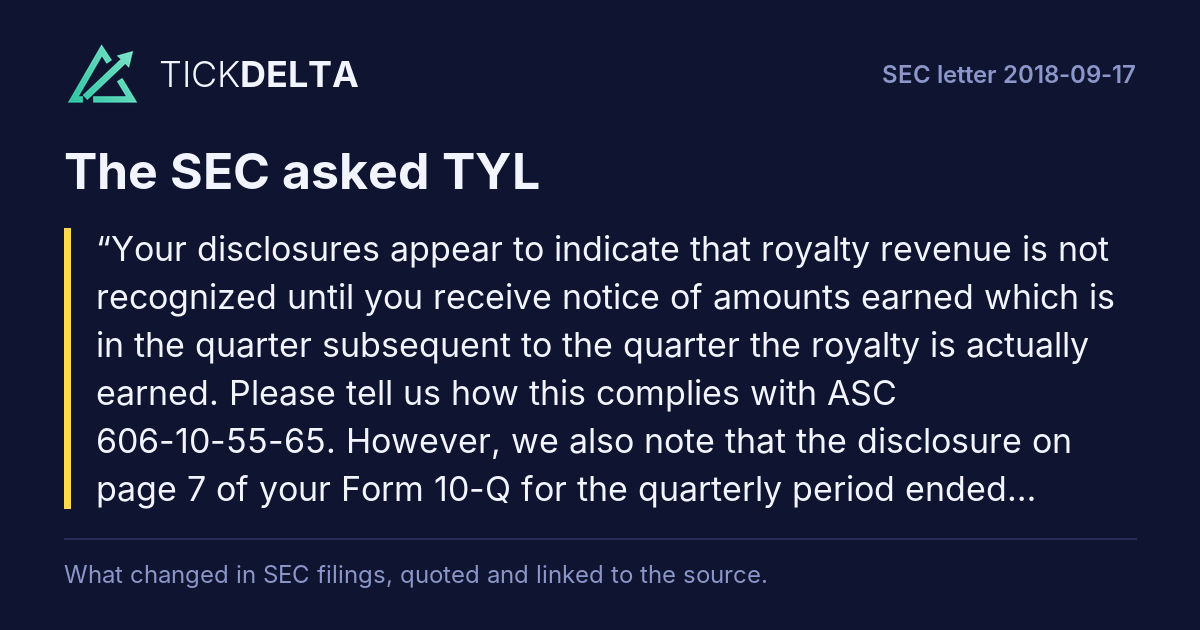
SEC asked (1)
Your disclosures appear to indicate that royalty revenue is not recognized until you receive notice of amounts earned which is in the quarter subsequent to the quarter the royalty is actually earned. Please tell us how this complies with ASC 606-10-55-65.
Rest of the question

However, we also note that the disclosure on page 7 of your Form 10-Q for the quarterly period ended March 31, 2018 indicates that royalties are recognized on an estimated basis in the period earned and are then trued up when you receive notice of amounts earned. Please reconcile these disclosures and tell us whether there has been a change in accounting for royalties.

TYL answered
We recognize sales-based royalties of our functional software licenses when the subsequent sale occurs consistent with ASC 606-10-55-65. Our policy for sales-based royalties changed with the adoption of ASC 606 as we recognized sales-based royalties on a lag (i.e when the royalty report was subsequently received) under ASC 605. A portion of our royalty revenue recognition disclosure was inadvertently deleted in the Form 10-Q for the quarter ended June 30, 2018, and will be adjusted as noted below.
Rest of the answer

It should also be noted that as a percentage of total revenues, royalties are not material, representing 0.4 percent of total revenues in the first quarter of 2018 and 0.5 percent of total revenues in the second quarter of 2018. Therefore, the impact of any true-up in estimating our royalty revenue recognition is not significant to the financial statements. For future filings, we will revise our disclosure to reflect what was previously disclosed in our March 31, 2018, Form 10-Q, to read as follows:

"We recognize royalty revenue when the sale occurs under the terms of our third-party royalty arrangements. Currently, our third-party royalties are recognized on an estimated basis and are trued up when we receive notice of amounts we are entitled to receive. Typically, we receive notice of royalty revenues we are entitled to and billed on a quarterly basis in the quarter immediately following the royalty reporting period."

Read in the reply ↗
In its next report

First report after the company's reply of 2018-09-26: 10-Q filed 2018-10-31 ↗, against the 10-Q filed 2018-08-01 ↗.

Tickdelta does not hold the text of both reports, so they are not compared here.

Subscription-Based Services , page 7
SEC asked (2)
You disclose that software and software services that are contingent on the transfer of other performance obligations are recognized ratably. Please tell us what these contingent performance obligations are and how they impact your revenue recognition. Refer to the authoritative guidance you relied upon.
TYL answered
For certain subscription contracts that are SaaS arrangements, the promise to provide services is not separately identifiable from other promises in the contract as contemplated by paragraph 606-10-25-19(b). In these instances, the services are not recognized separately. We do not have SaaS arrangements with contingent revenue features.
Rest of the answer

Our disclosure, while relaying the basic principle that the performance obligations could not be recognized separately due to not being distinct, also inadvertently included the phrase “contingent on the transfer of other performance obligations” which in this context is a concept associated with the previous standard of ASC 985-605 regarding revenue recognized for a bundle of services. We will revise our disclosure in future filings as we do not consider contingent features of a contract when determining whether promises are distinct. We apply the accounting guidance in ASC 606-10-25-19 through 25-22, and related implementation guidance. For future filings, we will revise the portion of the disclosure that refers to contingent revenue to read as follows:

“For software services associated with certain SaaS arrangements, we have concluded that the services are not distinct, and we recognize the revenue ratably over the remaining contractual period once we have provided the customer access to the software.”

Read in the reply ↗
In its next report

First report after the company's reply of 2018-09-26: 10-Q filed 2018-10-31 ↗, against the 10-Q filed 2018-08-01 ↗.

Tickdelta does not hold the text of both reports, so they are not compared here.

Deferred Commissions, page 10
SEC asked (3)
Please tell us, and revise to clarify, whether sales commissions paid upon contract renewal are commensurate with the initial commissions and disclose how commissions paid for renewals are considered in the three to seven year period of benefit for the initial commission.
Rest of the question

You also disclose that renewals are amortized over the “remaining period of benefit.” Please tell us whether the period of benefit for these commissions exceeds the term of the respective customer contract and if so, explain what the remaining period of benefit represents and how your policy complies with ASC 340-40-35-1. Also refer to ASC 340-40-50-2(b).

TYL answered
Sales commissions for renewal contracts are generally not paid in connection with the renewal of a contract. In the small number of instances where a commission is paid on renewal, it is not commensurate with the commission paid on the initial sale and is recognized over the term of renewal, which is generally one year.

To address your comment, in future filings, we will revise the disclosure to read as follows:

“Sales commissions earned by our sales force are considered incremental and recoverable costs of obtaining a contract with a customer.
Rest of the answer

Sales commissions for initial contracts are deferred and then amortized on a straight-line basis over a period of benefit that we have determined to be three to seven years. We utilized the 'portfolio approach' practical expedient in ASC 606-10-10-4, which allows entities to apply the guidance to a portfolio of contracts with similar characteristics because the effects on the financial statements of this approach would not differ materially from applying the guidance to individual contracts. Using the 'portfolio approach', we determined the period of benefit by taking into consideration our customer contracts, our technology life-cycle and other factors. Sales commissions for renewal contracts are generally not paid in connection with the renewal of a contract. In the small number of instances where a commission is paid on renewal, it is not commensurate with the commission paid on the initial sale and is recognized over the term of renewal, which is generally one year. Amortization expense related to deferred commissions is included in selling, general and administrative expenses in the accompanying condensed consolidated statements of income. Refer to Note 5 - Deferred Commissions for further information.”

Additionally, the Company acknowledges that:

•

The Company is responsible for the adequacy and accuracy of the disclosure in its filing;

Staff comments or changes to disclosure in response to staff comments do not foreclose the Commission from taking any action with respect to the filing; and

The Company may not assert Staff comments as a defense in any proceeding initiated by the Commission or any person under the federal securities laws of the United States.

Read in the reply ↗
In its next report

First report after the company's reply of 2018-09-26: 10-Q filed 2018-10-31 ↗, against the 10-Q filed 2018-08-01 ↗.

Tickdelta does not hold the text of both reports, so they are not compared here.

Also in this review: closing letter, 2018-10-02

3 other letters: notices that a filing will not be reviewed, requests to declare a registration effective, and the like
  • 2024-04-29 · SEC: review completed · Tyler Technologies, Inc. · CIK 0000860731
  • 2024-04-22 · SEC: letter · Tyler Technologies, Inc. · CIK 0000860731
  • 2024-04-25 · TYL: letter · Tyler Technologies, Inc. (the “Company”) CIK 0000860731

From the SEC's correspondence on EDGAR: staff letters (form UPLOAD) and company letters (form CORRESP), 12 letters filed since 2018-09-17. Questions and answers are matched by their numbers; topics come from words in each question. The reports are compared word for word (same form, before the first SEC letter against the first report after the company's reply). No AI.

Work on TYL in a spreadsheet: Excel workbook (a sheet per section, ten years by column, charts, links to the filings) · CSV. For a Google Sheet that stays up to date, paste =IMPORTDATA("https://tickdelta.com/company/TYL/export.csv") into a cell.