Unity Software Inc. U
New risk paragraphs, branching off last year
Each branch is a paragraph in Risk Factors with nothing like it in the 10-K filed Feb 21, 2025. A box jumps to the paragraph as filed, below.
Paragraphs with nothing like them in last year's 10-K
25 paragraphs in Risk Factors of the 10-K filed Feb 11, 2026 with nothing like them in the 10-K filed Feb 21, 2025. Quoted exactly. Paragraphs that were only edited are under 10-K change.
will vary from period to period, which will impact our costs and ability to achieve and maintain profitability.
We are increasingly building AI into certain of our offerings, such as Unity Vector, our new machine learning model, our new Unity AI product line, which includes AI Assistant and AI Generators, which are currently in beta, and Unity Inference Engine (formerly Unity Sentis), which allows creators to embed an AI model in the Unity Runtime for their game or application, enhancing gameplay and other functionality. AI Generators leverage both Unity-developed and third-party models for AI-driven assistance during creation. With respect to third-party models, we do not control the data used to train such models or the specific outputs they generate; we act as a conduit for customer requests and return the responses from those third-party models. The datasets used to train third-party models may inadvertently include content that infringes intellectual property rights. Because we do not control the training data or model weights of third-party models, we may be subject to liability or reputational harm if customers use outputs generated through our offerings that are alleged to infringe third-party intellectual property rights. Unity-developed models are trained exclusively on directly-licensed or open-licensed data; however, we rely on the accuracy and scope of those licenses as represented by the licensors, and if such representations are incorrect or incomplete, we could face claims that our training data included content used without proper authorization. The outputs of both Unity-developed and third-party models may also inadvertently replicate protected content, resulting in potential claims of infringement. We continue to advance machine
learning ("ML") algorithms in our Grow Solutions, which are designed to enable us to provide customers with better performance. AI technologies are complex and rapidly evolving, and we face significant competition from other companies as well as an evolving regulatory landscape. AI technologies, in particular generative AI and interactive chatbots, are subject to existing laws of various states and countries such as those regarding privacy, data security, and consumer protection, and the evolving regulatory landscape and our product development efforts may result in new or enhanced governmental or regulatory scrutiny, litigation, ethical concerns, or other complications that could adversely affect our business, reputation, or financial results. AI technologies, including generative AI and interactive chatbots, are subject to existing laws of various states and countries such as those regarding privacy, data security, and consumer protection. In particular, global AI regulatory frameworks remain highly uncertain, rapidly changing, and inconsistent across jurisdictions, and frequently have extraterritorial reach, and, as a result may apply to our AI offerings regardless of where they are developed or deployed. For example, the EU AI Act sets out a risk-based framework, subjecting certain AI technologies to numerous compliance obligations, including transparency, conformity and risk assessment, monitoring and human oversight requirements, and noncompliance could lead to fines of up to 35 million Euros or 7% of our total worldwide annual turnover. Certain provisions of the EU AI Act could require us to alter or restrict our use of AI both in features or products available to our users and in our systems that interact with our users. In addition, certain U.S. states have proposed, enacted, or are considering laws governing the development and use of AI technologies, such as the Colorado Artificial Intelligence Act, California Bot Disclosure Law, the Utah Artificial Intelligence Policy Act, and the California Consumer Privacy Act ("CCPA") regulations on automated decision-making technology.
As these requirements continue to emerge or change, we may be required to modify, restrict, or disable certain AI features; implement new technical, governance and other controls; or incur significant compliance and operational costs. Failure to anticipate or comply with evolving AI regulatory obligations could adversely affect our ability to develop and deliver AI-enabled offerings, reduce the competitiveness of our products, or negatively impact our business, reputation, or financial results.
The increasing use of AI and ML, including AI-driven automation tools, may enable customers to reduce their reliance on human developers, and therefore paid seat licenses, or otherwise circumvent usage- and seat-based licensing metrics by obfuscating the number of users accessing our products. Any such shift could materially reduce demand for our core subscription-based products and adversely affect our revenues and business model.
Advances in AI and 2D and 3D content generation technologies may enable our customers to use AI to automate or replicate aspects of content, content creation, simulation, or runtime functionality
provided by our platform and solutions, and allow competitors to develop solutions that reduce the competitiveness of our platform and solutions. Even where such activities are unauthorized or prohibited, our ability to prevent, detect, or stop it may be limited. To the extent such advances reduce the need for our products, or otherwise disintermediate Unity from the content creation process, our business and financial condition could be materially adversely affected.
In addition, some of our competitors are also our partners and/or customers. We compete to various degrees on the basis of price, technical performance, product features, system compatibility, quality and sales and technical support. These competitors may decide to stop buying our products, compete more aggressively with us, use technical capabilities to hinder the performance of our products, or use our products or the information they obtain about or derived from our products and technology to develop or improve their own competing solutions, which could materially and adversely affect our business, financial condition and results of operations.
Similarly, the market for programmatic advertising and Connected TV ("CTV") solutions is highly competitive and evolving, and it is uncertain whether our expansion into these gaming-adjacent verticals will develop as we expect. Our success will depend on our ability to compete with incumbent demand-side and supply-side advertising platforms, as well as the widespread adoption of our advertising technology by agencies and brands that have historically relied on traditional media or closed digital ecosystems. Market acceptance of our solutions in these areas may be hindered by our ability to provide comparable scale, targeting, and transparent measurement relative to established competitors. If our programmatic and CTV offerings do not achieve widespread adoption, or if we are unable to effectively capture advertising spend from outside of our core gaming audience, our ability to grow our revenue and diversify our business may suffer.
We are also expanding our In-App Purchase ("IAP") solutions, designed to support developers across a variety of alternative payment processing and monetization platforms. The success of these offerings depends on our ability to maintain seamless technical integration with a variety of third-party payment service providers while ensuring compliance with the evolving requirements of major platform providers and complex regulatory requirements. Platform providers may introduce new fee structures or technical hurdles relating to external payment flows that increase friction for users, reduce conversion rates, and diminish the economic benefit of our IAP offering to our customers. If we cannot effectively manage these complexities, our ability to grow our payment processing-related revenue could be adversely affected.
Show the other 15
derive from these investments is not sufficient to achieve a return on investment, our business and results of operations would suffer.
•timing of updates and new features on our platform, or the release of new product offerings and our investments to support these features and offerings;
Furthermore, increased scrutiny of the industry by regulatory bodies may ultimately lead to more onerous regulatory frameworks (e.g., various upcoming application store accountability regulations) or fundamental shifts in how platform providers enforce their policies. For example, regulatory actions involving competitors regarding potential policy violations may increase the likelihood of platform-wide crackdowns or more restrictive terms of service that could adversely affect our business, financial condition, or results of operations.
•difficulty collecting accounts receivable and potential for longer payment cycles, including due to disruptions or delays in global payment operations, and international payments or money transfers resulting from trade restrictions or sanctions or banking processes and procedures adopted in response;
Our agreements with our customers and other third parties may include indemnification provisions under which we agree to indemnify or otherwise be liable for losses suffered or incurred as a result of
make the financial reports and other public disclosures required of public companies. Additionally, vulnerabilities in our products may cause reputational harm resulting in customer loss, and it also may lead to legal liability if such vulnerabilities are exploited before we are able to release patches. Threat actors have used, and may in the future use, an initial compromise of one part of our environment to gain access to other parts of our environment, or to try to leverage a compromise of our networks or systems to gain access to the networks or systems of third parties with whom we work. They may also try to leverage potential vulnerabilities or other information in our platform or code for future attacks.
We enter into confidentiality and invention assignment agreements with our employees and consultants and enter into confidentiality agreements with other third parties, including suppliers and other
We may also incur significant costs for using alternative providers or taking other actions in preparation for, or in response to, events that damage the third-party hosting services we use.
In the U.S., federal, state, and local governments have enacted numerous privacy and data security laws, such as, the Telephone Consumer Protection Act ("TCPA"), which imposes various consumer
Other states have enacted or are considering enacting privacy and data security laws, and our actual or perceived noncompliance with these and other emerging state laws could harm our business. The U.S. Department of Justice has also adopted a new rule entitled Preventing Access to U.S. Sensitive Personal Data and Government-Related Data by Countries of Concern or Covered Persons, which limits our ability to provide access to certain US personal information to entities or employees located in certain countries of concern, thereby impacting usage of data by us and certain partners, impacting our ability to enter into certain investment agreements, and potentially limiting our ability to utilize employees in certain locations. Violations of the rule could lead to significant civil and criminal fines and penalties.
We and our customers are increasingly subject to specialized regulations governing digital storefronts and in-app purchasing, particularly those focused on the protection of minors. For example, the Texas App Store Accountability Act and similar statutes enacted or proposed in other states and territories impose new obligations on both application store operators and developers. These laws may require us to implement age-verification and parental consent workflows, including the ability to act upon age-category signals from third-party platforms, for ourselves or on behalf of our developers. Complying with these evolving and fragmented requirements could result in significant operational costs, necessitate substantial changes to our user interfaces and flows, and increase our exposure to enforcement actions. Any failure, or perceived failure, to satisfy these shifting in-app purchasing and age-assurance standards could lead to platform-wide penalties and other enforcement actions against Unity and the developers or third parties who may rely on our compliance mechanisms, reduce scale and usage of our monetization solutions, and materially harm our business.
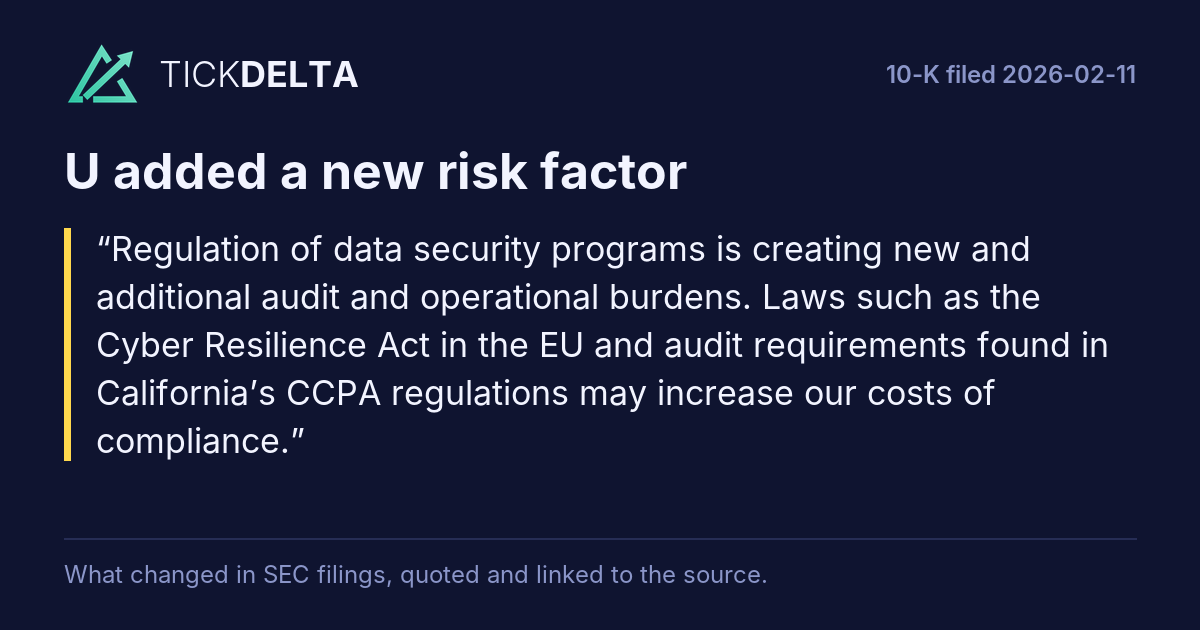
Regulation of data security programs is creating new and additional audit and operational burdens. Laws such as the Cyber Resilience Act in the EU and audit requirements found in California’s CCPA regulations may increase our costs of compliance.
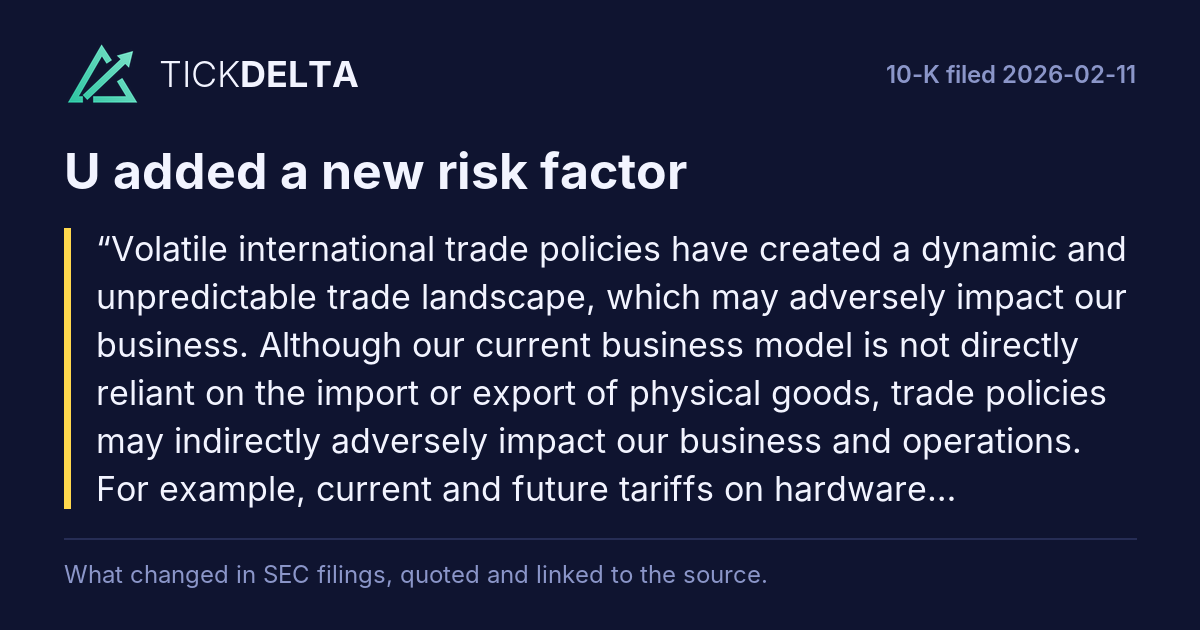
Volatile international trade policies have created a dynamic and unpredictable trade landscape, which may adversely impact our business. Although our current business model is not directly reliant on the import or export of physical goods, trade policies may indirectly adversely impact our business and operations. For example, current and future tariffs on hardware, networking infrastructure or other technology infrastructure used by us or our third-party vendors could raise costs, constrain supply or affect service reliability, which could harm our competitive position, reduce customer demand and damage customer relationships. In addition, many of our customers operate businesses that may be impacted by trade policies, which may result in decreased demand for our services or extended sales cycles as customers assess the impact of evolving trade policies on their operations and face increased costs or decreased revenue due to tariffs and trade restrictions. Trade disputes, trade restrictions, tariffs, and other political tensions between the U.S. and other countries may also exacerbate unfavorable macroeconomic conditions including inflationary pressures, foreign exchange volatility, financial market instability, and economic recessions or downturns, which may also negatively impact customer demand for our services, delay renewals or limit expansion opportunities with existing customers, limit our access to capital, or otherwise negatively impact our business and operations. Ongoing tariff and macroeconomic uncertainty has and may continue to contribute to volatility in the price of our common stock. In addition, retaliatory trade policies or anti-U.S. sentiment in certain regions, whether driven by trade tensions, political disagreements, or regulatory concerns, may make customers and governments more hesitant to adopt solutions offered by U.S.-based providers. This may lead to increased preference for local competitors, changes to government procurement policies, heightened regulatory scrutiny, decreased intellectual property protections, delays in regulatory approvals or other retaliatory regulatory non-tariff policies, the introduction of trade barriers applicable to digital services, which may result in heightened international legal and operational risks and difficulties in attracting and retaining non-U.S. customers, suppliers, employees, partners and investors. While we continue to monitor trade developments, the ultimate impact of these risks remains uncertain and any prolonged economic downturn, escalation in trade tensions, or deterioration in international perception of U.S.-based companies could materially and adversely affect our business, results of operations, financial condition and prospects. In addition, tariffs and other trade developments have and may continue to heighten the risks related to the other risk factors described elsewhere in this report.
transfers or services or take similar action against us, our customers, our services, and our business could be harmed.
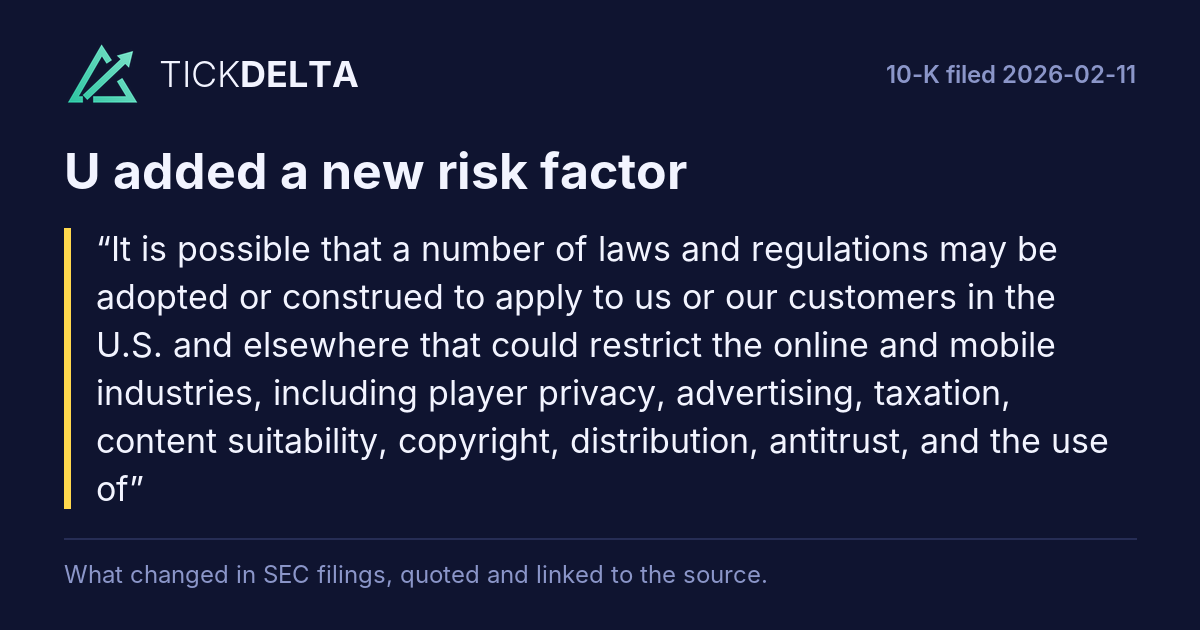
It is possible that a number of laws and regulations may be adopted or construed to apply to us or our customers in the U.S. and elsewhere that could restrict the online and mobile industries, including player privacy, advertising, taxation, content suitability, copyright, distribution, antitrust, and the use of
Paragraphs in the 10-Q filed Nov 5, 2026 that were not in the one before
New in the latest 10-Q
20 paragraphs in the 10-Q filed Nov 5, 2026 with nothing like them in the 10-Q filed Aug 6, 2026 (at least half the words must differ; new numbers alone do not count). Quoted exactly, grouped by the item heading above them. This is text that changed, not a judgement of how serious it is.
Financial statements and notes
UNITY SOFTWARE INC. CONDENSED CONSOLIDATED STATEMENTS OF CASH FLOWS (In thousands) (Unaudited) Nine Months Ended September 30, 2026 2025 Supplemental disclosure of cash flow information: Cash paid for interest $10,000 $10,000 Cash paid for income taxes, net of refunds $2,550 $6,868 Cash paid for operating leases $25,394 $33,015 Supplemental disclosures of non‑cash investing and financing activities: Assets acquired under operating lease $14,550 $6,987
Read in the 10-Q
September 30, 2026 and December 31, 2025, the allowance for uncollectible amounts was $ 9.3 million and $ 10.9 million, respectively.
Read in the 10-Q
certain conditions are met, as described in the indentures governing the 2026 Notes and 2030 Notes respectively.
Read in the 10-Q
In the normal course of business, we are party to various legal disputes that we believe are of the type common to companies engaged in our lines of business, including but not limited to commercial disputes, employment issues, tax disputes and disputes involving claims by third parties that our activities infringe their Intellectual Property ("IP") rights, as well as regulatory investigations or inquiries. Legal proceedings and regulatory investigations or inquiries are often complex, may require the expenditure of
Read in the 10-Q
significant funds and other resources, and the outcomes of such proceedings are inherently uncertain, with material adverse outcomes possible. IP claims generally involve the demand by a third-party that we cease the use or sale of the allegedly infringing products, processes or technologies and/or pay damages or royalties for past, present and future use of the allegedly infringing IP. These disputes may involve highly complex and technical issues, the outcome of which is inherently uncertain. Moreover, from time to time, we pursue litigation to assert our IP rights. Regardless of the merit or resolution of any such litigation, complex IP litigation is generally costly and diverts the efforts and attention of our management and technical personnel.
Read in the 10-Q
Show the other 15
We are currently engaged in a number of legal actions in the ordinary course of our business; however, we do not believe, based on currently available facts and circumstances, that the final outcome of any pending legal proceedings, ongoing regulatory investigations or tax disputes, taken individually or as a whole, will have a material adverse effect on our condensed consolidated financial statements. However, lawsuits may involve complex questions of fact and law and may require the expenditure of significant funds and other resources to defend. The results of litigation, regulatory investigations or tax disputes are inherently uncertain, and material adverse outcomes are possible. From time to time, we may enter into confidential discussions regarding the potential settlement of such lawsuits. Any settlement of pending litigation could require us to incur substantial costs and other ongoing expenses.
Read in the 10-Q
Starting in the first quarter of 2025, we have periodically issued PSUs to certain executives as part of their compensation. The vesting for each PSU is subject to the fulfillment of both a service period of
Read in the 10-Q
Basic net income (loss) per share is calculated using our weighted-average outstanding shares of common stock, including the impact of the redeemable noncontrolling interest from our China JV. Diluted net income (loss) per share is calculated using our weighted-average outstanding common stock including the dilutive effect of convertible notes using the if-converted method, and the dilutive effect of stock awards as determined under the treasury stock method. Stock awards include outstanding stock options, PVOs, RSUs, PVUs, PSUs, and ESPP units. Potential dilutive shares of common stock are excluded from the computation of diluted net income (loss) per share, if the impact of including them would have been antidilutive.
Read in the 10-Q
The following table shows the calculation of basic and diluted net income (loss) per share (in thousands):
Read in the 10-Q
In October 2026, we entered into an agreement to purchase, and completed the purchase of, a minority, equity interest in a private company for $ 100 million. We are still evaluating the accounting for this transaction.
Read in the 10-Q
accounting principles in the jurisdictions in which we conduct business. See Note 9, "Income Taxes," of the Notes to Condensed Consolidated Financial Statements.
Read in the 10-Q
Legal proceedings
The information set forth under Note 7. “Commitments and Contingencies” included in Part I, Item 1 of this Form 10-Q, is incorporated herein by reference. For additional discussion of certain risks associated with legal proceedings, see “Risk Factors” immediately below.
Read in the 10-Q
Risk Factors
If we fail to timely release updates and new features to our platform, develop successful new products, or adapt and respond effectively to rapidly changing technology and customer needs, requirements, or preferences, our platform may become less competitive.
Read in the 10-Q
The markets in which we operate are subject to rapid technological change, changing customer needs, requirements and preferences, and are highly competitive. The success of our business will depend, in part, on our ability to adapt and respond effectively to these changes and competitive pressures on a timely basis. Emerging technologies like AI are likely to impact the way that customers utilize our solutions, as well as enhance the functionality of our solutions. If we do not continue to improve our AI capabilities and data infrastructure on a timely basis or at all, our business could be harmed.
Read in the 10-Q
Our ability to retain and expand within our existing customers and attract new ones, and increase our revenue, depends in large part on our ability to maintain, improve and differentiate our existing platform and introduce new functionality promptly and effectively, as well as developing successful new product offerings. Revenue growth from our offerings also depends on our ability to continue to respond to advancements in competing technologies, and end-user demands and expectations, which will require us to incur additional costs to implement. If we do not continue to improve our platform with additional products, features and functionality in a timely fashion, or if new products or improvements to our platform are ineffective or otherwise not well received by customers, our revenue could be adversely affected.
Read in the 10-Q
For example, in October 2026, we announced Unity Spark, a browser-based, AI-powered game creation tool for creators, and plans to integrate it with Google's Playground platform. We expect to launch Unity Spark in closed beta later in 2026, but we may not do as anticipated or at all, and its features and availability may differ from what we have announced. There can be no assurance that Unity Spark will be successful, will generate significant revenue or become profitable.
Read in the 10-Q
If we fail to deliver timely releases of our solutions that are ready for commercial use, we release a version, service, tool or update with a material vulnerability, or other error, or we are unable to enhance our platform to keep pace with rapid technological changes or respond to new offerings by our competitors, or if new technologies emerge that are able to deliver competitive solutions at lower prices, more efficiently, more conveniently or more securely than our solutions, or if new operating systems, gaming platforms or devices are developed and we are unable to support our customers' deployment of games and other applications onto those systems, platforms or devices, our business, financial condition and results of operations could be adversely affected.
Read in the 10-Q
The actions of third parties with whom we do business may put our business and results of operations at risk.
Read in the 10-Q
We rely on third parties, including our strategic partners, for various aspects of our business, including deep technology collaborations, co-marketing, advertising partners, ad mediation services, ad attribution partners, development services agreements, and revenue share arrangements. Their actions may put our business, reputation, and brand at risk. In many cases, third parties may be given access to sensitive and proprietary information or personal information in order to provide services and support to our teams or customers, and they may misappropriate and engage in unauthorized use of our information, technology or customers' data. In addition, the failure of these third parties to provide adequate services and technologies, or the failure of the third parties to adequately maintain or update their services and technologies, could result in a disruption to our business operations. For example, we rely on ad attribution partners to accurately and reliably perform mobile measurement and attribute ad impressions. Any failure of those services may result in a reduction in the number of ads attributed to our ad platform and a resulting reduction in our revenue and the revenue realized by our ad publishers. Further, disruptions in the mobile application industry, financial markets, economic downturns, poor business decisions, or reputational harm may adversely affect our partners and may increase their propensity to engage in fraud or otherwise illegal or improper activity which could harm our business reputation, and they may not be able to continue honoring their obligations to us, or we may cease our arrangements with them. Similarly, we rely on third-party mediation platforms, some of which, including the MAX mediation platform ("MAX"), are operated by, or affiliated, with competing advertising networks. The majority of our Grow Solutions revenue is mediated through MAX. Our access to MAX is governed by a header bidding agreement (the "HBA") with AppLovin Corporation ("AppLovin"), which, if terminated, would prevent us accessing MAX. Interruption or loss of access to MAX would significantly harm our business and financial results. Alternative arrangements and services may not be available to us on commercially reasonable terms or at all and we may experience business interruptions upon a transition to an alternative partner or vendor. If we lose one or more business relationships, or experience a degradation of services, our business could be harmed and our financial results could be adversely affected.
Read in the 10-Q
On September 27, 2026, AppLovin filed an arbitration claim against us with JAMS alleging, among other things, breach of the HBA and unlawful and unfair business acts or practices related to our Ad Quality SDK (the "Arbitration Claim"), and sought provisional injunctive relief in San Francisco Superior Court to enjoin us from collecting or using what AppLovin claims to be its confidential and proprietary data, to disable that collection and to modify Ad Quality so that it no longer collects or uses that data. The court denied AppLovin's request on October 1, 2026. We have denied all of the allegations of wrongdoing in the Arbitration Claim and filed counterclaims against AppLovin with JAMS, including unfair competition on AppLovin's part. Although we cannot predict the ultimate outcome of the Arbitration Claim, we believe AppLovin's claims are without merit and intend to vigorously defend against them and pursue our counterclaims. An adverse ruling, or a deterioration in our relationship with AppLovin arising from the dispute, or otherwise, could result in changes to the terms on which we participate in MAX, restrictions on our use of data or technology relevant to our advertising business, a suspension or degradation of our access to MAX, and significant costs and expenses, any of which could materially and adversely affect our revenue and results of operations. In addition, disputes of this nature can be time-consuming and expensive to resolve and they divert management's time and attention and may harm our reputation and business.
Read in the 10-Q
The 10-Q's risk factors against the 10-K
Item 1A of the 10-Q filed Nov 5, 2026 against Item 1A of the 10-K filed Feb 11, 2026.
A 10-Q repeats only the risks that changed, so a 10-K paragraph that is missing from it is not counted as removed.
Added is a paragraph with nothing like it in the 10-K, Reworded a sentence that is in both with several words changed,
Quiet changes a sentence in both where one to four words changed and one is a hedge or a modal
(cut words struck through, new words highlighted).
Text on the page, not a score; each links to the filing at sec.gov.
What the 10-Q itself says about its risk factors:Other than the risk factors listed below, there have been no material changes from the risk factors previously described under Part I, Item 1A of our Annual Report on Form 10-K for the year ended December 31, 2025 and Part II, Item 1A of our Quarterly Report on Form 10-Q for the quarters ended March 31, 2026 and June 30, 2026.
Read in the 10-Q
Show the other 1
Phrases used for the first time
Two-word phrases in Risk Factors of the 10-K filed Feb 11, 2026 that are in none of the 1 earlier 10-Ks stored, back to Feb 21, 2025
Where each one is used
- third-party models: We are increasingly building AI into certain of our offerings, such as Unity Vector, our new machine learning model, our new Unity AI product line, which includes AI Assistant and AI Generators, which are currently in beta, and Unity Inference Engine (formerly Unity Sentis), which allows creators to embed an AI...
- trade policies: International trade policies, including tariffs, sanctions and trade barriers may adversely affect our business, financial condition, results of operations and prospects.
- unity vector: The markets in which we operate are subject to rapid technological change, changing customer needs, requirements and preferences, and are highly competitive. The success of our business will depend, in part, on our ability to adapt and respond effectively to these changes and competitive pressures on a timely...
- privacy data: learning ("ML") algorithms in our Grow Solutions, which are designed to enable us to provide customers with better performance. AI technologies are complex and rapidly evolving, and we face significant competition from other companies as well as an evolving regulatory landscape. AI technologies, in particular...
- in-app purchasing: We and our customers are increasingly subject to specialized regulations governing digital storefronts and in-app purchasing, particularly those focused on the protection of minors. For example, the Texas App Store Accountability Act and similar statutes enacted or proposed in other states and territories impose...
- conversion features: •the conditional conversion features of the 2030 Notes and the 2026 Notes, if triggered, and the conversion feature of the 2027 Notes may adversely affect our liquidity if we elect or are required to settle a portion or all of our conversion obligation through the payment of cash.
- adjacent industries: •initiatives to grow our presence in new or adjacent industries and use cases beyond the gaming industry;
- successful new: If we fail to timely release updates and new features to our platform, develop successful new products, or adapt and respond effectively to rapidly changing technology, or to changing customer needs, requirements, or preferences, our platform may become less competitive.
Used at least twice, small words left out. Counted, not picked: a phrase can be new because the company renamed something.
What was taken out
24 paragraphs of last year's Risk Factors with nothing like them now. The longest are quoted.
Sources
Item 1A of each 10-K and 10-Q on EDGAR, quoted exactly. Each paragraph links to the filing at sec.gov.
Also
10-K change: what was reworded or cut, section by section.
Work with it
Excel workbook · CSV. Google Sheet that stays up to date: paste =IMPORTDATA("https://tickdelta.com/company/U/export.csv") into a cell.