Form 10-K for the Fiscal Year Ended December 31, 2011
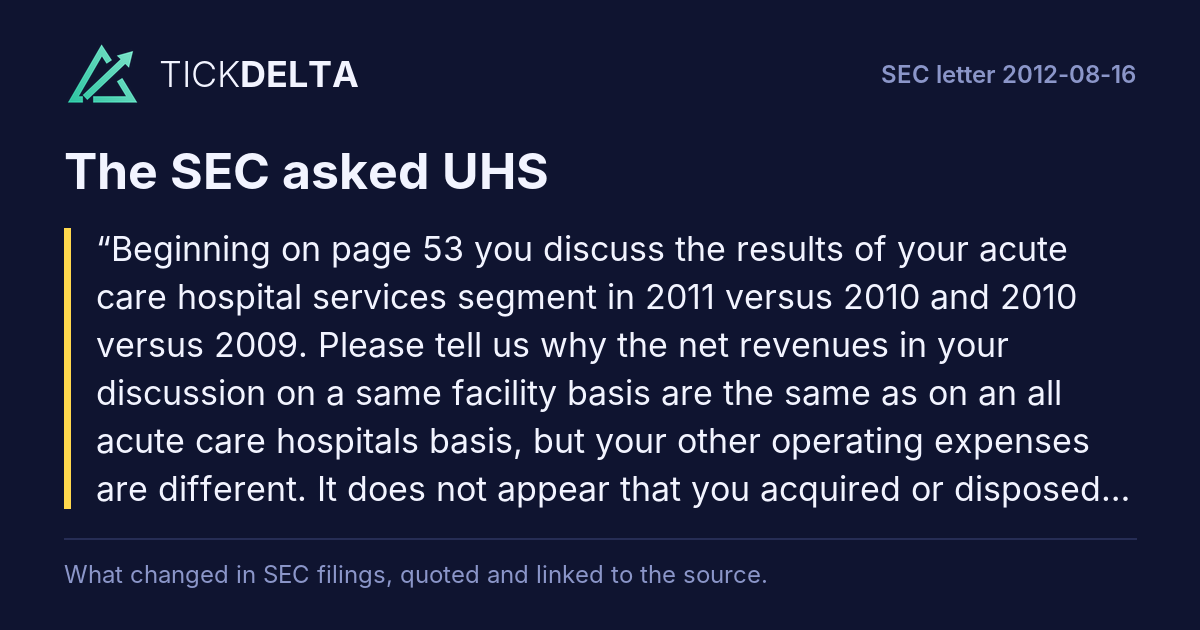
Beginning on page 53 you discuss the results of your acute care hospital services segment in 2011 versus 2010 and 2010 versus 2009. Please tell us why the net revenues in your discussion on a same facility basis are the same as on an all acute care hospitals basis, but your other operating expenses are different.Rest of the question
It does not appear that you acquired or disposed any significant acute care facilities in either 2010 or 2011 supporting the same amount of net revenues on a same facility and all acute care hospitals bases, but it is unclear why your operating expense amounts are therefore also not the same.
The voting rights of some investors are not proportional to their obligations to absorb the expected losses of the entity, their rights to receive the expected residual returns of the entity, or both. Read in the reply ↗
First report after the company's reply of 2012-08-28: 10-Q filed 2012-11-08 ↗, against the 10-Q filed 2012-08-08 ↗.
Tickdelta does not hold the text of both reports, so they are not compared here.
On page 64 you disclose the receipt of $11 million in Medicaid program incentive payments associated with electronic health records, or EHR. You also disclose that you deferred these payments at December 31, 2011 and will record the amounts as revenue when the applicable hospitals are deemed to have met the meaningful use criteria.Rest of the question
On page 41 of your June 30, 2012 Form 10-Q you disclose that you recognized the first $2 million of these payments as revenue in 2012. We do not believe that classification of these incentive payments as revenue is appropriate as they are not related to your ongoing central operating activities. Please address the following comments: Please provide us propose revised policy disclosure to be included in future periodic reports that separately describes your accounting for Medicare and Medicaid EHR incentive payments. Please explain to us how you will present the reclassification of your EHR incentive payments recorded in revenue during the second quarter of 2012 in your September 30, 2012 Form 10-Q and provide us proposed disclosure to be included in that filing that explains your reclassification and retroactive presentation.
Substantially all of the entity’s activities (for example, providing financing or buying assets) either involve or are conducted on behalf of an investor that has disproportionately few voting rights.
With respect to: 1) voting rights are proportional to each shareholder’s obligation to absorb losses and receive residual returns as each share of equity participates equally in the overall risks and rewards of the Trust.Read in the reply ↗Rest of the answer
Therefore, both conditions above are not present and it does not indicate that the equity investors as a group lack the characteristic in (b)(1).
Therefore, based on the criteria set forth in ASC 810-10-15 and the relevant circumstances outlined above, we concluded that the Trust was not a variable interest entity subject to the consolidation provisions therein.
Other:
Also pursuant to your request, we hereby acknowledge that:
we are responsible for the adequacy and accuracy of the disclosure in the filing staff comments or changes to disclosure in response to staff comments do not foreclose the Commission from taking any action with respect to the filing; and we may not assert staff comments as a defense in any proceeding initiated by the Commission or any person under the federal securities laws of the
United States.
Below is my contact information where I can be reached should the Staff have any questions or require any additional information. Thank you for your consideration and cooperation regarding this matter.
First report after the company's reply of 2012-08-28: 10-Q filed 2012-11-08 ↗, against the 10-Q filed 2012-08-08 ↗.
Tickdelta does not hold the text of both reports, so they are not compared here.
We acknowledge your disclosure regarding the adoption of ASU 2010-23. Please address the following comments: Please provide us proposed revised charity care policy disclosure to be included in future periodic reports under ASC 954-605-50-3 that clarifies what “financial or economic criteria” must be met by a patient to qualify for charity care.Rest of the question
You disclose the estimated cost of providing “charity services” in the first full paragraph on page 106. It appears that you include the cost of services provided at a discount to uninsured patients in the cost of charity services. Please provide us proposed revised disclosure to be included in future periodic reports that: o Discloses the cost of charity care provided as required by ASC 954-605-50-3. In this regard, the glossary at ASC 954-60-20 defines charity care as health care services that are provided but are never expected to result in cash flows. It appears that your discounted services provided to uninsured patients included in “charity services” have some anticipated cash inflows and therefore do not qualify for charity care. o Revises throughout your filing the use of “charity services” as that term is confusingly similar to charity care.
No numbered answer found in the reply. Read the reply ↗
First report after the company's reply of 2012-08-28: 10-Q filed 2012-11-08 ↗, against the 10-Q filed 2012-08-08 ↗.
Tickdelta does not hold the text of both reports, so they are not compared here.
You disclose that you serve as Advisor to the Trust pursuant to an annual agreement whereby you conduct the day-to-day affairs of the Trust, provide it administrative services and present it with investment opportunities. Also, certain of your officers and directors are also officers and/or directors of the Trust.Rest of the question
Please provide us your analysis supporting why consolidation of this trust is not appropriate and reference for us the authoritative literature you rely upon to support your position. In your response, demonstrate to us whether the Trust is a variable interest entity and, if so, whether you are the primary beneficiary.
No numbered answer found in the reply. Read the reply ↗
First report after the company's reply of 2012-08-28: 10-Q filed 2012-11-08 ↗, against the 10-Q filed 2012-08-08 ↗.
Tickdelta does not hold the text of both reports, so they are not compared here.
We acknowledge your response to our previous comment 2. As previously requested, please provide us proposed policy note disclosure to be included in future periodic reports that separately describes your accounting for Medicare and Medicaid EHR incentive payments.
In addition to the disclosure related to the Medicare and Medicaid electronic health records (“EHR”) incentive payments, as previously included in our response dated August 28, 2012 to comment 2 of the Staff’s letter to us dated
August 16, 2012 (which we will include in the Management’s Discussion and Analysis of Financial Condition and Results of Operations section of our future filings), we will also include the following as a separate caption under Note
1-Business and Summary of Significant Accounting Policies of the Notes to Consolidated Financial Statements of our future filings onRead in the reply ↗Rest of the answer
Form 10-K, and under Item 2: Management’s Discussion and Analysis of Financial Condition and Results of
Operations, Critical Accounting Policies and Estimates, in our future filings on Form 10-Q:
Accounting for Medicare and Medicaid
Electronic Health Records Incentive Payments: In July 2010, the Department of Health and Human Services published final regulations implementing the health information technology provisions of the American Recovery and Reinvestment Act. The regulation defines the “meaningful use” of Electronic Health Records (“EHR”) and established the requirements for the Medicare and Medicaid EHR payment incentive programs. The implementation period for these new Medicare and
Medicaid incentive payments started in federal fiscal year 2011 and can end as late as 2016 for Medicare and 2021 for the state Medicaid programs. We recognize income related to Medicare and Medicaid incentive payments using a gain contingency model that is based upon when our eligible hospitals have demonstrated “meaningful use” of certified EHR technology for the applicable period and the cost report information for the full cost report year that will determine the final calculation of the incentive payment is available.
Medicare EHR incentive payments: Federal regulations require that Medicare EHR incentive payments be computed based on the Medicare cost report that begins in the federal fiscal period in which a hospital meets the applicable “meaningful use” requirements. Since the annual Medicare cost report periods for each of our acute care hospitals ends on December 31st, we will recognize Medicare EHR incentive income for each hospital during the fourth quarter of the year in which the facility meets the “meaningful use” criteria and during the fourth quarter of each applicable subsequent year.
Medicaid EHR incentive payments: Medicaid EHR incentive payments are determined based upon prior period cost report information available at the time our hospitals meet the “meaningful use” criteria. Therefore, the majority of the Medicaid EHR incentive income recognition occurs in the period in which the applicable hospitals are deemed to have met initial “meaningful use” criteria. Upon meeting subsequent fiscal year “meaningful use” criteria, our hospitals may become entitled to additional Medicaid EHR incentive payments which will be recognized as incentive income in future periods.
Medicaid EHR incentive payments received prior to our hospitals meeting the “meaningful use” criteria are included in other current liabilities (as deferred EHR incentive income) in our consolidated balance sheet.
First report after the company's reply of 2012-10-02: 10-Q filed 2012-11-08 ↗, against the 10-Q filed 2012-08-08 ↗.
Tickdelta does not hold the text of both reports, so they are not compared here.
We acknowledge your response to our previous comment 3. Please revise your proposed disclosure to specifically disclose the cost of the charity care component of your total uncompensated care as required by ASC 954-60-50-3.Rest of the question
In this regard, we do not object to your disclosure of the costs to provide total uncompensated care but believe that the costs to provide charity care should be specifically disclosed to comply with the referenced guidance.
In addition to the disclosure related to the uncompensated care (consisting of charity care and uninsured discounts), as previously included in our response dated August 28, 2012 to comment 3 of the
Staff’s letter to us dated August 16, 2012, future filings will also include the following table which provides, separately, the cost of the charity care component of our total uncompensated care:
Estimated Cost of Providing Uncompensated Care
2011
2010
Estimated cost of providing charity care
$
145,337
129,787
Estimated cost of providing uninsured discounts relatedRead in the reply ↗Rest of the answer
care
27,366
27,838
Estimated cost of providing uncompensated care
172,703
157,625
Below is my contact information where I can be reached should the Staff have any questions or require any additional information. Thank you for your consideration and cooperation regarding this matter.
First report after the company's reply of 2012-10-02: 10-Q filed 2012-11-08 ↗, against the 10-Q filed 2012-08-08 ↗.
Tickdelta does not hold the text of both reports, so they are not compared here.
Also in this review: closing letter, 2012-10-15