Form 10-K for the fiscal year ended January 30, 2010
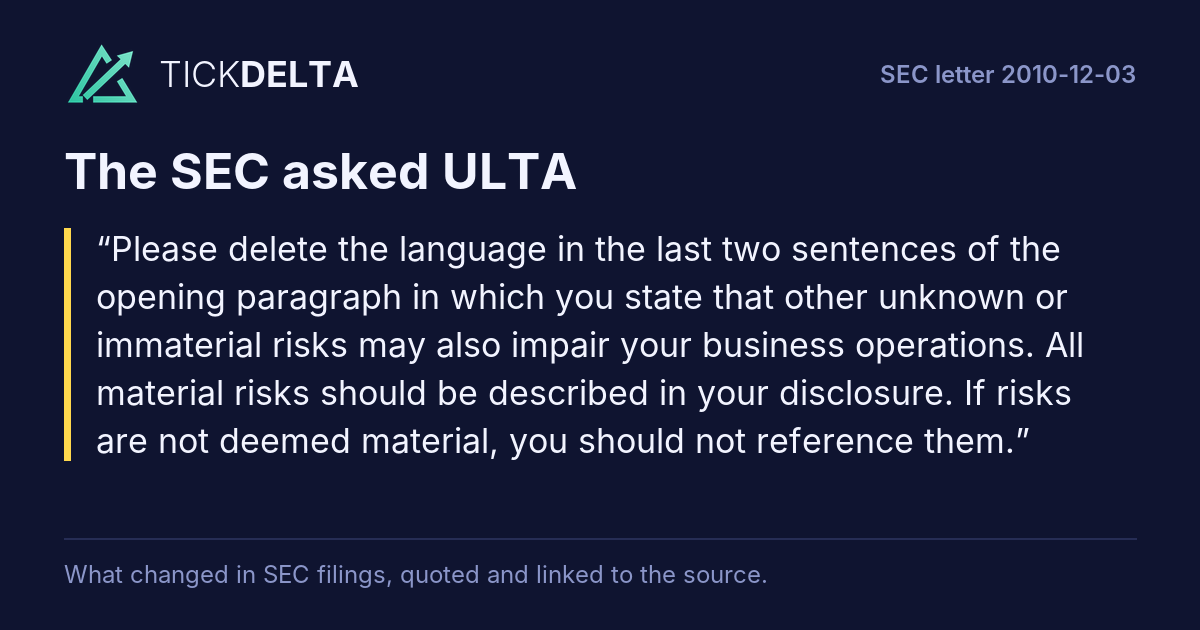
Please delete the language in the last two sentences of the opening paragraph in which you state that other unknown or immaterial risks may also impair your business operations. All material risks should be described in your disclosure. If risks are not deemed material, you should not reference them.
We will revise our “Risk Factors” section in future filings to delete the language in the last two sentences of the opening paragraph in which we state that other unknown or immaterial risks may also impair our business operations. Read in the reply ↗
First report after the company's reply of 2011-01-04: 10-K filed 2011-03-30 ↗, against the 10-K filed 2010-03-31 ↗.
Tickdelta does not hold the text of both reports, so they are not compared here.
We note that you state that your disclosure controls and procedures were effective “to ensure that the information required to be disclosed by [you] in [y]our reports that [you] file or submit under the Securities Exchange Act of 1934 is recorded, processed, summarized and reported within the time periods specified.” Please supplementally confirm, if true, that your officers concluded that your disclosure controlsRest of the question
and procedures were also effective to ensure that information required to be disclosed in the reports that you file or submit under the Exchange Act is accumulated and communicated to your management, including your principal executive and principal financial officer, to allow timely decisions regarding required disclosure. In addition, please confirm that you will revise future filings, including any amendments to filings as applicable, accordingly. See Exchange Act Rule 13a-15(e). This comment also applies to your Form 10-Q for the fiscal period ended May 1, 2010, your Form 10-Q for the fiscal period ended July 31, 2010 and your Form 10-Q for the fiscal period ended October 30, 2010.
Our Chief Executive Officer and Chief Financial Officer concluded that as of January 30, 2010
(fiscal 2009), May 1, 2010 (first quarter 2010), July 31, 2010 (second quarter 2010) and October
30, 2010 (third quarter 2010), disclosure controls and procedures were effective in ensuring that information required to be disclosed in the reports that the Company filed or submitted under the
Exchange Act was accumulated and communicated to the Company’s management, including our principle executive officer and principal financial officer, to allow timely decisions regarding required disclosure.Read in the reply ↗Rest of the answer
We confirm that we will revise our future filings, including any amendments to filings as applicable, accordingly.
First report after the company's reply of 2011-01-04: 10-K filed 2011-03-30 ↗, against the 10-K filed 2010-03-31 ↗.
Tickdelta does not hold the text of both reports, so they are not compared here.
Your discussion of operating expenses on page 35 indicates a portion of depreciation and amortization is classified within selling, general and administrative expenses and excluded from cost of goods sold. Please revise the description of the cost of goods sold line item in future filings to comply with SAB Topic no. 11.B. 2.Summary of significant accounting policies, page 55
We acknowledge the Staff’s comment and believe our accounting and disclosure is in compliance with current generally accepted accounting principals (GAAP) and Securities and
Exchange Commission (SEC) rules and guidance. We do not believe the guidance prescribed by SAB
Topic 11B applies to our facts given that the Company is not excluding depreciation and amortization from cost of sales or operating expenses.Read in the reply ↗Rest of the answer
The following table sets forth depreciation and amortization expense for the periods indicated:
Fiscal
2009
2008
2007
Depreciation and amortization included in cost of sales
$
51,919
42,751
34,533 selling, general and adminstrative expenses
10,247
8,694
4,970
Total depreciation and amortization expense
62,166
51,445
39,503
As described on page 35 of the Form 10-K, cost of sales includes depreciation and amortization related to warehousing and distribution activities as well as depreciation and amortization related to store fixturing and construction. Selling, general and administrative (SGA) expenses, which are considered operating expenses, includes depreciation and amortization for all assets except those related to our retail and warehouse operations, which is included in cost of sales, meaning SGA includes depreciation and amortization for general corporate use assets only. This disclosure is replicated in our policy note on page 58 of the Form 10-K which describes cost of sales and selling, general and administrative expenses.
We believe our existing disclosure is consistent with current GAAP and SEC requirements.
2. Summary of significant accounting policies, page 55
First report after the company's reply of 2011-01-04: 10-K filed 2011-03-30 ↗, against the 10-K filed 2010-03-31 ↗.
Tickdelta does not hold the text of both reports, so they are not compared here.
We assume the absence of disclosure related to segment reporting suggests you have concluded that you have only one reportable segment. Please explain to us in detail how you determined you have one reportable segment. Please also tell us if you aggregate operating segments, and if so, how the aggregation into one reportable segment complies with the aggregation requirements of FASB ASC 280-10-50.Rest of the question
Lastly, revise your future disclosure to comply with the requirements of FASB ASC 280-10-50-21. Please show us what your revised disclosure will look like.
The Company has determined that it has three operating segments: retail stores, salon services and e-commerce. The operating results for these operating segments are reviewed regularly by our Chief Executive Officer, who operates as our chief operating decision maker (CODM). The salon services and e-commerce operating segments do not meet the quantitative thresholds prescribed by
ACS 280-10-50-12 for separate disclosure.Read in the reply ↗Rest of the answer
We believe that salon services and e-commerce also meet the majority of the aggregation criteria in ACS 280-10-50-11 which allows both operating segments to be combined with retail stores into one reportable segment pursuant to 280-10-50-13. In addition, management does not believe that separate disclosure would be helpful to the readers of the financial statements. We disclose in the “Basis of presentation” section on page 34 of the
Form 10-K that our salon service revenue represents less than 10% of our combined product sales and service revenues. E-commerce sales were low single digits compared to the Company’s fiscal 2009 combined net sales.
We will revise future filings to include the following disclosure in both our Management Discussion and Analysis and notes to financial statements:
Segment reporting
The Company has determined its operating segments on the same basis that it uses to internally evaluate performance. The Company has combined its three operating segments: retail stores, salon services and e-commerce, into one reportable segment.
Please disclose in tabular form for each period presented the amount or percentage of total revenue contributed by each class of similar products or services. In this regard we note you offer salon services and products including make-up, skincare, fragrances and styling tools. Please refer to FASB ASC 280-10-50-40. See also Item 101(c)(1) of Regulation S-K as it relates to disclosure in your Business description.
We have considered FASB ASC 280-10-50-40 with respect to our disclosure and believe we are in compliance in all material respects. We have determined that salon services revenue is not material and does not require separate disclosure. We also do not believe that separate disclosure of salon services revenue would be beneficial to readers of the financial statements. We describe for our reader in “Item 1.Read in the reply ↗Rest of the answer
Business, Merchandising” beginning on page 9 of the Form 10-K that our retail stores carry a variety of beauty-related products including prestige and mass cosmetics, fragrance, haircare, skin care, bath and body products and salon styling tools. We believe all of these products are part of one product category, personal care products.
We also believe we are in compliance with Regulation S-K Item 101(c)(1) generally and Item
101(c)(1)(i) specifically in all material respects in “Item 1. Business, Overview” beginning on page 3 of the Form 10-K because we provide the reader with a significant amount of qualitative information describing our products, services, principal markets and methods of distribution. We do not believe additional disclosure is required based on our conclusion that salon services revenue is immaterial and that all of the retail products sold in our retail stores are part of one product category, personal care products.
You disclose that e-commerce sales are recorded upon shipment of merchandise. Please expand your disclosure to state when title transfers to the customer. Further, please explain to us how your accounting policy complies with the delivery and performance requirements of SAB Topic 13:A.Rest of the question
If shipping terms determine risk of loss during shipment and/or title transfer to the customer, please explain the terms to us and revise your disclosure to clarify these terms. If revenue on e-commerce sales is recognized prior to the transfer of title and delivery of the product to the customer, please clarify how your policy complies with GAAP.
E-commerce sales were low single digits compared to the Company’s fiscal 2009 combined net sales.
E-commerce sales are not material to our financial results and, therefore, we do not believe further disclosure in our financial statements is required or provides any additional benefit to users of our financial statements.Read in the reply ↗Rest of the answer
Currently, we record sales at the time of shipment by our third party carrier because we believe this is the most reliable measurement from a control perspective.
We estimate that in-transit goods represented approximately $200,000 of revenue and $50,000 of margin at any one quarterly balance sheet date during fiscal 2009. We do not believe that the benefit associated with estimating in-transit goods outweigh the cost. If e-commerce sales become material to our financial results in the future, we will disclose our accounting policy and ensure that it is consistent with SAB Topic 13A.
First report after the company's reply of 2011-01-04: 10-K filed 2011-03-30 ↗, against the 10-K filed 2010-03-31 ↗.
Tickdelta does not hold the text of both reports, so they are not compared here.
Please explain to us and disclose your policy for granting product returns. Further, please explain to us how accurate your historical estimates for the past three fiscal years have been with respect to estimating your allowance for sales returns, and how variances between actual and estimated returns are tracked and reviewed by management.Rest of the question
Lastly, reference is made to your valuation and qualifying accounts disclosure on page 68. Explain to us in detail why you did not disclose the allowance for sales returns activity, or revise your disclosure. Please refer to Rules 5-04 and 12-09 of Regulation S-X
The Company’s return policy generally provides for a full refund of the customer’s purchase price as long as the product is returned within 60 days of the original purchase provided certain conditions are met. In future filings we will revise our “Revenue recognition” disclosure to indicate our policy for granting product returns.
Actual product returns are tracked and our sales return reserve is adjusted on a monthly basis based on data from our point of sale (POS) system.Read in the reply ↗Rest of the answer
The sales return reserve represents the difference between the estimated net sales return and the corresponding gross margin adjustment, and the reserve is included in the “Other accrued liabilities” item of the “Accrued liabilities” note on page 61 of the Form 10-K.
The historical year end sales return estimates as compared to the actual results are as follows:
(Dollars in thousands)
Sales return estimate (A)
(1,289
)
(1,182
(1,013
Cost of sales adjustment
736
677
588
Net reserve
(553
(505
(425
Actual returns
(1,338
(1,023
(738
Variance (unfavorable) / favorable
(49
159
275
We believe the above analysis documents that our historical sales return reserve represents a reasonable estimate in all material respects.
The Company’s sales return reserve has not been disclosed in past filings because the Company did not consider its sales return reserve to be a valuation and qualifying account as it does not represent a deduction from a related balance sheet account as defined in Rule 12-09 or Regulation
S-X. In addition, the Company does not believe that the sales return reserve qualifies for separate disclosure due to its immaterial nature. We will disclose this information in future filings should we determine it to be material.
First report after the company's reply of 2011-01-04: 10-K filed 2011-03-30 ↗, against the 10-K filed 2010-03-31 ↗.
Tickdelta does not hold the text of both reports, so they are not compared here.
Please expand your policy for unredeemed gift cards to indicate whether or not gift cards are sold with expiration dates. Further, explain to us and disclose how revenue is recognized on unredeemed gift cards. Lastly, tell us and disclose the amount of deferred gift card revenue for the past two fiscal years ended January 30, 2010 and January 31, 2009.
Our gift cards do not expire and, historically, we have not recognized revenue from unredeemed gift cards due to statutory escheat requirements as well as materiality considerations. We are currently reevaluating our gift card program structure. Unearned gift card revenue as of January
30, 2010 and January 31, 2009 was $9.9 million and $7.9 million, respectively, which is included in the “Accrued customer liabilities” item of the “Accrued liabilities” note on page 61 of the Form
10-K.
In future filings we will revise our “Revenue recognition” disclosure to indicate the Company’s treatmentRead in the reply ↗Rest of the answer
of unredeemed gift cards and the amount of deferred gift card revenue for the past two fiscal years.
First report after the company's reply of 2011-01-04: 10-K filed 2011-03-30 ↗, against the 10-K filed 2010-03-31 ↗.
Tickdelta does not hold the text of both reports, so they are not compared here.
Please disclose your policy for classifying shipping and handling costs in the statements of income. If shipping costs or handling costs are significant and are not classified in cost of sales, disclose the amount(s) of these costs and the line item that includes them. Please refer to FASB ASC 605-45-50-2.
E-commerce shipping and handling costs are not significant. We will revise our “Cost of sales” disclosure in future filings to include shipping and handling costs. Read in the reply ↗
First report after the company's reply of 2011-01-04: 10-K filed 2011-03-30 ↗, against the 10-K filed 2010-03-31 ↗.
Tickdelta does not hold the text of both reports, so they are not compared here.
We note from your disclosure under Critical accounting policies and estimates on page 42 that your reserves for self-insurance have steadily declined over the past three years despite the significant increase in the number of stores, employees and sales.Rest of the question
Please explain to us the reason for the decrease and include in your response a table showing year end balances of the reserve and additions, subtractions and adjustments made during the year. To the extent material, please include a tabular presentation of your reserve activity in future filings. You may provide such information as part of your analysis of reserve accounts included in Schedule II to your financial statements.
to the Staff’s question regarding insurance expense trends over the three year period, the above table evidences that healthcare insurance expense increased approximately 7% and
23% in fiscal 2009 and 2008, respectively. The lower rate of increase in fiscal 2009 is due to certain changes in the plan including increased employee contributions. Workers compensation / general liability insurance also increased approximately 9% and 38% in fiscal 2009 and 2008, respectively.Read in the reply ↗Rest of the answer
Again, the fiscal 2009 rate of increase is lower because we renegotiated our policies and have had better loss experience in the last several years due to management initiatives to control cost including improving safety programs and communication. The decrease in the workers compensation / general liability accrual from fiscal 2007 through fiscal 2009 is primarily due to the fact that the Company’s loss experience has steadily improved during the last several years and the prepaid premium amounts paid to the insurer were adequate for the periods covered and did not require the Company to accrue additional premium adjustments.
Upon further assessment of the current structure of our insurance programs, we do not believe that healthcare and workers compensation / general liability insurance accruals qualify as significant estimates or critical accounting policies. We will eliminate this disclosure in future filings.
We note your statement that Ms. Kirby untimely filed one report. Please supplementally tell us the number of transactions that were not reported on a timely basis due to the failure to file such report, and confirm that you will include such required disclosure in future filings as applicable. Refer to Item 405(a)(2) of Regulation S-K. Article IV.Rest of the question
Compensation Committee Report and Compensation Discussion and Analysis,
Due to an inadvertent administrative error, one transaction was filed one day late. All other transactions were reported on a timely basis. We confirm that we will include such required disclosure in future filings as applicable. Read in the reply ↗
First report after the company's reply of 2011-01-04: 10-K filed 2011-03-30 ↗, against the 10-K filed 2010-03-31 ↗.
Tickdelta does not hold the text of both reports, so they are not compared here.
You state that your executive compensation is “evaluated against market based surveys and a pre-determined peer group.” Please revise your disclosure in future filings to identify the benchmarks used in determining the base salaries and annual bonuses (as a percentage of base pay) of your executive officers, as well as the components of the benchmarks.Rest of the question
In addition, please disclose in future filings the companies that participated in the Towers Perrin CDB, Retail Industry survey and the Towers Perrin CDB, General Industry survey, or tell us why you are not required to do so. Refer to Item 402(b)(2)(xiv) of Regulation S-K. Please show us what your proposed revised disclosure will look like.
In future filings we will clarify that the market references for setting base salaries and annual bonuses are the surveys and peer group as described on page 25 of the Proxy. The Towers
Perrin CDB, Retail Industry survey and the Towers Perrin CDB, General Industry survey consist of aggregated data, and do not specifically reference individual participating companies.Read in the reply ↗Rest of the answer
As a result, the Compensation Committee is not aware of the individual companies participating in the surveys and did not benchmark to any individual companies which participated in the surveys.
Rather, the Compensation Committee only referenced the composite aggregated data of the surveys for purposes of determining market practices.
In future filings, to the extent that the Company relies upon similar general market surveys, we will disclose such surveys. To the extent that the Company benchmarks against individual companies, similar to the peer group described on page 25 of the Proxy, the Company will identify in future filings all individual companies with which we benchmark.
First report after the company's reply of 2011-01-04: 10-K filed 2011-03-30 ↗, against the 10-K filed 2010-03-31 ↗.
Tickdelta does not hold the text of both reports, so they are not compared here.
With respect to your engagement of your compensation consultant, please revise your disclosure in future filings to expand upon the nature and scope of the consultant’s assignment, and the material elements of the instructions or directions that you gave to the consultant with respect to the performance of its duties under the engagement. Refer to Item 407(e)(3)(iii) of Regulation S-K.Rest of the question
Please show us what your proposed revised disclosure will look like.
In future filings we will expand upon the nature and scope of our compensation consultant’s assignment and include the material elements of any instructions or directions we give to the consultant with respect to the performance of its duties. Pursuant to its charter, the
Compensation Committee (the “Committee”) is authorized to retain and terminate any consultant, as well as approve the consultant’s fees, scope of work and other terms of retention.Read in the reply ↗Rest of the answer
In 2009 the
Committee retained compensation consultant Towers Perrin (known as Towers Watson after merging with
Watson Wyatt Worldwide effective January 1, 2010). During the period in question, Towers Watson advised the Committee on compensation issues and kept the Committee apprised of regulatory developments and competitive practices related to executive compensation practices. For fiscal
2009-2010, Towers Watson provided competitive market data and advice, when requested by the
Committee. In particular Towers Watson provided the Committee with information related to competitive incentive design practices and stock ownership guidelines. Towers Watson, however, did not determine or recommend the exact amount or form of executive compensation for any executive officers. Towers Watson reported directly to the Committee. A representative of Towers Watson, when requested, attended meetings of the Committee, was available to participate in executive sessions and communicated directly with the Committee Chair or its members outside of meetings.
The approval of the Chair of the Committee, acting on authority delegated by the Committee, was required for any other work to be done for the Company and its affiliates by Towers Watson.
First report after the company's reply of 2011-01-04: 10-K filed 2011-03-30 ↗, against the 10-K filed 2010-03-31 ↗.
Tickdelta does not hold the text of both reports, so they are not compared here.
We note your disclosure in response to Item 402(s) of Regulation S-K. Please supplementally describe the process you undertook to reach your determination that your compensation plans, practices and policies are not “reasonably likely to have a material adverse effect on the Company.”
A multi-disciplinary team consisting of finance, human resources, legal and audit personnel reviewed the Company’s variable pay plans, practices and policies and evaluated and identified the following:
•
Risk in pay plan design process;
Risk in pay plan content; and
Risk levels of pay plans.
Based on this review, the team determined that the Company did not have any compensation plans, practices or polices that created risks that were reasonably likely to have a material adverse effect on the Company, for the following reasons:
The Company’s variable compensation programs are linked toRead in the reply ↗Rest of the answer
specific performance metric goals set by the Compensation Committee for executive officers and for other employees by supervisors consistent with the Company’s compensation philosophy and business goals;
The performance periods for the pay programs are designed to match the period for which the employee had influence on the results;
Payments under the incentives are capped;
Payments are reviewed by the Compensation Committee, payroll and human resources and are subject to spot audits;
The mix between mixed and variable pay is balanced so as to neither discourage proper risk taking nor encourage excessive risk taking; and
No participant is allowed to approve his or her own performance goals or payout.
The team presented its analysis and assessment of these matters to management and the Compensation
Committee, which concurred.
**********
In responding to the Division’s comments, the Company acknowledges that:
The Company is responsible for the adequacy and accuracy of the disclosure in this filing;
Staff comments or changes to disclosure in response to staff comments do not foreclose the Commission from taking any action with respect to the filing; and
The Company may not assert staff comments as a defense in any proceeding initiated by the Commission or any person under the federal securities laws of the
United States.
First report after the company's reply of 2011-01-04: 10-K filed 2011-03-30 ↗, against the 10-K filed 2010-03-31 ↗.
Tickdelta does not hold the text of both reports, so they are not compared here.
Summary of significant accounting policies, page 55 1. We read your response to comment five of our letter dated December 3, 2010. We note you do not believe that separate disclosure of salon services revenue would be beneficial to the readers of your financial statements. We do not concur with your conclusion.Rest of the question
Please revise your future disclosure or advise us in detail why the readers of your financial statements would not find disclosure of the extent of services provided information useful or beneficial. Self-insurance, page 58 2. We read your response to comment 10 of our letter dated December 3, 2010. We believe the amounts charged to expense are significant and that you should include a tabular presentation of your reserve activity. Please confirm to us that you will present this information in future filings. Please respond to this letter within ten business days by providing the requested information, or by advising us when you will provide the requested response. If you do not believe our comments apply to your facts and circumstances please tell us why in your response. Please submit your cover letter over EDGAR. Please understand that we may have additional comments after reviewing your amendments and responses to our comments.
We confirm that we will include disclosure of the self insurance reserves and related expense in tabular form in future filings.
**********
In responding to the Division’s comments, the Company acknowledges that:
•
The Company is responsible for the adequacy and accuracy of the disclosure in this filing;
Staff comments or changes to disclosure in response to staff comments do not foreclose the Commission from taking any action with respect to the filing; and
The Company may not assert staff comments as a defense in any proceeding initiated by the Commission or any person under theRead in the reply ↗Rest of the answer
federal securities laws of the
United States.
First report after the company's reply of 2011-02-03: 10-K filed 2011-03-30 ↗, against the 10-K filed 2010-03-31 ↗.
Tickdelta does not hold the text of both reports, so they are not compared here.
Also in this review: request for more time, 2010-12-08, closing letter, 2011-02-11