tickdelta
Sign in

Tickdelta is free for now. Sign up and get Pro free

← Screener

ULTAUlta Beauty

Consumer discretionary · Specialty Retail · Nasdaq
Compare with peers → Embed
SEC comment letters, last 20 years

3 reviews of ULTA's filings by SEC staff

UPLOAD and CORRESP
ReviewsRead ↓
3
latest letter 2018-06-26
Questions asked
21
each answered in the company's own letter
No closing letter
0
reviews without a letter saying the staff completed it

When the SEC's staff reviews a filing, it writes to the company with numbered questions, and the company answers each one in a letter. SEC publishes the exchange once the review is over, at least 20 business days later. A question is not an accusation; most reviews end with the company adding detail to its next filing.

Form 10-K for the Fiscal Year Ended February 3, 2018

2018-06-26 to 2018-07-26 · 3 questions · 1 letter from the SEC, 1 from the company
Review closed 2018-07-26
Results discussion (MD&A)SegmentsNon-GAAP measuresIncome taxes
Results of Operations · Gross Profit, page 32
SEC asked (1)
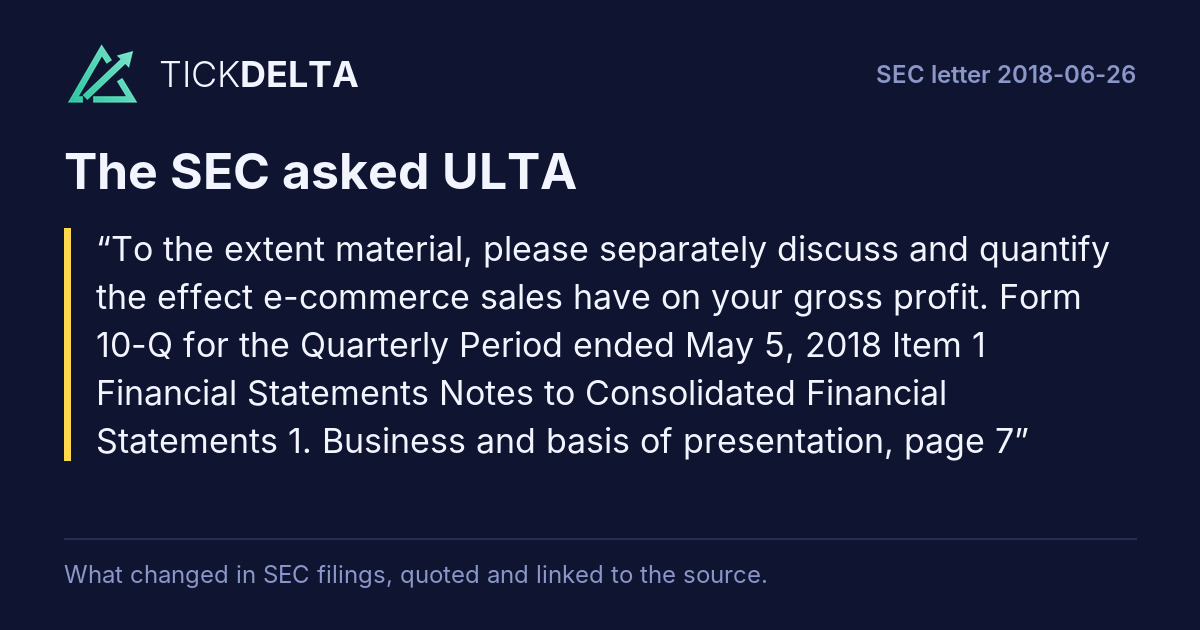
To the extent material, please separately discuss and quantify the effect e-commerce sales have on your gross profit. Form 10-Q for the Quarterly Period ended May 5, 2018 Item 1 Financial Statements Notes to Consolidated Financial Statements 1. Business and basis of presentation, page 7
ULTA answered
E-commerce sales represented 9.7% of our consolidated net sales in fiscal 2017. Consolidated gross profit was 35.6% in fiscal 2017. The average impact of e-commerce sales on the consolidated gross profit over the past three years was approximately [***] basis points, as shown in the following table:

Fiscal Year Ended

2017

2016

2015

Retail & Salon

[***%]

Total Company (1)

35.6%

36.0%

35.3%

(1)Includes retail, salon, and e-commerce.

The variance between consolidated gross profit excluding e-commerce and consolidated gross profit including e-commerce is not significantly different.
Rest of the answer

The small impact e-commerce has on total Company gross profit is not attributed to any underlying business conditions. Short-term trends in merchandising, new brands, channel sales mix, promotions, markdowns, supply chain investments, or other factors can cause differences that are greater or smaller than the average in any given year. Accordingly, we do not consider the effect of e-commerce sales on consolidated gross profit to be material.

Form 10‑Q for the Quarterly Period ended May 5, 2018

Item 1 Financial Statements

Notes to Consolidated Financial Statements

1. Business and basis of presentation, page 7

Read in the reply ↗
In its next report

First report after the company's reply of 2018-07-20: 10-Q filed 2018-08-30 ↗, against the 10-Q filed 2018-06-01 ↗.

Tickdelta does not hold the text of both reports, so they are not compared here.

Results of Operations · Gross Profit, page 32
SEC asked (2)
We note from your disclosure on page 16 that you aggregate your retail stores, salon services, and e-commerce operating segments into one reportable segment. It appears from your disclosure on page 12 and from your fourth quarter 2017 earnings call transcript that e-commerce net sales were 10% and “nearly 30%” of total net sales for the first quarter of 2018 and fourth quarter of 2017, respectively.
Rest of the question

Explain to us how you evaluated the aggregation criteria in ASC 280-10-50-11 in determining you have only one reportable segment. In doing so, explain in sufficient detail how you determined your operating segments have similar economic characteristics. We note from your most recent Forms 10-K and 10-Q that retail store and e-commerce comparable sales increases were materially different for all periods presented. We further note management’s statements during your fourth quarter 2017 earnings call that e-commerce sales have margins below that of your brick and mortar business.

ULTA answered
Since receiving the comment letter, we discovered one instance of the earnings call transcript online that states our e-commerce net sales were “nearly 30%” of total net sales for the fourth quarter of 2017, which we believe was the transcript the Staff reviewed. However, we stated in our fourth quarter 2017 earnings call on March 15, 2018 that our e-commerce net sales were “nearly 13%” of total net sales in the quarter (not 30%).
Rest of the answer

We contacted the third-party vendor and the inaccuracy was subsequently corrected.

In response to the Staff’s comment letter dated December 3, 2010 on our Form 10‑K for fiscal 2009, the Company noted that the salon services and e-commerce operating segments did not meet the quantitative threshold prescribed by ASC 280‑10‑50‑12 for separate disclosure. Further, the Company stated the aggregation criteria was satisfied and concluded that those operating segments should be combined with retail stores into one reportable segment pursuant to ASC 280‑10‑50‑13. As the Staff noted in the current comment letter dated June 26, 2018, the Company disclosed in its Form 10‑K for fiscal 2017 that we continue to aggregate three operating segments into one reportable segment.

After considering the evolution of our business and changes in the retail environment as described more fully below and upon further analysis, we have determined that the application of the relevant guidance in ASC 280 results in the identification of a single operating segment. The following analysis provides the basis for our conclusion.

Relevant Guidance

ASC 280‑10‑10‑1 describes the objective of segment reporting requirements, as follows:

The objective of requiring disclosures about segments of a public entity and related information is to provide information about the different types of business activities in which a public entity engages and the different economic environments in which it operates to help users of financial statements do all of the following:

§

Better understand the public entity’s performance;

Better assess its prospects for future net cash flows; and

Make more informed judgments about the public entity as a whole.

ASC 280‑10‑50‑1 states that an operating segment is a component of a public entity that has all of the following characteristics:

It engages in business activities from which it may recognize revenues and incur expenses.

Its operating results are regularly reviewed by the public entity’s chief operating decision maker (CODM) to make decisions about resources to be allocated to the segment and assess its performance.

Its discrete financial information is available.

Management’s Analysis

As a result of previous correspondence with the Staff regarding the Staff’s comment letter dated December 3, 2010 on the Company’s Form 10‑K for fiscal 2009, we began to disclose that we had three operating segments: retail stores, salon services, and e-commerce. Over the last eight years, our e-commerce sales as a percentage of consolidated net sales has increased gradually from low single digits in fiscal 2009 to 9.7% in fiscal 2017. Our salon service revenue as a percentage of consolidated net sales has been approximately 5.0% since 2009.

Business Overview

The Company operates under the strategy of All Things Beauty. All in One Place.™, a compelling value proposition, and a convenient and welcoming shopping environment. The stores and website provide guests with an integrated shopping experience and increased flexibility for their beauty buying needs. Regardless of whether in-store or online, we offer similar merchandise (which we purchase from the same suppliers) to similar customers, targeting the same class of customer – the “Beauty Enthusiast” through print, email marketing, digital marketing, and national TV and radio advertising.

Our stores and website offer similar products to provide one-stop shopping for prestige, mass, and salon products, including more than 20,000 products from over 500 well-established and emerging beauty brands across all categories and prices points. Our current store format also includes an open and modern salon area with approximately eight to ten stations, which carry approximately 3,000 professional haircare and 125 professional styling products within our total assortment. Our salon services help drive product sales. Conversely, retail product customers can purchase hair services in the salon as well as skin, brow, or make-up services in the store.

We utilize the same distribution centers and channels to distribute products and services to all customers. Our merchandise is delivered to our distribution centers, transported to our stores (or end customer for e-commerce orders) utilizing trucks, then sold to customers utilizing the same point of sale, inventory management and distribution systems and processes.

Our merchandising team works with our centralized merchandise planning and forecasting group to ensure a consistent execution of pricing strategy and product replenishment from the same vendors across our store base, including salon, and e-commerce platform.

Consumer Evolution

Consumer shopping patterns are and have been shifting and as a company we have been and are in the process of adjusting the way we communicate, market, and offer our products in response to this change in the retail environment. We continue to see a shift in how the guest shops both in-store and online. Most recently, approximately 80% of the Company’s online traffic was from a mobile device.

The ability for our guests to shop multiple channels has a significant impact on sales. Compared to a guest who shops in-store (retail products) only, a guest who also shops:

Salon services  spends 2.5x more;

Online  spends 3x more; and

Salon services and online  spends 5x more.

Therefore, the Company has increased its focus on guest centric initiatives and being an omni-channel based retailer, continuing to make significant investments in omni-channel capabilities by integrating operations, merchandising, marketing, supply chain, and technology across retail stores and online. This investment substantially enhances the Company’s ability to compete effectively and will allow guests to buy anywhere and fill anywhere, which results in sales that are generated and fulfilled across multiple channels, as continued focus is placed on providing a seamless experience for guests in-store (retail and salon) and online and via mobile devices.

When we began tracking the data in 2010, less than 3% of our loyalty members were omni-channel guests. Currently, 10% of our loyalty members shop both in-store (retail and salon) and online, but that number continues to grow.

We view brick-and-mortar, which includes the salon located in the brick-and-mortar store, and e-commerce as being integral and fundamentally inseparable components of the Company’s business of selling similar merchandise to similar customers. As the Company continues its journey to become an omni-channel retailer, the distinction between brick-and-mortar and e-commerce sales becomes increasingly irrelevant due to our initiatives to become more guest-centric in this changing retail environment. As a result, the operating segments that were identified in prior years have become progressively more integrated.

Examples of this integration include the use of the same:

Sourcing and logistics functions to procure the same merchandise from the same vendors;

Inventory in our distribution centers to fill orders from both online and stores;

Advertising, promotional offers, customer loyalty reward program and other marketing methods in offering merchandise for sale to the same base of customers;

Credit card opportunities (private label and co-branded) to customers; and

Customer service center.

This integration is demonstrated in a variety of ways, including existing capabilities such as:

Recently implemented capability for customers to order products online while shopping in our stores and have them shipped to their homes;

Availability of store and salon inventory for sale online;

Online access to store location information, brands by store, product and service information, and loyalty point and gift card balances;

Improved inventory productivity;

Online booking for salon service appointments;

Availability of salon products used during services for sale in-store; and

Ability for customers to return merchandise purchased online to store locations.

This integration will be further revealed in planned future capabilities such as:

Buy online, pick up in store capabilities;

Distributed order management capabilities to improve inventory accuracy and productivity across all channels;

Ship-from-store capabilities; and

New technology that leverages intelligence to enhance guest engagement and interaction across all channels, offering more personalized and targeted communications.

As explained above, we manage all aspects of the business including go-to-market strategy, procurement, advertising, and financial management on an integrated basis.

CODM / Discrete Financial Information

Our Chief Executive Officer operates as our CODM. The metrics received by the CODM include sales trends, gross profit, selling general & administrative expenses, operating income, and earnings before tax (EBT). While the CODM receives multiple metrics, the CODM uses the financial measure of consolidated EBT to assess performance. For purposes of making operational decisions and assessing financial performance, our CODM regularly reviews our financial information prepared at the consolidated financial statement level, with further disaggregated information reviewed for revenues and a measure of gross profit. This is consistent with how information is presented to the Board of Directors.

The Company’s internal financial reporting package includes sales and, in more limited manner, gross profit comparisons for retail stores, salon services, and e-commerce, however, it does not further segregate results of the Company’s overall operations in this manner (nor are there separate balance sheets). Although sales and a measure of gross profit by channel is available, a measure of net income or loss is not. This measure of gross profit information is not consistent with our financial measure of gross profit disclosed and evaluated on a consolidated basis in our filings as it only considers the cost of the product and not other components of cost of sales. Accordingly, we do not believe these represent individual operating segments because this information is not sufficient for the CODM to make decisions about allocating resources to the component and to assess its performance. This is consistent with management’s current determination that the Company’s overall operations results in one operating segment presented as one reportable segment, and reflects our view that our merchandise sales (whether brick-and-mortar or e-commerce) and salon services are integral and inseparable components of the overall business.

Key Operating Decisions

We are committed to executing our strategic imperatives to drive long-term growth and sustainable competitive advantages across all channels to benefit the Company’s consolidated results. Our CODM sets targets based on these strategic imperatives, which serve as the basis for how resources are allocated, performance is assessed, and key operating decisions are made. Our budgets and forecasts are also developed at the same level as the Company’s internal financial reporting package, further supporting our view that we have one operating segment.

To execute our strategic imperatives, over the past five years our CODM has made key operating decisions, including:

Opening approximately 100 new stores in each of the last several years (with plans to continue doing so in the near term) to make Ulta Beauty more accessible and convenient, including more access for customers to our omni-channel capabilities;

Opening three new distribution centers as part of a multi-year supply chain investment strategy to better serve our guests, to support growth of both brick-and-mortar and e-commerce, and improve our product availability and order fulfillment capabilities;

Consolidating our loyalty program from two programs into one, and adding a new membership level, to acquire new guests and deepen loyalty with existing guests. Our loyalty program allows guests to earn and redeem reward points in-store and online;

Rolling out a credit card program (private label and co-branded) and expanding our gift card program network, both of which support our loyalty program and serve the same guests, irrespective of in-store or online;

Using consistent broad scale advertising through print, email, digital, radio and television across all channels to sharpen our brand positioning, increase our brand awareness, and drive traffic to our stores (including service offerings) and online;

Investing to improve the overall guest experience in-store and online, for all aspects of our business, including process improvements, store and technology enhancements, and labor and staffing solutions, as well as potential new technology that leverages intelligence;

Determining our merchandise assortment and the products/brands to invest in, including our private label brand. Most of our products are available both in-store and online (other than a limited number of online only products);

Upgrading and enhancing our omni-channel capabilities, which continues to blur the lines between in-store and online sales, and helps drive guests to our salon service offerings;

Investing in infrastructure to support our guest experience and growth in-store and online and capture scale efficiencies; and

Attracting and retaining top talent at the senior management level that drives a winning culture and helps deliver a differentiated guest experience in-store and online. Our senior management team is compensated based on our consolidated results.

All of the aforementioned key operating decisions were made based on the impact to our consolidated operations and financial results, rather than a specific component of the Company.

Organizational Structure

The Company is not structured in a way that has segment managers for any components that are held directly accountable to the CODM. The CODM’s direct reports, who are responsible for the consolidated entity, consist of the following: Chief Financial Officer, Chief Merchandising & Marketing Officer, Chief Store Operations Officer, Chief Supply Chain Officer, Chief Information Officer, Chief Human Resources Officer, and General Counsel & Chief Compliance Officer.

The CODM and each of her direct reports play a key role in the Company’s ultimate success. The senior team works collaboratively and cross-functionally on prioritizing and achieving the annual targets for delivering our strategy that impacts the Company as a whole.

Our officers and senior management are compensated in accordance with the Company’s bonus plan (which sets targets for EBT) and long-term incentive plan (which sets targets for EBT and revenue). The performance targets under both plans are at the consolidated level, rather than a division or component level.

Conclusion

Based on all the factors and information provided above, we believe that our business has evolved, and continues to evolve, such that we currently have one operating segment.

We continue to invest in technology and supply chain (expanding our distribution center network capacity and logistics) to evolve our omni-channel capabilities serving the same guest. As the Company continues its journey to become an omni-channel retailer, the distinction between e-commerce and brick-and-mortar sales, including salon services (which helps drive product sales, and vice versa) becomes increasingly irrelevant due to our initiatives to become more guest-centric in this changing retail environment, which we believe gives the Company a strong competitive advantage and represents the future of retail.

We will update our disclosure in future annual filings to disclose we have one operating segment and one reportable segment.

Read in the reply ↗
In its next report

First report after the company's reply of 2018-07-20: 10-Q filed 2018-08-30 ↗, against the 10-Q filed 2018-06-01 ↗.

Tickdelta does not hold the text of both reports, so they are not compared here.

Form 8-K filed March 15, 2018
SEC asked (3)
We note that you adjust diluted EPS for the one-time hourly associates bonus on an aftertax basis. In future filings, please present such adjustments on a pre-tax basis with separate disclosure of the related income tax impact to comply with Non-GAAP Financial Measures C&DI 102.11.
ULTA answered
The Company acknowledges the Staff’s comment and will revise its future filings in a manner consistent with C&DI 102.11.

CONFIDENTIAL TREATMENT REQUEST

We hereby request that this response be maintained in confidence by the Commission and its Staff and be used solely for the purposes of the review with respect to the above-referenced filings.

This request also encompasses any memoranda, notes, transcripts or other writings of any sort whatsoever that are made by, or at the request of, any employee of the Commission (or any other government agency) and which: (1) incorporate, include, or
Rest of the answer

relate to this response; or (2) refer to any conference, meeting, or telephone conversation between or among us or our representatives, agents, or counsel on the one hand and employees of the Commission (or any other government agency) on the other, relating to this response (collectively, the “Confidential Material”).

We further request that the Confidential Material be afforded confidential treatment pursuant to 17 C.F.R. § 200.83 and FOIA, 5 U.S.C. § 552. The Confidential Material concerns, or may concern, customarily non-public, confidential and privileged business, commercial, and personal information concerning us and/or our personnel.

The Confidential Material is exempt from mandatory disclosure under various provisions of the FOIA, including: 5 U.S.C. § 552(b)(7) (which protects certain “records or information compiled for law enforcement purposes”); 5 U.S.C. § 552(b)(4) (which protects trade secrets and confidential and privileged financial and commercial information); and 5 U.S.C. § 552(b)(6) (which protects files “the disclosure of which would constitute a clearly unwarranted invasion of personal privacy”). The Commission treats records falling within the FOIA exemption categories as “nonpublic” and “will generally not publish or make available to any person” such records. 17 C.F.R. § 200.80(b).

Because the Confidential Material relates to the activities of the Company, and not the activities of any federal agency, we claim that we are exempt from disclosure under FOIA. Moreover, disclosure of this Confidential Material may be prohibited under 18 U.S.C. § 1905, and further protections may be available under the Privacy Act of 1974, 5 U.S.C. § 552a. In accordance with 17 C.F.R. § 200.83 and other applicable laws and regulations, we submit the Confidential Material to the Commission with a request that the Confidential Material be kept in a non-public file and that only members of the Commission or its Staff have access to it.

If any person who is not a member of the Commission or its Staff asks to inspect or copy the Confidential Material, pursuant to the FOIA or otherwise, or if any member of the Commission or its Staff contemplates disclosure of the Confidential Material to any person who is not a member of the Commission or its Staff, then we request that Russell E. Ryba of Foley & Lardner LLP promptly be notified of such request, be furnished a copy of all written materials pertaining to such request (including but not limited to the request itself), and be given at least ten (10) days advance notice of any intended release so that we may, if deemed necessary or appropriate, pursue any available remedies.

We request that you send an email to Russell E. Ryba of Foley & Lardner (rryba@foley.com) rather than rely upon the U.S. mail for notice of the opportunity to object to disclosure of any of the Confidential Material.

We request that should the Commission be inclined to grant any FOIA request for the Confidential Material, the Commission follow the procedures set forth in the 17 C.F.R. § 200.83 and 52 Fed. Reg. 23,781 (June 25, 1987) and provide us with an opportunity to substantiate further this request for confidential treatment and to request a hearing on the claim of exemption before a FOIA request for any of the Confidential Material be granted.

If the Commission or its Staff decides to transfer any of the Confidential Material to another government agency, we request that you forward with the Confidential Material a copy of this response. We further request that you inform the agency that we have requested the return of the Confidential Material (and any copies thereof) to Russell E. Ryba of Foley & Lardner LLP at the completion of the agency’s efforts in this review and have requested that this Confidential Material be accorded confidential treatment.

Please let me know if you need additional information or have any questions about this production.

* * *

If the Staff has any questions with respect to the foregoing, please contact the undersigned at (630) 410‑4807 or Russell E. Ryba of Foley & Lardner LLP at (414) 297‑5668.
Read in the reply ↗

Also in this review: closing letter, 2018-07-26
Form 10-K for the Fiscal Year Ended January 30, 2016

2016-07-28 to 2016-09-06 · 3 questions · 1 letter from the SEC, 1 from the company
Review closed 2016-09-06
RevenueSegments
Overview, page 1
SEC asked (1)
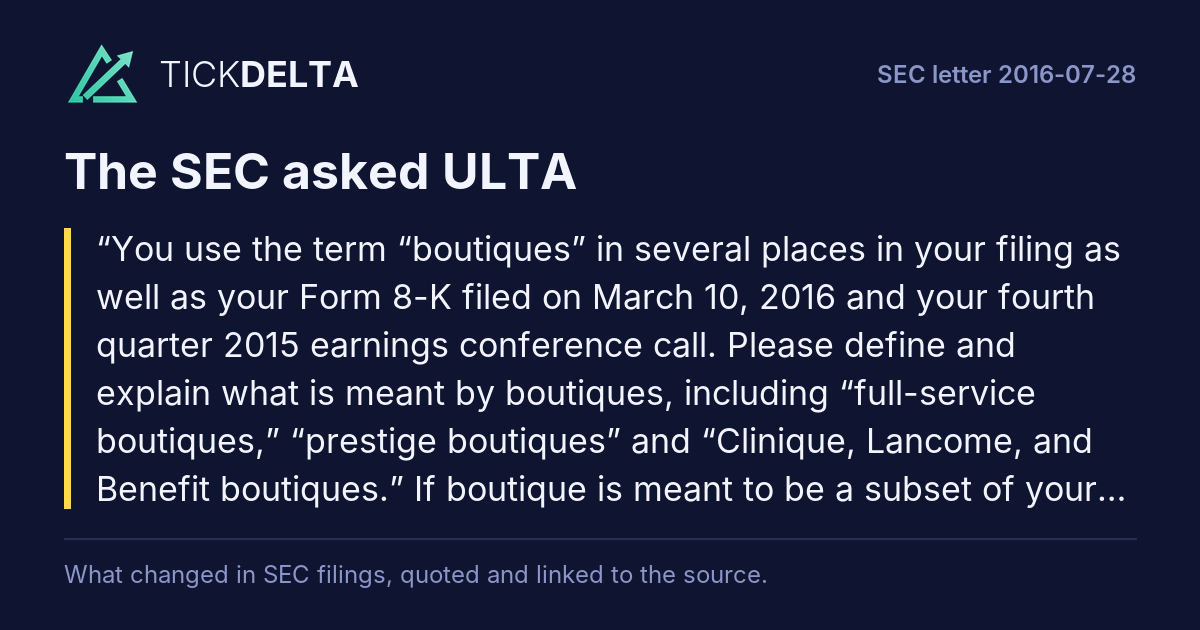
You use the term “boutiques” in several places in your filing as well as your Form 8-K filed on March 10, 2016 and your fourth quarter 2015 earnings conference call. Please define and explain what is meant by boutiques, including “full-service boutiques,” “prestige boutiques” and “Clinique, Lancome, and Benefit boutiques.” If boutique is meant to be a subset of your Ulta Beauty stores for your prestige brands,
Rest of the question

please clarify this in your filing. Please also clarify whether prestige consultants work solely in the prestige boutique and whether customers can purchase prestige products only in the prestige boutique.

ULTA answered
A typical Ulta Beauty store carries more than 20,000 prestige, mass and professional beauty products. We present these products in a self-service environment using centrally produced planograms, which are detailed schematics showing product placement in the store. Products are displayed on a variety of custom designed fixtures. Examples of these fixtures include boutiques, lighted arches, gondolas, étagères, tables and endcaps.
Rest of the answer

A “boutique” or “prestige boutique” is a set of custom designed fixtures configured to prominently display certain prestige brands such as Clinique,

Lancôme and Benefit within our stores.

Our prestige beauty consultants or advisors are trained to assist customers with all prestige brands throughout the store. Our customers can shop for prestige products in a variety of locations in the store, whether merchandised in prestige boutiques or displayed on other product fixtures elsewhere in the store.

In the Company’s future public filings, we will define “boutiques” as described above (namely, as a set of custom designed fixtures configured to prominently display certain prestige brands within our stores).

Read in the reply ↗
Financial Statements · Notes to Consolidated Financial Statements, page 50
SEC asked (2)
Please disclose revenues from external customers for each type of product and service sold such as cosmetics, haircare, salon styling tools, skincare and bath and body, fragrance, nail polish and nail care products, men’s products, Ulta Beauty Collection, and other health and beauty products. Alternatively, you may provide such disclosure in a manner in which you group similar products and services.
Rest of the question

Refer to ASC 280-10-50-40. 8. Share Repurchase Program, page 12

ULTA answered
In response to the Staff’s comment, in future annual filings the Company will provide further detail on revenues from external customers by type of product and services sold in Note 1, Business and Basis of Presentation, of the Notes to Consolidated Financial Statements, including the percentage of net sales for each significant type of product and service for all periods presented.
Rest of the answer

Future annual filings will generally include disclosure similar to the following, which is a markup of Note 1 in Ulta Beauty’s Form 10-K for the fiscal year ended January 30, 2016, with the new information highlighted in italics:

1. Business and basis of presentation

Ulta Salon, Cosmetics & Fragrance, Inc. was incorporated in the state of Delaware on January 9, 1990, to operate specialty retail stores selling cosmetics, fragrance, haircare and skincare products, and related accessories and services. The stores also feature full-service salons. As of January 30, 2016, the Company operated 874 stores in 48 states. As used in these notes and throughout this Annual Report on Form 10-K, all references to “we,” “us,” “our,” “Ulta,” “Ulta Beauty” or the “Company,” refer to Ulta Salon, Cosmetics &

Fragrance, Inc. and its consolidated subsidiary, Ulta Inc. All amounts are stated in thousands, with the exception of per share amounts and number of stores.

The Company has determined its operating segments on the same basis that it uses to internally evaluate performance. The Company has combined its three operating segments, retail stores, salon services and e-commerce, into one reportable segment because they have a similar class of consumer, economic characteristics, nature of products and distribution methods.

The Company separates its merchandise and services revenue into five primary categories: (1) cosmetics; (2) skincare, bath and fragrance; (3) haircare products and styling tools; (4) salon services; and (5) other, which includes nail products and accessories. The following table sets forth the approximate percentage of net sales attributed to each merchandise category for the fiscal years set forth below:

Fiscal year ended

January 30,

2016

January 31,

2015

February 1,

2014

Cosmetics x

%

Skincare, Bath & Fragrance

Haircare Products & Styling Tools

Salon Services

Other

100

8. Share

Read in the reply ↗
Financial Statements · Notes to Consolidated Financial Statements, page 50
SEC asked (3)
We note that you entered into an accelerated share repurchase (ASR) agreement with Goldman, Sachs & Co. to repurchase $200 million in shares of your common stock. We also note that you paid the $200 million and received an initial delivery of 852,000 shares of common stock which represents 80% of the total shares you expect to receive.
Rest of the question

We further note that you accounted for this as an equity transaction and recorded the excess over par value as reduction to additional paid-in capital and retained earnings. Please tell us how you accounted for the ASR at inception and how you accounted for it at settlement, as you stated in your first quarter 2016 earnings call on May 26, 2016 that the ASR has been settled. In doing so, please refer to ASC 505-30-25-5 and 25-6 and specifically tell us how you considered the forward contract and ASC 815-40. You may want to provide journal entries to illustrate your accounting. Furthermore, please provide us with the calculation of your weighted average shares outstanding that shows the immediate reduction for the shares received from Goldman, Sachs & Co.

ULTA answered
Accounting

Considerations

The following outlines the accounting considerations related to the Company’s ASR agreement.

Per ASC 505-30-25-5 and 25-6, an entity shall account for an accelerated share repurchase program as two separate transactions: (1) as shares of common stock acquired in a treasury stock transaction recorded on the acquisition date; and (2) as a forward contract indexed to its own common stock.
Rest of the answer

As such, the

Company viewed the ASR agreement as two separate transactions.

Transaction #1 – Treasury Stock Acquisition:

On March 15, 2016, during Ulta Beauty’s first quarter, the Company paid $200 million and received initial delivery of 851,653 shares of its common stock.

During the first quarter of 2016, the Company recorded (1) the par value of the common shares received (851,653 x $0.01), (2) the fair value of the ASR agreement in additional paid-in capital, (3) retained earnings equal to the shares repurchased multiplied by the March 15, 2016 stock price of

$187.87, less par value, and (4) the cash payment made. The ASR agreement was not settled until Ulta Beauty’s second quarter.

Trade Date Entry:

Initial delivery of 851,653 shares, or 80% of total:

Common Stock (Par Value)

$

8,516.53

Additional Paid-In Capital

40,000,000.00

Retained Earnings*

159,991,483.47

Cash

200,000,000.00

*

The Company elected to retire the shares repurchased as part of the ASR agreement; therefore, in accordance with ASC 505-30-30-8, the Company recorded the excess over par value and additional paid-in capital to retained earnings as opposed to treasury stock.

Transaction #2 – Forward Contract:

On May 16, 2016, during the Company’s second quarter, the ASR settled and the Company received an additional 153,418 shares of common stock.

The first consideration for the second transaction was to determine whether the forward contract indexed to our own stock should be considered a liability contract per ASC 480-10-25-14. An instrument requiring delivery of a variable number of shares is classified as a liability if, at inception, the monetary value of the obligation is based solely or predominantly on (1) a fixed monetary amount known at inception, (2) variations in something other than the fair value of the issuer’s equity shares or (3) variations inversely related to changes in the fair value of the issuer’s equity shares.

Under the Company’s ASR agreement, a variable number of shares were to be delivered at settlement or maturity. The monetary value delivered at settlement was equal to the volume-weighted average daily market price (VWAP) over the term of the agreement and the spot (closing) share price, multiplied by the number of shares. Since the monetary value changed as the VWAP changed, it was not predominantly based on a fixed monetary amount. As stated above, the obligation is based on the VWAP of the Company’s shares (which is not something other than the fair value of the

Company’s equity shares). Additionally, the Company could have been required to deliver value as the VWAP increased and could have received value as the VWAP decreased; therefore the monetary value was not based on variations inversely related to changes in the fair value of the reporting entity’s equity shares. As a result, we believe that the ASR agreement is not within the scope of ASC 480-10-25.

Forward contracts to repurchase a variable number of our equity shares that require physical settlement are accounted for in conformity with guidance in ASC 815-10-15. Under ASC 815-10-15-74, contracts issued or held by a company that are both (1) indexed to its own stock and (2) classified in stockholders’ equity in its Statement of Financial Position shall not be considered to be derivative instruments. These two items are evaluated below:

1. Indexed to Its Own Stock – Per the two-step approach outlined in ASC 815-40-15-7, the Company determined that the ASR agreement entered into on March 8, 2016 was indexed to its own stock:

ASC 815-40-15-7

Applicability to the Company’s ASR

Step 1 – Evaluate the instrument’s contingent exercise provisions, if any.

Any contingent exercise provision must be evaluated to determine if there are factors that would preclude the financial instrument from being considered indexed to a company’s own stock. The Company’s instruments do not contain an exercise contingency; therefore, no further evaluation is needed. Proceed to Step 2.

Step 2 – Evaluate the instrument’s settlement provisions.

If the number of shares used to calculate the settlement amount of the forward contract is not fixed, the instrument would still be considered indexed to a company’s own stock if the only variables that could affect the settlement would be inputs to the fair value of a fixed-for-fixed forward or option on equity shares. Under the Company’s ASR agreement, the only variable that can affect the settlement amount of the contract is the VWAP of the Company’s stock, which is an input to the fair value of a fixed-for-fixed forward contract on equity shares. Therefore, the ASR forward contracts are considered indexed to the Company’s own stock.

2. Equity Classification – ASC 815-40-25 provides guidance on the balance sheet classification of freestanding derivative financial instruments that a company enters into that are indexed to, and sometimes settled in, its own stock. Contracts that include any provision that could require net cash settlement cannot be accounted for as equity, except in limited circumstances. ASC 815-40-25 sets forth a number of additional criteria, intended to identify situations in which net cash settlement could be forced, that must be met for a contract to be classified as equity:

ASC 815-40-25 Criteria

The contract permits the entity to settle in unregistered shares.

True. The ASR agreement states that net share settlement shall be made by delivery of registered or unregistered shares.

The entity has sufficient authorized and unissued shares available to settle the contract after considering all other commitments that may require the issuance of stock during the maximum period the derivative instrument could remain outstanding.

True. The Company has 400,000,000 authorized shares and more than 80% of the authorized shares are unissued.

The contract contains an explicit limit on the number of shares to be delivered in a share settlement.

True. The ASR agreement has an explicit limit on the number of shares to be delivered. Under no circumstance are the shares to be greater than the number of shares we have authorized and unissued.

There are no required cash payments to the counterparty in the event the entity fails to make timely filings with the Securities and Exchange Commission.

True. There is no requirement to deliver cash in respect of the settlement of the ASR agreement.

There are no cash settled top-off or make-whole provisions.

True. There is no requirement to settle any shortfalls with cash.

There are no provisions in the contract that indicate that the counterparty has rights that rank higher than those of a shareholder of the stock underlying the contract.

True. There are no such provisions within the ASR agreement.

There is no requirement in the contract to post collateral at any point or for any reason.

True. There is no requirement to post collateral in the ASR agreement.

Based on the transaction structure, the forward purchase contract portion of the

Company’s ASR transaction would satisfy all of the criteria above; therefore, the forward contract should be classified as an equity instrument. Therefore, any changes to the market value of the contract are recorded in the equity section of the balance sheet, not the income statement. The fair value of the forward contract at inception is zero, so no accounting for the forward contract is required until settlement, as long as the forward contract continues to meet the requirements for classification as an equity instrument.

At settlement on May 16, 2016, during the Company’s second quarter, the

VWAP exceeded the initial purchase price and 153,418 additional shares were delivered to the Company. Accordingly, during the second quarter of 2016, we recorded (1) the par value of the common shares received (153,418 x $0.01),

(2) retained earnings (because we intend to retire the shares) equal to the shares repurchased multiplied by the May 16, 2016 stock price of $208.13, less par value, and (3) an offsetting entry to additional paid-in capital.

Expected Settlement Date Entry:

Settlement with delivery of 153,418 shares:

1,534.18

Retained Earnings

31,929,354.16

31,930,888.34

Weighted average shares outstanding

In accordance with ASC 260-10-55-88, the above-noted treasury stock acquisition (Transaction #1) resulted in an immediate reduction of 851,653 shares of the Company’s common stock from the outstanding shares used to calculate the weighted-average common shares outstanding for both basic and diluted EPS. The table below shows a summary of the weighted average share calculation for the first quarter.

Total Issued

# of shares

QTD

Weighted Average

BEGINNING BALANCE – COMMON STOCK

63,540,648

Stock Option Exercises (3/11/16 – 4/25/16)

94,386

40,716

Share Repurchase Program (2/1/16 – 4/29/16)

(157,756

)

(110,385

Accelerated Share Repurchase Program (3/15/16)

(851,653

(439,865

ENDING BALANCE – COMMON STOCK

62,625,625

63,031,114

Based on ASC 260-10-55-32 through 55-36, upon settlement (Transaction #2) in the second quarter, the shares repurchased resulted in a reduction of 153,418 shares of the Company’s common stock from the outstanding shares used to calculate the weighted-average common shares outstanding for both basic and diluted EPS.

* * *

In connection with the foregoing, the Company hereby acknowledges that:

• the Company is responsible for the adequacy and accuracy of the disclosure in the filings;

Staff comments or changes to disclosure in response to Staff comments do not foreclose the Commission from taking any action with respect to the filings; and the Company may not assert Staff comments as a defense in any proceeding initiated by the Commission or any person under the federal securities laws of the United States.

If the Staff has any questions with respect to the foregoing, please contact the undersigned at (630) 410-4807 or Russell E. Ryba of Foley & Lardner LLP at (414) 297-5668.

Read in the reply ↗

Also in this review: closing letter, 2016-09-06

Form 10-K for the fiscal year ended January 30, 2010

2010-12-03 to 2011-02-11 · 15 questions · 2 letters from the SEC, 2 from the company
Review closed 2011-02-11
RevenueSegmentsReserves and insuranceExecutive payRisk factorsControlsCritical estimates
Item 1A. Risk Factors, page 14
SEC asked (1)
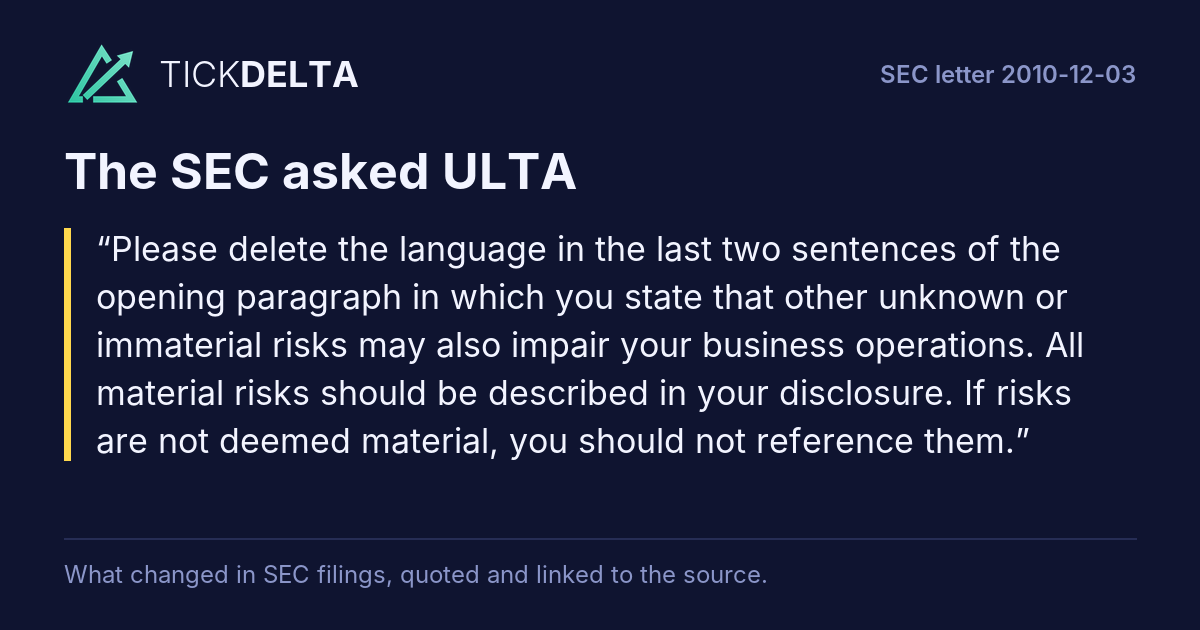
Please delete the language in the last two sentences of the opening paragraph in which you state that other unknown or immaterial risks may also impair your business operations. All material risks should be described in your disclosure. If risks are not deemed material, you should not reference them.
ULTA answered
We will revise our “Risk Factors” section in future filings to delete the language in the last two sentences of the opening paragraph in which we state that other unknown or immaterial risks may also impair our business operations. Read in the reply ↗
In its next report

First report after the company's reply of 2011-01-04: 10-K filed 2011-03-30 ↗, against the 10-K filed 2010-03-31 ↗.

Tickdelta does not hold the text of both reports, so they are not compared here.

Item 9A. Controls and Procedures, page 44
SEC asked (2)
We note that you state that your disclosure controls and procedures were effective “to ensure that the information required to be disclosed by [you] in [y]our reports that [you] file or submit under the Securities Exchange Act of 1934 is recorded, processed, summarized and reported within the time periods specified.” Please supplementally confirm, if true, that your officers concluded that your disclosure controls
Rest of the question

and procedures were also effective to ensure that information required to be disclosed in the reports that you file or submit under the Exchange Act is accumulated and communicated to your management, including your principal executive and principal financial officer, to allow timely decisions regarding required disclosure. In addition, please confirm that you will revise future filings, including any amendments to filings as applicable, accordingly. See Exchange Act Rule 13a-15(e). This comment also applies to your Form 10-Q for the fiscal period ended May 1, 2010, your Form 10-Q for the fiscal period ended July 31, 2010 and your Form 10-Q for the fiscal period ended October 30, 2010.

ULTA answered
Our Chief Executive Officer and Chief Financial Officer concluded that as of January 30, 2010

(fiscal 2009), May 1, 2010 (first quarter 2010), July 31, 2010 (second quarter 2010) and October

30, 2010 (third quarter 2010), disclosure controls and procedures were effective in ensuring that information required to be disclosed in the reports that the Company filed or submitted under the

Exchange Act was accumulated and communicated to the Company’s management, including our principle executive officer and principal financial officer, to allow timely decisions regarding required disclosure.
Rest of the answer

We confirm that we will revise our future filings, including any amendments to filings as applicable, accordingly.

Read in the reply ↗
In its next report

First report after the company's reply of 2011-01-04: 10-K filed 2011-03-30 ↗, against the 10-K filed 2010-03-31 ↗.

Tickdelta does not hold the text of both reports, so they are not compared here.

Item 15. Exhibits and Financial Statement Schedules, page 46 · Statements of Income, page 50
SEC asked (3)
Your discussion of operating expenses on page 35 indicates a portion of depreciation and amortization is classified within selling, general and administrative expenses and excluded from cost of goods sold. Please revise the description of the cost of goods sold line item in future filings to comply with SAB Topic no. 11.B. 2.Summary of significant accounting policies, page 55
ULTA answered
We acknowledge the Staff’s comment and believe our accounting and disclosure is in compliance with current generally accepted accounting principals (GAAP) and Securities and

Exchange Commission (SEC) rules and guidance. We do not believe the guidance prescribed by SAB

Topic 11B applies to our facts given that the Company is not excluding depreciation and amortization from cost of sales or operating expenses.
Rest of the answer

The following table sets forth depreciation and amortization expense for the periods indicated:

Fiscal

2009

2008

2007

Depreciation and amortization included in cost of sales

$

51,919

42,751

34,533 selling, general and adminstrative expenses

10,247

8,694

4,970

Total depreciation and amortization expense

62,166

51,445

39,503

As described on page 35 of the Form 10-K, cost of sales includes depreciation and amortization related to warehousing and distribution activities as well as depreciation and amortization related to store fixturing and construction. Selling, general and administrative (SGA) expenses, which are considered operating expenses, includes depreciation and amortization for all assets except those related to our retail and warehouse operations, which is included in cost of sales, meaning SGA includes depreciation and amortization for general corporate use assets only. This disclosure is replicated in our policy note on page 58 of the Form 10-K which describes cost of sales and selling, general and administrative expenses.

We believe our existing disclosure is consistent with current GAAP and SEC requirements.

2. Summary of significant accounting policies, page 55

Read in the reply ↗
In its next report

First report after the company's reply of 2011-01-04: 10-K filed 2011-03-30 ↗, against the 10-K filed 2010-03-31 ↗.

Tickdelta does not hold the text of both reports, so they are not compared here.

General
SEC asked (4)
We assume the absence of disclosure related to segment reporting suggests you have concluded that you have only one reportable segment. Please explain to us in detail how you determined you have one reportable segment. Please also tell us if you aggregate operating segments, and if so, how the aggregation into one reportable segment complies with the aggregation requirements of FASB ASC 280-10-50.
Rest of the question

Lastly, revise your future disclosure to comply with the requirements of FASB ASC 280-10-50-21. Please show us what your revised disclosure will look like.

ULTA answered
The Company has determined that it has three operating segments: retail stores, salon services and e-commerce. The operating results for these operating segments are reviewed regularly by our Chief Executive Officer, who operates as our chief operating decision maker (CODM). The salon services and e-commerce operating segments do not meet the quantitative thresholds prescribed by

ACS 280-10-50-12 for separate disclosure.
Rest of the answer

We believe that salon services and e-commerce also meet the majority of the aggregation criteria in ACS 280-10-50-11 which allows both operating segments to be combined with retail stores into one reportable segment pursuant to 280-10-50-13. In addition, management does not believe that separate disclosure would be helpful to the readers of the financial statements. We disclose in the “Basis of presentation” section on page 34 of the

Form 10-K that our salon service revenue represents less than 10% of our combined product sales and service revenues. E-commerce sales were low single digits compared to the Company’s fiscal 2009 combined net sales.

We will revise future filings to include the following disclosure in both our Management Discussion and Analysis and notes to financial statements:

Segment reporting

The Company has determined its operating segments on the same basis that it uses to internally evaluate performance. The Company has combined its three operating segments: retail stores, salon services and e-commerce, into one reportable segment.

Read in the reply ↗
General
SEC asked (5)
Please disclose in tabular form for each period presented the amount or percentage of total revenue contributed by each class of similar products or services. In this regard we note you offer salon services and products including make-up, skincare, fragrances and styling tools. Please refer to FASB ASC 280-10-50-40. See also Item 101(c)(1) of Regulation S-K as it relates to disclosure in your Business description.
ULTA answered
We have considered FASB ASC 280-10-50-40 with respect to our disclosure and believe we are in compliance in all material respects. We have determined that salon services revenue is not material and does not require separate disclosure. We also do not believe that separate disclosure of salon services revenue would be beneficial to readers of the financial statements. We describe for our reader in “Item 1.
Rest of the answer

Business, Merchandising” beginning on page 9 of the Form 10-K that our retail stores carry a variety of beauty-related products including prestige and mass cosmetics, fragrance, haircare, skin care, bath and body products and salon styling tools. We believe all of these products are part of one product category, personal care products.

We also believe we are in compliance with Regulation S-K Item 101(c)(1) generally and Item

101(c)(1)(i) specifically in all material respects in “Item 1. Business, Overview” beginning on page 3 of the Form 10-K because we provide the reader with a significant amount of qualitative information describing our products, services, principal markets and methods of distribution. We do not believe additional disclosure is required based on our conclusion that salon services revenue is immaterial and that all of the retail products sold in our retail stores are part of one product category, personal care products.

Read in the reply ↗
Revenue recognition, page 57
SEC asked (6)
You disclose that e-commerce sales are recorded upon shipment of merchandise. Please expand your disclosure to state when title transfers to the customer. Further, please explain to us how your accounting policy complies with the delivery and performance requirements of SAB Topic 13:A.
Rest of the question

If shipping terms determine risk of loss during shipment and/or title transfer to the customer, please explain the terms to us and revise your disclosure to clarify these terms. If revenue on e-commerce sales is recognized prior to the transfer of title and delivery of the product to the customer, please clarify how your policy complies with GAAP.

ULTA answered
E-commerce sales were low single digits compared to the Company’s fiscal 2009 combined net sales.

E-commerce sales are not material to our financial results and, therefore, we do not believe further disclosure in our financial statements is required or provides any additional benefit to users of our financial statements.
Rest of the answer

Currently, we record sales at the time of shipment by our third party carrier because we believe this is the most reliable measurement from a control perspective.

We estimate that in-transit goods represented approximately $200,000 of revenue and $50,000 of margin at any one quarterly balance sheet date during fiscal 2009. We do not believe that the benefit associated with estimating in-transit goods outweigh the cost. If e-commerce sales become material to our financial results in the future, we will disclose our accounting policy and ensure that it is consistent with SAB Topic 13A.

Read in the reply ↗
In its next report

First report after the company's reply of 2011-01-04: 10-K filed 2011-03-30 ↗, against the 10-K filed 2010-03-31 ↗.

Tickdelta does not hold the text of both reports, so they are not compared here.

Revenue recognition, page 57
SEC asked (7)
Please explain to us and disclose your policy for granting product returns. Further, please explain to us how accurate your historical estimates for the past three fiscal years have been with respect to estimating your allowance for sales returns, and how variances between actual and estimated returns are tracked and reviewed by management.
Rest of the question

Lastly, reference is made to your valuation and qualifying accounts disclosure on page 68. Explain to us in detail why you did not disclose the allowance for sales returns activity, or revise your disclosure. Please refer to Rules 5-04 and 12-09 of Regulation S-X

ULTA answered
The Company’s return policy generally provides for a full refund of the customer’s purchase price as long as the product is returned within 60 days of the original purchase provided certain conditions are met. In future filings we will revise our “Revenue recognition” disclosure to indicate our policy for granting product returns.

Actual product returns are tracked and our sales return reserve is adjusted on a monthly basis based on data from our point of sale (POS) system.
Rest of the answer

The sales return reserve represents the difference between the estimated net sales return and the corresponding gross margin adjustment, and the reserve is included in the “Other accrued liabilities” item of the “Accrued liabilities” note on page 61 of the Form 10-K.

The historical year end sales return estimates as compared to the actual results are as follows:

(Dollars in thousands)

Sales return estimate (A)

(1,289

)

(1,182

(1,013

Cost of sales adjustment

736

677

588

Net reserve

(553

(505

(425

Actual returns

(1,338

(1,023

(738

Variance (unfavorable) / favorable

(49

159

275

We believe the above analysis documents that our historical sales return reserve represents a reasonable estimate in all material respects.

The Company’s sales return reserve has not been disclosed in past filings because the Company did not consider its sales return reserve to be a valuation and qualifying account as it does not represent a deduction from a related balance sheet account as defined in Rule 12-09 or Regulation

S-X. In addition, the Company does not believe that the sales return reserve qualifies for separate disclosure due to its immaterial nature. We will disclose this information in future filings should we determine it to be material.

Read in the reply ↗
In its next report

First report after the company's reply of 2011-01-04: 10-K filed 2011-03-30 ↗, against the 10-K filed 2010-03-31 ↗.

Tickdelta does not hold the text of both reports, so they are not compared here.

Revenue recognition, page 57
SEC asked (8)
Please expand your policy for unredeemed gift cards to indicate whether or not gift cards are sold with expiration dates. Further, explain to us and disclose how revenue is recognized on unredeemed gift cards. Lastly, tell us and disclose the amount of deferred gift card revenue for the past two fiscal years ended January 30, 2010 and January 31, 2009.
ULTA answered
Our gift cards do not expire and, historically, we have not recognized revenue from unredeemed gift cards due to statutory escheat requirements as well as materiality considerations. We are currently reevaluating our gift card program structure. Unearned gift card revenue as of January

30, 2010 and January 31, 2009 was $9.9 million and $7.9 million, respectively, which is included in the “Accrued customer liabilities” item of the “Accrued liabilities” note on page 61 of the Form

10-K.

In future filings we will revise our “Revenue recognition” disclosure to indicate the Company’s treatment
Rest of the answer

of unredeemed gift cards and the amount of deferred gift card revenue for the past two fiscal years.

Read in the reply ↗
In its next report

First report after the company's reply of 2011-01-04: 10-K filed 2011-03-30 ↗, against the 10-K filed 2010-03-31 ↗.

Tickdelta does not hold the text of both reports, so they are not compared here.

Cost of sales, page 58
SEC asked (9)
Please disclose your policy for classifying shipping and handling costs in the statements of income. If shipping costs or handling costs are significant and are not classified in cost of sales, disclose the amount(s) of these costs and the line item that includes them. Please refer to FASB ASC 605-45-50-2.
ULTA answered
E-commerce shipping and handling costs are not significant. We will revise our “Cost of sales” disclosure in future filings to include shipping and handling costs. Read in the reply ↗
In its next report

First report after the company's reply of 2011-01-04: 10-K filed 2011-03-30 ↗, against the 10-K filed 2010-03-31 ↗.

Tickdelta does not hold the text of both reports, so they are not compared here.

Self-insurance, page 58
SEC asked (10)
We note from your disclosure under Critical accounting policies and estimates on page 42 that your reserves for self-insurance have steadily declined over the past three years despite the significant increase in the number of stores, employees and sales.
Rest of the question

Please explain to us the reason for the decrease and include in your response a table showing year end balances of the reserve and additions, subtractions and adjustments made during the year. To the extent material, please include a tabular presentation of your reserve activity in future filings. You may provide such information as part of your analysis of reserve accounts included in Schedule II to your financial statements.

ULTA answered
to the Staff’s question regarding insurance expense trends over the three year period, the above table evidences that healthcare insurance expense increased approximately 7% and

23% in fiscal 2009 and 2008, respectively. The lower rate of increase in fiscal 2009 is due to certain changes in the plan including increased employee contributions. Workers compensation / general liability insurance also increased approximately 9% and 38% in fiscal 2009 and 2008, respectively.
Rest of the answer

Again, the fiscal 2009 rate of increase is lower because we renegotiated our policies and have had better loss experience in the last several years due to management initiatives to control cost including improving safety programs and communication. The decrease in the workers compensation / general liability accrual from fiscal 2007 through fiscal 2009 is primarily due to the fact that the Company’s loss experience has steadily improved during the last several years and the prepaid premium amounts paid to the insurer were adequate for the periods covered and did not require the Company to accrue additional premium adjustments.

Upon further assessment of the current structure of our insurance programs, we do not believe that healthcare and workers compensation / general liability insurance accruals qualify as significant estimates or critical accounting policies. We will eliminate this disclosure in future filings.

Read in the reply ↗
Section 16(a) Beneficial Ownership Reporting Compliance, page 38
SEC asked (11)
We note your statement that Ms. Kirby untimely filed one report. Please supplementally tell us the number of transactions that were not reported on a timely basis due to the failure to file such report, and confirm that you will include such required disclosure in future filings as applicable. Refer to Item 405(a)(2) of Regulation S-K. Article IV.
Rest of the question

Compensation Committee Report and Compensation Discussion and Analysis,

ULTA answered
Due to an inadvertent administrative error, one transaction was filed one day late. All other transactions were reported on a timely basis. We confirm that we will include such required disclosure in future filings as applicable. Read in the reply ↗
In its next report

First report after the company's reply of 2011-01-04: 10-K filed 2011-03-30 ↗, against the 10-K filed 2010-03-31 ↗.

Tickdelta does not hold the text of both reports, so they are not compared here.

Section 16(a) Beneficial Ownership Reporting Compliance, page 38
SEC asked (12)
You state that your executive compensation is “evaluated against market based surveys and a pre-determined peer group.” Please revise your disclosure in future filings to identify the benchmarks used in determining the base salaries and annual bonuses (as a percentage of base pay) of your executive officers, as well as the components of the benchmarks.
Rest of the question

In addition, please disclose in future filings the companies that participated in the Towers Perrin CDB, Retail Industry survey and the Towers Perrin CDB, General Industry survey, or tell us why you are not required to do so. Refer to Item 402(b)(2)(xiv) of Regulation S-K. Please show us what your proposed revised disclosure will look like.

ULTA answered
In future filings we will clarify that the market references for setting base salaries and annual bonuses are the surveys and peer group as described on page 25 of the Proxy. The Towers

Perrin CDB, Retail Industry survey and the Towers Perrin CDB, General Industry survey consist of aggregated data, and do not specifically reference individual participating companies.
Rest of the answer

As a result, the Compensation Committee is not aware of the individual companies participating in the surveys and did not benchmark to any individual companies which participated in the surveys.

Rather, the Compensation Committee only referenced the composite aggregated data of the surveys for purposes of determining market practices.

In future filings, to the extent that the Company relies upon similar general market surveys, we will disclose such surveys. To the extent that the Company benchmarks against individual companies, similar to the peer group described on page 25 of the Proxy, the Company will identify in future filings all individual companies with which we benchmark.

Read in the reply ↗
In its next report

First report after the company's reply of 2011-01-04: 10-K filed 2011-03-30 ↗, against the 10-K filed 2010-03-31 ↗.

Tickdelta does not hold the text of both reports, so they are not compared here.

Section 16(a) Beneficial Ownership Reporting Compliance, page 38
SEC asked (13)
With respect to your engagement of your compensation consultant, please revise your disclosure in future filings to expand upon the nature and scope of the consultant’s assignment, and the material elements of the instructions or directions that you gave to the consultant with respect to the performance of its duties under the engagement. Refer to Item 407(e)(3)(iii) of Regulation S-K.
Rest of the question

Please show us what your proposed revised disclosure will look like.

ULTA answered
In future filings we will expand upon the nature and scope of our compensation consultant’s assignment and include the material elements of any instructions or directions we give to the consultant with respect to the performance of its duties. Pursuant to its charter, the

Compensation Committee (the “Committee”) is authorized to retain and terminate any consultant, as well as approve the consultant’s fees, scope of work and other terms of retention.
Rest of the answer

In 2009 the

Committee retained compensation consultant Towers Perrin (known as Towers Watson after merging with

Watson Wyatt Worldwide effective January 1, 2010). During the period in question, Towers Watson advised the Committee on compensation issues and kept the Committee apprised of regulatory developments and competitive practices related to executive compensation practices. For fiscal

2009-2010, Towers Watson provided competitive market data and advice, when requested by the

Committee. In particular Towers Watson provided the Committee with information related to competitive incentive design practices and stock ownership guidelines. Towers Watson, however, did not determine or recommend the exact amount or form of executive compensation for any executive officers. Towers Watson reported directly to the Committee. A representative of Towers Watson, when requested, attended meetings of the Committee, was available to participate in executive sessions and communicated directly with the Committee Chair or its members outside of meetings.

The approval of the Chair of the Committee, acting on authority delegated by the Committee, was required for any other work to be done for the Company and its affiliates by Towers Watson.

Read in the reply ↗
In its next report

First report after the company's reply of 2011-01-04: 10-K filed 2011-03-30 ↗, against the 10-K filed 2010-03-31 ↗.

Tickdelta does not hold the text of both reports, so they are not compared here.

Compensation Risk, page 23
SEC asked (14)
We note your disclosure in response to Item 402(s) of Regulation S-K. Please supplementally describe the process you undertook to reach your determination that your compensation plans, practices and policies are not “reasonably likely to have a material adverse effect on the Company.”
ULTA answered
A multi-disciplinary team consisting of finance, human resources, legal and audit personnel reviewed the Company’s variable pay plans, practices and policies and evaluated and identified the following:

•

Risk in pay plan design process;

Risk in pay plan content; and

Risk levels of pay plans.

Based on this review, the team determined that the Company did not have any compensation plans, practices or polices that created risks that were reasonably likely to have a material adverse effect on the Company, for the following reasons:

The Company’s variable compensation programs are linked to
Rest of the answer

specific performance metric goals set by the Compensation Committee for executive officers and for other employees by supervisors consistent with the Company’s compensation philosophy and business goals;

The performance periods for the pay programs are designed to match the period for which the employee had influence on the results;

Payments under the incentives are capped;

Payments are reviewed by the Compensation Committee, payroll and human resources and are subject to spot audits;

The mix between mixed and variable pay is balanced so as to neither discourage proper risk taking nor encourage excessive risk taking; and

No participant is allowed to approve his or her own performance goals or payout.

The team presented its analysis and assessment of these matters to management and the Compensation

Committee, which concurred.

**********

In responding to the Division’s comments, the Company acknowledges that:

The Company is responsible for the adequacy and accuracy of the disclosure in this filing;

Staff comments or changes to disclosure in response to staff comments do not foreclose the Commission from taking any action with respect to the filing; and

The Company may not assert staff comments as a defense in any proceeding initiated by the Commission or any person under the federal securities laws of the

United States.

Read in the reply ↗
In its next report

First report after the company's reply of 2011-01-04: 10-K filed 2011-03-30 ↗, against the 10-K filed 2010-03-31 ↗.

Tickdelta does not hold the text of both reports, so they are not compared here.

Item 15. Exhibits and Financial Statement Schedules, page 46
SEC asked
Summary of significant accounting policies, page 55 1. We read your response to comment five of our letter dated December 3, 2010. We note you do not believe that separate disclosure of salon services revenue would be beneficial to the readers of your financial statements. We do not concur with your conclusion.
Rest of the question

Please revise your future disclosure or advise us in detail why the readers of your financial statements would not find disclosure of the extent of services provided information useful or beneficial. Self-insurance, page 58 2. We read your response to comment 10 of our letter dated December 3, 2010. We believe the amounts charged to expense are significant and that you should include a tabular presentation of your reserve activity. Please confirm to us that you will present this information in future filings. Please respond to this letter within ten business days by providing the requested information, or by advising us when you will provide the requested response. If you do not believe our comments apply to your facts and circumstances please tell us why in your response. Please submit your cover letter over EDGAR. Please understand that we may have additional comments after reviewing your amendments and responses to our comments.

ULTA answered
We confirm that we will include disclosure of the self insurance reserves and related expense in tabular form in future filings.

**********

In responding to the Division’s comments, the Company acknowledges that:

•

The Company is responsible for the adequacy and accuracy of the disclosure in this filing;

Staff comments or changes to disclosure in response to staff comments do not foreclose the Commission from taking any action with respect to the filing; and

The Company may not assert staff comments as a defense in any proceeding initiated by the Commission or any person under the
Rest of the answer

federal securities laws of the

United States.

Read in the reply ↗
In its next report

First report after the company's reply of 2011-02-03: 10-K filed 2011-03-30 ↗, against the 10-K filed 2010-03-31 ↗.

Tickdelta does not hold the text of both reports, so they are not compared here.

Also in this review: request for more time, 2010-12-08, closing letter, 2011-02-11

From the SEC's correspondence on EDGAR: staff letters (form UPLOAD) and company letters (form CORRESP), 22 letters filed since 2010-12-03. Questions and answers are matched by their numbers; topics come from words in each question. The reports are compared word for word (same form, before the first SEC letter against the first report after the company's reply). No AI.

Next in Owners and insiders Insider trades →