Paragraph 8 · 50% changed
Every version of it
Screener
/
SEC EDGAR
/CIK 0001090727
/10-K filed Feb 17, 2026, compared with Feb 18, 2025
/Numbers from the XBRL of the 10-Ks
NYSE
Industrials · Trucking & Delivery
United Parcel Service UPS
The 10-K against last year's
308 changes: 67 added, 83 removed, 151 reworded, 7 quiet changes
10-K Feb 17, 2026 vs Feb 18, 2025
Risk Factors
19.0%
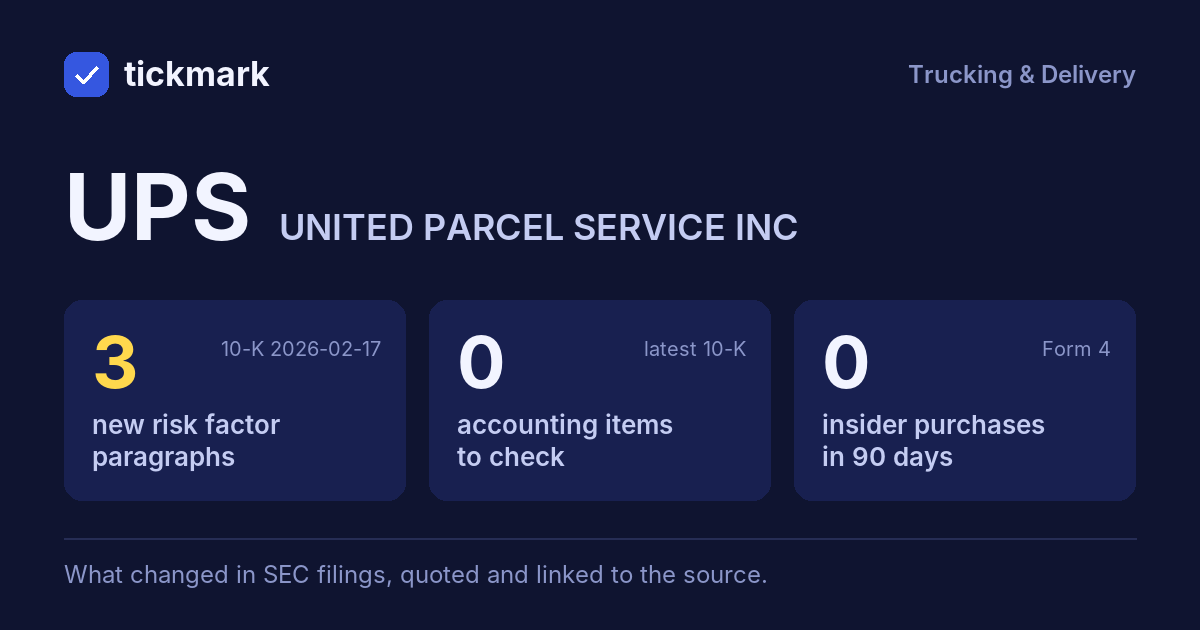
of the text changed · 6,093 words now · 3 new paragraphs, 0 gone
MD&A
46.4%
of the text changed · 13,906 words now · 64 new paragraphs, 83 gone
Legal Proceedings
27.1%
of the text changed · 828 words now
Accounting Policies
29.0%
of the text changed · 5,554 words now
10-K 0001628280-26-008432 (Feb 17, 2026) vs 10-K 0001090727-25-000019 (Feb 18, 2025)
Every paragraph, and how much of it changed
One bar per paragraph, in the order of the 10-K. Height and colour show the share of its words not in the closest paragraph a year earlier; the tallest bars are new paragraphs.
Risk Factors
72 paragraphs · 3 new · 52 reworded · 0 gone · 10-K Feb 17, 2026 against Feb 18, 2025
New paragraph
Reworded (5% of its words or more)
Same or nearly
Paragraph 28 · 46% changed
Every version of it
Paragraph 13 · 40% changed
Every version of it
In addition, we our Network Reconfiguration and Efficiency Reimagined initiatives have led to, and are expected to continue to strive to lower lead to, consolidations of our cost to serve, including labor costs, through various strategic initiatives. facilities and workforce, as well as an end-to-end process redesign. Our inability to continue to retain experienced and motivated employees through the execution of these and other initiatives may also materially adversely affect us.
Paragraph 19 · 37% changed
Every version of it
We rely on information technology networks and systems and other operational technologies, technologies to operate our business, including the internet and a number of internally-developed internally developed systems and applications, as well as certain technology systems from third-party vendors (collectively referred to as "IT"), to operate our business. "IT"). For example, we rely on these technologies IT to receive package level information in advance of the physical receipt of packages, move and track packages through our operations, efficiently plan deliveries, execute billing processes, provide information to package recipients, manage employee data and track and report financial and operational data. Our franchise locations and subsidiaries also rely on IT systems to manage their business processes and activities.
Paragraph 37 · 31% changed
Every version of it
The increased severity or frequency of certain weather conditions (including as a result of climate change) or other natural or man-made disasters, including storms, floods, fires, wind gusts, earthquakes, rising temperatures, epidemics, pandemics, conflicts, civil or political unrest, safety failures or terrorist attacks, have in the past and may in the future disrupt our business. Customers may reduce shipments, supply chains may be disrupted, demand may be negatively impacted, property may be damaged, employees may be injured, or our costs to operate our business may increase, any of which could have a material adverse effect on us. Any such event affecting one of our major facilities could result in a significant interruption in or disruption of our business. To the extent that weather conditions or other disasters become more frequent or severe, disruptions to our business and those of our customers and costs to repair damaged facilities or maintain or resume operations could increase. Furthermore, as a result of the impact of climate change on the frequency or severity of weather conditions and other disasters, insurance providers may reduce the availability or increase the cost of insurance.
Paragraph 20 · 29% changed
Every version of it
Paragraph 10 · 28% changed
Every version of it
Some of our other larger customers can account for a relatively significant portion of our volume and revenues in a particular quarter or year. Customer impact on our revenue and profitability can vary based on a number of factors, factors including: contractual volume amounts; pricing terms; product launches; e-commerce or other industry trends, including those related to the holiday season; business combinations and the overall growth of a customer's underlying business; as well as any disruptions to their businesses. business. Customers could choose, and have in the past chosen, to divert all or a portion of their business with us to one of our competitors, demand pricing concessions, request enhanced services that increase our costs, or develop their own logistics capabilities. In addition, certain of our significant customer contracts include termination rights of either party upon the occurrence of certain events or without cause upon advance notice to the other party. If all or a portion of our business relationships with one or more significant customers were to terminate or significantly change in an unplanned manner, this could materially adversely affect us.
Paragraph 49 · 28% changed
Every version of it
Paragraph 8 · 50% changed
Every version of it
10-K Feb 18, 2025For the year ended December 31, 2024, one customer, Amazon.com, Inc. and its affiliates, accounted for 11.8% of our consolidated revenues. In the first quarter of 2025, we entered into an agreement in principle with this customer that will provide for a reduction in their volume by more than 50% by June 2026. In connection therewith, we are making certain business and operational changes intended to match our workforce to our activity and eliminate our stranded costs. In the event we are not able to successfully reduce our costs in connection therewith, our profitability could be materially impacted. For additional information on the expected operational and financial impacts arising from this agreement, see “Management’s Discussion and Analysis of Financial Condition and Results of Operations”.
10-K Feb 17, 2026
Our strategy includes planned volume declines from our largest customer, Amazon.com, Inc. For 2025, this customer and its affiliates accounted for 10.6% of our consolidated revenues. In connection with the execution of this strategy, we have made and continue to make reductions in the number of our facilities, vehicles and aircraft, and our workforce, intended to better align our assets and workforce to our planned operations, and to eliminate stranded costs. In the event we are not able to successfully make appropriate adjustments or control related costs, our profitability could be materially impacted. For
Paragraph 28 · 46% changed
Every version of it
10-K Feb 18, 2025Although to date we are unaware of any material data breach or cybersecurity incident, including an information system disruption, we cannot provide any assurances that such material events and impacts will not occur in the future. Our efforts to deter, identify, mitigate and/or eliminate future breaches or cybersecurity incidents may require significant additional effort and expense and may not be successful.
10-K Feb 17, 2026
identify, mitigate and/or eliminate future breaches or cybersecurity incidents may require significant additional effort and expense and may not be successful.
Paragraph 13 · 40% changed
Every version of it
10-K Feb 18, 2025
In addition, we continue to strive to lower our cost to serve, including labor costs, through various strategic initiatives. Our inability to continue to retain experienced and motivated employees through the execution of these initiatives may also materially adversely affect us.
10-K Feb 17, 2026
In addition, our Network Reconfiguration and Efficiency Reimagined initiatives have led to, and are expected to continue to lead to, consolidations of our facilities and workforce, as well as an end-to-end process redesign. Our inability to continue to retain experienced and motivated employees through the execution of these and other initiatives may also materially adversely affect us.
Paragraph 19 · 37% changed
Every version of it
10-K Feb 18, 2025
We rely on information technology networks and systems and other operational technologies, including the internet and a number of internally-developed systems and applications, as well as certain technology systems from third-party vendors (collectively referred to as "IT"), to operate our business. For example, we rely on these technologies to receive package level information in advance of the physical receipt of packages, move and track packages through our operations, efficiently plan deliveries, execute billing processes, provide information to package recipients, manage employee data and track and report financial and operational data. Our franchise locations and subsidiaries also rely on IT systems to manage their business processes and activities.
10-K Feb 17, 2026
We rely on information technology networks and systems and other operational technologies to operate our business, including the internet and internally developed systems and applications, as well as certain technology systems from third-party vendors (collectively referred to as "IT"). For example, we rely on IT to receive package level information in advance of the
Paragraph 37 · 31% changed
Every version of it
10-K Feb 18, 2025
The increased severity or frequency of certain weather conditions (including as a result of climate change) or other natural or man-made disasters, including storms, floods, fires, wind gusts, earthquakes, rising temperatures, epidemics, pandemics, conflicts, civil or political unrest, or terrorist attacks, have in the past and may in the future disrupt our business. Customers may reduce shipments, supply chains may be disrupted, demand may be negatively impacted, property may be damaged, employees may be injured, or our costs to operate our business may increase, any of which could have a material adverse effect on us. Any such event affecting one of our major facilities could result in a significant interruption in or disruption of our business. To the extent that weather conditions or other disasters become more frequent or severe, disruptions to our business and those of our customers and costs to repair damaged facilities or maintain or resume operations could increase. Furthermore, as a result of the impact of climate change on the frequency or severity of weather conditions and other disasters, insurance providers may reduce the availability or increase the cost of insurance.
10-K Feb 17, 2026
The increased severity or frequency of certain weather conditions (including as a result of climate change) or other natural or man-made disasters, including storms, floods, fires, wind gusts, earthquakes, rising temperatures, epidemics, pandemics, conflicts, civil or political unrest, safety failures or terrorist attacks, have in the past and may in the future disrupt our business. Customers may reduce shipments, supply chains may be disrupted, demand may be negatively impacted, property may be
Paragraph 20 · 29% changed
Every version of it
10-K Feb 18, 2025We rely on information technology networks and systems and other operational technologies, including the internet and a number of internally-developed systems and applications, as well as certain technology systems from third-party vendors (collectively referred to as "IT"), to operate our business. For example, we rely on these technologies to receive package level information in advance of the physical receipt of packages, move and track packages through our operations, efficiently plan deliveries, execute billing processes, provide information to package recipients, manage employee data and track and report financial and operational data. Our franchise locations and subsidiaries also rely on IT systems to manage their business processes and activities.
10-K Feb 17, 2026
physical receipt of packages, move and track packages through our operations, efficiently plan deliveries, execute billing processes, provide information to package recipients, manage employee data and track and report financial and operational data. Our franchise locations and subsidiaries also rely on IT to manage their business processes and activities.
Paragraph 10 · 28% changed
Every version of it
10-K Feb 18, 2025
Some of our other larger customers can account for a relatively significant portion of our volume and revenues in a particular quarter or year. Customer impact on our revenue and profitability can vary based on a number of factors, including: contractual volume amounts; pricing terms; product launches; e-commerce or other industry trends, including those related to the holiday season; business combinations and the overall growth of a customer's underlying business; as well as any disruptions to their businesses. Customers could choose, and have in the past chosen, to divert all or a portion of their business
10-K Feb 17, 2026
Some of our other larger customers can account for a relatively significant portion of our volume and revenues in a particular quarter or year. Customer impact on our revenue and profitability can vary based on a number of factors including: contractual volume amounts; pricing terms; product launches; e-commerce or other industry trends, including those related to the holiday season; business combinations and the overall growth of a customer's underlying business; as well as any disruptions to their business. Customers could choose, and have in the past chosen, to divert all or a portion of their business with us to one of our competitors, demand pricing concessions, request enhanced services that increase our costs, or develop their own logistics capabilities. In addition, certain of our significant customer contracts include termination rights of either party upon the occurrence of certain events or without cause upon advance notice to the other party. If all or a portion of our business relationships with one or more significant customers were to terminate or significantly change in an unplanned manner, this could materially adversely affect us.
Paragraph 49 · 28% changed
Every version of it
10-K Feb 18, 2025Changes in foreign currency exchange rates or interest rates may have a material adverse effect on us.
10-K Feb 17, 2026
currency exchange rates and interest rates cannot always be predicted or effectively hedged, and may have a material adverse effect on us.
MD&A
219 paragraphs · 64 new · 107 reworded · 83 gone · 10-K Feb 17, 2026 against Feb 18, 2025
New paragraph
Reworded (5% of its words or more)
Same or nearly
Paragraph 121 · 50% changed
Interest expense Expense increased primarily due to higher interest rates on new average outstanding debt issuances in 2024. balances and lower capitalized interest.
Paragraph 10 · 49% changed
During 2024, 2025, we also returned $6.4 billion in cash to shareholders in the form of dividends of $6.52 per share, for a total of $5.4 billion, and $500 million by completing $1.0 billion of share repurchases. For the year, capital expenditures were $3.9 billion. repurchases and paying $5.4 billion in dividends.
Paragraph 18 · 49% changed
Paragraph 102 · 49% changed
•Management compensation costs cost decreased $127 million $242 million, primarily due to lower overall headcount, partially offset by higher headcount and a decrease in incentive compensation expense. compensation.
Paragraph 95 · 48% changed
Paragraph 42 · 47% changed
We exclude have excluded the impact in 2024 of a charge an expense to settle a previously disclosed regulatory matter that we consider to be unrelated to matter. We do not believe this was a component of our ongoing operations and that we do not expect this or similar expenses to recur. For more information regarding this regulatory matter, see note 10 to the audited, consolidated financial statements.
Paragraph 60 · 47% changed
Revenue per piece declined 0.5% for increased 7.1% in 2025, with growth in both Air and Ground products. This increase reflects the year due primarily to the decrease in fuel surcharges discussed below. The negative full-year impact of changes in product mix, including an increase in lighter weight, shorter zone shipments, were partially offset by the positive impact of pricing actions to address revenue quality, including demand related surcharges, which led to sequential improvement in the revenue per piece growth rate during the second half of the year. In December 2023, we implemented an average 5.9% net increase in base and accessorial rates for both our Air and Ground products. Revenue per piece from our Air products increased due to changes implemented in customer mix while revenue per piece from our Ground products declined due to changes December 2024, as well as favorable trends in both customer and product mix. Changes in package characteristics and fuel surcharges also contributed to the increase.
Paragraph 61 · 46% changed
Paragraph 121 · 50% changed
10-K Feb 18, 2025
Interest expense increased primarily due to higher interest rates on new debt issuances in 2024.
10-K Feb 17, 2026
Interest Expense increased due to higher average outstanding debt balances and lower capitalized interest.
Paragraph 10 · 49% changed
10-K Feb 18, 2025
During 2024, we also returned cash to shareholders in the form of dividends of $6.52 per share, for a total of $5.4 billion, and $500 million of share repurchases. For the year, capital expenditures were $3.9 billion.
10-K Feb 17, 2026
During 2025, we returned $6.4 billion in cash to shareholders by completing $1.0 billion of share repurchases and paying $5.4 billion in dividends.
Paragraph 18 · 49% changed
10-K Feb 18, 2025◦a charge related to a regulatory matter unrelated to our ongoing operations of $45 million, or $0.05 per diluted share;
10-K Feb 17, 2026
◦Goodwill and Asset Impairment Charges of $156 million, or $0.18 per diluted share, which includes a charge of $137 million related to the retirement of our MD-11 aircraft fleet;
Paragraph 102 · 49% changed
10-K Feb 18, 2025
•Management compensation costs decreased $127 million due to lower overall headcount, partially offset by higher incentive compensation expense.
10-K Feb 17, 2026
•Management compensation cost decreased $242 million, primarily due to lower overall headcount and a decrease in incentive compensation.
Paragraph 95 · 48% changed
10-K Feb 18, 2025Year Ended December 31, Change 2024 2023 $ % Non-GAAP adjustments to Operating Expenses (in millions): Transformation Strategy Costs Forwarding $ 39 $ 68 $ (29) (42.6)% Logistics 57 48 9 18.8% Other SCS — 2 (2) (100.0)% Total Transformation Strategy Costs 96 118 (22) (18.6)% Gain on Divestiture of Coyote Forwarding (156) — (156) N/A Total Gain on Divestiture of Coyote (156) — (156) N/A Goodwill and Asset Impairment Charges Forwarding — 119 (119) (100.0)% Logistics 101 — 101 N/A Other SCS — 117 (117) (100.0)% Total Goodwill and Asset Impairment Charges 101 236 (135) (57.2)% Expense for Regulatory Matter Other SCS 45 — 45 N/A Total Expense for Regulatory Matter 45 — 45 N/A Total non-GAAP Adjustments to Operating $ 86 $ 354 $ (268) (75.7)% Expenses
10-K Feb 17, 2026
Non-GAAP adjusted operating expenses exclude the impact of $35 and $96 million in Transformation Strategy Costs in 2025 and 2024, respectively. 2025 results also exclude a $19 million Net Loss on Divestiture of an SCS business. 2024 results exclude a $156 million Gain on Divestiture related to Coyote, $101 million in Goodwill and Asset Impairment Charges and a $45 million Expense for a Regulatory Matter.
Paragraph 42 · 47% changed
10-K Feb 18, 2025
We exclude the impact of a charge to settle a regulatory matter that we consider to be unrelated to our ongoing operations and that we do not expect to recur. For more information regarding this regulatory matter, see note 10 to the audited, consolidated financial statements.
10-K Feb 17, 2026
We have excluded the impact in 2024 of an expense to settle a previously disclosed regulatory matter. We do not believe this was a component of our ongoing operations and we do not expect this or similar expenses to recur.
Paragraph 60 · 47% changed
10-K Feb 18, 2025
Revenue per piece declined 0.5% for the year due primarily to the decrease in fuel surcharges discussed below. The negative impact of changes in product mix, including an increase in lighter weight, shorter zone shipments, were partially offset by the positive impact of pricing actions to address revenue quality, including demand related surcharges, which led to sequential improvement in the revenue per piece growth rate during the second half of the year. In December 2023, we implemented an average 5.9% net increase in base and accessorial rates for both our Air and Ground products. Revenue per piece from our Air products increased due to changes in customer mix while revenue per piece from our Ground products declined due to changes in both customer and product mix.
10-K Feb 17, 2026
Revenue per piece increased 7.1% in 2025, with growth in both Air and Ground products. This increase reflects the full-year impact of an average 5.9% net increase in base and accessorial rates implemented in December 2024, as well as favorable trends in customer and product mix. Changes in package characteristics and fuel surcharges also contributed to the increase.
Paragraph 61 · 46% changed
10-K Feb 18, 2025We expect revenue per piece to increase during 2025 as we focus on growing higher yielding volume from customers that value our end-to-end integrated network and the impact of an average 5.9% net increase in base and accessorial rates implemented in December 2024.
10-K Feb 17, 2026
In December 2025, we implemented a separate average 5.9% net increase in base and accessorial rates for both Air and Ground products, which we expect will contribute to revenue per piece growth in 2026.
A paragraph is matched with the one last year that shares the most of its words; under half in common makes it new. The paragraphs shown are the 8 reworded the most in each section.
The paragraph that changed most in each section
The redline
Marked against last year's 10-K: cut words struck through, new words highlighted.
MD&A437 words changed in this paragraph; it is 36% similar to last year's version.
Transformation 2.0: Based on a number of factors factors, including evaluating the efficiencies gained as a part of Transformation 1.0, previously achieved, and in connection with changes in our executive leadership in 2020, we identified and reprioritized certain then-current and future investments, including additional investments in our workforce, portfolio of businesses and technology (such projects, collectively, “Transformation 2.0”). "Transformation 2.0"). Specifically, we identified opportunities to reduce spans and layers of management, began a review of our business portfolio and identified opportunities to invest in certain technologies, including financial reporting and certain schedule, time and pay systems, to reduce global indirect operating costs, provide better visibility, and reduce reliance on legacy systems and coding languages. Our organizational structure review indicated an opportunity to realize initial savings of approximately $400 million with potential opportunities to save up to an additional $240 million through the reduction of spans and layers of management with an anticipation that these savings would be recurring. The business portfolio review was expanded in 2022. As a result, we determined to exit certain businesses that were not aligned with our corporate strategy and determined to make new investments into certain businesses, including healthcare-focused businesses, better aligned to our strategic targets. In connection therewith, we incurred costs primarily consisting of outside professional fees related to these reviews and other costs associated with these transactions. Lastly, our review of our systems and technologies identified certain areas of our business that were reliant on outdated technologies. Our reviews determined that continued use of these legacy technologies would likely increase maintenance costs and that investments into new technologies would enhance our ability to leverage our data and allow us to establish a more flexible system architecture. As of December 31, 2023, we substantially completed our initiatives to reduce spans and layers of management and achieved savings in line with our anticipated benefits. Our ongoing efforts under Transformation 2.0 include initiatives related to our financial systems and our business portfolio review. As of December 31, 2024, we have incurred $798 million of costs as part of Transformation 2.0. Transformation 2.0 initiatives are expected to conclude during 2025 with anticipated remaining costs of approximately $90 million primarily related to completion of our technology initiatives. Costs associated with Transformation 2.0 have primarily consisted of compensation and benefit costs related to reductions in our workforce and fees paid to third-party consultants. Additional detail relating to the projects, initiatives and timing of costs as a part of Transformation 2.0 are contained was completed in the table above. Investments in technology are expected to provide enhanced quality of reporting for both internal 2025, and external purposes in part through simplification and standardization of data to better enable migration into cloud-based tools and automation of manual activities, including transitioning general ledger, consolidation, and planning tools along with U.S. payroll from older programs and software supporting our freight forwarding business. These efforts to enhance our technology are expected to reduce the need for future investments; we expect to begin to realize benefits therefrom in 2025. Investments in our business portfolio review are expected to lead to better alignment of our businesses in support of our corporate strategy. We are realigning businesses within Supply Chain Solutions to better execute our strategy; the operational performance of these businesses is included in our GAAP and non-GAAP adjusted results. total related costs were $835 million.
Source: Item 7, 10-K 0001628280-26-008432 vs Item 7, 10-K 0001090727-25-000019
Risk Factors219 words changed in this paragraph; it is 60% similar to last year's version.
We regularly assess the carrying values of our assets relative to their estimated fair values. If the carrying value of an asset exceeds its estimated fair value, we may be required to incur charges to reduce the its carrying value. Fair value thereof. The determination of fair value is determinations are dependent on a significant number of estimates and assumptions that could be impacted by a variety of factors, including changes in business strategy, revenue, revenues, expenses, acquisition integration activities, government regulations, including regulation related to climate change, costs of capital and economic or market conditions. The use of different estimates or assumptions could also result in different estimates of fair value. Our estimates of fair value estimates. Our fair value estimates have resulted from time to time, and may in the future result, in substantial impairments of our assets. For example, during the year ended December 31, 2023, as a result of a number of factors including changes in business strategy and challenging macroeconomic conditions such as increases in the risk-free interest rate and volatility of the stock prices of market comparables, we incurred impairment charges of $125 and $111 million in respect of goodwill and indefinite-lived intangible assets, respectively. While we did not identify incur any impairment impairments of goodwill during 2025 or 2024, certain of our reporting units experienced a decrease in the excess of their estimated fair values over their respective carrying values. Additional decreases could result in goodwill or other impairment charges, which could be material. values during each year. We have been and may be required in the future to recognize additional impairments of long-lived assets, including definite-lived intangible assets, property, plant and equipment and leases. Furthermore, leases, which could be material. For example, as previously disclosed, we have been and may be required in the future to recognize increased depreciation and amortization charges if we determine the useful lives or salvage values of our assets are less than we originally estimated. Changes in our business plans, including anticipated changes to our network in 2025, have previously and may in the future lead to revisions in our estimates of useful lives or salvage values of our assets. Such charges have in the past, and may in the future, reduce our net income, potentially materially. recorded
Source: Item 1A, 10-K 0001628280-26-008432 vs Item 1A, 10-K 0001090727-25-000019
Accounting Policies132 words changed in this paragraph; it is 55% similar to last year's version.
We recognize liabilities for uncertain tax positions based on a two-step process. The first step is to evaluate the tax position for recognition by determining if the weight of available evidence indicates that it is more likely than not that the position will be sustained on audit, including resolution of related appeals or litigation processes, if any. Once it is determined that the position meets the recognition threshold, the second step requires us to estimate and measure the largest amount of tax benefit that is more likely than not to be realized upon ultimate settlement. The difference between the amount of recognizable tax benefit and the total amount of tax benefit from positions filed or to be filed with the tax authorities is recorded as a liability for uncertain tax benefits. It is inherently difficult and subjective to estimate such amounts, as we have to determine the probability of various possible outcomes. We reevaluate uncertain tax positions on a quarterly basis. This evaluation is based on factors including, but not limited to, changes in facts or circumstances, changes in tax law, effectively settled issues under audit and new audit activity. Such a change in recognition or measurement could result in the recognition of a tax benefit or an additional charge to the tax provision.
Source: Item 8, Note 1 – SUMMARY OF ACCOUNTING POLICIES, 10-K 0001628280-26-008432 vs Item 8, Note 1 – SUMMARY OF ACCOUNTING POLICIES, 10-K 0001090727-25-000019
Legal ProceedingsNew paragraph this year (124 words), with no similar paragraph last year.
In December 2025, Malone et al. v. United Parcel Service Inc. (OH) was certified as a class action in federal court in the Eastern District of Pennsylvania. The plaintiffs filed this action alleging entitlement to overtime under the Pennsylvania Minimum Wage Act, seeking allegedly unpaid wages. We are vigorously defending ourselves in this matter. We believe that we have meritorious defenses, and there are unresolved questions of law and fact that could be important to the ultimate resolution of this matter. Accordingly, we are not able to estimate a possible loss or range of loss that may result from this matter or to determine whether such loss, if any, would have a material adverse effect on our financial condition, results of operations or liquidity.
Source: Item 3, via Note 10 – LEGAL PROCEEDINGS AND CONTINGENCIES, 10-K 0001628280-26-008432 vs Item 3, via Note 10 – LEGAL PROCEEDINGS AND CONTINGENCIES, 10-K 0001090727-25-000019
Sentences and paragraphs added, removed or reworded
Every change, by type
Sentences and paragraphs of UPS's Risk Factors and MD&A, 10-K Feb 17, 2026 against 10-K Feb 18, 2025. Each links to the text at sec.gov.
Quiet changes are sentences kept from last year with one to four words changed, at least one of them a hedge, a modal or a qualifier (may, could, will, not, significant, material…). A year or date rolling forward is not counted.
The full word list
adverse, adversely, all, although, anticipate, anticipates, any, approximately, believe, believes, can, cannot, certain, could, expect, expects, generally, however, if, intend, intends, largely, likely, many, material, materially, may, might, most, must, never, no, not, possible, primarily, probable, should, significant, significantly, some, substantial, substantially, unlikely, will, would
AddedRisk Factors
additional information on the operational and financial impacts arising from this strategy, see "Management’s Discussion and Analysis of Financial Condition and Results of Operations".
Read it in 10-K Feb 17, 2026 at sec.gov
AddedRisk Factors
In addition, we are increasing our utilization of artificial intelligence ("AI") to optimize our operations, improve the customer experience and support decision-making. The rapid evolution and increased adoption of AI technologies has and may continue to intensify our cybersecurity risks. AI technologies often require access to large volumes of sensitive data. If our AI systems are compromised through cyberattacks or unauthorized access, it could result in data breaches, a loss of proprietary information, or violations of data protection laws. Additionally, leveraging AI capabilities for our internal functions may introduce additional operational vulnerabilities by producing inaccurate outcomes, recommendations or other suggestions based on flaws in the underlying data, or other unintended results.
Read it in 10-K Feb 17, 2026 at sec.gov
AddedRisk Factors
$182 million in asset impairment charges during the fourth quarter of 2025. Furthermore, we have been and may be required in the future to recognize accelerated depreciation and amortization charges if we determine the useful lives or salvage values of our assets are less than we originally estimated. Changes in our business plans, including network changes that began in 2025, have led to and may in the future lead to revisions in our estimates of useful lives or salvage values of our assets. Such charges have in the past, and may in the future, reduce our net income, potentially materially.
Read it in 10-K Feb 17, 2026 at sec.gov
RewordedRisk Factors
IT and other systems (ours, as well as those of our franchisees, acquired businesses, and third-party service providers) have been and will continue in the future to be susceptible to damage, disruptions and shutdowns due to programming errors, defects or other vulnerabilities, power outages, hardware failures, misconfigurations, computer viruses, cyber-attacks, encryption caused by ransomware or malware attacks, exfiltration of data, attacks by foreign governments, state-sponsored actors, or criminal groups, theft, misconduct by employees or other insiders, telecommunications failures, misuse, human errors or other catastrophic events.
Read it in 10-K Feb 17, 2026 at sec.gov
RewordedRisk Factors
Customers may reduce shipments, supply chains may be disrupted, demand may be negatively impacted, property may be damaged, employees may be injured, or our costs to operate our business may increase, any of which could have a material adverse effect on us.
Read it in 10-K Feb 17, 2026 at sec.gov
RewordedRisk Factors
Customers could choose, and have in the past chosen, to divert all or a portion of their business with us to one of our competitors, demand pricing concessions, request enhanced services that increase our costs, or develop their own logistics capabilities.
Read it in 10-K Feb 17, 2026 at sec.gov
RewordedRisk Factors
We monitor and manage foreign currency exchange rate and interest rate exposures, and use derivative instruments to mitigate the impact of changes in these rates on our financial condition and results of operations; however, changes in foreign currency exchange rates and interest rates cannot always be predicted or effectively hedged, and may have a material adverse effect on us.
Read it in 10-K Feb 17, 2026 at sec.gov
RewordedRisk Factors
Furthermore, many countries, as well as countries and U.S. states, in which we operate or are subject to regulation states have adopted, or are expected to adopt, additional requirements relating to the disclosure of GHG emissions disclosures and related matters.
Read it in 10-K Feb 17, 2026 at sec.gov
Show the other 50
RewordedRisk Factors
RewordedRisk Factors
Changes in our relationships with any of our significant customers, including as a result of our strategy to reduce volume from our largest customer or the loss or reduction in business from one or more of them, other customers, could have a material adverse effect on us.
Read it in 10-K Feb 17, 2026 at sec.gov
RewordedRisk Factors
We rely on information technology networks and systems and other operational technologies, technologies to operate our business, including the internet and a number of internally-developed internally developed systems and applications, as well as certain technology systems from third-party vendors (collectively referred to as "IT"), to operate our business. "IT").
Read it in 10-K Feb 17, 2026 at sec.gov
RewordedRisk Factors
For the year ended December 31, 2024, one customer, Amazon.com, Inc. 2025, this customer and its affiliates, affiliates accounted for 11.8% 10.6% of our consolidated revenues.
Read it in 10-K Feb 17, 2026 at sec.gov
RewordedRisk Factors
RewordedRisk Factors
In addition, in January 2025, the President of 2026, the U.S. signed an executive order indicating that the U.S. would withdraw withdrew from the Paris Climate Accords.
Read it in 10-K Feb 17, 2026 at sec.gov
RewordedRisk Factors
Many of our U.S. employees are employed under a national master agreement with the Teamsters and various supplemental agreements with affiliated local unions affiliated with the International Brotherhood of Teamsters (the "Teamsters"). unions.
Read it in 10-K Feb 17, 2026 at sec.gov
Quiet changesRisk Factors
Quiet changesRisk Factors
While we maintain cyber insurance, we cannot be certain that our coverage will be adequate for any liabilities actually incurred, that insurance will continue to be available to us on economically reasonable terms, or at all, or that any insurer will not deny coverage as to any future claim.
Read it in 10-K Feb 17, 2026 at sec.gov
Quiet changesRisk Factors
Quiet changesRisk Factors
We conduct business in a number of many countries, with a significant portion of our revenue derived from operations outside the United States.
Read it in 10-K Feb 17, 2026 at sec.gov
AddedMD&A
The following discussion should be read in conjunction with the consolidated financial statements and related notes
Read it in 10-K Feb 17, 2026 at sec.gov
AddedMD&A
As part of this strategy, we drove a reduction in volume from our largest customer, with a targeted reduction of 50% by June 2026 from 2024 levels. Partly as a result, we increased consolidated revenue per piece by 6.6%, and expanded SMB penetration to over 30% of total U.S. volume.
Read it in 10-K Feb 17, 2026 at sec.gov
AddedMD&A
In connection with this strategic execution of volume declines, we began our Network Reconfiguration and Efficiency Reimagined initiatives. These initiatives are intended to enhance the efficiency of our network through automation and operational sort consolidation in our U.S. Domestic network. From these initiatives, we delivered on our planned year-over-year cost savings of approximately $3.5 billion in 2025. See Supplemental Information - Items Affecting Comparability for additional discussion.
Read it in 10-K Feb 17, 2026 at sec.gov
AddedMD&A
Also in 2025, we completed the acquisitions of Frigo-Trans and Biotech & Pharma Logistics ("Frigo-Trans"), and Andlauer Healthcare Group ("AHG"). In 2025, our global healthcare portfolio generated more than $11 billion in revenue, furthering our progress towards our goal to become the number one complex healthcare logistics provider in the world. In September 2024, we completed the divestiture of our truckload brokerage services ("Coyote"), which contributed $1.6 billion of revenue in 2024 prior to its divestiture.
Read it in 10-K Feb 17, 2026 at sec.gov
AddedMD&A
Effective January 1, 2025, we insourced our former SurePost product, and replaced it with Ground Saver, a domestic economy service meant to complement our array of products used by our customers. This change provided us greater operational control and service quality with respect to this product. However, this insourcing pressured our operating results, as pickup and delivery costs were higher than in 2024. In December 2025, we entered into a new agreement with the United States Postal Service ("USPS") to assist with final-mile delivery for a portion of our Ground Saver and Mail Innovations volumes starting in 2026, which is expected to allow us to more cost efficiently serve our customers while maintaining our service levels.
Read it in 10-K Feb 17, 2026 at sec.gov
AddedMD&A
In the International market, during 2025 we implemented weekend delivery within Europe. Additionally, our new air hub in the Philippines is slated to open towards the end of 2026 and our expansion in Hong Kong is planned to open in 2028. Both gateways are expected to give us broader access and faster time in transit on the trade lanes that are growing in Asia.
Read it in 10-K Feb 17, 2026 at sec.gov
AddedMD&A
Our 2025 financial results also reflect the impact of a complex macro environment, driven by evolving trade policies, and the significant strategic actions we are taking including revenue quality initiatives. Global trade policy changes during 2025, including pending and enacted tariffs and de minimis exclusions, resulted in shifting trade lane volumes, particularly reducing volumes on our China to U.S. lane, pressuring our International Package segment margins during the year.
Read it in 10-K Feb 17, 2026 at sec.gov
AddedMD&A
•Average daily package volume in our global small package operations decreased in 2025, primarily due to the execution of planned volume declines from our largest customer and revenue quality actions we took related to certain e-commerce customers.
Read it in 10-K Feb 17, 2026 at sec.gov
AddedMD&A
•Revenue declined in 2025, primarily driven by the impact of the Coyote divestiture, the volume declines described above, and decreases in our Mail Innovations volume. These decreases were partially offset by growth in our International Package segment, driven by higher average daily volume and ongoing revenue‑quality initiatives, as well as increased air cargo revenue from the full onboarding in the fourth quarter of 2024 of volume under our USPS contract and continued contributions from our healthcare logistics businesses.
Read it in 10-K Feb 17, 2026 at sec.gov
AddedMD&A
•Revenue per piece increased due to favorable trends in customer and product mix as well as revenue quality actions that we took.
Read it in 10-K Feb 17, 2026 at sec.gov
AddedMD&A
•Operating expenses decreased in 2025, driven by decreases in purchased transportation expense, primarily attributable to the impact of the Coyote divestiture, the insourcing of our Ground Saver product and a gain from sale-leaseback transactions involving real estate properties within Supply Chain Solutions ("SCS"). These decreases were partially offset by increases in compensation and benefits and higher pick up and delivery costs associated with the insourcing of our Ground Saver product, incremental costs related to the grounding of our MD-11 fleet and costs related to implementing weekend delivery within Europe.
Read it in 10-K Feb 17, 2026 at sec.gov
AddedMD&A
•Operating profit and operating margin decreased due to increased pickup and delivery expenses in the U.S. Domestic Package segment and shifting international volume to less profitable trade lanes due to trade policy challenges, partially offset by the impact of our revenue quality efforts.
Read it in 10-K Feb 17, 2026 at sec.gov
RemovedMD&A
RemovedMD&A
RemovedMD&A
RemovedMD&A
RemovedMD&A
RemovedMD&A
RemovedMD&A
RemovedMD&A
RemovedMD&A
RemovedMD&A
RemovedMD&A
RemovedMD&A
RewordedMD&A
Compensation and benefits $ 48,605 $ 48,093 $ 47,092 $ 1,001 2.1% 512 1.1% Transformation Strategy Costs (420) (213) (337) 124 (36.8)% (207) 97.2% Multiemployer Pension Plan Withdrawal Expense (19) — (19) N/A One-Time Compensation Payment — (61) 61 19 (100.0)% Non-GAAP Adjusted Compensation and Benefits 48,185 47,861 46,694 1,167 2.5% 324 0.7% Repairs and maintenance 3,107 2,940 2,828 112 4.0% 167 5.7% Depreciation and amortization 3,746 3,609 3,366 243 7.2% 137 3.8% Purchased transportation 10,588 13,589 13,640 (51) (0.4)% (3,001) (22.1)% Fuel 4,316 4,366 4,775 (409) (8.6)% (50) (1.1)% Other occupancy 2,269 2,117 2,019 98 4.9% 152 7.2% Other expenses 8,163 7,888 8,097 (209) (2.6)% 275 3.5% Total Other expenses 32,189 34,509 34,725 (216) (0.6)% (2,320) (6.7)% Transformation Strategy Costs (173) (109) (98) (11) 11.2% (64) 58.7% Net (Loss) Gain on Divestiture of Coyote (19) 156 — 156 (175) N/A One-Time Payment for International Regulatory Matter (88) — (88) N/A 88 (100.0)% Goodwill and Asset Impairment Charges (182) (108) (236) 128 (54.2)% (74) 68.5% Expense for Regulatory Matter (45) — (45) N/A 45 (100.0)% Non-GAAP Adjusted Total Other Expenses $ 31,815 34,315 $ 34,391 $ (76) (0.2)% (2,500) (7.3)% Total Operating Expenses $ 80,794 $ 82,602 $ 81,817 $ 785 1.0% (1,808) (2.2)% Non-GAAP Adjusted Total Operating Expenses $ 80,000 $ 82,176 $ 81,085 $ 1,091 1.3% (2,176) (2.6)% Currency (Benefit) / Cost - (in millions)* (152) * millions) 1 240 (1) Amount represents the change in currency translation compared to the prior year.
Read it in 10-K Feb 17, 2026 at sec.gov
RewordedMD&A
RewordedMD&A
RewordedMD&A
Transformation Strategy Costs Forwarding $ 31 $ 39 $ 68 $ (29) (42.6)% (8) Logistics 4 57 48 9 18.8% Other SCS — 2 (2) (100.0)% (53) Total Transformation Strategy Costs 35 96 118 (22) (18.6)% Gain (61) Net Loss (Gain) on Divestiture of Coyote Forwarding (156) — (156) N/A 156 Other SCS 19 — 19 Total Gain Loss (Gain) on Divestiture of Coyote 19 (156) — (156) N/A 175 Goodwill and Asset Impairment Charges Forwarding — 119 (119) (100.0)% Logistics 101 — 101 N/A Other SCS — 117 (117) (100.0)% (101) Total Goodwill and Asset Impairment Charges — 101 236 (135) (57.2)% (101) Expense for Regulatory Matter Other SCS 45 — 45 N/A (45) Total Expense for Regulatory Matter 45 — 45 N/A (45) Total non-GAAP Non-GAAP Adjustments to Operating Expenses $ 54 $ 86 $ 354 $ (268) (75.7)% Expenses (32)
Read it in 10-K Feb 17, 2026 at sec.gov
RewordedMD&A
RewordedMD&A
Operating Expenses $ 15,703 $ 14,769 $ 14,600 $ 169 1.2% 934 6.3% Non-GAAP adjustments Adjustments to operating expenses Operating Expenses Transformation Strategy Costs (53) (79) 26 (32.9)% Goodwill and Asset Impairment Charges (9) (2) (7) 350.0% One-Time Payment for Int'l International Regulatory Matter (88) — (88) N/A Asset Impairment Charges (2) — (2) N/A Transformation Strategy Costs (79) (51) (28) 54.9% 88 (100.0)% Non-GAAP Adjusted Operating Expenses $ 15,641 $ 14,600 $ 14,549 $ 51 0.4% 1,041 7.1% Operating Profit (in millions) and Operating Margin:
Read it in 10-K Feb 17, 2026 at sec.gov
RewordedMD&A
Operating Expenses $ 9,498 $ 11,802 $ 12,168 $ (366) (3.0)% (2,304) (19.5)% Non-GAAP Adjustments to Operating Expenses Transformation Strategy Costs (35) (96) (118) 22 (18.6)% 61 (63.5)% Net (Loss) Gain on Divestiture of Coyote (19) 156 — 156 (175) N/A Goodwill and Asset Impairment Charges — (101) (236) 135 (57.2)% 101 (100.0)% Expense for Regulatory Matter (45) — (45) N/A 45 (100.0)% Non-GAAP Adjusted Operating Expenses $ 9,444 $ 11,716 $ 11,814 $ (98) (0.8)% (2,272) (19.4)% Operating Profit (in millions) and Operating Margins: Margin:
Read it in 10-K Feb 17, 2026 at sec.gov
RewordedMD&A
The remeasurement of our defined benefit pension and postretirement medical plans' assets and liabilities resulted did not result in losses of $0.7 and $0.4 billion for the years ended December 31, 2024 and 2023, respectively. any mark-to-market adjustment in 2025, compared to a $665 million loss in 2024.
Read it in 10-K Feb 17, 2026 at sec.gov
RewordedMD&A
As of our July 1 testing date, we concluded the fair value of each reporting unit exceeded its carrying value; however, three reporting units (Roadie, Global Freight Forwarding, and Global Logistics and Distribution) exhibited limited excess of fair value and thus reflect a greater risk of impairment occurring in future periods. value.
Read it in 10-K Feb 17, 2026 at sec.gov
RewordedMD&A
We exclude do not consider these transactions to be a component of our ongoing operations, nor do we consider the impact of goodwill and asset impairment charges which we do not consider these transactions when evaluating the operating performance of our business units, making decisions to allocate resources or in determining incentive compensation awards.
Read it in 10-K Feb 17, 2026 at sec.gov
RewordedMD&A
RewordedMD&A
Forwarding $ 2,916 $ 4,728 $ 5,534 $ (806) (14.6)% (1,812) (38.3)% Logistics 5,855 6,437 5,927 510 8.6% (582) (9.0)% Other SCS 1,795 1,569 1,461 108 7.4% 226 14.4% Total Revenue $ 10,566 $ 12,734 $ 12,922 $ (188) (1.5)% (2,168) (17.0)% Operating Expenses (in millions):
Read it in 10-K Feb 17, 2026 at sec.gov
Quiet changesMD&A
Quiet changesMD&A
The declaration of dividends is subject to the discretion of the Board and will depend depends on various factors, including our net income, financial condition, cash requirements, future prospects and other relevant factors.
Read it in 10-K Feb 17, 2026 at sec.gov
Quiet changesMD&A
Several factors can affect may influence the actual cost, or severity, of a claim, including:
Read it in 10-K Feb 17, 2026 at sec.gov
Sources
The two latest 10-Ks on EDGAR, section by section. Each change links to the text at sec.gov.
Also
New risk factors: paragraphs with nothing like them last year, quoted in full.
Work with it
Excel workbook · CSV. Google Sheet that stays up to date: paste =IMPORTDATA("https://tickdelta.com/company/UPS/export.csv") into a cell.