United Rentals, Inc. · United Rentals (North America), Inc. · Forms 10-K for the year ended December 31, 2015 · Filed January 27, 2016 · File Nos. 1-14387 and 1-13663
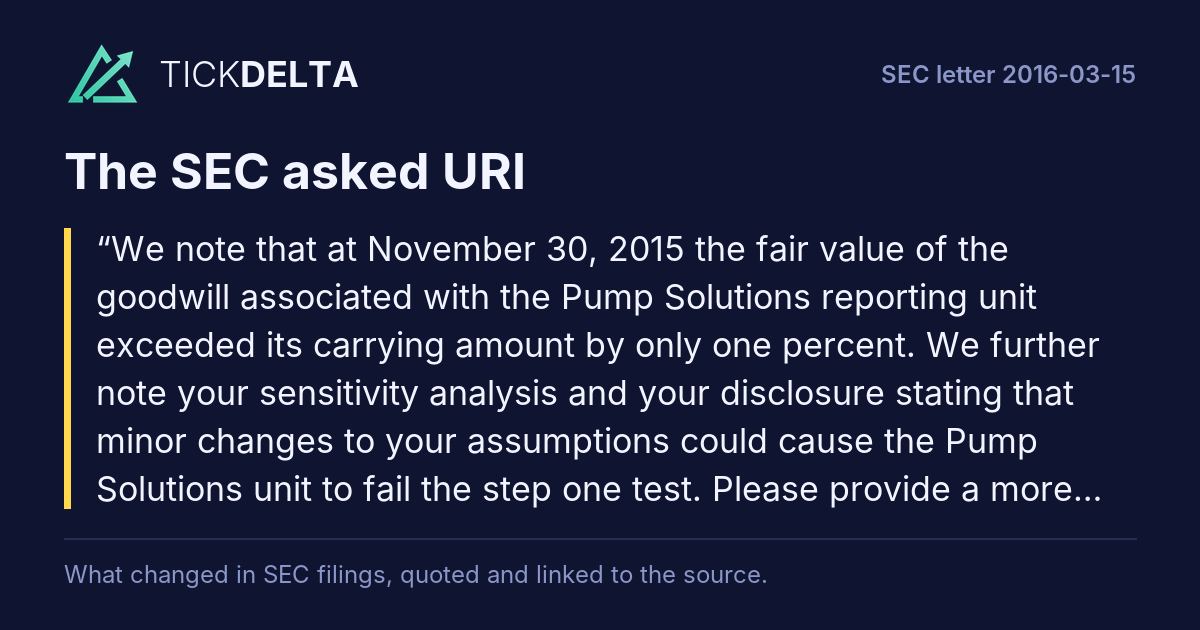
We note that at November 30, 2015 the fair value of the goodwill associated with the Pump Solutions reporting unit exceeded its carrying amount by only one percent. We further note your sensitivity analysis and your disclosure stating that minor changes to your assumptions could cause the Pump Solutions unit to fail the step one test.Rest of the question
Please provide a more comprehensive discussion explaining the basis for the key assumptions you used to perform your impairment tests. In this regard, we note that the November 30, 2015 impairment test assumed earnings growth for the Pump Solutions reporting unit over the next three years while the economic environment surrounding the oil industry has been quite volatile and has negatively impacted Pump Solution’s results for the year ended December 31, 2015.
The Company acknowledges the Staff’s comment and notes that pricing and volume pressures associated with upstream oil and gas customers negatively impacted the Pump Solutions region's rental revenue in 2015. Key assumptions used to perform the goodwill impairment test for the Pump Solutions region at November 30, 2015 included:
•
Earnings growth projected to occur in *[REDACTED]* through *[REDACTED]* at an average annual growth rate of *[REDACTED]* percent, including the impact of the cold starts addressed in the reply to question 2 below; due to the cyclicality of our business, we assumedRead in the reply ↗Rest of the answer
a recession in *[REDACTED]* for the impairment tests, with corresponding decreases in projected cash flows and earnings of *[REDACTED]* percent and *[REDACTED]* percent, respectively. The earnings projections reflect:
◦
A lower level of earnings growth expected from upstream oil and gas following the reduced 2015 actual results for Pump Solutions as a result of the oil and gas volatility; and
Consistent earnings growth derived from industries outside of the oil and gas sectors;
EBITDA margins that reflect the reduced 2015 actual results, with a total margin improvement in *[REDACTED]* through *[REDACTED]* of *[REDACTED]* percentage points and a decline in EBITDA margin in *[REDACTED]* of *[REDACTED]* percentage points due to an assumed recession;
A terminal long term growth rate of *[REDACTED]* percent, which is based on estimated inflation of *[REDACTED]* percent plus estimated general growth in the economy of *[REDACTED]* percent; and
A discount rate of *[REDACTED]* percent, which included a company specific risk premium of approximately *[REDACTED]* percent to incorporate the impact of additional risk in the oil and gas sector.
Given the recent volatility in upstream oil and gas that negatively impacted 2015 results, most notably for our upstream customers, we adjusted the forecasts used in our goodwill impairment tests for the portion of our revenue mix expected to come from upstream oil and gas customers, and have applied reduced short term growth expectations as compared to previous forecasts on a lower revenue base for these customers. Lower actual revenues in 2015 and modified short term growth expectations from upstream oil and gas in our forecasts are the primary reasons for the Pump Solutions region’s fair value exceeding its carrying value by only 1 percent at November 30, 2015.
As reflected in the forecast assumptions above, the Company is committed to a strategy of driving growth in our Pump Solutions business beyond oil and gas. As discussed in the Form 10-K for the year ended December 31, 2015 ("2015 Form 10-K"), the Pump Solutions region is primarily comprised of locations acquired in the April 2014 National Pump acquisition, and was established upon the National Pump acquisition. At the time the acquisition was announced, we noted in our investor presentation and on associated calls that half of National Pump’s revenue mix at the time came from the upstream oil and gas sector, which was highly profitable and experienced high time utilization. We also identified growth beyond oil and gas as an important factor in our decision to purchase the National Pump business, and noted the following components of our strategy for National Pump:
Cross-selling in verticals where we had a strong presence, namely across our general rentals, trench safety and power and HVAC businesses, as well as with current National Pump customers that may not previously have been our customers. We identified little customer overlap between the businesses at that time;
Integrating pumps as part of a comprehensive equipment rental offering; and
Expanding into potential high margin markets outside of oil and gas, with a focus on industrial, municipal, utilities, mining and construction activities.
Consistent with the above strategy, since the acquisition of National Pump, the Company has:
Opened 16 new Pump Solutions branches through February 29, 2016, including 2 opened in 2016. All but 2 of these new branches directly support industries other than upstream oil and gas;
Converted certain pumps that were almost exclusively for use in the upstream oil markets to multi-use, solid handling pumps that can be used across multiple industries. We expect to continue such conversions in support of diversification beyond oil and gas;
Focused on cross-selling with our other reporting units across our national accounts; and
Experienced robust revenue growth across other verticals, with average growth rates since acquisition of 50 percent or better in municipal, downstream oil, and mining and construction. Outside of these verticals that experienced significant growth, the remaining Pump Solutions locations experienced an offsetting decrease in revenue across the same period due largely to the oil and gas volatility.
Because a portion of its revenue mix continues to be in the oil and gas sector, the Pump Solutions region continues to be exposed to oil and gas volatility. Our impairment test at November 30, 2015 reflected the portion of revenue we expect from oil and gas in the short term at a moderate growth rate which is reflective of current market conditions in upstream oil and gas, and also included our estimate of the growth we are beginning to experience, as noted above, in other verticals. The forecasts used in the impairment test also incorporated our continuing focus on diversifying our Pump Solutions business across these verticals, with associated higher growth rates than upstream oil and gas.
Based on our results through February 2016 and our forecast for the remainder of the year, we currently expect our 2016 results for the region to be consistent with the forecast included in our November 30, 2015 goodwill impairment test. As noted in our 2015 Form 10-K, the Company will continue to monitor the Pump Solutions reporting unit for impairment.
Your disclosure states that you monitor the margin variances for the regions in the trench, power and pump segment and there isn’t a long history of the Pump Solutions region's rental margins. We further note that based on your discussion of the results of segment operations found on page 34, it appears that Pump Solutions had a significant negative impact on the reporting segment’s results.Rest of the question
Please supplementally explain to us how you determined that aggregation of these reporting units was appropriate based on ASC 28010-50-11.
The Company acknowledges the Staff’s comment and believes that its disclosures are consistent with the following guidance on segment disclosure objectives per ASC 280-10-10-1:
"The objective of requiring disclosures about segments of a public entity and related information is to provide information about the different types of business activities in which a public entity engages and the different economic environments in which it operates to help users of financial statements do all of the following:
a. Better understand the public entity’s performance b.Read in the reply ↗Rest of the answer
Better assess its prospects for future net cash flows c. Make more informed judgments about the public entity as a whole."
As detailed below, there are 4 primary components we considered in determining that these objectives were met, as follows (each numbered item is explained in detail in the corresponding section below):
Investor's point of view
2. Gross margin similarity
We note your disclosure on page 31, which indicates that in your general rentals segment there have historically been regions with margin variances over 10 percent. To the extent that any of your regions have margin variances greater than 10 percent in the future, please identify them in your discussion of segment results of operations and explain why such variances occurred.
No numbered answer found in the reply. Read the reply ↗
Also in this review: closing letter, 2016-03-31