Screener / SEC EDGAR /CIK 0000314808 /10-K filed Feb 20, 2026, compared with Feb 20, 2025 /Numbers from the XBRL of the 10-Ks
NYSE Energy · Drilling Oil & Gas Wells

Valaris Ltd VAL

Compare with peers Embed
New in the 10-K 23 paragraphs with nothing like them in the 10-K filed Feb 20, 2025 New in the 10-Q 11 paragraphs not in the 10-Q filed Aug 6, 2026 10-Q against the 10-K 1 risk factor paragraphs and sentences added or reworded

New risk paragraphs, branching off last year

Each branch is a paragraph in Risk Factors with nothing like it in the 10-K filed Feb 20, 2025. A box jumps to the paragraph as filed, below.

23 new

Paragraphs with nothing like them in last year's 10-K

Quoted exactly

23 paragraphs in Risk Factors of the 10-K filed Feb 20, 2026 with nothing like them in the 10-K filed Feb 20, 2025. Quoted exactly. Paragraphs that were only edited are under 10-K change.

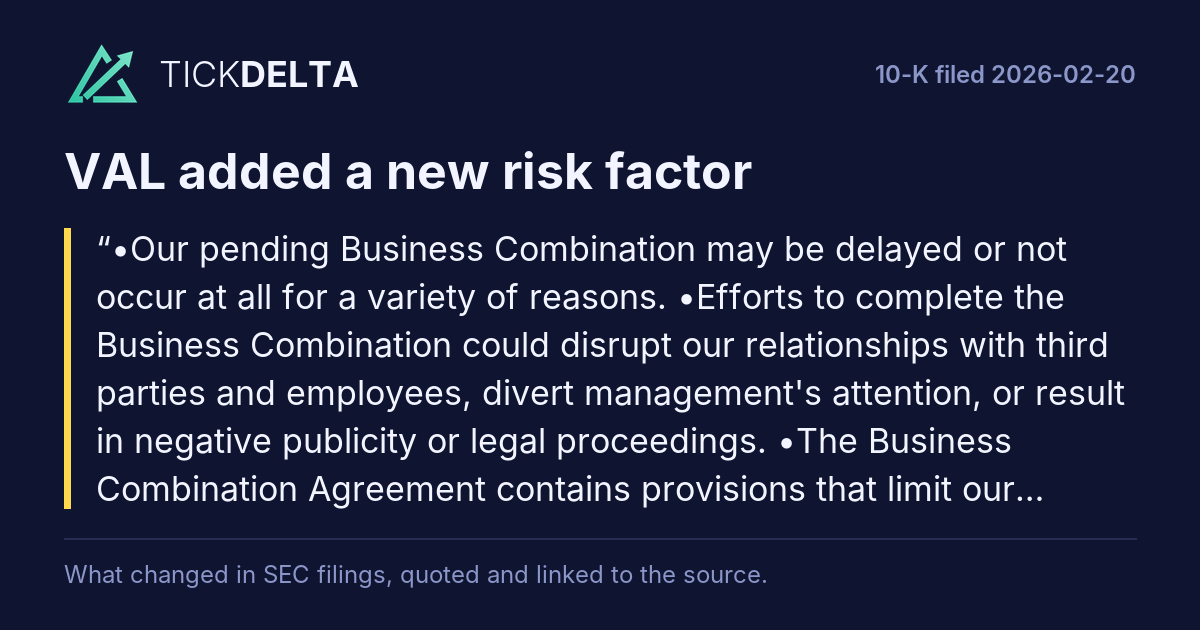
•Our pending Business Combination may be delayed or not occur at all for a variety of reasons.

•Efforts to complete the Business Combination could disrupt our relationships with third parties and employees, divert management's attention, or result in negative publicity or legal proceedings.

•The Business Combination Agreement contains provisions that limit our ability to pursue alternatives to the Business Combination.

Read in the 10-K

•We make significant expenditures for a variety of reasons, including to maintain our competitiveness.

Read in the 10-K

Our pending Business Combination may be delayed or not occur at all for a variety of reasons, some of which are outside of the parties’ control, and if these conditions are not satisfied, the Business Combination Agreement may be terminated and the Business Combination may not be completed.

On February 9, 2026, Valaris and Transocean (Valaris and Transocean, collectively, the “Parties” and each, a “Party”), entered into a business combination agreement (the “Business Combination Agreement”), providing for the combination of the two Parties (the “Business Combination”). Pursuant to the Business Combination Agreement, and on the terms and subject to the conditions thereof, Transocean will acquire all of the issued and outstanding common shares of Valaris in exchange for shares of Transocean at an exchange ratio of 15.235 Transocean shares for each Valaris share. The Business Combination will be effected by way of a court-approved scheme of arrangement between Valaris and the holders of the Valaris shares pursuant to section 99 of the Companies Act 1981 of Bermuda, as amended. Following the consummation of the Business Combination, Transocean’s existing shareholders and Valaris’ existing shareholders will own approximately 53% and 47%, respectively, of the combined company on a fully diluted basis assuming conversion to shares of Transocean’s exchangeable bonds due 2029.

Completion of the Business Combination is subject to customary closing conditions, including (1) the receipt of the requisite approvals of the Valaris shareholders and the Transocean shareholders, (2) the granting of the sanction order on terms consistent with the Business Combination Agreement, (3) the Transocean shares issued pursuant to the Business Combination Agreement having been approved for listing on the NYSE, (4) certain regulatory approvals having been obtained or any applicable waiting period having expired or been terminated, (5) no governmental authority within applicable jurisdictions having enacted or issued any law or order preventing or prohibiting the consummation of the Business Combination and (6) the absence of a Transocean Material Adverse Effect or a Valaris Material Adverse Effect (as each are defined in the Business Combination Agreement). Therefore, the Business Combination Agreement may not be completed or may not be completed as timely as expected.

In addition, the Business Combination Agreement also contains certain customary termination rights in favor of each Party, including for the failure to receive the requisite approvals of the Valaris shareholders and Transocean shareholders. A Party may terminate the Business Combination Agreement, prior to the receipt of the requisite approval of the other Party’s shareholders, if the other Party shall have made an Adverse Recommendation Change (as defined in the Business Combination Agreement). Either Valaris or Transocean may terminate the Business Combination Agreement if the effective time shall not have occurred on or prior to February 9, 2027 (as such date may be extended in accordance with the terms of the Business Combination Agreement).

Failure to complete the Business Combination could adversely affect our business and the market price of our common shares in a number of ways, including:

•The market price of our common shares may decline to the extent that the current market price reflects an assumption that the Business Combination will be consummated;

•If the Business Combination Agreement is terminated under certain circumstances specified in the Business Combination Agreement, we would be required to pay a termination fee of approximately $173.0 million to Transocean, and in other specified circumstances where the Business Combination Agreement is terminated following the failure to obtain the requisite shareholder approval and the above referenced termination fee is not otherwise payable, if Valaris shareholders failed to approve the transactions contemplated by the Business Combination Agreement, Valaris will be required to reimburse Transocean’s transaction expenses up to $58 million;

•We have incurred, and will continue to incur, significant expenses for professional services in connection with the Business Combination Agreement for which we will have received little or no benefit if the Business Combination Agreement is not consummated; and

•A failed Business Combination Agreement may result in negative publicity and/or give a negative impression of us in the investment community, with our customers and our other stakeholders.

Efforts to complete the Business Combination could disrupt our relationships with third parties and employees, divert management’s attention, or result in negative publicity or legal proceedings, any of which could negatively impact our operating results and ongoing business.

We have expended, and continue to expend, significant management time and resources in an effort to complete the Business Combination, which may have a negative impact on our ongoing business and operations. Uncertainty regarding the outcome of the Business Combination and our future could disrupt our business relationships with our existing and potential customers, suppliers and other business partners, who may attempt to negotiate changes in existing business relationships or consider entering into business relationships with parties other than us, or terminate or amend contracts. Uncertainty regarding the outcome of the Business Combination could also adversely affect our ability to recruit and retain key personnel and other employees. The pendency of the Business Combination may also result in negative publicity and a negative impression of us in the financial markets, and may lead to litigation against us and our directors and officers. Such litigation could be distracting to management and, may, in the future, require us to incur significant costs. Such litigation could result in the Business Combination being delayed and/or enjoined by a court of competent jurisdiction, which could prevent the Business Combination from becoming effective. The occurrence of any of these events individually or in combination could have a material and adverse effect on our business, financial condition and results of operations.

The Business Combination Agreement contains provisions that limit our ability to pursue alternatives to the Business Combination which could discourage a potential competing acquiror from making an alternative transaction proposal.

The Business Combination Agreement contains provisions that subject Valaris to certain restrictions on its ability to solicit an alternative acquisition proposal from third parties, to provide non-public information to third parties and to engage in discussions with third parties regarding alternative acquisition proposals, subject to customary exceptions. Each Party is required to call a meeting of its shareholders to obtain the required approval of such Party’s shareholders described above and, subject to certain exceptions, to recommend that their respective shareholders approve such proposals. Neither Party has the ability to terminate to accept a Superior Proposal (as defined in the Business Combination Agreement).

Additionally, if the Business Combination Agreement is terminated and we determine to seek another business combination, we may not be able to negotiate a transaction with another party on terms comparable to, or better than, the terms of the Business Combination.

While the Business Combination Agreement is in effect, we are subject to restrictions on our business activities.

The Business Combination Agreement generally requires us to operate our business in the ordinary course consistent with past practices. It also imposes customary interim operating covenants that restrict us from taking specified actions, subject to certain exceptions, until the Business Combination is completed or until the Business Combination Agreement is terminated, including, but not limited to, our ability to amend our organizational documents; declare dividends or repurchase shares; encumber assets; make acquisitions or dispositions; incur or guarantee indebtedness; enter into, or amend, any material contract.
Read in the 10-K

We expect to agree to extend the maturity of the Notes Receivable from ARO to facilitate its capital allocation priorities, in particular its newbuild jackup rig program. Notwithstanding any extension of the maturity, in the event that ARO does not repay the Notes Receivable from ARO when they become due, we would require the prior consent of our joint venture partner to enforce ARO's payment obligations.

Read in the 10-K

operations may discontinue that practice, may reduce the insurance capacity they are willing to deploy or demand significantly higher premiums or deductibles to cover these risks. Additionally, a significant number of high cost climate-related insurance claims or natural catastrophes such as hurricanes, floods or windstorms may result in withdrawal of insurance capacity and increasing premiums to oil and natural gas industry companies.

Read in the 10-K
Show the other 1

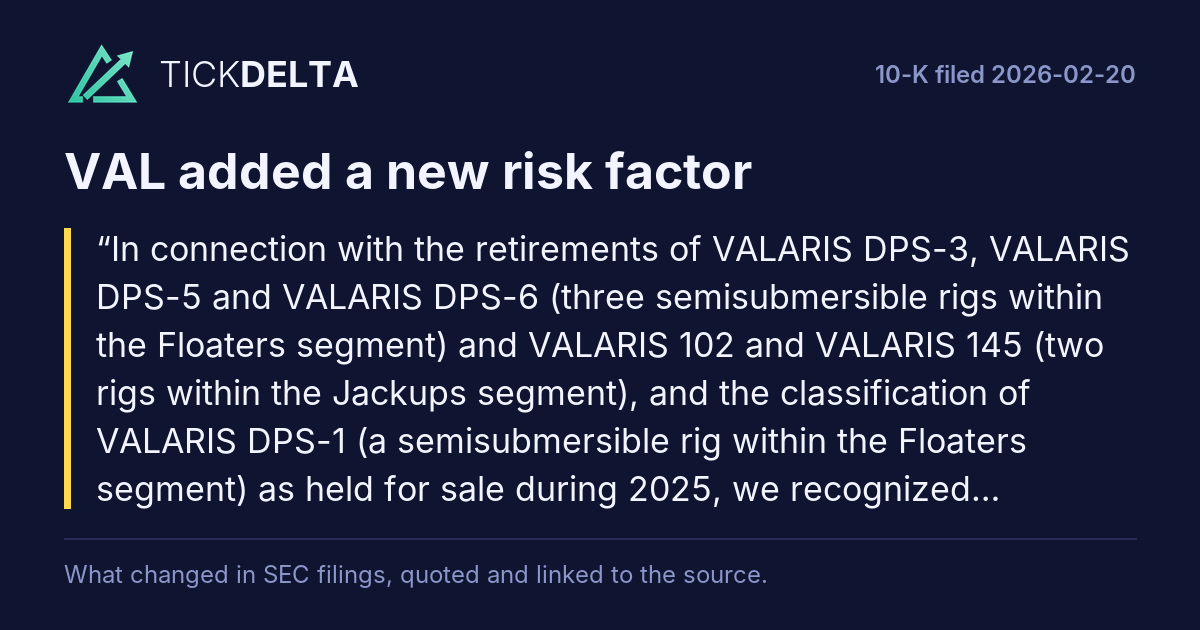
In connection with the retirements of VALARIS DPS-3, VALARIS DPS-5 and VALARIS DPS-6 (three semisubmersible rigs within the Floaters segment) and VALARIS 102 and VALARIS 145 (two rigs within the Jackups segment), and the classification of VALARIS DPS-1 (a semisubmersible rig within the Floaters segment) as held for sale during 2025, we recognized non-cash losses on impairment of $27.3 million for the year ended December 31, 2025. See "Note 5 - Property and Equipment" to our consolidated financial statements included in "Item 8. Financial Statements and Supplementary Data" for information regarding the retirements of these assets.

Read in the 10-K

Paragraphs in the 10-Q filed Nov 3, 2026 that were not in the one before

New in the latest 10-Q

11 paragraphs in the 10-Q filed Nov 3, 2026 with nothing like them in the 10-Q filed Aug 6, 2026 (at least half the words must differ; new numbers alone do not count). Quoted exactly, grouped by the item heading above them. This is text that changed, not a judgement of how serious it is.

Financial statements and notes

Shareholder meetings for both Valaris and Transocean are scheduled for November 24, 2026, and a hearing before the Supreme Court of Bermuda to sanction the Business Combination is scheduled for November 26, 2026. Subject to receipt of the requisite shareholder and court approvals, and satisfaction of the remaining closing conditions, the Business Combination is expected to close on or about December 1, 2026.

Read in the 10-Q

(1) In September 2026, we sold VALARIS 111 for recycling and transferred possession of the rig to the buyer. Accordingly, the rig is excluded from the fleet table above as of September 30, 2026. However, due to a termination right stipulated within the sale agreement, the rig remained on our balance sheet and was classified as held for sale as of September 30, 2026. See "Note 5 - Property and Equipment" for additional information regarding the sale of VALARIS 111.

Read in the 10-Q

Shareholder meetings for both Valaris and Transocean are scheduled for November 24, 2026, and a hearing before the Supreme Court of Bermuda to sanction the Business Combination is scheduled for November 26, 2026. Subject to receipt of the requisite shareholder and court approvals, and satisfaction of the remaining closing conditions, the Business Combination is expected to close on or about December 1, 2026.

Read in the 10-Q

(4) The increase for ARO is primarily due to three-year contract extensions for five ARO-owned rigs.

Read in the 10-Q

Three Months Ended September 30, 2026 Compared to Three Months Ended June 30, 2026

Read in the 10-Q
Show the other 6

Nine Months Ended September 30, 2026 Compared to Nine Months Ended September 30, 2025

Read in the 10-Q

Three Months Ended September 30, 2026 Compared to Three Months Ended June 30, 2026

Read in the 10-Q

Nine Months Ended September 30, 2026 Compared to Nine Months Ended September 30, 2025

Read in the 10-Q

Nine Months Ended September 30, 2026 Compared to Nine Months Ended September 30, 2025

Read in the 10-Q

Three Months Ended September 30, 2026 Compared to Three Months Ended June 30, 2026

Read in the 10-Q

Nine Months Ended September 30, 2026 Compared to Nine Months Ended September 30, 2025

Read in the 10-Q

The 10-Q's risk factors against the 10-K

Item 1A of the 10-Q filed Nov 3, 2026 against Item 1A of the 10-K filed Feb 20, 2026. A 10-Q repeats only the risks that changed, so a 10-K paragraph that is missing from it is not counted as removed. Added is a paragraph with nothing like it in the 10-K, Reworded a sentence that is in both with several words changed, Quiet changes a sentence in both where one to four words changed and one is a hedge or a modal (cut words struck through, new words highlighted). Text on the page, not a score; each links to the filing at sec.gov.

Added10-Q Nov 3, 2026 vs 10-K Feb 20, 2026
There are numerous factors that affect our business and results of operations, many of which are beyond our control. In addition to the other information presented in this quarterly report, you should carefully read and consider "Item 1A. Risk Factors" in Part I and "Item 7. Management's Discussion and Analysis of Financial Condition and Results of Operations" in Part II of our annual report on Form 10-K for the year ended December 31, 2025, which contains descriptions of significant risks that may cause our actual results of operations in future periods to differ materially from those currently anticipated or expected.

Read it in the 10-Q at sec.gov

Phrases used for the first time

Two-word phrases in Risk Factors of the 10-K filed Feb 20, 2026 that are in none of the 1 earlier 10-Ks stored, back to Feb 20, 2025

combination agreement ×28negative publicity ×4valaris dps ×4contains provisions ×3valaris shareholders ×3employees divert ×2pursue alternatives ×2transocean shares ×2requisite approvals ×2transocean shareholders ×2party’s shareholders ×2termination fee ×2negative impression ×2alternative acquisition ×2floaters segment ×2new geographical ×2
Where each one is used
  • combination agreement: •The Business Combination Agreement contains provisions that limit our ability to pursue alternatives to the Business Combination.
  • negative publicity: •Efforts to complete the Business Combination could disrupt our relationships with third parties and employees, divert management's attention, or result in negative publicity or legal proceedings.
  • valaris dps: In connection with the retirements of VALARIS DPS-3, VALARIS DPS-5 and VALARIS DPS-6 (three semisubmersible rigs within the Floaters segment) and VALARIS 102 and VALARIS 145 (two rigs within the Jackups segment), and the classification of VALARIS DPS-1 (a semisubmersible rig within the Floaters segment) as held for...
  • contains provisions: •The Business Combination Agreement contains provisions that limit our ability to pursue alternatives to the Business Combination.
  • valaris shareholders: Completion of the Business Combination is subject to customary closing conditions, including (1) the receipt of the requisite approvals of the Valaris shareholders and the Transocean shareholders, (2) the granting of the sanction order on terms consistent with the Business Combination Agreement, (3) the Transocean...
  • employees divert: •Efforts to complete the Business Combination could disrupt our relationships with third parties and employees, divert management's attention, or result in negative publicity or legal proceedings.
  • pursue alternatives: •The Business Combination Agreement contains provisions that limit our ability to pursue alternatives to the Business Combination.
  • transocean shares: On February 9, 2026, Valaris and Transocean (Valaris and Transocean, collectively, the “Parties” and each, a “Party”), entered into a business combination agreement (the “Business Combination Agreement”), providing for the combination of the two Parties (the “Business Combination”). Pursuant to the Business...

The 10-K at sec.gov

Used at least twice, small words left out. Counted, not picked: a phrase can be new because the company renamed something.

What was taken out

6 paragraphs of last year's Risk Factors with nothing like them now. The longest are quoted.

Across all companies
Public health crises, pandemics and epidemics and fear of such events may adversely impact our operations, the operations of our customers and the global economy, including the worldwide demand for oil and natural gas and the level of demand for our services. Other effects of such public health crises, pandemics and epidemics may include significant volatility and disruption of the global financial markets; continued volatility of crude oil prices and related uncertainties around OPEC+ production; disruption of our operations, including suspension of drilling activities; impact to costs;...
In the 10-K filed Feb 20, 2025
adopted by customers and suppliers, particularly given the complexity of our supply chain, our reliance on third-party manufacturers, and the potential for jurisdictions in which we operate to enact opposing or incompatible regulations. Actions we may take to achieve our sustainability initiatives, including the development and implementation of new emissions-reduction technology, may require increased expenditures, which may materially adversely affect our financial position, operating results or cash flows.
In the 10-K filed Feb 20, 2025
•The impact and effects of public health crises, pandemics and epidemics could have a material adverse effect on our business, financial condition and results of operations.
In the 10-K filed Feb 20, 2025
The impact and effects of public health crises, pandemics and epidemics could have a material adverse effect on our business, financial condition and results of operations.
In the 10-K filed Feb 20, 2025

Sources

Item 1A of each 10-K and 10-Q on EDGAR, quoted exactly. Each paragraph links to the filing at sec.gov.

Also

10-K change: what was reworded or cut, section by section.

Work with it

Excel workbook · CSV. Google Sheet that stays up to date: paste =IMPORTDATA("https://tickdelta.com/company/VAL/export.csv") into a cell.

Next:10-K change
Esc

Type a ticker such as AAPL, a name, an investor such as Buffett, or a topic such as tariffs. ↑ ↓ to move, Enter to open.