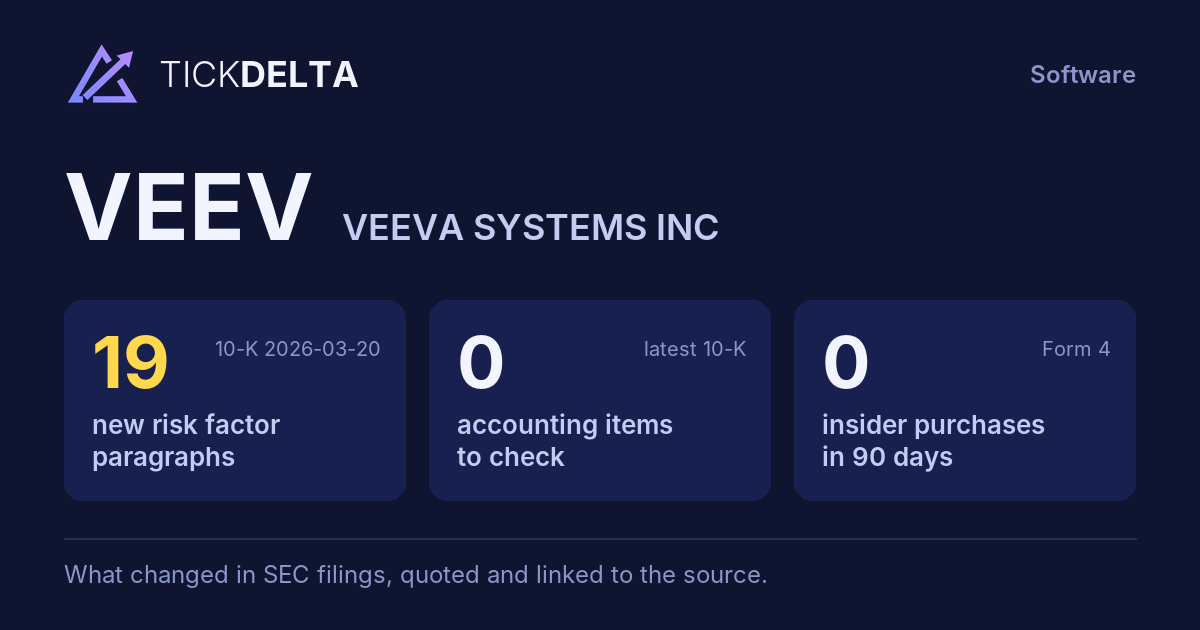
Marked against last year's 10-K:
cut words struck through, new words highlighted and underlined.
Risk Factors 375 words changed in this paragraph; it is 41% similar to last year's version.
Our subscription orders are generally billed at the beginning of the subscription period in annual or quarterly increments, which means the annualized value of such orders may not be completely reflected in deferred revenue at any single point in time. Many of our customers, including many of our large customers, are billed on a quarterly basis and therefore a substantial portion of the value of contracts billed on a quarterly basis will not be reflected in our deferred revenue at the end of any given quarter. Also, particularly with respect to expansion orders for our Commercial Solutions, because the term of orders for additional end users or applications is commonly less than one year to align to the renewal date of existing Commercial Solutions orders, the annualized value of such orders may not be completely reflected in deferred revenue at any single point in time. We have also agreed from time to time, and may agree in the future, to allow customers to change the renewal dates of their orders to, for example, align more closely with a customer’s annual budget process or to align with the renewal dates of other orders placed by other entities within the same corporate control group, or to change payment terms from annual to quarterly, or vice versa. Such changes may result in an order of less than one year as necessary to align all orders to the desired renewal date and, thus, may result in a lesser increase to deferred revenue compared to if the adjustment had not occurred. Additionally, changes in renewal dates may change the fiscal quarter in which deferred revenue associated with a particular order is booked. Accordingly, we do not believe that changes on a quarterly or annual basis in deferred revenue, calculated billings, or normalized billings are precise indicators of the underlying momentum of our business or future revenues. We believe that our subscription revenue guidance and normalized billings guidance for the full fiscal year are the best indicators of the momentum of our business or future revenues. Please note that we define the term calculated billings for any period to mean revenue for the period plus the change in deferred revenue from the immediately preceding period minus the change in unbilled accounts receivable from the immediately preceding period. We define the term normalized billings for any period to mean calculated billings adjusted for the impact of (i) term changes in our customer renewals, such as changes to renewal date (for example, changing the renewal date of multiple products to be coterminous) or changes to billing frequency (for example, changing from annual to quarterly billings), and (ii) delayed renewals that have closed and billed after the period end. However, many companies that provide cloud-based software report changes in deferred revenue or billings as key operating or financial metrics, and it is possible that analysts or investors may view these metrics as important. Thus, any changes in our deferred revenue balances or deferred revenue trends could adversely affect the market price of our common stock.
Source: Item 1A, 10-K 0001393052-26-000014 vs Item 1A, 10-K 0001393052-25-000022
Accounting Policies 137 words changed in this paragraph; it is 39% similar to last year's version.
In November 2024, September 2025, the FASB issued ASU 2024-03, Income Statement 2025-06, Intangibles - Reporting Comprehensive Income Goodwill and Other - Expense Disaggregation Disclosure Internal-Use Software (Subtopic 220-40): Disaggregation of Income Statement Expenses, which requires disclosure, in the notes 350-40): Targeted Improvements to the financial statements, of additional information about certain Accounting for Internal-Use Software, which modernizes the recognition and capitalization framework for internal-use software development costs and expenses in order to reflect current software development practices. The amendments also require Subtopic 360-10 disclosures for interim and annual reporting periods. all capitalized internal-use software costs. This new standard is effective for our fiscal year beginning on February 1, 2027 2028 and interim periods beginning on February 1, 2028 within that fiscal year and may be applied prospectively, retrospectively, or using a modified transition approach. The Company will early adopt ASU 2025-06 in the fiscal quarter ended April 30, 2026 on a prospective basis and retrospective application is permitted. basis. We are currently evaluating this do not expect the adoption of ASU 2025-06 to determine its have a material impact on our disclosures. consolidated financial statements.
Source: Item 8, Note 1 – Summary of Business and Significant Accounting Policies, 10-K 0001393052-26-000014 vs Item 8, Note 1 – Summary of Business and Significant Accounting Policies, 10-K 0001393052-25-000022
MD&A 113 words changed in this paragraph; it is 66% similar to last year's version.
The increase in subscription services revenues consisted of $274 $247 million of subscription services revenue attributable to R&D and Quality Solutions and $109 $153 million of subscription services revenue attributable to Commercial Solutions. The increase in subscription services revenue attributable to R&D solutions and Quality Solutions was primarily due to driven by the expanding use by existing customers of our Veeva Development Cloud products by both existing and new customers. The increase in subscription services revenue attributable to Commercial Solutions was primarily due to expanding use of our Veeva Commercial Quality Cloud products by both existing and new customers and, to a lesser extent, due to higher prices in connection with our annual inflation adjustment. adjustment for Veeva Development Cloud products. The increase in subscription revenue attributable to Commercial Solutions was primarily driven by the expanding use by existing customers of our Veeva Commercial Cloud and Veeva Data Cloud products and, to a lesser extent, due to higher prices in connection with our annual inflation adjustment for Veeva Commercial Cloud products. The geographic mix of subscription services revenues was 60% from North America, 28% from Europe, and 12% from other locations, primarily Asia Pacific, for the fiscal year ended January 31, 2026, as compared to 59% from North America, 28% from Europe, and 13% from other locations, primarily Asia Pacific, for the fiscal year ended January 31, 2025, as compared to 58% from North America, 27% from Europe, and 15% from other locations, primarily Asia Pacific, for the fiscal year ended January 31, 2024. 2025.
Source: Item 7, 10-K 0001393052-26-000014 vs Item 7, 10-K 0001393052-25-000022
Legal Proceedings New paragraph this year (88 words), with no similar paragraph last year.
On August 13, 2025, Veeva and IQVIA entered into a settlement agreement that resolved all ongoing litigations between Veeva and IQVIA. Prior to that, IQVIA and Veeva had been involved in a series of litigations since 2017, including IQVIA Inc. v. Veeva Systems Inc. (No. 2:17-cv-00177) and IQVIA Inc. v. Veeva Systems Inc. (No. 2:19-cv-15517). Under the terms of the settlement agreement, neither party paid damages to the other party and both parties agreed to dismiss with prejudice all claims and counterclaims currently pending. Accordingly, all claims and
Source: Item 3, via Note 13 – Commitments and Contingencies, 10-K 0001393052-26-000014 vs Item 3, via Note 14 – Commitments and Contingencies, 10-K 0001393052-25-000022