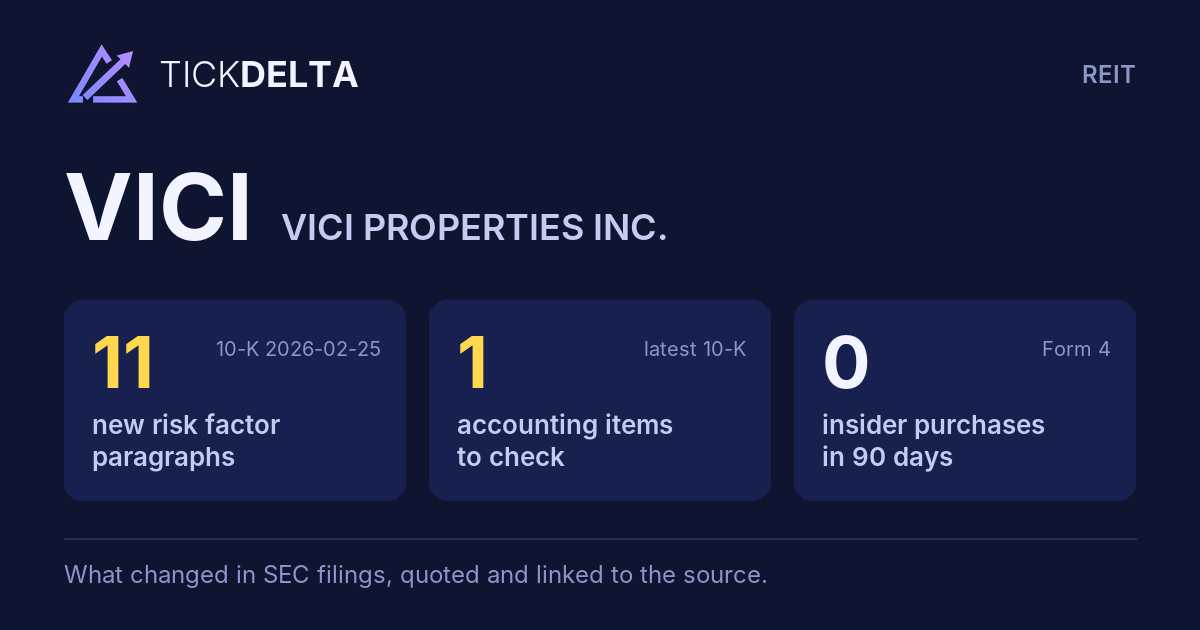
Sentences and paragraphs of VICI's Risk Factors and MD&A, 10-K 2026-02-25 against 10-K 2025-02-20.
Each links to the text at sec.gov.
AddedRisk Factors
Adverse developments affecting any of them, whether arising from conditions in the markets in which a tenant operates, the performance of such tenant’s portfolio or individual properties therein, or broader economic or industry factors, could impair such tenant’s ability to perform its obligations under its lease agreement with us. In such circumstances, a tenant could default on its obligations or, in advance thereof or in connection therewith, seek to modify or renegotiate its lease agreement with us, including with respect to economic provisions (such as rent escalators, base rental payments, capital expenditure requirements, or other provisions), covenants, or changes with respect to the composition of properties under the lease agreement (including the potential sale or disposition of such properties, whether to the tenant or other third parties). A tenant also could take other actions that could impact us, including seeking the ability to sell certain of its operations at our properties, electing not to renew its lease at maturity or pursuing a strategic transaction. Any such modification, non-renewal, strategic transaction or other action could materially and adversely affect our results of operations, the value of the underlying real estate or our ability to re-lease such real estate on comparable terms, or at all. These risks are heightened with respect to our larger tenants due to, among other things, the concentration of our revenues received from them. For example, market commentary has arisen regarding the performance of properties we lease to Caesars under the Caesars Regional Master Lease and the potential impact of such performance on the Company. This recent performance and related market narratives has adversely affected the market price of our common stock and may adversely affect our business and financial performance.
Read it in 10-K 2026-02-25 at sec.gov ↗
AddedRisk Factors
Pursuant to our investment strategy, we have and may continue to make investments that involve entering into new asset classes or sectors, or utilize novel transaction structures such as strategic co-investment ventures, joint ventures, funds, and other forms of investment partnership. These new asset classes and transaction structures may have new, different or increased risks compared to what we are currently exposed to in our business and we may not be able to manage these risks successfully. In particular, such risks include potential impacts on our regulatory requirements, including our ability to maintain our REIT status; effectively navigating shared approval rights or governance with partners or investors whose economic interests may diverge from ours; addressing additional capital requirements or partner funding failures requiring us to contribute additional capital or raise funds or incur indebtedness on unfavorable terms; addressing contractual restrictions on our ability to transfer interests or exit investments when desired; and addressing potential disputes with partners that divert management attention and result in potential litigation, arbitration, or termination, and increased expenses. If we are not able to successfully manage the risks associated with such activity, it could have an adverse effect on our business, financial condition and results of operations.
Read it in 10-K 2026-02-25 at sec.gov ↗
AddedRisk Factors
Furthermore, there could be other adverse impacts associated with the funding of development, construction or pre-stabilization loans, including increased costs that the borrower is unable or unwilling to pay, and other negative consequences, up to and including a bankruptcy filing by the borrower if they fail to fund their portion of the development project or experience cost overruns or other negative developments that impair their ability to complete the project and commence operations. In addition, other negative developments including construction delays, disruptions in supply chains, cost increases associated with building materials and construction services, environmental and remediation efforts, and costs or difficulties associated with obtaining construction permits and complying with local regulations, availability and cost of labor, and cost overruns, as well as changes in the value of collateral during construction or prior to stabilization, may adversely affect our investments or our realization of the anticipated benefits from such investments. In addition, borrowers may not have access to capital, which in turn, may result in the borrower’s inability to complete the project or, in the case of a construction loan, repay our loan in full or on a timely basis. In such cases, the borrower could default on its obligations or, in advance thereof or in connection therewith, seek to modify or renegotiate the terms of its loan agreement with us, including with respect to economic provisions, covenants, or other changes. Such borrowers could also take other actions that could impact us, including seeking to sell the development or operations, or other strategic action that does not align with our interests as a lender.
Read it in 10-K 2026-02-25 at sec.gov ↗
Show the other 15
AddedRisk Factors
In addition, certain of our investments, such as the North Fork loan, are secured by the property and assets of the borrower, including cash flows and revenues generated by the property, but excluding real property or any interests therein. Accordingly, investments where the underlying property is on tribal land may expose us to additional risks related to our ability to realize repayment of loaned amounts, the enforceability of contractual provisions, including limited waivers of sovereign immunity (to the extent applicable) and customary rights and remedies with respect to such investments or the assets secured as collateral, up to and including limitations on the ability to exercise customary foreclosure remedies in the event of a default. In addition, in the event of a foreclosure, the applicable borrower or its operating subsidiary may not be replaceable as operator of the gaming operations at such property and the assets of such borrower and its applicable subsidiaries may be insufficient to ensure payment in full to us of the amounts lent under such loan arrangements.
Read it in 10-K 2026-02-25 at sec.gov ↗
AddedRisk Factors
Uncertainty in the macroeconomic environment, including heightened interest rates and uncertainty regarding future interest rates, have and may continue to negatively affect us.
Read it in 10-K 2026-02-25 at sec.gov ↗
AddedRisk Factors
• Certain provisions of Maryland law may limit the ability of a third party to acquire control of us. Certain provisions of the MGCL may have the effect of inhibiting a third party from acquiring us or of impeding a change of control under circumstances
Read it in 10-K 2026-02-25 at sec.gov ↗
AddedMD&A
•Announced a $1.16 billion transaction to acquire seven casino properties from Golden and enter into the Golden Master Lease with a newly formed entity that will be owned and controlled by Blake L. Sartini, current chairman and chief executive officer of Golden, with an initial annual rent of $87.0 million.
Read it in 10-K 2026-02-25 at sec.gov ↗
AddedMD&A
•Made three real estate debt investments totaling $966.0 million of commitments.
Read it in 10-K 2026-02-25 at sec.gov ↗
AddedMD&A
•PENN Lease Combination. On December 4, 2025, we and PENN combined the existing individual leases with respect to the Hollywood Casino at Greektown (the “Greektown Lease”) in Detroit, Michigan, and the Margaritaville Resort Casino (the “Margaritaville Lease”) in Bossier City, Louisiana, into one master lease for both properties (the “PENN Master Lease”). The PENN Master Lease has total annual rent equal to $80.7 million (the “Combined Rent”), representing the combined annual rent amounts under the Greektown Lease and the Margaritaville Lease as of December 4, 2025. There was no change to the aggregate amount of rent collected by us as a result of the combination. Annual rent escalation on the Combined Rent will occur on June 1 of each year based on the following construct: on June 1, 2026, the Combined Rent will escalate at a fixed 1.0%, and beginning on June 1, 2027, and for each year thereafter, the Combined Rent will escalate at 1.0% if the minimum net revenue to rent ratio (the “Minimum Ratio”) is achieved. The Minimum Ratio will be set as of June 1, 2026 and will be based on the sum of net revenues generated by the two assets over the performance period from June 1, 2025 to May 31, 2026, divided by the Combined Rent. The PENN Master Lease has an initial maturity on May 23, 2034 with four 5-year tenant renewal options. The existing guarantor under the Greektown Lease and Margaritaville Lease remains the same for the PENN Master Lease with PENN continuing to guarantee all obligations.
Read it in 10-K 2026-02-25 at sec.gov ↗
AddedMD&A
•Golden Entertainment Transaction. On November 6, 2025, we announced that we entered into an agreement to acquire 100% of the land, real property and improvements of seven casino properties (the “Golden Portfolio”) from Golden for $1.16 billion and to enter into the Golden Master Lease with a newly formed entity that will be owned and controlled by Blake L. Sartini, current chairman and chief executive officer of Golden, which entity will acquire the operating business of Golden in connection with the closing of the transaction. The Golden Portfolio includes: The STRAT Hotel, Casino & Tower on the North Las Vegas Strip; Arizona Charlie’s Decatur and Arizona Charlie’s Boulder in the Las Vegas Locals market; Aquarius Casino Resort and Edgewater Casino Resort in Laughlin, Nevada; and Pahrump Nugget Hotel & Casino and Lakeside RV Park & Casino in Pahrump, Nevada. The Golden Portfolio features approximately 362,000 square feet of casino space, over 6,000 hotel rooms, 4,306 slot machines and 78 table games.
Read it in 10-K 2026-02-25 at sec.gov ↗
AddedMD&A
The Golden Master Lease will have an initial total annual rent of $87.0 million and an initial term of 30 years, with four 5-year tenant renewal options. Rent under the Golden Master Lease will escalate annually at 2.0% beginning in Lease Year 3. The obligations of Golden OpCo under the Golden Master Lease will be guaranteed by a holding company that is owned and controlled by Mr. Sartini and owns all of the gaming and operating assets of Golden, with additional credit support provided by financial covenants within the lease. Golden shareholders will receive approximately 24.3 million shares of newly issued VICI stock in exchange for the outstanding shares of Golden stock, which represents an agreed-upon exchange ratio of 0.902 per share of Golden’s common stock based on VICI’s 10-day volume weighted average price as of November 5, 2025, as well as cash consideration that is payable by an affiliate of the Golden OpCo. In connection with the transaction, we will assume and immediately retire Golden’s outstanding $426.0 million of debt using a combination of cash on hand, net proceeds available pursuant to forward sale agreements and/or drawing down funds available under our revolving credit facility. We do not expect to require additional financing, including capital markets activity, to complete the transaction. The transaction is expected to close in mid-2026, subject to the approval of the Golden stockholders, as well as customary closing conditions and regulatory approvals.
Read it in 10-K 2026-02-25 at sec.gov ↗
AddedMD&A
•Northfield Park Severance Lease. On October 16, 2025, we announced that, in connection with MGM’s agreement to sell the operations of Northfield Park (“Northfield Park”), located in Northfield, Ohio, to an affiliate of funds managed by Clairvest Group Inc. (“Clairvest”), we agreed to enter into (i) a new triple-net lease agreement with an affiliate of Clairvest with respect to the real property of Northfield Park (“Northfield Park Lease”) and (ii) an amendment to the existing MGM Master Lease in order to account for MGM’s divestiture of the operations of Northfield Park and to reduce the annual base rent under the MGM Master Lease by the initial base rent under the Northfield Park Lease. The Northfield Park Lease will have an initial annual base rent of $53.0 million (or $54.0 million if the transaction closes on or after May 1, 2026 to reflect the 2.0% annual escalation provided under the MGM Master Lease). Upon closing, the Northfield Park Lease will begin a new 25-year lease term with three 10-year tenant renewal options, with other economic terms substantially similar to the MGM Master Lease, including escalation of 2.0% per annum (with escalation equal to the greater of 2.0% and the change in CPI (capped at 3.0%) beginning at the same time as the MGM Master Lease in 2032) and a minimum capital expenditure requirement equal to 1.0% of annual net revenue. The Northfield Park Lease will be guaranteed by an affiliate of funds managed by Clairvest that will own the operations of Northfield Park. The transaction is subject to customary closing conditions and regulatory approvals and
Read it in 10-K 2026-02-25 at sec.gov ↗
AddedMD&A
•North Fork Casino Loan. On April 4, 2025, we provided a commitment of up to $510.0 million of a $725.0 million delayed draw term loan facility (the “Term Loan Arrangement”) to the North Fork Rancheria Economic Development Authority, a wholly owned entity of the North Fork Rancheria of Mono Indians of California. Proceeds from the Term Loan Arrangement will be used for the development of the North Fork Mono Casino & Resort (“North Fork”) located near Madera, California, which will be developed and managed by affiliates of Red Rock Resorts, Inc. (“Red Rock Resorts”). The Term Loan Arrangement consists of a $340.0 million Term Loan A, of which we have committed up to $125.0 million, and a $385.0 million Term Loan B, of which we have committed up to the full $385.0 million, for a total commitment of $510.0 million. The Term Loan A has an initial term of five years and the Term Loan B has an initial term of six years. The project is expected to be funded in accordance with a construction draw schedule and is expected to be completed in the second half of 2026.
Read it in 10-K 2026-02-25 at sec.gov ↗
AddedMD&A
Our tenants’ and borrowers’ business strategies and their ability to execute their business plans effectively, including in response to evolving competitive, regulatory and consumer dynamics, may also impact our performance, especially over the long-term. The gaming industry continues to experience intensifying competition from multiple sources, including the expansion of gaming in new jurisdictions, the growth of internet gaming, sports betting and other alternatives and accompanying regulatory developments, and evolving consumer preferences and behaviors. Other experiential industries also face varying degrees of competition and other emerging developments that require strategic engagement.
Read it in 10-K 2026-02-25 at sec.gov ↗
AddedMD&A
The degree to which individual operators successfully execute their business plans, including navigating these competitive challenges, varies significantly. Strategies that lack sufficient investment in revenue growth, marketing and customer reinvestment, product offering and amenity enhancements, and competitive positioning may result in performance declines over time. These strategic decisions by our tenants and borrowers regarding, among other things, capital allocation, property
Read it in 10-K 2026-02-25 at sec.gov ↗
AddedMD&A
improvements, technology investments, and marketing, and their ability to successfully implement such initiatives, may influence their ability to maintain market position and financial performance, which in turn may affect their ability to fulfill their contractual obligations pursuant to our lease and loan agreements, as applicable, and therefore, the value of our properties and our overall financial performance.
Read it in 10-K 2026-02-25 at sec.gov ↗
AddedMD&A
Pursuant to our portfolio and asset management function, we monitor all of our tenants’ performance at our properties, as well as our borrowers’ performance under our investments, on an ongoing basis to evaluate the near-term financial health of these assets and investments and seek to ensure their long-term viability. Through these efforts, we have observed, and Caesars management has publicly reported, declining profitability of their operations at certain properties we lease to Caesars under the Caesars Regional Master Lease. Accordingly, we continue to evaluate Caesars’ financial performance and ability to maintain compliance with the terms of the Caesars Regional Master Lease.
Read it in 10-K 2026-02-25 at sec.gov ↗
AddedMD&A
We believe we remain structurally insulated from short-term operational and financial disruptions in light of the Caesars Regional Master Lease’s remaining nine years in its initial lease term with an initial maturity in July 2035. This is further reinforced by the contractual parent guarantee, pursuant to which Caesars Entertainment, Inc. guarantees throughout the entire lease term the prompt and complete payment and performance in full of all monetary and non-monetary obligations of the tenants under the Caesars leases. However, Caesars’ continued underperformance within the regional portfolio leased from VICI and related market narratives have, and may continue to have, an adverse effect on our stock performance and, accordingly, our cost of capital. In particular, market commentary has arisen regarding the potential impact of such performance trends, including questions from investors and analysts regarding, among other things, the long-term viability of the Caesars Regional Master Lease and potential modifications to address such concerns.
Read it in 10-K 2026-02-25 at sec.gov ↗