Form 10-12G
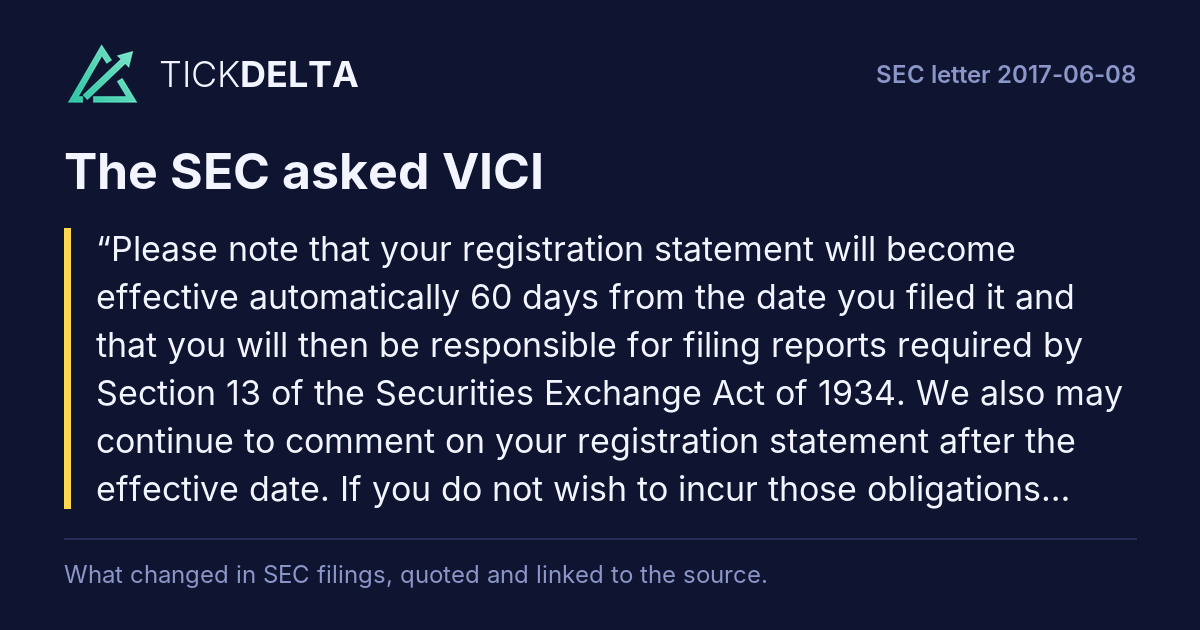
Please note that your registration statement will become effective automatically 60 days from the date you filed it and that you will then be responsible for filing reports required by Section 13 of the Securities Exchange Act of 1934. We also may continue to comment on your registration statement after the effective date.Rest of the question
If you do not wish to incur those obligations until all of the following issues are resolved, you may wish to consider withdrawing your registration statement and resubmitting a new registration statement when you have revised your document.
The Company acknowledges the Staff’s comment and its obligation to file reports required by Section 13 of the
Securities Exchange Act of 1934 following the effectiveness of the Registration Statement. As discussed above, the Company has withdrawn the originally filed Form 10 and filed a new Form 10 for the purpose of starting a new 60-day period. Read in the reply ↗
We note that pro forma operating expenses for the golf course are $13.7 million. Please reconcile this amount to the disclosure on page 65 that states that the golf course properties incurred operating expenses on a pro forma basis of $18.2 million.
The Company hereby clarifies that pro forma operating expenses for the golf course properties for the year ended December 31, 2016, total $18.2 million as disclosed on page 68 of the Registration Statement. This amount is comprised of pro forma direct golf course operating expenses of $13.7 million, pro forma golf course depreciation expense of $2.5 million and pro forma golf course general and administrative expenses of $2.0 million. The Company has clarified the disclosure on page 68 of the Registration Statement. Read in the reply ↗
We note your adjustment (d). Please revise your disclosure to describe the methods, factors (e.g. discount rates, number of years for which cash flows are projected, etc.) and significant assumptions used in determining the valuation amounts for the fresh start adjustments.
In response to the
Staff’s comment, the Company has added disclosure to adjustment (d) on page 61 of the Registration Statement regarding the methods, factors and significant assumptions used in determining the valuation amounts for the fresh start adjustments. Read in the reply ↗
We note from your disclosure that the lease agreements are bifurcated between operating leases and direct financing leases. Please provide to us your detailed analysis supporting your conclusions to bifurcate your lease agreements and how they qualified to be accounted for as operating leases and direct financing leases. Please cite the applicable guidance in your response.
In determining the appropriate bifurcation of the lease agreements between operating leases and direct financing leases, management evaluated the guidance in ASC 840-10-25-60, which provides guidance on a lessor’s classification of a lease involving both land and buildings. The Company determined that under ASC
840-10-25-60(c), the Lease Agreements do not meet either the transfer of ownership criterion or the bargain purchase option criterion.Read in the reply ↗Rest of the answer
The Company then assessed, on a property-by-property basis, whether the fair value of the land is less than or greater than 25% of the total fair value of the leased property at lease inception under ASC 840-10-25-63 and 66 to determine whether the lessor is required to consider the land and buildings as a single unit or separately for purposes of applying the lease term criterion in ASC 840-10-25-1(c) and the minimum lease payment criterion in ASC 840-10-25-1(d). The Company determined that, for two properties, the land component was greater than 25% of the total fair value of the leased property and, as such, the land component for those properties should be treated separately.
The Company then assessed the criteria under ASC 840-10-25-1(c) and (d) and determined that all but one of the properties met the criteria under (c) and the remaining property (Caesars Palace Las Vegas) met the criteria under (d). The
Company then assessed whether the two criteria were met under ASC 840-10-25-42 and concluded that they were both met as collectability of the minimum lease payments is reasonably predictable and no important uncertainties surround the amount of unreimbursable costs yet to be incurred by the lessor.
The Company then assessed the guidance under ASC 840-10-25-68 to determine whether the building element should be accounted for as a direct financing lease, a leveraged lease or an operating lease as appropriate under ASC 840-10-25-43. The Company determined that the building element did not meet the sales-type criteria under ASC 840-10-25-43(a) as there is no transfer of ownership. The Company determined that the building element met the criteria under ASC 840-10-25-43(b) as the lease meets both of the criteria in ASC 840-10-25-42, does not give rise to any manufacturer’s or dealer’s profit or loss to the lessor as the leases are recorded at fair value and does not meet the criteria to be recorded as a leveraged lease as it does not involve three parties. As a result, the Company concluded that the building element should be accounted for as a direct financing lease.
The Company then assessed ASC
840-10-25-68 and concluded that the land element of the lease for the two properties where the land component was greater than
25% shall be accounted for as an operating lease.
For illustrative purposes, with respect the CPLV Lease Agreement, the Company analyzed the fair value of the land as a percentage of the total leased property in accordance with ASC 840-10-25-66 and determined that the fair value of the land exceeded 25% of the fair value of the leased property. The Company therefore concluded that the building element should be accounted for separately for purposes of applying the lease-term criterion in ASC 840-10-25(c) and (d).
The Company compared the lease term of 35 years to the remaining useful life of the building element in accordance with ASC 840-10-25(c) and determined that the lease term is not equal to 75% or more of the estimated economic life of the building element. The Company therefore concluded that this criterion was not met.
The Company then compared the present value of the minimum lease payments related to the building element as a percentage of fair value of the building element in accordance with ASC
840-10-25-1(d). The present value of the minimum lease payments exceeds 90% of the fair value of the building element and, as a result, the Company concluded that this criterion was met.
As a result of the above analysis, the Company concluded that the land element of the lease should be accounted for separately as an operating lease and that the building element of the lease should be accounted for as a direct financing lease in accordance with ASC 840-10-25-68. The Company undertook a similar analysis for each of the non-CPLV properties.
We note your adjustment (cc). Please clarify for us and provide details on how you calculated earned income from direct financing leases. Your response should address how your interest income exceeds pro forma rent payments accounted for under the direct financing lease method. Additionally, tell us the interest rate implicit in the leases.
In response to the Staff’s comment, the Company hereby provides the following details. The Company determined the net investment related to direct financing leases (i.e., gross investment less unearned income) at lease inception on a property-by-property basis in accordance with ASC
840-30-30-11 and 13.Read in the reply ↗Rest of the answer
The Company then calculated earned income from direct financing leases in accordance with ASC 840-30-35-23, whereby the lessor shall amortize the unearned income and initial direct costs to income over the lease term to produce a constant periodic rate of return on the net investment in the lease.
The contractual escalators on the rent per the Lease Agreements results in a constant monthly periodic rate of return higher than it would be in the case of constant annual cash flows. Thus, in the early years of the leases, interest income under the direct financing lease method calculated on the lease receivable exceeds the pro forma rent payments. This reverses in the later years of the lease term and results in the balance of the lease receivable equal to the salvage value of the leased assets at the end of the lease term. The Company believes the length of the leases with CEOC LLC will extend to the full thirty-five year lease term, including all optional renewal periods.
The interest rate implicit in the CPLV Lease Agreement and the Non-CPLV Lease Agreements is 5.9% and 11.3%, respectively.
We note your disclosure that Caesars Palace Las Vegas has over 1,400 slot and table gaming units, a 14,187 square foot high limit casino area, a 4,557 square foot high limit slots area, and a 24-hour poker room. We also note your disclosure regarding its 4,300seat Colosseum entertainment venue, the 81,300 square foot OMNIA Nightclub, over 20 restaurants, lounges and bars, approximately 702,000 square feet of retailRest of the question
space, approximately 40,450 square feet of spa facilities and five swimming pools spanning eight acres. Please revise your properties disclosure to provide a more complete description of the non-CPLV properties or advise us why such disclosure is not necessary.
In response to the Staff’s comment, the Company has added disclosure on pages 77 through 79 of the Registration
Statement to include more complete descriptions of the non-CPLV properties. Read in the reply ↗
We note that you have entered into long term lease agreements for your properties. To the extent material, please include disclosure regarding occupancy and RevPAR or advise us why such disclosure is not material.
In response to the Staff’s comment, the Company submits that property operating metrics, such as occupancy and RevPAR, are not material to the lease payments to be received by the lessor under the Lease Agreements, particularly during the first eight years of the terms of the leases. The terms of the Company’s Lease
Agreements provide for increases or decreases in only a portion of the rent payments (30% for the Non-CPLV Lease Agreements and 20% for the CPLV Lease Agreement) based on revenues of the tenant beginning in the eighth year of the lease term with the remaining portion of the rentRead in the reply ↗Rest of the answer
payments continuing to be subject to an escalator based on the Consumer Price Index. At such time, although the Company anticipates that occupancy and RevPAR will continue to not be material drivers of the rent payments, the Company will assess the materiality of changes in property operating metrics on changes to rent payments resulting from the revenue-based portion of the rent.
With respect to each expected director, please briefly discuss the specific experience, qualifications, attributes or skills that led to the conclusion that the person should serve as a director. See Item 5 of Form 10 and Item 401(e) of Regulation S-K.
In response to the
Staff’s comment, the Company has added disclosure on pages 82 through 85 of the Registration Statement. Read in the reply ↗
Please include disclosure regarding the securities to be issued pursuant to the Bankruptcy Code. See Item 701 of Regulation S-K.
In response to the Staff’s comment, the Company has added disclosure on page 94 of the Registration Statement. Read in the reply ↗
We note your disclosure that each holder of Series A preferred stock will be convertible into common stock based on the conversion rate in effect on the conversion date. Please revise to disclose how the conversion rate will be calculated.
In response to the Staff’s comment, the Company has added disclosure on page 99 of the Registration Statement.
* * *
We hope that the foregoing has been responsive to the Staff’s comments. Should you have any questions relating to any of the foregoing, please feel free to contact the undersigned at (312) 862-3333 or Carol Anne Huff at (312) 862-2163. Read in the reply ↗
We note your response to comment 7 that operating metrics such as occupancy and RevPAR are not material drivers of rent payments. Please clarify whether the company views these operating metrics to be material based on their relevance to CEOC’s ability to make rental payments.
Because the
Lease Agreements will be guaranteed by Caesars Entertainment Corporation (“CEC”), CEOC’s parent, the Company views the revenues and cash and cash equivalents of CEC as the key indicators of the tenant’s ability to make rental payments. The Company has included disclosure of CEC’s revenues and cash and cash equivalents giving pro forma effect to the Restructuring and CEC’s merger with Caesars Acquisition Company on pages 4 and 17 of the Amendment.Read in the reply ↗Rest of the answer
The Company notes that CEC is a public reporting company registered under the Securities Exchange Act of 1934, as amended, and that its financial statements are referenced under Item 13 of the Registration Statement in accordance with Section 2340 of the
Financial Reporting Manual (“FRM”). The full financial statements of CEC, together with whatever additional metrics CEC considers most material to its operations from time to time, are therefore readily available to investors.
The Company respectfully advises the Staff that it does not believe that operating metrics such as RevPAR and occupancy are material indicators of CEC’s financial condition. CEC’s revenues are derived from four revenue streams, including gaming operations, hotel operations, food and beverage, and entertainment and other business offerings. According to CEC’s
Prospectus dated June 23, 2017, for 2016, on a pro forma basis giving effect to the Restructuring and CEC’s merger with Caesars Acquisition Company, hotel operations constituted 15% of pro forma revenue, casino entertainment constituted
58% of pro forma revenues, food and beverage constituted 16% of pro forma revenue, and entertainment and other business offerings constituted 11% of pro forma revenue. The Company believes that total revenue, together with cash and cash equivalents, provides the most relevant information with respect to CEC’s financial condition and results of operations and that any additional financial information is readily available to investors in the manner contemplated by the FRM.
We note your response to prior comment 5. Please revise your disclosure in Note 1(d) to disclose the components (i.e. future minimum lease payments to be received, unearned premium, etc.) of the net investment in direct financing leases similar to the disclosures required by ASC 840-30-50-4.
In response to the Staff’s comment, the Company has added disclosure to Note 1(d) on pages 61 and 62 of the
Amendment.
* * *
We hope that the foregoing has been responsive to the Staff’s comments. Should you have any questions relating to any of the foregoing, please feel free to contact the undersigned at (312) 862-3333 or Carol Anne Huff at (312) 862-2163. Read in the reply ↗
Also in this review: closing letter, 2017-10-18