tickdelta
Sign in

Tickdelta is free for now. Sign up and get Pro free

← Screener

VMCVulcan Materials Company

Materials · Aggregates · NYSE
Compare with peers → Embed
SEC comment letters, last 20 years

2 reviews of VMC's filings by SEC staff

UPLOAD and CORRESP
ReviewsRead ↓
2
latest letter 2018-03-20
Questions asked
6
each answered in the company's own letter
No closing letter
0
reviews without a letter saying the staff completed it

When the SEC's staff reviews a filing, it writes to the company with numbered questions, and the company answers each one in a letter. SEC publishes the exchange once the review is over, at least 20 business days later. A question is not an accusation; most reviews end with the company adding detail to its next filing.

Form 10-K

2018-03-20 to 2018-04-06 · 3 questions · 1 letter from the SEC, 1 from the company
Review closed 2018-04-06
RevenueNon-GAAP measuresSegmentsResults discussion (MD&A)Liquidity and cash
Management’s Discussion and Analysis · Reconciliation of Non-GAAP Financial Measures, page 32
SEC asked (1)
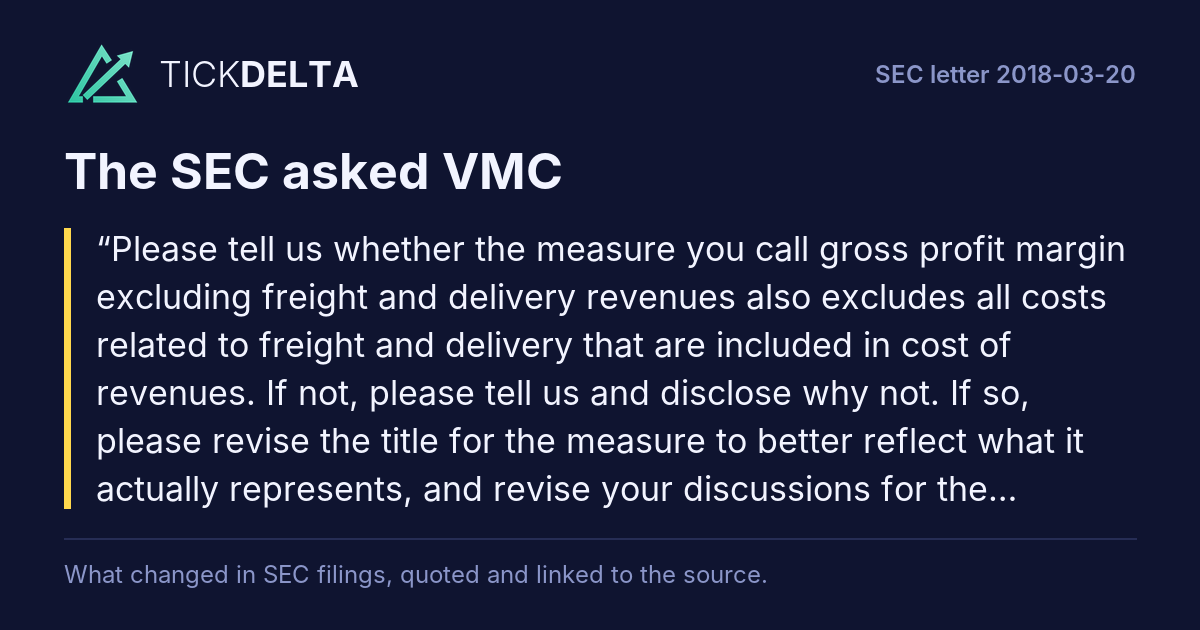
Please tell us whether the measure you call gross profit margin excluding freight and delivery revenues also excludes all costs related to freight and delivery that are included in cost of revenues. If not, please tell us and disclose why not.
Rest of the question

If so, please revise the title for the measure to better reflect what it actually represents, and revise your discussions for the reconciliations related to the numerator (gross profit) to clearly disclose the adjustments for both (a) freight and delivery revenues and (b) all costs related to freight and delivery that are included in cost of revenues. For the aggregates segment measure, also address your treatment of the costs related to the other revenues excluded.

VMC answered
The measure we refer to as “Gross Profit Margin Excluding Freight and Delivery Revenues” excludes both the revenues and costs related to freight and delivery. We will undertake to revise in future filings both the title for this measure and related reconciliation discussion as follows:

“Gross Profit Margin Excluding Freight and Delivery Revenues and Costs”

“Gross profit margin excluding freight and delivery revenues and costs is not a Generally Accepted Accounting Principle (GAAP) measure.

We present this metric as it is consistent with the basis by which we review our operating results.
Rest of the answer

Likewise, we believe that this presentation is consistent with our competitors and consistent with the basis by which investors analyze our operating results considering that freight and delivery services represent pass-through activities (we do not generate a profit associated with the transportation component of the selling price of the product). Reconciliation of this metric to its nearest

GAAP measure is presented below:”

For the aggregates segment measure, we also exclude both the revenues and costs related to freight and delivery.

Costs related to other revenues are not excluded because they are immaterial and cannot be segregated from the costs of our product sales without undue burden and expense. However, to avoid confusion and improve comparability from period to period, we undertake to revise this measure in future filings to exclude an adjustment for other revenues as follows:

“Aggregates segment gross profit margin as a percentage of segment sales excluding freight, delivery & transportation revenues is not a GAAP measure. We present this metric as it is consistent with the basis by which we review our operating results. We believe that this presentation is consistent with our competitors and meaningful to our investors as it excludes revenues associated with freight, delivery and transportation, all of which are pass-through activities

(we do not generate a profit associated with the transportation component of the selling price of the product). Incremental gross profit as a percentage of freight-adjusted revenues represents the year-over-year change in gross profit divided by the year-over-year change in freight-adjusted revenues. Reconciliations of these metrics to their nearest GAAP measures are presented below:

dollars in millions

2017

2016

2015

Aggregates Segment

Gross profit

$

860.0

873.1

755.7

Segment sales

3,096.1

2,961.8

2,777.8

Freight, delivery & transportation revenues 1

670.7

651.9

644.7

Segment sales excluding freight, delivery & transportation revenues

2,425.4

2,309.9

2,133.1

Gross profit as a percentage of segment sales excluding freight, delivery & transportation revenues

35.4

%

37.8

Incremental gross profit as a percentage of segment sales excluding freight, delivery & transportation revenues n/a

66.4

At the segment level, freight, delivery & transportation revenues include intersegment freight & delivery revenues, which are eliminated at the consolidated level.”

Read in the reply ↗
In its next report

First report after the company's reply of 2018-04-02: 10-Q filed 2018-05-04 ↗, against the 10-Q filed 2017-11-03 ↗.

Tickdelta does not hold the text of both reports, so they are not compared here.
Liquidity and Financial Resources, page 45
SEC asked (2)
Please disclose the information required by Item 10(e)(1)(i)(C) and (D) of Regulation S- K for the net earnings before DDA&A non-GAAP measure presented.
VMC answered
We acknowledge that net earnings before DDA&A is a non-GAAP measure and understand the requirements of Item 10(e)(1)(i)(C) and (D). This liquidity measure is not used internally by current management nor do we believe that it is widely used by our investors. We undertake to remove the subtotal “Net earnings before noncash deductions for DDA&A” from our cash from operating activities table in future filings. Read in the reply ↗
In its next report

First report after the company's reply of 2018-04-02: 10-Q filed 2018-05-04 ↗, against the 10-Q filed 2017-11-03 ↗.

Tickdelta does not hold the text of both reports, so they are not compared here.

Consolidated Financial Statements · Consolidated Statements of Comprehensive Income, page 62
SEC asked (3)
On page 71, you indicate total revenues include sales of product and services to customers and freight and delivery revenues billed to customers. Pages 32 and 33 appear to indicate that freight and delivery revenues exceed 10% of your total revenues. Please separately present your revenues from products, services and other in your statements of comprehensive income.
Rest of the question

Similarly revise your cost of revenues presentation. Refer to Rule 5-03.1 and .2 of Regulation S-X.

VMC answered
We acknowledge and understand the requirements of Rule 5-03.1 and 5-03.2 of

Regulation S-X that states revenues from tangible products and revenues from services must be stated separately when each class is more than 10% of the total, and cost from tangible goods sold and cost of services must also be stated separately. Freight and delivery is a fulfillment activity we perform to supply our customers with our product; we do not provide stand-alone freight and delivery services.
Rest of the answer

Looking forward, our freight and delivery activities will not represent distinct performance obligations under ASC 606. Therefore, we do not believe that we are required to present this activity separately from revenues generated from product sales in our statement of comprehensive income, nor do we believe such a separate presentation would be material to investors. To clarify that we are not in the freight or shipping business and that our freight and delivery revenues represent a fulfillment activity that is more commonly referred to as shipping and handling, we undertake to modify our disclosure in future filings as follows:

“Total revenues are primarily derived from our product sales of aggregates, asphalt mix and ready-mixed concrete, and include freight and delivery costs we incur and bill to our customers to deliver these products.”

The Company acknowledges that it is responsible for the adequacy and accuracy of its disclosures. If you have any questions regarding the above responses, please do not hesitate to call the undersigned at (205) 298-3223.

Read in the reply ↗
In its next report

First report after the company's reply of 2018-04-02: 10-Q filed 2018-05-04 ↗, against the 10-Q filed 2017-11-03 ↗.

Tickdelta does not hold the text of both reports, so they are not compared here.

Also in this review: closing letter, 2018-04-06
Form 10-K for the Year Ended December 31, 2015

2016-09-02 to 2016-09-20 · 3 questions · 1 letter from the SEC, 1 from the company
Review closed 2016-09-20
Results discussion (MD&A)RevenueSegments
Operations, page 28 · Results of Operations, page 35
SEC asked (1)
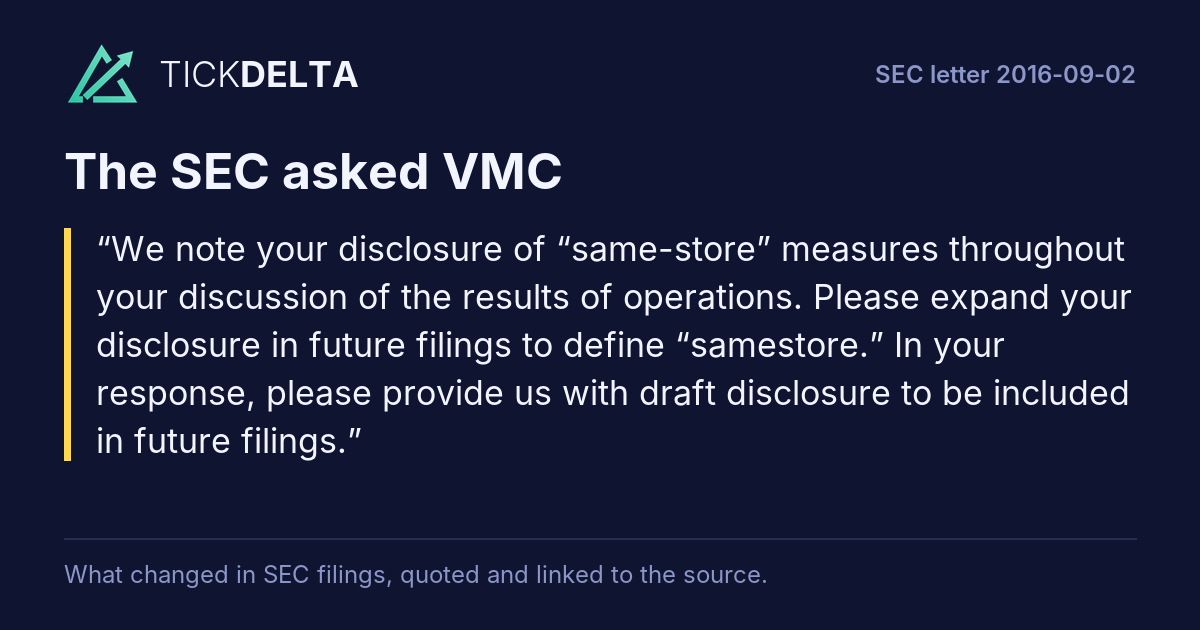
We note your disclosure of “same-store” measures throughout your discussion of the results of operations. Please expand your disclosure in future filings to define “samestore.” In your response, please provide us with draft disclosure to be included in future filings.
VMC answered
The U.S. aggregates industry is highly fragmented and many opportunities for consolidation exist. Since becoming a public company in 1956, Vulcan has principally grown by mergers and acquisitions. Conversely, we have divested underperforming and non-strategic operations. When discussing our financial results in comparison to prior periods, we exclude the operating results of recently acquired/divested businesses that do not have comparable results in the periods being discussed. This approach allows us to evaluate the performance of our operations on a comparable basis.
Rest of the answer

We believe that measuring performance on a same-store basis is useful to investors because it enables evaluation of how our operations are performing period over period without the effects of acquisition and divestiture activity.

In Note 19 of our Notes to Consolidated Financial Statements (pages 106 and 107), we disclosed the acquisition/divestiture of a number of operations in 2014 and 2015. The results of these operations have been excluded from our discussion of “same-store” operating results. We will undertake to include the following disclosure in future filings that include same-store performance metrics:

“We have provided certain information on a same-store basis. When discussing our financial results in comparison to prior periods, we exclude the operating results of recently acquired/divested businesses that do not have comparable results in the periods being discussed. These recently acquired/divested businesses are disclosed in Note 19 “Acquisitions and

Divestitures.” This approach allows us to evaluate the performance of our operations on a comparable basis. We believe that measuring performance on a same-store basis is useful to investors because it enables evaluation of how our operations are performing period over period without the effects of acquisition and divestiture activity. Our same-store information may not be comparable to similar measures utilized by other entities.”

Read in the reply ↗
In its next report

First report after the company's reply of 2016-09-15: 10-Q filed 2016-11-02 ↗, against the 10-Q filed 2016-08-03 ↗.

Tickdelta does not hold the text of both reports, so they are not compared here.

Notes to Consolidated Financial Statements, page 63 · General
SEC asked (2)
We note your disclosure throughout the document referencing foreign subsidiaries and foreign operations. Your accounting policies do not appear to address your accounting for foreign currency matters. In future filings, please provide the disclosures required by FASB ASC 830. In your response, please provide us with draft disclosure to be included in future filings.
VMC answered
The vast majority of our business activities are domestic. Foreign currency transaction gains were $2,232,000 in 2015, $1,810,000 in 2014 and $33,000 in 2013, and were immaterial to our financial statements. However, assuming no change in the underlying facts and circumstances, we will undertake to include the following accounting policy disclosure in future Form 10-K filings:

“The U. S. dollar is the functional currency for all of our operations. For our non-U.S.
Rest of the answer

subsidiaries, local currency inventories and long-term assets such as property, plant and equipment and intangibles are remeasured into U.S. dollars at approximate rates prevailing when acquired;

all other assets and liabilities are remeasured at year-end exchange rates. Inventories charged to cost of sales and depreciation are remeasured at historical rates; all other income and expense items are remeasured at average exchange rates prevailing during the year. Gains and losses which result from remeasurement are included in earnings and are not material for the years presented.”

Read in the reply ↗
Note 15: Segment Reporting, page 101
SEC asked (3)
We note your disclosure on page 83 that your foreign earnings from continuing operations was $34,310,000, but your disclosure here states only $11,408,000 of revenue generated by your aggregates operating segment was nondomestic.
Rest of the question

Please clarify whether you generated nondomestic revenues from your other operating segments, if so, please revise your footnote to disclose revenue from external customers attributed to U.S. and attributed to all foreign countries in total pursuant to ASC 280-10-50-41.

VMC answered
The disclosure on page 83 provides earnings from continuing operations before income taxes that were generated by our foreign subsidiaries from revenues both within the U.S. as well as outside the U.S. (nondomestic). In contrast, the disclosure on page 101 provides only nondomestic revenues by our foreign subsidiaries (excludes revenues within the U.S. by our foreign subsidiaries).

Our foreign subsidiaries generated $164,831,000 of revenue in 2015 which resulted in $34,310,000 of pretax earnings from continuing operations.
Rest of the answer

Of this $164,831,000 of revenue, $153,423,000 was attributable to revenues within the U.S., with the remaining $11,408,000 attributable to revenues outside the U.S. We did not generate nondomestic revenues from our other operating segments.

We will undertake to include the following expanded disclosure (modified as necessary to reflect the appropriate periods) in future Form 10-K filings:

“The vast majority of our activities are domestic. We sell a relatively small amount of construction aggregates outside the United States. Total domestic revenues were $3,410,773,000 in 2015, $2,979,470,000 in 2014 and $2,758,370,000 in 2013. Nondomestic Aggregates segment revenues were $11,408,000 in 2015, $14,699,000 in 2014 and $12,339,000 in

2013; there were no nondomestic revenues in our Asphalt Mix, Concrete or Calcium segments.”

Closing:

The Company acknowledges that:

• it is responsible for the adequacy and accuracy of the disclosure in the filing;

Staff comments or changes to disclosure in response to Staff comments do not foreclose the Commission from taking any action with respect to the filing; and it may not assert Staff comments as a defense in any proceeding initiated by the Commission or any person under the federal securities laws of the United States.

Read in the reply ↗
In its next report

First report after the company's reply of 2016-09-15: 10-Q filed 2016-11-02 ↗, against the 10-Q filed 2016-08-03 ↗.

Tickdelta does not hold the text of both reports, so they are not compared here.

Also in this review: closing letter, 2016-09-20

Other letters

Letters without questions

UPLOAD and CORRESP
3 other letters: notices that a filing will not be reviewed, requests to declare a registration effective, and the like

From the SEC's correspondence on EDGAR: staff letters (form UPLOAD) and company letters (form CORRESP), 13 letters filed since 2016-09-06. Questions and answers are matched by their numbers; topics come from words in each question. The reports are compared word for word (same form, before the first SEC letter against the first report after the company's reply). No AI.

Next in Owners and insiders Insider trades →