NCR Voyix Corp VYX
New risk paragraphs, branching off last year
Each branch is a paragraph in Risk Factors with nothing like it in the 10-K filed Feb 27, 2025. A box jumps to the paragraph as filed, below.
Paragraphs with nothing like them in last year's 10-K
14 paragraphs in Risk Factors of the 10-K filed Feb 26, 2026 with nothing like them in the 10-K filed Feb 27, 2025. Quoted exactly. Paragraphs that were only edited are under 10-K change.
•If we are unable to achieve the successful adoption of our cloud platform and modernized SaaS solutions, then our revenue, financial condition and our results of operations could be negatively impacted.
•Our use of artificial intelligence in our products and operations, as well as our potential failure to effectively implement, use and market these technologies, may result in reputational harm or liability or could adversely affect our revenues and profitability.
If we are unable to achieve the successful adoption of our cloud platform and modernized SaaS solutions, then our revenue, financial condition and results of operations could be negatively impacted. We have taken significant steps, including the Spin-Off of NCR Atleos, the Digital Banking Sale and the Hardware Business Transition, to strategically position us for long-term growth. We have developed a modernized suite of SaaS solutions that natively integrates with our cloud-based platform in order to meet the evolving needs of our retail and restaurant customers.
Accordingly, our strategic focus has now shifted towards accelerating the adoption of the Voyix Commerce Platform and our subscription-based SaaS solutions. The successful adoption of our platform and SaaS solutions by new and existing customers is dependent on a variety of factors including, among others, the demand for, and the performance and competitive differentiation of, our platform and solutions; the timely development and deployment of new or enhanced solutions and capabilities; our ability to convert existing customers and attract new customers to our platform and solutions; our ability to expand our customers’ use of our full suite of offerings, including, among others, our payment acceptance and processing capabilities; the optimization, performance and expansion of our services offerings; and the continued expansion of third-party integrations and open platform enablers to increase the extensibility and interoperability of our platform and SaaS solutions.
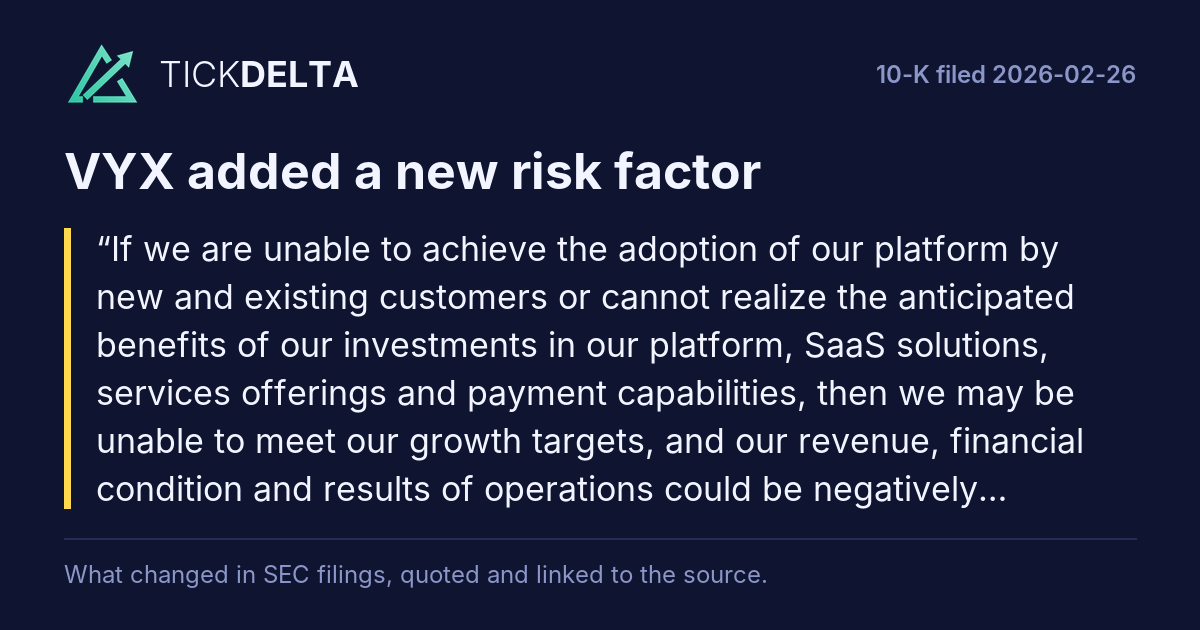
If we are unable to achieve the adoption of our platform by new and existing customers or cannot realize the anticipated benefits of our investments in our platform, SaaS solutions, services offerings and payment capabilities, then we may be unable to meet our growth targets, and our revenue, financial condition and results of operations could be negatively impacted.
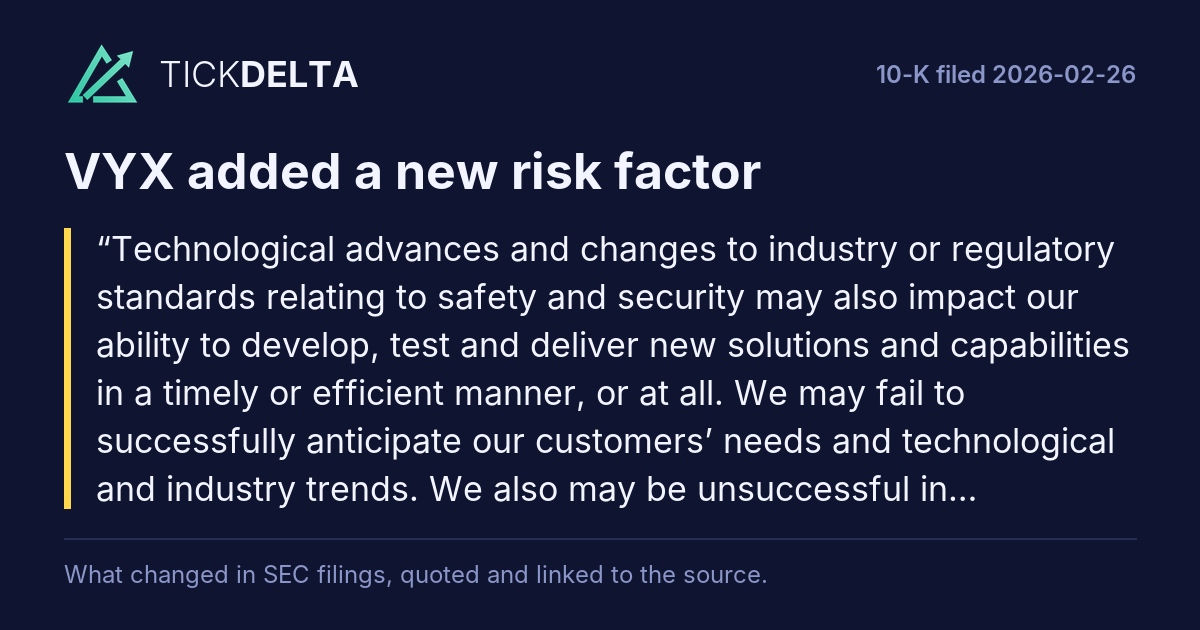
Technological advances and changes to industry or regulatory standards relating to safety and security may also impact our ability to develop, test and deliver new solutions and capabilities in a timely or efficient manner, or at all. We may fail to successfully anticipate our customers’ needs and technological and industry trends. We also may be unsuccessful in marketing and selling these solutions, once developed, which could natively impact our business and operating results.
Show the other 8
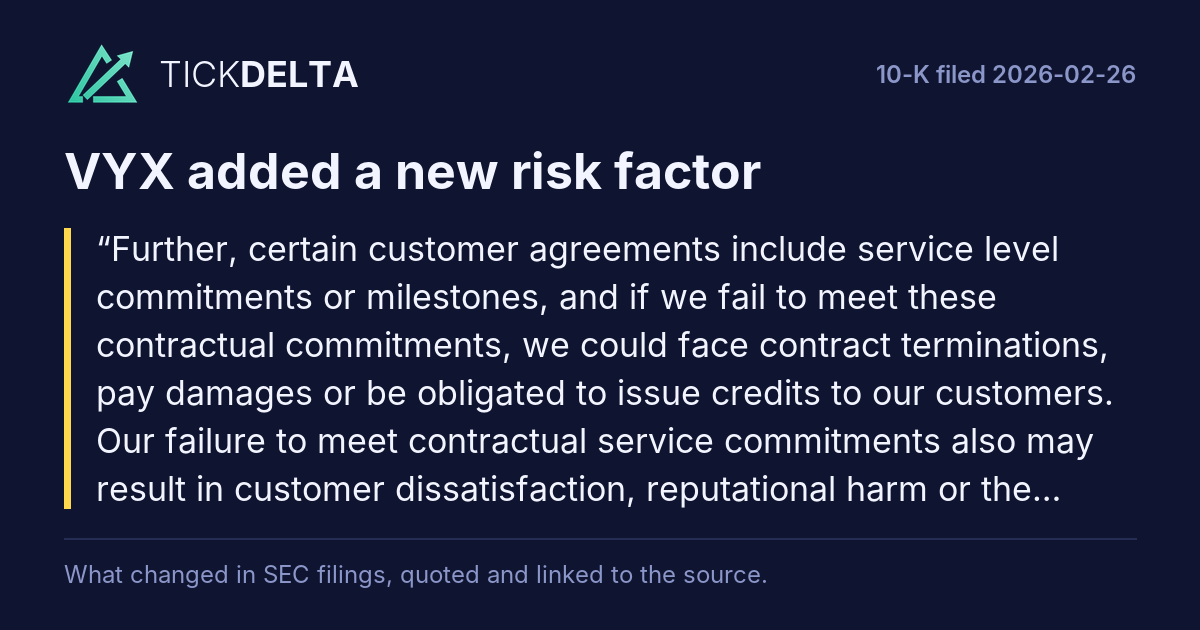
Further, certain customer agreements include service level commitments or milestones, and if we fail to meet these contractual commitments, we could face contract terminations, pay damages or be obligated to issue credits to our customers. Our failure to meet contractual service commitments also may result in customer dissatisfaction, reputational harm or the loss of customers, which could have a material adverse effect on our business and results of operations.
While we have programs and measures in place that are designed to protect and safeguard our data and the third-party data we collect, store and process, and while we have implemented access controls designed to limit the risk of unauthorized use or
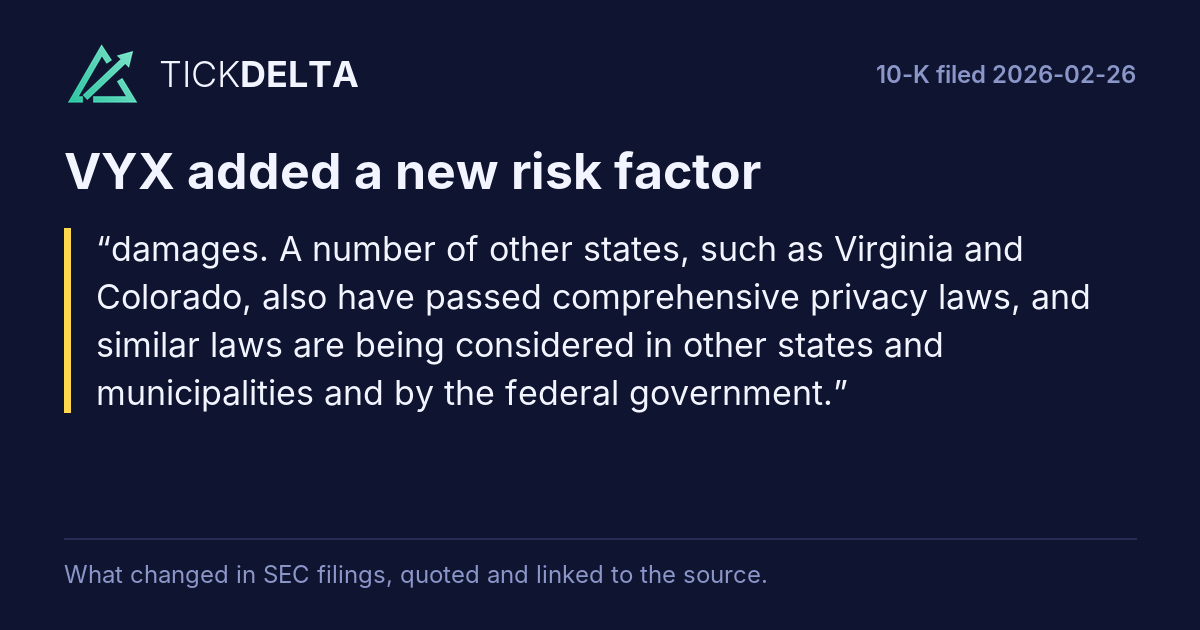
damages. A number of other states, such as Virginia and Colorado, also have passed comprehensive privacy laws, and similar laws are being considered in other states and municipalities and by the federal government.
Effective IP protection may not be available in every country where our products and services are offered or may be offered in the future, and the laws of certain foreign jurisdictions may not recognize certain intellectual property rights or protect them to the same extent as the laws of the United States. Changes in, or unexpected interpretations of, intellectual property laws may compromise our ability to enforce our intellectual property rights, or such changes could jeopardize the validity, enforceability or scope of our IP rights or harm our ability to obtain IP protections.
function as designed or have unintended consequences, which could subject us to new or enhanced competitive harm, legal liability, regulatory or public scrutiny or reputational harm.
As the AI legal and regulatory landscape evolves over time, we may incur significant costs to achieve compliance and ensure responsible use, or we could experience limitations on our ability to use AI internally or within our offerings. Our adoption of AI within our offerings and internal operations may result in unanticipated liabilities, costs or regulatory fines, or we may not realize the expected benefits of our investment into AI capabilities, leading to material harm to our business, reputation, financial condition and operating results.
recently invalidated tariffs or the effect of those tariffs recently imposed on our Company, operations and financial results. Similarly, the Company’s operations, vendor costs and product pricing are impacted by various trade treaties, such as the United States-Mexico-Canada Agreement. Any termination or modification to trade treaties that impact the Company’s products could impact our business, financial condition, and results of operations. In addition, as a result of these recent developments in U.S. foreign trade policy, we do not know whether certain foreign countries will adopt retaliatory trade policies or what the impact of any such retaliatory trade policies could be on our business. If geopolitical tensions, trade disputes and other global conflicts develop or further escalate, which could occur with little to no advanced notice, then we may not be able to effectively mitigate any increased costs of our offerings, enhanced disruptions to our supply chain or impairment to our ability to effectively operate and compete in some or all of the countries in which we do business.
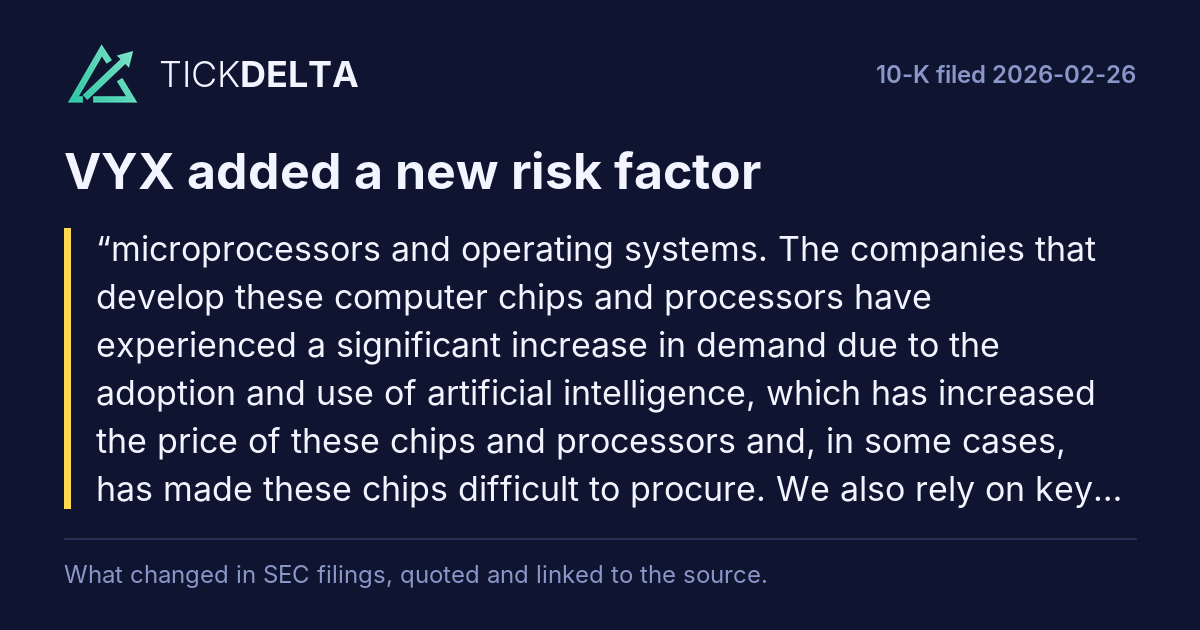
microprocessors and operating systems. The companies that develop these computer chips and processors have experienced a significant increase in demand due to the adoption and use of artificial intelligence, which has increased the price of these chips and processors and, in some cases, has made these chips difficult to procure. We also rely on key technology providers with respect to our payments offerings. If we are unable to secure the necessary services, components or technologies from our vendors at a reasonable price or at all, and have to find an alternative supplier, the delivery of our commercial offerings could be delayed, or these offerings may no longer be profitable. Such delays or increased costs could affect our business and operating results.
Paragraphs in the 10-Q filed Nov 5, 2026 that were not in the one before
New in the latest 10-Q
17 paragraphs in the 10-Q filed Nov 5, 2026 with nothing like them in the 10-Q filed Aug 5, 2026 (at least half the words must differ; new numbers alone do not count). Quoted exactly, grouped by the item heading above them. This is text that changed, not a judgement of how serious it is.
Financial statements and notes
Adjustments to reconcile net income (loss) to net cash provided by (used in) operating activities:
Read in the 10-Q
Loss (gain) on disposal of property, plant and equipment and other assets, net 6 (3)
Read in the 10-Q
Effect of exchange rate changes on cash, cash equivalents and restricted cash — 4
Read in the 10-Q
• Restaurants - Our Restaurants segment serves restaurants and food service establishments of varying size, format and complexity, including, for example, quick-service, table-service, and fast-casual restaurants. We offer an end-to-end suite of unified commerce solutions, spanning across software, payments, installation and maintenance services, managed and professional services, and hardware. Our SaaS solutions for restaurants, powered by the Voyix Commerce Platform, include, among others, POS, consumer marketing and loyalty, inventory and kitchen management ordering, pay-at-table, menu management, and labor management.
Read in the 10-Q
Kalamazoo River is a “future site” within the meaning of the Cost Sharing Agreement. The case remains pending with respect to BAT’s remaining counterclaims and affirmative defenses.
Read in the 10-Q
Show the other 12
Separately, the Company commenced a parallel arbitration against AT&T for the recovery of the Withheld Payments, and AT&T filed counterclaims alleging that the contractual indemnity threshold set forth in the 1996 Divestiture Agreement wasn’t yet met at the time it began making indemnity payments and disputing the calculation of the net tax benefits that was applied to its indemnity obligation payments. The Company disputes the allegations relating to the contractual indemnity threshold. On August 20, 2026, the arbitrator entered an order compelling AT&T to pay the Withheld Payments and compelling AT&T to timely remit payment on all future invoices. AT&T has paid this amount as ordered. A hearing on AT&T’s remaining counterclaims is expected to occur in the fourth quarter of 2026. The Company believes that it has substantial defenses to AT&T’s claims and intends to vigorously defend this matter. However, complex arbitration is inherently uncertain, and the Company cannot predict the ultimate outcome of the matter. Although the Company does not currently believe that a loss is probable beyond amounts previously accrued, it cannot rule out the possibility that the matter could negatively impact the Company’s financial condition or cash flows.
Read in the 10-Q
September 30, 2026 In millions Total Quoted Prices in Significant Other Significant
Read in the 10-Q
• Restaurants - Our Restaurants segment serves restaurants and food service establishments of varying size, format and complexity, including, for example, quick-service, table-service, and fast-casual restaurants. We offer an end-to-end suite of unified commerce solutions, spanning across software, payments, installation and maintenance services, managed and professional services, and hardware. Our SaaS solutions for restaurants, powered by the Voyix Commerce Platform, include, among others, POS, consumer marketing and loyalty, inventory and kitchen management ordering, pay-at-table, menu management, and labor management.
Read in the 10-Q
• Net income from continuing operations was $14 million, compared to a net loss from continuing operations of $18 million in the prior year period
Read in the 10-Q
• Adjusted EBITDA was $120 million compared to $123 million in the prior year period
Read in the 10-Q
would represent approximately 8% of our outstanding common stock as of September 30, 2026, including the preferred shares on an as-converted basis.
Read in the 10-Q
Other information
On November 3, 2026, the Board appointed Darren Wilson, (previously the Company’s Executive Vice President and President, Retail and Payments), as President of the Company, effective November 5, 2026 (the “Effective Date”). In connection with Mr. Wilson’s appointment, James G. Kelly will continue to serve as the Company’s Chief Executive Officer and as a member of the Board but will cease to serve as President as of the Effective Date.
Read in the 10-Q
Mr. Wilson, age 59, has served as Executive Vice President and President, Retail and Payments since February 2025. He joined the Company in November 2024 as Executive Vice President and President, International. Before joining the Company, Mr. Wilson served as President, International at EVO Payments, Inc. from April 2014 to March 2023, and earlier held leadership roles at Worldpay UK, Global Payments Inc. and HSBC Banking Group. There are no arrangements or understandings between Mr. Wilson and any other person under which he was selected as President, and he has no family relationships with any director or executive officer of the Company. Mr. Wilson has no direct or indirect material interest in any transaction required to be disclosed under Item 404(a) of Regulation S-K.
Read in the 10-Q
In connection with Mr. Wilson’s appointment as President of the Company, on November 4, 2026, the Company and Mr. Wilson entered into an amendment to Mr. Wilson’s Statement of Terms & Conditions of Employment dated November 1, 2024, as amended on February 9, 2025. The amendment provides for: (i) Mr. Wilson’s new title of President; (ii) an increase in his annual base salary to £488,721; (iii) an increase in his annual target long-term incentive award value to $3,000,000; and (iv) if his employment is terminated by the Company without cause, vesting of his equity awards in an amount equal to the greater of 50% or pro rata vesting.
Read in the 10-Q
On November 3, 2026, the Board appointed Brendan Tansill as Executive Vice President and President, Retail and Payments of the Company, effective December 14, 2026, succeeding Mr. Wilson in such role.
Read in the 10-Q
In addition, on November 2, 2026, the Compensation Committee of the Board approved the amendment and restatement of the NCR Voyix Corporation 2024 Executive Severance Plan (as amended and restated, the “Severance Plan”) to create a severance tier for the President of the Company equal to the Chief Financial Officer’s tier (1.5 times base salary plus target bonus for a qualifying termination not connected with a change in control, and 2.0 times base salary plus target bonus for a qualifying termination connected with a change in control).
Read in the 10-Q
The foregoing descriptions are summaries and are qualified in their entirety by the full text of the amendment to Mr. Wilson’s employment agreement and the Severance Plan, which are filed as Exhibits 10.1 and 10.2 to this Quarterly Report on Form 10-Q and incorporated herein by reference.
Read in the 10-Q
The 10-Q's risk factors against the 10-K
Item 1A of the 10-Q filed Nov 5, 2026 against Item 1A of the 10-K filed Feb 26, 2026.
A 10-Q repeats only the risks that changed, so a 10-K paragraph that is missing from it is not counted as removed.
Added is a paragraph with nothing like it in the 10-K, Reworded a sentence that is in both with several words changed,
Quiet changes a sentence in both where one to four words changed and one is a hedge or a modal
(cut words struck through, new words highlighted).
Text on the page, not a score; each links to the filing at sec.gov.
Phrases used for the first time
Two-word phrases in Risk Factors of the 10-K filed Feb 26, 2026 that are in none of the 1 earlier 10-Ks stored, back to Feb 27, 2025
Where each one is used
- commercial offerings: In addition, the legal and regulatory landscape relating to the use of artificial intelligence, machine learning and other automated decision-making capabilities continues to evolve, and there is uncertainty regarding the scope and timing of the adoption of these new and existing laws and regulations. For example,...
- saas solutions: •If we are unable to achieve the successful adoption of our cloud platform and modernized SaaS solutions, then our revenue, financial condition and our results of operations could be negatively impacted.
- long-term growth: If we are unable to achieve the successful adoption of our cloud platform and modernized SaaS solutions, then our revenue, financial condition and results of operations could be negatively impacted. We have taken significant steps, including the Spin-Off of NCR Atleos, the Digital Banking Sale and the Hardware...
- service offerings: If we do not successfully develop and enhance capabilities that differentiate the solutions and services we offer and keep pace with technological advancements, then our business, financial condition and operating results may be harmed. The retail and restaurant markets in which we compete are characterized by...
- achieve compliance: Outside the United States, the number of laws, regulations and industry standards governing data privacy and security is increasing. The European Union’s General Data Protection Regulation (“EU GDPR”), the United Kingdom’s General Data Protection Regulation and Brazil’s General Data Protection Law impose strict...
- successful adoption: •If we are unable to achieve the successful adoption of our cloud platform and modernized SaaS solutions, then our revenue, financial condition and our results of operations could be negatively impacted.
- technological advancements: •If we do not successfully develop and enhance capabilities that differentiate the solutions and services we offer and keep pace with technological advancements, then our business, financial condition and operating results may be harmed.
- implementation phase: We may not realize the anticipated cost savings or other benefits related to the transition of our Hardware Business to an outsourced design and manufacturing (ODM) model on a timely basis or at all. In August 2024, we announced our entry into a commercial agreement with Ennoconn Corporation (“Ennoconn”) to...
Used at least twice, small words left out. Counted, not picked: a phrase can be new because the company renamed something.
What was taken out
16 paragraphs of last year's Risk Factors with nothing like them now. The longest are quoted.
Sources
Item 1A of each 10-K and 10-Q on EDGAR, quoted exactly. Each paragraph links to the filing at sec.gov.
Also
10-K change: what was reworded or cut, section by section.
Work with it
Excel workbook · CSV. Google Sheet that stays up to date: paste =IMPORTDATA("https://tickdelta.com/company/VYX/export.csv") into a cell.