Western Alliance Bancorporation WAL
New risk paragraphs, branching off last year
Each branch is a paragraph in Risk Factors with nothing like it in the 10-K filed Feb 25, 2025. A box jumps to the paragraph as filed, below.
Paragraphs with nothing like them in last year's 10-K
14 paragraphs in Risk Factors of the 10-K filed Feb 23, 2026 with nothing like them in the 10-K filed Feb 25, 2025. Quoted exactly. Paragraphs that were only edited are under 10-K change.
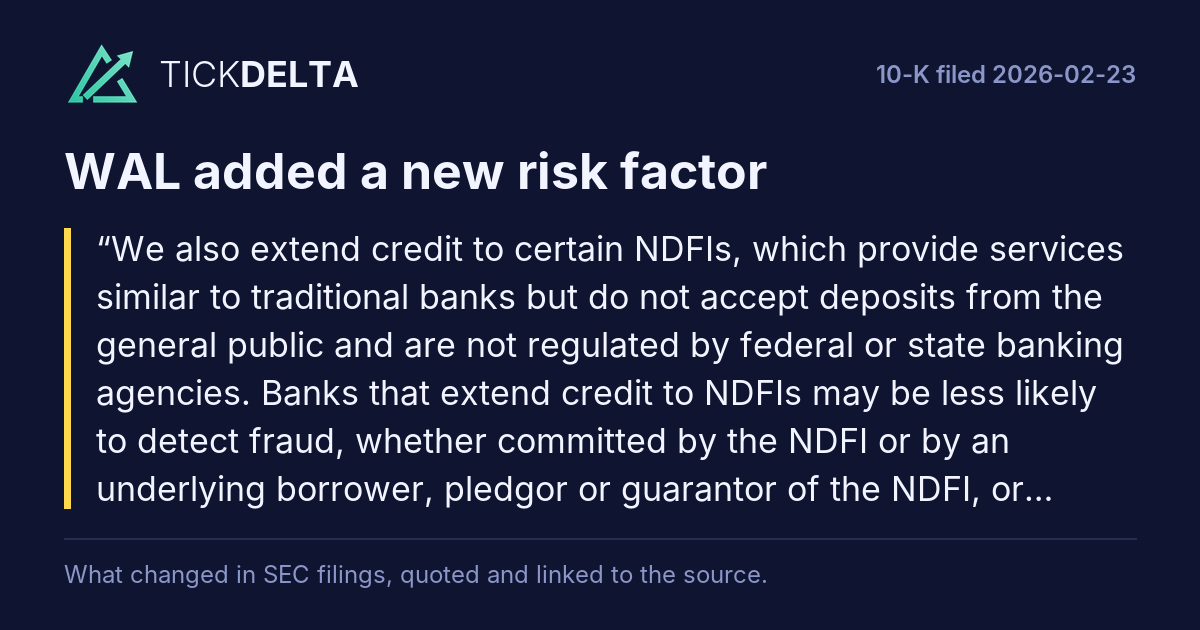
We also extend credit to certain NDFIs, which provide services similar to traditional banks but do not accept deposits from the general public and are not regulated by federal or state banking agencies. Banks that extend credit to NDFIs may be less likely to detect fraud, whether committed by the NDFI or by an underlying borrower, pledgor or guarantor of the NDFI, or other underlying credit issues, than for loans to traditional commercial borrowers, due to the lack of a direct relationship between the bank and the third parties and collateral underlying the loan. We experienced potential fraud in connection with an extension of credit to an NDFI in the third quarter of 2025 that resulted in the establishment of a $29.6 million specific reserve, as discussed in more detail in Recent Developments within Item 7 of this Form 10-K. Approximately $14.7 billion, or 25.0% of our total HFI loans are loans to NDFIs. While we carefully underwrite and monitor extensions of credit to NDFIs in accordance with our
policies, any undetected fraud or underlying credit issues could have a material adverse impact on our financial conditions and results of operations.
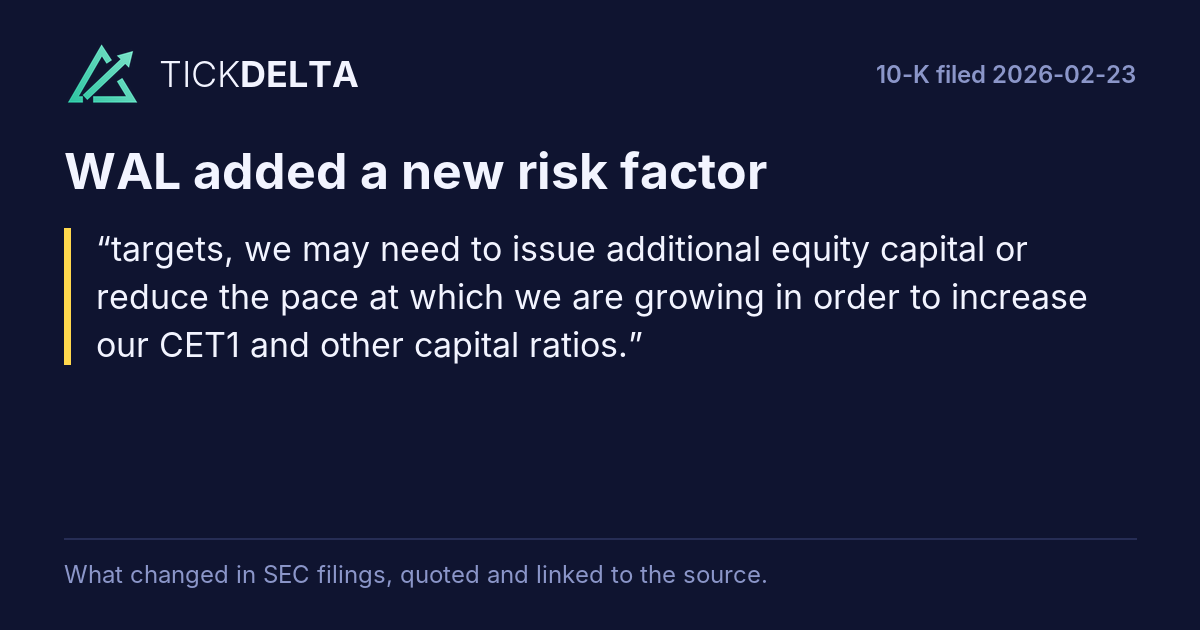
targets, we may need to issue additional equity capital or reduce the pace at which we are growing in order to increase our CET1 and other capital ratios.
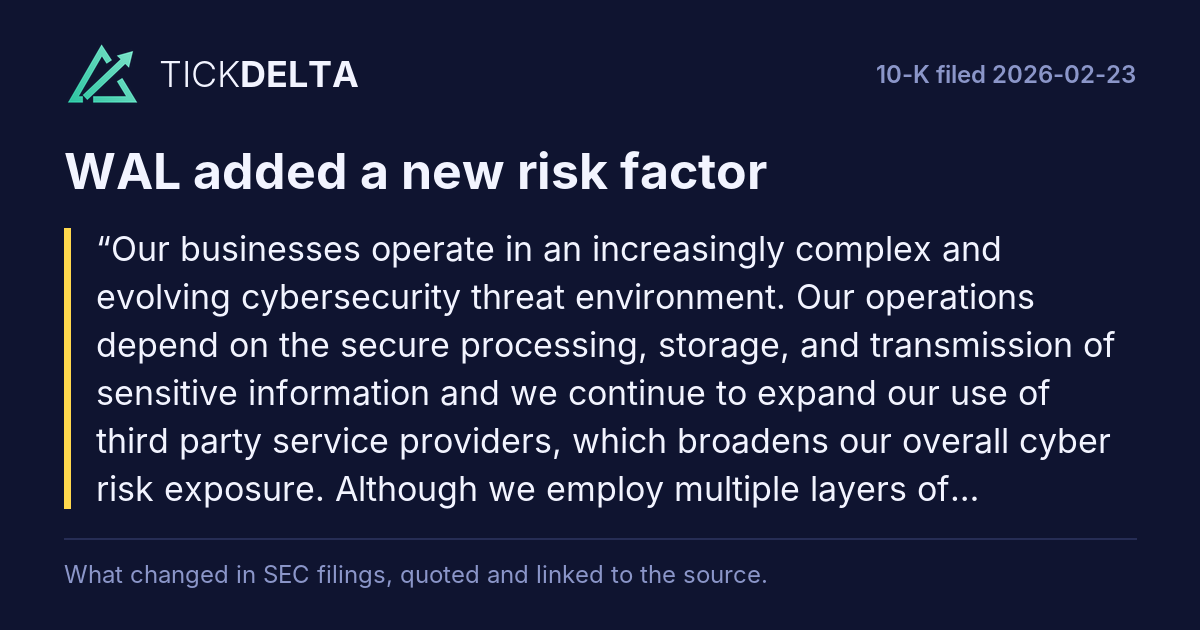
Our businesses operate in an increasingly complex and evolving cybersecurity threat environment. Our operations depend on the secure processing, storage, and transmission of sensitive information and we continue to expand our use of third party service providers, which broadens our overall cyber risk exposure. Although we employ multiple layers of protective controls to maintain the confidentiality, integrity, and security of information across all geographies and business lines, and we
continually enhance these, the nature of cyber threats continues to evolve. Threat actors repeatedly target financial institutions and their service providers, and as a result, our system and those of our customers and vendors remain vulnerable to unauthorized access, fraudulent activity, data exfiltration or destruction, service outages, malware, ransomware, cyber-attacks, and other adverse events that could result in significant losses to us or our customers. These threats may originate from external actors, including foreign governments, organized criminal groups, and other malicious entities, or failure or vulnerabilities within our outsourced or infrastructure-support providers, or internal environments. Additionally, the continued evolution and increased usage of AI technologies may further increase these risks.
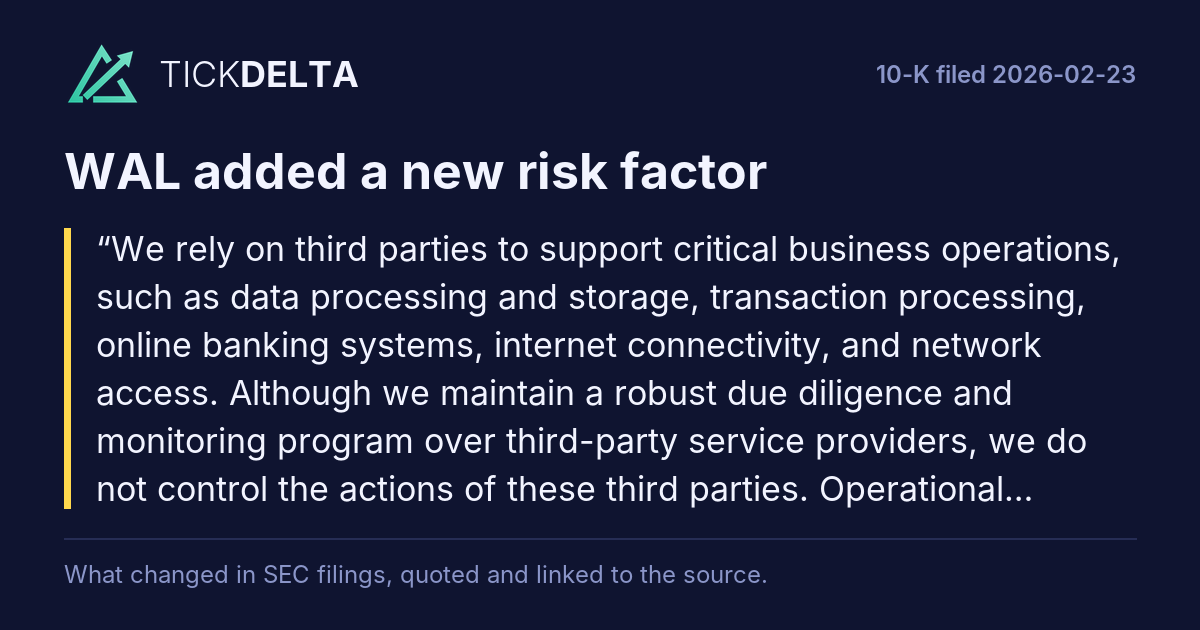
We rely on third parties to support critical business operations, such as data processing and storage, transaction processing, online banking systems, internet connectivity, and network access. Although we maintain a robust due diligence and monitoring program over third-party service providers, we do not control the actions of these third parties. Operational failures, capacity constraints, technology outages, cyber-attacks, performance issues, or service interruptions at a service provider could impair our ability to deliver products and services, affect customer experience, and negatively impact our operations. Financial or operational stress of a third-party service provider could impair its ability to fulfill contracted services. Replacing such providers could require significant time, cost, and operational adjustments, and suitable alternative providers may not be available on comparable terms or within required timeframes. Any of these events could adversely affect our business and financial performance.
The development and use of AI presents risks and challenges that may adversely impact our business
We or our third-party (or fourth-party) vendors, customers or counterparties develop or incorporate AI technology in certain business processes, services or products. The development and use of AI presents a number of risks and challenges, including concerns around safety and soundness, privacy and data-handling, fair access to financial services, fair treatment to customers, inaccuracy of results broadly known as “hallucinations” and compliance with applicable laws and regulations. The legal and regulatory environment relating to AI is uncertain and rapidly evolving, both in the U.S. and internationally, and includes regulatory schemes targeted specifically at AI as well as provisions in intellectual property, privacy, consumer protection, employment, and other laws applicable to the use of AI. These evolving laws and regulations could require changes in our implementation of AI technology and increase our compliance costs and the risks to us of non-compliance.
AI models, particularly generative or agentic AI models, may produce outputs or take action that is incorrect, that reflects biases included in the data on which they are trained, that results in the release of private, confidential, or proprietary information, that infringes on the intellectual property rights of others, or that is otherwise harmful. In addition, the complexity of many AI models makes it difficult to understand why they are generating particular outputs. This limited transparency increases the
challenges associated with assessing the proper operation of AI models, understanding and monitoring the capabilities of the AI models, reducing erroneous output, eliminating bias, and complying with regulations that require documentation or explanation of the basis on which decisions are made. Further, we may rely on AI models developed by third parties, and, to that extent, would be dependent in part on the manner in which those third parties develop and train their models, including risks arising from the inclusion of any unauthorized material in the training data for their models and the effectiveness of the steps these third parties have taken to limit the risks associated with output of their models, matters over which we may have limited visibility. Any of these risks could expose us to liability or adverse legal or regulatory consequences and harm our reputation and the public perception of our business or the effectiveness of our security measures.
Show the other 3
Regulatory compliance requirements and expense likely will increase when we reach $100 billion in assets.
Regulatory requirements and associated costs generally increase based on a bank holding company’s consolidated asset tier. Upon exceeding the $100 billion in assets threshold, we will become subject to Category IV enhanced prudential standards. As of December 31, 2025, we had $92.8 billion in assets on a consolidated basis. Under such enhanced prudential standards, Category IV bank holding companies are subject to greater regulation and supervision, including, but not limited to: certain capital planning and stress testing and capital buffer requirements; supervisory capital stress testing conducted by the FRB biennially; and certain liquidity risk management and liquidity stress testing and buffer requirements. Our preparations for, and the application of, these enhanced prudential standards and resolution planning requirements for our depository institution could adversely affect our results of operations and financial performance through additional capital and liquidity requirements and increased compliance costs. While compliance costs associated with those and other Category IV regulations are expected to be substantial, we believe a considerable portion of these costs have already been incurred as we have proactively upgraded compliance systems, processes, and staffing in anticipation of surpassing the $100 billion asset mark.
•actions of activist stockholders could impact the pursuit of our business strategies, cause us to incur substantial costs, and divert management's and the Board's attention and resources;
pursuant to common stock repurchase programs. In September 2025, the BOD adopted a common stock repurchase program, pursuant to which we remain authorized to repurchase up to $231.9 million of shares of our common stock as of December 31, 2025.
Paragraphs in the 10-Q filed Oct 30, 2026 that were not in the one before
New in the latest 10-Q
6 paragraphs in the 10-Q filed Oct 30, 2026 with nothing like them in the 10-Q filed Jul 31, 2026 (at least half the words must differ; new numbers alone do not count). Quoted exactly, grouped by the item heading above them. This is text that changed, not a judgement of how serious it is.
Financial statements and notes
During the three and nine months ended September 30, 2026, the Company completed private label residential mortgage securitization transactions involving mortgage loans with an aggregate unpaid principal balance of approximately $ 1.1 billion and $ 1.8 billion, respectively. The loans, previously classified as loans held for sale, were transferred to a securitization entity that issued mortgage-backed securities to third-party investors.
Read in the 10-Q
The Company determined that the transfers qualified for sale accounting and derecognized the transferred loans upon completion of the transactions. The Company retains certain ongoing rights and obligations associated with the transactions, including servicing rights and obligations arising from customary representations and warranties. The Company evaluated its continuing interests in the securitization entity and determined that consolidation was not required. As of September 30, 2026, the carrying amounts of assets and liabilities associated with these interests were $ 133 million and $ 1 million, respectively. The related assets were primarily classified as AFS debt securities and MSRs, and the related liabilities were primarily included in Other liabilities on the Consolidated Balance Sheet. The Company’s maximum exposure to loss associated with these continuing interests was $ 134 million at September 30, 2026.
Read in the 10-Q
Amortized Cost Basis at September 30, 2026 Payment Delay and Term Extension Payment Delay, Term Extension, and Interest Rate Reduction Payment Delay Total % of Total Class of Financing Receivable Three Months Ended (dollars in millions) ────────────────────────────────────────────────────────────────────────────────────────────────────────────────────────────────────────────────────────────────────────────────────────────────────────────────────────────────── Residential - EBO $ 25 $38 $ — $63 8.8% Nine Months Ended Residential - EBO $ 29 $51 $ — $80 11.2% Amortized Cost Basis at September 30, 2025 Payment Delay and Term Extension Payment Delay, Term Extension, and Interest Rate Reduction Payment Delay Total % of Total Class of Financing Receivable Three Months Ended (dollars in millions) Residential EBO $ 50 $47 $ 1 $98 10.3% Nine Months Ended Residential EBO $ 67 $54 $ 1 $122 12.8%
Read in the 10-Q
Amortized Cost Basis at September 30, 2026 Payment Delay and Term Extension Payment Delay, Term Extension, and Interest Rate Reduction Payment Delay Total % of Total Class of Financing Receivable Three Months Ended (dollars in millions) Residential - EBO $ 25 $38 $ — $$63 8.8% Nine Months Ended ────────────────────────────────────────────────────────────────────────────────────────────────────────────────────────────────────────────────────────────────────────────────────────────────────────────────────────────────── Residential - EBO $ 29 $51 $ — $80 11.2% Amortized Cost Basis at September 30, 2025 Payment Delay and Term Extension Payment Delay, Term Extension, and Interest Rate Reduction Payment Delay Total % of Total Class of Financing Receivable Three Months Ended (dollars in millions) Residential EBO $ 50 $47 $ 1 $98 10.3% Nine Months Ended Residential EBO $ 67 $54 $ 1 $122 12.8%
Read in the 10-Q
aggregate remaining approved amount under the Company's $300 million stock repurchase program was approximately $87.5 million.
Read in the 10-Q
Show the other 1
The Company also maintains uncommitted warehouse borrowing repurchase agreements. As of September 30, 2026, borrowing capacity under these facilities was $2.1 billion, with no outstanding borrowings.
Read in the 10-Q
The 10-Q's risk factors against the 10-K
Item 1A of the 10-Q filed Oct 30, 2026 against Item 1A of the 10-K filed Feb 23, 2026.
A 10-Q repeats only the risks that changed, so a 10-K paragraph that is missing from it is not counted as removed.
Added is a paragraph with nothing like it in the 10-K, Reworded a sentence that is in both with several words changed,
Quiet changes a sentence in both where one to four words changed and one is a hedge or a modal
(cut words struck through, new words highlighted).
Text on the page, not a score; each links to the filing at sec.gov.
What the 10-Q itself says about its risk factors:There have not been any material changes to the risk factors previously disclosed in Item 1A of the Company's Annual Report on Form 10-K for the year ended December 31, 2025.
Read in the 10-Q
1 paragraph in the 10-Q's Item 1A, and none of them adds, rewords or quietly edits a paragraph of the 10-K's.
Phrases used for the first time
Two-word phrases in Risk Factors of the 10-K filed Feb 23, 2026 that are in none of the 1 earlier 10-Ks stored, back to Feb 25, 2025
Where each one is used
- genius act: We are continuing to pursue digital payments initiatives and implementation of a fully integrated digital banking platform for our customers. The digital payments products and services we offer may use or rely on blockchain-based technologies or assets. Use of blockchain-based technologies in payments are a...
- third-party service: A failure in, or breach of, our security or technology systems, or those of our third-party service providers, including as a result of cyber-attacks, could disrupt our operations, result in the unauthorized disclosure or misuse of confidential or proprietary information, damage our reputation, increase our...
- enhanced prudential: Regulatory requirements and associated costs generally increase based on a bank holding company’s consolidated asset tier. Upon exceeding the $100 billion in assets threshold, we will become subject to Category IV enhanced prudential standards. As of December 31, 2025, we had $92.8 billion in assets on a...
- prudential standards: Regulatory requirements and associated costs generally increase based on a bank holding company’s consolidated asset tier. Upon exceeding the $100 billion in assets threshold, we will become subject to Category IV enhanced prudential standards. As of December 31, 2025, we had $92.8 billion in assets on a...
- corporate dei: As a regulated financial institution and a publicly traded company, we are facing evolving scrutiny from customers, regulators, investors, and other stakeholders related to ESG practices and disclosure. Frequently, these stakeholders have differing, and sometimes conflicting, views, priorities and expectations...
- extend credit: We also extend credit to certain NDFIs, which provide services similar to traditional banks but do not accept deposits from the general public and are not regulated by federal or state banking agencies. Banks that extend credit to NDFIs may be less likely to detect fraud, whether committed by the NDFI or by an...
- underlying credit: We also extend credit to certain NDFIs, which provide services similar to traditional banks but do not accept deposits from the general public and are not regulated by federal or state banking agencies. Banks that extend credit to NDFIs may be less likely to detect fraud, whether committed by the NDFI or by an...
- credit issues: We also extend credit to certain NDFIs, which provide services similar to traditional banks but do not accept deposits from the general public and are not regulated by federal or state banking agencies. Banks that extend credit to NDFIs may be less likely to detect fraud, whether committed by the NDFI or by an...
Used at least twice, small words left out. Counted, not picked: a phrase can be new because the company renamed something.
What was taken out
8 paragraphs of last year's Risk Factors with nothing like them now. The longest are quoted.
Sources
Item 1A of each 10-K and 10-Q on EDGAR, quoted exactly. Each paragraph links to the filing at sec.gov.
Also
10-K change: what was reworded or cut, section by section.
Work with it
Excel workbook · CSV. Google Sheet that stays up to date: paste =IMPORTDATA("https://tickdelta.com/company/WAL/export.csv") into a cell.