WEX Inc. WEX
New risk paragraphs, branching off last year
Each branch is a paragraph in Risk Factors with nothing like it in the 10-K filed Feb 20, 2025. A box jumps to the paragraph as filed, below.
Paragraphs with nothing like them in last year's 10-K
17 paragraphs in Risk Factors of the 10-K filed Feb 13, 2026 with nothing like them in the 10-K filed Feb 20, 2025. Quoted exactly. Paragraphs that were only edited are under 10-K change.
•If we stop receiving incentives from Mastercard or Visa or are unable to meet our transaction volume commitments with them our profitability could be adversely impacted.
•the speed of adoption or a material change in the use of alternative fuel and hybrid vehicles;
•general local, regional, or worldwide economic conditions, including heightened international trade tensions;
If we stop receiving incentives from Mastercard or Visa or are unable to meet our transaction volume commitments with them our profitability could be adversely impacted.
Under certain agreements we receive cash and other incentives in some of our business areas from scheme networks, including Mastercard and Visa. If we stop receiving such incentives as a result of these agreements being terminated or not being renewed on favorable terms or if the scheme networks provide these incentives directly to our customers or partners our financial results could be adversely affected. Additionally, if we become more reliant on incentives from a single scheme network, our brand or competitive positioning could be materially harmed.
We also often agree to commitments to deliver specific transaction volumes to certain scheme networks. If the scheme networks launch their own proprietary products or partner with our competitors to offer similar services, potentially diverting volume away from our platforms, or we otherwise fail to meet these volume thresholds, we may face additional costs or lose eligibility for volume-based incentives, which could materially affect our operations and financial results.
services, by limiting our ability to provide our services, or by resulting in security or other issues to our technology systems and the information contained therein. As a result, such events could negatively impact our business, financial condition, and operating results, potentially materially.
Show the other 7
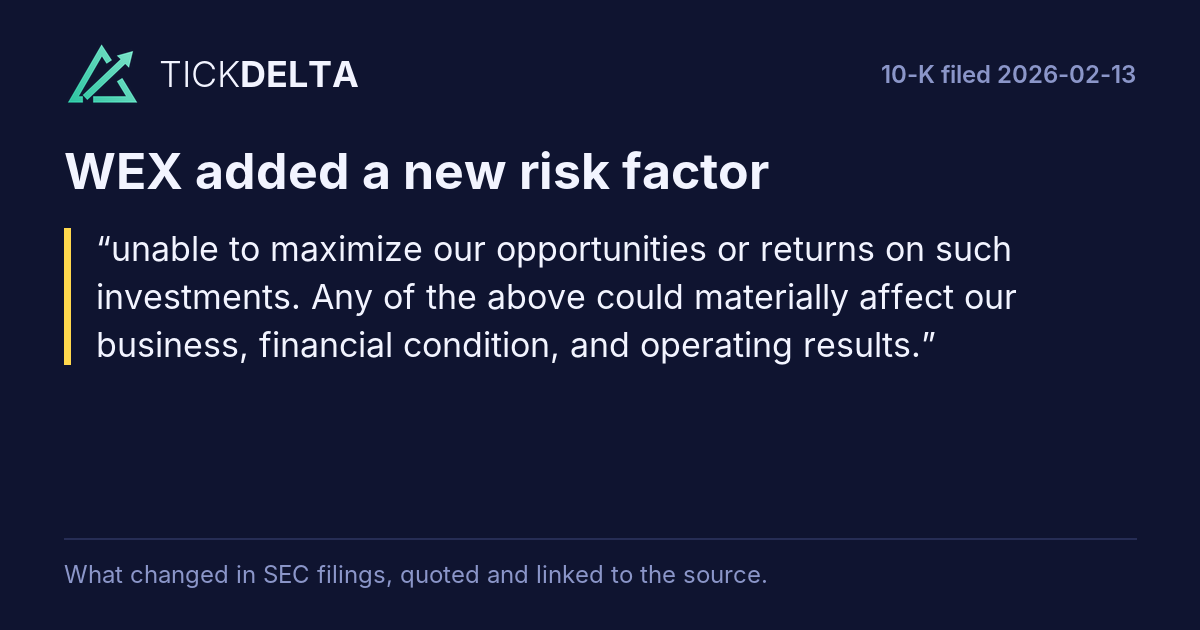
unable to maximize our opportunities or returns on such investments. Any of the above could materially affect our business, financial condition, and operating results.
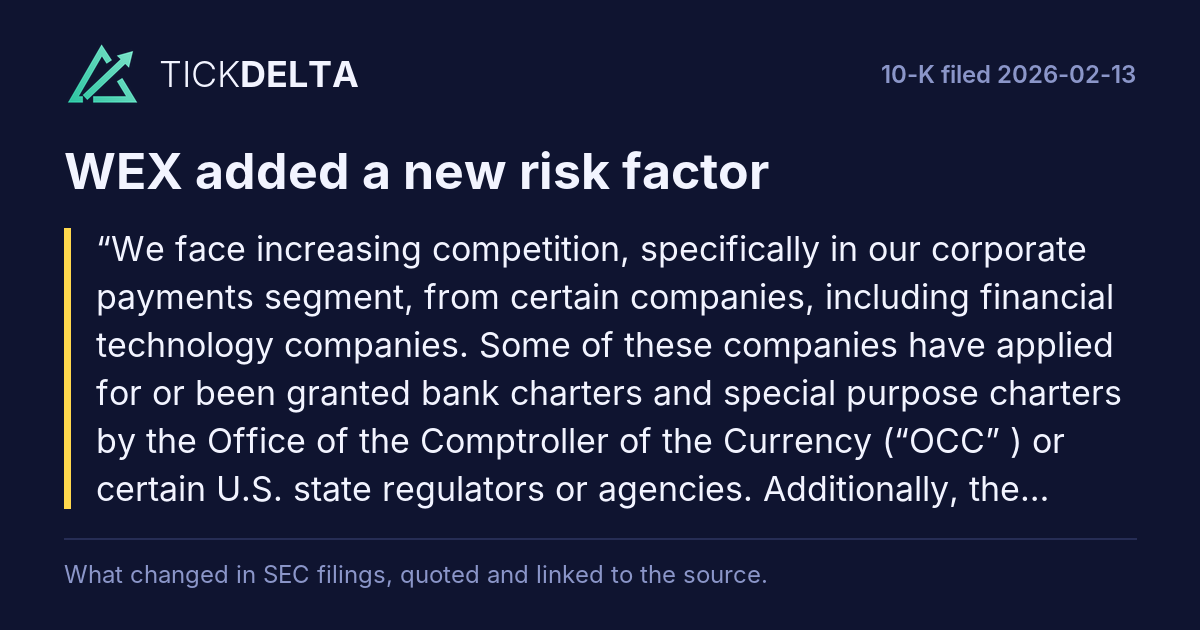
We face increasing competition, specifically in our corporate payments segment, from certain companies, including financial technology companies. Some of these companies have applied for or been granted bank charters and special purpose charters by the Office of the Comptroller of the Currency (“OCC” ) or certain U.S. state regulators or agencies. Additionally, the Federal Reserve has introduced a proposal that would enable many of these same institutions to directly facilitate clearing and settlement activities for their own payment transactions with the Federal Reserve Banks through the granting of access to certain specified accounts. If the proposal moves forward or the OCC and such federal and state regulators or agencies continue to grant bank charters to such applicants, which may include current or potential customers of ours, recipients of such accounts or charters may enter or increase their offerings in the corporate payments market, which could increase the competition that we face and reduce our competitive advantage. Accordingly, we are subject to risks related to price-based competition, loss of income, margin compression, and loss of deposits related to our corporate payments business. For more information, please see Part I – Item 1A – Risk Factors – “The loss or suspension of WEX Bank's industrial loan company charter or changes in applicable regulatory requirements could be disruptive to certain of our operations, increase costs and increase competition.”
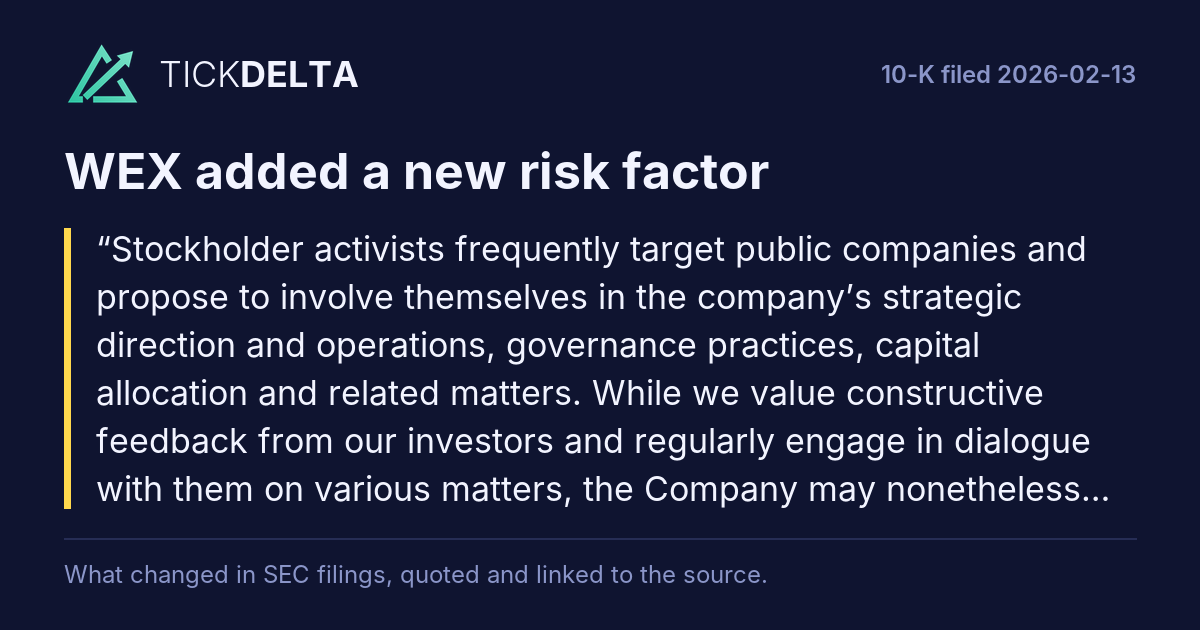
Stockholder activists frequently target public companies and propose to involve themselves in the company’s strategic direction and operations, governance practices, capital allocation and related matters. While we value constructive feedback from our investors and regularly engage in dialogue with them on various matters, the Company may nonetheless be subject to actions or proposals from activist stockholders that may not align with our business strategies or the interests of our other stockholders.
On February 9, 2026, Impactive Capital, an activist hedge fund, delivered a letter to the Company nominating four candidates for election to our board of directors at the Company’s upcoming 2026 Annual Meeting of Stockholders. Responding to this proxy contest and other actions by Impactive Capital, or other activist stockholders, may disrupt our business, cause us to incur substantial costs, and divert the attention of management and employees. For example, we have engaged legal, financial, and communications advisors to assist in responding to the proxy contest, and these costs may adversely impact our financial results.
In addition, any perceived uncertainties as to our future direction resulting from such a situation could result in the loss of potential business opportunities, cause concern to our current or potential customers, and make it more difficult to attract and retain qualified personnel and business partners, any of which could negatively impact our business. The actions of activist stockholders may also cause significant fluctuations in our stock price based on temporary or speculative market perceptions or other factors that do not necessarily reflect the underlying fundamentals of our business. We cannot predict the outcome or timing of any matters relating to the proxy contest or the ultimate impact that such matters may have on our business, liquidity, financial condition, or results of operations.
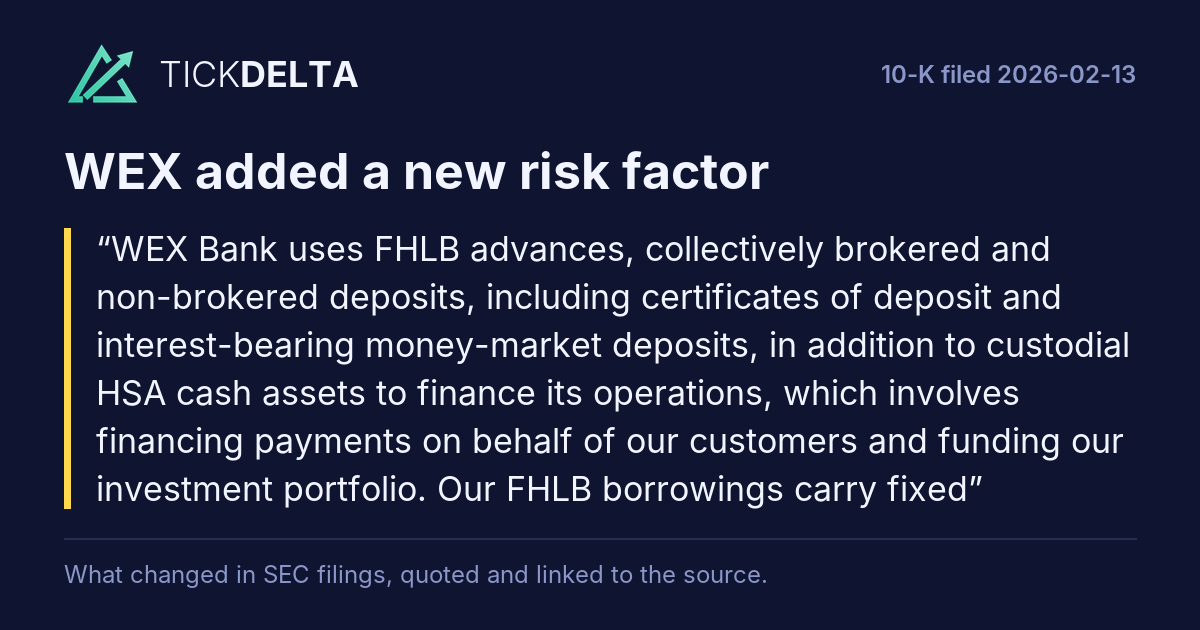
WEX Bank uses FHLB advances, collectively brokered and non-brokered deposits, including certificates of deposit and interest-bearing money-market deposits, in addition to custodial HSA cash assets to finance its operations, which involves financing payments on behalf of our customers and funding our investment portfolio. Our FHLB borrowings carry fixed
•increase our interest expense materially, if interest rates rise as debt under the Credit Agreement bears interest at variable rates;
events of default that if breached could allow the requisite noteholders to accelerate the maturity of the Senior Notes, and to exercise their rights and remedies under the Indenture, and could also trigger a cross-default under the Credit Agreement.
Moreover, AI is subject to rapidly evolving domestic and international laws and regulations, which could impose significant costs and obligations on us. In the United States, federal lawmakers are considering legislation that could restrict the development and use of AI, although it remains unclear whether such proposals will become law. Multiple states have already enacted and are considering additional measures governing areas such as model transparency and disclosures,
safety testing and risk management, data protection, automated decision-making and labeling of generative AI content, compliance with which may require increased technical and personnel resources and be costly. Federal and state agencies have also issued guidance and initiated rulemakings. Given our global operations, comparable non-U.S. regimes also remain relevant, including the European Union Artificial Intelligence Act, which applies to companies that develop, use, or provide AI in the EU and imposes requirements around transparency, conformity assessments and monitoring, risk assessments, human oversight, security, accuracy, general purpose AI, and foundation models and the United Kingdom’s regulator-led framework. Additionally, existing laws and regulations could be interpreted in ways that would affect our use of AI and our AI offerings. We also expect that regulators may continue to apply existing consumer protection and other laws to the development and deployment of AI. Moreover, AI usage is the subject of evolving review by various U.S. regulatory agencies, including the SEC and the U.S. Federal Trade Commission, and state regulatory agencies and attorneys general. It is possible that governments may also seek to regulate, limit, or block the use of AI in our products and services or otherwise impose other restrictions that may hinder the usability or effectiveness of our products and services. Any failure to accurately identify and address our responsibilities in this uncertain environment, and adequately address relevant ethical and social issues that may arise with AI technologies and use cases could negatively affect the adoption of our products and services and subject us to reputational harm, regulatory action, or litigation, which may harm our financial condition and operating results.
Paragraphs in the 10-Q filed Oct 29, 2026 that were not in the one before
New in the latest 10-Q
16 paragraphs in the 10-Q filed Oct 29, 2026 with nothing like them in the 10-Q filed Jul 23, 2026 (at least half the words must differ; new numbers alone do not count). Quoted exactly, grouped by the item heading above them. This is text that changed, not a judgement of how serious it is.
Financial statements and notes
(1) The significant expense categories and amounts align with the segment-level information that is regularly provided to the CODM.
Read in the 10-Q
Three Months Ended September 30, Increase Nine Months Ended September 30, Increase
Read in the 10-Q
During both the three and nine months ended September 30, 2026, other operating expenses were impacted by higher stock-based compensation, driven by an increase in estimated attainments, primarily as a result of the higher domestic fuel prices’ impact on our performance-based awards.
Read in the 10-Q
HSA custodial investment revenue earned from custodial deposits held at third-party banks is reflected within account servicing revenues while the revenue earned on invested HSA deposits held by WEX Bank are reflected within other revenues. Despite the overall increase in total custodial investment revenue, total account servicing revenue decreased due to a shift to other revenues driven by lower HSA deposits held by third-party depository banks as a result of these deposits being transferred to WEX Bank, which typically earns higher yields.
Read in the 10-Q
During the three and nine months ended September 30, 2026, there were instances in which certain expenses did not remain comparable to those of the same periods of the prior year, which are described hereafter.
Read in the 10-Q
Show the other 11
Service fees decreased in both the three and nine-month periods ended September 30, 2026 due substantially to cost savings resulting from transitioning payment processing in-house from a third-party vendor and the renegotiation of bank fees, which contributed to near equal reductions in expense.
Read in the 10-Q
During the three and nine months ended September 30, 2026, the provision for credit losses primarily decreased as a result of lower collection risk in the receivables portfolio, primarily due to an improvement in the aging of segment receivables.
Read in the 10-Q
In addition to evaluating the Company’s liquidity on a GAAP basis, Company management uses adjusted free cash flow, a non-GAAP financial measure, to evaluate cash generation by adjusting for certain activities including those related to WEX Bank. For example, WEX Bank funds certain customer receivables through the issuance of deposits, short-term debt or the HSA deposits provided by our Benefits segment. WEX Bank can also elect to invest HSA deposits. Changes in deposits, short-term debt and investment activity are reflected in the calculation of adjusted free cash flow.
Read in the 10-Q
We view adjusted free cash flow as an important and useful measure for understanding our cash generation from ongoing operations in order to determine the amount of cash generated that is available to be used toward management’s capital allocation priorities. Adjusted free cash flow, however, is not a measure of cash available for discretionary expenditures, as WEX has certain non-discretionary obligations and cash requirements, such as debt service requirements, that are not deducted from this measure.
Read in the 10-Q
• Net sales and maturities or purchases of current investment securities relates to the investment of HSA deposits, which are obtained operationally and included within Net Funding Activity described below;
Read in the 10-Q
• Capital expenditures are investments in property, equipment and capitalized software required to operate the business;
Read in the 10-Q
• To reflect cash generated by core operations, adjusted free cash flow incorporates Net Funding Activity, which includes changes in HSA deposits invested in debt securities and changes in deposits and short-term debt used specifically as part of our accounts receivable financing strategy. Because these funding activities directly support operations, incorporating them provides a view into underlying cash generation;
Read in the 10-Q
• WEX Bank cash, which comprises the majority of our consolidated cash balances, may be increased or decreased as a result of the timing of Net Funding Activity and regulatory capital requirements, rather than Company operating activities. Accordingly, we remove the change in WEX Bank cash balances from adjusted free cash flow, to isolate balances not readily available to WEX Inc.; and
Read in the 10-Q
• Management views certain other adjustments, including add-backs to operating cash flows for contingent consideration paid to sellers for acquisitions, as cash expenditures not arising from the ongoing operations of the business, and therefore excludes them from adjusted free cash flow.
Read in the 10-Q
Controls and procedures
Based on their evaluation, the principal executive officer and principal financial officer of WEX Inc. concluded that the Company’s disclosure controls and procedures were effective as of September 30, 2026.
Read in the 10-Q
Other information
(1) This number includes (i) up to 2,801 shares of common stock subject to RSUs previously granted to Ms. Kimball (the “RSU Shares”) that vest on December 16, 2026, March 15, 2027, March 16, 2027 and March 17, 2027, (ii) up to 1,809 shares of common stock subject to PSUs (based on target performance) previously granted to Ms. Kimball on March 15, 2024 (the “PSU Shares”) with a performance end date on March 15, 2027 and (iii) up to 793 shares of common stock subject to MSUs (based on target performance) previously granted to Ms. Kimball on March 15, 2024, March 17, 2025 and March 16, 2026 (the “MSU Shares”) with performance end dates on March 15, 2027, March 17, 2027 and March 16, 2027, respectively. The aggregate number of RSU, PSU and MSU Shares available to be sold is not yet determinable as the PSU and MSU Shares will be impacted by their future attainment and the RSU, PSU and MSU Shares will be net of shares sold to satisfy tax withholding obligations that arise in connection with the vesting and settlement of such RSU, PSU and MSU awards.
Read in the 10-Q
The 10-Q's risk factors against the 10-K
Item 1A of the 10-Q filed Oct 29, 2026 against Item 1A of the 10-K filed Feb 13, 2026.
A 10-Q repeats only the risks that changed, so a 10-K paragraph that is missing from it is not counted as removed.
Added is a paragraph with nothing like it in the 10-K, Reworded a sentence that is in both with several words changed,
Quiet changes a sentence in both where one to four words changed and one is a hedge or a modal
(cut words struck through, new words highlighted).
Text on the page, not a score; each links to the filing at sec.gov.
Phrases used for the first time
Two-word phrases in Risk Factors of the 10-K filed Feb 13, 2026 that are in none of the 1 earlier 10-Ks stored, back to Feb 20, 2025
Where each one is used
- venezuela europe: •geo-political conditions, including revolution, insurgency, environmental activism, terrorism, war or international conflicts, such as, the ongoing conflicts and instability in Venezuela, Europe and the Middle East;
- international conflicts: •geo-political conditions, including revolution, insurgency, environmental activism, terrorism, war or international conflicts, such as, the ongoing conflicts and instability in Venezuela, Europe and the Middle East;
- climate-related disclosure: In addition to its impact on the price of fuel, the market demand for and supply of fuel and other vehicle products and services may affect the number of transactions or the volume of fuel sold. Fewer gallons sold equates to a lower total purchase price of fuel on which our negotiated percentage revenue is...
- scheme networks: Under certain agreements we receive cash and other incentives in some of our business areas from scheme networks, including Mastercard and Visa. If we stop receiving such incentives as a result of these agreements being terminated or not being renewed on favorable terms or if the scheme networks provide these...
- stop receiving: •If we stop receiving incentives from Mastercard or Visa or are unable to meet our transaction volume commitments with them our profitability could be adversely impacted.
- experience credit: •We have experienced and may in the future experience credit and fraud losses and other adverse effects.
- long-lived assets: •We have incurred, and may incur in the future, impairment charges on goodwill or other long-lived assets.
- heightened international: •general local, regional, or worldwide economic conditions, including heightened international trade tensions;
Used at least twice, small words left out. Counted, not picked: a phrase can be new because the company renamed something.
What was taken out
21 paragraphs of last year's Risk Factors with nothing like them now. The longest are quoted.
Sources
Item 1A of each 10-K and 10-Q on EDGAR, quoted exactly. Each paragraph links to the filing at sec.gov.
Also
10-K change: what was reworded or cut, section by section.
Work with it
Excel workbook · CSV. Google Sheet that stays up to date: paste =IMPORTDATA("https://tickdelta.com/company/WEX/export.csv") into a cell.