Added10-Q 2026-11-02 vs 10-K 2026-02-24
Item 2. Unregistered Sales of Equity Securities, Use of Proceeds, and Issuer Purchases of Equity Securities
Tickdelta is free for now. Sign up and get Pro free
1 paragraph in Risk Factors of the 10-K filed Feb 24, 2026 with nothing like it in the 10-K filed Feb 25, 2025. Quoted exactly. Paragraphs that were only edited are under 10-K change.
Compared with the Risk Factors in the latest 10-K of the other 19 Energy companies: a paragraph with at least half its words the same at another company is called similar, and the companies are listed under it. A paragraph most of them have is marked boilerplate. No line means no other company has one like it. This counts text; it does not say how serious a risk is.
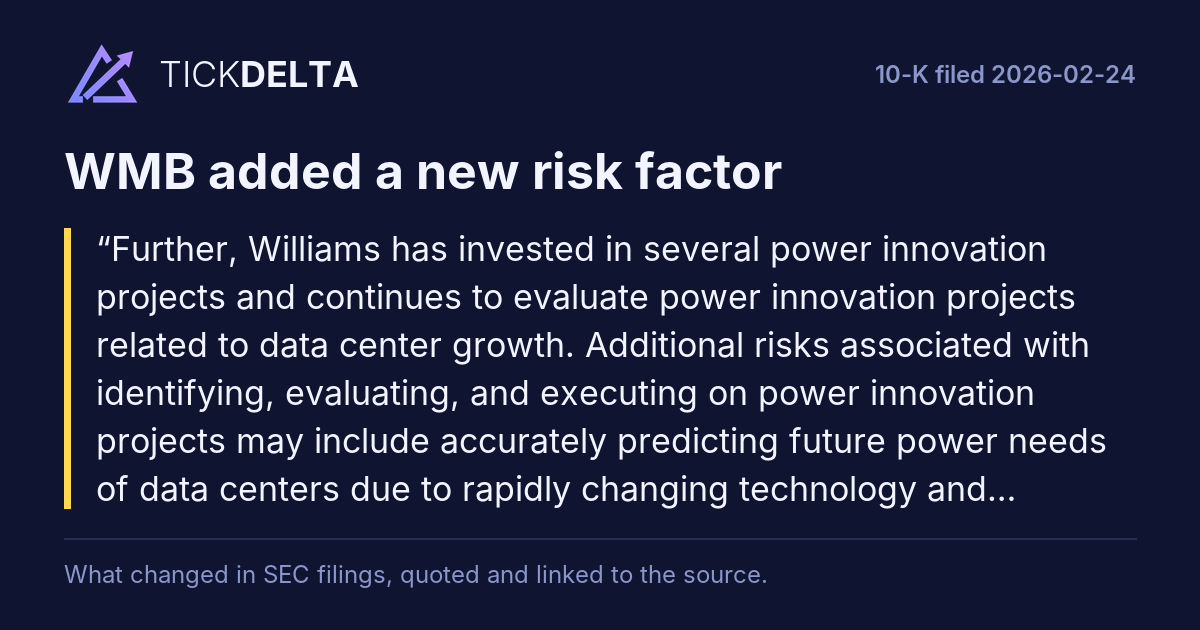
Further, Williams has invested in several power innovation projects and continues to evaluate power innovation projects related to data center growth. Additional risks associated with identifying, evaluating, and executing on power innovation projects may include accurately predicting future power needs of data centers due to rapidly changing technology and market dynamics, which could result in underutilized or stranded assets; managing the potential power demand; obtaining or constructing power generation sources, including sourcing turbines and batteries and maintaining other transmission capabilities to meet potential load growth from any data center customer; financing the capital investment needed to build and maintain the necessary infrastructure to support data center development; managing community opposition; managing the possible environmental impact of power innovation projects, and evaluating and complying with evolving regulations related to data center development. Risks associated with construction are similar to those described above for other capital projects, including obtaining long-lead specialized equipment and materials, such that projects are completed, on time or at all, and the risk that construction cost overruns, including due to inflation or the imposition of tariffs on foreign-made materials and goods necessary to conduct business, could cause total project costs to exceed budgeted costs. Williams’ behind the meter power generation projects require the constant, reliable production of electricity, which if not met, may result in contractual penalties and reputational damage, among other consequences. If realized, any of these risks could have an adverse impact on Williams’ financial condition, results of operations, including the possible impairment of assets, or cash flows.
Read in the 10-K ↗
43 paragraphs in the 10-Q filed Nov 2, 2026 with nothing like them in the 10-Q filed Aug 3, 2026 (at least half the words must differ; new numbers alone do not count). Quoted exactly, grouped by the item heading above them. This is text that changed, not a judgement of how serious it is.
Momentum Acquisition: On September 3, 2026, Williams closed on the acquisition of 100 percent of M6 Midstream LLC (Momentum), which owns midstream assets in the Haynesville Shale region.
Read in the 10-Q ↗
September 30, 2026. Included in this total are Williams’ investments in Louisiana LNG and Cogentrix (discussed below).
Read in the 10-Q ↗
On September 3, 2026, Williams closed on the acquisition of 100 percent of M6 Midstream LLC (Momentum), which owns gathering, processing, and transportation assets in the Haynesville Shale region (Momentum Acquisition). Total consideration for the acquisition was approximately $ 5.1 billion, including cash and approximately 27 million shares of Williams common stock valued based on the closing market price as of the transaction close date and subject to certain holding restrictions. Williams retained $ 869 million outstanding principal amount of long-term debt issued by New Generation Gas Gathering LLC (NG3), a partially-owned consolidated subsidiary of Momentum. Purchases of businesses, net of cash acquired in the Williams Consolidated Statement of Cash Flows includes $ 2.8 billion reflecting the cash purchase price, reduced for the cash acquired as presented in the purchase price allocation. The purpose of this acquisition was to strengthen Williams’ position in the Haynesville Shale region and advance its strategy to connect growing sources of natural gas production with expanding demand along the Gulf Coast. Assets acquired, acquisition-related costs incurred, and results of operations realized are included within Williams’ West segment.
Read in the 10-Q ↗
During the period from the acquisition date of September 3, 2026 to September 30, 2026, the operations acquired in the Momentum Acquisition contributed Revenues of $ 113 million and Modified EBITDA (as defined in Note 11 - Segment Disclosures) of $ 40 million.
Read in the 10-Q ↗
Acquisition-related costs for the Momentum Acquisition totaled $ 33 million and are included in General and administrative expenses.
Read in the 10-Q ↗
Williams accounted for the Momentum Acquisition as a business combination, which requires, among other things, that identifiable assets acquired and liabilities assumed be recognized at their acquisition date fair values.
Read in the 10-Q ↗
The following table presents the preliminary allocation of the acquisition date fair value of the major classes of the assets acquired and liabilities assumed at September 3, 2026. The fair value of accounts receivable acquired equals contractual amounts receivable. The allocation is considered preliminary because the valuation work has not
Read in the 10-Q ↗
been completed due to the ongoing review of the valuation results and validation of significant inputs and assumptions. Preliminary fair value measurements were made for certain acquired assets and liabilities, primarily property, plant, and equipment, which utilized the cost approach; intangible assets and noncontrolling interests, which utilized the income approach; and retained long-term debt, which utilized the market approach. However, adjustments to those measurements may be made in subsequent periods, up to one year from the acquisition date, as new information related to facts and circumstances as of the acquisition date may be identified.
Read in the 10-Q ↗
Other intangible assets recognized in the Momentum Acquisition are related to contractual customer relationships from agreements with customers under which Williams performs gas gathering and related services. The basis for determining the value of these intangible assets is estimated future net cash flows to be derived from acquired contractual customer relationships discounted using a risk-adjusted discount rate. These intangible assets are being amortized on a straight-line basis over a period of 20 years which represents the term over which the contractual customer relationships are expected to contribute to Williams’ cash flows. The majority of the expected future revenues from these contractual customer relationships are impacted by Williams’ ability and intent to renew or renegotiate existing customer contracts. Williams expenses costs incurred to renew or extend the terms of its gas gathering contracts with customers. Based on the estimated future revenues during the current contract periods (as estimated at the time of the acquisition), the weighted-average period prior to the next renewal or extension of the existing contractual customer relationships is approximately 9 years.
Read in the 10-Q ↗
The following pro forma Revenues and Net income (loss) attributable to The Williams Companies, Inc. for the three and nine months ended September 30, 2026 and 2025, respectively, are presented as if the Momentum Acquisition had been completed on January 1, 2025. These pro forma amounts are not necessarily indicative of what the actual results would have been if the acquisition had in fact occurred on the dates or for the periods indicated, nor do they purport to project Revenues or Net income (loss) attributable to The Williams Companies, Inc. for any future periods or as of any date. These amounts do not give effect to any potential cost savings, operating synergies, or revenue enhancements to result from the transaction or the potential costs to achieve these cost savings, operating synergies, and revenue enhancements.
Read in the 10-Q ↗
Three Months Ended September 30, 2026 As Reported Pro Forma Momentum (1) Pro Forma Combined ─────────────────────────────────────────────────────────────────────────────────────────────────────────────────────────────────────────────────────────────────────────────────────────────────── (Millions) Revenues $ 3,223 $ 351 $ 3,574 Net income (loss) attributable to The Williams Companies, Inc. 700 23 723 Three Months Ended September 30, 2025 As Reported Pro Forma Momentum Pro Forma Combined (Millions) Revenues $ 2,923 $ 327 $ 3,250 Net income (loss) attributable to The Williams Companies, Inc. 647 13 660 Nine Months Ended September 30, 2026 As Reported Pro Forma Momentum (1) Pro Forma Combined (Millions) Revenues $ 9,306 $ 1,293 $ 10,599 Net income (loss) attributable to The Williams Companies, Inc. 2,392 70 2,462 Nine Months Ended September 30, 2025 As Reported Pro Forma Momentum Pro Forma Combined (Millions) Revenues $ 8,752 $ 1,063 $ 9,815 Net income (loss) attributable to The Williams Companies, Inc. 1,884 7 1,891
Read in the 10-Q ↗
(1)Excludes results from operations acquired in the acquisition for the period beginning on the acquisition date, as these results are included in the amounts as reported.
Read in the 10-Q ↗
In connection with the Momentum Acquisition, Williams retained $ 869 million outstanding principal amount of secured variable rate debt due in 2029 (see Note 3 - Acquisitions and Divestitures).
Read in the 10-Q ↗
Williams is a lessor through certain power purchase agreements, whereby Williams provides power generation and pipeline capacity to a counterparty on a firm basis.
Read in the 10-Q ↗
In the third quarter of 2026, the Socrates South power generation facility was placed in service. The related power purchase agreement has an initial noncancellable term of 10 years with an option for the customer to extend the term by an additional five years.
Read in the 10-Q ↗
Williams determined that the agreement contains an operating lease. Judgment is used in determining whether the power purchase agreements contain leases and whether they are classified as operating, sales-type, or direct financing leases. Operating lease income is recognized within Service revenues in the Consolidated Statement of Income.
Read in the 10-Q ↗
Williams has elected the lessor practical expedient to not separate lease and qualifying nonlease components associated with the power purchase agreements. The qualifying nonlease components primarily consist of certain operating and maintenance services. Williams determined that the lease component is predominant and accounts for the combined components as an operating lease with the related income recognized on a straight-line basis over the lease term. Variable lease income primarily consists of usage-based charges for power generated and fuel used during the period and is recognized in the period earned.
Read in the 10-Q ↗
At September 30, 2026, the gross carrying amount of power generation facilities and associated gas pipeline infrastructure subject to operating leases was $ 1 billion.
Read in the 10-Q ↗
At September 30, 2026, future lease payments to be received under operating lease terms related to in-service power projects were as follows:
Read in the 10-Q ↗
Commitments for construction and acquisition of property, plant, and equipment for Williams are approximately $ 5.9 billion at September 30, 2026. A significant portion of the Williams commitment relates to acquisition of long-lead time equipment for power projects, which are backed by reimbursement from the power project customer if the equipment order is cancelled.
Read in the 10-Q ↗
• Higher shrink natural gas purchases and commodity consideration costs associated with Williams’ equity NGL production activities primarily at the West segment.
Read in the 10-Q ↗
Other operating (income) expense - net reflects the absence of the 2025 write-off of certain DJ Basin region assets in the West segment.
Read in the 10-Q ↗
The unfavorable change in Net income (loss) attributable to noncontrolling interests is primarily due to higher results at Pantheon.
Read in the 10-Q ↗
• Higher shrink natural gas purchases and commodity consideration costs associated with Williams’ equity NGL production activities primarily at the West segment.
Read in the 10-Q ↗
Other operating (income) expense - net reflects the absence of the 2025 write-off of certain DJ Basin region assets.
Read in the 10-Q ↗
Equity earnings (losses) changed favorably primarily due to an increase at Appalachia Midstream Investments.
Read in the 10-Q ↗
The unfavorable change in Net income (loss) attributable to noncontrolling interests is primarily due to higher results at the Northeast JV and Pantheon.
Read in the 10-Q ↗
• An unfavorable change related to certain asset retirements in the Gulf Coast region; partially offset by
Read in the 10-Q ↗
• An unfavorable change related to certain asset retirements in the Gulf Coast region; partially offset by
Read in the 10-Q ↗
Service revenues increased primarily due to lease revenues from certain corporate office properties.
Read in the 10-Q ↗
Net realized product sales from our upstream operations decreased primarily due to:
Read in the 10-Q ↗
Service revenues increased primarily due to lease revenues from certain corporate office properties.
Read in the 10-Q ↗
Net realized product sales from our upstream operations decreased primarily due to:
Read in the 10-Q ↗
Taxes, other than income taxes increased primarily due to higher property taxes related to new assets placed into service.
Read in the 10-Q ↗
In September 2026, Williams acquired Momentum for total consideration of approximately $5.1 billion, including cash, approximately 27 million shares of Williams common stock that is subject to certain holding restrictions, and retention of $869 million outstanding principal amount of Momentum long-term debt (see Note 3 - Acquisitions and Divestitures).
Read in the 10-Q ↗
Proceeds from sale of partial interest in consolidated subsidiary (Note 1) Financing 3,737 —
Read in the 10-Q ↗
Williams completed the Momentum Acquisition on September 3, 2026. Momentum’s total revenues constituted approximately 1 percent of total revenues as shown in Williams’ consolidated financial statements for the nine months ended September 30, 2026. Momentum’s total assets constituted approximately 9 percent of total assets as shown in Williams’ consolidated financial statements at September 30, 2026. Williams has excluded Momentum’s disclosure controls and procedures that are subsumed by their internal control over financial reporting from the scope of management’s assessment of the effectiveness of Williams’ disclosure controls and procedures. This exclusion is in accordance with the guidance issued by the Staff of the Securities and Exchange Commission that an assessment of recent business combinations may be omitted from management’s assessment of internal control over financial reporting for one year following the acquisition.
Read in the 10-Q ↗
On October 29, 2026, the Compensation and Management Development Committee (Committee) of the Board of Directors of The Williams Companies, Inc. (Company) approved a fully performance-based, one-time cash long-term incentive award (Five-Year Performance Award) for Chad Zamarin, President and Chief Executive Officer; Larry Larsen, Executive Vice President and Chief Operating Officer; John Porter, Executive Vice President and Chief Financial Officer; Rob Wingo, Executive Vice President, Corporate Strategic Development; and Lane Wilson, Senior Vice President and General Counsel. The Committee designed the Five-Year Performance Award to focus the executive team on achievement of the Company’s long-term growth and financial-strength objectives through 2030, while also supporting leadership continuity during this critical period of execution. The Five-Year Performance Award is separate from the Company’s regular annual cash incentive and long-term incentive programs and is intended to reinforce performance against distinct long-term objectives over a five-year period.
Read in the 10-Q ↗
The performance period for the Five-Year Performance Award is January 1, 2026 to December 31, 2030 and it will be earned only if the Company achieves two rigorous performance conditions: (i) a 10 percent compound annual growth rate in Adjusted EBITDA and (ii) a debt leverage ratio, measured as debt to Adjusted EBITDA as of December 31, 2030, that does not exceed 4.0x. If the debt leverage condition is satisfied, payout may range from target for a 10 percent Adjusted EBITDA compound annual growth rate to a maximum of 200 percent of target for a 16 percent Adjusted EBITDA compound annual growth rate, with payout levels between target and maximum determined by straight-line interpolation. There is no payout opportunity below target, and no amount will be earned unless both the Adjusted EBITDA growth and leverage conditions are satisfied.
Read in the 10-Q ↗
Following the performance period, the Committee will certify the level of achievement of the applicable performance conditions. Any earned Five-Year Performance Award will be paid in cash as soon as practicable after certification, but no later than March 15, 2031, subject to the applicable award agreement and The Williams Companies, Inc. 2007 Incentive Plan, including applicable continued-employment, forfeiture and clawback provisions.
Read in the 10-Q ↗
Generally, a participant must remain employed by the Company through the payment date to receive the Five-Year Performance Award. A pro-rated Five-Year Performance Award may be paid upon retirement, death, disability or a termination of employment in connection with the sale of a business. The Five-Year Performance Award will be paid at target if either (i) the participant experiences a qualifying termination within two years following a change in control or (ii) the Five-Year Performance Award is not assumed or substantially replaced by a successor. The Five-Year Performance Award will be forfeited upon any voluntary termination, excluding retirement, and upon any involuntary termination, including for cause, performance, reduction in force or position elimination.
Read in the 10-Q ↗
The target and maximum Five-Year Performance Award values for each named executive officer are as follows:
Read in the 10-Q ↗
10.1§* The Williams Companies, Inc. 2007 Incentive Plan as amended and restated effective July 29, 2026.
Read in the 10-Q ↗
Item 1A of the 10-Q filed Nov 2, 2026 against Item 1A of the 10-K filed Feb 24, 2026.
A 10-Q repeats only the risks that changed, so a 10-K paragraph that is missing from it is not counted as removed.
Added is a paragraph with nothing like it in the 10-K, Reworded a sentence that is in both with several words changed,
Quiet changes a sentence in both where one to four words changed and one is a hedge or a modal
(cut words struck through, new words highlighted and underlined).
Text on the page, not a score; each links to the filing at sec.gov.
What the 10-Q itself says about its risk factors:
Read in the 10-Q ↗
Part I, Item 1A. Risk Factors in the Annual Report on Form 10-K for the year ended December 31, 2025, as filed with the SEC on February 24, 2026, includes risk factors that could materially affect Williams’, Transco’s, and NWP’s businesses, financial condition, or future results. Those Risk Factors have not materially changed.
Work on WMB in a spreadsheet:
Excel workbook (a sheet per section, ten years by column, charts, links to the filings) ·
CSV.
For a Google Sheet that stays up to date, paste =IMPORTDATA("https://tickdelta.com/company/WMB/export.csv") into a cell.