Warby Parker Inc. WRBY
New risk paragraphs, branching off last year
Each branch is a paragraph in Risk Factors with nothing like it in the 10-K filed Feb 27, 2025. A box jumps to the paragraph as filed, below.
Paragraphs with nothing like them in last year's 10-K
17 paragraphs in Risk Factors of the 10-K filed Feb 26, 2026 with nothing like them in the 10-K filed Feb 27, 2025. Quoted exactly. Paragraphs that were only edited are under 10-K change.
economic conditions and global events, such as geopolitical conflicts, natural disasters, or public health crises, may disrupt our supply chain, potentially preventing us from procuring timely deliveries or securing comparable alternatives at acceptable prices.
Our use of artificial intelligence may result in operational disruptions, reputational harm, competitive challenges, regulatory scrutiny, liability, or security risks that could adversely affect our business, financial condition, and results of operations.
• invest in new products, such as the AI-powered smart glasses the Company is developing with Google;
Our success will depend, in part, on our ability to expand our services and grow our business in response to changing technologies, customer demands, and competitive pressures. We have and may continue to expand our services and grow our business by entering into partnerships or alliances with third parties. For example, we have recently partnered with Target Corporation to open shop-in-shop stores within select Target locations, and we are partnering with Google and Samsung to develop AI-powered smart glasses. Certain of our partnerships are, and may in the future be, with partners that have significant size, scale, geographic, and other advantages over us. As a result, certain of the terms in such partnerships may be less favorable to us compared to partnerships with other parties. Any of our partnerships may not lead to the business, growth, and financial outcomes that we expect, may raise new obligations and challenges, may divert the attention of management, and may also result in higher costs for us or other negative impacts to our business, operations, regulatory posture, or strategy, which we may not anticipate or currently project, that result in a material adverse effect to our business, financial condition, and results of operations. These partnerships can require several agreements to be entered into over time following the initial partnership agreement. In addition, these partnerships may span multiple years and may require significant upfront costs. As a result, we may not be able to accurately assess the success of these partnerships for several periods and only after we have made substantial
investments and expenditures. If any partnership results in future material adverse effects to our business, financial condition, and results of operations, we may not be able to terminate such partnership on a timely or cost-effective basis and termination may result in loss of certain rights related to the partnership and the products or services subject to the partnership. If any such partnerships are terminated or any of our partners refuse to renew their agreements with us on commercially reasonable terms, we may not be able to secure similar terms or replace such partners in an acceptable time frame. Additionally, certain of our partnerships depend or may in the future depend on the achievement of certain milestones. We may not achieve such milestones, which would impact our ability to realize some or all of the benefits of such partnerships.
campaigns and litigation, to advance their perspectives. To the extent we are subject to such activism, it may require us to incur costs or otherwise adversely impact our business.
Show the other 9
private rights of action to individuals who believe their personal information has been misused, such as the CCPA.
example, we have registrations in a number of foreign countries in which we are not currently offering products or services, and those registrations could be subject to invalidation proceedings if we cannot demonstrate use of the marks by the applicable use deadlines in those countries.
We use third-party open-source software in connection with the development and deployment of our software applications. From time to time, companies that use third-party open-source software have faced claims challenging the use of such open-source software and their compliance with the terms of the applicable open-
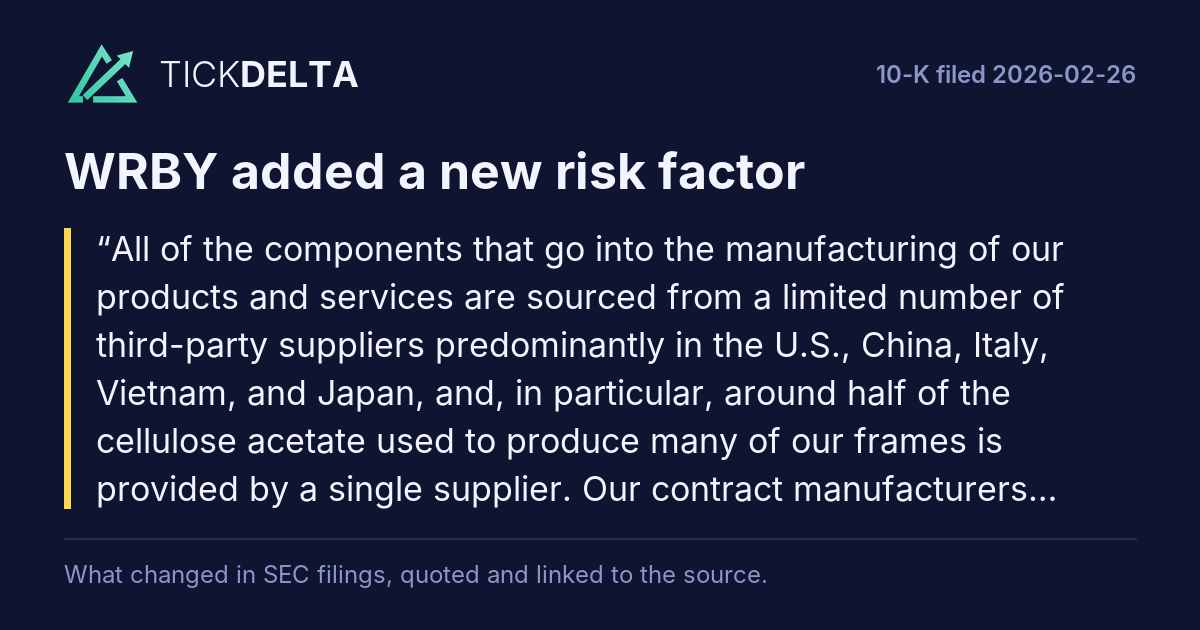
All of the components that go into the manufacturing of our products and services are sourced from a limited number of third-party suppliers predominantly in the U.S., China, Italy, Vietnam, and Japan, and, in particular, around half of the cellulose acetate used to produce many of our frames is provided by a single supplier. Our contract manufacturers purchase many of these components on our behalf. For our business to be successful, our suppliers must be willing and able to provide us with inputs in substantial quantities, in compliance with
lengthy interruptions to our business. All of the aforementioned risks may be exacerbated if our business continuity and disaster recovery plans prove to be inadequate.
changes may materially and adversely impact our business, financial condition, results of operations, and cash flows.
• rumors and market speculation involving us or other companies in our industry;
trading and register shares of Class C common stock for sale in the future. In addition, if we issue shares of Class C common stock in the future, such issuances would have a dilutive effect on the economic interests of our Class A common stock and Class B common stock.
We cannot guarantee that our share repurchase program will be fully implemented or that such program will enhance the long-term value of the share price of our Class A common stock.
In February 2026, our Board of Directors authorized a share repurchase program to purchase up to $100.0 million of our Class A common stock (the “Share Repurchase Program”). Repurchases under the Share Repurchase Program may be made in the open market, in privately negotiated transactions, or otherwise, with the amount and timing of repurchases to be determined at the Company’s discretion, depending on market conditions and corporate needs. Open market repurchases will be structured to occur in accordance with applicable federal securities laws, including within the pricing and volume requirements of Rule 10b-18 under the Securities Exchange Act of 1934, as amended. The Company may also, from time to time, enter into Rule 10b5-1 plans to facilitate repurchases of its shares under this authorization. The Share Repurchase Program does not have a fixed expiration date, does not obligate the Company to acquire any particular amount of Class A common stock, and may be modified, suspended, or terminated at any time at the discretion of the Company’s Board of Directors.
The existence of the Share Repurchase Program could affect the price of our stock and could potentially reduce the market liquidity for our stock. Although the Share Repurchase Program is intended to enhance long-term stockholder value, there is no assurance that it will do so because the market price of our Class A common stock may decline below the levels at which we repurchase shares, and short-term stock price fluctuations could reduce the effectiveness of the program. Repurchasing our Class A common stock reduces the amount of cash we have available to fund working capital, capital expenditures, strategic acquisitions or investments, other business opportunities, and other general corporate projects, and we may fail to realize the anticipated long-term stockholder value of any share repurchase program.
Paragraphs in the 10-Q filed Nov 5, 2026 that were not in the one before
New in the latest 10-Q
4 paragraphs in the 10-Q filed Nov 5, 2026 with nothing like them in the 10-Q filed Aug 6, 2026 (at least half the words must differ; new numbers alone do not count). Quoted exactly, grouped by the item heading above them. This is text that changed, not a judgement of how serious it is.
Financial statements and notes
In October 2026, the Company invested $ 5.6 million in a private optical lens technology company in exchange for shares of its preferred stock. Concurrently, the Company entered into a commercial agreement with the optical lens technology company pursuant to which the Company committed to funding a total of $ 5.6 million over approximately 24 months towards various research and development programs for new lenses and lens technology.
Read in the 10-Q
In October 2026, the Company invested $5.6 million in a private optical lens technology company in exchange for shares of its preferred stock. Concurrently, the Company entered into a commercial agreement with the optical lens technology company pursuant to which the Company committed to funding a total of $5.6 million over approximately 24 months towards various research and development programs for new lenses and lens technology.
Read in the 10-Q
Other information
On August 18, 2026, Neil Blumenthal, our Co-Chief Executive Officer and director, adopted a Rule 10b5-1 trading arrangement intended to satisfy the affirmative defense of Rule 10b5-1(c) providing for the sale of up to an aggregate of 750,000 shares of our Class A common stock. The trading arrangement will expire on June 30, 2027 or earlier if all transactions under the trading arrangement are completed.
Read in the 10-Q
On August 19, 2026, Dave Gilboa, our Co-Chief Executive Officer and director, adopted a Rule 10b5-1 trading arrangement intended to satisfy the affirmative defense of Rule 10b5-1(c) providing for the sale of up to an aggregate of 2,064,191 shares of our Class A common stock. The trading arrangement will expire on June 30, 2027 or earlier if all transactions under the trading arrangement are completed.
Read in the 10-Q
The 10-Q's risk factors against the 10-K
Item 1A of the 10-Q filed Nov 5, 2026 against Item 1A of the 10-K filed Feb 26, 2026.
A 10-Q repeats only the risks that changed, so a 10-K paragraph that is missing from it is not counted as removed.
Added is a paragraph with nothing like it in the 10-K, Reworded a sentence that is in both with several words changed,
Quiet changes a sentence in both where one to four words changed and one is a hedge or a modal
(cut words struck through, new words highlighted).
Text on the page, not a score; each links to the filing at sec.gov.
Phrases used for the first time
Two-word phrases in Risk Factors of the 10-K filed Feb 26, 2026 that are in none of the 1 earlier 10-Ks stored, back to Feb 27, 2025
Where each one is used
- share repurchase: We cannot guarantee that our share repurchase program will be fully implemented or that such program will enhance the long-term value of the share price of our Class A common stock.
- repurchase program: We cannot guarantee that our share repurchase program will be fully implemented or that such program will enhance the long-term value of the share price of our Class A common stock.
- ai-powered smart: We use AI for certain business purposes, including the automation of certain tasks, predicting market trends, improving our customer experience, and deploying certain customer facing applications. We are also developing products and services that integrate AI, such as the AI-powered smart glasses we are developing...
- smart glasses: We use AI for certain business purposes, including the automation of certain tasks, predicting market trends, improving our customer experience, and deploying certain customer facing applications. We are also developing products and services that integrate AI, such as the AI-powered smart glasses we are developing...
- health crises: economic conditions and global events, such as geopolitical conflicts, natural disasters, or public health crises, may disrupt our supply chain, potentially preventing us from procuring timely deliveries or securing comparable alternatives at acceptable prices.
- quality management: In the United States, the methods used in, and the facilities used for, the manufacture of medical devices must comply with the FDA’s design control requirements and current Good Manufacturing Practices for medical devices, known as the Quality Management System Regulation, or QMSR, which is a complex regulatory...
- management system: In the United States, the methods used in, and the facilities used for, the manufacture of medical devices must comply with the FDA’s design control requirements and current Good Manufacturing Practices for medical devices, known as the Quality Management System Regulation, or QMSR, which is a complex regulatory...
- particular around: All of the components that go into the manufacturing of our products and services are sourced from a limited number of third-party suppliers predominantly in the U.S., China, Italy, Vietnam, and Japan, and, in particular, around half of the cellulose acetate used to produce many of our frames is provided by a...
Used at least twice, small words left out. Counted, not picked: a phrase can be new because the company renamed something.
What was taken out
49 paragraphs of last year's Risk Factors with nothing like them now. The longest are quoted.
Sources
Item 1A of each 10-K and 10-Q on EDGAR, quoted exactly. Each paragraph links to the filing at sec.gov.
Also
10-K change: what was reworded or cut, section by section.
Work with it
Excel workbook · CSV. Google Sheet that stays up to date: paste =IMPORTDATA("https://tickdelta.com/company/WRBY/export.csv") into a cell.