Wsfs Financial Corp WSFS
New risk paragraphs, branching off last year
Each branch is a paragraph in Risk Factors with nothing like it in the 10-K filed Feb 28, 2025. A box jumps to the paragraph as filed, below.
Paragraphs with nothing like them in last year's 10-K
4 paragraphs in Risk Factors of the 10-K filed Mar 2, 2026 with nothing like them in the 10-K filed Feb 28, 2025. Quoted exactly. Paragraphs that were only edited are under 10-K change.
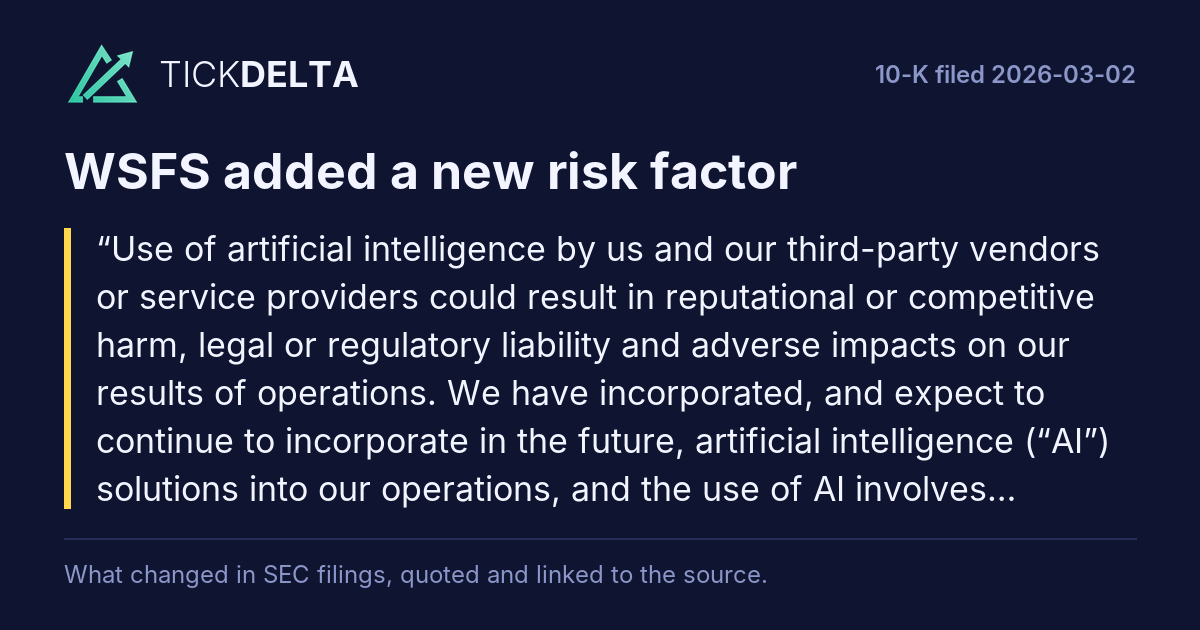
Use of artificial intelligence by us and our third-party vendors or service providers could result in reputational or competitive harm, legal or regulatory liability and adverse impacts on our results of operations.
We have incorporated, and expect to continue to incorporate in the future, artificial intelligence (“AI”) solutions into our operations, and the use of AI involves various risks and challenges that could adversely affect our business, financial condition or results of operations. In addition, we expect our third-party vendors and service providers to increasingly develop and incorporate AI into their product offerings. The use, development and deployment of AI systems or the AI systems of third-party AI vendors involve inherent technical complexities and uncertainties, and these AI systems may encounter unexpected technical difficulties, limitations or errors, including inaccuracies in data processing or flawed algorithms, which could compromise the reliability and effectiveness of our products and services based on AI. In addition, our competitors or other third parties may incorporate AI into their products more quickly or more successfully than us, which could impair our ability to compete effectively.
The use of AI applications, including large language models, has resulted in, and may in the future result in, cybersecurity vulnerabilities or incidents that implicate the personal information, intellectual property, proprietary data or other sensitive information of end users of such applications. Any such cybersecurity incidents related to our use of AI applications could adversely affect our reputation and results of operations. AI also presents emerging ethical issues, and if our use of AI becomes controversial, we may experience brand or reputational harm, competitive harm, regulatory scrutiny or legal liability.
The increased adoption of AI technologies in our products and services may result in new or enhanced governmental or regulatory scrutiny, litigation, confidentiality or security risks or other complications that could adversely affect our business, reputation or financial results. The regulatory landscape governing AI technologies is evolving rapidly, and various jurisdictions, including Europe and certain U.S. states, have proposed or already adopted laws governing the use, development and deployment of AI technologies. Changes in laws, regulations or enforcement practices may impose new compliance requirements, restrict certain AI applications or increase our regulatory obligations, which could negatively impact our business and results of operations.
Paragraphs in the 10-Q filed Nov 3, 2026 that were not in the one before
New in the latest 10-Q
6 paragraphs in the 10-Q filed Nov 3, 2026 with nothing like them in the 10-Q filed Aug 5, 2026 (at least half the words must differ; new numbers alone do not count). Quoted exactly, grouped by the item heading above them. This is text that changed, not a judgement of how serious it is.
10-Q
▪ WSFS Institutional Services® fees increased 45%, BMT-DE increased 22%, and Private Wealth Management increased 14%.
Read in the 10-Q
• Loans, held for sale decreased $40.2 million due to the retention of originated mortgage and SBA loans.
Read in the 10-Q
All savings associations and banks are subject to the Community Reinvestment Act (CRA), which requires federal banking regulators to use their supervisory authority to encourage such institutions to help meet the credit needs of the communities within the institution’s assessment area. The CRA does not impose specific lending requirements, and it does not contemplate that a savings association or bank would take any action inconsistent with safety and soundness. The federal banking agencies evaluate the performance of each of their regulated institutions periodically. Evaluations that result in a conclusion of “Needs to Improve” or “Substantial Non-Compliance” may block or impede regulatory approvals for other actions by an institution.
Read in the 10-Q
The Bank received a rating of “Satisfactory” in its most recent performance evaluation.
Read in the 10-Q
On October 24, 2023, the Federal Reserve, FDIC, and OCC issued a final rule revising their framework for evaluating banks’ records of community reinvestment under the CRA. Under the revised framework, banks with assets of at least $2 billion, such as the Bank, are considered large banks and their retail lending, retail services and products, community development financing, and community development services will be subject to periodic evaluation. Depending on a large bank’s geographic distribution of lending, the evaluation of retail lending may include assessment areas in which the bank extends loans but does not operate any deposit-taking facilities, in addition to assessment areas in which the bank has deposit taking facilities. Industry organizations have challenged the final rule in court, and on March 29, 2024, the United States District Court for the Northern District of Texas granted an injunction and stay of the final rule. On July 16, 2025, the Federal Reserve, FDIC, and OCC issued a notice of proposed rulemaking to rescind the October 24, 2023 final rule implementing the CRA and to replace it with the prior CRA regulations that were originally adopted by the agencies in 1995, with certain amendments. On July 1, 2026, the OCC and FDIC filed an unopposed motion to dismiss their appeal of the District Court’s injunction against their 2023 CRA
Read in the 10-Q
Show the other 1
rules. That motion was granted, and the agencies’ appeal was dismissed on July 9, 2026. On July 31, 2026, the OCC and FDIC issued a notice of proposed rulemaking to amend the CRA rules, proposing targeted revisions to the current rules that leaves in place much of the framework that has existed since 1995.
Read in the 10-Q
The 10-Q's risk factors against the 10-K
Item 1A of the 10-Q filed Nov 3, 2026 against Item 1A of the 10-K filed Mar 2, 2026.
A 10-Q repeats only the risks that changed, so a 10-K paragraph that is missing from it is not counted as removed.
Added is a paragraph with nothing like it in the 10-K, Reworded a sentence that is in both with several words changed,
Quiet changes a sentence in both where one to four words changed and one is a hedge or a modal
(cut words struck through, new words highlighted).
Text on the page, not a score; each links to the filing at sec.gov.
What the 10-Q itself says about its risk factors:There have not been any material changes to the risk factors previously disclosed under Item 1A of the Company’s Annual Report on Form 10-K for the year ended December 31, 2025.
Read in the 10-Q
1 paragraph in the 10-Q's Item 1A, and none of them adds, rewords or quietly edits a paragraph of the 10-K's.
Phrases used for the first time
Two-word phrases in Risk Factors of the 10-K filed Mar 2, 2026 that are in none of the 1 earlier 10-Ks stored, back to Feb 28, 2025
Where each one is used
- trust segment: •Decreases in our Wealth and Trust segment's AUM portfolios as a result of, among other things, decreases in market value from investment performance losses and Clients' increased financial needs;
- federal consumer: We are subject to extensive federal and state regulation, supervision and examination governing almost all aspects of our operations. The Federal Reserve is the primary federal regulator for the Company, the OCC is the Bank’s primary regulator and the CFPB regulates the Bank’s compliance with a defined category of...
- artificial intelligence: Use of artificial intelligence by us and our third-party vendors or service providers could result in reputational or competitive harm, legal or regulatory liability and adverse impacts on our results of operations.
- competitive harm: Use of artificial intelligence by us and our third-party vendors or service providers could result in reputational or competitive harm, legal or regulatory liability and adverse impacts on our results of operations.
Used at least twice, small words left out. Counted, not picked: a phrase can be new because the company renamed something.
Sources
Item 1A of each 10-K and 10-Q on EDGAR, quoted exactly. Each paragraph links to the filing at sec.gov.
Also
10-K change: what was reworded or cut, section by section.
Work with it
Excel workbook · CSV. Google Sheet that stays up to date: paste =IMPORTDATA("https://tickdelta.com/company/WSFS/export.csv") into a cell.