Zoom Communications, Inc. ZM
New risk paragraphs, branching off last year
Each branch is a paragraph in Risk Factors with nothing like it in the 10-K filed Feb 28, 2025. A box jumps to the paragraph as filed, below.
Paragraphs with nothing like them in last year's 10-K
11 paragraphs in Risk Factors of the 10-K filed Feb 27, 2026 with nothing like them in the 10-K filed Feb 28, 2025. Quoted exactly. Paragraphs that were only edited are under 10-K change.
•Contact Center providers, including Five9, Inc., Genesys, and NICE inContact; and
customers a free period of time at the beginning of the subscription term that can result in deferred billings or long-term accounts receivable and increase the risk of loss on uncollected accounts receivable.
Our business may be significantly affected by changes in the economy, such as high inflation and the responses by central banking authorities to control such inflation, recessionary or uncertain environments, fluctuations in the foreign currency exchange rates and geopolitical tensions and military conflicts, and tariffs, the threat of new or increased tariffs and
worldwide and as a result, if our platform, products, or solutions are compromised, a significant number or all of our customers and their data could be simultaneously affected. The potential liability and associated consequences we could suffer as a result of such a large-scale event could be catastrophic and result in irreparable harm.
Our customers may place certain security obligations on us. For example, some of our customers may be subject to the EU’s Digital Operational Resilience Act (DORA) and similar UK regulatory requirements on operational resilience. These laws may obligate our customers to impose contractual provisions on us, including certain mandatory third-party risk management provisions. If we fail to materially comply with these contractual requirements, we may be subject to investigations, audits or other adverse consequences.
Show the other 5
Additionally, foreign government initiatives intended to reduce reliance on non-domestic technology may cause foreign governmental agency customers to stop using our solutions, decrease the profitability of sales to such customers, or make it less likely that we are able to sell our solutions to other foreign governmental agencies.
While the One Big Beautiful Bill Act (“OBBBA”) did not result in our being subject to the Corporate Alternative Minimum Tax (“CAMT”) for the current year, future changes in our financial results, business operations, or the interpretation and application of OBBBA provisions could cause us to become subject to CAMT in subsequent periods, which may materially increase our effective tax rate. In addition, on February 18, 2026, the U.S. Department of the Treasury and the Internal Revenue Service released guidance addressing adjustments to adjusted financial statement income (AFSI) under CAMT related to domestic research and development expenditures capitalized under Section 174. We believe the guidance is intended to mitigate certain book-tax timing differences associated with the capitalization and amortization of domestic research and development expenditures. Although the guidance does not impact the current fiscal year, it could affect our CAMT calculations in future periods, and we are evaluating its potential impact.
foreign adversaries and, if so, to disclose their ownership. We cannot predict if or when the FCC will adopt the proposed rules or similar rules and any impact on our operations or business.
On March 12, 2025, the FCC opened a proceeding to begin the process of identifying FCC rules, regulations, and guidance documents for elimination or modification to alleviate unnecessary regulatory burdens and eliminating or modifying such rules. This proceeding could result in substantial changes to the FCC’s rules, including the elimination or modification of rules that impose burdens on us and rules that benefit us, including those that prevent anticompetitive behavior by competitors. We cannot predict which rules will be affected by this initiative, when the FCC will act, or the impact of any elimination or modification of existing FCC rules on our operations or business.
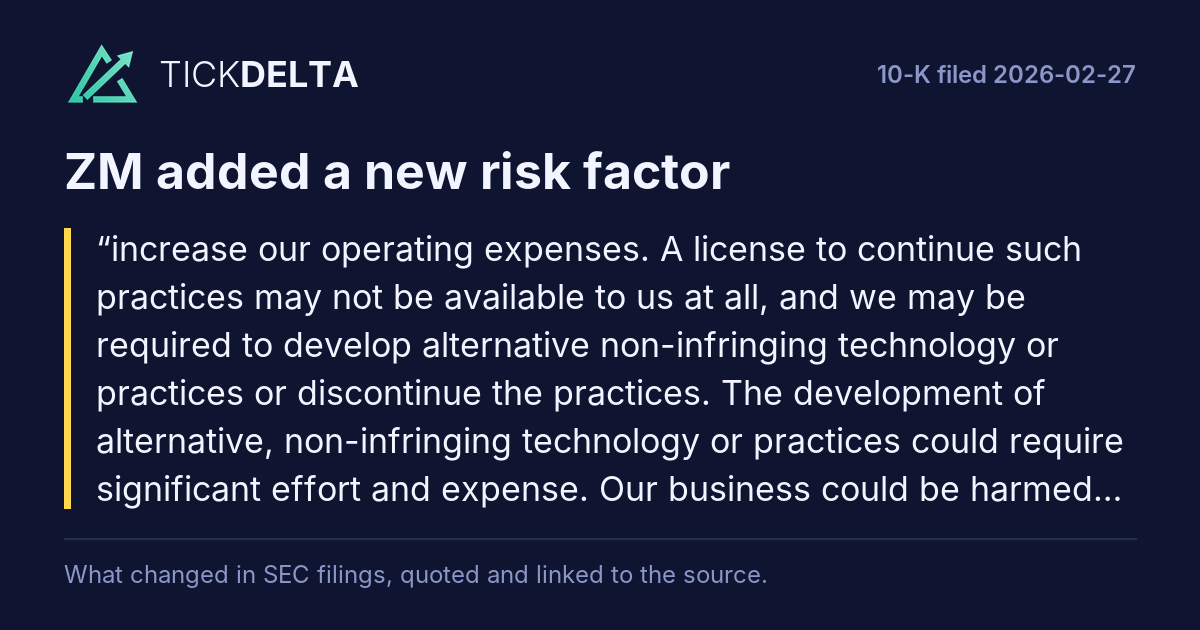
increase our operating expenses. A license to continue such practices may not be available to us at all, and we may be required to develop alternative non-infringing technology or practices or discontinue the practices. The development of alternative, non-infringing technology or practices could require significant effort and expense. Our business could be harmed as a result.
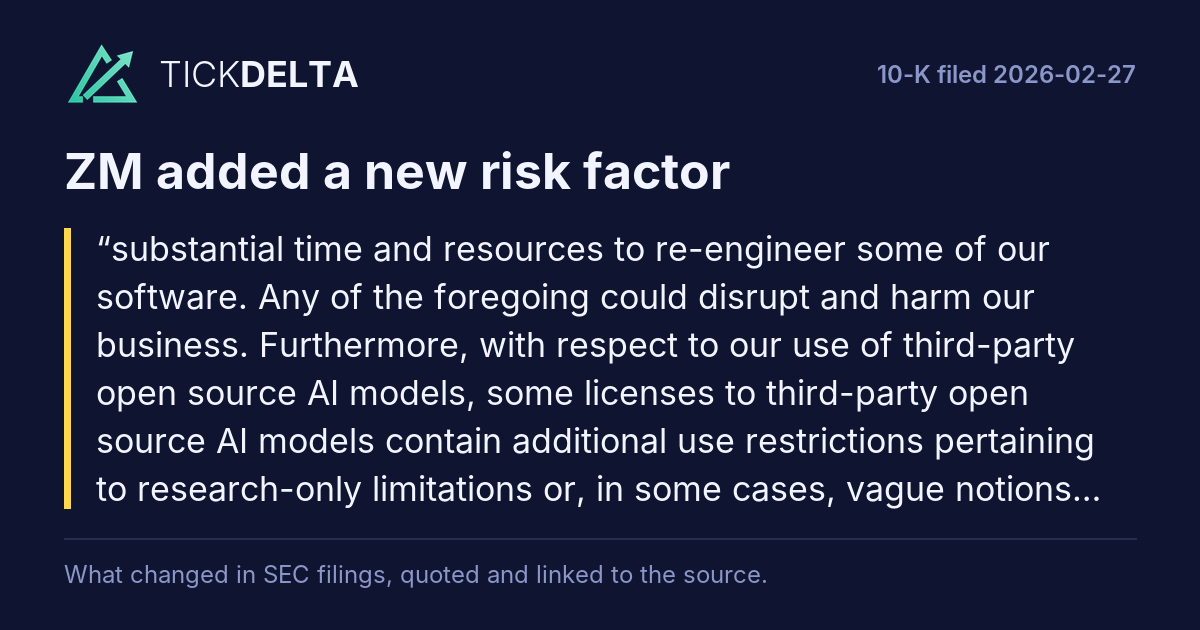
substantial time and resources to re-engineer some of our software. Any of the foregoing could disrupt and harm our business. Furthermore, with respect to our use of third-party open source AI models, some licenses to third-party open source AI models contain additional use restrictions pertaining to research-only limitations or, in some cases, vague notions of responsible uses for the AI models, which may not in all instances comport with our business practices.
Paragraphs in the 10-Q filed Aug 26, 2026 that were not in the one before
New in the latest 10-Q
18 paragraphs in the 10-Q filed Aug 26, 2026 with nothing like them in the 10-Q filed May 22, 2026 (at least half the words must differ; new numbers alone do not count). Quoted exactly, grouped by the item heading above them. This is text that changed, not a judgement of how serious it is.
Financial statements and notes
During the six months ended July 31, 2026, we made an additional $ 300.9 million investment in preferred stock of Anthropic, PBC (“Anthropic”). During the three months ended July 31, 2026, we recorded unrealized gains of $ 1,612.7 million on our investment in Anthropic, based on valuation adjustments using information including Anthropic’s financing round announced on May 28, 2026. As of July 31, 2026, the carrying value of our preferred stock of Anthropic was $ 3,134.5 million.
Read in the 10-Q
During the six months ended July 31, 2026, we also invested $ 140.2 million in equity securities of other private companies developing AI products.
Read in the 10-Q
Non-marketable equity securities accounted for under the measurement alternative are investments in privately held companies without readily determinable market values. The carrying value of these non-marketable equity securities is adjusted upward or downward to fair value upon observable transactions for identical or similar investments of the same issuer or when
Read in the 10-Q
the investment is determined to be impaired. Non-marketable equity securities that have been remeasured during the period based on observable transactions are classified within Level 2 or Level 3 in the fair value hierarchy, and remeasurements due to impairment are classified within Level 3.
Read in the 10-Q
As of July 31, 2026, the carrying value of our non-marketable equity securities accounted for under the measurement alternative was $ 3,657.5 million, of which $ 3,142.4 million was remeasured at fair value during the three months ended July 31, 2026 and was primarily classified within Level 2 of the fair value hierarchy at the time of measurement.
Read in the 10-Q
Show the other 13
Our system of action for modern work bridges work both inside and outside the organization, connecting horizontal and vertical workflows, driving outcomes for customers, turning seamless communication into action across sales, marketing and customer experience to drive business value, all powered by Zoom AI.
Read in the 10-Q
Zoom Workplace brings together Zoom’s core communication and productivity tools - including Zoom Meetings, Zoom Phone, Zoom Team Chat, Zoom Canvas, Zoom Whiteboard, and Workvivo - to support collaboration within large enterprises to small and medium businesses. Zoom Customer Experience (“Zoom CX”) supports customer engagement across the customer lifecycle through Zoom Contact Center and Zoom Virtual Agent for customer service teams. For other verticals, Zoom offers solutions such as Zoom Revenue Accelerator and Common Room for sales teams, Zoom Events and Zoom Webinars for marketing teams, and BrightHire for human resources.
Read in the 10-Q
We believe we are well-positioned as AI technology continues to advance. We are enhancing our agentic AI capabilities throughout the platform to continue delivering business value to customers, with the recent introduction of ZoomMate, Zoom AI Productivity Suite, and My Notes, among other capabilities. In line with our commitment to responsible AI, Zoom does not use customer audio, video, chat, screen sharing, attachments, or other communications (such as poll results, whiteboard, and reactions) to train Zoom’s or third-party AI models.
Read in the 10-Q
During the current quarter, we introduced a series of new products and enhancements across our platform. These included ZoomMate, an AI-powered teammate that connects meetings, messages, and workflows to help users move seamlessly from conversation to completion while retaining context across Zoom and integrated systems; the AI Productivity Suite, which introduces Canvas, Slides, Sheets, and Paper to transform meeting insights into actionable deliverables; agentic agents, which allow users to create and deploy custom AI agents within ZoomMate for support, scheduling, and automation; Zoom AI On-Prem, for organizations that need to run Zoom's AI capabilities within their own infrastructure; and a voice translator, which provides live speech‑to‑speech translation in Meetings so participants can hear real‑time translated audio. These offerings expand our agentic AI capabilities across collaboration, customer support, and industry-specific workflows through new integrations and platform enhancements.
Read in the 10-Q
In July 2026, we acquired Common Room, an AI-native go-to-market intelligence platform that unifies fragmented buyer signals and first-party customer data into person-level buyer intelligence, activated through AI agents for revenue teams. With the acquisition, we extend Zoom Revenue Accelerator upstream of the sales conversation, combining Common Room's buyer intelligence with the conversation data and insights Zoom already captures, further advancing our strategy to become a system of action for revenue teams.
Read in the 10-Q
(1) NM - Not meaningful. Percentage changes are not presented when the calculation is not meaningful or would not provide useful information.
Read in the 10-Q
securities generally consist of high-grade commercial paper, agency bonds, corporate and other debt securities, U.S. government agency securities, and treasury bills.
Read in the 10-Q
Risk Factors
may also be unable to grant equity compensation to employees in certain countries outside of the United States due to the complexities of local laws and regulations. This may require us to offer equally compelling alternatives to supplement our compensation, such as long-term cash compensation plans or increased short-term cash compensation, in order to continue to attract and retain employees in these jurisdictions.
Read in the 10-Q
our total revenue was lower than anticipated in part due to the strengthening of the U.S. dollar. We do not currently maintain a program to hedge exposures to non-U.S. dollar currencies.
Read in the 10-Q
During fiscal year 2021, we experienced rapid growth in usage of our unified communications and collaboration platform largely due to the COVID-19 pandemic. This usage dramatically changed the scale of our business. Since then, our
Read in the 10-Q
Individuals are increasingly resistant to the collection, use, and sharing of personal information to deliver targeted advertising. Third-party platforms have introduced (or plan to introduce) measures to provide users with more privacy controls over targeted advertising activities, and regulators (including in the EEA/UK) are heavily scrutinizing the use of technologies used to deliver such advertisements. Major technology platforms on which we rely to gather information about consumers have adopted or proposed measures to provide consumers with additional control over the collection, use, and sharing of their
Read in the 10-Q
There have been various Congressional and executive efforts to eliminate or modify Section 230 of the Communications Act of 1934, enacted as part of the Communications Decency Act of 1996. Section 230 provides protection
Read in the 10-Q
additional funds through the issuance of equity or equity-linked or debt securities, those securities may have rights, preferences, or privileges senior to the rights of our Class A common stock, and our stockholders may experience dilution.
Read in the 10-Q
The 10-Q's risk factors against the 10-K
Item 1A of the 10-Q filed Aug 26, 2026 against Item 1A of the 10-K filed Feb 27, 2026.
A 10-Q repeats only the risks that changed, so a 10-K paragraph that is missing from it is not counted as removed.
Added is a paragraph with nothing like it in the 10-K, Reworded a sentence that is in both with several words changed,
Quiet changes a sentence in both where one to four words changed and one is a hedge or a modal
(cut words struck through, new words highlighted).
Text on the page, not a score; each links to the filing at sec.gov.
Show the other 18
The first 23 of 44 are shown (at most 12 of each type).
Phrases used for the first time
Two-word phrases in Risk Factors of the 10-K filed Feb 27, 2026 that are in none of the 1 earlier 10-Ks stored, back to Feb 28, 2025
Where each one is used
- released notice: On January 4, 2018, the Federal Communications Commission (“FCC”) released an order reclassifying broadband internet access as an information service, a regulatory regime generally referred to as network neutrality, subject to certain provisions of Title I of the Communications Act. The order requires broadband...
- proposed changes: On January 4, 2018, the Federal Communications Commission (“FCC”) released an order reclassifying broadband internet access as an information service, a regulatory regime generally referred to as network neutrality, subject to certain provisions of Title I of the Communications Act. The order requires broadband...
- operational resilience: Our customers may place certain security obligations on us. For example, some of our customers may be subject to the EU’s Digital Operational Resilience Act (DORA) and similar UK regulatory requirements on operational resilience. These laws may obligate our customers to impose contractual provisions on us,...
- minimum tax: While the One Big Beautiful Bill Act (“OBBBA”) did not result in our being subject to the Corporate Alternative Minimum Tax (“CAMT”) for the current year, future changes in our financial results, business operations, or the interpretation and application of OBBBA provisions could cause us to become subject to CAMT...
- domestic research: While the One Big Beautiful Bill Act (“OBBBA”) did not result in our being subject to the Corporate Alternative Minimum Tax (“CAMT”) for the current year, future changes in our financial results, business operations, or the interpretation and application of OBBBA provisions could cause us to become subject to CAMT...
- development expenditures: While the One Big Beautiful Bill Act (“OBBBA”) did not result in our being subject to the Corporate Alternative Minimum Tax (“CAMT”) for the current year, future changes in our financial results, business operations, or the interpretation and application of OBBBA provisions could cause us to become subject to CAMT...
- entities located: In the United States, federal, state, and local governments have enacted numerous privacy, data protection, and information security laws, including data breach notification laws, personal information privacy laws, consumer protection laws (e.g., Section 5 of the Federal Trade Commission Act), and other similar...
- fcc rules: On March 12, 2025, the FCC opened a proceeding to begin the process of identifying FCC rules, regulations, and guidance documents for elimination or modification to alleviate unnecessary regulatory burdens and eliminating or modifying such rules. This proceeding could result in substantial changes to the FCC’s...
Used at least twice, small words left out. Counted, not picked: a phrase can be new because the company renamed something.
What was taken out
7 paragraphs of last year's Risk Factors with nothing like them now. The longest are quoted.
Sources
Item 1A of each 10-K and 10-Q on EDGAR, quoted exactly. Each paragraph links to the filing at sec.gov.
Also
10-K change: what was reworded or cut, section by section.
Work with it
Excel workbook · CSV. Google Sheet that stays up to date: paste =IMPORTDATA("https://tickdelta.com/company/ZM/export.csv") into a cell.